Most AI support chatbots on the market in 2026 aren't chatbots in the old sense. They read your help center, look up an order, issue a refund and pass the conversation to a person when they're stuck. The buying question has moved on from whether it can talk. What matters now is what a resolved conversation costs, and what happens when the agent can't resolve one.
This guide works through the Top 150 AI Support Chatbots board, which ranks 162 entries. The leaderboard below shows the top 25 with live ToolRank scores. Intercom's helpdesk holds #1 at a score of 72, Zendesk is #2, and Decagon and Sierra follow. We read vendor pricing pages instead of sales decks, so you'll see exactly which prices are public and which are locked behind a sales call.
One warning before the picks. Every vendor here quotes a resolution rate, and no two of those numbers measure the same thing. Treat them as claims, not benchmarks.
The top 25 right now
- # 1Top PickAmazon Connect CustomerPlatformAmazon Connect Customer is an AI-powered solution that enhances customer experience by resolving interactions, personalizing engagement, and learning from conversations. It offers a pay-as-you-go pricing model without fixed costs.72ToolRankStrong
- # 2Runner UpZendesk AI PlatformAI AppZendesk AI enhances customer service with AI agents, automation, and quality assurance. It resolves complex inquiries across chat, email, and voice, empowering service teams to deliver exceptional support efficiently.72ToolRankStrong
- # 3Third PlaceSierra AI AgentsAI AgentSierra empowers businesses to build advanced AI agents for enhanced customer experiences. It enables personalized interactions across multiple channels, automates workflows, and provides deep insights into agent performance, all while offering outcome-based pricing for measurable value delivery.71ToolRankStrong



- 4Intercom AI HelpdeskAI AgentIntercom is a helpdesk designed for the AI Agent era, featuring a natively integrated AI Agent named Fin. It enables perfect customer experiences by improving conversations over time. The platform offers an AI-powered workspace for human agents, AI-driven insights, and a self-improving system for continuous enhancement.70ToolRankStrong
- 5Dialogflow Customer Experience Agent StudioPlatformDialogflow's Customer Experience Agent Studio enables rapid development of personalized conversational agents. Powered by Gemini, it supports multimodal interactions and integrates seamlessly across channels, enhancing customer engagement and reducing operational costs.68ToolRankStrong
- 6Decagon AI ConciergeAI AgentDecagon builds, optimizes, and scales AI agents designed to act as a personalized concierge for every customer. It offers a unified platform for defining workflows in natural language, testing, and analytics, enabling consistent, trusted customer experiences across chat, voice, and email channels.68ToolRankStrong
- 7Fin AI AgentAI AgentFin is an AI Customer Agent designed to enhance customer experiences across service, sales, and eCommerce. Trusted by over 12,000 brands, it delivers accurate responses and resolves complex queries across multiple channels, ensuring seamless customer interactions.68ToolRankStrong
- 8SprinklrAI AppSprinklr is an AI-native customer experience platform that unifies customer journeys across various touchpoints. It empowers teams to engage effectively, driving customer loyalty and satisfaction through intelligent automation and insights.67ToolRankStrong
- 9LivePerson Conversational AI PlatformPlatformLivePerson's Conversational AI platform enables brands to engage with personalized experiences at scale, driving high-value results and transforming customer interactions into measurable business outcomes.65ToolRankStrong
- 10Kore.aiPlatformKore.ai provides an enterprise AI platform that accelerates outcomes in customer service and employee productivity through agentic AI applications. It offers pre-built applications and tailored solutions across various industries, enhancing operational efficiency and user experience.64ToolRankStrong
- 11Freshchat: AI Messaging PlatformAI AppFreshchat is an AI-powered omnichannel messaging platform offering live chat and chatbot solutions for smarter conversational support. It enables seamless customer engagement across various channels, enhancing customer service experiences.60ToolRankStrong
- 12Shopify InboxAI AppShopify Inbox is a customer-chat app with an AI sales associate that helps buyers find products and answers questions. It integrates with Shopify to personalize responses based on customer preferences and purchase history, enhancing customer interaction and support efficiency.60ToolRankStrong
- 13Sendbird AI PlatformAI AppSendbird is an AI-powered customer experience platform that enhances customer engagement and loyalty. It offers communication APIs and AI agents to provide personalized customer interactions across various industries.58ToolRankSolid
- 14BotpressAI AppBotpress is an enterprise-grade AI agent platform designed for customer support. It offers no technical ceiling and no per-seat cost, allowing teams to efficiently manage complex support tasks while leveraging AI capabilities.56ToolRankSolid
- 15NextivaAI AppNextiva is an AI-powered customer experience management platform offering business phone services, contact center solutions, and AI receptionist capabilities. It helps businesses optimize customer journeys with unified communication tools.55ToolRankSolid
- 16HelpCrunchAI AppHelpCrunch is a customer communication platform offering live chat, chatbot, knowledge base, popups, and email marketing tools. It helps businesses engage with clients across multiple channels, providing a unified dashboard for seamless customer support and interaction.54ToolRankSolid
- 17Ada AI Customer ServiceAI AgentAda provides AI customer service agents designed to autonomously resolve up to 83% of support issues. It aims to reduce costs, boost customer satisfaction (CSAT), and scale omnichannel customer experiences efficiently across various channels and languages.54ToolRankSolid
- 18GorgiasAI AppGorgias is a conversational AI platform for ecommerce that combines a helpdesk and an AI Agent to automate support and drive sales. It is built for online stores on Shopify, BigCommerce, Magento, and WooCommerce.54ToolRankSolid
- 19Infobip Communication PlatformAI AppInfobip is a comprehensive communication platform that enables businesses to build meaningful customer relationships across multiple channels including SMS, email, and chatbots. It offers robust APIs for custom solutions and supports seamless customer engagement and interaction management.54ToolRankSolid
- 20OpenAI AppOpen is a unified AI customer support platform that automates up to 77% of support tickets across chat, email, voice, WhatsApp, and social channels. Its AI engine, Agent 5, resolves customer inquiries instantly while maintaining a personal touch, and seamlessly hands off complex cases to human agents with full context. The platform integrates with existing helpdesks and offers a $2 million refund guarantee.53ToolRankSolid
- 21Tidio AI Customer Service AgentAI AgentTidio's AI Customer Service Agent, Lyro, scales support by automating conversations and providing reliable answers in your brand voice. It integrates with live chat and helpdesk tools, trusted by over 300,000 businesses to enhance customer experience and drive sales.53ToolRankSolid
- 22LiveChatAI AppLiveChat is an AI-powered live chat software designed for businesses, enhancing real-time website support to boost sales and customer satisfaction. It offers features like AI agents, omnichannel inbox, and 200+ integrations, making it ideal for ecommerce and B2B.53ToolRankSolid
- 23Cresta AI AgentsAI AppCresta provides a unified platform for human and AI agents, enhancing customer experiences and driving measurable business outcomes. It helps organizations save money, increase revenue, and build customer loyalty through advanced AI technology.53ToolRankSolid
- 24Yellow.aiAI AgentYellow.ai provides enterprise AI agents for customer experience (CX) and employee experience (EX) automation. Powered by over 15 LLMs, it enables human-like interactions across various channels, enhancing efficiency and reducing operational costs.53ToolRankSolid
- 25Help ScoutAI AppHelp Scout is an intuitive customer service software designed to enhance support experiences. It combines AI capabilities with collaboration tools, enabling teams to deliver exceptional service efficiently and effectively, all while being cost-effective compared to other platforms.52ToolRankSolid



















How ToolRank works
ToolRank is ToolPotion’s proprietary ranking engine.
It continuously evaluates hundreds of signals across the open web — real traffic and popularity, audience and community strength, authority and longevity, adoption and engagement — processing millions of data points to place every tool where it has earned to be.
Every AI type is measured by its own tailored model: what proves traction for a SaaS app is not what proves it for an open-source framework or a creator channel. Missing a platform never counts against a tool — ToolRank judges the evidence that exists.
No paid placement. No self-reported numbers.
Quick picks
- For most teams, start with Intercom AI Helpdesk, the #1 entry on the 2026 board, where the helpdesk and its Fin agent are built as one product.
- If your team already lives in Zendesk, Zendesk AI Platform (#2) is the path of least friction, because the AI agents are native to the helpdesk.
- Large enterprises with messy workflows should shortlist Decagon AI Concierge and Sierra AI Agents, which both sit on a 70 ToolRank and both sell by quote.
- The lowest published per-resolution price we found belongs to Help Scout at $0.75, charged on top of per-user plans.
- Online stores get the most from Gorgias, which prices its AI Agent at $1.00 per automated interaction on monthly billing.
- Teams that would rather build their own agent can try Botpress, which has a free plan and sells conversation bundles.
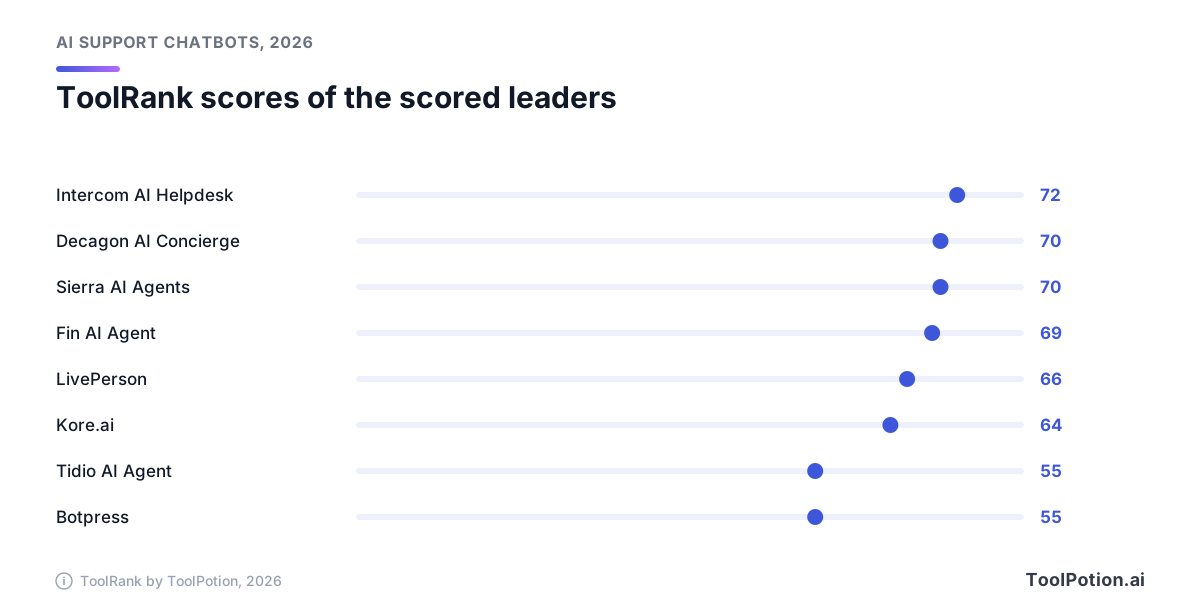
Among the scored entries the top is crowded. Four sit within three points of each other, and then the scores fall away: the sixth scored name is at 64 and the next two are at 55.
What changed in 2026
The biggest news is corporate. Intercom renamed itself Fin in 2026 to match its AI agent and Salesforce bought it for about $3.6 billion. The deal closed months ahead of schedule, and Fin's own announcement confirms the completion. Fin says more than 30,000 companies use it. Our board still lists the helpdesk and the agent separately, so you'll see both below. If you're buying Fin, you're now buying from a Salesforce company, and the helpdesk roadmap is a fair question for the sales call.
Zendesk answered at its Relate conference by pricing AI agents on resolutions instead of seats. It also added a second AI model that has to confirm each resolution before it becomes billable (CMSWire). That's a pricing admission as much as a product launch: software that does the work doesn't fit a per-seat model.
Money followed the same logic. Decagon raised $250 million at a $4.5 billion valuation early in the year. SoundHound AI completed its acquisition of LivePerson in 2026.
The result is a market that now prices along a spectrum, from paying for access to paying for results.
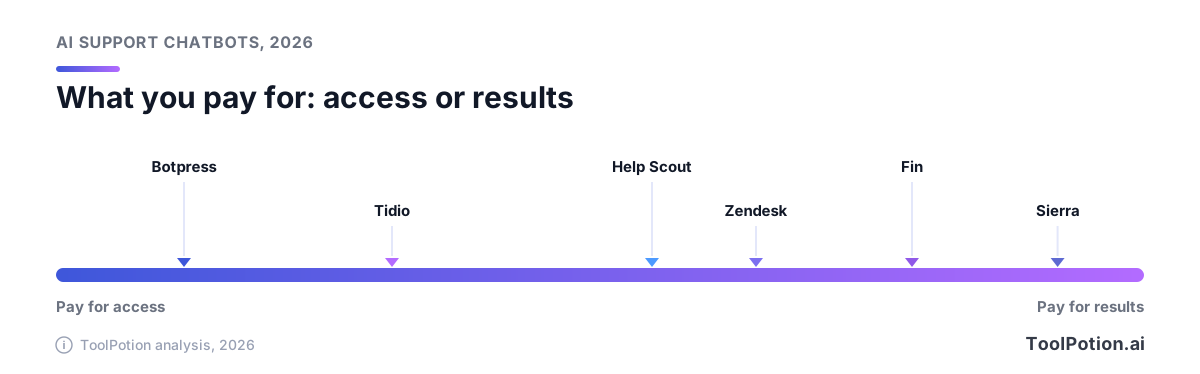
At the far end sits Sierra, which says it gets paid only when it completes a task, against criteria agreed upfront (Sierra). It publishes no rates.
Customers haven't moved as fast as vendors. In a Gartner survey of more than 3,500 customers, 87% said companies using generative AI for service must offer a way to reach a human, while half said their interactions are easier when companies use it (CX Dive). Both halves of that finding matter when you pick a tool.
What an agent does between the question and the answer
Strip away the branding and every tool on the board does the same loop. A customer asks, the agent reads your knowledge base, takes an action if the question needs one, and either answers or escalates.
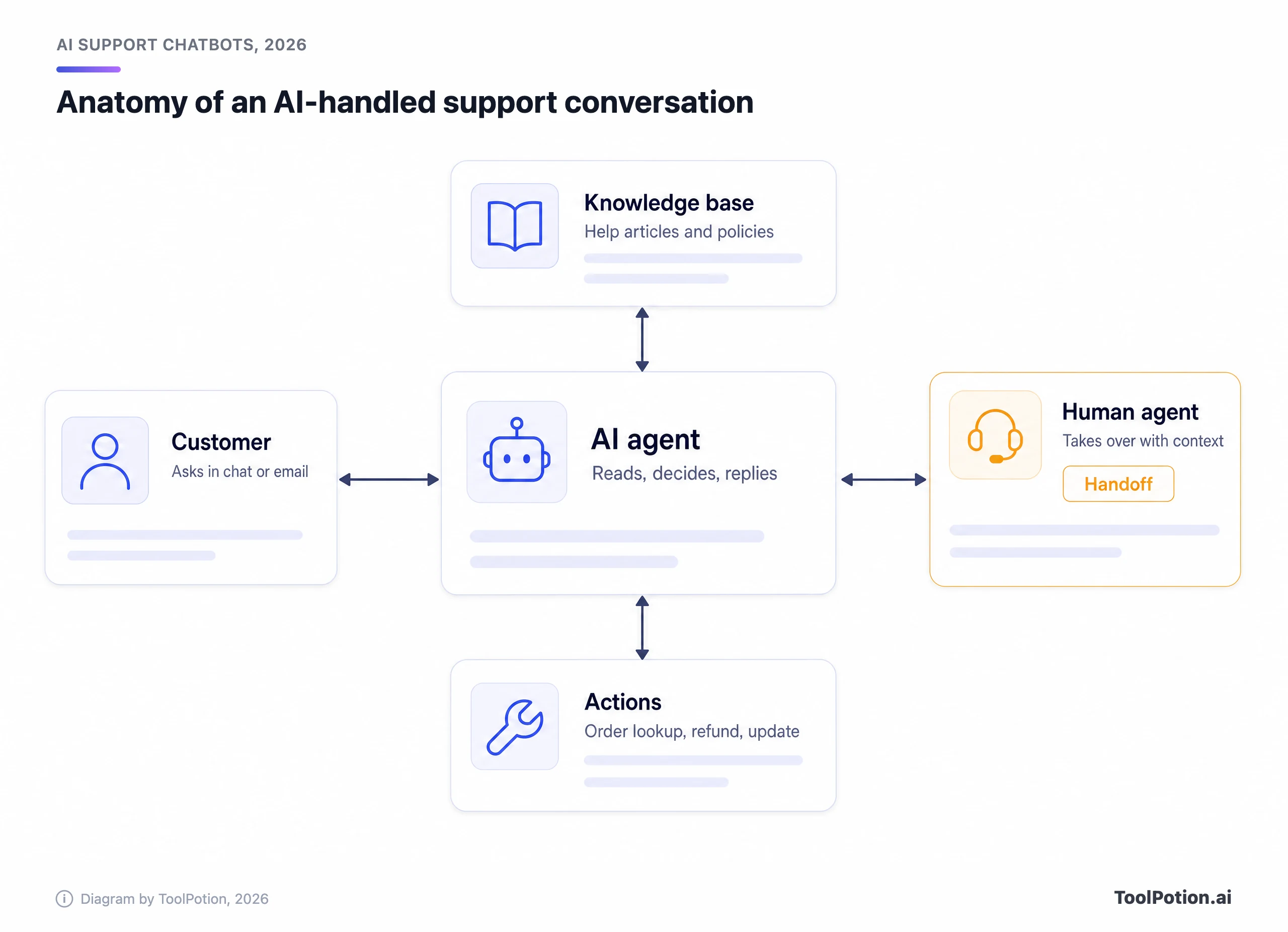
The knowledge base sets the ceiling. An agent can only be as right as the articles and policies you feed it, which is why vendors sell learning loops. Zendesk calls its version a Resolution Learning Loop that closes knowledge gaps from each interaction, and the Intercom listing makes a similar promise. Take those as intentions. Ask to see how a bad answer gets corrected, and who approves the fix.
Actions are where vendors really differ. Answering from a help article is a commodity. Looking up an order or issuing a refund means wiring the agent into your systems. Sierra's Ghostwriter builds agents from your SOPs and transcripts, Decagon has you write workflows in plain language, and Ada says its agents get API, code and MCP tools to finish tasks. In each case a person on your side still owns the integrations.
Then there's the exit door. Gartner's analyst Eric Keller says AI service should make clear it is AI, explain its answer and process, and provide an off ramp to a human. The same piece says the human should have the context of what the customer already tried, so nobody starts over (CX Dive). Ask every vendor to show a live handoff, not a slide of one.
What a resolution costs
Three pricing models are in play: per seat, per resolution and platform contracts quoted by sales. Most of the mid-market has landed on a hybrid, with seats for your humans and a fee for each conversation the AI closes.
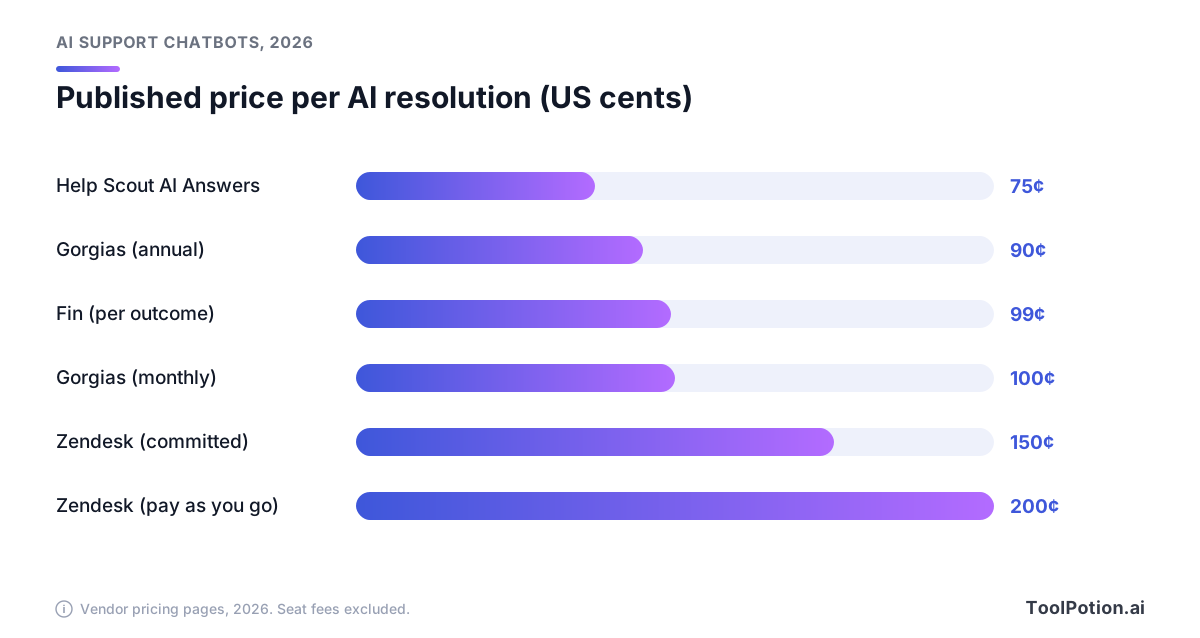
The spread looks wide until you read the definitions. Fin's $0.99 applies once per conversation when a customer confirms resolution, doesn't ask for more help, or a workflow completes (Intercom pricing). "Doesn't ask for more help" is a generous test. Zendesk's $1.50 committed rate and $2.00 pay-as-you-go rate (Zendesk pricing) apply to resolutions its evaluator model has verified. Help Scout charges once per conversation at $0.75 (Help Scout pricing). Gorgias charges $0.90 per automated interaction on an annual contract and $1.50 above your plan's allowance (Gorgias pricing).
Seats come on top. Intercom's helpdesk runs $29, $85 or $132 per seat a month on its Essential, Advanced and Expert plans, billed annually. Zendesk's annual per-agent rates are $19, $55 and $115 for Support Team, Suite Team and Suite Professional, and each plan includes 5 to 10 automated resolutions per agent each month. Sierra, Decagon and Ada publish no rates at all, so any figure you see for them online is somebody's estimate.
Try your own volume below. It counts resolution fees only, so add your seat costs.
At 5,000 AI-resolved conversations a month, Help Scout's rate comes to $3,750 and Zendesk's committed rate to $7,500. That gap is real money, but a cheap resolution that customers reopen is the most expensive kind.
The leaders, reviewed
Intercom AI Helpdesk: best all-round pick
Intercom is a helpdesk built around its own AI agent, and it climbed from #3 to #1 on the 2026 board with a ToolRank of 72 (strong tier). The agent, an inbox, ticketing and a Copilot for human reps live in one workspace, which means handoffs stay inside one system. The catch is the bill. Seats start at $29 on Essential, and Fin's outcomes are charged on top.
Fin AI Agent: best if you're not on Intercom
Fin is the same company's agent sold on its own, and it sits at #5 with a 69 (strong). It slid from #1 to #5 on the 2026 board, while the helpdesk listing rose. They are one company's products, so read the pair together. Fin's pricing page says it works on top of Zendesk, Salesforce, HubSpot, Freshworks and others at $0.99 an outcome with a 50-outcome monthly minimum (Fin pricing). The claimed 76% average resolution rate is Fin's own figure.
Zendesk AI Platform: best for existing Zendesk teams
Zendesk is #2 and isn't scored yet, so there's no number to compare. What it has is a helpdesk many teams already run, plus a pricing model that now ties AI cost to verified results. The directory listing stresses a knowledge graph that unifies service content, and agents that handle chat, email and voice. You'll still pay per agent on top, and the verification step cuts both ways, since it protects you from billing for bad answers but makes your invoice depend on a second model's judgment.
Decagon AI Concierge: best for enterprise customization
Decagon jumped from #6 to #3 with a 70 (strong). Its pitch is Agent Operating Procedures, workflows you write in natural language, across chat, voice and email. Its site cites Chime at 70% chat and voice resolution and Duolingo at 80% deflection, which are customer claims and not audited numbers. Pricing is by quote only, and third-party estimates of its contract sizes vary too much to repeat here. Treat the $4.5 billion valuation as a sign of investor appetite and not a quality guarantee.
Sierra AI Agents: best for outcome-priced enterprise deals
Sierra is #4 with a 70 (strong). Customers on its site include Rocket Mortgage, SiriusXM and Uber, and one agent can run across chat, SMS, WhatsApp, email and voice. Its Ghostwriter tool builds agents from SOPs, transcripts or plain descriptions, and its Insights tools let you watch conversations after launch. The outcome pricing is attractive on paper, and the open question is who defines an outcome. Get that definition written into the contract before the pilot, not after the first invoice.
LivePerson: best for large messaging operations
LivePerson is #7 at 66 (strong) and orchestrates AI and human agents across voice and messaging. It lets you plug in your preferred models. The catch is corporate. SoundHound now owns it, so a procurement team will want answers about continuity and roadmap before a multi-year commitment.
Sprinklr and Kore.ai: the enterprise suites
Sprinklr (#6, not yet scored) sells a unified customer-experience suite covering service, social, marketing and insights. Kore.ai (#8, 64, strong) is a build-it-yourself agent platform with prebuilt apps for banking, healthcare, retail and IT. Both fit buyers who want one vendor across many departments. Neither suits a team that wants to go live next week.
Tidio AI Customer Service Agent: best first experiment
Tidio is #9 with a 55 (solid). Its Lyro agent starts at $32.50 a month for 50 conversations, the free plan gives you 50 one-off conversations to try, and the Premium plan advertises a guaranteed 50% Lyro resolution rate (Tidio pricing). Humans and AI conversations are billed separately, so model both. It's a sensible way to learn what an agent does to your queue before you sign anything big.
Botpress: best to build on
Botpress holds #10 at 55 (solid). The free plan covers 25 conversations a month, Plus is $150 a month billed annually for 250, and Team is $750 for 1,500, with overage at $65 and $50 per 100 conversations (Botpress pricing). It gives you more control than a managed agent and more to maintain, and it connects to Zendesk, Intercom and Freshdesk. If nobody on your team can maintain an agent, pick a managed one.
Ada AI Customer Service: best for multilingual teams
Ada slipped from #7 to #11 with a 54 (solid) on the 2026 board. It claims an 84% automated resolution rate on chat and works across messaging, voice and email in many languages. Pricing isn't published, and that 84% is the vendor's.
Help Scout: best for small teams that value simplicity
Help Scout is unscored at #13. The free plan covers up to 5 users, paid plans run $25, $45 and $75 per user a month, and AI Answers adds $0.75 per resolution. It's the cheapest published rate in this guide. Plans stay simple, and the AI Answers fee bills only once per conversation.
Gorgias: best for ecommerce support
Gorgias holds #15 with a 53 (solid). Its helpdesk plans run from $10 for 50 tickets a month up to $900 for 5,000 on monthly billing, and the AI Agent charges per automated interaction. Each such interaction counts toward your ticket allowance, so read the plan math carefully.
How to choose
Don't pick on resolution rate. Pick on your own queue. Pull a week of real tickets, sort them into routine questions, tasks that need an action and cases that need judgment, and see how much each vendor can plausibly absorb.
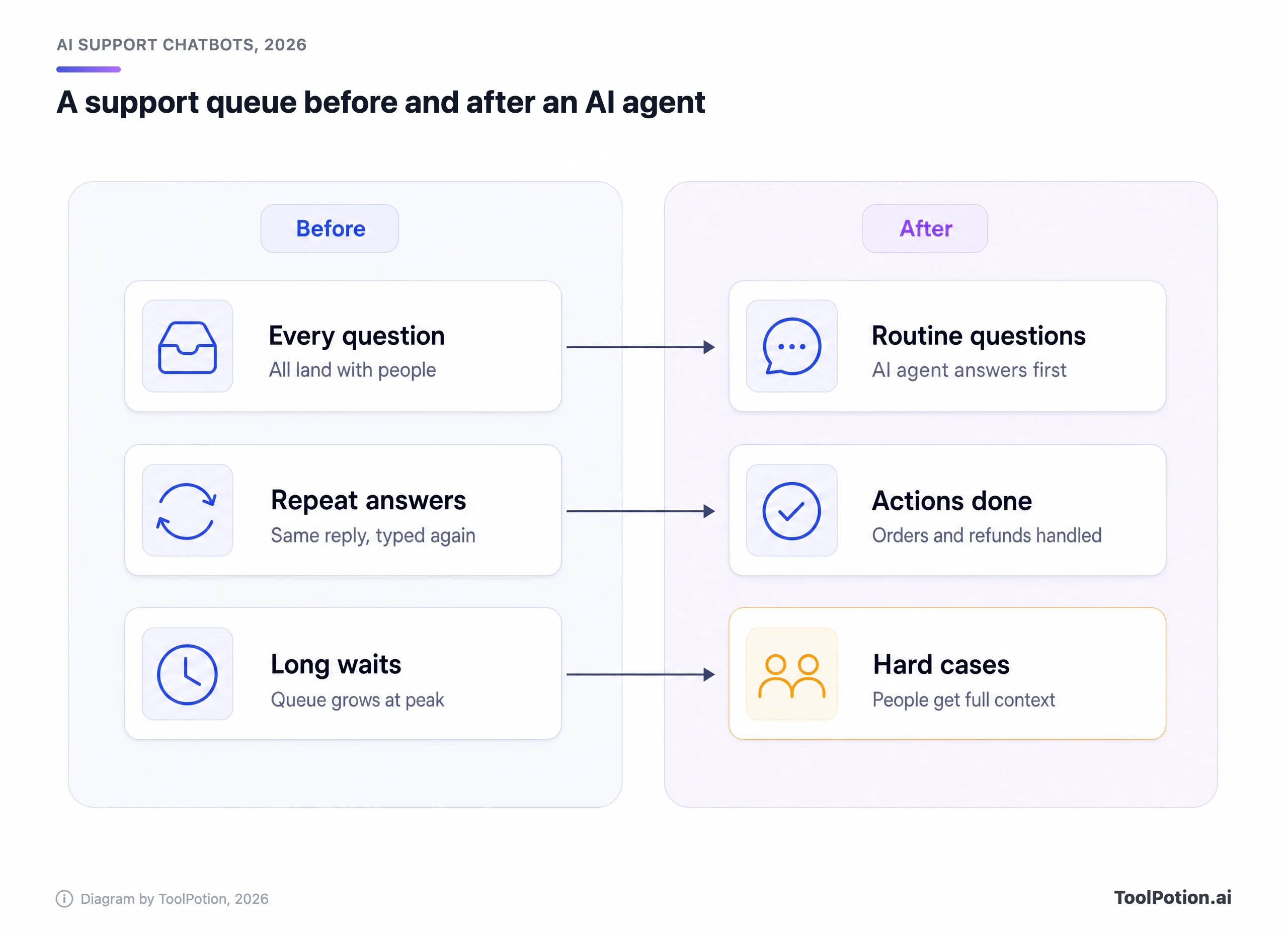
Then get four answers in writing. You need the vendor's definition of a resolution and who verifies it. You need the list of systems the agent can act on and who builds those connections. You need to see a handoff from the human's side, with the transcript and customer record attached. And you need the cost of a conversation that the agent opens and a person finishes. If the answers are vague, the price is meaningless.
Run the pilot against a slice of live traffic, such as one channel or one product line, and keep a person reviewing a sample of the conversations the agent marked as resolved. Reopen rates tell you more than any vendor dashboard, because a resolution the customer has to repeat isn't one. Gartner's survey point on human access also argues for keeping the escape hatch visible during the pilot, since hiding it is how trust gets lost.
Match the vendor to your size. A team of five doesn't need an enterprise platform, and an airline doesn't need a website widget. The tree below turns that into a recommendation.
About ToolRank
ToolRank is ToolPotion's independent ranking of AI tools, and placement can't be bought. Every board is on the ToolRank leaderboards page, and the full list of tools in this category is in the directory hub. For a wider view, see the full AI Support Chatbots leaderboard.
Rising and newer names
Decagon (#6 to #3) and Intercom's helpdesk (#3 to #1) made the biggest moves on the 2026 board. Beyond the top 25, a few entries are worth watching. Kustomer (#26) is a service platform and CRM in one. Siena AI (#28) builds empathic agents for commerce. Zowie (#31) targets enterprise service teams, and Fini AI (#34) describes a self-improving agent that retrieves data and takes actions.
If you're comparing adjacent categories, the Top 250 AI Tools for Customer Support Agents shares 23 tools with this board in its top 50. Builders should check the AI chatbot builders board, and teams still choosing a helpdesk can compare AI help desk tools or the wider Customer Support leaderboard.
Frequently asked questions
What is the best AI customer support chatbot in 2026?
On our board, Intercom AI Helpdesk is #1 with a ToolRank of 72. The best fit for you depends on your helpdesk, your volume and whether you need actions like refunds.
How much do AI support agents cost?
Published per-resolution prices run from $0.75 at Help Scout to $2.00 for Zendesk pay as you go, with Fin at $0.99. Seats and platform fees come on top, and Sierra, Decagon and Ada don't publish rates.
What counts as a resolution?
It varies. Fin counts a conversation when the customer confirms, or doesn't ask for more help, or a workflow completes. Zendesk requires verification by a second AI model. Get the definition in writing.
Can an AI agent issue refunds?
Yes, if it's connected to your order or payment systems. Decagon, Sierra and Ada all describe agents that act through connected tools, and your team owns those integrations.
Will customers accept an AI agent?
Mostly, if they can reach a human. A Gartner survey found 87% of customers say companies using generative AI must offer a human, and half say their interactions are easier with it.
Are there free options?
Tidio's free plan includes 50 one-off Lyro conversations, Botpress's free plan has 25 conversations a month, and Help Scout's free plan covers up to 5 users. Each limits AI usage, so check before relying on it.
Can I add an AI agent to the helpdesk I already use?
Often. Fin works on top of Zendesk, Salesforce, HubSpot, Freshworks and several others, and Botpress connects to Zendesk, Intercom and Freshdesk.