The best AI chatbot in 2026 is whichever one fits the job in front of you, because the top of the field has bunched up. ChatGPT and Claude tie at a ToolRank score of 96. Six more names sit within six points of them, and all eight are in the elite tier on our Top 150 AI Chatbots board.
That makes the usual "which is smartest" question the wrong one. A better one is what you'll ask it to do, whether you'll hand it anything private, and what you're willing to pay. Those three answers split the leaders cleanly, and this guide shows how.
The leaderboard below shows the current top 25. Below is the judgment it can't give you: who to pick for what, where each one falls short, and which 2026 changes (ads, price tiers, data handling) should affect your choice.
The top 25 AI chatbots right now
- # 1Top PickChatGPTAI AppChatGPT is a versatile AI application that allows users to chat, work, create images, and code in one platform. It offers a seamless experience for answering questions, finding inspiration, and enhancing productivity.96ToolRankElite
- # 2Runner UpClaudeAI AppClaude is Anthropic's AI assistant designed for problem solvers. It provides tools for generating code, visualizing data, and creating content across various platforms, enhancing productivity for users in diverse fields.96ToolRankElite
- # 3Third PlaceGoogle GeminiAI AppGoogle Gemini is an AI assistant designed to help with writing, planning, and brainstorming tasks. It leverages generative AI to provide assistance across various creative and organizational needs. Users can interact with Gemini for support in generating ideas and structuring information.94ToolRankElite


- 4Perplexity — AI Answer EngineAI AppPerplexity is a free AI-powered answer engine that delivers accurate, trusted, and real-time answers to any question, making information retrieval efficient and straightforward.92ToolRankElite
- 5Microsoft CopilotAI AppMicrosoft Copilot is an AI companion designed to inform, entertain, and inspire users. It provides advice, feedback, and direct answers to queries. This AI tool aims to enhance productivity and creativity by assisting with various tasks, making it a versatile digital assistant for everyday needs.92ToolRankElite
- 6Meta AIAI AppMeta AI is a versatile AI assistant designed to help users accomplish tasks, generate free AI images, and find answers to questions. It can solve complex math problems, offer feedback on workout form, and review essays, making it a powerful tool for productivity and creativity.92ToolRankElite
- 7DeepSeekAI AppDeepSeek AI is your intelligent assistant for coding, content creation, and file reading. It allows document uploads and supports long-context conversations, providing expert help in AI and natural language processing tasks.92ToolRankElite
- 8GrokAI AppGrok is an AI assistant from xAI that handles text and voice chat, image and video generation, real-time web search, and coding. It suits anyone wanting a general-purpose AI with live answers from the web and X.91ToolRankElite
- 9QwenAI AppQwen Studio provides extensive capabilities in chatbot functionality, image and video understanding, image generation, document processing, and web search integration. It is designed for users seeking advanced AI tools for various applications.76ToolRankStrong
- 10Yuanbao–Tencent's All-in-One AI AssistantAI AppYuanbao is Tencent's versatile AI assistant, integrating the latest Hy3 model for enhanced document processing, diverse writing styles, and human-like chat interactions. It offers practical AI search, intelligent image recognition, and various capabilities to streamline work, study, and daily life.75ToolRankStrong
- 11Baidu Wenxin AssistantAI AppBaidu Wenxin Assistant is a comprehensive tool designed to enhance productivity on PC. It offers unique features like 'Inspiration Exploration' for deep problem analysis, intelligent text and image creation, AI reading, and a vast array of applications to inspire creativity.75ToolRankStrong
- 12Poe - AI ChatAI AppPoe offers a unified platform to chat with a diverse range of AI models, including GPT and Claude variants, as well as image generation tools. Users can engage in private or group conversations, exploring thousands of AI options for various tasks. It provides a convenient way to access and compare different AI capabilities.74ToolRankStrong
- 13Nova AI Chatbot - AI Mobile AppMobile AppNova AI Chatbot is an AI-powered mobile application that allows users to interact with advanced AI models. Users can ask Nova to write anything, making it a versatile tool for various writing needs.73ToolRankStrong
- 14Kimi AIAI AppKimi AI with K3 is designed for agentic coding and knowledge work. It enables users to build multiplayer and 3D games, create professional slides, and efficiently manage tasks using Swarm and Goal functionalities.73ToolRankStrong
- 15Microsoft EdgeAI AppMicrosoft Edge is a web browser designed for superior performance on Windows. It offers built-in security features, AI capabilities like Copilot, and seamless integration with Microsoft services to enhance productivity and online safety.71ToolRankStrong
- 16Vibe by Mistral (ex-Le Chat)Mobile AppVibe by Mistral (formerly Le Chat) is your AI agent designed for long-horizon tasks, seamlessly integrating your knowledge and tools to enhance productivity. This app is free to use and prioritizes user privacy by not sharing data with third parties.71ToolRankStrong
- 17Pi, the AIAI AppPi is an emotionally intelligent AI designed to be a curious, kind, and helpful personal companion. It assists users in untangling thoughts, getting tasks done, fueling curiosity with simple explanations, and making decisions. Pi offers a voice mode for on-the-go conversations and can be found on major app stores.71ToolRankStrong
- 18Z.aiAI AppZ.ai is an advanced AI assistant powered by GLM-5.3-Flash. It helps users build websites, write code, manage long-term tasks, and provides instant answers, offering a fast, smart, and reliable solution.71ToolRankStrong
- 19ChatOn AIMobile AppChatOn AI is a versatile chatbot assistant designed for iPhone users. It offers multiple AI tools for tasks like coding, math, and writing, enhancing productivity with clear reasoning and fewer errors.69ToolRankStrong
- 20Open WebUIAI AppA self-hosted, extensible AI platform that connects to any local or cloud model, runs entirely offline, and can be extended with Python, giving individuals and enterprises full control over their AI, data, and infrastructure.69ToolRankStrong
- 21Luzia AI AssistantAI AppLuzia is a free, intelligent AI assistant designed to help with daily tasks. It can assist with writing, coding, translation, image generation, and more. Available across multiple platforms, Luzia aims to be a versatile and accessible AI companion for users worldwide.68ToolRankStrong
- 22iFLYTEK Spark (讯飞星火)AI AppiFLYTEK Spark is a cognitive AI model by iFLYTEK, offering cross-domain knowledge and language understanding. It supports natural dialogue, task execution, language comprehension, knowledge Q&A, logical reasoning, math problem-solving, and code understanding and writing.60ToolRankStrong
- 23Monica AI AssistantAI AppMonica is an all-in-one AI assistant offering chat, smart search, writing assistance, summarization, translation, and image/video generation. It integrates leading AI models like GPT-5.5, Claude 4.7 Opus, and Gemini 3.1 Pro directly into your browser, desktop, or mobile device for enhanced productivity.59ToolRankSolid
- 24HuggingChatAI AppHuggingChat is Hugging Face's free chat app for talking to open-source AI models. Its Omni feature automatically picks the best available model for a request, or users can choose from more than 140 open models directly, including a new ML Intern mode built to search papers, datasets, model training runs and the Hugging Face Hub.58ToolRankSolid
- 25Duck.ai by DuckDuckGoAI AppDuck.ai offers private AI chat powered by DuckDuckGo. Use popular AI models like ChatGPT and Claude without compromising your privacy. Chats are anonymized, protecting your information from hackers, scammers, and companies. It's free to use and requires no account, making advanced AI accessible and secure for everyone.57ToolRankSolid

















How ToolRank works
ToolRank is ToolPotion’s proprietary ranking engine.
It continuously evaluates hundreds of signals across the open web — real traffic and popularity, audience and community strength, authority and longevity, adoption and engagement — processing millions of data points to place every tool where it has earned to be.
Every AI type is measured by its own tailored model: what proves traction for a SaaS app is not what proves it for an open-source framework or a creator channel. Missing a platform never counts against a tool — ToolRank judges the evidence that exists.
No paid placement. No self-reported numbers.
Quick picks
- Best all-rounder: ChatGPT. It's #1 on the 2026 board with a score of 96, and it covers writing, research, images, voice and code in one app.
- Best for long documents, code and an ad-free app: Claude, tied with ChatGPT at 96. Anthropic has publicly committed to keeping it free of ads.
- Best if you live in Google's apps: Google Gemini, #3 at 93.
- Best for research you can check: Perplexity. It's built around cited answers.
- Best on a budget, with a caveat: DeepSeek, because its own policy says your data lands on servers in China.
- Best for Microsoft 365 users: Microsoft Copilot, which climbed from #13 to #6.
Six points separate the top eight
Look at the spread before you read anything into the order. ChatGPT and Claude score 96, Google Gemini 93, DeepSeek 92, and Perplexity, Copilot and Meta AI 91. Grok closes the elite group at 90.
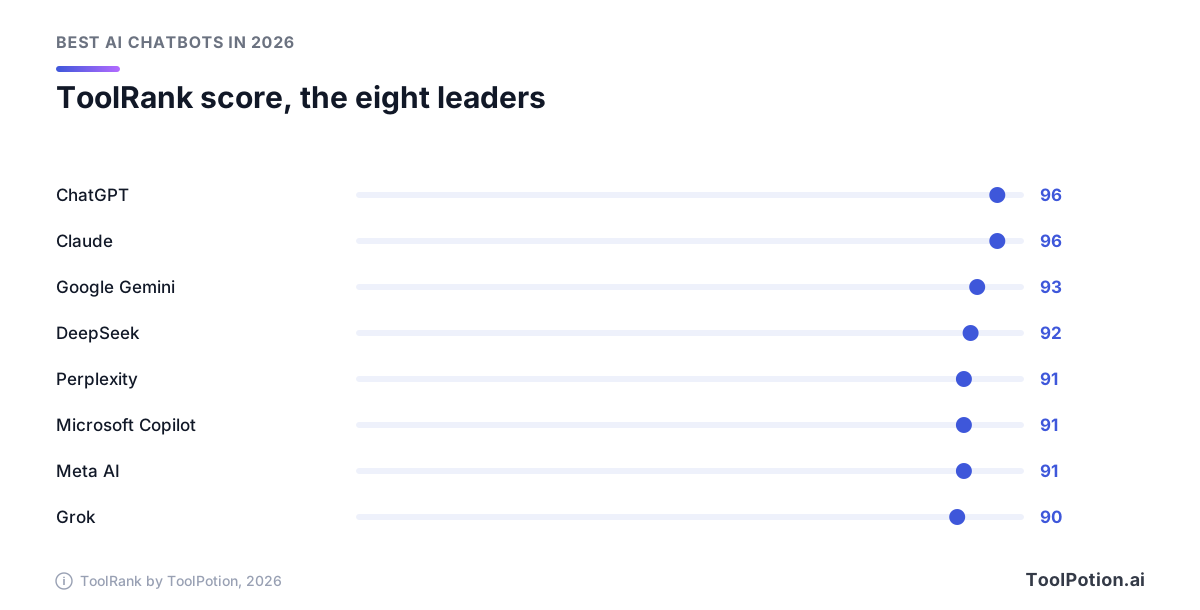
A six-point range is narrow. Any of these eight can draft an email, explain a contract clause or debug a short script, and the differences that matter show up around the edges: how fresh the web access is, how much a free plan lets you do, and what happens to what you type. The next tier is a different story. Qwen, #9, scores 76 and sits in the strong tier, so the gap between eighth and ninth is bigger than the gap between first and eighth.
What changed for chatbots in 2026
Usage went mainstream. Pew's 2026 survey of 5,119 U.S. adults found that about half now use AI chatbots, and 44% use ChatGPT, up from 18% in 2023 (Pew Research Center). Gemini reaches 24%, Copilot 17%, Meta AI 14%, Grok 8% and Claude 6%.
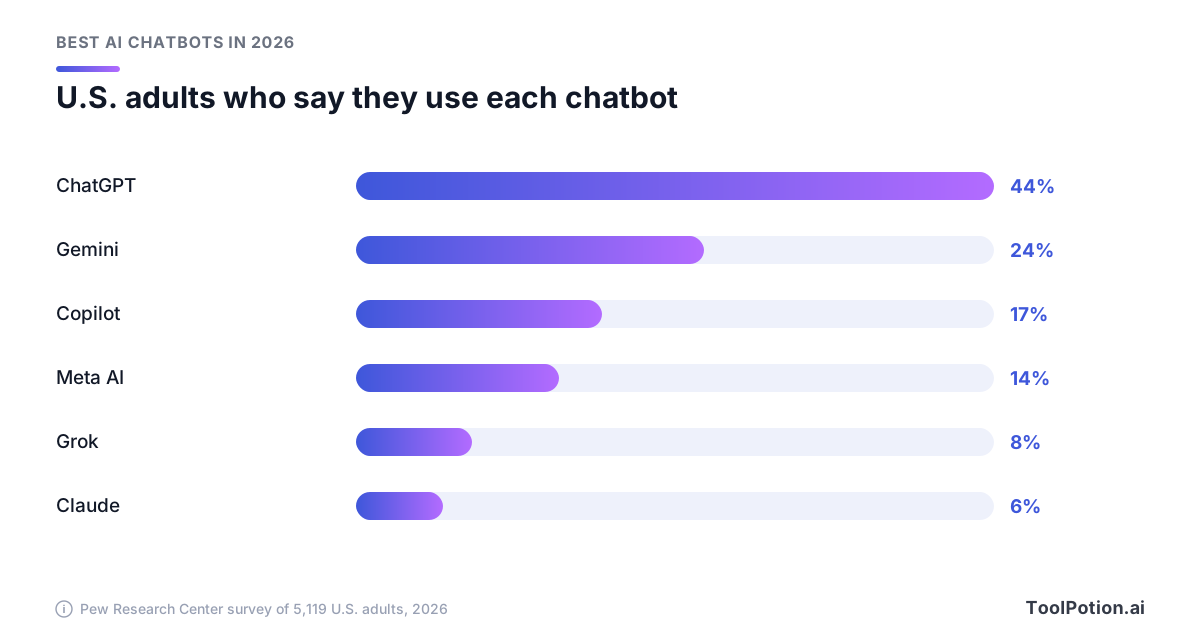
ChatGPT's lead is shrinking, though. Sensor Tower data reported by TechCrunch put ChatGPT's market share at 46.4%, the first time it has dipped below 50%, with Gemini at 27.7% and Claude at 10.3% (TechCrunch). People switch more readily than they used to.
The second shift is advertising. ChatGPT's Free and $8 Go plans now show ads (the rollout started as a U.S. test), matched to conversation topics, while Plus, Pro, Business, Enterprise and Education stay ad-free. OpenAI says ads stay away from health, politics and mental-health topics and that advertisers don't see your conversations (TechCrunch). Anthropic took the opposite position and said Claude "will remain ad-free" (Anthropic). If you use a chatbot for personal questions, that difference is worth more than a point of ToolRank.
Third, the price ladder got taller. OpenAI added a $100 Pro tier next to the $200 one, with 5x Plus's Codex capacity against 20x for the $200 plan, and Plus stayed at $20 (TechCrunch). OpenAI has since paused new sign-ups for the $200 plan, though the $100 tier stays open (TechCrunch). Google went the other way at the bottom: its AI Plus plan reached the U.S. at $7.99 a month and was later cut to $4.99 (9to5Google), while AI Pro is $19.99 on Google's plan page.
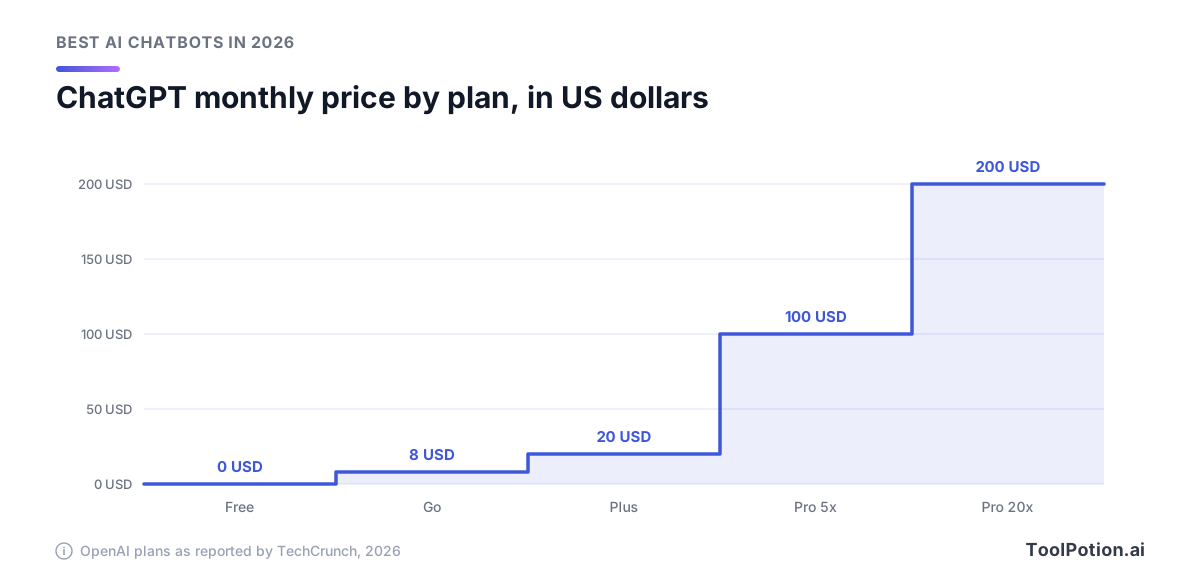
Notice what the chart says. The $20 plan is the sweet spot at OpenAI, Anthropic and Google, and the jump after it is steep. Unless you hit usage limits every week, the tiers above $20 are for professionals who bill for their output.
What happens between your question and the answer
It helps to know what you're actually paying for. The model is the part that writes, and the brand name usually refers to a bundle around it. Depending on the app, that bundle can search the live web, read the files you upload, run code or other tools, and recall things you told it earlier.
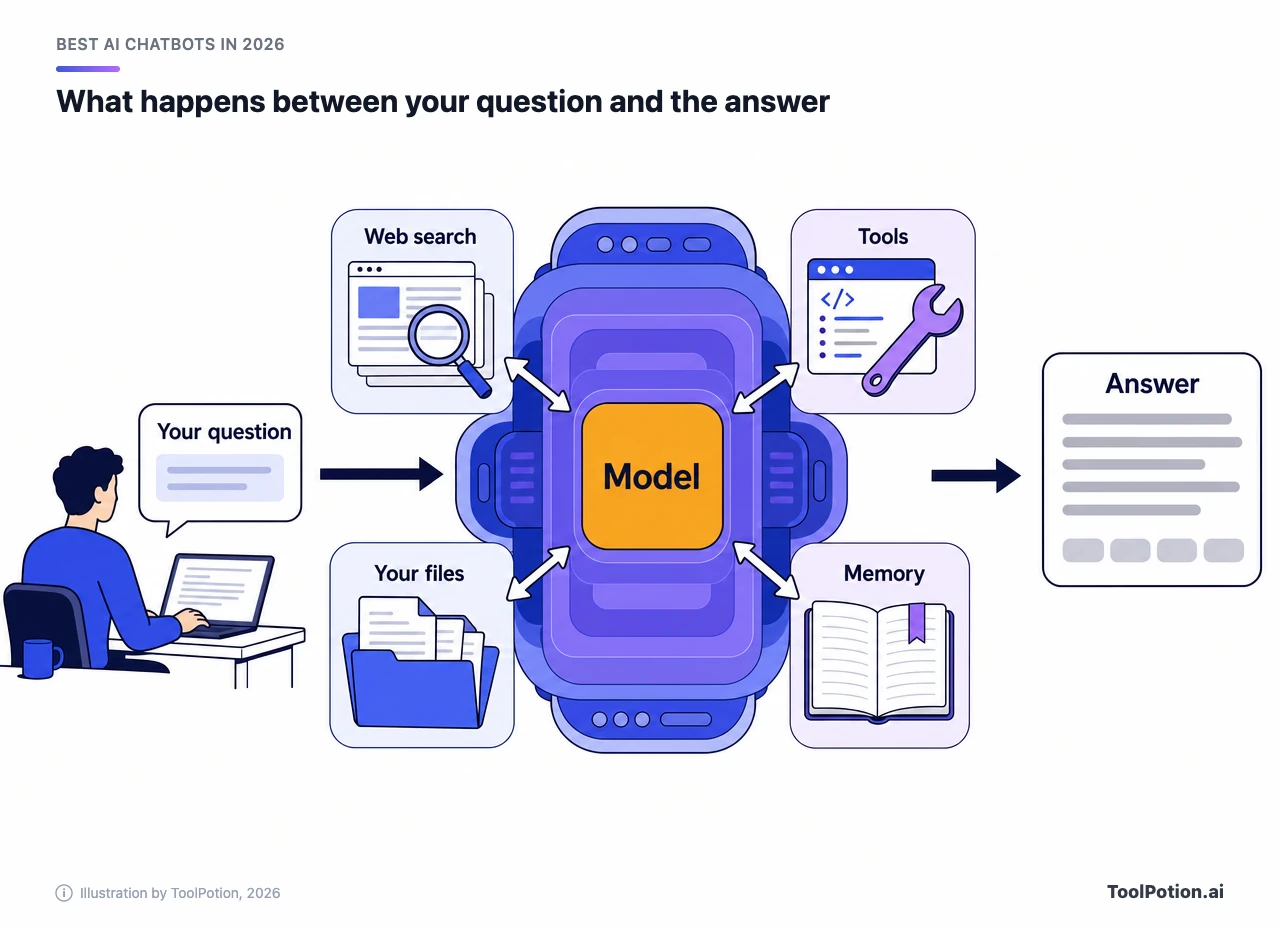
Those side stations explain most of the differences between chatbots that score within a point of each other. A model with weak search but strong file handling will beat a stronger rival on a 200-page report. Memory is handy, and it's also the feature whose privacy page you should read.
The leaders, one by one
ChatGPT: the default for good reason
It's #1 on the 2026 board with a ToolRank score of 96, up from #10, and it has the widest toolbox: chat, image generation, deep research across web sources, voice with video, and coding help through Codex on higher tiers.
The catch is the pricing structure. Free and Go carry ads now, and the jump from Plus to the $200 Pro tier is $180 a month (new sign-ups for that tier are paused for now). For most readers, Plus at $20 is the plan that makes sense, and it's the cheapest ad-free way in.
Claude: the careful writer and coder
Claude ties ChatGPT at 96 and holds #2. It covers web, iOS, Android and desktop, searches the web, remembers across conversations and writes or edits code and documents.
Free costs $0, Pro is $20 a month ($17 if you pay annually), and Max starts at $100. Team seats run $20 to $25 each per month (Claude pricing). It has no ads and a clear stance on keeping them out. The honest weakness is reach: Claude trails far behind ChatGPT in everyday usage, so it's a less obvious default for friends, family and coworkers.
Google Gemini: best if Google already runs your life
At #3 with a score of 93, Gemini is the strongest pick for anyone whose work lives in Gmail, Docs and Android. Its free plan is generous, AI Plus now costs less than ChatGPT Go, and the paid tiers bundle cloud storage, which changes the math if you were already paying Google for space. Skip it if you'd rather keep your chatbot apart from your Google account, because the integration that makes Gemini handy is the same thing that ties it to that account.
DeepSeek: capable, cheap and the data question
DeepSeek is #4 at 92. Its V4 models arrived in 2026 with a 1M-token context window and open weights, and DeepSeek says they nearly close the gap with frontier models on reasoning, though TechCrunch notes they still lag slightly on knowledge tests (TechCrunch). That makes it useful for long documents and cheap coding help.
Now the part you shouldn't skip. DeepSeek's privacy policy states: "we directly collect, process and store your Personal Data in People's Republic of China," and the data it takes includes prompts, uploaded files and chat history (DeepSeek privacy policy). Italy's data authority blocked the app in 2025 after DeepSeek said European rules didn't apply to it, and regulators in Belgium and Ireland opened inquiries (Euronews). Use it for public material. Keep client data, source code and anything personal out of it.
Perplexity: when the source matters more than the prose
Perplexity is #5 at 91, and it's the one chatbot designed around citations rather than conversation. You get a short answer with links, which suits fact-checking, shopping research and any question where "says who?" is the next thing you'd ask. The core service is free.
Writing and coding aren't what it's built for, so treat it as a research desk rather than a general assistant.
Microsoft Copilot: the quiet climber
Copilot jumped from #13 to #6 with a score of 91, one of only two entries the board flags as big climbers. Pew has 17% of U.S. adults using it, which puts it ahead of Meta AI, Grok and Claude. If you work in Word, Excel and Outlook, it's the one closest to your documents.
Beyond Office, it covers writing feedback, image generation and code help, and there's a free version to try before you pay for anything.
Meta AI: free and built into the Meta apps
Meta AI is #7 at 91, down from #5. It's free, it generates images from text and it lives inside the Meta apps people already open. Pew puts its U.S. use at 14%. Those are real strengths if you want a casual assistant inside a chat thread.
The catch is scope. It's a casual helper for quick questions and images, and it slid from #5 to #7 this year, so it's not the tool to build a work routine around.
Grok: live posts and not much else to separate it
Grok is #8 at 90, the lowest of the elite group. Its pitch is real-time web search and live posts from X, plus image and video generation and voice chat. If your day involves tracking breaking conversations, that live feed is its edge. If it doesn't, the case for it over a free rival gets thin. Pew has 8% of U.S. adults using it.
Qwen and Kimi: the challengers to know
Two names outside the eight deserve a look. Qwen (#9, score 76) pairs chat with document processing, image and video understanding and web search. Kimi AI (#10, score 75) is aimed at agentic coding and knowledge work, building slides and running parallel tasks. Both sit in the strong tier. Read each one's data policy before you paste anything sensitive, as you would with DeepSeek.
Before you paste anything in
Privacy is where the eight leaders differ most, and it rarely shows up in a score. Four things are worth checking before you share anything sensitive.
- Whether the plan shows ads. On ChatGPT's Free and Go plans, ads are matched to what you talk about, so a recipe search can bring grocery ads.
- Where the data goes. DeepSeek's policy is explicit that it's stored in China, which is a deal-breaker for many employers.
- What you've connected. Agents that read your inbox, calendar or payments are only as safe as the company behind them.
- What memory remembers. Claude and Copilot can both carry details between chats, which is handy until you forget what you told them.
None of this means avoiding chatbots. It means matching the plan to the material. Draft a blog post on a free tier, and move to a paid, ad-free plan or a local app when the files get private.
How to choose
Start with the job. The map below pairs six common ones with the leader that fits best, and each pick follows from the reviews above.
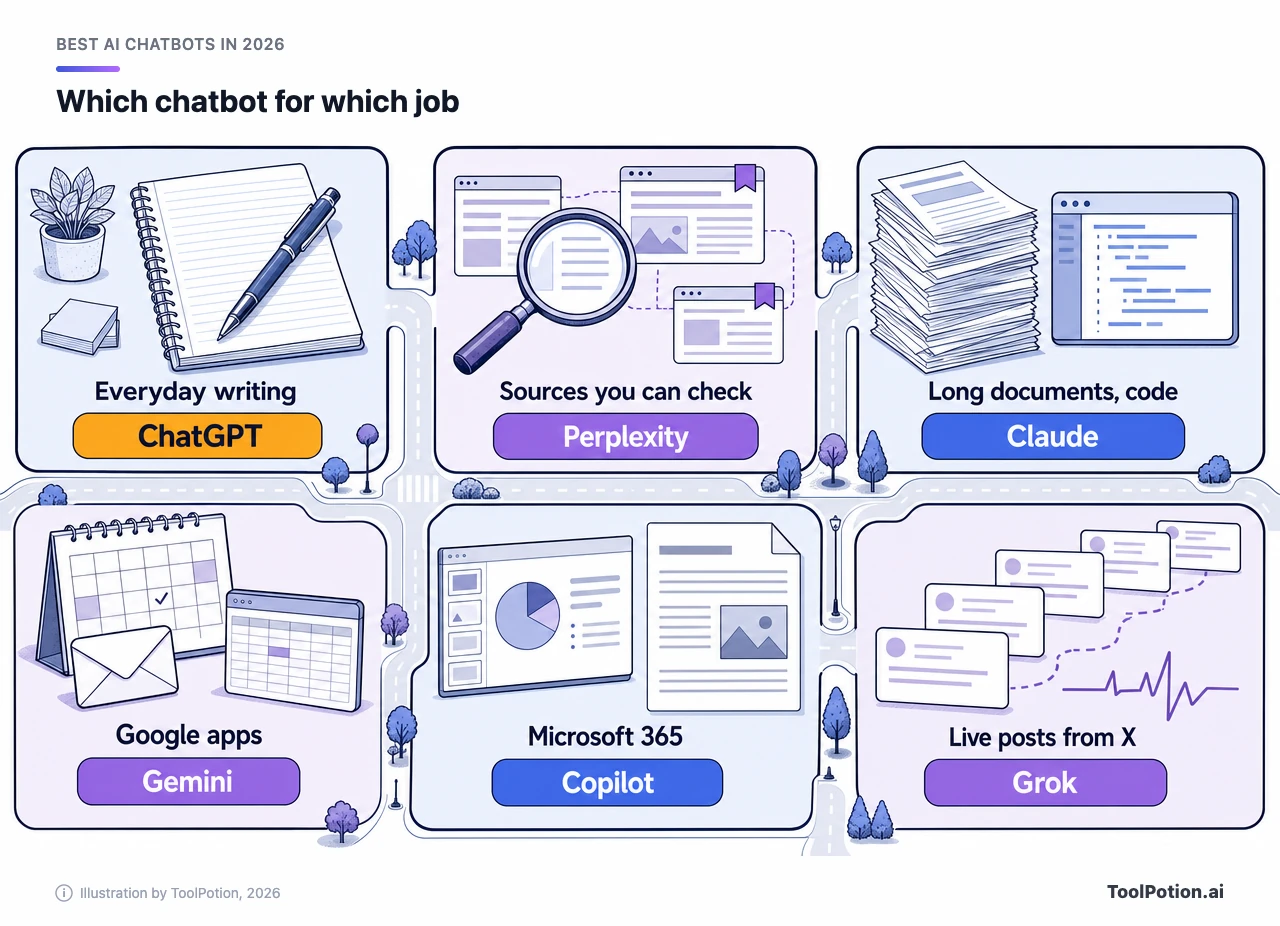
A few situations make the choice concrete. If you write code every day, the $100 tiers are where the two biggest labs now compete head to head, since OpenAI positioned its new Pro plan against Anthropic's $100 Claude option. Trial both before you commit. A small team should look at Claude's Team seats, which run $20 to $25 a month per seat, or ChatGPT's Business and Enterprise plans, which carry no ads. Students on a budget can start with the free plans from Gemini and Claude, then use Perplexity to find sources worth citing. Heavy research users will spend most of their time in one tool and a small amount in the other, and that split is normal.
Then add two filters. First, what you'd regret leaking: if the answer is client files or health questions, rule out DeepSeek and think twice about any free plan that shows ads. Second, how often you'll hit a limit. Free tiers are fine for a few questions a day, and the $20 plans are enough for daily work. Past that, you're buying capacity.
If you'd rather click than read, the short quiz below gets you to one recommendation in two or three taps.
The table below lays out the paid plans whose prices and limits we could confirm. Click any column header to sort, for example by price to see the cheapest ad-free option.
A final practical point: you don't have to marry one. Plenty of people use a general chatbot for drafting and a research tool for facts. For narrower jobs, our boards for brainstorming, generating code and summarizing documents rank the tools built for each task, and the Top 250 AI Apps board covers the wider field.
About ToolRank
ToolRank is ToolPotion's independent ranking for AI tools, with a 0 to 100 score and a tier for every entry. Placement can't be bought. You can browse every board on the leaderboards page, or see everything in the category in the full AI chatbots directory.
Self-hosted options and a few hosted alternatives
If you want control over your data, the self-hosted options are the ones to watch. Open WebUI (#17) is a self-hosted platform that connects to local or cloud models and can run entirely offline. LibreChat (#23) unifies several model providers in one customizable interface. GPT4All (#24) runs models on an ordinary laptop without a GPU, and Jan (#25) does the same with an option to connect to cloud models. LibreChat, GPT4All and Jan each score 55.
They won't match the leaders on raw capability, but they answer the privacy question differently: your prompts can stay on your machine. In the hosted field, Poe (#15, score 71) is the pick if you'd rather chat with several models from one account, and Vibe by Mistral (#16, score 71) is a free option from a European lab. The full list lives on the AI chatbots board, and personal-assistant apps have their own board.
Frequently asked questions
What is the best AI chatbot in 2026?
ChatGPT and Claude tie at the top of our board with a ToolRank score of 96. ChatGPT is the broader all-rounder, while Claude suits long documents and code and has no ads. For cited research, Perplexity is the better fit.
Is ChatGPT or Claude better?
It depends on the job and the plan. ChatGPT has more features, such as image generation, voice and deep research. Claude has a stated no-ads policy and a clean focus on writing and code. Both cost $20 a month at the individual level.
Which AI chatbot is best for free?
Claude, Google Gemini, Microsoft Copilot, Perplexity and Meta AI all have free ways in. ChatGPT's free plan also exists but now shows ads. Pick based on what you do: Gemini for Google apps, Perplexity for research, Copilot for Microsoft tools.
Is DeepSeek safe to use?
It's a capable model, but its privacy policy says it stores your data in China, and Italy's regulator blocked it in 2025. That doesn't make it unusable. It means you shouldn't put personal, client or proprietary data into it.
Do AI chatbots show ads?
Some do. ChatGPT's Free and Go plans show ads matched to conversation topics. Plus and higher tiers don't. Anthropic says Claude will stay ad-free.
Can I run an AI chatbot on my own computer?
Yes. GPT4All runs models on a normal desktop or laptop without a GPU, Jan runs them locally, and Open WebUI and LibreChat give you a self-hosted interface. You trade some capability for privacy.