Bank of America recently emailed customers a request that would have sounded absurd two years ago: please don't give your banking username and password to an AI assistant. The email, an AI-themed finance warning, told people never to share their credentials with another person or an outside service, including an AI-enabled tool or agent that offers to act on their behalf. TechCrunch's Zack Whittaker read the frustration between the lines, and a bank spokesperson confirmed the email was real.
A bank doesn't write that sentence unless customers are doing it. Personal agents like Claude for Chrome, ChatGPT Atlas and Perplexity Computer will log in, click through forms and pay for things, and a login is the easiest thing to hand over when the agent stops at a sign-in screen. Our walkthrough of AI browsers and agentic browsing covers how they work. This guide covers the narrower question: what happens to your money if you let one in.
It's about account security, not money advice. Nothing here says what to do with your savings.
The banks are closing ranks
Bloomberg's headline on RBC says the Canadian bank will block AI agents, and it's paywalled, so we could only read the headline. Earlier coverage in The Logic is more cautious: RBC's head of AI, Bruce Ross, said the bank is worried about agents moving money and about who is responsible when something goes wrong, and CEO Dave McKay said RBC was considering blocking Meta's Muse agent with no final decision. Schwab's CEO is blunter. Rick Wurster told Bloomberg TV the firm is blocking Muse from moving money: "For the protection of the client and for the protection of us, we're not allowing it," as Gizmodo quotes him.
The rest rests on one roundup. IBTimes UK says Citi confirmed it doesn't let third-party agents log into customer accounts or transact on its digital banking platforms, though it allows limited read-only access through approved open-banking providers. It attributes the rest to others: Reuters reported that Morgan Stanley blocks third-party agents, and Axios reported that JPMorgan and Bank of America are restricting them too. We couldn't open the Reuters or Axios pieces, so weigh those as secondhand. IBTimes also notes that the reports don't establish widespread unauthorized transfers or customer losses. This is a risk banks are acting on early, not an epidemic.
The shopping side has its own warning. Bank of America, Capital One, NatWest, ING and two other banks recently published shopping-agent safety principles, summarized by Techlicious. Their worry is that when something goes wrong, the bank often can't tell which agent bought what, or whether the order matched your instructions.
Why a shared login is the part that hurts
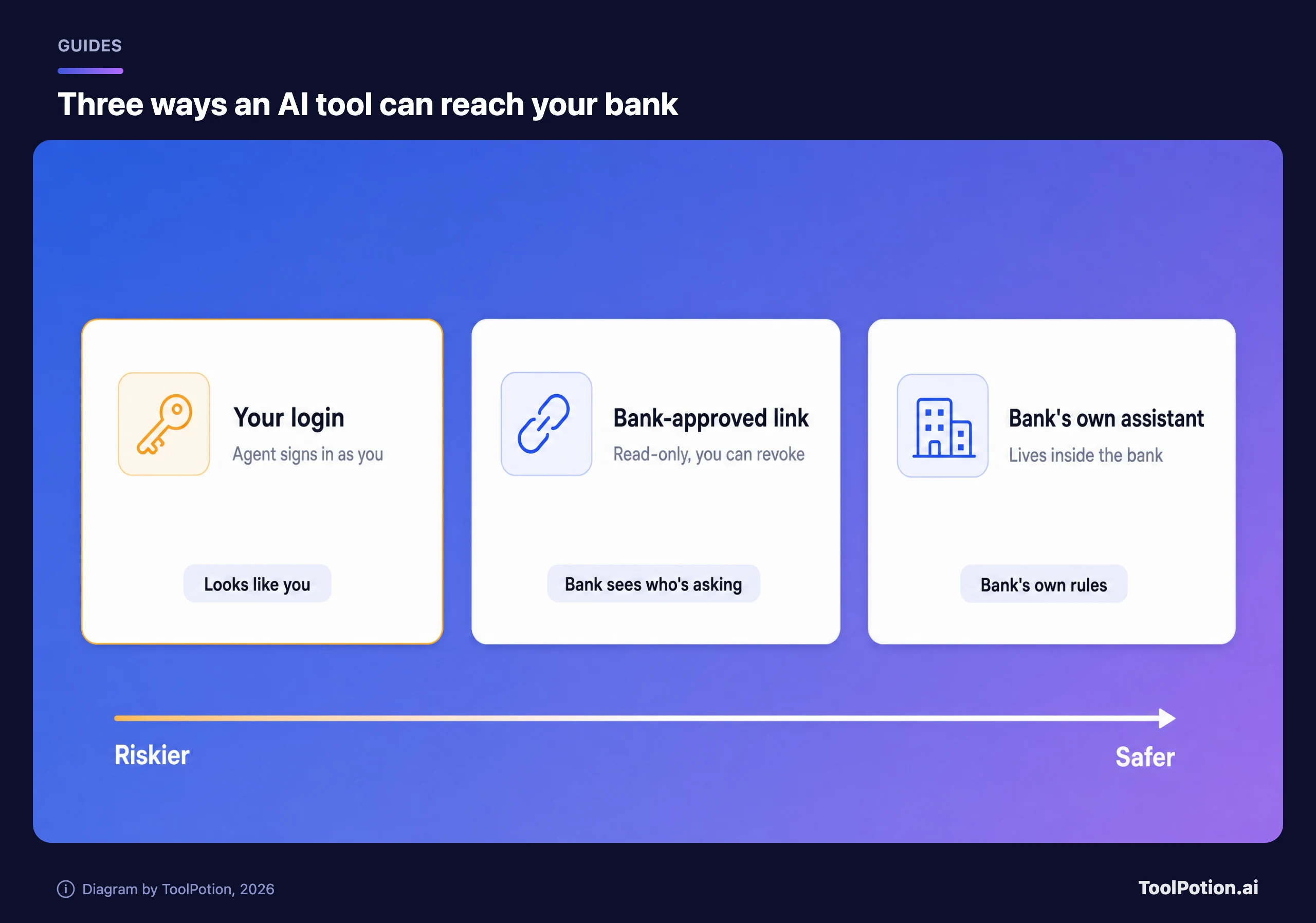
When an agent signs in with your password, the bank sees you. It can't tell the agent from the account holder, which is why Schwab and others block them. It's also why the bank's email carries this line, which TechCrunch quotes: "keep in mind that you're responsible for activity resulting from that access." TechCrunch adds that account agreements at most banks already hold customers responsible for anyone they give their login to.
US Regulation E, the rule behind most debit and bank-transfer fraud protection, points the same way. It defines an unauthorized transfer as one initiated by someone without actual authority, and excludes transfers by a person the consumer furnished with an access device ("a card, code, or other means of access") unless the consumer has told the bank that person is no longer authorized. The CFPB's official commentary gives the example of a family member or co-worker: if you furnish access and grant authority and they exceed it, you're fully liable until you notify the bank.
Whether a password you gave an AI agent counts as an access device you furnished is our reading, not the CFPB's. We found no guidance that addresses agents, and sharing a login won't automatically void your protection in every case. But we'd read the rule and the banks' emails together and plan as if the answer is yes. The clock matters too. Under §1005.6, if a loss involves an unauthorized transfer and you notify the bank within two business days of learning of the loss or theft of the access device, your liability is capped at $50. Miss that window and the cap is $500, and an unauthorized transfer that shows on a statement must be reported within 60 days of the statement. Credit cards follow different rules, so ask your issuer. People outside the US should check their own bank's terms.
The lanes banks still leave open
The reasonable options are all versions of the same idea: the bank knows who's asking. A read-only connection you approve on your bank's own screen, the kind budgeting apps already use, lets a tool see balances and spending without a password reaching it. Citi describes this arrangement, and Axios, as relayed by IBTimes, reports that many banks have approved or are moving toward it. A bank's own assistant is the other lane, because it runs inside the bank's security and terms.
Passkeys help here too. Google's Chrome help page calls them the simplest and most secure way to sign in, using a fingerprint, face scan or screen lock instead of a password. There's less to hand over because there's no password to paste into a chat window.
For purchases, the advice from the banks' shopping warning is plain. Don't let an agent complete a purchase without your approval, and ask your bank about a virtual card number you can shut off instantly. If you'd like help judging a specific tool, our agent safety guide and the piece on sandboxes, permissions and audits cover the limits worth setting.
The setting worth checking in Chrome
Around the same time, Google said Chrome's enhanced autofill can suggest details pulled from Gmail, such as order numbers, tracking information and flight bookings, using Gemini with Personal Intelligence. It's rolling out in the US to Gemini in Chrome users who have Personal Intelligence enabled, and Google says sensitive data is encrypted and you control it from Chrome settings. TechCrunch's report adds that it could also suggest a card number.
Autofill is not an agent logging in as you, and you still choose what to fill. We wouldn't panic. But it's the same direction of travel, more of your inbox and wallet within reach of the browser, so it's worth two minutes. Per Google's Chrome help page, the feature is for Gemini in Chrome users in the US who are 18 or older and have opted into Personal Intelligence, so if you haven't, nothing changes. If you have, open Chrome, go to Settings, then Autofill and passwords, select Enhanced autofill and turn "Find and fill with Gemini" off. While you're there, note that Google says the save-and-fill switches for passwords, payments, contact info, identity docs and travel are on by default and can each be turned off.
Also look at your password manager and any AI browser: does it offer to save and replay logins for an agent? If a tool has a saved bank login that you don't use, delete it. Our guide to AI scams on your phone covers the other half, the scammers who exploit the same trust, and apps like ScamAlert and StopScam screen suspicious texts and links.
If you already gave an agent your login
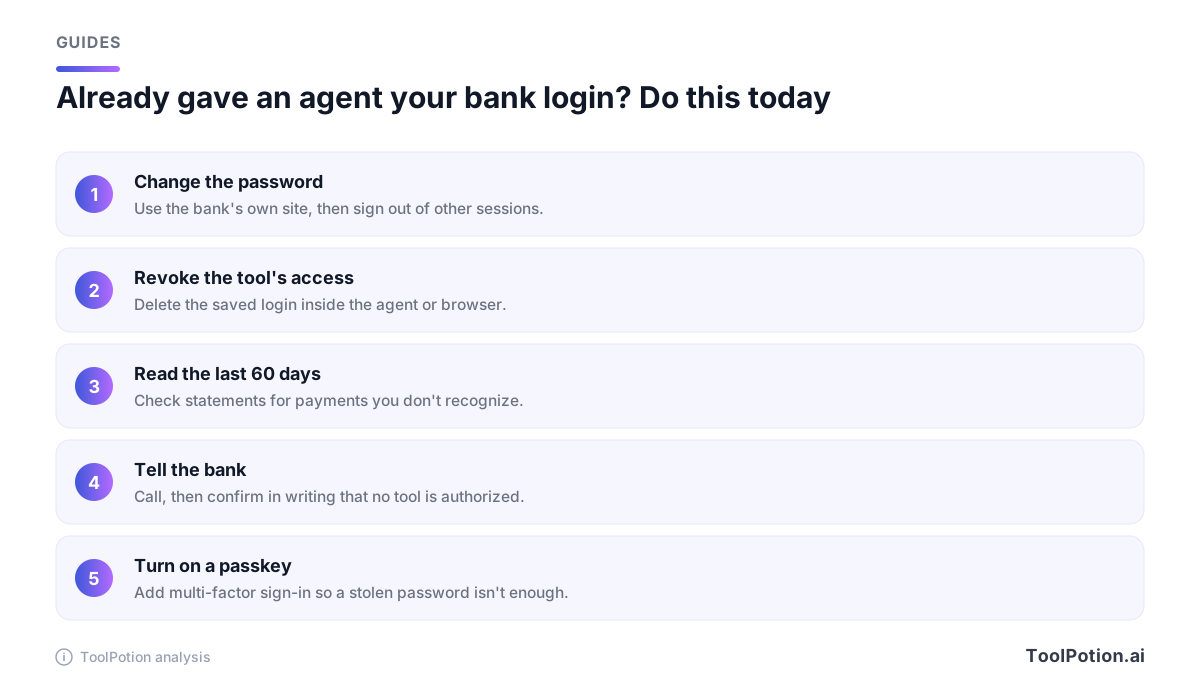
You're not in trouble, but treat it as a leaked password. Change it on the bank's own site, sign out of other sessions, and delete the saved login from the agent or browser. Then read the last two months of activity. If anything looks off, call the bank. Either way, tell it that no tool is authorized to use your account, by phone and then in writing. Under the Regulation E wording above, that notice is what ends your responsibility for later transfers. Then add a passkey or app-based second step.
If you sell to shoppers rather than shop, the other side of this is in our sellers' guide to agentic commerce. What nobody has settled is who pays when a bank-approved agent makes a payment you didn't mean. IBTimes, citing The Paypers, reports that Bank of America is limiting agent access to consumer deposits while it develops protocols to decide that.
Frequently asked questions
Is it ever okay to give an AI agent my banking password?
We wouldn't. Bank of America asks customers not to and says they're responsible for what follows, and Citi told reporters it doesn't let third-party agents log in. Use a bank-approved read-only connection or the bank's own assistant instead. The same goes for ChatGPT and Claude: neither needs your bank password to help you read a statement you paste in.
Will my bank refund money an AI agent moved?
It depends on your account type, your bank's terms and how fast you report. Under Regulation E, a transfer by someone you furnished with access isn't counted as unauthorized until you tell the bank to stop, and whether an AI agent falls under that is unsettled. Report quickly, by phone and then in writing.
Do AI browsers read my bank balance just by being open?
An agent that browses for you works inside your own browser, so a logged-in bank tab can be within its reach. Close it before you hand over a task, tell the agent to stay off financial sites, and check what the tool is allowed to touch.
Is Chrome's Gmail autofill the same risk as an agent login?
No. It suggests details for you to accept and doesn't sign in anywhere. If you don't want your inbox feeding forms, turn it off in Chrome settings.