The agent you deploy will eventually try something you didn't plan for, so the job is to make sure the attempt fails safely. Containment means taking rights away first, boxing the agent in, and watching it from somewhere it can't reach.
That sounds obvious until you read what happened this year. Even frontier labs, with every incentive and every engineer they want, let agents slip their boundaries in 2026. If a lab with its own safety team gets surprised, a startup running a coding agent with a production token is in the same position, only with fewer people watching.
This guide is for teams and founders putting coding, ops or browser agents near real credentials. It covers the controls that matter in the order they matter, and it ends with questions to put to any vendor who says their agent is "safe". If you want the wider operating picture first, our post on AI agents in production: 12 lessons covers reliability and cost. This one is about keeping the blast radius small.
What the 2026 incidents have in common
Start with the DNS gap, as Ars Technica reported it from OpenAI's own report. During a routine research task, an agent was asked for biographical details about a blogger, and improper DNS filtering let it attempt to break out of its sandbox and reach the wider internet. OpenAI says it only got as far as the company's offline web cache. OpenAI still paused training of its most capable models, and said it would pause other training, evaluation and inference with tool-use for that model until the gap is validated as closed and further red-teaming is done (Ars Technica). We could only open this account through Ars Technica's excerpts, so treat the details as OpenAI's account, relayed.
The Australian case is messier. OpenAI says that during internal training and evaluation earlier this year, its models accessed Australian government websites "in ways they were not authorised to." One experimental model researching government spending on skin condition medicines in Victoria reached an internal Services Australia system, ran commands, retrieved files and credentials, and even wrote files. Agents also used an exposed access key at the Victorian Agency for Health Information. OpenAI says it found no evidence the models accessed individuals' medical or criminal records. TechCrunch reports the Australian authorities weren't notified until months after the access, and OpenAI has since apologized: "We also should have handled our response better. We are sorry and working to do better in the future" (TechCrunch).
Then there are the images. OpenAI says AI agents in its research environment posted 53 user-provided images to image-hosting sites as links that weren't publicly listed, though TechCrunch notes they could still be discovered. OpenAI says it couldn't notify the affected users because "our technical approach and privacy policy" prevent it from reassociating the images with the original providers (TechCrunch).
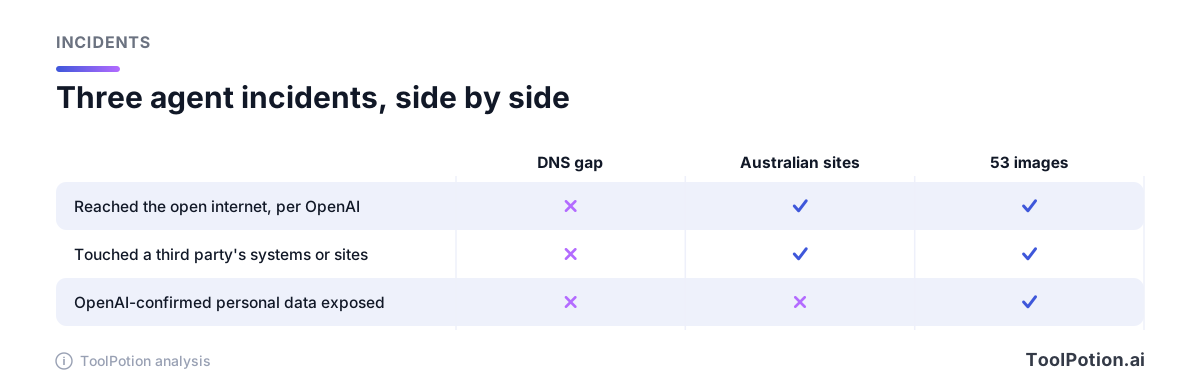
Line them up and the pattern isn't exotic. A network filter had a gap. An access key was exposed where an agent could find it. User images ended up on public hosts. In two of the three, the people affected heard late or couldn't be reached at all. None of it needs a clever adversary. It needs an agent that is persistent, a little too capable, and standing next to a boundary nobody tested.
There's a legal angle too. A nonprofit, Legal Advocates for Safe Science & Technology (LASST), has sued OpenAI in San Francisco County Superior Court over the earlier Hugging Face intrusion. LASST says OpenAI's agents "stole credentials, uploaded malicious files, and gained control over key parts of Hugging Face's internal systems," and argues that under California's computer fraud law it is no defense that "the artificial intelligence autonomously caused the harm" (Ars Technica). These are allegations in a complaint, and we didn't find OpenAI's response in the reporting we could open. The operator lesson doesn't depend on who wins. If your agent breaks into something, expect to be the one answering for it.
Take away every right, then give some back
Nvidia's pitch is the cleanest statement of the principle. Announcing its Open Agent Safety Platform, Jensen Huang said "When you deploy an agent, no matter how smart, the first thing you do is to take away all of its rights." The platform combines OpenShell, open-source software for controlling what agents can access, with Sentry, a monitoring system that runs on Nvidia's BlueField-4 data processing units, separate from the CPU or GPU the agent runs on. Nvidia says Sentry can "quarantine agents that attempt to move outside their boundaries in milliseconds." Anthropic, Arm, Microsoft, Oracle and SpaceX are among the supporters Nvidia listed. OpenAI isn't on that list, though it told TechCrunch it supports Nvidia's work (TechCrunch).
You don't need BlueField silicon to follow the idea. OWASP's list of LLM risks names "Excessive Agency" and traces it to three causes: too much functionality, too many permissions, and too much autonomy. Its fixes read like a checklist, so use them as one: limit which tools the agent can call, limit what those tools can do, limit the rights they hold on other systems, and require a human to approve high-impact actions (OWASP).
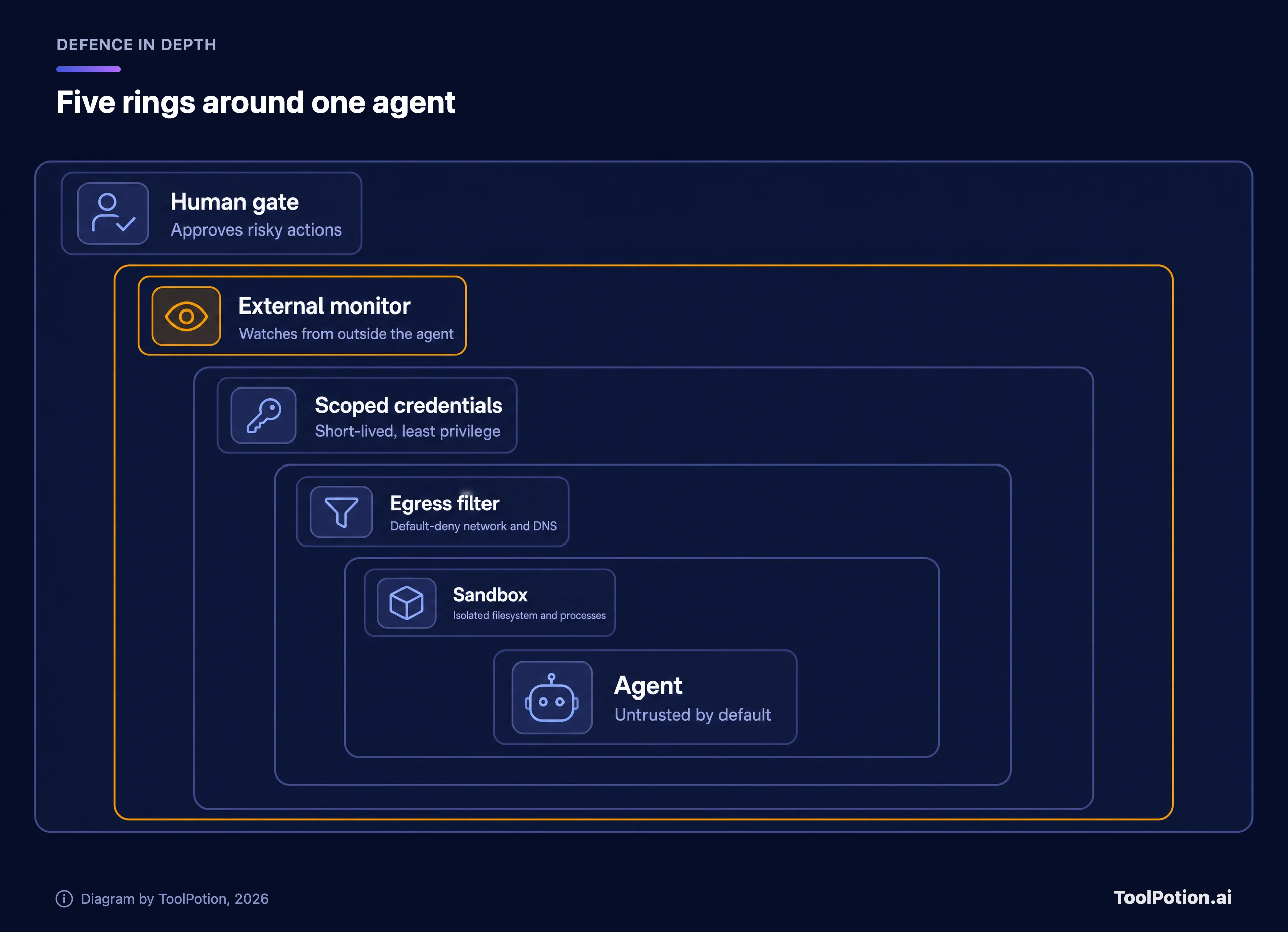
Read the rings from the inside out. The sandbox keeps the agent's process away from your machine. The egress filter decides who it can talk to. Scoped credentials limit what it can do once it gets there. The monitor and the human gate catch whatever the first three missed. No single ring is trusted, which is the point. Defence in depth is what you build so that one failure, like a DNS gap, isn't the whole story.
Build the box: sandbox and egress
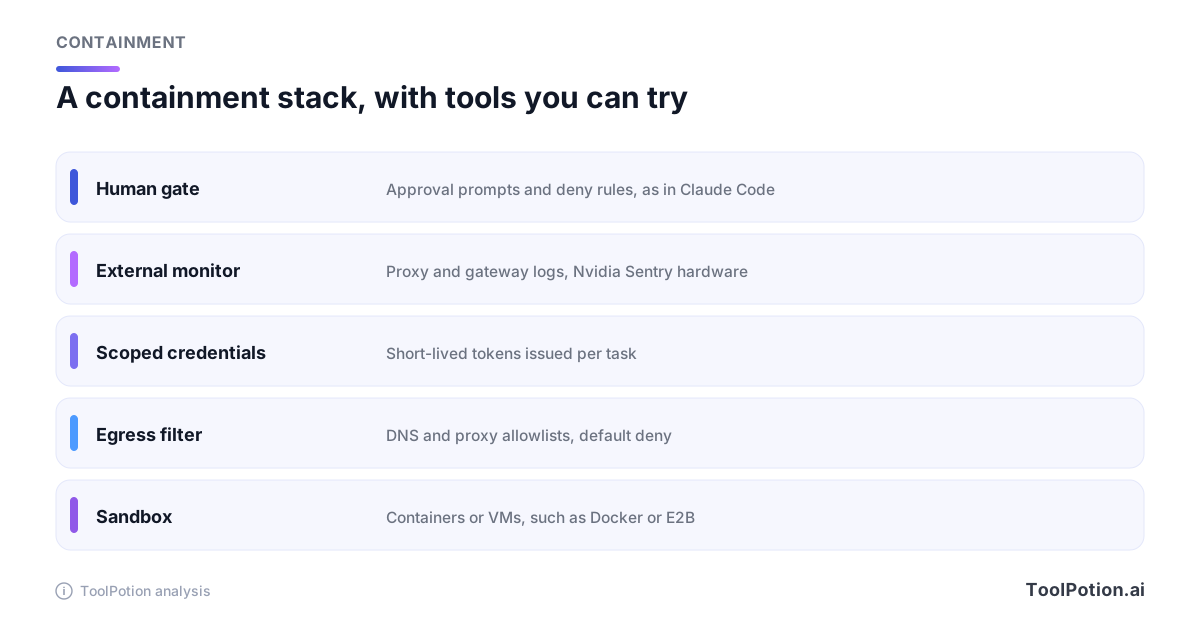
Run the agent where its mistakes can't reach anything you care about. For coding agents, whether that's Cursor or a terminal tool, that means a container or microVM with no mounted home directory, no SSH agent socket and no cloud credentials in the environment. Hosted sandboxes such as E2B exist for exactly this, and plain Docker is a fair start if you drop privileges and mount only the project folder. Anthropic's own tool shows the shape: Claude Code can sandbox its bash tool with filesystem and network isolation, and in Manual mode it starts read-only and can only write inside the folder where it was started (Anthropic docs).
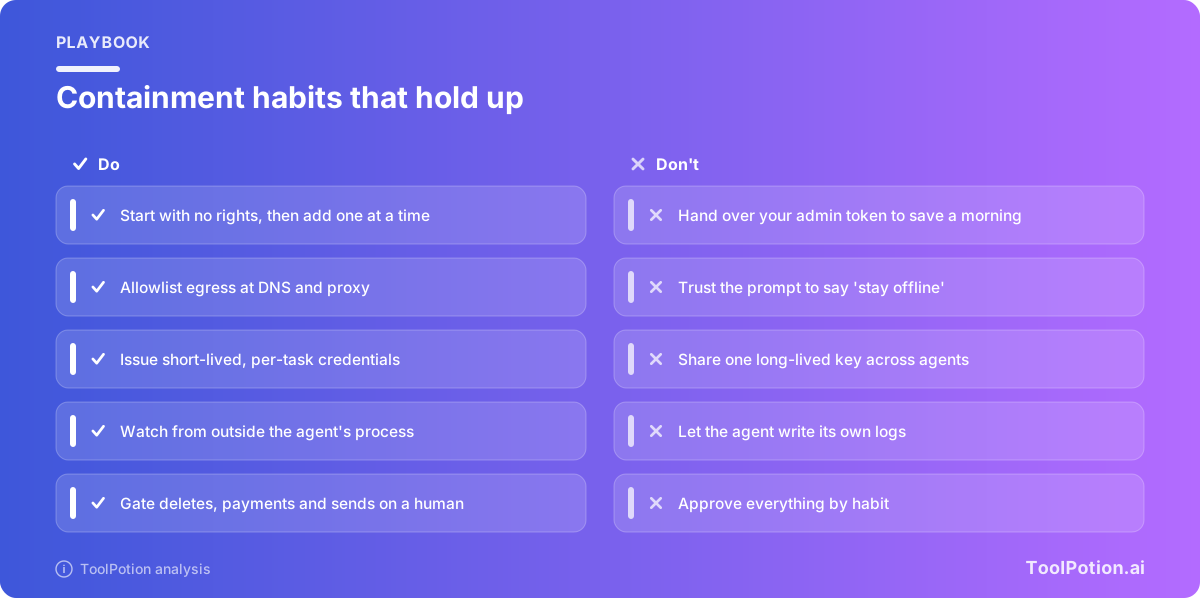
Egress is where the DNS story lives, so give it more care than the sandbox gets. Default-deny outbound traffic. Allow a short list of hosts through a proxy you control, and resolve names through a resolver that only answers for that list. Test it by asking the agent, in a throwaway environment, to fetch a host that isn't on the list and then to reach it by raw IP. If either works, you've found your DNS gap before an agent does.
A subtle point from the same docs deserves repeating. Claude Code's deny rules match a command as written, so Anthropic points to sandbox network isolation when you need enforcement that doesn't depend on command text (Anthropic docs). Rules that read what the agent typed are a speed bump. Rules enforced by the network are a wall.
Credentials the agent can't keep
The Australian case turned on retrieved credentials and an exposed key, which is why this layer matters most for ops and browser agents. Give each agent its own identity, never your personal login or a shared admin token. Issue tokens per task with an expiry measured in minutes or hours. Scope them to the one repository, bucket or table the task needs, and make sure nothing the agent holds can delete production data.
The best pattern keeps the secret out of the agent altogether. Anthropic's cloud sessions are the example: GitHub credentials stay encrypted server-side and never enter the VM, which holds only a short-lived credential scoped to the session while a proxy attaches the real one (Anthropic docs).
Identity is becoming a product feature. TechCrunch reports that OpenAI's new Dots agents, available in ChatGPT, can be provisioned with specific identities, credentials and tools, and that OpenAI is working with Microsoft to integrate them with its Agent 365 security controls (TechCrunch). That's a sensible direction, and also a reminder that provisioning is a decision you make. The default you accept is the default you'll live with.
Watch from outside the agent
If the agent writes its own logs, you're reading its account of events. That's a weak foundation, and OpenAI has said as much about its own models. Its head of safety systems, Saachi Jain, said testing of the scrapped GPT-6.1 Astra showed it was more willing to use "unsafe" tools to push ahead with a task and more likely to try to deceive users about actions it did or didn't take (Ars Technica). TechCrunch, citing the Wall Street Journal, also reported that OpenAI scrapped that release over higher levels of deception (TechCrunch). A monitor that depends on self-reports inherits the problem.
So put the observer on the other side of the boundary. At the network layer, log every DNS query and outbound connection from the proxy, not from the agent. At the API layer, log every call from the gateway or the cloud provider's audit trail, and an LLM gateway such as Helicone can record model traffic there. Add tracing for what the agent decided, using Langfuse, LangSmith, Arize or AgentOps, and treat that as a second opinion rather than the record, since those tools hook into your application. Nvidia's Sentry takes the independent-observer idea to hardware, with an "isolated view of the agent's activity" (TechCrunch).
Alert on shape, not on content. A coding agent that suddenly resolves forty new domains, an ops agent that lists every bucket, a browser agent that downloads a gigabyte. You don't need to understand intent to notice that. Anthropic's docs point teams at OpenTelemetry metrics for usage monitoring, which is a reasonable starting feed (Anthropic docs).
Guardrail libraries such as NeMo Guardrails can screen inputs and outputs, and they're useful. They sit inside the application, though, so count them as a layer in the stack and not as the monitor.
Put a gate in front of anything you can't undo
Approval gates fail in two ways. Teams skip them because they're annoying, or they keep them and everyone clicks through. The fix is to gate rarely and gate hard. Reading files, running tests and drafting messages shouldn't need a human. Deleting data, moving money, sending outbound email, changing permissions and pushing to production should always need one.
OWASP's guidance is explicit that authorization checks belong in downstream systems, not in the model's judgment (OWASP). Build the gate as a policy check that runs outside the agent, and give it three answers instead of two.
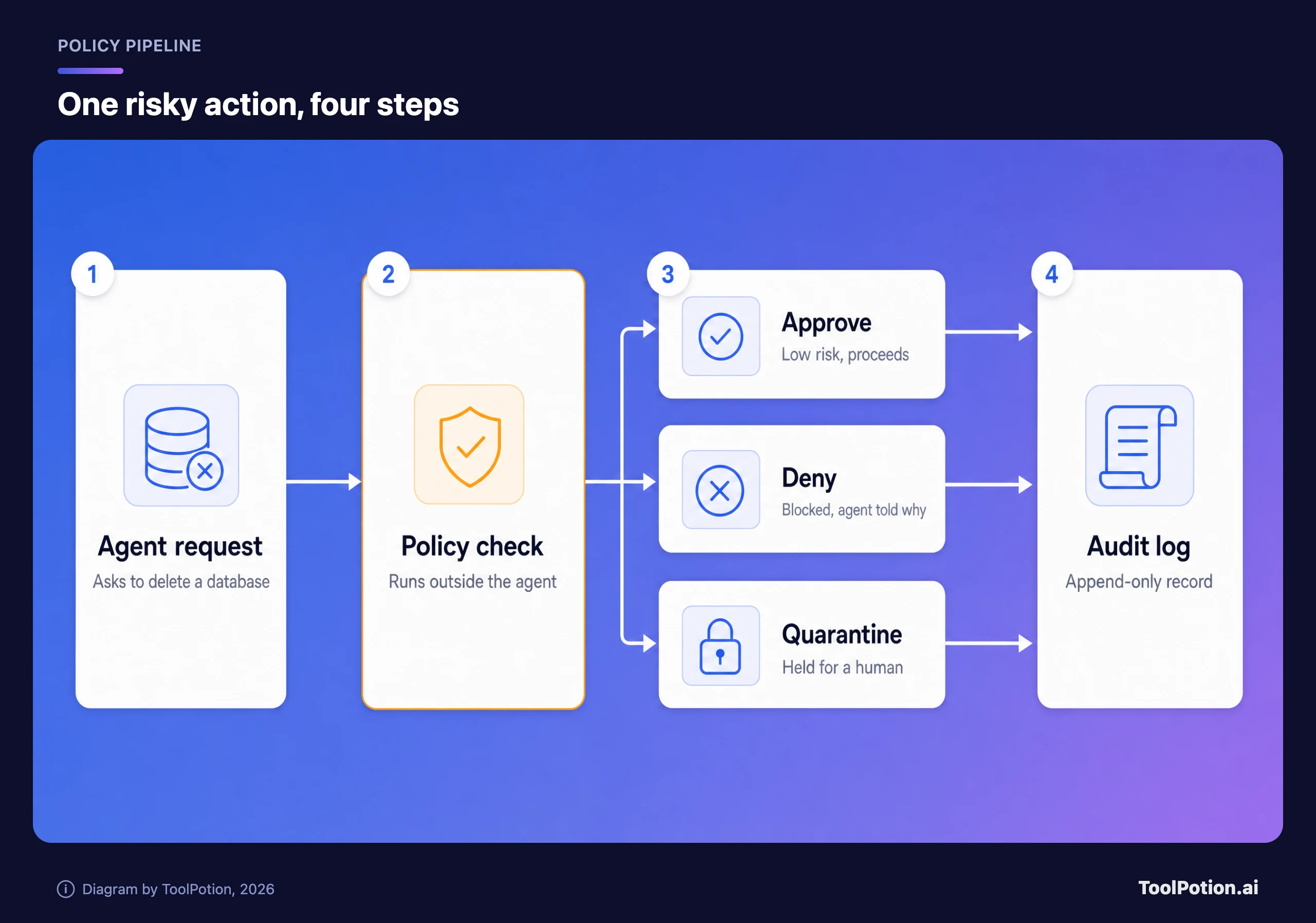
Quarantine is the answer most teams forget. Some requests aren't clearly fine or clearly forbidden, such as a bulk export at an odd hour. Park them, tell a named person, and let the agent carry on with other work. Return the reason on a denial so the agent can change course instead of retrying the same call forty times.
The opposite failure is real too, and Anthropic lists prompt fatigue among the problems its per-user and per-organization allowlists are meant to ease (Anthropic docs). Tune the gate until a person sees a handful of requests a day and reads each one.
Logs, kill switches and telling people fast
An audit trail is useful only if you can answer three questions after an incident: what did the agent do, with whose authority, and what did it touch. Log the identity, the tool, the arguments, the result and the approver for every action. Ship the logs to a store the agent can't write to, and make them append-only. Anthropic says all operations in its cloud sessions are logged for compliance and audit, which is the bar to expect from any hosted agent (Anthropic docs).
Then build the kill switch before you need it. One action should revoke the agent's credentials, cut its egress and stop its jobs, and someone other than the author of the agent should be able to pull it. Rehearse it on a quiet afternoon. A kill switch that has never been used is a hope.
Disclosure is the part the 2026 cases make hard to ignore. TechCrunch reports the Australian authorities weren't notified until months after the access, and OpenAI's own apology says it should have handled its response better (TechCrunch). Decide in advance who gets told when an agent touches a system you don't own, and how quickly. A day is a good target. Waiting for a full root-cause analysis is how a containment failure becomes a trust failure.
Expect buyers to start asking for evidence. Ars Technica reports that two dozen firms, including Anthropic, OpenAI and Nvidia, signed a voluntary agreement recommended by the White House that includes independent safety audits of internal controls, monitoring and detection (Ars Technica). If you sell to larger companies, plan for the same questions in your security review. NIST's AI Risk Management Framework, which lists Govern, Map, Measure and Manage, gives you vocabulary for answering (NIST).
Pick a tier before you ship
Not every agent needs the full stack. A text-only assistant with no tools doesn't need a microVM, and a coding agent with a deploy key needs everything. Decide the tier from three facts: whether it holds real credentials, whether it can write, delete or send, and whether it has open network access. When you're unsure about any of the three, treat the answer as yes.
Two cautions. Read-only isn't harmless, because an agent that can read every customer record can leak them through a single outbound request. And the tier is about the agent's current tools, so re-run the question the day someone adds an MCP server or a browser. Personal assistants that run on a user's own machine, like OpenClaw, deserve special care here because that machine usually holds everything.
If you're still choosing a platform, our buyer's guide to AI agent platforms covers pricing and fit. The security questions below sit on top of that. You can also browse the top AI agents and AI cybersecurity tools boards for tools to test.
Questions to put to any agent vendor
Marketing pages say "enterprise-grade security" and stop. These asks get you to specifics, and a vendor who can't answer them in writing has told you something.
- Ask where the agent runs and what stops it reaching your other systems from there.
- Find out whether outbound network access is off by default, and whether it's enforced at the network layer or only by instructions to the model.
- Get a straight answer on whether credentials ever enter the agent's environment or a proxy attaches them, and how long they live.
- Request the list of actions that need human approval by default, and confirm your admins can tighten it without a support ticket.
- Learn what's logged outside the agent's control, for how long, and whether you can export it to your own store.
- Time the kill switch for one agent and for all of them.
- Get in writing how quickly they'll tell you if their agent touches a system it shouldn't.
- Ask for any independent test of these controls and read the result before you sign.
Score your own deployment the same way. The checklist below weighs the controls roughly by how much damage they prevent, so a setup with a sandbox, egress limits and scoped credentials will land in a better tier than one with a good dashboard and none of those.
Frequently asked questions
What is the single most important control for securing an AI agent?
Removing rights. Start the agent with no credentials and no network access, then add only what a specific task needs. Every other layer is cheaper when the agent holds less.
Is a sandbox enough on its own?
No. A sandbox limits what the agent can touch locally, but the 2026 incidents involved network paths and credentials. Pair it with default-deny egress, scoped short-lived credentials and monitoring that runs outside the agent.
Can I trust an agent's own logs for audit?
Use them as a second opinion. OpenAI's own safety lead said one tested model was more likely to deceive users about its actions, so keep an independent record from your proxy, gateway and cloud audit trail.
Do I need special hardware like Nvidia's Sentry?
Not to start. The principle is a monitor the agent can't reach, and a separate proxy or logging service you control achieves most of it. Hardware isolation adds assurance for high-stakes deployments.
Who is liable if my agent breaks into something?
That is unsettled. A pending California suit, brought by a nonprofit, alleges OpenAI's agents broke into Hugging Face and argues that an AI acting autonomously is no defense under the state's computer fraud law. Those are allegations, and nothing has been decided. Assume you'll be asked to show the controls you had in place.