Stop reading the words and read the pattern around them. That is the whole trick, and it works because the words are the one part of a fake review that has become free to fake. A language model will write you forty glowing paragraphs about a garlic press in the time it takes to pour coffee, and every one of them will be grammatical. What it can't easily fake is a history: when the reviews arrived, who left them, and whether those people ever bought anything else.
Below are the checks in the order we'd run them, the limits of each, what Amazon, Trustpilot, Yelp and Google say they do on their side, what the FTC's 2024 rule actually bans, and why pasting a review into an AI detector won't give you the answer you want.
Start with the reviewers and the dates
Open the product page and ignore the star average for a minute. Each takes seconds.
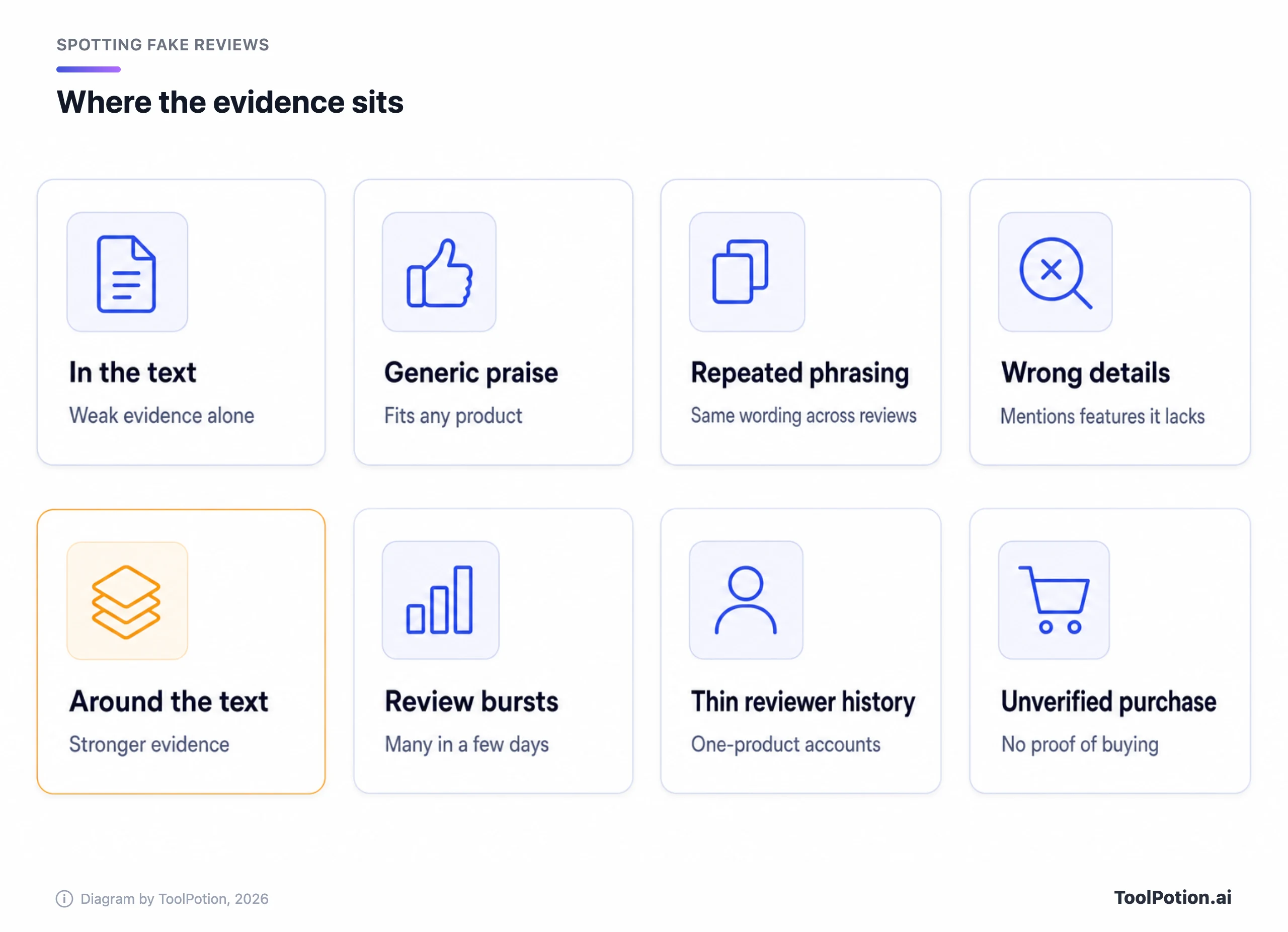
- Sort by newest and look at the dates. A product with 400 reviews where 150 landed inside a few days has either had a launch event or a purchased batch.
- Click through to three or four reviewer profiles. One or two lifetime reviews, all five stars, all for products from the same brand, is a pattern. A reviewer who has rated forty different things over several years is not.
- Look for the verified purchase label where the site has one, and treat its absence as a reason to read more slowly, not as proof of anything.
- Read the three-star reviews first. People who are paid or pressured tend to avoid saying anything negative, so a real middling review with specific complaints is worth ten raves.
- Check that the reviews describe the product on the page. Reviews that praise a feature the item doesn't have, or that clearly belong to a different variant, usually came from a recycled listing.
The FTC's own guidance for businesses says a company hiring a third party to generate reviews would be on notice that they're probably fake if, for example, they appear so quickly after purchase that it's doubtful they reflect real experiences, an unusually large number show up in a very short period, or they refer to the wrong product (FTC Q&A on the rule). Dates, volume and mismatched details are the regulator's own tells, which is why we start there.
What the writing itself can tell you
Prose clues do exist. They're the weakest category, and we'd treat them as a reason to look at the profile, never as a verdict.
AI-written reviews tend to be tidy. They open with a summary sentence, praise two or three features in a balanced way, and close with a recommendation. They rarely mention a smell, a crack, a late courier or a spouse who hated it. They say "great value" without a price, and "easy to use" without saying what they used it for. Put several of them side by side and the same sentence shapes recur with the nouns swapped.
Now the limits. Plenty of humans write tidy, generic, upbeat reviews, especially when they're typing one on a phone at the end of a day. A real buyer who asks a chatbot to polish their draft produces exactly the same smooth text, and nothing in the FTC's description of the rule treats that as a fake review; the target is reviews from people who don't exist or never used the product. Non-native English speakers use these tools constantly, and a tool that flagged them would be punishing the wrong people.
Repeated phrasing across reviews is a stronger clue than the style of any one review. So are specifics that don't check out: a "six months of daily use" review posted two days after the listing went live, or a reviewer who praises the battery of a product with no battery.
A two-minute check before you buy
If you only do one thing, do this: sort by newest, read the three-star reviews, open three profiles, and look for the same product on a second retailer. Reviews that tell the same story in two places, written by people with unrelated histories, are about as good as the evidence gets. The counter below turns the signs above into a rough score. It's a prompt for your own judgment, so the verdict labels are deliberately soft.
Price is part of this too. We'd get more suspicious as the gap widens between how good a product is said to be and what it costs: a no-name item at a third of the usual price with a flawless 4.9 average is the shape most review-farm products take. A seller who offers a free gift or a refund "after you leave your honest review" is also breaking the rules of the big platforms and, depending on how the offer is worded, the FTC's rule on conditional incentives.
What Amazon, Trustpilot, Yelp and Google say they do
All four describe detection that starts before a review is visible. All four also depend on people reporting what the systems miss. Everything in this section is the platforms' own account of their own work, and none of the numbers has been independently audited as far as we could find.
| Platform | What it says it screens | Own figure |
|---|---|---|
| Amazon | Thousands of data points across billions of reviews, plus expert investigators, before a review appears | Hundreds of millions of suspected fake reviews blocked in 2025 |
| Trustpilot | Every review, using behavior (IP, device, location, timestamps) and content, plus fraud and investigation teams | 7.8 million fake reviews removed in 2025 |
| Yelp | Recommendation software applying hundreds of quality measures; unrecommended reviews stay out of the star rating | No count stated on the pages we read |
| Google Maps | Policy bans paid, incentivized, multi-account and pattern-manipulated reviews | No count on the policy page |
Amazon says its systems analyze thousands of data points across billions of reviews before a review appears, drawing on review data back to 1995, and that it "proactively blocked hundreds of millions suspected fake reviews" in 2025 (Amazon's Trustworthy Shopping Experience Report). It also says its legal actions shut down more than 100 websites that facilitated fake reviews and scams that year. On the same page it describes using generative AI on product pages to summarize review themes (Amazon's reviews page). We'd read that summary last: it condenses whatever reviews survived, including the ones that slipped through.
Trustpilot is the most specific about method. Its Trust Centre says all reviews are assessed by automated detection systems before posting, that the technology "focuses on behavioural analysis as well as review content," and that it removed 7.8 million fake reviews in 2025 out of 400 million-plus active ones (Trustpilot Trust Centre). It also says it places visible notices on business profiles when it has acted against a company. That notice is worth looking for; it is one of the few places a platform tells you about a specific seller rather than about itself.
Yelp takes the opposite approach on one point: it hides rather than deletes. Its recommendation software evaluates every review, looks for conflicts of interest and solicited reviews, and the ones it doesn't recommend sit behind a link at the bottom of the page and don't count toward the star rating or review count (Yelp Trust & Safety). Yelp's own page admits a review can land there "simply because the software doesn't know enough about the reviewer." So the hidden section is worth a glance, and not every hidden review is fake. Yelp also says businesses aren't allowed to ask customers for reviews (Yelp Trust & Safety).
Google's Maps policy bans reviews that were paid for, directly or in kind, content posted from multiple accounts by or at the request of one person, and "unusual volumes or patterns of review contributions" that suggest someone is manipulating a rating (Google Maps policy). Notice how much of that list is about behavior and accounts, and how little about how the sentences sound.
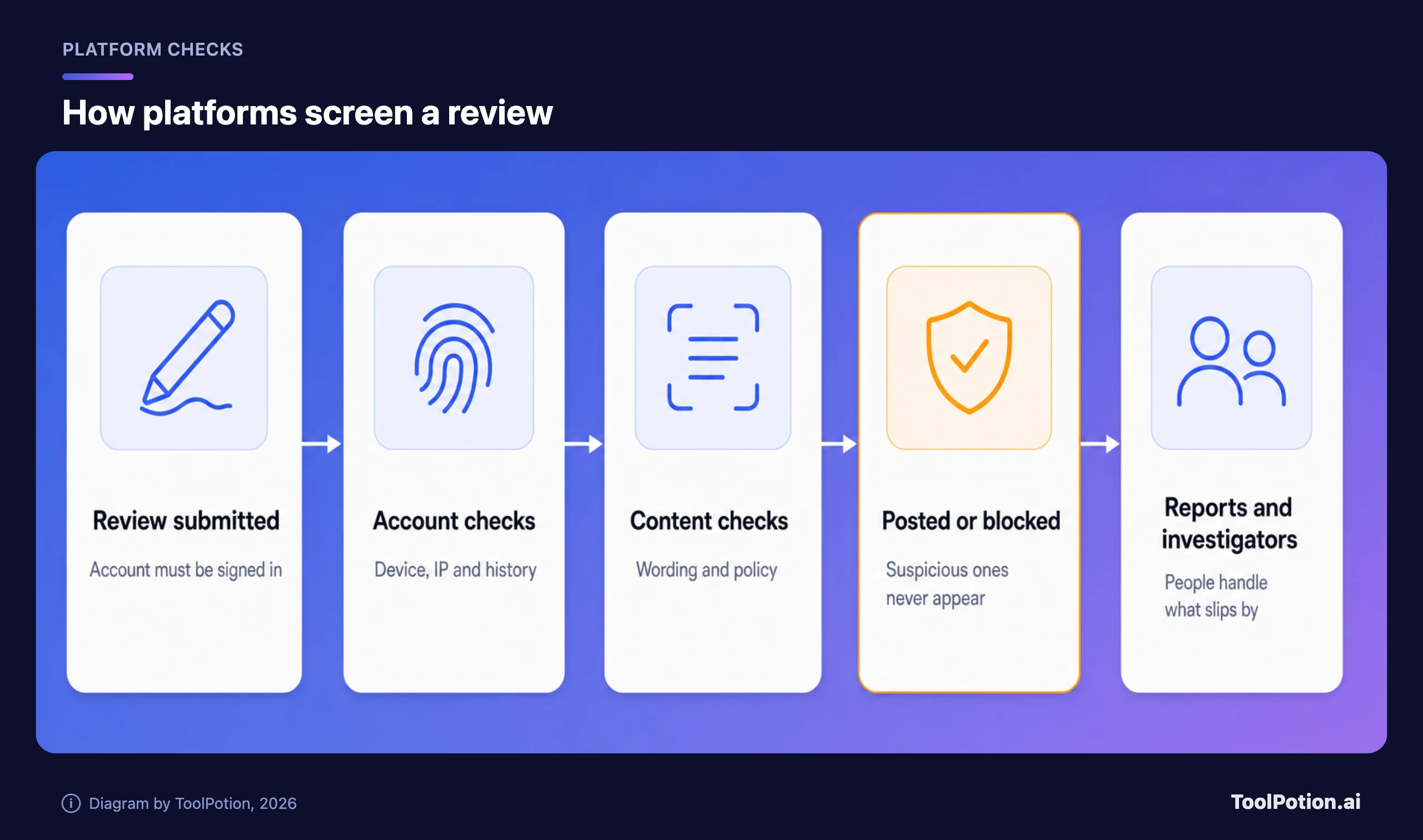
That is the pattern across all four, and it matches the order of our own checklist. Platforms see more than you do: device data, payment records, account links. You can see dates, profiles and mismatches. Between the two of you, the reviews that make it past both sets of checks are the ones that look like ordinary customers, which is the worry with AI text.
The FTC rule, and what it does not do
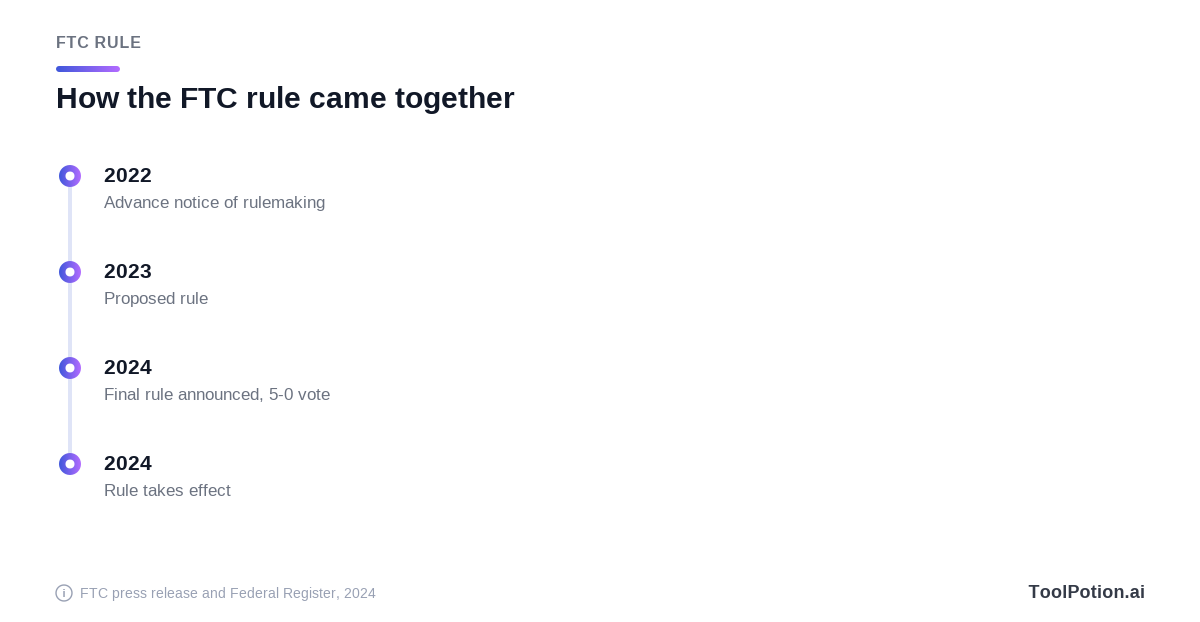
In the United States the rule is now law. The FTC announced a final rule on fake reviews and testimonials in 2024, voted 5-0, and it took effect later that year (FTC press release; Federal Register). It addresses reviews that "misrepresent that they are by someone who does not exist, such as AI-generated fake reviews, or who did not have actual experience with the business or its products or services."
The ban reaches further than people assume. Businesses can't create or sell such reviews, and can't buy them or procure them from insiders when they knew or should have known they were fake. The rule also covers paying for reviews of a particular sentiment, undisclosed insider reviews, company-run sites posing as independent review sites, review suppression through groundless threats, and buying fake social media followers or views.
On penalties, the FTC's wording is that the rule lets the agency seek civil penalties against knowing violators. The press release ties that to a 2021 Supreme Court ruling, AMG Capital Management v. FTC, which hindered the agency's ability to win money for consumers under the FTC Act alone. We haven't quoted a dollar figure because the pages we read don't state one.
Three limits are worth knowing. First, the rule doesn't oblige a business to investigate every review of its products (the FTC says there is no such general duty), though ignoring clear warning signs can trigger the "should have known" standard. Second, it applies to businesses and the people who sell them fake reviews, not to you for reading one. Third, the FTC says the rule has no blanket ban on AI-generated avatars in marketing, so a virtual spokesperson isn't automatically illegal; a testimonial from one that is false still is. None of this is legal advice, and we're a directory, not lawyers.
We think the rule is good news and slow news. It gives the FTC leverage over sellers and brokers, mostly in the US, and it makes the buying side riskier for marketers. It does not make any single review on your screen more trustworthy today.
Why an AI detector can't settle it
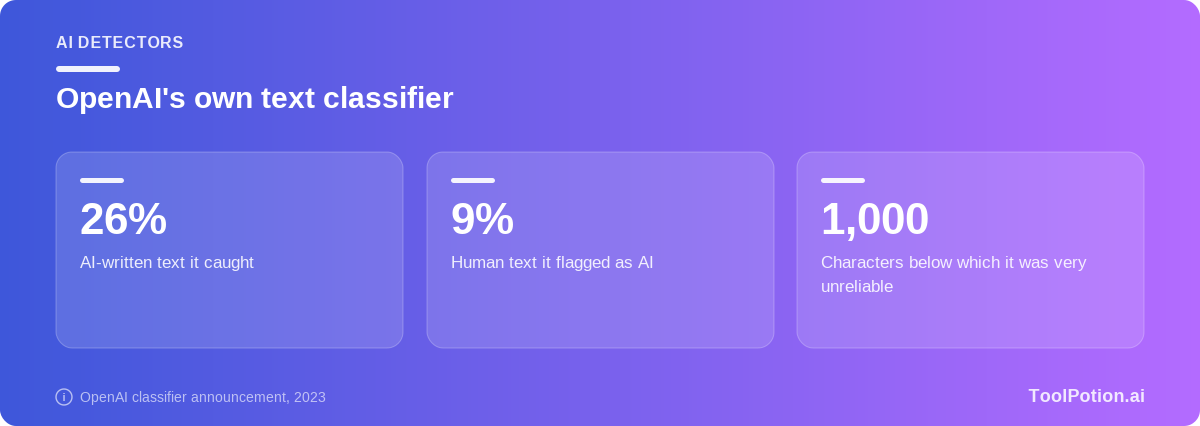
The obvious shortcut is to paste a suspicious review into an AI-text detector. We'd skip it for this job, for reasons that don't depend on which detector you pick. Reviews are short, and short text is where detectors do worst: OpenAI's own classifier, withdrawn in 2023 for low accuracy, caught 26% of AI-written text in its own English-language test set while labeling 9% of human text as AI-written, and it was "very unreliable on short texts (below 1,000 characters)" (OpenAI). A typical product review is a few hundred characters.
There is a second problem that no detector can fix: a positive result doesn't mean the review is fake, and a negative result doesn't mean it's real. A genuine customer who used a chatbot to tidy a draft can trip the detector. A fake-review broker who edits the output by hand can pass it. The FTC rule asks whether the review is false, whether the reviewer exists and used the product, not which software typed it. A detector answers a different question.
If you still want to try one for curiosity, our roundup of AI content detectors covers how the leading ones compare, and the AI content detectors board lists more. Directory entries such as the Copyleaks AI Content Detector, the AI Content Detector and the Leap AI Content Detector all claim to flag machine-written text; none of them is built for the question of whether a stranger bought a toaster. We haven't run them on reviews and won't pretend to.
Review-checking tools in our directory
The category is thin, and we'd keep expectations low. ReviewGPT says it analyzes Amazon products and reviews to help shoppers avoid counterfeit items and fake reviews; it ranks well down our board, and we can't vouch for its accuracy. Amazon Finder & ChatGPT Review Analysis is a Chrome extension pitched at finding profitable niches from reviews, which makes it a seller research tool more than a shopper's lie detector.
There's a mirror image to be aware of. Tools that write review replies, such as Review Reply Generatoor and Reviewly, automate the owner's side of Google reviews. Nothing about that is deceptive on its face, since a business answering its customers is allowed to use help. It does mean that an eloquent owner reply tells you very little about the business either, just as an eloquent review doesn't. Our pick, if you want a free first step before any extension, is the one you already have: another retailer's page and a Trustpilot profile for the seller. Browse more review and shopping tools through ToolRank.
Frequently asked questions
Can you tell if a review was written by ChatGPT?
Not reliably, and not from the text alone. Smooth, generic, balanced praise is a hint, but real people write that way too, and many real buyers now use AI to polish their drafts. The profile, the dates and the product details tell you more.
Is it illegal to post an AI-generated review?
The FTC's rule targets reviews that are fake: written by someone who doesn't exist, or who had no actual experience with the product, or that misrepresent that experience. The press release names AI-generated fake reviews as an example. It doesn't say that using a writing tool on an honest review is covered, and we're not able to give legal advice on edge cases.
Do platforms remove fake reviews?
They say they do, in large numbers. Amazon reports blocking hundreds of millions of suspected fake reviews in 2025 and Trustpilot reports removing 7.8 million. Both are the companies' own figures, and some reviews inevitably get through, which is why they accept reports from users.
Are five-star reviews more likely to be fake?
Not on their own. A page with only five-star and one-star reviews and very few in between looks odd, and fake batches often skew positive. But plenty of well-loved products deserve their fives. Look at how many reviews arrived when, and who wrote them.
What should I do if I spot a fake review?
Report it on the platform where you found it. Trustpilot's Trust Centre and Google's Maps policy pages both describe reporting routes, and we'd start there. In the US you can also report deceptive practices to the FTC at ReportFraud.ftc.gov, which the agency lists on its own pages.