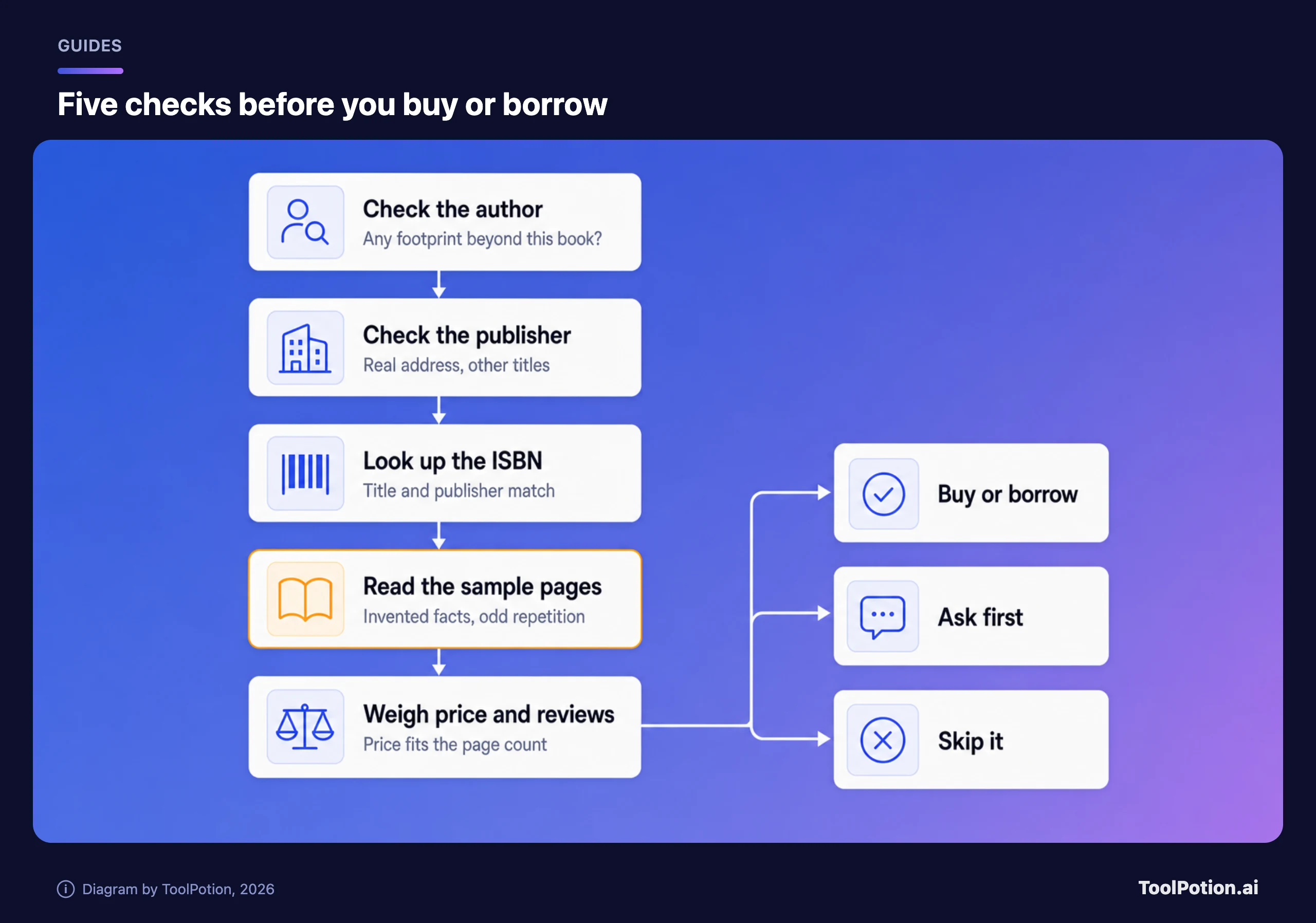
Perumal Murugan didn't need a detector. After visiting a newly opened public library in Coimbatore, the Tamil novelist wrote that he'd found books with unfamiliar authors' names, unusually high prices and questionable ISBNs (BBC News). Anyone can run those checks on a book they're about to buy or borrow, and we'd run them in the order below.
One caveat before we start: the Tamil Nadu case is an allegation. The BBC says it remains unclear whether AI was used to produce any of the disputed books, and the checks here find bad books of any origin. That's the point.
Start with the author
Search the name outside the book's own listing. A working author usually leaves something else behind: earlier titles from other publishers, interviews, a university page, a newsletter. A name that exists only on one product page is a flag, and so is a bio that could describe anyone. The stronger version is asking whether the person says the book is theirs. Economist Jean Drèze told The Hindu he hadn't written a book at a Madurai library that listed him as author, the BBC reports, and he didn't respond to BBC Tamil's request for comment (BBC News). Absence alone proves little (new writers exist, and plenty of good ones keep a low profile), so count it as one flag among several.
Then the publisher and the ISBN
Look the publisher up the same way: a website, a street address, other titles. BBC Tamil visited a Chennai address listed by one publisher named in the controversy and by another, and found no signs identifying either business. A woman there confirmed that one of them operated at the address, and its proprietor declined to comment because the matter was before the courts (BBC News).
Then type the ISBN into a library catalog or a bookseller's database. It should return this title, this author and this publisher. A different book, nothing at all, or a different publisher is a reason to ask questions before you pay.
Read a sample and check three facts
Don't judge prose style, because people write badly and models write smoothly. Check facts. The BBC reports one title described Naladiyar as a Tamil poet and philosopher, when Naladiyar is a classical Tamil work of 400 four-line verses, and another reportedly credited an ancient poem to the wrong author (BBC News). A reader who knows the subject catches that in a minute. If you don't, pick a date, a quotation and a citation from the sample and verify each. The BBC notes that AI tools can "produce false information and invented references," and a book where the references fail to resolve has a problem whoever typed it.
Price and volume come next. The same BBC report gives one 300-page title at 1,445 rupees, which tells you nothing without a baseline, so compare it with similar books from presses you know. On Amazon, open the author page: dozens of recent titles across unrelated subjects deserve a second look. Amazon limits new titles to 2 per format each week "to help promote a positive experience for all authors and readers" (KDP Help), and Self Publishing Advice reports the cut from 10 came in 2026 (Self Publishing Advice). The 2 counts per format, so one account can still add six titles a week across eBook, paperback and hardcover. A long list proves nothing by itself, so check the publication dates, because dozens of unrelated titles in a few months deserve a question. Neither page says how Amazon polices the limit across several accounts, and we won't guess.
Reviews are the weakest check. Read the three-star ones and look for specifics of the text, because generic praise is cheap to produce in bulk. Then tick what you found.
A procurement failure with an AI label on it
The Madras High Court has ordered the state's anti-corruption agency to investigate the purchases and to freeze bank accounts linked to a publisher accused of supplying the books (BBC News). Murugan alleged that nearly 1,800 books in the Tamil section of the Periyar Arivulagam library came from one little-known publisher. The state's school education minister called it potentially "India's first AI scam." The state government blames the previous DMK administration for buying the books; the DMK denies it and calls the allegations politically motivated.
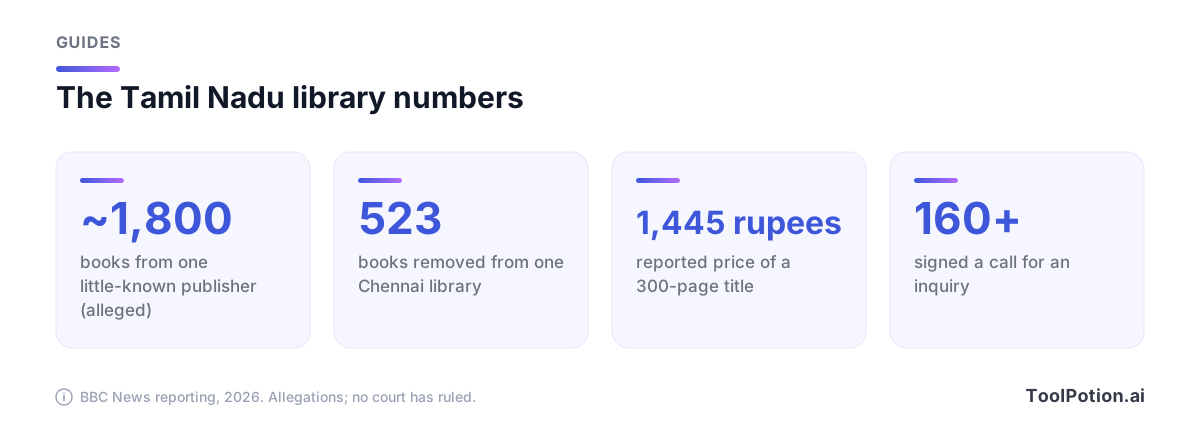
We think the label is the least interesting part. Unfamiliar authors, steep prices and shaky ISBNs are fraud flags from long before language models. What AI changed is the supply: tools can generate entire books quickly and cheaply, as the BBC puts it, so a bad-faith seller can fill a catalog faster than any committee can read it. More than 160 writers, researchers and publishers asked how the books passed expert committees, price negotiations and several levels of review, and they want procurement records released and collections audited. If the allegations hold, that review chain is what failed.
What Amazon asks of authors, and what it doesn't
Amazon's content guidelines say authors must tell it about AI-generated text, images or translations when they publish or republish a book through KDP. AI-generated means a tool created the content "even if you applied substantial edits afterwards." AI-assisted work, such as editing, error-checking or brainstorming, doesn't have to be reported (KDP content guidelines).
That's a rule for publishers, and it has two gaps for buyers. It runs on the author's honesty, and the pages we read don't say the disclosure appears on the product page, so a book with no AI label isn't a book cleared of AI. The same page says Amazon will "promptly investigate any book when notified of potential noncompliance," and there's a report link for it. We'd use it with specifics (the ISBN, the invented citation), and we'd like to see the disclosure shown to readers. We haven't found Amazon saying it will.
Why a detector score isn't evidence
The Caine Prize shows the cost of leaning on one. An article in The Atlantic alleged that the detector Pangram showed this year's winning story was entirely AI generated. After an internal review that included interviews with the author, the judges and the magazine that first published the story, plus an independent metadata analysis of the author's drafts by a digital forensic investigator, the prize said it found no evidence of generative AI. Chair Ellah Wakatama said: "From our detailed investigation, we feel the evidence is clear: The Blue Fighter was human written." Simbarashe Kundizeza had denied the allegation and keeps the £10,000 award. The Atlantic's writer, Vauhini Vara, had told the BBC's Front Row that every other earlier Caine Prize winning story she put through Pangram "came out as 100% human" (BBC News). A clean review doesn't prove the detector was wrong, but it shows what a score alone can't: whether the drafts exist.
The detectors' own record is thin. OpenAI withdrew its text classifier in 2023 for low accuracy; before that on its own challenge set of English texts it correctly identified 26% of AI-written text and wrongly labeled 9% of human writing as AI (OpenAI). A 2023 study found several widely used detectors consistently misclassified non-native English writing as AI-generated (arXiv). That study says nothing about Pangram or the Caine case, so we don't claim it explains either. It's why we'd want a human check on anyone writing in a second language.
A score from GPTZero or Pangram is a reason to look harder, never a verdict, and none of the BBC's Tamil Nadu reporting says a detector was used. Our AI content detectors comparison and the content detector board cover the tools; the full category lists the rest. If you're accusing a named person of anything, we'd want records, drafts and a conversation first.
What libraries and buyers can ask for
Libraries can ask vendors for registration documents, a physical address and a sample batch they can read before the full order ships. The Tamil Nadu signatories asked for an independent inquiry, released procurement records and an audit of collections, and we'd add return rights for any title that fails a spot check. Buyers can ask a seller whether the text is AI-generated (it costs nothing). The Authors Guild runs a Human Authored certification with a public database that anyone can search, covering text written by a human with minimal AI use such as spelling and grammar checks. Non-members pay $10 a title and verify their identity; the page describes identity checks and licensing terms but no test of the manuscript. We'd take a certification as a good sign and its absence as meaningless, since nearly every book lacks one.
Authors who use AI tools legitimately have a stake in this too. Disclosure rules and certifications are how they separate their work from the shelf-fillers, and the tools in our directory range from Type.ai to the AI writing assistants board. We'd like to see those authors say so on the product page, since Amazon doesn't.
Frequently asked questions
Is it against Amazon's rules to publish an AI-generated book?
No. The KDP guidelines require disclosure of AI-generated content and compliance with the content and intellectual property rules, but they don't ban it (KDP content guidelines).
Can an AI detector prove a book was written by AI?
No. Detectors give probabilities, they've mislabeled human writing, and a prize investigation found no evidence of AI in a story The Atlantic said a detector had flagged.
Does a factual error mean the book is AI-generated?
No. Humans get facts wrong too, which is why the BBC says it's unclear whether AI wrote the disputed Tamil books. Errors, invented references and a missing author footprint together justify a complaint. One alone doesn't.
What should I do if I find a suspicious book at my library?
Tell a librarian, with the ISBN and the specific claims that fail. A concrete list gets acted on faster than a detector screenshot.