A project manager in the 2025 workslop survey got a deliverable from her supervisor that was, in her words, "poor quality work." It created "a huge time waste and inconvenience," she wrote, and since it came from the boss she "felt uncomfortable confronting her about its poor quality and requesting she redo it." So she did the work herself, at the expense of her other projects (BetterUp Labs).
That is the whole problem in one anecdote: whoever made the draft, she paid for it, with her own projects and with the question of whether it was safe to say anything. This guide covers what researchers found, how to raise it without accusing anyone, and the team habits that stop it coming back.
What the survey counted
The term comes from researchers at BetterUp Labs and the Stanford Social Media Lab, who defined workslop as "AI-generated work content that masquerades as good work, but lacks the substance to meaningfully advance a given task" (Fortune). Their write-up ran in Harvard Business Review in 2025, with a companion piece on why people produce it. The survey covered 1,150 full-time U.S. desk workers.
Roughly 40% said they had received workslop from a colleague in the previous month. Respondents estimated that about 15% of the content they get at work fits the description. Each incident took about an hour and 56 minutes to deal with (BetterUp's own page rounds it to 2 hours), which the researchers priced at $186 per worker per month, or about $9 million a year for a 10,000-person company (CNBC).
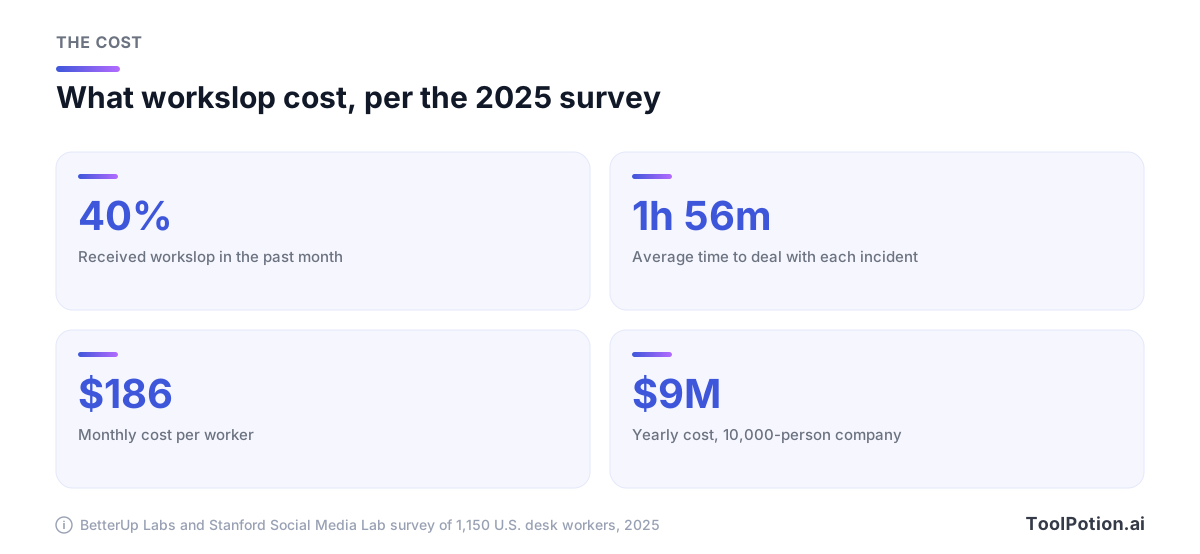
Two cautions before anyone quotes those numbers in a budget meeting. They come from one survey of self-reported experience, and the dollar figure is built from the salaries respondents reported (Entrepreneur). We think the direction is solid and the decimals are soft. Nobody has yet published a before-and-after study of a team that fixed the problem, and we'd like to see one.
The social cost is the number we'd show a skeptical manager first. Per CNBC's account, about half of recipients said they saw the sender as less creative, capable or reliable afterward, and about one in three told a teammate or boss. Kate Niederhoffer of BetterUp Labs described her own reaction to receiving it: "Can they not complete the job themselves? I don't trust them. I don't want to work with them again."
Recognizing it without guessing
Jeff Hancock, who founded the Stanford Social Media Lab, told CNBC that AI has removed the effort that used to limit how much filler a person could produce: "I can generate a lot of useless or unproductive content very easily." The sign he named is "purple prose": three paragraphs where one bullet point would do. CNBC's examples of the form are bad code, decks with incomplete information and strangely worded emails.
Notice what is on that list. None of it requires proving that a model wrote the thing. A report with invented figures is a problem whether a person or a chatbot invented them, and that is the version you can point to in a meeting. We'd skip AI-detector scores as evidence in a workplace conversation: a percentage guesses at who wrote the text, while a missing source, a wrong number or an absent decision can be checked by anyone (see the AI content detector board and our roundup for what they claim to measure).
Raising it with a colleague, step by step
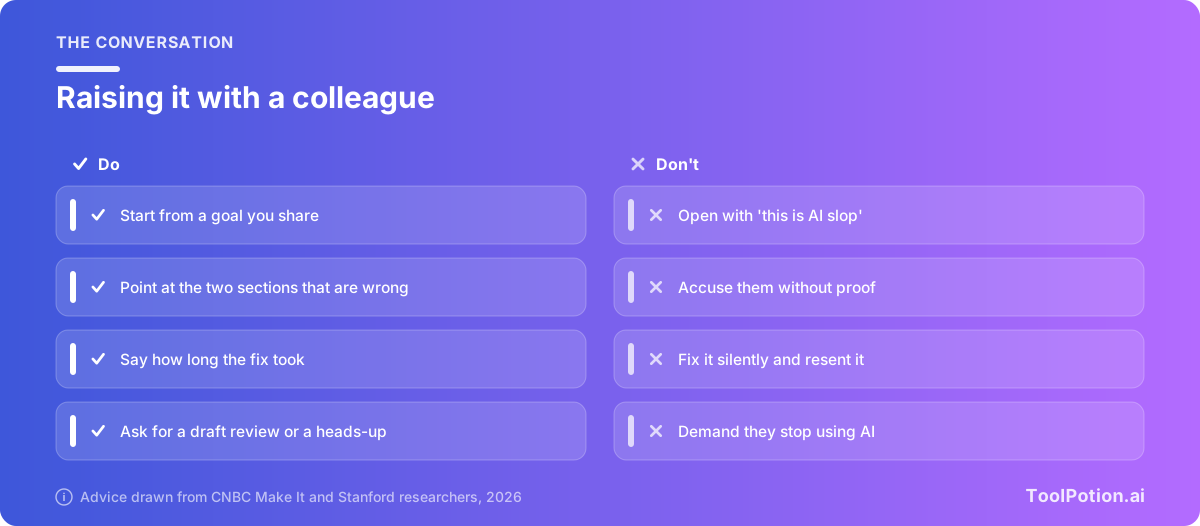
CNBC Make It ran a playbook on exactly this by Melody Wilding, an executive coach and author of Managing Up. Her advice, which we'd follow nearly as written, boils down to four moves (CNBC).
- Open with a shared goal. Wilding's sample lines: "We both want the executive team to be happy with this," or "Since both of our names are on this, I hope you'll agree it needs to hold up to scrutiny from the client."
- Name the specific problems and skip the blanket verdict. Two sections where the data doesn't match what you discussed. Formatting that changes halfway through. A figure with no source.
- Say what it cost. Wilding's sample: "I've spent time redoing this, which meant pushing back a project for my boss." A cost you can name is hard to argue with.
- Ask for one change next time: a quick review of AI drafts before they reach you, or a heads-up when AI was used. Wilding's line is "One thing that would help is knowing when AI was used."
Wilding warns against a blanket "this whole thing looks AI-generated," especially when you can't prove it: it puts the other person on the defensive and takes the focus off what needs to change. When you do bring up AI, she suggests a hedge and an admission that you use it too: "I could be wrong, but some of this reads like AI was involved. I use it too, so that's not the issue." We'd still lead with the defects and mention AI second, if at all.
When the sender is your manager
Upward is harder, and the survey shows why: the project manager above stayed quiet because the draft came from her supervisor. Wilding's advice is to acknowledge your own use of AI first, which tells the boss you aren't opposed to the tools and keeps the discussion on quality and time. Then put a number on the cost and tie it to something they care about, such as the project you had to delay.
The ask carries the conversation here, more than the complaint does. Don't request that your manager stop using AI. Request a small process change they can agree to without losing face: they skim the draft once before forwarding it, or they add a line saying which parts the model wrote. We doubt a manager will refuse a review step when the alternative is hearing the same complaint from three people.
The work didn't disappear, it moved
Our house position is that AI should remove work, not move it onto someone else. Workslop is the clearest case of the second thing. The sender's task shrinks to a prompt and a paste, and the recipient inherits the verifying, the rewriting and the awkward meeting to ask what was meant.
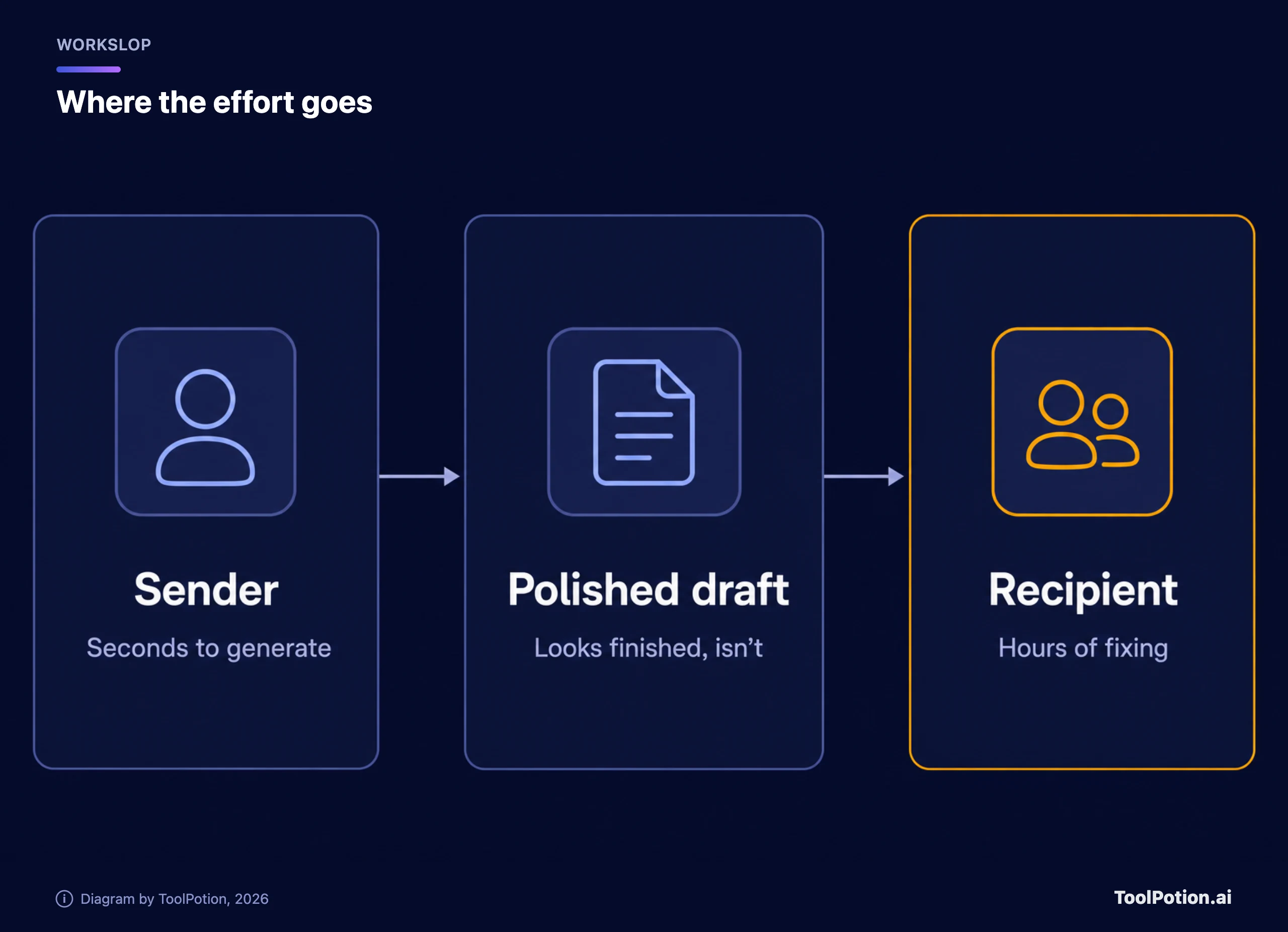
The newer numbers point the same way. Workday's own research, a global survey of 3,200 full-time employees who were all active AI users, found that 85% said AI saved them one to seven hours a week, yet nearly 40% of the time saved was lost to rework: correcting errors, rewriting content and verifying output (Workday, published in 2026; also CNBC). Only 14% consistently got clear, positive net outcomes. That is a company-wide version of what the receiver of one bad draft feels. If a team's "time saved" figure is counted only on the sending side, it is overstated by whatever the receiving side pays.
This also settles the tool question. ChatGPT, Claude, Microsoft 365 Copilot and Gemini can all produce polished emptiness on request, and all of them can produce a good first draft that a careful person then fixes. Grammarly sits on the other side of the line: it works on text you already wrote. We wouldn't blame the product for workslop. The habit is what changes the outcome. If you want to compare drafting tools, the ToolRank board for AI writing assistants and our writing assistants roundup are the places to start.
Team norms that hold up
Hancock's advice, per Fortune, is for teams to hold high standards and to critique each other openly: those that focus on task quality "critique each other, they accept critiques" and see less workslop. The researchers suggest the same expectations that apply between two colleagues should apply to work done by a human and AI (Fortune). Three norms follow from that and from the CNBC pieces.
Say when AI was used
Hancock told CNBC that disclosing AI use lets colleagues understand your prompts and goals and fill in the gaps. In practice it is one line: "First pass drafted with Claude, numbers checked against the finance export." It costs ten seconds, it tells the reader how hard to look, and it removes the guessing game that makes the awkward conversation awkward. Write it into the template for status updates and reports so nobody has to volunteer it.
Review before you send
The sender owns the first read. That means every line, every number, every quote and every link, checked by the person whose name is on it. Our guide to fact-checking AI output lays out a verification workflow that scales, and the short version for a team is to check anything that a reader could act on.
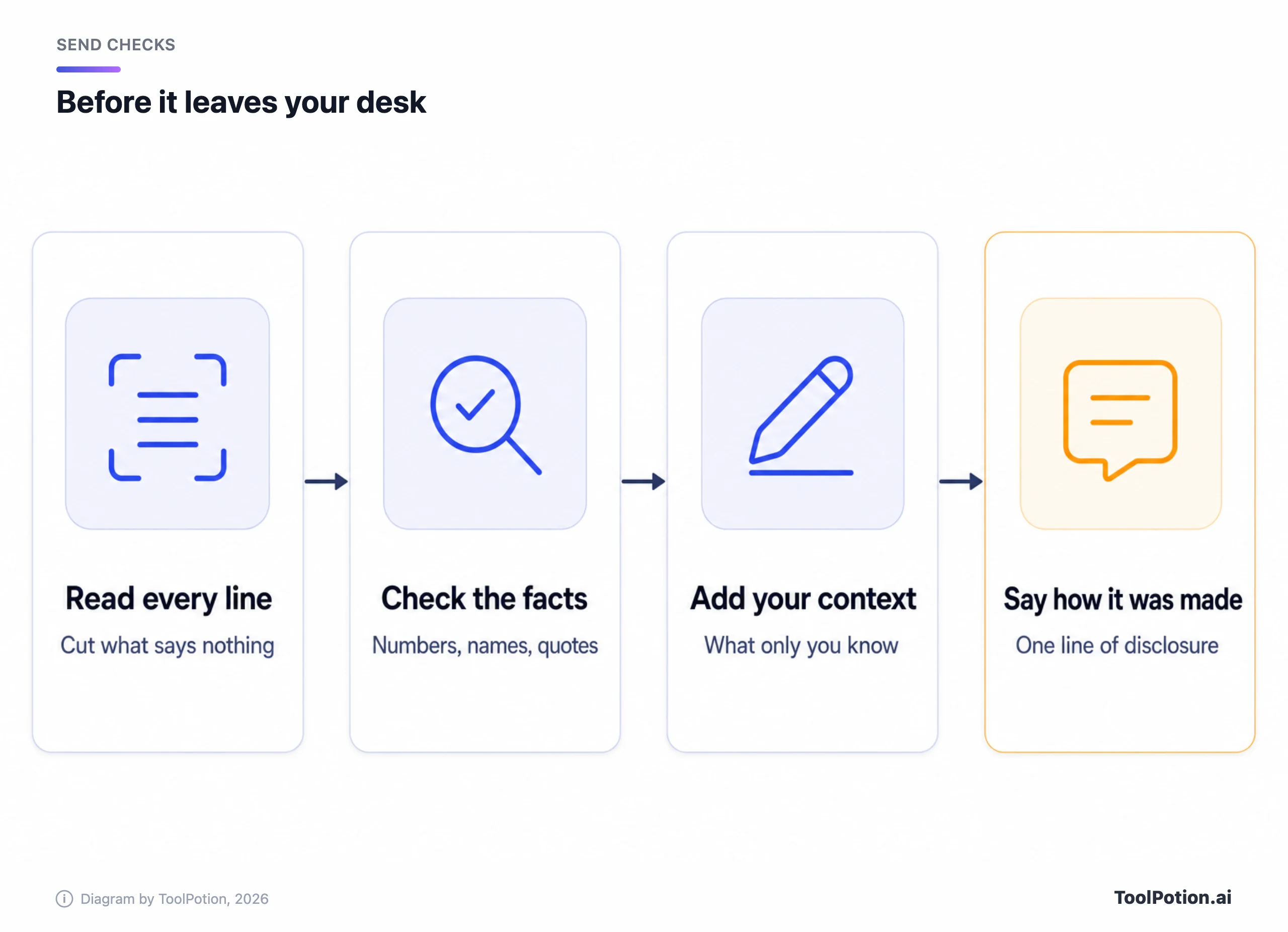
Write a definition of done
Most workslop gets through because nobody ever said what finished means. A definition of done can be four lines: who the audience is, what decision the document supports, where each figure came from, and who besides the author has read it. A draft that can't answer those isn't finished, whoever or whatever wrote it. If your team already has an AI policy, add these lines to it; our AI usage policy template has a version people tend to follow.
Our pick for a first step is disclosure, because it needs no tooling and no approval. The definition of done comes second, since it takes a meeting to agree. Then use the checklist below to see which habits your team already has.
Where it goes wrong
The conversation can backfire in a few predictable ways. Some people simply didn't know their draft was thin; they saw a confident-sounding document and forwarded it. Others get defensive, usually when the feedback sounds like a verdict on their competence, and the shared-goal opening exists for them. And a few will keep sending slop whatever you say, in which case the documented time cost is what you take to a manager.
There's a quieter failure too: becoming the team's permanent fixer. If you quietly repair every draft, the sender never learns, and you absorb the two hours each time. One honest conversation costs less than a year of cleanup. It also gives the sender the one thing they can't get from the model, which is a colleague's reaction to the finished page, and most people would rather learn that from you in private than from a client in public.
What nobody has settled is whether norms like these reduce the volume. The researchers recommend guardrails and a "pilot" mindset, and Hancock's own finding is about teams with high standards, but we haven't seen measured results from a team that adopted a disclosure rule. If you try one, track the hours you spend on rework before and after. That number will persuade your manager better than any survey.
Frequently asked questions
What is AI workslop?
It is AI-generated work that looks polished but lacks the substance to move a task forward, so the colleague receiving it has to do the thinking and cleanup. The term was coined in 2025 research by BetterUp Labs and the Stanford Social Media Lab and published in Harvard Business Review.
How much does workslop cost?
In the BetterUp and Stanford survey of 1,150 U.S. desk workers, each incident took about 1 hour 56 minutes to deal with, and the researchers estimated $186 per worker per month. They projected about $9 million a year for a 10,000-person company. Those figures are self-reported estimates from one survey.
How do I tell a colleague their work needs fixing without accusing them of using AI?
Point at the specific problems (a missing source, mismatched data, formatting that changes partway) and tie them to a goal you share. Leave out any guess about how the work was made. Wilding's advice is to ask for a change in process, such as a review before sending or a note saying when AI was used.
Should I run their work through an AI detector?
We wouldn't. A detector score is a guess about authorship that the sender can dispute, and it moves the conversation away from the actual defect. A wrong figure or a missing source is easier to settle.
Is it okay to use ChatGPT, Claude, Copilot or Gemini at work?
Yes, and a lot of people already do: Gallup found the share of U.S. employees using AI in their role a few times a year or more nearly doubled from 21% to 40% between 2023 and 2025 (Gallup). The standard is the same as for any other draft: you read it, you checked it, and you'd put your name on it. Tell colleagues when a document started with a model.