One student told the researchers about classmates who admit, peer-to-peer, "I wrote this whole essay with ChatGPT." The student's next sentence is the one that stuck with us: "Then they don't get caught, they get a good grade probably, and then because it worked the first time, they do it on their next assessment" (OfS and Advance HE report).
That quote sits in a report the Office for Students (OfS), the regulator for higher education in England, published with the charity Advance HE. Its title is a gentle one, Making AI work for students. Its findings on assessment are not gentle. Coursework that students do unsupervised, at home, with a ChatGPT tab open, can often be finished to a high standard with little engagement from the student, sometimes in minutes, and the marker frequently can't tell.
We read the report itself, not just the coverage, because the Guardian's headline and the regulator's own wording differ, and the report is the more careful of the two. The most useful part is the least dramatic: what a handful of universities are already doing about it.
What the regulator found, and what it didn't
The research ran earlier this year and rests on conversations with more than 300 students and staff. The Guardian counts 127 universities and colleges among them (The Guardian); the OfS summary page says "over 120 institutions" (OfS), and the report's methodology section says at least 127 (report). It is interview and survey evidence, primarily from English institutions. Nobody has measured how many assessments are completed by AI, and the OfS says it will do further research "to establish the scale and nature of change" (OfS press release). Until then, any percentage for England in 2026 is a guess.
What the participants did describe is consistent. Unsupervised assessments "can be completed to a high standard using AI tools with limited engagement from students", and programs assessed through remotely submitted essays were called particularly vulnerable (report). Students told the researchers about peers who finished work "sometimes in just a few minutes" and got a similar grade to those who did it themselves. Some peers couldn't recall basic details of what they'd just submitted. Staff described receiving high volumes of submissions that look the same, reference the same literature and are written in the same style.
One student survey respondent put the cost in personal terms. "It is incredibly disconcerting when I plan, and write an essay completely by myself, and get the exact same grade as someone who used AI to write it." The honest students are the ones being short-changed, and we'd put that cost first.
A detail on the headline. "Close to impossible" is a staff respondent's phrase, and the full sentence is narrower than the Guardian's headline: pervasive AI use "may render our assessment of students close to impossible in some areas." The regulator's own summary says AI poses "significant risks to the validity and effectiveness of assessments." We think the second phrasing is the accurate one, and it is still alarming enough.
The report makes a fairness point too. Participants worried that a student paying for the most advanced model may get a higher grade than an equally knowledgeable classmate on a cheaper model or none (report).
A regulator that has levers, and says it will pull them
Josh Fleming, the OfS director of strategy and delivery, called AI use in higher education "a generational risk to the system as it stands, threatening to undermine students' learning and institutions' ability to assess them". He added: "We need to see far greater efforts to tackle these risks, including far greater use of AI-free assessment" (OfS press release).
The press release is where the force is: the OfS says it will require institutions to ensure assessments are valid and reliable measures of knowledge and skills, and that "in many cases, this will require the use of secure (AI-free) assessments." Where institutions fall short, its levers include specific conditions of registration, monetary penalties, or suspending access to student support funding and OfS grant funding. It published guidance on how institutions can comply alongside the report.
The Department for Education told the Guardian it expects the OfS "to both enforce the existing standards effectively, and work at pace" on AI. Universities UK, which represents 147 institutions, answered that "there is further to go but many have made substantial changes" (The Guardian). Participants had also warned that new AI-specific registration conditions could be counterproductive, and asked for clarity on the existing ones instead (OfS). The OfS answered with the second: guidance on how the existing conditions apply to AI.
Three fixes, and the one the regulator prefers
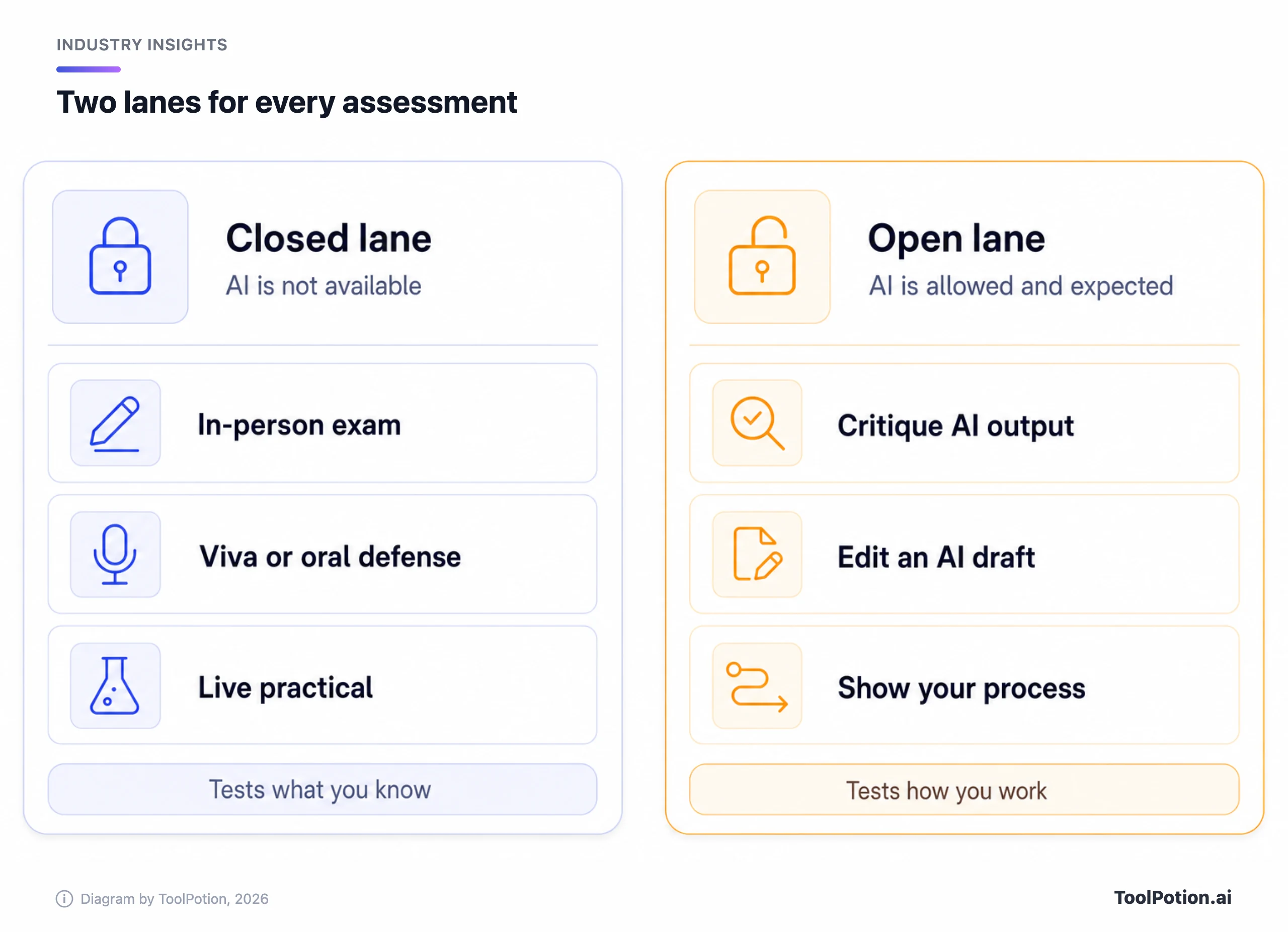
The report sorts what universities are doing into three groups. Secure assessments are designed so students can't use AI while doing them: in-person written exams, presentations, vivas (short oral discussions of a submitted piece of work), practicals and performances. Process-based assessments grade how the work was produced as well as the result, sometimes at several checkpoints the report calls stage gates. Open assessments allow or require AI, for example asking students to critique AI output, or to edit an AI-written first draft (report).
The regulator leans one way. Secure methods "will often be the most effective forms of assessment because they provide a high degree of confidence that students are demonstrating their own knowledge and skills." On the other side, it says that if an assessment can be completed with AI without the knowledge being tested, "the assessment should be replaced." And assessing knowledge, as opposed to skills, "will usually require assessments to be secure."
We agree with that, and we'd go further than the polite phrasing. A take-home essay that tests recall of a reading list is finished as a measuring instrument. Only a supervised room, a conversation or a rebuilt task replaces it.
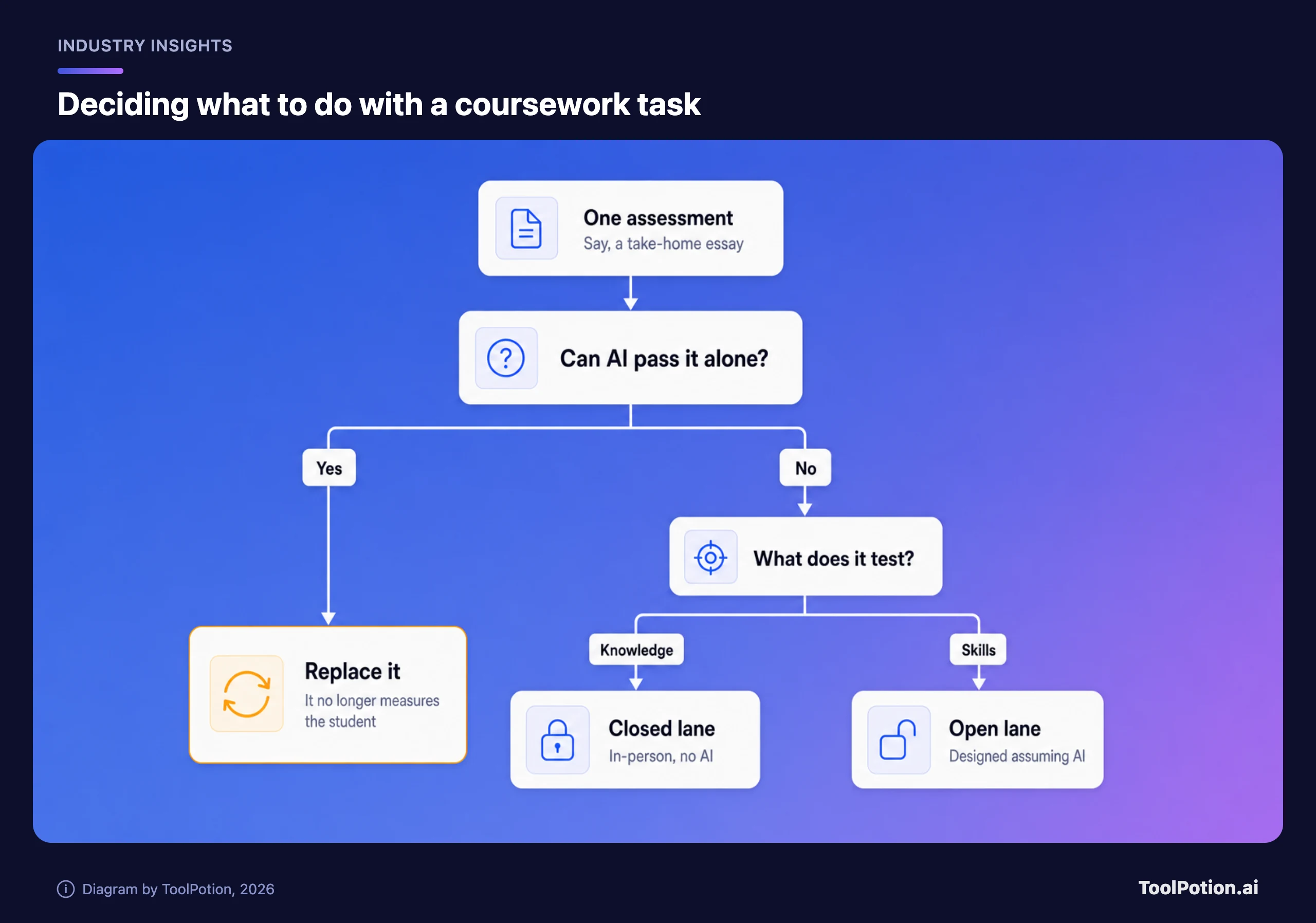
The report lists the trade-offs. In-person exams and vivas are resource-intensive. Closed-book exams may resemble professional work very little, and their reliance on long-term memory may disadvantage some groups, disabled students among them. Professional bodies sometimes prescribe particular formats. And wearable technology may make cheating in secure assessments easier. The regulator's answer to the authenticity worry is that efforts to build assessments that are both authentic and robust "are welcome", which is not a plan.
Bath gave up on the traffic light
The report's case studies are the best part. The University of Bath had a three-category scheme: AI prohibited, some specified uses allowed, or AI integral to the assessment. The middle category broke. Staff found it "was not possible to police specified uses of AI in Category B assessments in a way that was reliable and equitable."
In 2026 Bath moved to a two-lane model first developed at the University of Sydney. Every assessment goes in either a closed lane, where conditions ensure students can't access AI tools, or an open lane, where AI is allowed and the task is designed on the assumption that students will use it. Bath's staff held a retreat to work out robust open-lane tasks, and the university stresses that even closed-lane assessments must be designed around the intended learning outcomes (report).
We like this for one reason. It stops pretending that 'use AI to brainstorm but not to draft' can be checked. The report says the same: without structural changes, it isn't possible to verify whether students followed an AI policy or to meaningfully deter misuse.
Universities that lock down exams are also handing out AI. Kent introduced an institutionally licensed ChatGPT Edu platform in 2026. Students complete training on AI literacy, responsible use, data protection, prompting and academic integrity before they get in, and use is optional. Imperial gives students and staff a workspace called dAIsy that reaches ChatGPT, Claude and DeepSeek through one data-secure interface, and is launching 40-hour courses on AI at work. The report adds that Oxford and the London School of Economics have agreements with AI providers as well (report).
That isn't hypocrisy: a university that wants graduates to use these tools well, and to know what each can do without them, needs a room for each. We'd pick that pairing over either extreme. If you're still choosing an assistant, ChatGPT vs Claude vs Gemini lays out how the three differ.
Why a detector can't be the referee
The obvious alternative to redesigning everything is to catch AI text after the fact. The report is blunt that this doesn't work well enough. Academic research suggests humans can't reliably identify AI text, newer detectors may do better than older ones, but improvements "are often temporary and typically followed by advances in AI systems", and tools that rephrase text to fool detectors (humanisers) cut accuracy further (report).
Many institutions use the tools anyway. Some put the score into misconduct cases as supporting evidence; other staff use it informally to pick out work that then gets flagged or marked down. Turnitin, whose AI detector is widely used in UK higher education, told the researchers its output should be used as only one data point. Some institutions had stopped using detectors altogether.
Student participants were harsher. They said detectors are inaccurate and overstate AI use, and some were frustrated that once a detector gave them a high score there appeared to be no route to proving their innocence. Students described lowering their scores by removing characteristics of AI text such as em dashes, using humanisers, or deliberately adding spelling and grammar mistakes. (We ban the em dash in our own house style, so we've felt a small chill.) A tool that pushes honest writers to make their work worse is not measuring honesty.
The report's position on the score is the one we'd hold: at most one piece of evidence in a thorough assessment of whether a student committed misconduct, and "suspicion of AI use without strong evidence should not be used as a basis to award students a lower mark." The report adds that misconduct processes are "time- and resource-intensive, stressful for students, and unlikely to be effective in securing the validity of an assessment process."
Human markers miss it too. In a 2024 study, University of Reading researchers slipped fully AI-written (GPT-4) answers into five modules of one psychology degree without telling the markers; 94% went undetected and they scored on average about half a grade boundary higher than real students (PLOS One). For the tool-by-tool picture, we cover GPTZero, Grammarly's detector and the Copyleaks extension in our top AI content detectors post, and the AI content detector board ranks the field. Our view of detectors matches the regulator's: use them as a smoke alarm, never as a judge.
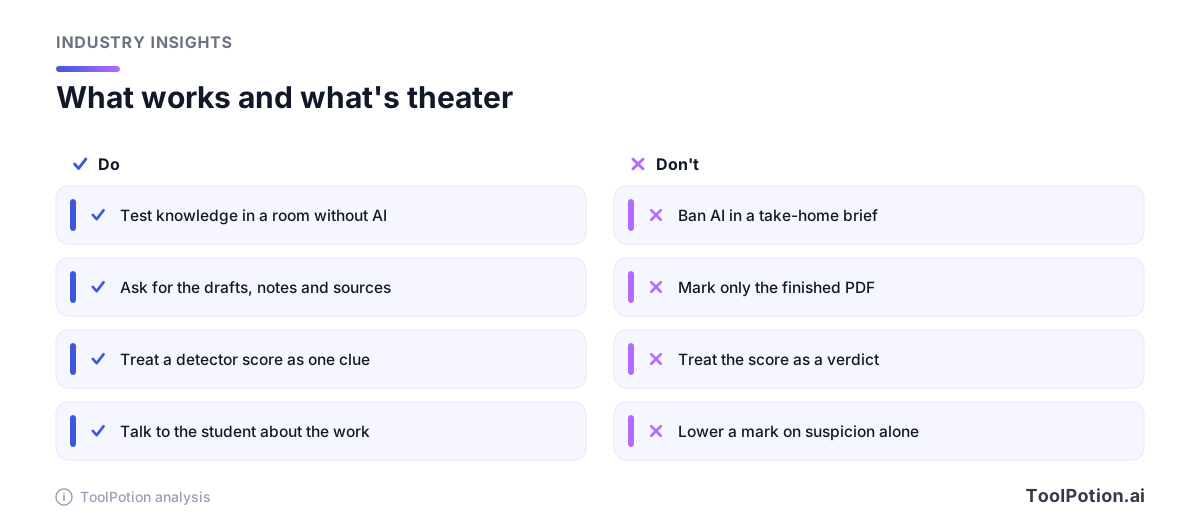
So here's our split. What works: assessments held in a room without AI for knowledge, drafts and sources collected for projects, and a short conversation with the student about their own work. What's theater: banning AI in a take-home brief and hoping, marking only the final file, and treating a detector percentage as a finding.
What students and parents should expect
None of this is a judgment on students. The report itself says AI is widely used by students to explain difficult concepts, summarize long documents, generate practice questions and revise, and that it may help neurodivergent or disabled students and those whose first language isn't English. It also says many students now see AI as the most effective route to a high grade, and may feel at a disadvantage if they don't use it. That is a rational reading of assessments that couldn't tell the difference.
The OfS press release says many students find their institution's or department's policies hard to understand. The regulator's own report concedes that the boundary between acceptable and unacceptable use is hard to draw, because AI "can generate ideas and reasoning in ways that blur" student and machine work (report). So the safest assumptions for a first-year or a parent are these.
- Expect more of the final mark to depend on something done in a room: a written exam, a presentation, a practical, or a short oral discussion of work you handed in.
- Expect to be asked for the working. Notes, dated drafts and sources are what process-based assessment looks at, and some institutions already ask students to declare how they used AI (the report says many students fear a declaration will cast suspicion on their work).
- Expect the rule to differ by module. One assessment may be closed, the next open, and the brief for each is what counts, not the university homepage.
- If a piece of work is questioned, ask what evidence exists beyond a detector score, and ask to explain the work in person. The regulator says a score alone shouldn't decide the outcome.
- If you rely on reasonable adjustments, check that the new format has them. The report says every student should be able to show their knowledge and skills in secure and open assessments alike, through inclusive design and adjustments.
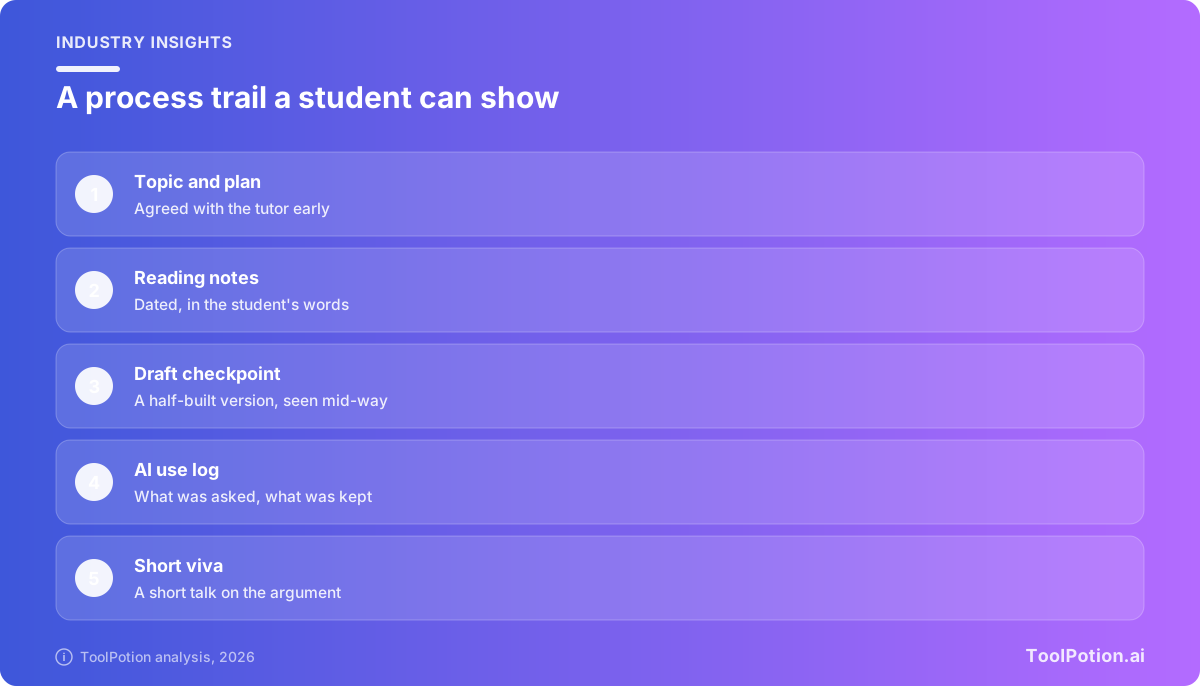
Parents get one extra question to ask: how the course is assessed in the final years, and how much of it happens in supervised settings. The answer says more than any AI policy statement does.
Using AI inside the rules
Start with the rule for the specific assessment, in writing. If it's unclear, ask the tutor and keep the reply. We can't tell you what your module allows. Where AI is allowed, the uses the report describes students making are explaining difficult material, quizzing themselves, planning revision and checking understanding. NotebookLM and the others in our NotebookLM vs ChatGPT Projects vs Claude Projects comparison are built for study of your own sources.
The test we'd use is the viva test. Could you explain every argument in the piece, out loud, with no screen? If yes, AI probably helped you learn. If no, it did the work, and the report's worry about 'cognitive offloading', where AI replaces reading, research or problem-solving, applies to you whatever the rule says. Grammar and spelling help from a tool such as Grammarly feels like a different matter, but the report notes that punctuation and grammar tools can contain powerful AI features too, so check the rule before assuming.
The checklist above isn't an official instrument. It's six habits that make a conversation with a marker easy.
What to watch next
The OfS has given institutions the guidance on how its existing conditions apply to AI, so the next evidence is enforcement: whether any university gets a specific condition of registration, and for what. Advance HE plans an AI-focused Change Academy program for member institutions in early 2027 (OfS press release).
We'd also watch the cheating figures. The Guardian's 2025 investigation found almost 7,000 proven AI cheating cases in 2023-24, or 5.1 per 1,000 students, while more than 27% of responding universities didn't yet record AI misuse as a separate category (The Guardian). If proven cases fall as exams return, that will mean the redesign worked, or that detection got harder. Nobody can tell those two apart from the numbers alone. That is our case for assessments that don't depend on catching anyone.