A civil engineer with senior-level experience can apply for a contract on Mercor that pays $80 an hour. The job isn't to build anything. It is to invent a fictional infrastructure project, write the answer a top engineer would give, and then author a rubric that tells an AI model's grader what a good answer looks like. The listing says the rubrics must "distinguish authentic civil engineering judgment from generic textbook or coursework-level recall" (Mercor listing).
That is the business Mercor now says is worth $20 billion. The company announced a $750 million Series D at that valuation (Mercor), and Reuters headlined the same figure for its latest funding round. Earlier reporting was less settled: Bloomberg, as relayed by The Next Web, described early talks at $20 billion with at least one term sheet, double the $10 billion round of late 2025, and cautioned that a deal might not close. The valuation is now Mercor's own announcement; the revenue figures below are still reports and company claims, and we'd treat them as unaudited.
Mercor doesn't build a chatbot. It finds people who know things, pays them by the hour, and sells what they produce to the labs that make the chatbots. If you've used ChatGPT or Claude for a legal or medical question and the answer sounded like it came from someone who'd been in the room, part of the reason is people doing exactly this work.
Who does the work, and what a task looks like
Mercor's own site is blunt about the labor pool. Its homepage lists an average contracted rate of $90 an hour and, when we checked, a Cardiologist role at $350 an hour (Mercor). The explore page, as posted when we checked, lists a Retail Trader at $400 per task, an Economics Research Expert at $150 to $160 an hour and a Backend Software Engineer at $50 to $80 (Mercor listings); a Biology and Life Sciences Domain Expert at $90 to $140 appears on the related listings. Listings change, so treat every rate here as a snapshot.
The economics role shows the template. It asks for a PhD and at least two years at an institution such as the World Bank, the IMF, the Fed or a graduate school, and says the work is "a research project with a leading foundational model AI lab" (Mercor listing). The commitment is at least 10 hours a week for at least four weeks. You're an independent contractor, paid weekly through Stripe or Wise, and the page adds that "projects can be extended, shortened, or concluded early depending on needs and performance."
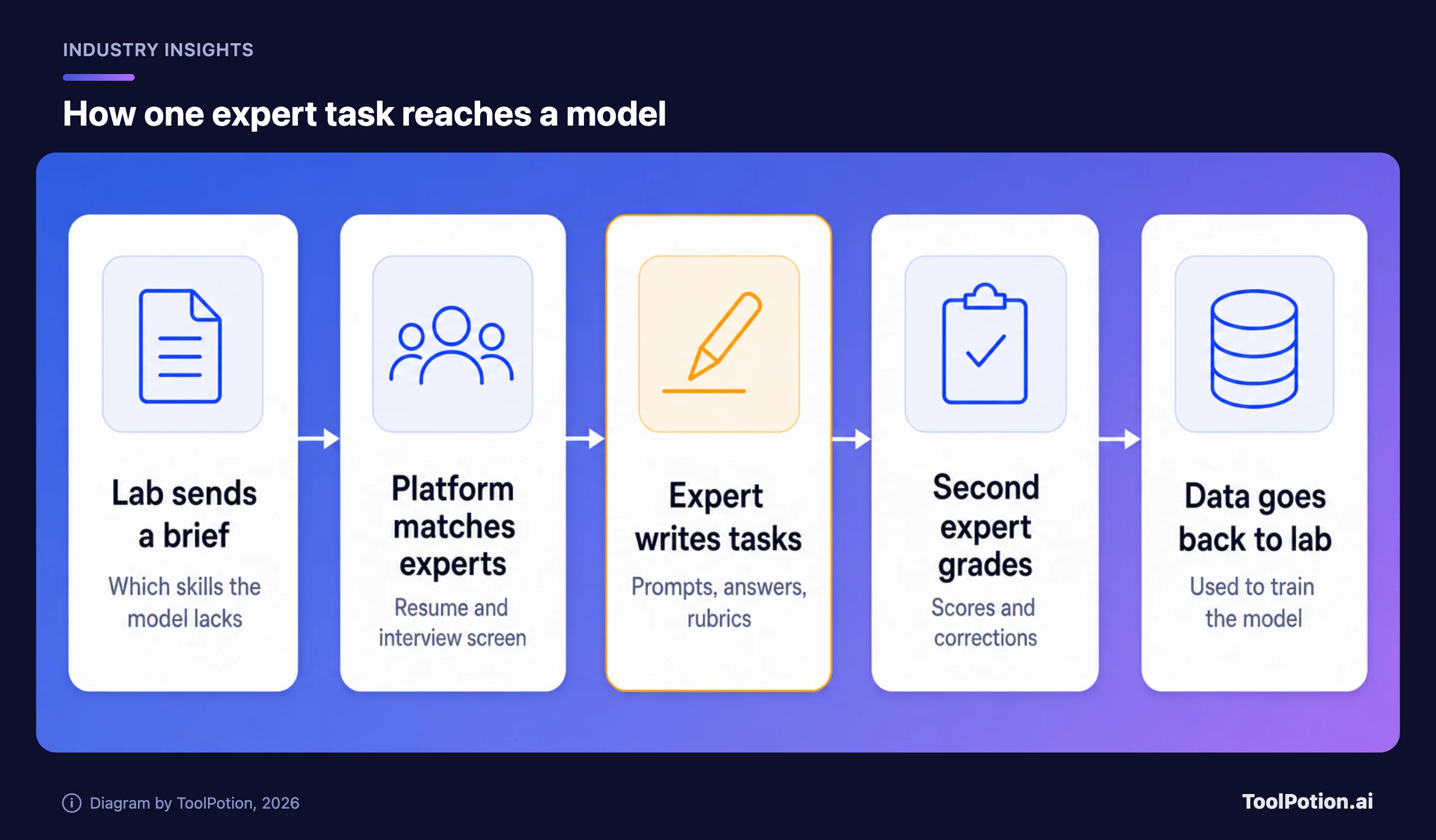
Strip away the branding and a task is mostly writing. You draft a hard prompt in your field, write the reference answer, build the checklist a grader will use, or score a model's attempt against it. A second expert then reviews your work. Mercor also publishes benchmarks it builds with partners, including one with Harvey of 1,749 attorney-built legal tasks across 24 practice areas, graded on finished memos and redlines (Mercor). Those are the same skills the hourly listings buy, pointed at a public scoreboard.
Getting in is a process. A recent report from Bianet says Mercor publicly claims a 1% to 2% acceptance rate and screens applicants with an AI-avatar video assessment. We couldn't verify the acceptance figure independently, and Mercor's listings don't say how many apply.
Engineering roles show how far the model has moved from labeling. Mercor's list has a Senior Software Engineer at $50 to $80 an hour for backend work in Node.js, TypeScript and Rust, an MLOps engineer at $90 to $120, and simulation roles for network, electrical and mechanical engineers at $70 to $90 (Mercor listings). Those buyers are teaching models to do tasks that coding agents like Claude Code and Gemini CLI now attempt for developers every day, and our terminal coding agents comparison shows where those tools stand. An engineer grading a model's code is training the tool that may change that engineer's own job, and nothing in the listings says so.
Who pays, and how much of it reaches the expert
The customers, as The Next Web reports them, are OpenAI, Anthropic and Google, with Meta a major client until a breach earlier this year. That breach, a supply-chain attack on the open-source library LiteLLM, exposed up to four terabytes of Mercor data, per the same report. Meta paused its work with Mercor indefinitely afterward; OpenAI and Anthropic stayed, according to CEO Brendan Foody. Mercor calls the impact "very limited."
The revenue number needs a footnote. Foody says the annualized run rate has passed $2 billion. That is gross billings, and according to The Information, as cited by The Next Web, contractors keep 60 to 70 percent of it. The Next Web estimates net revenue at $600 million to $800 million, which puts a $20 billion valuation at roughly 25 to 33 times net. Whether that's a fair price isn't ours to say. It is the number worth holding next to the $2 billion headline.
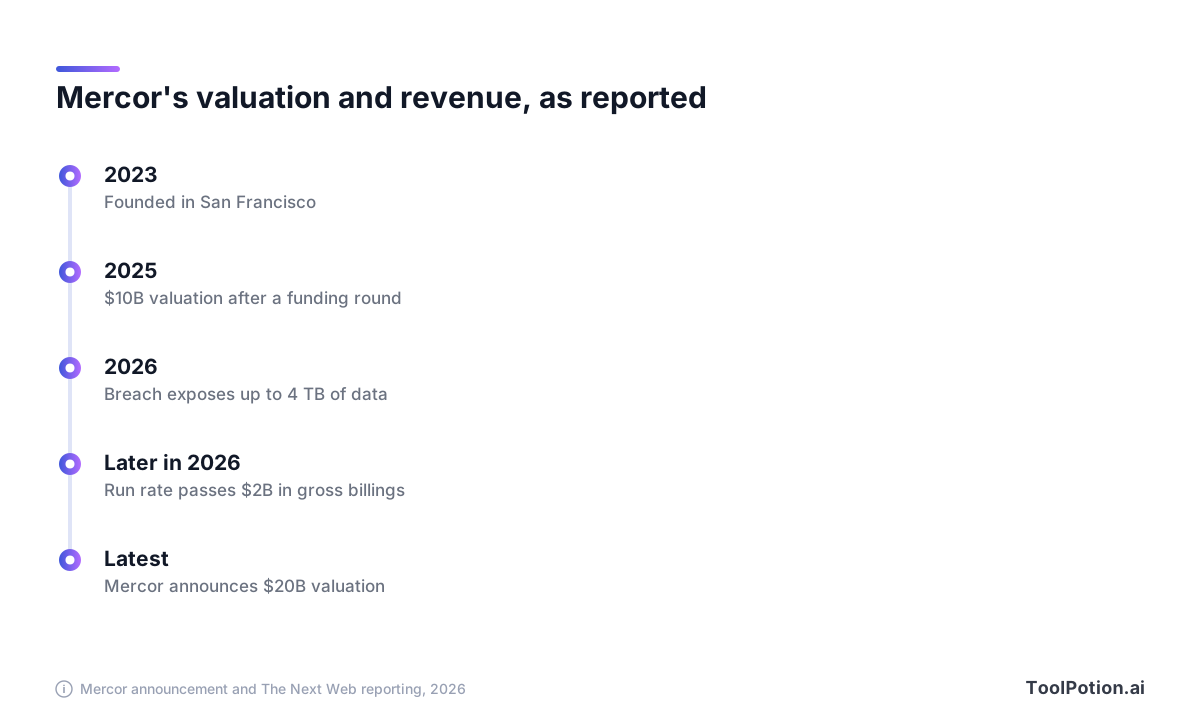
The competition is just as richly valued. The Next Web puts Scale AI at about $29 billion since Meta took a stake, and Surge AI as reportedly raising near $25 billion. The posted pay, meanwhile, spreads wide.
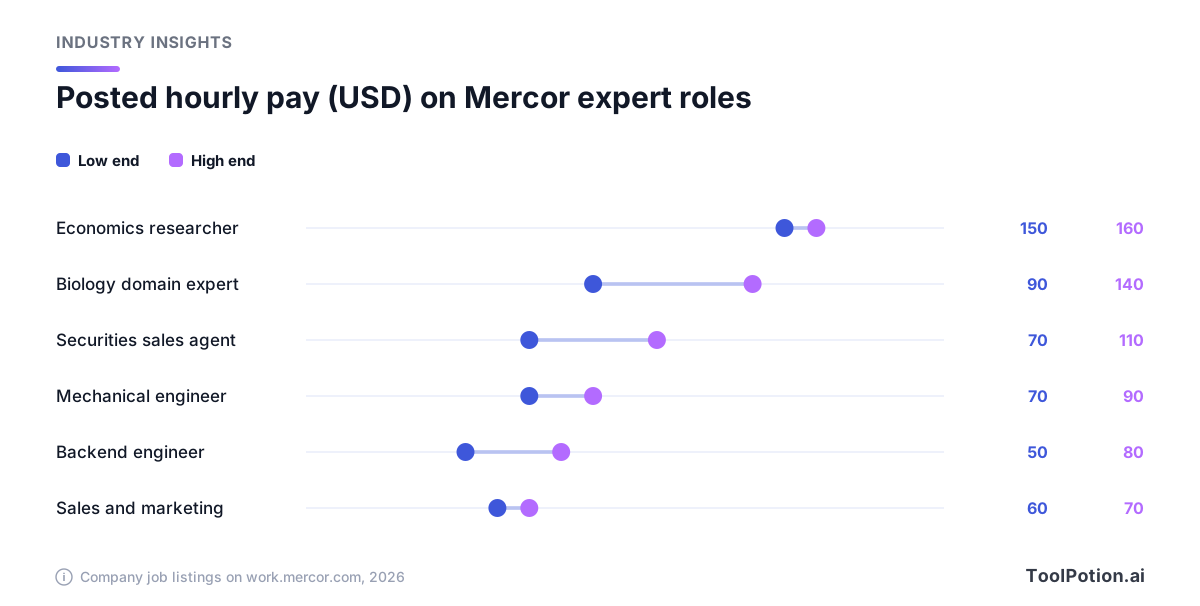
We read that spread as honest advertising. A PhD economist and a backend engineer are both "experts," and the platform pays them differently because the labs apparently do. Bianet says rates on these platforms can reach $150 an hour and beyond. In Mercor's listings that figure is real but sits at the top, and the one economics listing at that level showed 24 hires in a month when we looked.
Why labs want a physician and not a thousand clickers
Earlier data labeling was crowd work. Scale AI (which runs the Outlier and Remotasks brands, per Bianet) and Surge AI (DataAnnotation) built their names on large pools of contributors. Our read is that those tasks leaned simple: tag an image, rank two replies, fix a sentence. They had clear right answers and could be checked cheaply. You didn't need a license to draw a box around a pedestrian.
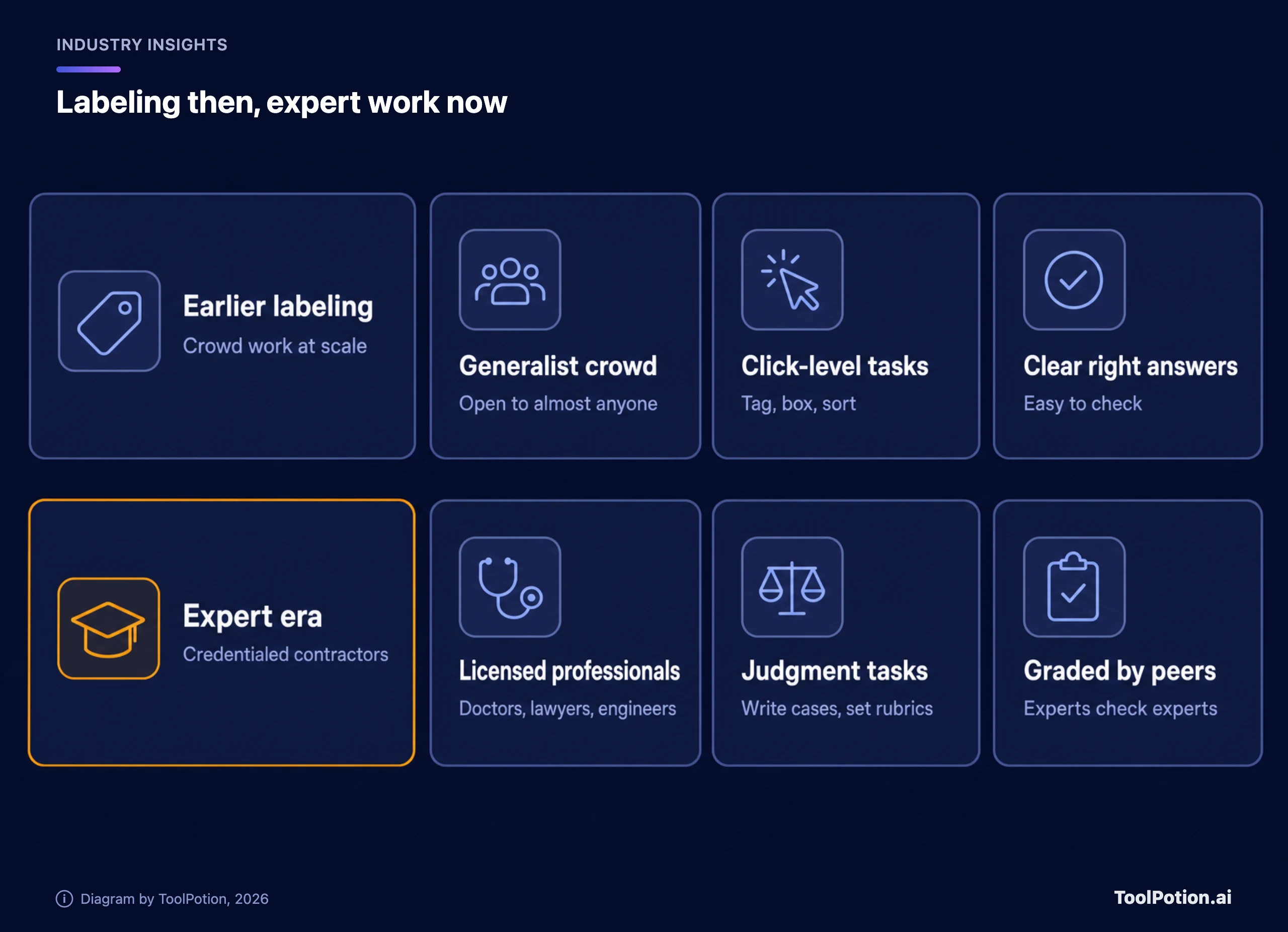
Frontier models now fail in places where nobody can check them cheaply. Is this contract clause enforceable? Does this dosage note miss an interaction? A generalist can't grade that, so the labs buy the grader. We think that's the reason the work moved up the pay scale, and it's also why the old crowd model hasn't disappeared: it's cheaper, and plenty of tasks still fit it. Scale AI is still in our directory as a data platform, and its crowd brands haven't gone away.
But the expert model carries one cost the crowd model didn't. An expert's judgment is the product, so a bad rubric or a tired grader leaks straight into a model's habits. Labs can't see that from the outside. We can't either, and none of the reporting we read measured it.
The fight over what these contracts are
Everyone on this work is a contractor, and that is the center of the dispute. Bloomberg Law reported that suits against Mercor, Handshake AI Solutions and Assured Robot Intelligence (acquired by Meta) accuse the companies of "deliberately misclassifying data annotators, engineers, and others" to avoid minimum wage, overtime and benefits (Bloomberg Law). The excerpt we could read didn't include the companies' responses. Allegations are allegations, and we found no ruling in the Mercor or Handshake cases.
The same fight has hit its older rivals. A California state-court class action, McKinney v. Scale AI, was preliminarily approved for settlement; the court-run settlement site says the defendants "strongly deny violating any laws" and deny that contributors aren't independent contractors, and the law firm King & Siegel puts the fund at $12.5 million for California contributors. Surge AI, which runs DataAnnotation, was sued in a proposed class action in California state court in 2025 that alleges it misclassified its annotators on purpose, per Bloomberg Law. Bianet also describes both cases. A settlement isn't a finding that the work was employment, and the Surge claims are allegations.
Then there's the pay-cut story. Forbes and Business Insider reported, in a piece AOL republished from People, that contractors on a project reviewing video for Instagram and Facebook were paid $21 an hour, learned the project was canceled, and were offered a new project at $16. Mercor told Forbes the claims were "inaccurate," and a spokesperson told People "our role descriptions and onboarding materials clearly state that the work is temporary and project-based." One contractor told Forbes: "I know we are working with AI but we don't work for AI." Another, who took the lower rate, told Business Insider: "We needed to have the guaranteed income, even if it's demoralizing."
Pay structure compounds it. Hourly contractors get paid for time they log, and the listings don't promise a number of hours. In the economics listing, ten hours a week is what you commit to; the page doesn't say Mercor guarantees you any. A person who budgets around the posted rate times forty hours is budgeting around a number nobody offered.
Mercor's listings do say projects can end early, and its spokesperson points to that. But nobody can plan a month on a contract that says so. We'd side with the workers on one thing: a listing that advertises $150 an hour next to "concluded early" is selling the rate and burying the term.
Burnout and quality, said by people who left
The reporting on burnout is thin and mostly anecdotal. Bianet quotes a communications freelancer, Victoria, who left after about two months and said "the whole experience felt very Orwellian." Her task hours fell, she said, from twenty a week to three total over her last two weeks while the workforce grew. A former Yandex consultant, Deniz, said his 30-person team got an email that their two-year project was over, and called the model "designed to bypass every protection offered by regular salary jobs." Bianet says both asked to stay anonymous, so those first names are as it gives them.
The article also cites Utrecht University's Ghost Work project and American Psychological Association research on unpredictable work and electronic monitoring. Those studies concern crowd work and monitored employees broadly, not Mercor, so read them as context. Nobody we found has measured burnout among credentialed AI trainers specifically.
On data quality, Mercor's CEO told Fortune that his personal angel stake in Deeptune was in a lot of ways "the main motivation, actually" for buying that startup, according to The Next Web, and the outlet notes that public reporting hasn't established whether the board reviewed it. Deeptune builds simulated environments where AI agents practice tasks. That isn't a data-quality failure, but it's a governance detail we'd want an answer to before trusting the company's own benchmarks as neutral.
If you're thinking about applying
Treat it as a side contract, not a career. We'd take a project if the hourly rate beats your normal rate after you count the unpaid interview, the onboarding and the days between projects. We'd skip it if you need it to cover rent. The listings we opened ask for as little as four weeks, and the platform's own terms say work can stop early.
Before you apply, read the contract for four things: how notice works, whether hours are capped, who owns what you write, and what the project is for. If the project trains a model to do your own job, that's your call to make, and a good reason to ask who benefits. Then run the checklist below.
Our own view on pay is simple. A listing that shows a range and a weekly payout date is better than one that says "competitive." Mercor's do both, which is to its credit. The gap is in guaranteed hours, and no listing we read offered any.
What it changes for the models we use
Expect the gap between assistants on professional questions to depend more on who graded the training data than on raw model size. That's our read, not a measured result: none of the labs name their graders, and a vendor's benchmark (including the ones Mercor publishes with partners) is a claim until someone else repeats it. When you compare assistants for legal or medical drafting, our ChatGPT, Claude and Gemini comparison is a better place to start than any leaderboard run by a data vendor.
If you freelance, there's a second effect. This work pays experts to teach models skills that clients may soon buy from the model instead. Our freelancer board ranks the AI tools freelancers use today, and the freelancer hub lists the rest.
Watch for two things. One is whether these suits and settlements answer the contractor question for expert-tier work, because that sets the price of every future project. The other is how a $20 billion valuation sits against net revenue that The Next Web estimates at 30 to 40 percent of the headline run rate.