Nobody wins all of it. Claude is the better pick for writing and code, Gemini for research, Google apps and anything with images or video, and ChatGPT for the widest spread of features plus voice. If you only buy one and can't decide, start where your work already lives: Google tools point to Gemini, long documents and repositories point to Claude, and a mixed week points to ChatGPT.
The money won't settle it. The three companies landed on almost the same price ladder: about $20 a month for the standard plan and $100 for the heavy-use tier. ChatGPT Plus is $20, Claude Pro is $20, and Google AI Pro is $19.99 (OpenAI, Anthropic, Google). So the question is what each $20 buys, and that changed a lot this year.
Every app has a new flagship family. OpenAI moved ChatGPT to GPT-6, Anthropic shipped Claude Fable 5.1 and the 5.5 models, and Google shipped Gemini 3.8 Flash while holding its newest model, Gemini 4 Argon, back from most people. Prices, plan names and limits shifted along with them. This guide covers all of it, takes positions on each job, and ends with a picker and a seat-cost calculator you can run on your own numbers.
Which one wins each job
Start with the scorecard. These are editorial scores, not benchmark results: a judgment built from what each plan includes, what the vendors publish and how the models place in public voting. A 4 is the best of the three. A 0 means the plan lists no such feature.
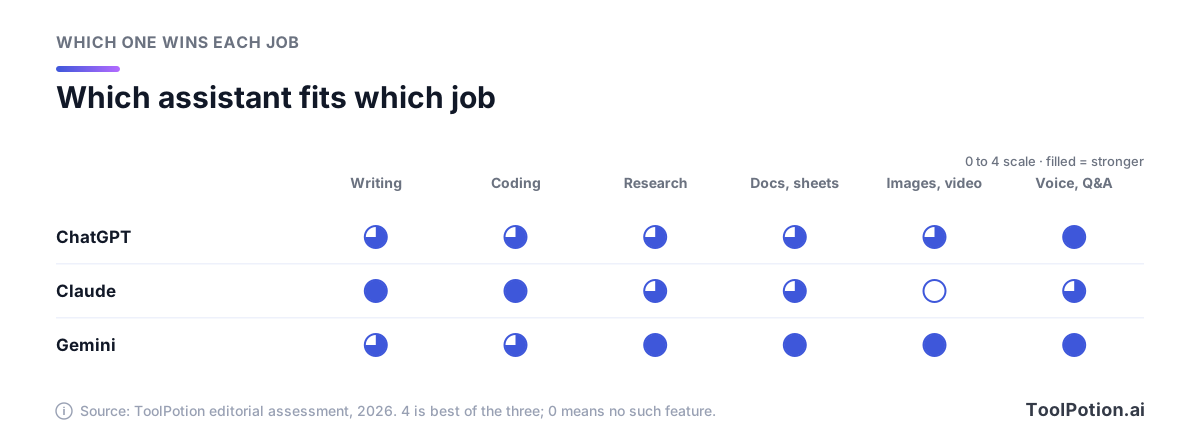
Claude gets the top mark for writing and coding. Gemini takes research, documents and spreadsheets, and images and video. ChatGPT sits near the top everywhere and wins nothing outright except voice, where it ties with Gemini. That pattern is the real finding: ChatGPT is the safest generalist, and the other two are sharper in their lanes.
Writing
Claude is the one to use if the output is prose someone else will read. The public evidence is indirect but consistent. On the Text Arena leaderboard, where people vote on blind head-to-head answers, Claude models take six of the top twelve places, with Claude Opus 5.5 second at 1507 (Arena). Arena measures general preference, not essay quality, so treat it as a nudge. ChatGPT and Gemini are both capable drafters; our scorecard gives them one point less on prose.
Coding
This is the closest race. OpenAI's GPT-6 Astra reportedly scored 74.1% on the DeepSWE v1.1 bug-fixing benchmark against 73.7% for Claude Opus 5, per a launch report (DataNorth). Google says Gemini 4 Argon reaches 77.9% on the same test, but only a small group of security testers can use it so far (Google). Those are vendor numbers on a single benchmark. What decides it for most people is the tool around the model: Claude Code comes with Claude Pro, Codex in ChatGPT comes with Plus, and Google's Gemini CLI is open source. Pick the one whose agent you'll actually keep open, and see our AI agents board for the wider field.
Research and long documents
Gemini. Deep Research is on its free tier, the Pro plan lists a 1M-token context window and uploads of up to 1,500 pages (Google), and Gemini Notebook sits next to it. Claude has a Research feature on Pro and its context reaches 1M tokens on the models that support it, but Gemini bundles more research tooling at $20. ChatGPT has deep research too, and a smaller reasoning window on Plus, which matters if you feed it a whole contract bundle.
Documents, spreadsheets and email
It depends on which suite you live in. Gemini is built into Gmail and Docs on Google's plans, and Google lists the Gemini assistant in Docs and Meet on Workspace Business Standard at $14 per user per month (Google Workspace). ChatGPT lists extensions for Excel, Word, PowerPoint and Google Sheets on Plus (OpenAI). Claude works inside Microsoft 365 and Outlook on Pro and above. If your company runs on Microsoft, Claude and ChatGPT both fit. If it runs on Google, Gemini has the home-field advantage.
Images, video, voice and everyday questions
This is where Claude is thinnest. Its plan page lists no image or video generator, while ChatGPT has image creation on every paid tier and Gemini adds video generation and Flow credits for its creative studio. All three do voice: ChatGPT offers voice with video on Go and above, Claude has voice mode on every plan, and Google has Gemini Live, which Google says now runs on its Gemini 3.8 Live voice models. For everyday questions, any of them is fine, and the free tiers cover most of it. Perplexity is still the better answer engine when you want sources first.
What each app runs on now
The model names are a mess, so here is the short version of what you'll see in the picker.
ChatGPT now runs on the GPT-6 family. OpenAI's release notes say Plus, Pro, Business and Enterprise use GPT-6 Sol in chat, while Free and Go use the smaller GPT-6 Luna, and the Pro reasoning option uses GPT-6 Astra (OpenAI release notes). A newer GPT-6.1 Sol has landed in ChatGPT Work and Codex first. OpenAI says it improves agentic coding and computer use over GPT-6 Sol.
Claude has four current models. Anthropic launched Fable 5.1 as its most advanced model for coding and knowledge work, then Opus 5.5, Sonnet 5.5 and Haiku 5.5 in the weeks after, and its pricing page lists context of up to 1M tokens depending on the model. Anthropic says Opus 5.5 performs at Fable 5.1's level on most work at 40% lower cost (Anthropic release notes). In the app, Free gets Sonnet and Haiku, Pro adds Opus, and Fable is the catch, which we cover in the pricing section. Our directory also tracks Claude Fable 5 and Claude Sonnet 5.
Gemini is the most fragmented. Google's subscription page says the free app gives access to 3.6 Flash with varying access to 3.1 Pro, and paid plans get more of both. Search Engine Journal reports that Google rolled Gemini 3.8 Flash out to Pro and Ultra subscribers in AI Mode, the latest in a quick run of Flash releases. Gemini 4 Argon leads the Text Arena at 1525 but is limited to trusted cyber defenders for now, with Google saying it will reach paid API and Ultra subscribers later.
One more fact worth knowing: no OpenAI model appears in the Text Arena top twelve at the time of writing. Arena only measures chat preference, so it says nothing about agents or tools, and rankings move weekly. Check our LLM board for the current picture.
What the plans cost
Here is the whole ladder in one table. All prices are US dollars from the vendors' own pages.
| Tier | ChatGPT | Claude | Gemini |
|---|---|---|---|
| Free | $0. Unlimited text chats on GPT-6 Luna, limited uploads, images and voice | $0. Sonnet and Haiku, web search, memory, 5 projects | $0. 3.6 Flash, some 3.1 Pro, Deep Research, images, Live |
| Entry | Go, $8. More messages and uploads, may show ads | None | Google AI Plus, $4.99. 2x free usage, 400 GB |
| Standard | Plus, $20. GPT-6 Sol, Codex, Projects | Pro, $20 ($17 annual). Opus, Claude Code, Research | Google AI Pro, $19.99. 4x free usage, 1M context, 5 TB |
| Heavy use | Pro, from $100 (also $200 and $500) | Max, from $100 (5x or 20x Pro) | Ultra, $99.99 (5x) or $199.99 (20x) |
| Team seat | Business, $20 annual or $25 monthly; premium $100 or $125 | Team, $20 annual or $25 monthly; premium $100 or $125 | Gemini Enterprise Business, from $21; Workspace Standard, $14 |
| Enterprise | Custom pricing | $20 per seat plus usage at API rates | Standard and Plus editions, from $30 |
Two things in that table deserve a closer look. First, the middle of the market is a tie. At $20, Claude Pro and ChatGPT Plus both cost the same, and Google AI Pro is a cent cheaper while including 5 TB of storage (Google). Claude drops to $17 a month if you pay annually. ChatGPT lists monthly billing for Go and Plus (OpenAI).
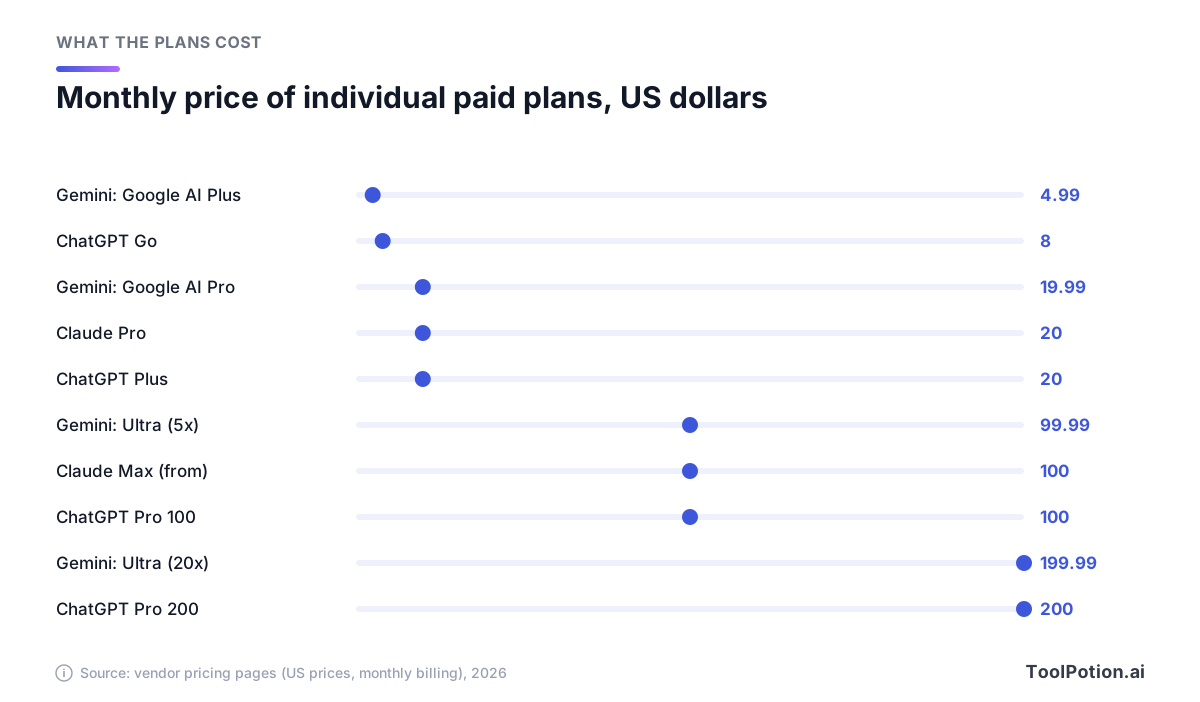
Second, the ceiling is where they differ. ChatGPT now has three Pro tiers at $100, $200 and $500, with the $500 plan adding a faster Astra service tier in Work and Codex (OpenAI release notes). OpenAI also paused new sign-ups to the $200 plan for a short spell and has since reopened it. Google's Ultra comes in 5x and 20x versions at $99.99 and $199.99. Claude Max starts at $100 and lets you choose 5x or 20x more usage than Pro.
The Claude catch is Fable. On Pro it isn't covered by your plan's usage at all: Anthropic's pricing page lists "usage credits" for Fable on Pro, while Max and premium Team seats get Fable for up to 50% of weekly limits. If you want the very top Claude model every day, the real price is Max. For most people Opus 5.5 is the model to use anyway.
ChatGPT's cheap tier comes with a trade-off too. Go costs $8 and OpenAI says it may include ads, while Plus, Pro, Business and Enterprise stay ad-free (OpenAI). Google's $4.99 AI Plus gives twice the free tier's usage and 400 GB of storage, which makes it the cheapest paid entry point of the three.
For teams, the price of a seat is nearly identical again. ChatGPT Business and Claude Team both list standard seats at $20 per user per month billed annually or $25 monthly, and premium seats at $100 or $125 (OpenAI, Anthropic). Gemini Enterprise Business starts at $21 per seat for up to 300 seats (Google). Try the numbers for your headcount.
The difference at small scale is a few dollars, so don't pick a team plan on price. Pick it on where the files and email already live, and on what the admin console gives you.
Agents and computer use
All three vendors now sell an assistant that does things instead of just answering, and the designs differ.
ChatGPT has the most agent surface. ChatGPT Work handles longer tasks on desktop, web and mobile on Plus and Pro. Codex Cloud runs coding tasks in the cloud even when your laptop sleeps. The newest piece is the dot: an always-on agent powered by GPT-6 Astra with its own cloud computer, rolling out to eligible Pro and Business Premium users. OpenAI says Pro access excludes the European Economic Area, Switzerland and the UK at launch, and that dot usage won't count against allowances for the first month (OpenAI release notes). Press coverage of Astra describes it operating software through screens: filling in online forms, updating CRM records and editing spreadsheets.
Claude took a different route. Claude Cowork, its multi-step task agent, has been merged into the main app, so you ask a quick question or hand over a larger job without switching modes. Anthropic enabled a computer-use preview for Pro and Max earlier this year, and scheduled tasks arrived for Cowork before that (Anthropic release notes). Claude for Chrome covers browser work. It is a capable agent, if less flashy than a 24/7 background worker.
Google's answer is Gemini Spark. Google describes it as an agent that runs "24/7, even if your phone and laptop are turned off", connected to Gmail, Calendar, Drive, Docs, Sheets and Maps, and built to check with you before major actions (Google). Access is for Pro and Ultra subscribers over 18 in select countries. If most of your life is in Google Workspace, this is the most natural agent of the three. Google's announcement of Connected Apps says you can @-mention services such as Airtable, Linear, monday.com and Adobe inside a chat, which adds reach beyond Google.
Our advice on agents: don't pay for one until you have a repeated task to hand it. These features are new, regional rollouts are uneven, and every one of them asks for broad access to your accounts. Start with a single narrow job, such as a weekly inbox summary, and judge it after a month.
Memory, projects, files and context
Memory is on everywhere, but it behaves differently. Claude's memory is listed on every plan, including Free, and Anthropic's release notes describe it as individual, categorized entries you can edit (Anthropic). ChatGPT lists limited memory on Free and expanded memory on Plus and Pro. Gemini keeps saved preferences and past-chat references, and has a Temporary Chat for sessions that shouldn't be remembered.
Projects are the place to park long-running work. ChatGPT offers Projects on every plan, including shared projects. Claude gives Free up to five projects and unlimited on Pro, but sharing a project with colleagues is a Team feature. Gemini is mid-change: Google's release notes say Gems will migrate to a new "skills" system, so reusable instructions built today are going to move.
Context is where the plans split cleanly.
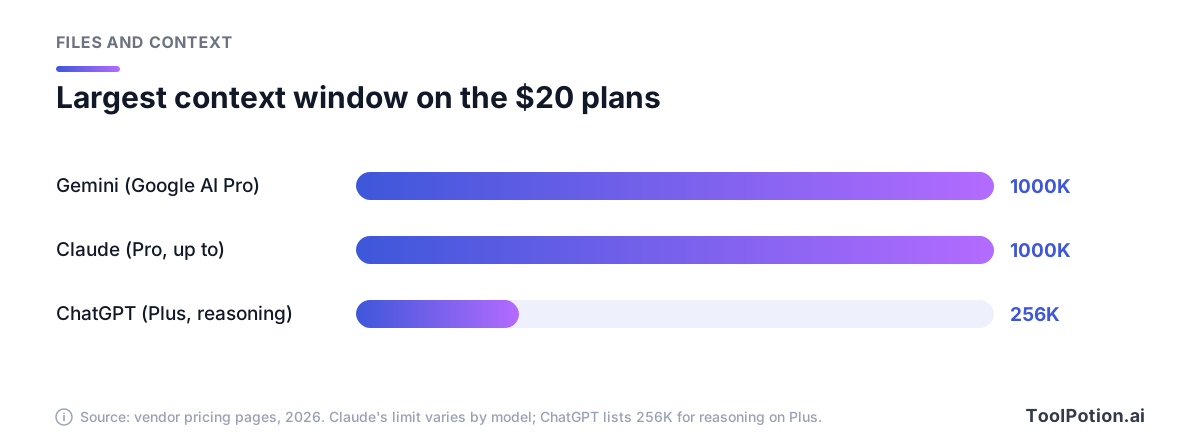
ChatGPT's own pricing page lists a 54K total window for its fast model on Plus and 256K for reasoning, rising to 128K and 400K on Pro (OpenAI). Claude lists "up to 1M" depending on the model, and Google's Pro plan lists a 1M-token window. In plain terms, ChatGPT Plus handles about 320 pages of text in a reasoning chat, and the other two can hold a small library. For a long report, a repository or a stack of contracts, that gap is real. For a typical email thread it makes no difference.
Where each one plugs in
Integrations are the quiet reason people stay put. ChatGPT Business lists connections to Google Workspace, Slack, GitHub and Microsoft 365, and Plus includes apps that connect to internal tools plus a plugin directory (OpenAI). Claude connects to Microsoft 365, Outlook and Chrome on Pro, adds @Claude and enterprise search on Team, and supports connectors and desktop extensions on every plan (Anthropic). Gemini is deepest in Google's own products and has been widening outward through Connected Apps, per Google.
A practical rule: count how many hours a week you spend inside Gmail, Docs and Sheets versus Word, Excel and Teams. Whichever suite wins decides the tie. Microsoft's own Copilot is the other serious option for Microsoft shops, and we compare it in our chatbot roundup.
Privacy defaults
This is the section where the three differ most, and where the defaults matter more than the policies.
ChatGPT's individual plans list an opt-out for training: your content may be used to improve models unless you switch it off (OpenAI). Business and Enterprise don't train on your data by default.
Claude's consumer privacy page says Anthropic uses your chats and coding sessions to improve its models if you choose to allow it in Privacy Settings, or if a conversation is flagged for safety review. Incognito chats are never used (Anthropic privacy). Anthropic's pricing page labels every consumer plan "Opt-out", and its help page says turning the model-training setting off stops new chats from being used. Read together, treat training as on until you switch it off, and check Privacy Settings on day one. Team and Enterprise are "none by default".
Gemini is the most data-hungry default. Google says Gemini Apps activity is used to provide, develop and improve its services, including training generative AI models, and that a subset of chats is reviewed by human reviewers with the account link removed. The default auto-delete is 18 months. Turn off Keep Activity and future chats stop being used for training, and Temporary Chats are not used and are kept for 72 hours (Google). Google says Gemini Enterprise customer data isn't used to train Google models (Google).
Our position: for anything confidential, use a business plan from any of the three, or at minimum change the defaults on day one. On individual plans none of them keeps your chats out of training without you doing something.
Where each one is weak
Every assistant has a gap you should know about before paying.
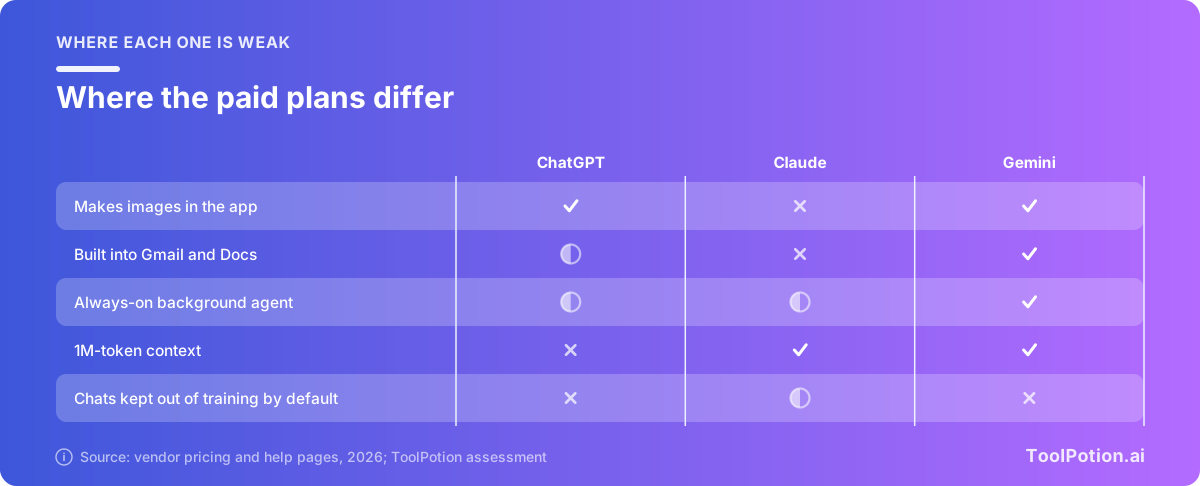
ChatGPT's weak point is complexity. There are Free, Go, Plus, three Pro tiers and Business, a model picker that lists GPT-6 Astra, Sol and Luna next to a 5.6 series, a smaller reasoning window on Plus, and ads possible on the cheaper tiers. It does the most things, and it's the hardest to explain.
Claude's weak point is range and capacity. It has no image or video generation on the plan page, its Free tier works on rolling five-hour session windows, and weekly caps apply to Pro. The best model isn't in the Pro allowance. If you need pictures, you'll pay for a second tool.
Gemini's weak point is churn and defaults. Flash models arrive every few weeks, Gems are being replaced, the flagship Argon isn't in the app yet, and chats train the model unless you turn it off. It is also strongest inside Google's products, so if you use a different suite, a good share of its value disappears.
Picking one, and when to pay for two
Use this as a first pass.
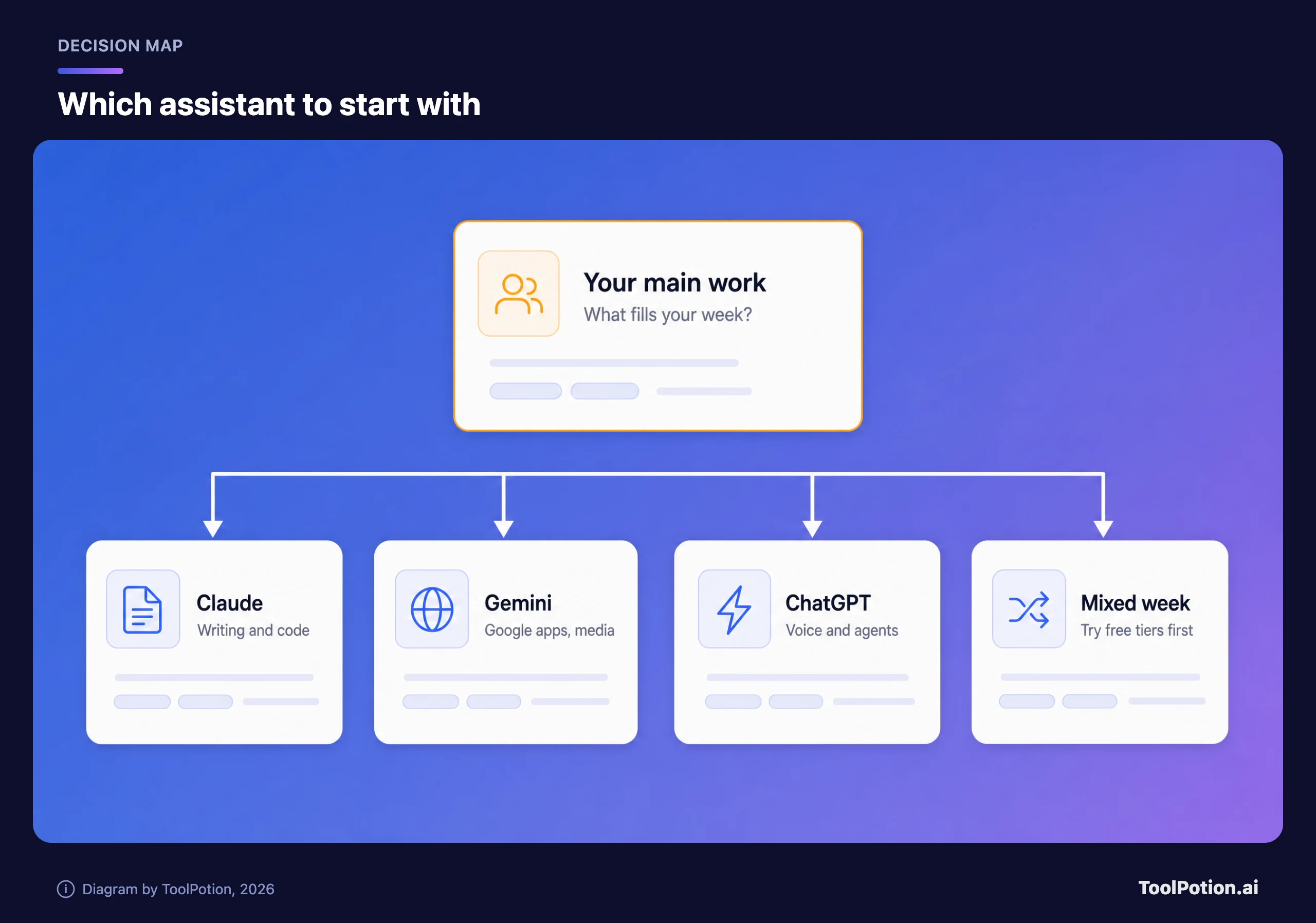
The map is short on purpose. Claude if your week is writing and code. Gemini if your week is Google apps, research and media. ChatGPT if it's voice, agents and a bit of everything. If your week is mixed, spend a few days on the free tiers first. ChatGPT's free plan has unlimited text chats on GPT-6 Luna, Claude's free plan includes Sonnet and Haiku with memory and five projects, and Gemini's free plan includes Deep Research, image generation and Gemini Live.
The picker below is the same logic with your own weights. The scores are our editorial ratings, so argue with them: if you disagree with a number, move the slider until the order matches your experience.
Now the question of two subscriptions. One plan is enough for most people, and the usual reason to add a second is a specific, repeated gap. Writers on Claude who need images, or Gemini users who want a better coding agent, are the typical cases. A second assistant also doesn't have to be paid: a free tier covers an occasional need at no cost.
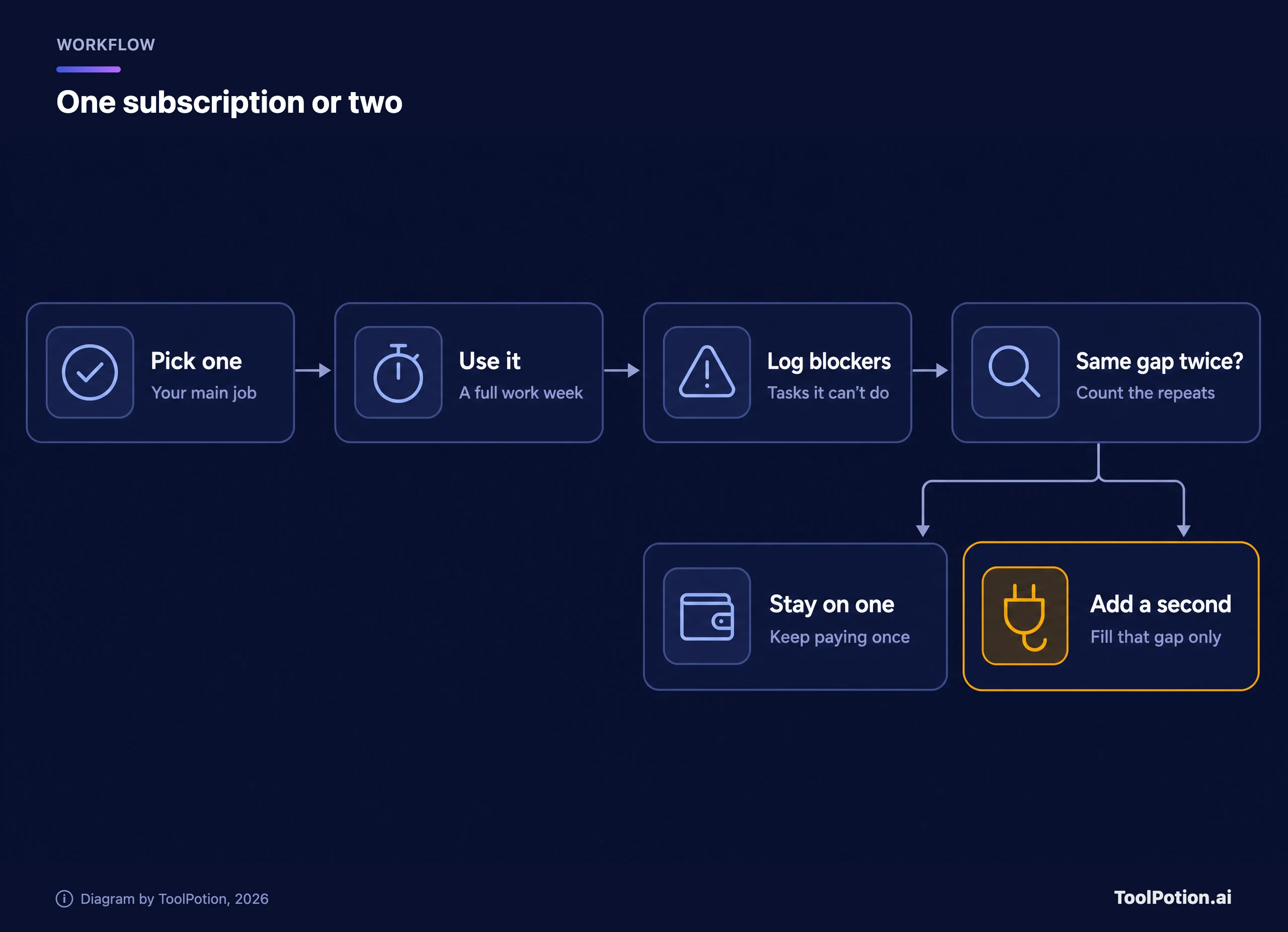
A pair of $20 plans costs about $40 a month, which is less than one heavy-use tier at $100. The pairs that make sense are Claude with Gemini (writing and code plus Google and media) and ChatGPT with Claude (breadth plus depth in writing and code). Paying for all three is hard to justify unless this is your job.
For a team, standardize on one assistant for the shared work and let people expense a second only with a named reason. Seat prices are close enough that the real cost is in switching and in wasted seats, not the list price.
Three setups with real numbers
Abstract advice is easy to nod at, so here are three cases priced from the tables above.
A freelance writer who also edits images for client posts needs strong prose and the occasional picture. Claude Pro at $20 handles the writing and the long drafts. The pictures can come from Gemini's free tier, which includes image generation, so the second assistant costs nothing. Total: $20 a month. If pictures become weekly work, Google AI Plus at $4.99 is the cheapest upgrade on the market.
A five-person agency that lives in Gmail, Docs and Sheets has two sensible routes. Google lists Workspace Business Standard at $14 per user with the Gemini assistant in Gmail, Docs and Meet, which is $70 a month for five seats and replaces the email and storage bill you already pay (Google Workspace). Gemini Enterprise Business at $21 a seat would be $105 a month for the heavier agent and connector features. Adding ChatGPT Business for the same five people at $20 each on annual billing is another $100. For this team the first route is the sensible default, and the second assistant should wait for a named gap.
A solo developer has the real fork. Claude Pro at $20 includes Claude Code, and ChatGPT Plus at $20 includes Codex, so both let you start cheaply. The question is what happens when you hit the limit. Claude Max starts at $100 for 5x the usage of Pro, and ChatGPT Pro starts at $100 too. Because coding agents burn allowance fast on large repositories, a developer who runs agents all day should price the $100 tier from the start rather than juggle two $20 plans.
Frequently asked questions
Which is better, ChatGPT, Claude or Gemini?
None of them across the board. Claude leads on writing and coding, Gemini on research, Google apps and media, and ChatGPT on breadth and voice. Choose by the job you do most.
Is the free version of each enough?
For occasional use, yes. ChatGPT's free plan gives unlimited text chats on GPT-6 Luna, Claude's gives Sonnet and Haiku with memory, and Gemini's gives Deep Research and image generation. Paid plans matter once you hit limits or need the larger models, agents and long context.
Which has the cheapest paid plan?
Google AI Plus at $4.99, then ChatGPT Go at $8 (which may show ads). At the $20 level all three cost about the same. Claude has no plan under $17 a month.
Can I use Claude for images?
Not for generating them. Anthropic's plan page lists no image or video generator, though Claude can read and analyze images you upload. Pair it with ChatGPT or Gemini if you need to create pictures.
Which one is safest for company data?
A business or enterprise plan from any of the three. ChatGPT Business, Claude Team and Gemini Enterprise all say they don't train on your business data by default. Individual plans need their privacy settings checked.
Is Gemini 4 Argon in the Gemini app?
Not yet for most people. Google says it is rolling out to trusted cyber defenders first and will come to paid API and Google AI Ultra subscribers later, and its launch post doesn't give a consumer date.