Jason Haley has lived in his Southaven, Mississippi, house for 20 years and, by his own account, never thought of himself as an activist. Then a power plant went up about half a mile away. "There's a high-pitched hum and then another sound like an airplane over your house," he told the Guardian. He started recording noise levels and posting the videos. Earlier this year he became one of three plaintiffs suing over the turbines that feed xAI's data centers.
Then the realtors started knocking. They were going door to door in his neighborhood, Colonial Hills, with an offer from xAI's subsidiary MZX: it would buy your house, as long as you agreed not to join Haley's lawsuit.
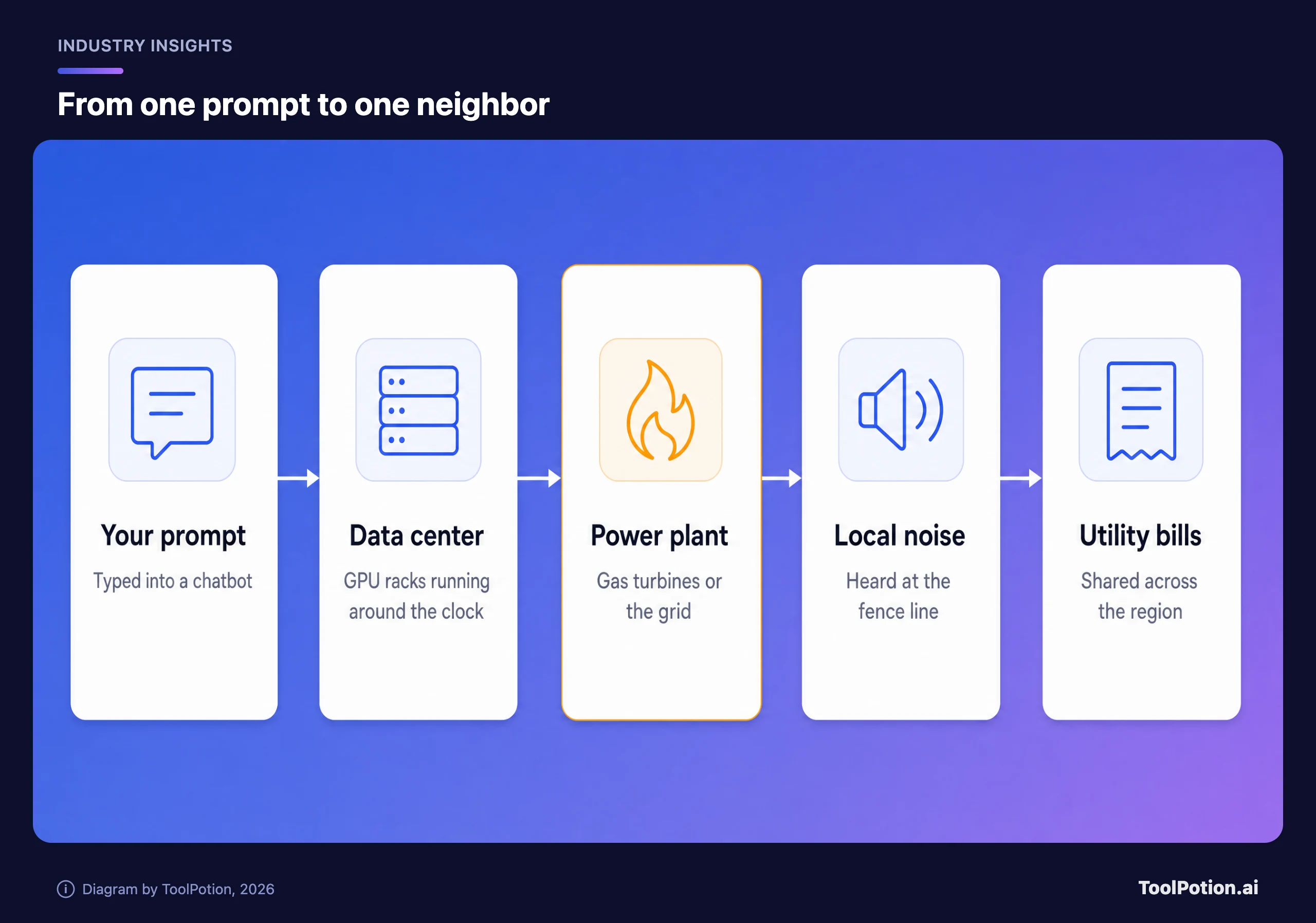
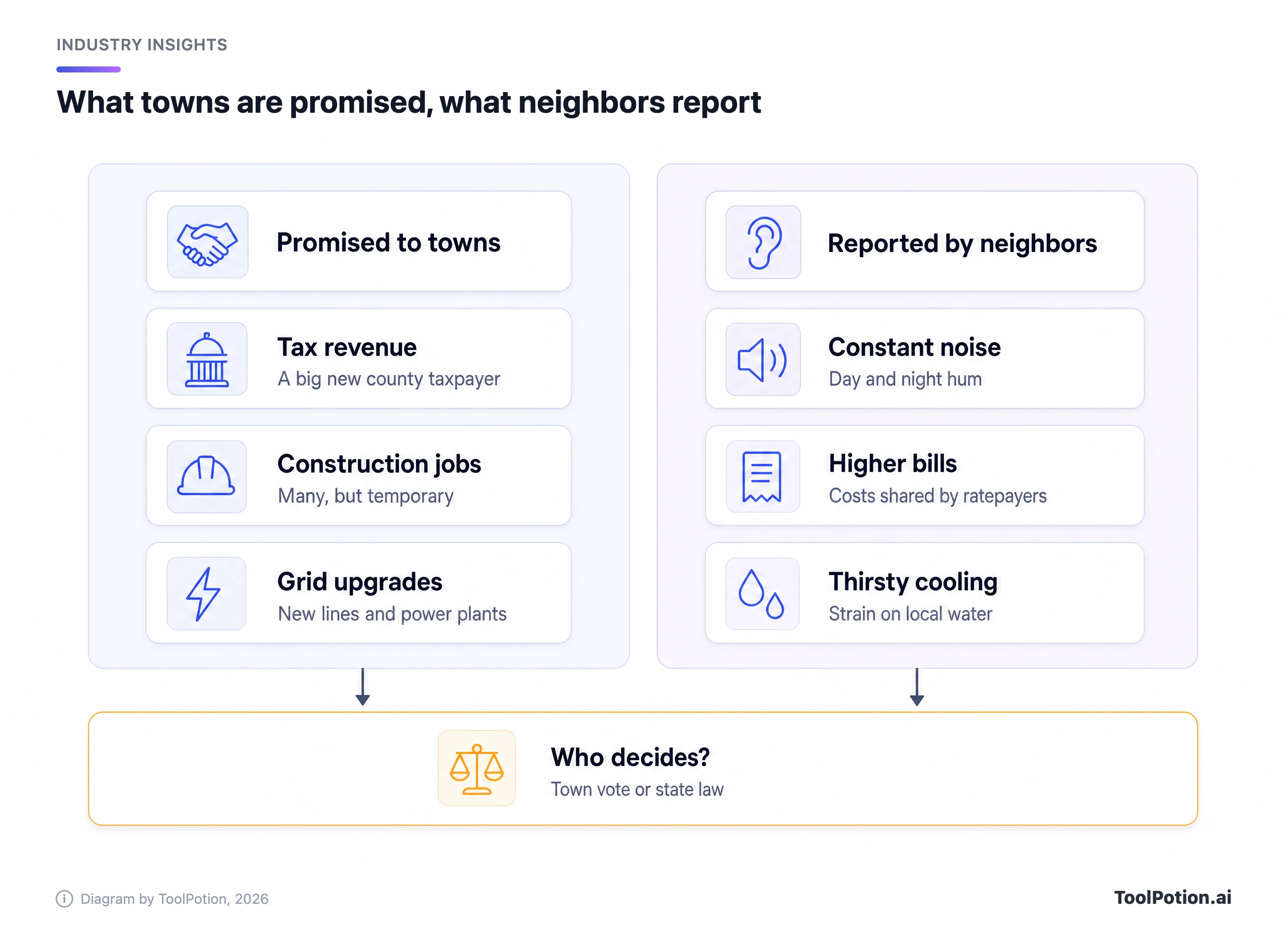
That is the part of an AI chatbot you don't see on the pricing page. Every answer from Grok, ChatGPT, Claude, Gemini or Microsoft Copilot is computed in a building somewhere, and more of those buildings are going up next to people who didn't ask for them. The BBC cites a tracker that lists about 12,250 data centers worldwide, some not yet operating, against around 8,000 operating in 2021, and says opposition is growing in the US, Mexico, France, Indonesia and the UK.
A letter from MZX
The letter, which the Mississippi Free Press published and The Verge quoted, is blunt for a corporate document. MZX "denies all of the allegations against it," it says, but because it "requires property for its business purposes" it is offering to buy houses in exchange for a release of all claims tied to the lawsuit. Sign, and you "will also be unable to bring claims on your own behalf."
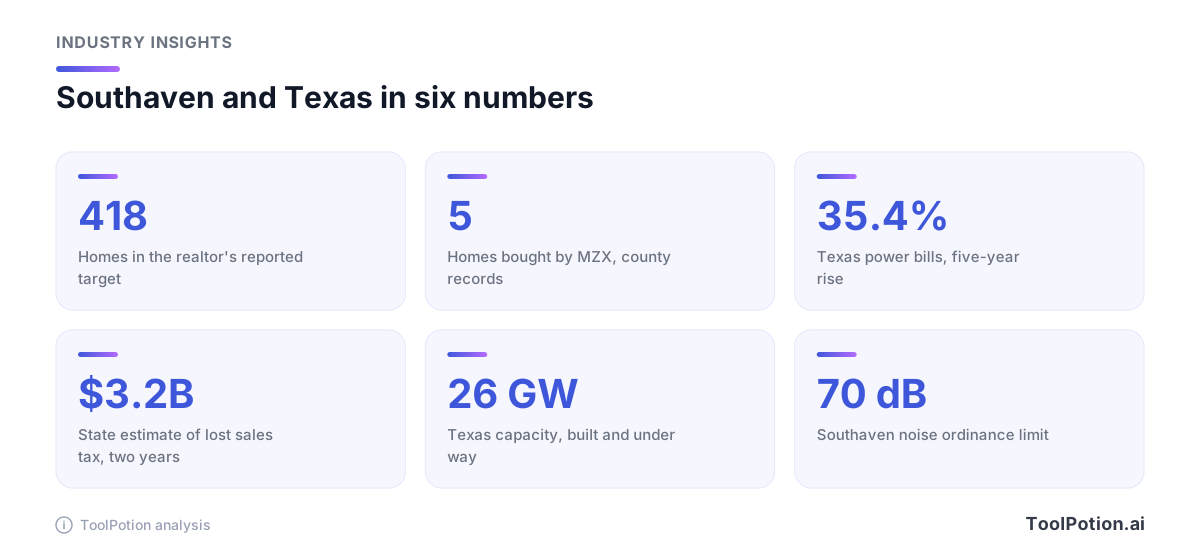
How big is the plan? Per the Guardian, a realtor told one resident there was a target of 418 homes, with 18 owners already agreed, according to a recording the paper heard. xAI didn't answer questions about those numbers. What the paper could check is the county record: five neighborhood homes have been bought by MZX in recent weeks, according to DeSoto County records. The Verge adds that renters in the area report being given 60 days' notice after their landlords agreed to sell.
Southaven's mayor, Darren Musselwhite, framed it differently. "The buyout is not intended to be a company city at this point," he said, calling it a way to house some employees and "a goodwill gesture from a good corporate citizen" for people who see the development as a negative. Gavin Foust, a paramedic who lives near Haley, said his elderly neighbors have just agreed to sell. He won't take the deal himself because of the no-lawsuit condition. "Why push people out?" he asked.
Elizabeth Rose, a piano teacher who lives about two miles from the site, gave the plan a nickname: "Elonville." Her roommate would accept three or four times the home's value, she told the Guardian, but she wouldn't take the offer "just to make things difficult for Elon." That's one person's stubbornness, and Haley himself acknowledges opposition isn't universal. Some neighbors aren't bothered by the noise, and some locals champion the money coming into one of the poorest states in the country.
The noise is the part you can hear
Rose says the plant, a former Duke Energy site now housing 69 temporary gas turbines, began its low-level growl last year. "It sounds like an airplane engine but it's continuous, it's incredibly loud," she said. "I've been woken up at 2am by it."
xAI denies the noise allegations. It has said "we care deeply about being good neighbors," and says it has varied its power output and built sound-dampening walls. The city says its monitors haven't found a breach of the local limit of 70 decibels. The Guardian notes that critics point to evidence that persistent noise at 50 decibels or more, like readings near the plant, may be linked to health effects. Both of those can be true at once.
The noise is also tangled up with a permitting fight. The US Environmental Protection Agency has determined that dozens of the turbines ran without permits required by federal law, the Guardian reports, while also saying enforcement is for the state. The Southern Environmental Law Center estimated the turbines' emissions cause $44 million a year in health costs, though nobody has run air monitoring on site. In a separate suit, the NAACP and environmental groups accuse xAI of operating unpermitted turbines, and the Justice Department's attempt to block it, on national security grounds, failed, the Guardian reports. Under an agreement with state regulators, xAI is to replace the temporary turbines with a permanent gas-fired plant in 2027, which should quiet things down. Haley says of that agreement, "I'm still hopeful but I'm not confident."
What changed Haley wasn't technology policy. "Put it this way, I'm now registered to vote."
Texas made it a ballot issue
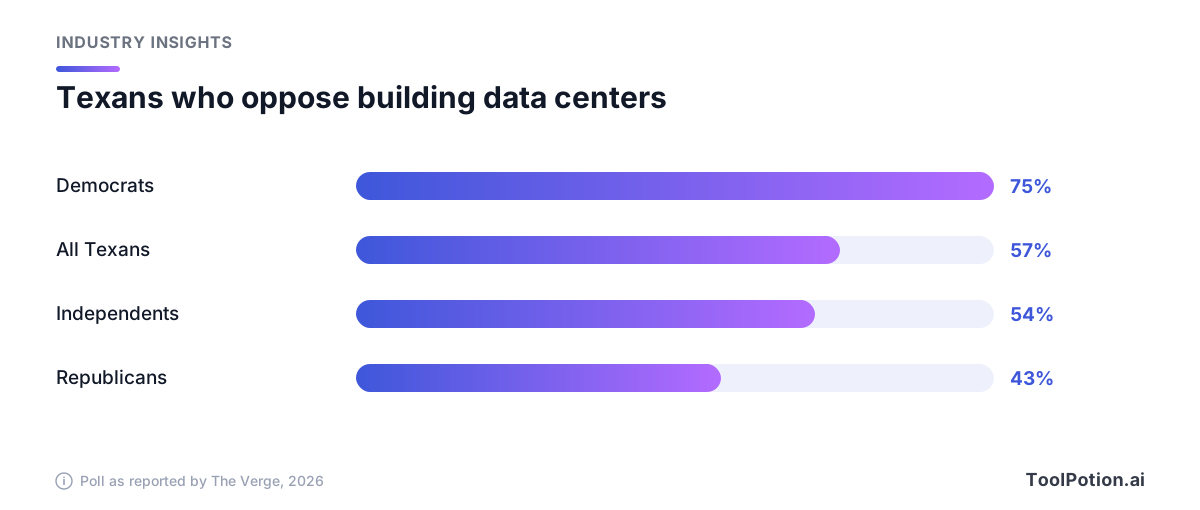
Southaven is one town. Texas is a state full of them. The Verge reports that 57 percent of Texans oppose building data centers in a recent poll, including 43 percent of Republicans, 75 percent of Democrats and 54 percent of independents. Gary Bledsoe, president of the state NAACP, told the site that with elections coming, the data center fight "is the issue in Texas."
The coalition he joined, We the People Texas, is an odd one. Jet Parker, who cofounded Save Rural Texas after a county meeting about a data center near the Oklahoma border, described a room full of Democrats, libertarians, independents and Republicans. "We have almost nothing in common in so many other ways," she said. "And yet you get us in the room with this issue, and it's like a wall."
Their grievances differ. Some are about water. HARC, a Houston research group, estimates Texas data centers used about 25 billion gallons last year, around 0.4 percent of the state's total, and that it could reach as much as 2.7 percent by 2030. Some are about money: a sales tax exemption that Texas passed in 2013 and expanded to hyperscale sites in 2015 was first expected to cost $14.6 million in 2014 and 2015, and state officials now estimate $3.2 billion in lost revenue over two years. And some are about power. Texas electricity bills have risen 35.4 percent on average over five years, per The Verge, as utilities build for rising demand, and the state's largest grid operator estimates data center demand could grow nearly tenfold by 2030.
Governor Greg Abbott, who once called Texas the epicenter of AI development, has since asked regulators to make data centers cover the cost of their own grid infrastructure and announced permit pauses pending audits of electricity and water use. His campaign says its standards require data centers to "reuse their own water" and "not disrupt residential neighborhoods." Critics say the audits miss projects that generate their own power on site. The race to replace him has the same fight in it. His Democratic challenger, Gina Hinojosa, calls for a moratorium on development until the legislature passes more protections, and Republican Senate candidate Ken Paxton, who voted for the 2013 exemption, now says he'd support repealing it. We won't weigh the campaigns against each other. What matters here is that a state with one of the country's most welcoming incentive packages now has leading candidates on both sides talking about unwinding it.
The best case for the buildings
It's easy to write this story as villagers versus a billionaire, and it would be incomplete. The people who want these buildings have arguments, and some are backed by better evidence than the hype suggests.
Start with jobs, the weakest claim and the most repeated. Economists Dany Bahar and Greg Wright compared roughly 1,500 US data center sites with 52 announced-but-canceled ones in a Brookings brief. They found that counties getting their first large data center saw data processing employment rise 56 percent over the first decade. That works out to roughly 100 to 200 jobs in a typical county, wages stayed flat and home prices rose 2 to 5 percent. The authors say the jobs are real but fewer than industry advocates claim, because sites tend to be picked in counties that were already growing.
Tax base is the stronger argument. Brookings notes that proponents point to a single hyperscale campus becoming one of a county's largest taxpayers, and its numbers show that in hyperscale counties state incentives were only about 2 percent of construction investment. In colocation counties, where landlords lease space to remote tenants who may have no local operational presence, incentives were 62 percent of the investment. That's the facility type with the thinnest local payroll. If we were a county commissioner, that's the number we'd carry into the room. Georgia Tech's Daniel Yue co-authored a study of earlier data centers and told NPR's KUT that host communities saw economic growth of about 1 percent in three years and maybe 5 percent over the long term, but mostly in metro areas. He said rural counties "may not be able to depend on spillovers to drive job growth."
And the grid? A TechCrunch panel of industry insiders argued the demand surge could open the door to grid modernization. Tim Heidel, CEO of Veir, a startup selling superconducting power lines that raised $110 million in a Series C, said "the scale of the investment in AI infrastructure is driving a tremendous amount of innovation." Kristin Eberhard of Rewiring America called this "a very improv era," with room for new ideas. Heidel's company sells the technology he's praising, which doesn't make him wrong, and TechCrunch's write-up doesn't say who pays while the upgrades happen. The data center industry's own trade group is blunter about its intentions. Jess Heck of the Data Center Coalition told The Verge members "want to be true partners, good neighbors in every Texas community where we operate."
Britain, and the paperwork nobody did
The same argument is playing out in the UK with a different complaint. An investigation by the nonprofit Spotlight on Corruption, reported by the Guardian, found that officials developing the government's AI growth zones met 137 businesses and only two community groups. They met no environmental organizations. Its campaign lead, Kamila Kingstone, said the government "totally failed at the most senior level to speak to environmental NGOs or community groups." A government spokesperson replied that datacenters should "deliver benefits for the communities that host them" and pointed to a plan letting English councils in growth zones keep the extra business rates.
Chi Onwurah, an MP for Newcastle, linked it to the American fights. "It is critically important that AI benefits communities and is also shaped by them," she said, adding that she was concerned by the US sense that datacenters are being imposed without enough consultation. Fourteen local campaigns rallied at the Scottish parliament in recent months, the Guardian says, against datacenters planned in Scotland.
What this means if you just use the chatbot
One person's prompts won't decide whether a turbine runs in Southaven. We don't think guilt is the useful response, and none of the coverage we read offers a per-prompt figure we'd trust. But the buying decisions teams make do add up, and a few habits are cheap.
- Ask your vendor where your workloads run and what powers that site. Most won't say, and a refusal is information.
- Use the smallest model that does the job. Local AI vs cloud AI covers when running on your own hardware makes sense, and the BBC notes some predict more processing will move onto the chips already in our devices.
- Read what you're actually paying for. Credits, seats and tokens hide how much compute a task burns, as our pricing models guide explains.
- Price the exit. If a vendor's site becomes a local controversy or a regulatory target, open-source AI vs SaaS is the switching math to have done in advance.
- If you're picking a chatbot anyway, our ToolRank chatbot board, the wider AI chatbots hub and ChatGPT vs Claude vs Gemini compare them on what they do for you. Neither measures what they cost a neighborhood, and we'd like that to change.
What we're watching
Four things. First, the replacement of xAI's temporary turbines with a permanent plant, promised for 2027, and whether the people in Colonial Hills hear a difference. Second, whether more homes change hands in Southaven, since five sales is a small number against a reported target of 418. Third, whether Texas audits reach the data centers that make their own power. Fourth, the money: the BBC says the industry is expected to spend $765 billion on AI infrastructure in 2026 and more than $1 trillion next year, and about 16 US states have proposed laws to ban or pause new facilities.