Buy the GPU only if you'll keep it busy. That's the short answer on local AI vs cloud AI in 2026: above roughly 26% sustained daily use, a local rig beats paying per token. Below that, you're financing idle silicon at 2026 memory prices, and those prices are ugly: NVIDIA pushed the DGX Spark from $3,999 to $4,699 in February 2026, blaming DRAM and storage costs (Notebookcheck).
Meanwhile the cloud side got cheaper in ways most comparisons skip. Prompt cache reads run at 0.1x input price, and the 50% Batch discount stacks on top, taking Claude Haiku 4.5 to $0.50 in / $2.50 out per million tokens (Anthropic).
Here's what that math looks like, what 24GB runs, and where the line falls for you.
Local AI vs cloud AI: the 2026 playbook broke in four places
The break-even math you've read is wrong, and not by a rounding error. It's wrong because the hardware got more expensive, the capability stat got misread, the tooling changed sides, and the cloud rate card quietly dropped underneath everyone's spreadsheet.
The three assumptions every comparison still makes
Almost every local-vs-cloud guide on the first page of results rests on the same three claims, all of them dated 2024. One: hardware is a fixed, falling cost, so you amortize a $1,999 GPU over 18 months and compare against per-token spend. Two: open-weight models trail closed frontier models by three to six months, so whatever you run at home is a couple of quarters behind. Three: "local" means Ollama on your machine and "cloud" means a frontier API, a clean two-way fight.
All three were reasonable in 2024. None survives contact with 2026.
What changed between 2024 and now
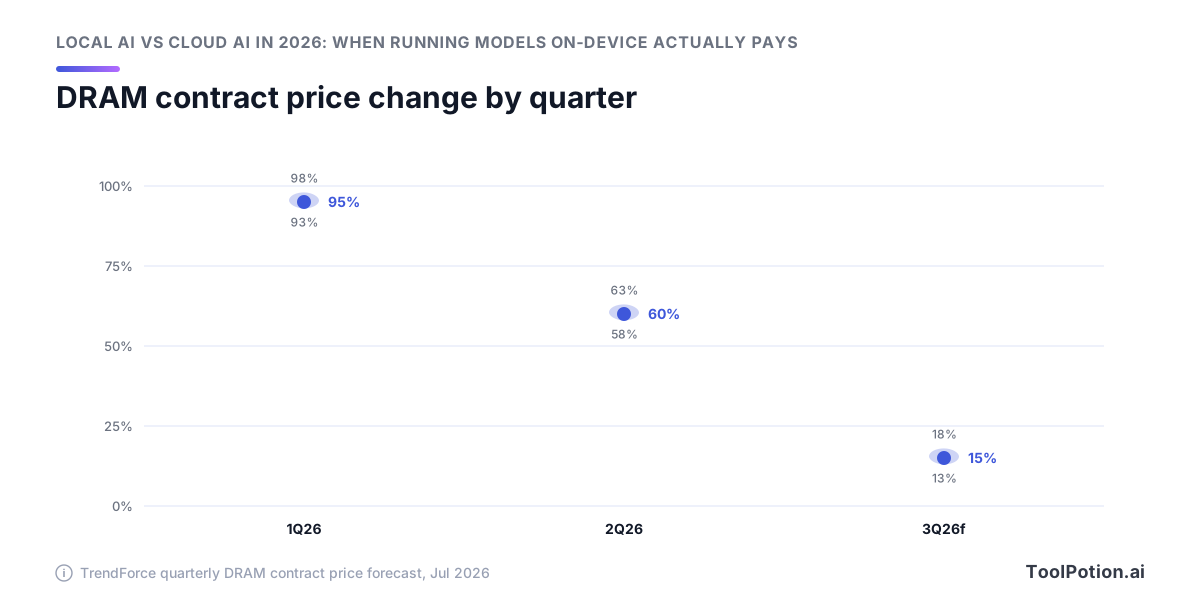
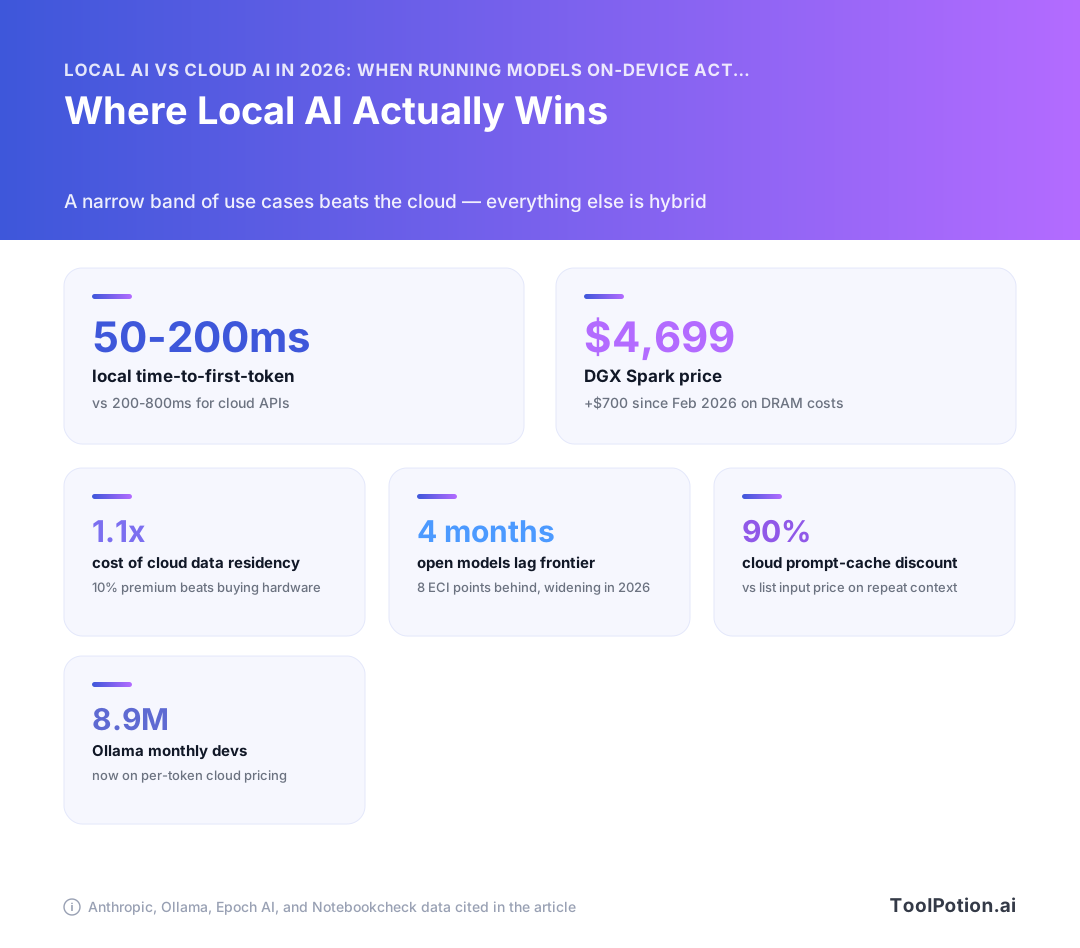
Start with the hardware floor, because it moved in the wrong direction. NVIDIA raised the DGX Spark from $3,999 to $4,699 in February 2026, a $700 hike it blamed on skyrocketing DRAM and storage costs. Conventional DRAM contract prices rose roughly 93-98% quarter over quarter in 1Q26 and are still climbing 13-18% in 3Q26. Every calculator quoting MSRP is understating your CapEx by four figures.
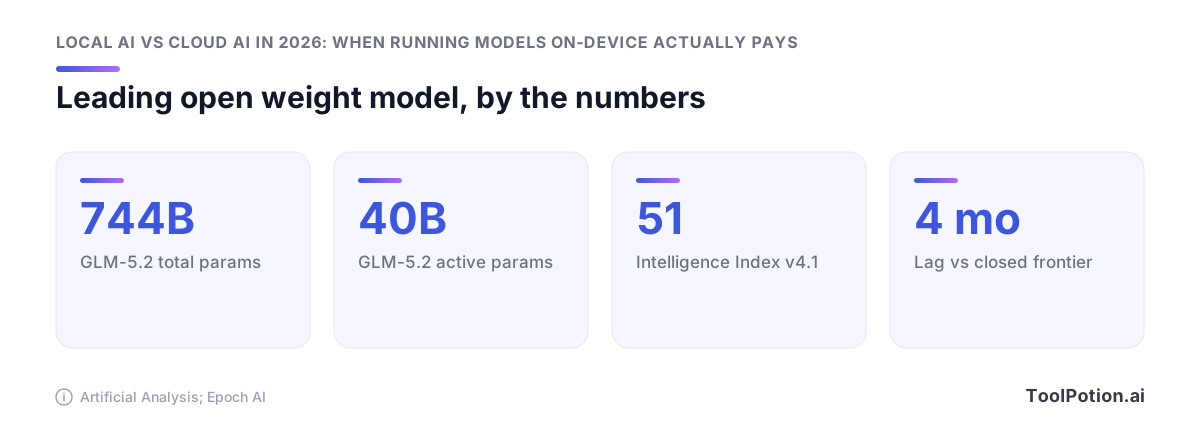
Then the capability gap. Epoch AI puts the lag at 4 months, or 8 ECI points since January 2026, wider than the 3-month average it measured from January 2023 through October 2025. The part nobody quotes: the model carrying that claim, GLM-5.2, is 744B total and 40B active parameters. That's a rack, not a laptop.
The third break is the strangest one. On August 31, 2026, Ollama moved Pro, Max and Team to per-token cloud pricing at $20, $100 and $500 a month. The default "run it locally" tool now sells you tokens, which turns the comparison into a three-way race between your GPU, cheap hosted open weights, and frontier APIs. If you're sizing up options across the AI models we track, that middle lane is the one to price first.
And the cloud side got cheaper in ways no published calculator models: prompt cache reads at 0.1x base input price, a 50% Batch API discount that stacks on top, and US-only inference pinning for a 1.1x multiplier. That last one sells you the data-residency property people buy hardware for, at a 10% premium instead of $4,699.
What local models genuinely handle in 2026
A 24GB card in 2026 runs a good 20-30B mixture-of-experts model, and that model will draft, summarize, classify and reason through structured problems at a quality most teams find acceptable. It will also confidently invent facts about anything outside its training data. Those two sentences are the capability map, and most break-even guides skip the second one.
The consumer-hardware ceiling is the 20-30B MoE class
gpt-oss-20b and Qwen3-30B-A3B are the practical ceiling for a single consumer GPU. Both are sparse MoE designs, so the active parameter count stays small enough that a 24GB card holds the weights and still has room left for context. Below that sit the dense Llama, Mistral and Phi class models at 7-14B, which fit more comfortably and give up capability for it. Our open-weight LLM listings skew hard toward this band, because it's what people can run at home.
Strong at reasoning, weak at world knowledge
Hand a local 30B model a document and ask it to extract fields, follow a schema, or walk a chain of steps, and it holds up fine. Ask it who acquired whom in 2024 and you get plausible fiction.
Parameter count is what buys memorized facts, and a consumer-sized model has thrown most of those parameters away. Retrieval closes the gap: put the facts in context and let the local model do the structured part. Anything that needs broad recall with no retrieval layer behind it belongs on a frontier API.
Why the open-models-are-catching-up headline is about hardware you don't own
Epoch AI puts the gap at 4 months, or 8 ECI points, since January 2026, slightly wider than the 3-month average it measured across January 2023 to October 2025 (Epoch AI). The number is sound and it says nothing about your laptop. The model carrying the open-weight crown, GLM-5.2, scores 51 on Artificial Analysis's Intelligence Index v4.1 at 744B total parameters with 40B active (Artificial Analysis). That's datacenter hardware. The same measurement has GLM-5.2 burning 43,000 output tokens per task, 37,000 of them reasoning tokens, which lands at roughly $0.46 per task against $0.18 for MiniMax-M3.
What quantization costs you
Q4_K_M is the default for a reason. On Mistral-7B-Instruct-v0.2 under llama.cpp on an Apple M1 Pro, it took the model from 7.2GB to 4.1GB, 43.1% smaller, for 0.51% perplexity loss (dasroot). Q2_K is where the curve breaks, at 7.94% perplexity loss, and you feel that in instruction following long before you see it in a benchmark. Quantize to 4-bit, stop there, and spend the memory you saved on context length.
The hardware floor moved, and it moved the wrong way
Every break-even calculator you'll find assumes you can buy the box at list price. In 2026 you mostly can't, and list price itself went up.
The memory crisis, in prices you can check
Conventional DRAM contract prices rose roughly 93-98% quarter over quarter in 1Q26, another 58-63% in 2Q26, and TrendForce forecasts a further 13-18% in 3Q26 (TrendForce). That's deceleration, not relief. Prices are still climbing off a base that already doubled. The demand isn't coming from you: data centers are absorbing up to 70% of world memory output in 2026 against roughly 20-30% in 2022, and HBM alone took 23% of DRAM wafers this year versus 8% in 2024 (IDC). Local inference is a memory-capacity purchase competing with the people building the clouds you're trying to avoid.
DGX Spark, RTX 5090, and the gap between MSRP and street
NVIDIA raised the DGX Spark from $3,999 to $4,699 in February 2026, a $700 hike the company attributed to skyrocketing DRAM and storage costs (Notebookcheck). Its 128GB of LPDDR5X is the whole reason it's interesting for local models, and it's also the reason its price tracks a commodity market you don't control.
Treat any 2025 MSRP you see quoted in a comparison post as fiction. Check what the part sells for this week, then run your math on that number.
Electricity is the line item everyone forgets
A GPU is a one-time purchase that sends you a bill every month. US residential electricity averaged 18.34 ¢/kWh in June 2026, up 5.0% year over year, with states ranging from 8.96¢ in New Mexico to 28.50¢ in California (EIA). The same rig has a running cost that varies by more than 3x depending on where it's plugged in. If you're in California, the power alone can rival what the equivalent hosted tokens would cost. In New Mexico the calculus is different enough to change the answer.
What a defensible 2026 rig costs
Budget the box at current street price, add the power draw at your actual utility rate, and add the hours you'll spend on local inference frameworks and quantization tuning that a hosted endpoint doesn't ask of you. A four-figure CapEx number with a three-digit annual OpEx tail is the honest starting point, and both halves got worse this year for reasons that have nothing to do with how good the models are.
Ollama vs cloud API cost: the comparison is now three-way
Three prices matter now: the GPU you buy, hosted open weights, and a frontier API. The middle option wins for most workloads, and it's the one almost no published break-even formula includes.
Ollama itself became a cloud API on August 31, 2026
The tool that taught a generation of developers to run models on their own machine now sells tokens. On August 31, 2026 Ollama moved Pro, Max and Team onto per-token cloud pricing: $20/mo including $60 of usage, $100/mo including $300, and $500/mo including $1,000 shared across unlimited users, with zero data retention and hosting in the US and Europe (Ollama). So "Ollama vs the cloud" no longer describes a real choice.
Hosted open weights: the middle option nobody models
| Model | Input / output per MTok | Source |
|---|---|---|
| nemotron-3-super (Ollama Cloud) | $0.015 / $0.60 | Ollama |
| deepseek-v4-flash (Ollama Cloud) | $0.22 / $0.66 | Ollama |
| qwen3.5:397b (Ollama Cloud) | $0.60 / $3.60 | Ollama |
| Claude Haiku 4.5 | $1.00 / $5.00 | Anthropic |
| Claude Sonnet 5 | $2.00 / $10.00 | Anthropic |
Read the fine print before you build a forecast on those numbers. Most Ollama Cloud rates double between 12:00 and 18:00 UTC on weekdays (Ollama), which turns your bill into a scheduling question. Push bulk jobs to nights and weekends and you keep the headline rate. Run an interactive product for European afternoon users and you pay the doubled one every business day. That timing variable is worth more attention than the choice between two similarly priced hosting providers.
Frontier APIs are cheaper than their list price suggests
Cache reads bill at 0.1x the base input price, the Batch API takes 50% off both input and output, and the two discounts stack (Anthropic). Batched Haiku 4.5 lands at $0.50 input and $2.50 output per million tokens, and Sonnet 5 held its introductory $2/$10 rather than moving to the scheduled $3/$15 on September 1, 2026 (Anthropic). Async bulk work is exactly what local rigs get pitched for, and it's the workload where cloud discounts bite hardest.
The tokenizer footnote that cuts the other way
Claude 4.7 and later use a newer tokenizer that produces roughly 30% more tokens for the same text (Anthropic). Your real Sonnet 5 bill on a fixed corpus runs about 30% above what the $2/$10 card implies when you compare against a local model with an older tokenizer. Count tokens on your own text with both before you commit.
Running the crossover: at what volume does your GPU win?
Owned hardware starts beating hosted open weights somewhere around 26% sustained daily GPU utilization, roughly six hours a day of real work every day, amortized against 2026 hardware prices and your local electricity rate. Below that line the card sits idle while the depreciation clock runs. Price your own volume against the hosted rate before you buy: deepseek-v4-flash runs $0.22 input and $0.66 output per million tokens on Ollama Cloud (Ollama).
Where local wins (a short, nameable list)
Four cases hold up under scrutiny. Everything else is a hybrid setup where you route the easy queries to a local model and escalate the rest.
Sustained high-volume batch work that keeps the card busy
If your GPU sits idle 90% of the day, you bought a space heater. The buy case needs the card working more than a quarter of the day, every day, and it needs to survive the comparison against the Claude Batch API, which cuts input and output tokens by 50% and stacks with prompt caching (Anthropic). That puts Haiku 4.5 batch work at $0.50 per million input tokens and $2.50 output. Your local rig has to beat that on amortized hardware plus electricity, and at 18.34 ¢/kWh average US residential power in June 2026 (EIA), a card pulling real load isn't free either. Run the numbers with your actual token volume before you run them with a spec sheet.
Hard data sovereignty, CLOUD Act and not just GDPR
There's a real category here, and it's narrower than most people claim. GDPR compliance is a contract problem. A requirement that no US-jurisdiction entity can be compelled to produce your data is a physics problem, and physics problems get solved with hardware you control.
Interactive loops where time-to-first-token is the product
Local inference delivers 50-200ms time-to-first-token against 200-800ms for cloud, with Claude Haiku 4.5 measured at 597ms and GPT-4.1 Mini around 2,400ms (Eden AI). For a chat window nobody notices. For inline code completion, or a multi-step agent chaining eight calls, that difference compounds into something users feel. If you're building in that shape, browse the AI agents in our directory and check how many of them make a round trip per keystroke.
Offline and air-gapped operation
No argument to make. Either the network is there or it isn't.
The privacy argument the cloud now sells back to you
The strongest counter to case two is that Anthropic will sell you the property directly. On Claude 4.6 and later, pinning inference to US-only with inference_geo: "us" costs a 1.1x multiplier across all token categories (Anthropic). That's a 10% premium instead of $4,699 of DGX Spark. Ollama's paid plans, meanwhile, advertise zero data retention hosted in the US and Europe as of August 31, 2026 (Ollama). If your privacy requirement is satisfied by a contractual guarantee and a geographic pin, you don't have a hardware requirement.
The hybrid setup most practitioners land on
Route by difficulty, not by principle. A 20-30B MoE model on your own card handles roughly seven of every ten queries in a typical assistant or document-processing workload, and the remaining three go to a frontier API. That split is the architecture. Everything else is tuning.
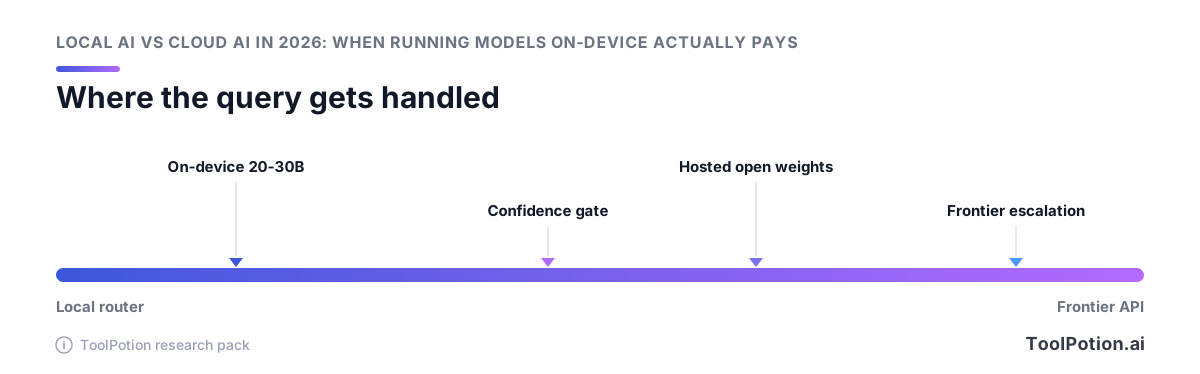
Three signals decide the escalation, and you can compute all of them before the local model finishes: the model's own confidence (log-prob margin or a cheap self-check), whether the query needs world knowledge the local weights don't have, and context length. The knowledge one catches most of your failures. A 24GB-class model reasons fine and recalls badly, so anything that reads like "who acquired whom in 2025" should skip local entirely.
A concrete stack that works
Ollama or LM Studio in front, one frontier API behind, and a thin router in between that logs every decision.
Send the escalated traffic to Claude Haiku 4.5 at $1/MTok input and $5/MTok output first, and only reach for Sonnet 5 at $2/$10 when Haiku's answer fails your check (Anthropic pricing). If the escalated work is async, batch it: the Batch API halves both sides, so Haiku lands at $0.50/$2.50. Most teams skip this and pay list price on work that could have waited twenty minutes.
Instrument the escalation rate or you're flying blind
Log four numbers per request: which tier served it, the local model's confidence, token counts, and whether a human retried the answer. The retry rate is your real quality signal. If escalation sits below about 20%, your local model is answering things it shouldn't and you'll see it in retries. Above 45% and the GPU isn't earning its depreciation.
Why the boundary moves every quarter
Prices on both sides move faster than your architecture does. Ollama repriced Pro, Max and Team to per-token cloud billing on August 31, 2026 (Ollama), Ollama Cloud rates double between 12:00 and 18:00 UTC on weekdays (Ollama pricing), and open-weight capability trails closed frontier models by about 4 months on average since January 2026 (Epoch AI). Re-run your routing thresholds against live numbers once a quarter. Put it on the calendar.
The tooling layer is stable enough to build on
Ollama runs at 8.9 million monthly active developers with a 14-person team, sits inside 85% of the Fortune 500, and raised $65M led by Theory Ventures in July 2026 (TechCrunch). That's not a project that disappears next year. The router glue around it is the part you own, and you can borrow most of it from the open-source AI repos already publishing this pattern.
Decide in five questions
Answer these in order. The first one that gives you a hard yes decides your setup, and you can stop there.
Do you have a hard sovereignty requirement?
Hard means air-gapped, CLOUD Act exposure that legal has written down, or a contract that names the machine. If that's you, buy the hardware and stop reading the cost section. If your requirement is softer than that, Anthropic will pin inference to US-only with inference_geo: "us" on Claude 4.6 and later for a 1.1x multiplier on all token categories (Anthropic pricing docs), and Ollama's paid plans run zero data retention in the US and Europe (Ollama). A 10% premium beats $4,699 of hardware for almost everyone.
Is your work latency-bound or throughput-bound?
Interactive loops where a person waits on every token favor local: 50-200ms to first token against 200-800ms for cloud, with Claude Haiku 4.5 measured at 597ms (Eden AI). Throughput work goes the other way. Batch it and take the 50% discount, which puts Haiku 4.5 at $0.50/MTok in and $2.50 out (Anthropic).
Will the GPU stay busy more than a quarter of every day?
Below that line your card is depreciating while idle and hosted open weights win on cost. Above it, local math starts working. Be honest about the denominator, since nights and weekends count.
Does your task need world knowledge or just reasoning?
Reasoning over text you supply runs fine on a 20-30B MoE model. Questions that depend on facts the model has to already know belong on a frontier API, or on hosted GLM-5.2, which is 744B total parameters and never fits your laptop (Artificial Analysis).
Can you tolerate re-tuning every quarter?
The open-closed gap sits at 4 months and moved from a 3-month average (Epoch AI), so your routing threshold has a shelf life. Teams that won't revisit it should default to a frontier API with caching on and route nothing. Teams that will can look at real deployment case studies for what other people's thresholds ended up being.
What would change this verdict in 2027
This advice has an expiry date, and there are three specific numbers that set it.
Memory prices are decelerating, not falling
Conventional DRAM contract prices rose roughly 93-98% quarter over quarter in 1Q26, then 58-63% in 2Q26, with 13-18% forecast for 3Q26. That curve is flattening. It's still pointed up. A slower rate of increase doesn't give you back the $700 NVIDIA added to the DGX Spark in February 2026, and nothing in the forecast says street prices come down next year. Plan on the hardware case staying weak through 2027 unless data center demand eases.
Watch the open/closed gap, not the headline benchmark
Two signals matter more than any leaderboard position. The first is Epoch AI's ECI gap, which sat at 4 months, or 8 points, since January 2026. The second is active parameter count: GLM-5.2 leads on open weights at 40B active out of 744B total, so the day a sub-30B-active model lands within a few ECI points of frontier, the 24GB card gets interesting again. Also watch whether Ollama's peak-hour doubling (12:00-18:00 UTC weekdays) sticks or normalizes. Our AI trend reports track the model releases that would move any of these.
Frequently Asked Questions
Is it cheaper to run an LLM locally or use a cloud API in 2026?
For most people, cloud, and the gap widened in 2026. Claude Haiku 4.5 lists at $1 per million input tokens and $5 per million output, falls to $0.50/$2.50 through the Batch API, and prompt cache hits bill at 0.1x the base input rate (Anthropic pricing). On the other side, an NVIDIA DGX Spark went from $3,999 to $4,699 in February 2026 because of DRAM and storage costs (Notebookcheck), and you still pay for power at a US residential average of 18.34 ¢/kWh in June 2026 (EIA). Local earns its money on sustained high-volume batch work that keeps the card busy a large share of every day, on air-gapped operation, and on latency-sensitive loops.
What hardware do I need to run an LLM locally in 2026?
A 24GB GPU is the practical consumer floor, and it caps you at the 20-30B mixture-of-experts class rather than anything near the open-weight frontier. Above that, you're buying a 128GB LPDDR5X box like the DGX Spark, which now costs $4,699 (Notebookcheck). Budget for memory prices that keep climbing: conventional DRAM contract prices rose about 93-98% quarter over quarter in 1Q26 and 58-63% in 2Q26, with another 13-18% forecast for 3Q26 (TrendForce). Quantization stretches what fits, and 4-bit is close to free: Q4_K_M shrank Mistral-7B-Instruct-v0.2 from 7.2 GB to 4.1 GB for 0.51% perplexity loss, while Q2_K broke down at 7.94% (quantization tradeoffs).
How good are local models compared to Claude or GPT?
The widely quoted gap is real but it describes hardware you probably don't own. Epoch AI measured open-weight models trailing closed frontier models by an average of 4 months, or 8 ECI points, since January 2026, slightly wider than the 3-month average for January 2023 through October 2025 (Epoch AI). The model carrying that claim, GLM-5.2, scores 51 on Artificial Analysis's Intelligence Index v4.1 at 744B total and 40B active parameters, which is datacenter hardware (Artificial Analysis). What actually fits on a laptop or a single GPU is strong at structured reasoning and weak at world knowledge, so treat the 4-month figure as a ceiling you can't reach at home.
Is Ollama still free, and how does Ollama Cloud pricing compare to frontier APIs?
The local-versus-Ollama framing stopped making sense on August 31, 2026, when Ollama moved its Pro, Max and Team plans to per-token cloud pricing: $20/mo including $60 of usage, $100/mo including $300, and $500/mo including $1,000 shared across unlimited users, with zero data retention hosted in the US and Europe (Ollama blog). Hosted open weights are cheap there: deepseek-v4-flash runs $0.22 input and $0.66 output per million tokens, nemotron-3-super $0.015/$0.60, qwen3.5:397b $0.60/$3.60, though most rates double during peak hours from 12:00 to 18:00 UTC on weekdays (Ollama pricing). Compare that to Claude Haiku 4.5 at $1/$5 (Anthropic pricing) and the real decision is three-way, with hosted open weights beating your own GPU on cost for most workloads. Ollama has the scale to be taken seriously either way, at 8.9 million monthly active developers and 85% of the Fortune 500 (TechCrunch).
Does running a model locally actually make my data more private than a cloud API?
It gives you one property nothing else does, which is that the bytes never leave your machine, and that matters for air-gapped work and for hard data-sovereignty requirements like the CLOUD Act. For everything softer than that, providers now sell the same guarantee cheaply. On Claude 4.6 and later, pinning inference to US-only with inference_geo: "us" costs a 1.1x multiplier across all token categories (Anthropic pricing), and Ollama's paid plans run zero data retention in the US and Europe (Ollama blog). A 10% premium is a much smaller commitment than $4,699 of hardware (Notebookcheck).
Which local model should I start with on a 24GB GPU?
Start with a 20-30B mixture-of-experts model such as Qwen3-30B-A3B or gpt-oss-20b, quantized to Q4_K_M. That class scores 73-87% on AIME 2024 on a single RTX 5090, so reasoning holds up well, while factual recall about the world is where it falls short. Q4_K_M is the right quantization stop: it cut a 7.2 GB model to 4.1 GB for 0.51% perplexity loss, and Q2_K degraded sharply at 7.94% (quantization tradeoffs). Run it as the first hop and escalate knowledge-heavy queries to a cloud model.