If your AI-made image, video or audio could pass for the real thing, label it. That one rule covers most of what YouTube, Meta, TikTok and the EU now ask of you. Captions, scripts, upscaling and obviously stylized art mostly don't need a label. Realistic people, places and events that never happened do.
The details moved a lot this year. The EU's transparency rules for AI content began to apply in 2026, and the final EU code of practice on labeling came out with roughly 190 signatories. Platforms kept their creator toggles and leaned harder on invisible metadata. Ad systems added their own boxes to tick.
This guide sorts it into things you can act on: what each platform wants, how Content Credentials and watermarks work, what the EU and a few US laws add, and a decision rule you can run in under a minute. It's written for creators, marketers and small brands, not for lawyers, so check anything high-stakes with one.
The one-question test for most posts
Platform rules read like legal text, but they boil down to realism. YouTube's help page asks creators to disclose when AI "meaningfully alters or generates photorealistic content", meaning a real person appearing to say or do something they didn't, altered footage of a real place, or a realistic scene that never happened. Everything cosmetic sits outside that.
The same page lists what you can skip: beauty filters, color adjustments, special effects, "cloning one's own voice to create voice overs", and production help like scripts and thumbnails. Upscaling, repair and caption generation are also fine (YouTube Help).
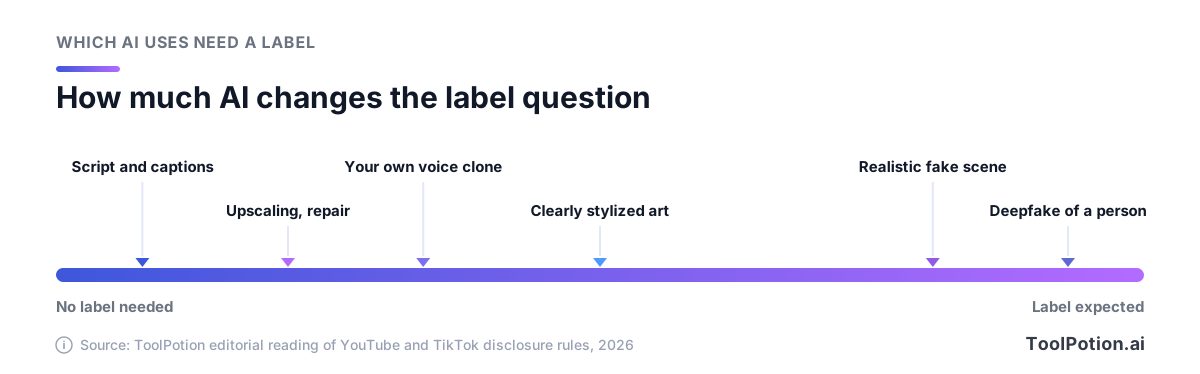
The figure above is ToolPotion's reading of where common AI uses sit. The middle is the fuzzy zone. A heavily stylized illustration of a real person is not a deepfake, but a photoreal portrait of that same person is. When you can't decide, ask whether a stranger scrolling past at speed would take it for a camera recording. If yes, label it.
What each platform asks of creators
Four of the five big platforms below have some form of creator disclosure or automatic labeling. X is the outlier, going by the policy page we read. Here's the short version before the detail.
| Platform | Who has to disclose | What viewers see | If you skip it |
|---|---|---|---|
| YouTube | Creators, for realistic altered or synthetic content | Player label for photoreal content; description label for animated or non-realistic | Label added by YouTube; repeat offenders risk removal or Partner Program suspension |
| Instagram and Facebook | Creators, for photorealistic video and realistic-sounding audio | AI label, also applied when Meta reads C2PA or IPTC metadata | Meta said in 2024 it "may apply penalties" |
| TikTok | Creators, for realistic AI content | AI label, plus automatic labels from Content Credentials | TikTok says harmfully misleading AI content is prohibited, labeled or not |
| Optional self-attestation in select countries; no mandatory toggle found | A Content Credentials icon when the file carries C2PA data | Not documented | |
| X | We found no AI-label toggle in its policy | No automatic label described on that page | Misleading synthetic media that risks serious harm is not allowed |
YouTube
YouTube puts the label in the video player for photorealistic content and in the expanded description for animated or non-realistic work. The enforcement language is worth reading twice: creators who consistently don't disclose face "manual application of a label, or penalties from YouTube, including removal of content or suspension from the YouTube Partner Program." So the platform can slap the label on for you, and you don't get to choose the wording.
Instagram and Facebook
Meta's rule is narrower than YouTube's but explicit. It said it would "require people to use this disclosure and label tool when they post organic content with a photorealistic video or realistic-sounding audio that was digitally created or altered" (Meta). Meta also says it can label images from Google, OpenAI, Microsoft, Adobe, Midjourney and Shutterstock by reading their C2PA and IPTC metadata. The label it shows is called "AI info". For content that AI tools only edited, Meta moved the label into the post menu, so a light retouch doesn't shout at viewers.
TikTok
TikTok was early. It says it was the first video platform to adopt Content Credentials, which lets it label AI content automatically and keeps the credentials on downloaded files (TikTok newsroom). It says it requires people to label realistic AI-generated content, and its labeling tool is built for that. TikTok also says its policies "firmly prohibit harmfully misleading AI-generated content", whether it's labeled or not. We couldn't read TikTok's full community guidelines outside the app, so check the exemptions and penalties there before you publish a campaign.
LinkedIn and X
LinkedIn leans on provenance. Images and video that carry C2PA credentials get an icon, and clicking it shows whether AI generated or modified the content, which app made it, and who issued the credential. In select countries, uploads without credentials get an optional way to self-attest that AI made the media (LinkedIn Help). X's policy bans "inauthentic media" that may cause "widespread confusion on public issues" or serious harm, including fabricated or simulated real people, but the page we read describes no creator label and says X "may not take action" when it can't reliably tell (X Help). On X, a label is your own protection, not a requirement.
Ads have a second set of rules
Organic posts and paid ads are policed separately, and ads are stricter where elections are involved. Google's political content policy, in its election ads section, says advertisers "must disclose all election ads that contain synthetic or digitally altered content" by ticking an "Altered or synthetic content" box in campaign settings. It covers content that inauthentically depicts real or realistic-looking people or events. Google adds an automatic disclosure on feeds, Shorts and in-stream video. Other formats need a prominent note inside the ad itself (Google Ads policy).
Google's own sample wordings are useful templates: "This image does not depict real events" and "This video content was synthetically generated". Cropping, color correction and background tweaks that don't create a false depiction don't need one. Google's rule is for election ads. Meta, in a 2024 post, asked advertisers to disclose digital creation or alteration in political and social issue ads. We found no separate AI-disclosure rule for ordinary product ads on the pages we read, but the organic rules above still apply to the same creative.
A practical habit for brands: put the label decision in the ad brief, next to the headline and the audience. It's much cheaper to add a line of text before approval than to rebuild a rejected video.
Content Credentials, watermarks and what they can't do
A label you type is only one of three ways a file can say it came from AI. The other two sit inside the file. Content Credentials (the C2PA standard) are signed metadata recording the tool and the edits. Invisible watermarks, like Google's SynthID, change the pixels or audio themselves. Backers of Content Credentials include more than 500 companies, among them Microsoft, Adobe, Google, Meta, Amazon and OpenAI (Content Credentials).
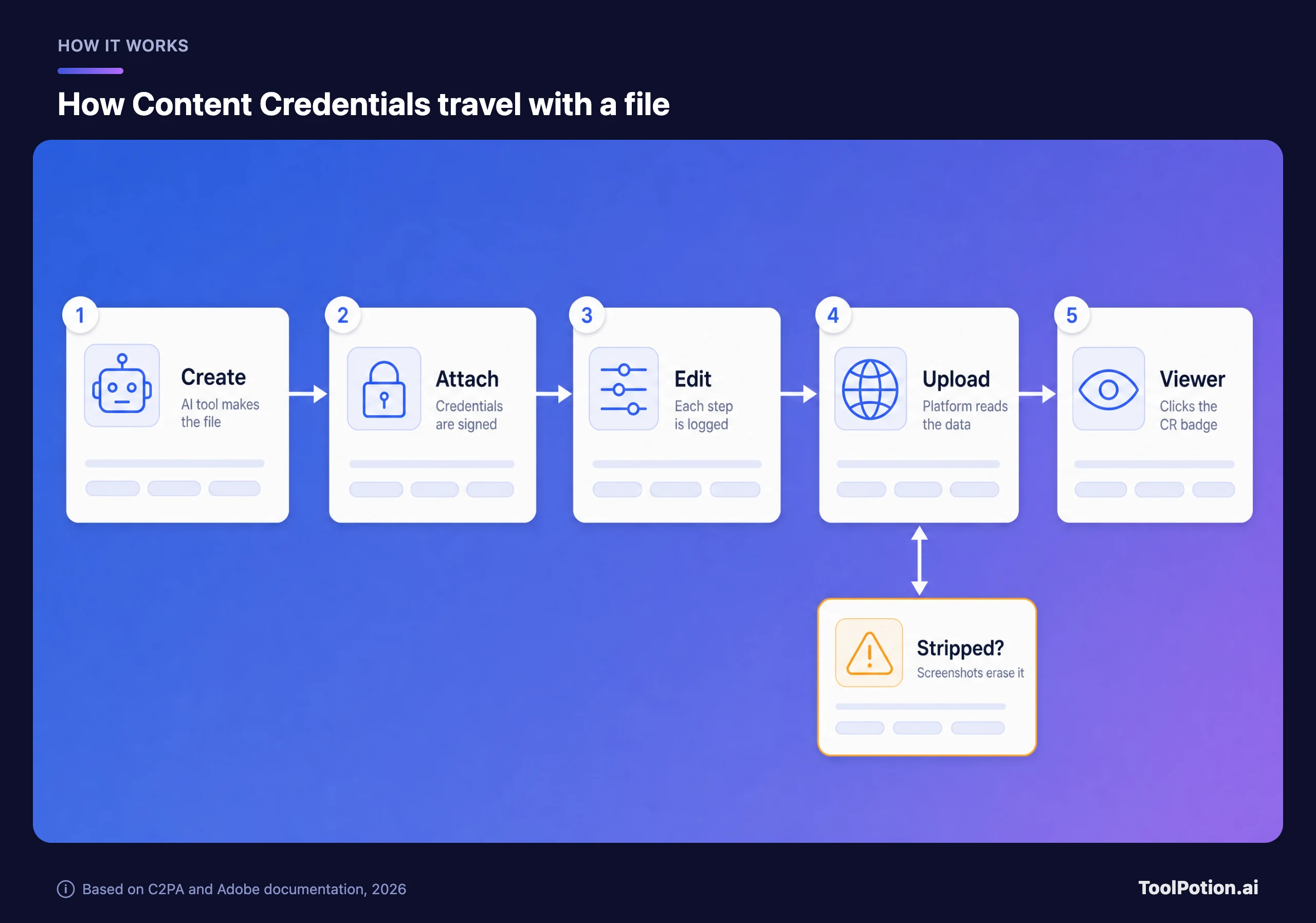
The flow works only while the file stays intact. Screenshots, format conversion and heavy compression can wipe the metadata, and OpenAI's own help page says metadata "can sometimes be removed by platforms, editing tools, or file conversions". That's why vendors now pair it with a watermark.
Which tools do what, as far as vendors say:
- Adobe Firefly: Adobe says it "automatically applies Content Credentials to content made with Adobe Firefly and its APIs". Credentials also work in Photoshop, Lightroom and Premiere, with a Chrome extension for viewing them.
- ChatGPT and the OpenAI API: supported images carry both C2PA metadata and SynthID watermarks, and supported audio carries a SynthID watermark. OpenAI adds that coverage varies by product, model and export path, and that you can ask for a visible watermark in the prompt (OpenAI Help).
- Google Gemini and other Google models: SynthID watermarks cover images, video, audio and Gemini-app text. Google's SynthID Detector lets anyone check a file, and Google says it now recognizes content from partners including OpenAI, NVIDIA, Kakao and Apple (Google DeepMind).
- Midjourney: Meta names it among the generators whose images it can label from metadata. No first-party Midjourney page describing its credentials turned up in this research, so check your export before you rely on it.
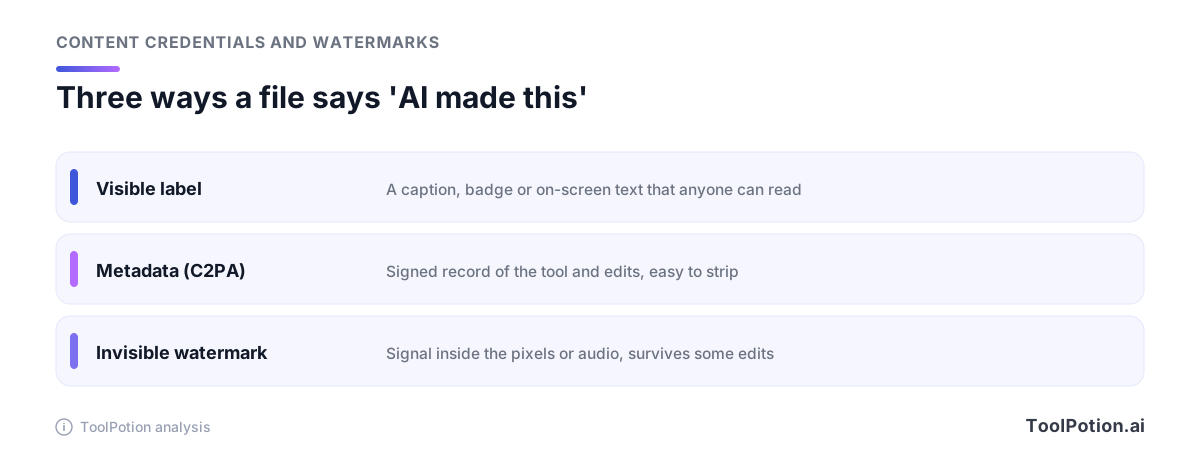
The layers cover for each other. A caption survives a screenshot. A watermark survives some edits that kill metadata. Metadata carries the richest detail, like who made the file and which steps touched it. None of it is proof of truth: OpenAI notes provenance markers are "not a guarantee that content is accurate, unedited, legally owned, or presented in the correct context." If you finish work in Canva or CapCut, test whether the export keeps what the generator added.
What the EU AI Act asks of you
Article 50 of the EU AI Act is the transparency article, and it applies in 2026. It splits duties in two. Providers, the companies building generative tools, must mark synthetic audio, image, video and text outputs in a machine-readable way when technically feasible. Deployers, meaning whoever uses those tools to publish content, must disclose deepfakes and AI-generated text on matters of public interest (AI Act, Article 50).
There are carve-outs. AI text that has been through human review, with someone taking editorial responsibility, doesn't need the note. For artistic, satirical or fictional works the duty shrinks to disclosing that the content exists, in a way that doesn't spoil the work. In plain terms, a brand publishing a realistic synthetic ad in the EU looks like a deployer, though that's an editorial reading, not legal advice.
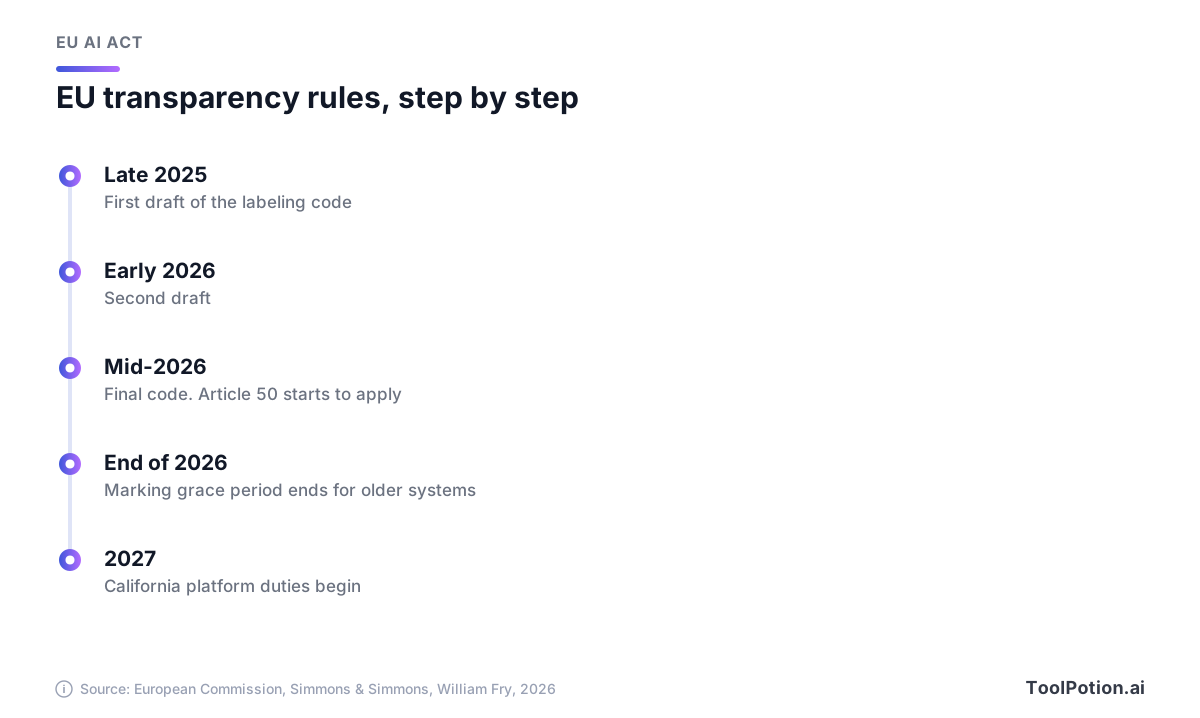
The timeline got a late adjustment. The EU's digital omnibus gave providers a four-month grace period on the machine-readable marking duty in Article 50(2), moving it to the end of 2026 (Gibson Dunn). Law-firm analyses say the grace covers only systems already on the market before Article 50 began to apply, while newer systems have to comply at once. Treat that scope as secondary reading until you check the final text. The deployer duty to disclose deepfakes still applies from the start. The Commission's code of practice is voluntary, but it says following it is an adequate way to show compliance, and it ships an EU icon set deployers can use for labels.
For a small team, the provider duty is mostly your tool vendor's problem. Yours is the deployer side: disclose realistic synthetic people and events, and keep a record that a human reviewed AI text before it ran as editorial content.
US rules: states first, platforms next
There's no single federal labeling law. The action is in the states. Public Citizen's tracker counts 30 states with election deepfake laws, with Maryland the latest this year and 20 states still without one (Public Citizen). Many accept a disclosure that content was AI-generated, but what a label buys you differs by state, and some laws set their own disclaimer wording or limit the safe harbor. If your content touches a candidate or a ballot question, a label may not be enough.
California's AI Transparency Act is the other one to know. Adobe's help pages name it alongside the EU act as a law requiring transparency for generative content. Law-firm summaries say its provider duties began this year for large generative AI systems, and that large online platforms must surface provenance data from 2027. We couldn't open the legislature's own page, so confirm those dates with counsel if you serve Californians at scale.
A decision rule you can run in a minute
Most posts fall into one of four buckets. The tool below walks through them. It's built from the platform and ad rules above, so it's a guide, not a legal ruling.
If you'd rather keep the rule in your head, here it is in order:
- AI only helped with text, captions, edits or repair: no platform label. Keep your drafts anyway.
- AI made or changed visuals or audio, and it could pass as real: label it using the platform toggle, and add a caption line.
- A real person's face, voice or likeness is involved: label it, and get written consent before you publish.
- It's a political or election ad, or touches an election: use the ad disclosure box and read your state's rules.
- It's clearly stylized or fictional: a label is optional, but a short caption line costs nothing.
Labels can come from several places, which is why a missing toggle isn't always a problem and a missing caption isn't always safe.
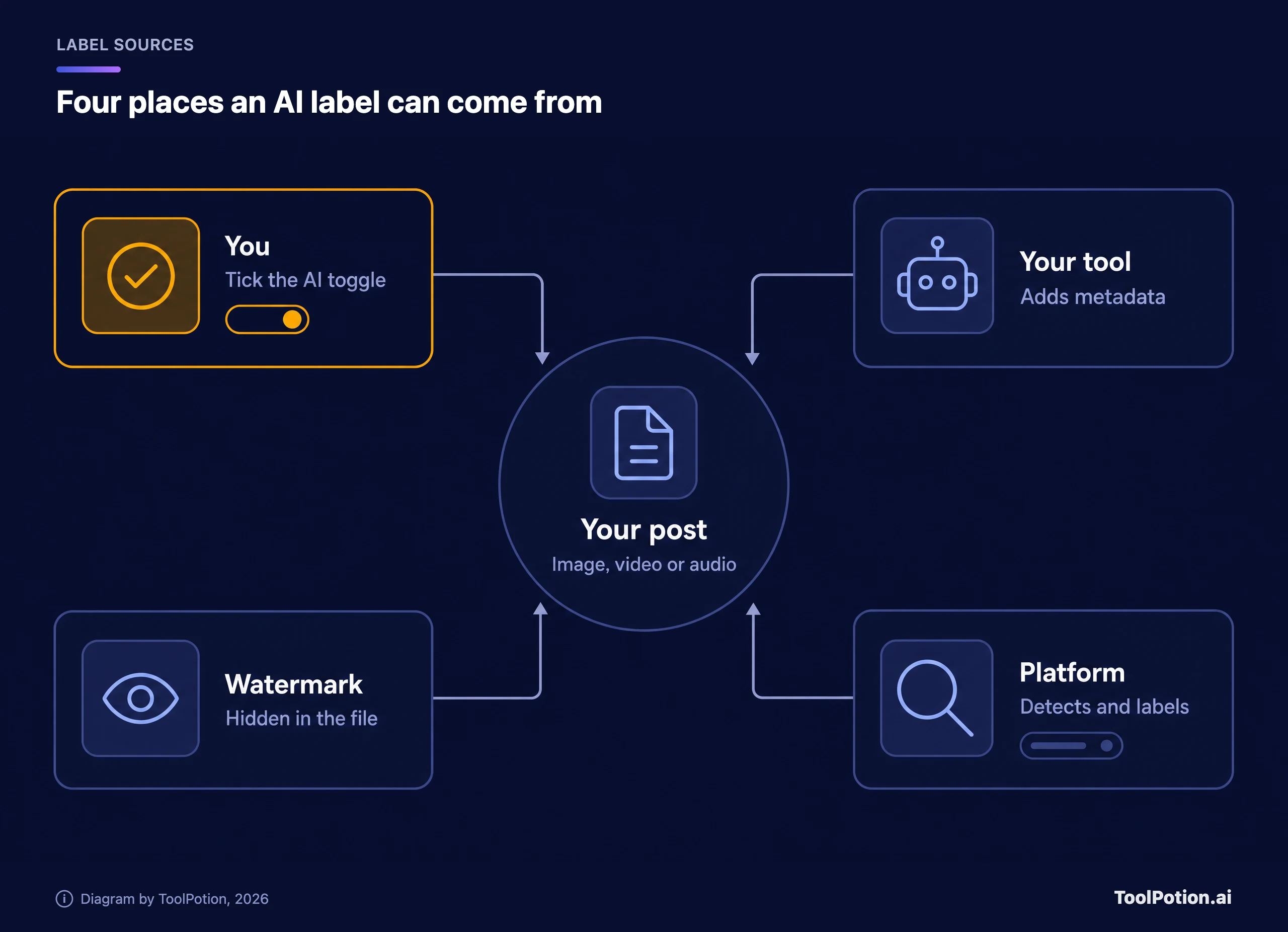
You control only the first source. The other three depend on your tool, your export settings and the platform's detection, so don't assume they'll cover you. Tick the toggle yourself.
A pre-post checklist and caption lines
The checklist below is the whole process in seven lines. Run it for any post that used a generative tool for visuals, voice or likeness.
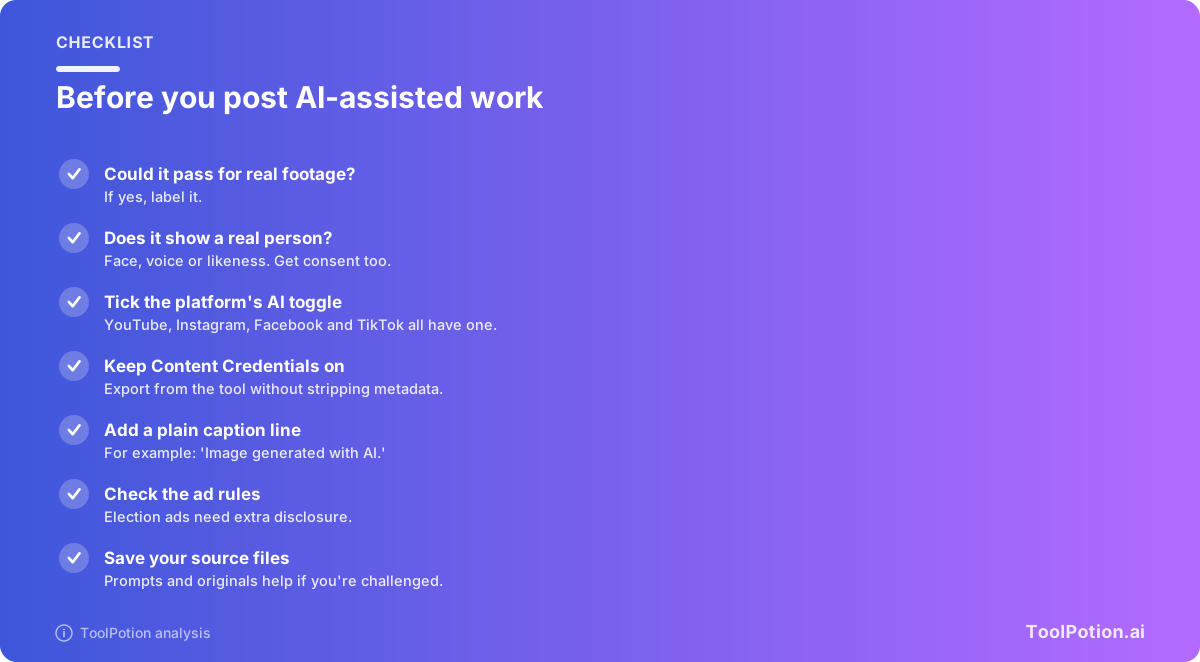
Caption wording should be plain and sit near the top, not buried under thirty hashtags. A few lines that work: "Image generated with AI." "Voiceover created with an AI voice." "Scenes in this video are AI-generated and didn't happen." Skip coy phrasing like "enhanced by technology". It reads as evasive, and platforms and regulators don't treat it as a label.
Keep your source files too: the prompt, the original photo, the export settings. If a post gets flagged or a regulator asks, that file trail is the cheapest defense you'll have. For image and video tools, ToolPotion's boards of AI image generators, AI video generators and AI voice generators are a starting point if you want to compare which ones attach credentials, and the video generation stack comparison covers the big names. For example, Runway and ElevenLabs are worth checking on export behavior before you build a workflow around them.
Where labels fall short
Labeling is a floor, not a shield. A label doesn't make a deceptive post honest, and X's policy and the stricter US states show that disclosure alone won't save a fake of a real person. It also doesn't fix consent, copyright or likeness rights, which are separate questions.
The tech has holes too. Metadata disappears when someone screenshots your image. Watermark detectors only recognize their own partners' marks. A file that came from a tool outside the C2PA circle carries nothing at all, and LinkedIn presents credentials as what the file says, not as verified truth. Platforms also disagree: the same video may need a toggle on YouTube, an optional self-attest on LinkedIn, and a caption line in the EU.
Rules also keep moving. Several of the pages above updated this year, and we couldn't read TikTok's full guidelines. Re-check the platform pages before a big campaign, and put the date you checked in your own style guide.
Frequently asked questions
Do I have to label AI-written text?
On the platforms above, text and captions are not the focus. YouTube lists scripts as production help that needs no disclosure. The EU is different for one case: AI text published to inform the public on matters of public interest needs a disclosure unless a human reviewed it and takes editorial responsibility.
Is a label the same as Content Credentials?
No. A label is a human-readable note on the post. Content Credentials are signed metadata inside the file. You want both, because platforms read the metadata when it's there and viewers read the label when it isn't.
What if I only used AI to touch up a photo?
Light edits like color, retouching, cropping and upscaling are generally outside the disclosure rules. Meta moves labels for AI-edited content into the post menu. If the edit changes what the picture claims to show, such as adding people or events, treat it as AI-generated.
Can I add a visible watermark myself?
Yes. OpenAI says you can ask ChatGPT or its API to include a visible watermark in an image, and you can add a caption or overlay in any editor. A visible mark is the one marker that survives a screenshot, though it can be cropped out.
Will a label hurt my reach?
None of the platform pages cited here say labeled content is demoted. Meta says it keeps labeled content on its platforms, and removal depends on whether the content breaks other policies. Hiding the fact is the bigger risk, since YouTube and Meta both describe penalties for repeat non-disclosure.