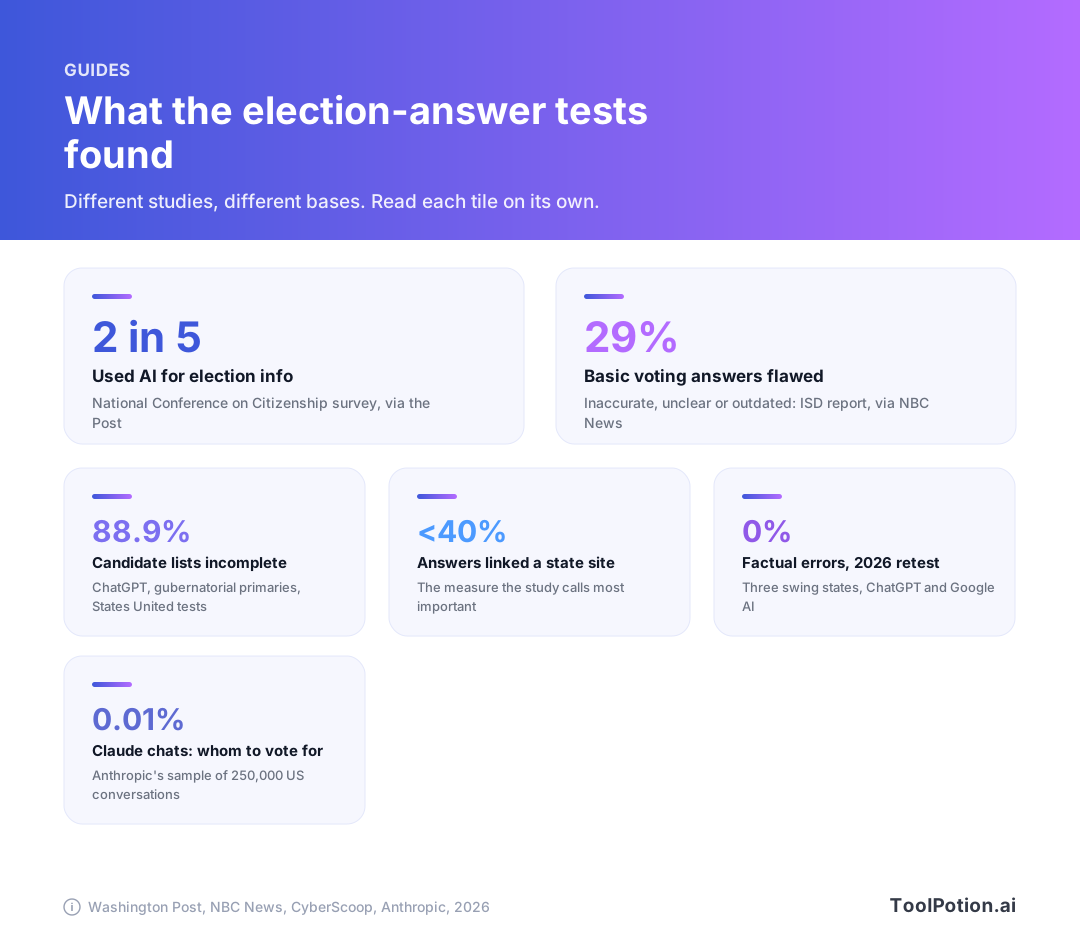
One of the voter guides The Washington Post collected listed a U.S. Senate race in Missouri, with candidates "pending final certified general-election ballot." The Post's annotation on it is blunt: "There is no Missouri Senate race." Another error put a House candidate in Washington state on a ballot he isn't on. The Post, which asked six popular chatbots to build voter guides for addresses in every U.S. county, also cited a National Conference on Citizenship survey in which 2 in 5 Americans said they had used AI to look up election information.
So the habit is mainstream, and the failures are the kind you wouldn't spot by reading the answer. A made-up race reads just like a real one. Here's how to check any chatbot's answer in a few minutes, using pages the government runs.
The mistakes are rarely loud
It would be easy to write this as "chatbots get elections wrong," and that wouldn't be fair. A nonprofit, States United Democracy Center, tested ChatGPT's free tier and Google's AI answers on basic election questions in six swing states. In 2025, 6.9% of Google's answers and 8.2% of ChatGPT's contained verifiable factual errors. In 2026 retests across Arizona, Pennsylvania and Michigan, the error rate was zero, and the study says so plainly (CyberScoop).
The same study found a different problem. ChatGPT gave incomplete lists of candidates in gubernatorial primaries 88.9% of the time, and responses linked to a state election website in fewer than 40% of cases. "It's not giving you complete information, so the voter thinks these are the [only] two people running," States United's Thania Sanchez told CyberScoop, describing answers that name a Republican and a Democrat and skip everyone else.
That is the shape of the risk in 2026. The answer isn't wrong, exactly. It's missing a name, or a deadline, or a polling-place change that came after the model last learned anything. A separate report from the Institute for Strategic Dialogue, covered by NBC News, found that leading chatbots gave inaccurate, unclear or outdated replies on 29% of basic questions about elections and voting procedures. NBC also reported that Spanish-language answers were the worst of the lot.
Google's behavior shifted mid-study, too. Between the two rounds, its AI answers in incognito mode switched to showing only links for election queries. A written answer you got earlier this year may not look the same now.
A chatbot is also a moving target
Two things make an answer hard to trust even when it sounds right. One is that the sources are being courted. A CNN segment on a report that political campaigns are working to influence AI models as voters turn to chatbots makes the same point, and Isabel Linzer of the Center for Democracy and Technology told CyberScoop that campaigns are structuring their materials so AI models will cite them, which she calls generative engine optimization. The Post's report also flagged AI-powered websites feeding chatbots questionable information.
The other is that chatbots are agreeable. NPR followed a West Virginia voter, Adam Johnson, who spent hours going through his ballot with ChatGPT and concluded: "ChatGPT is just kind of a people pleaser." Rafael Batista, a Johns Hopkins fellow who studies how AI shapes people's experience of the world, put the risk this way in the same NPR story: "So you leave more confident, without necessarily learning more about the world."
The companies say they've rerouted voting questions
OpenAI and Anthropic both say voting questions are going to a nonprofit called Democracy Works for official information. OpenAI's 2026 election page says that integration is live in the U.S., covering registration, deadlines and voting locations, with links to official sources "so people can check the details for themselves." It also says live vote counts from The Associated Press arrive after polls close, and that election officials remain the authority on results. OpenAI has also told Politico it is opening an Election Operations Center, a war room of staff watching for misuse of its tools until all votes are counted.
Anthropic's midterms post says Claude is starting to draw on the same Democracy Works feed for US users, and it keeps a TurboVote banner on questions about registration, polling places and dates. Anthropic also reports that only about 0.01% of US Claude.ai conversations in its sample asked whom to vote for. More often, people asked things like where candidates stand on an issue.
We think those changes are good, and they point the same way as this article. Each of them works by pointing back to the same state and local officials you could ask yourself. If the assistant's best move is to link to the election office, your best move is to start there for anything that has a date, an address or a name attached. Neither page says how often its voting answers still go wrong.
Five steps, about five minutes
This works for any assistant, including ChatGPT, Claude and Perplexity, and for the AI summary on top of a search page.
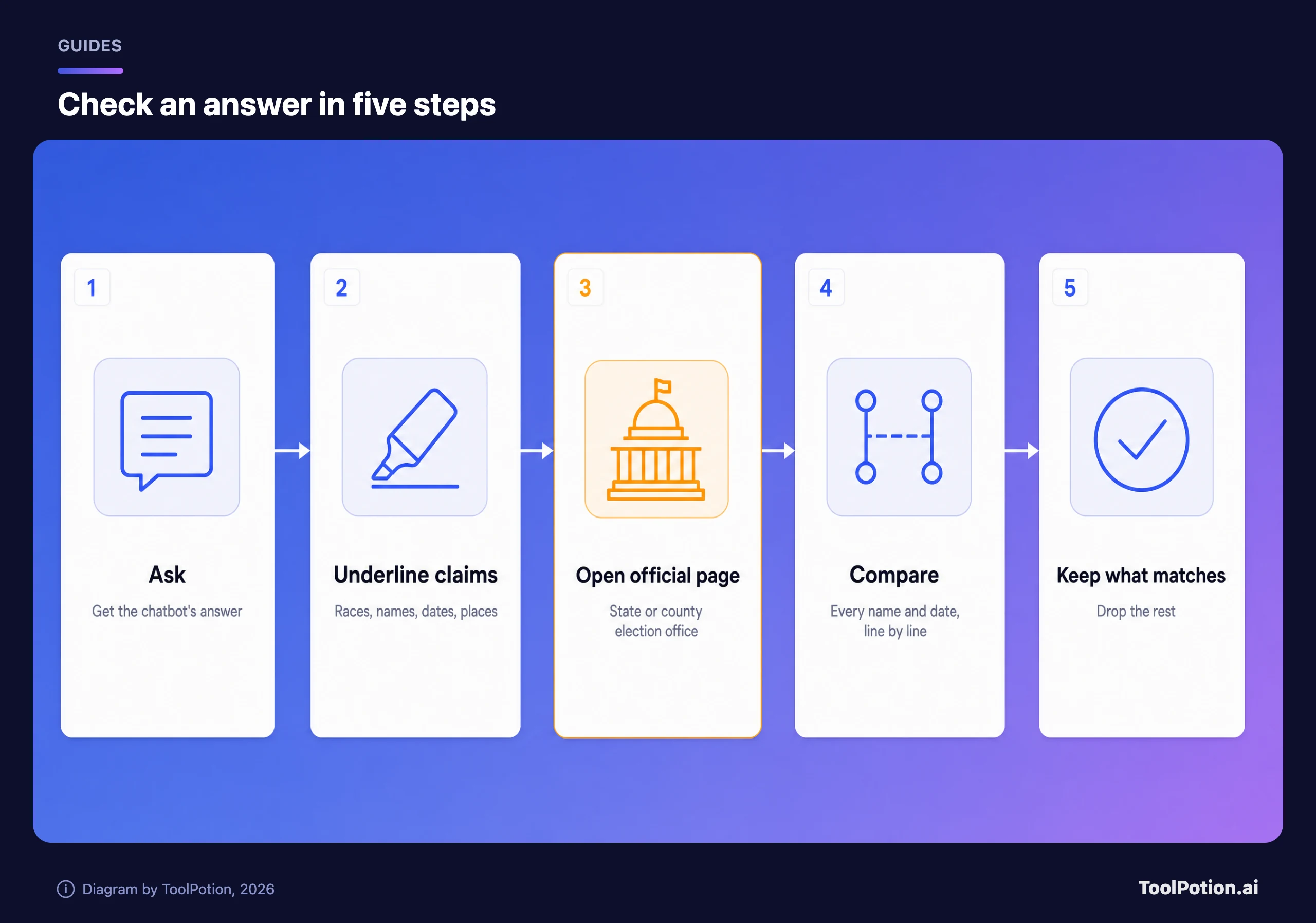
- Ask your question and copy down every concrete claim: each race, each candidate's name, each date, each address.
- For registration, ID rules, and early or mail voting, open vote.gov, which sends you to your state's own page for each.
- For polling places, deadlines and results, find your state or local office with the election office finder on USA.gov. Look for a .gov address.
- For who is on your ballot, pull up your sample ballot from the state or county election office and go through it office by office. A race the chatbot named that isn't there is the Missouri problem. A candidate on the sample ballot that the chatbot skipped is the Sanchez problem.
- Keep only what matches. Anything you can't confirm on an official page is unconfirmed, however confident it sounded.
Step four is the one that would have caught the Post's errors.
Using the chatbot for what it's good at
We wouldn't ban it. The NPR voters who got value from chatbots used them for things like making sense of a long ballot or finding where to start. One Pennsylvania volunteer told NPR she prompted Claude to pick statements from candidates' own speeches or official websites, which is one way to limit what a model can invent. Another voter, Tyler Black, said he checks one chatbot's answers against another. Batista said that beats asking the same model twice, though he hasn't seen evidence it works well.
Two habits help more. Ask for the source link on every claim and open it, because a link that doesn't open, or doesn't say what the answer claims, tells you the claim is unsupported. And keep your own leanings out of the prompt: Batista suggests framing questions so your preferences stay hidden. Our guide to fact-checking AI output goes through that workflow in general, and if the thing that made you doubt an answer was a screenshot or a clip, how to spot AI-generated images and video covers that side. If you're choosing an assistant at all, our chatbot board lists what's in the directory.
Frequently asked questions
Can I trust a chatbot to tell me where to vote?
Use it as a pointer, not an answer. Polling places and hours can change, and the study above found links to a state election site in fewer than 40% of answers. Confirm the address on your state or county election office page before you go.
Why does the chatbot say there's no information on my local race?
Down-ballot races get thin news coverage, which is why some of NPR's voters turned to chatbots for them, and a model may find nothing reliable to say. Your sample ballot lists them all, and your county election office can tell you who qualified.
Are the answers different for different people?
They can be. Experts quoted by CyberScoop and NPR say answers can be shaped by your chat history and how you phrase the question. That's another reason to treat an official page, which reads the same for everyone, as the reference.
What should I do if I find a wrong answer?
Take a screenshot of the answer and report it to the company through the app's feedback button. If it gave wrong voting instructions, such as a wrong date or place, also tell your local election office so they know what voters are being told.