The Justice Department has "made inquiries" about Nvidia's $12.9 billion purchase of Hugging Face, according to The Verge, relaying a Reuters report based on unnamed sources. Nvidia and the department both declined to comment to Reuters, per PYMNTS. So a deal announced as settled now has a regulator asking questions, and anyone who downloads open models has a reason to look at their own setup.
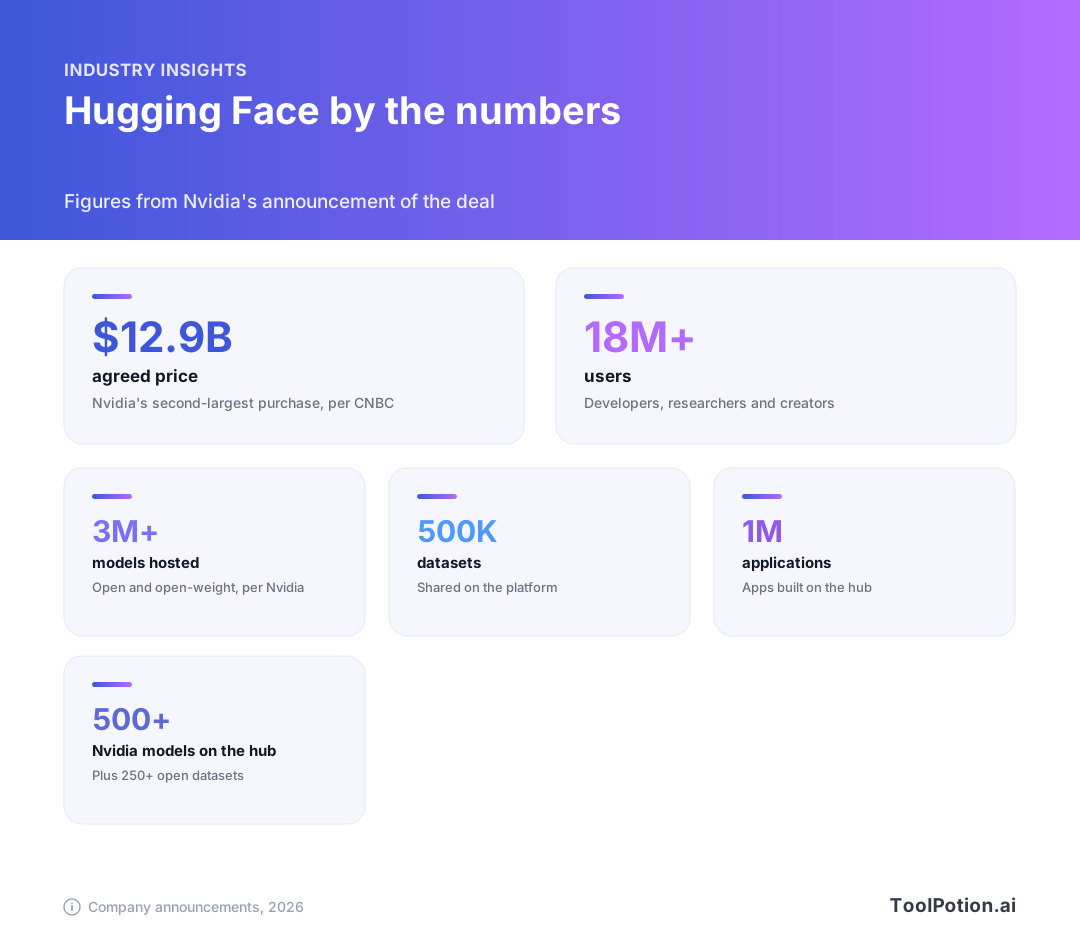
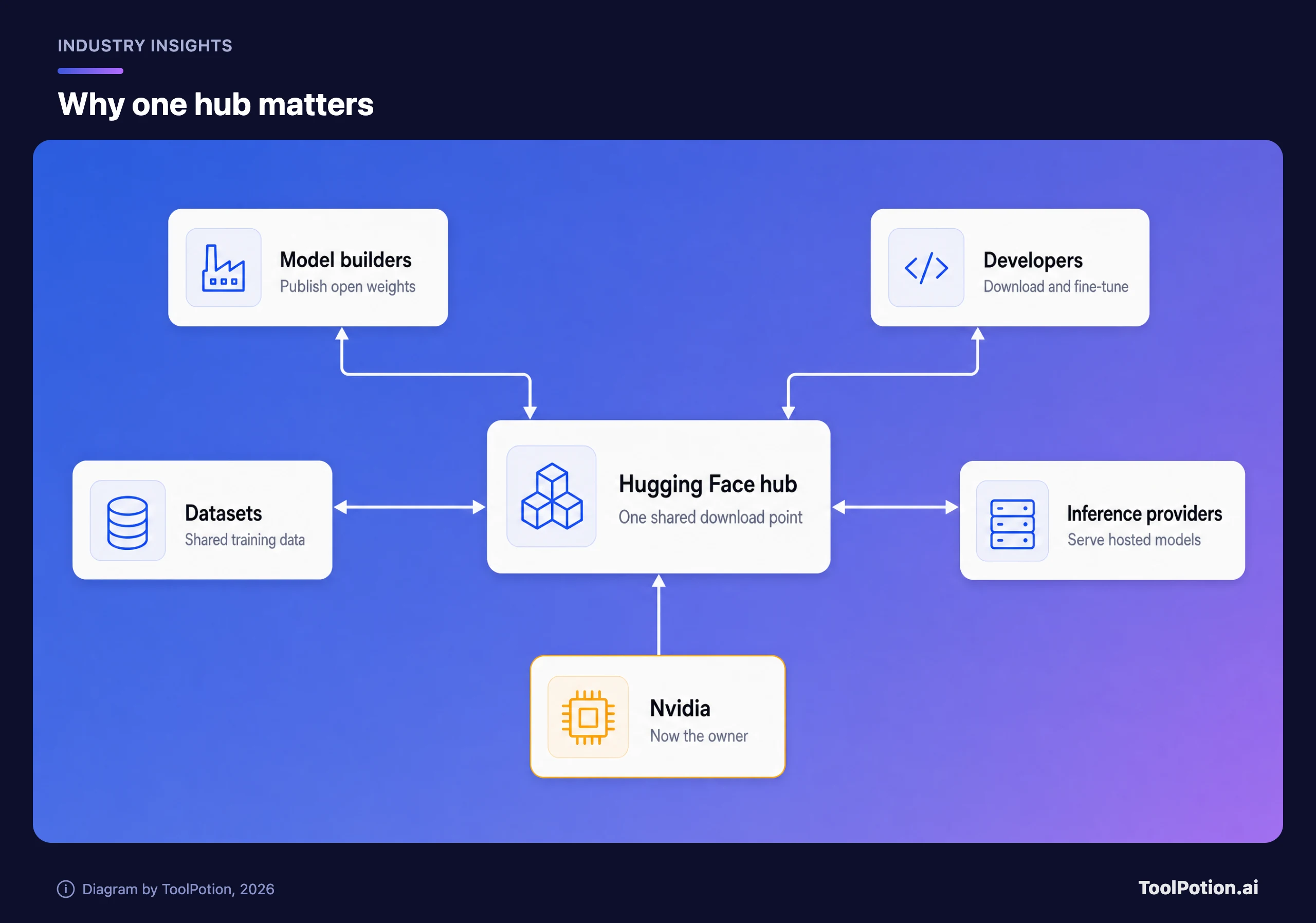
If you've never opened the site: Hugging Face is where open models live. It works like the package registry for AI. A model builder uploads weights, a developer downloads them, and a library like Transformers knows where to look by default. Nvidia's own announcement says more than 18 million people use it to share more than 3 million models, 500,000 datasets and 1 million applications (Nvidia).
Nvidia says the hub stays open
Jensen Huang published the announcement himself. The key sentences are about neutrality: "Hugging Face will remain an open platform for the entire AI ecosystem," he wrote, and "NVIDIA compute will not be required to build on or deploy through Hugging Face" (Nvidia). It also promises continued support for open-weight models "from every model builder" and for multi-cloud, multi-accelerator work.
That's a lot of commitment for a blog post. It's not a contract, and nothing in it says what happens to the pricing, the terms of service or the hosting terms of competitors' models. Nvidia says its infrastructure can help with "platform reliability, safety, model evaluation, inference and deployment." Inference and deployment are exactly where a chip company has something to sell.
Hugging Face's CEO, Clément Delangue, told CNBC that his company approached Huang first, because it needed "more resources, more scale, more visibility" and Nvidia was "a perfect home" (CNBC). Read that as a founder choosing his buyer, not a company being taken. It also fits Nvidia's record on the hub: it says it is the largest contributor of open models and data to Hugging Face, with more than 500 models and 250 datasets (Nvidia).
The Justice Department is reportedly asking about control
Everything in this section traces to Reuters' unnamed sources. Per PYMNTS summarizing the Reuters report, the department is looking at whether the deal could hurt competition by handing Nvidia control of a key distribution point for AI. The questions are reportedly part of a wider investigation into Nvidia's conduct that began under the Biden administration and continued under Trump. That wider probe has asked about other acquisitions, investments, sales practices and whether Nvidia pressures customers.
There is a precedent in the coverage. PYMNTS notes that Bloomberg reported earlier this year that the department was looking at whether Nvidia structured its licensing deal with the chip startup Groq to avoid antitrust review. That is Bloomberg's reporting, not a finding. CNBC says the Hugging Face deal is Nvidia's second-largest purchase, after the $20 billion it paid for Groq assets at the end of last year, and that the company is moving beyond hardware and further up the AI stack (CNBC). Chips, then the software that runs on them, then the place the models are stored. You can see why a lawyer would draw a line through it.
The same report says an investigation is not evidence of wrongdoing and may not end in a lawsuit. PYMNTS adds that CNBC confirmed the inquiry with an unnamed source after Reuters published. We'd keep expectations low in both directions. An inquiry is a phone call, not a challenge to the deal. But the theory it points to is easy to follow: a company that sells most of the chips used to run open models now owns the place the models are fetched from.
Developers are nervous anyway
The reaction on Hacker News was less polite than the press release. One commenter predicted that "Soon HuggingFace will require an NVidia Developer account, an onerous license agreement that must be agreed to during registration and a bloated cli interface with loads of telemetry" (Hacker News). A reply pushed back that Nvidia only asks for a license agreement for things like CUDA and its drivers, not for basic SDK access.
Another commenter went after the technical stakes: Hugging Face "has the llama.cpp team, which is (was?) arguably the biggest threat to Nvidia's dominance through it's closed CUDA software" (Hacker News). That is one person's opinion, posted before the deal was announced, and we couldn't confirm it with the project. But it points at something real. llama.cpp is what lets Ollama and a lot of laptop setups run models without an Nvidia card, so if a hardware-neutral runtime ever lost its footing, the people who'd notice first are those running models locally. Nothing in Nvidia's announcement mentions it, and we haven't seen any statement from the project's maintainers that we could verify. Treat it as a question to watch, not a finding.
And then there's the plain cynic's version, from a third commenter: this is "like a company buying your local public pool, and you trying to convince everyone that things won't slowly turn to crap" (Hacker News). It's one anonymous user, not an expert, but it names the real worry. Platforms rarely break a promise on day one. They change the defaults later.
Our read
We think Nvidia has good reasons to keep the hub open for a long while. Its models are on there, its customers' models are on there, and a hub that visibly favors one chip would send builders elsewhere. The announcement says as much. What we don't believe is that a blog post is a guarantee, and the regulatory question is also unresolved. If the Justice Department's questions turn into something formal, the deal's timing and conditions could change. Nobody outside the room knows, and none of the coverage we read says when this ends.
One more detail from CNBC deserves a mention. Hugging Face was recently at the center of a hacking incident, and Delangue blamed engineering mistakes and told CNBC the breach showed why the company should "double down" on open-source AI (CNBC). Whatever you think of that argument, it tells you the platform is a target. A hub that large is also a single point of failure for everyone who builds on it, with or without a new owner.
The cleaner takeaway is older than this deal. Any single host for your model files is a dependency, and dependencies get a vote on your uptime. Our guides on which open-weight models to run, the cost math of open source versus SaaS and local versus cloud AI all rest on the same point: the less you rent, the less anyone can change under you.
An afternoon of housekeeping
None of this is urgent, and none of it is paranoia. Do it before you need it, because after a terms change is the wrong time to discover you never copied anything.
- Pin every production model to a commit hash instead of "main". With the Hugging Face Python tools that means passing
revision="<commit-sha>"when you download or load. - Copy the weights you actually ship to storage you control, a bucket or an internal registry, and load from that path in production.
- Save each model's license text next to its weights. Licenses can be edited on the model page later. Your copy shows what you agreed to.
- Mirror the datasets you train on, too. People forget these.
- Test one runtime that doesn't need an Nvidia GPU, even if you never plan to use it.
from huggingface_hub import snapshot_download

path = snapshot_download(
    repo_id="org/model-name",
    revision="<commit-sha>",   # not "main"
    local_dir="/models/model-name",
)
Here's the same list as something you can tick through. Anything under five points means a policy change could cost you a launch.
The next thing to watch is whether the department's questions get a public form, either a formal request for information or a statement from Nvidia. Until then, the safe assumption is that Hugging Face stays as open as it is today, and the sensible habit is to not depend on that.