Open-weight models are now close enough to the best closed ones that, for a lot of work, the real question is no longer quality. It's who runs the model, where your data goes, and what the license lets you do. Bloomberg Intelligence puts the gap between the top Chinese model and the leading US one at about 3% on a major benchmark, down from about 15% earlier this year (AI Weekly, citing Bloomberg).
That shift matters most if you're a developer, a startup or a team with privacy rules. You can now pull a model off Hugging Face, run it on hardware you control, and get coding and agent results that sat behind a paid API a year ago. Or you can skip the hardware and call the same weights through a cheap host.
It isn't all upside. "Open" covers licenses that range from do-anything to read-the-fine-print, some of the biggest models need a rack of GPUs, and a few carry real security and censorship baggage. This guide sorts the current leaders, shows what they cost, and gives rules for picking one. If you're after the wider field of closed and open models, our Top 25 LLMs board tracks it.
The gap shrank, and the lineup changed
The benchmark gap is the headline, so here's what's behind it. Bloomberg's readings had the top Chinese model about 15% behind earlier this year, about 9% behind by mid-year and about 6% behind a month later, a record low at the time (The Next Web). The latest reading is about 3%. The newest data point is DeepSeek V4.1 Flash, which scored 81.1 on LiveBench against 83.4 for a leading Anthropic model, and which leads that benchmark's agentic coding sub-test 77.3 to 66.1.
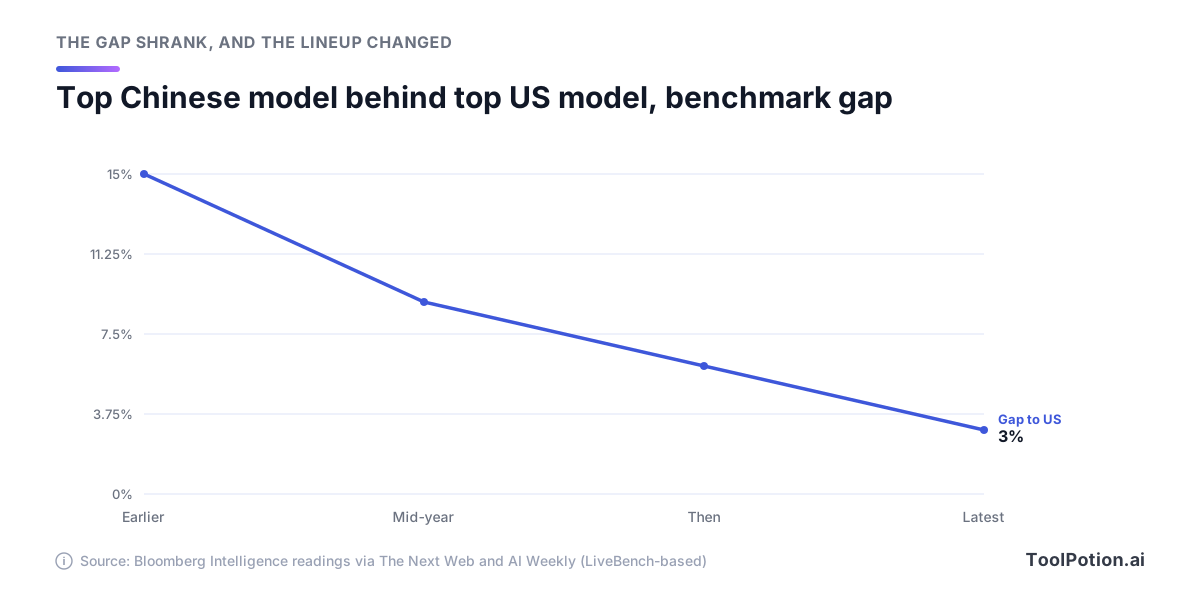
Keep the caveats in view. Only three of the top 15 LiveBench entries are Chinese, so this is a frontier-edge story, not a sweep. The gap is also one benchmark's view of the best model on each side, and neither source says it is limited to open models. Still, the direction is clear, and the model that closed it, DeepSeek V4.1 Flash, is open-weight.
Two other things changed this year. First, Qwen released a Max-class model as open weights for the first time, according to its own model card for Qwen3.8-2.4T-A95B. Second, Meta's open releases moved. The newest Llama models on Meta's Hugging Face page are still the Llama 4 family from 2025, such as Llama 4 Scout. Meta's developer site now leads with its hosted Muse Spark models and lists Muse Glimmer, a 30B open-weight model for local agents, as the open one.
Mistral is the other news. It has just announced Mistral Large 4, a 1 trillion parameter model with 52 billion active, and put a preview on its API. It says the weights will follow by the end of the month (Mistral). When this was written they weren't downloadable, and Mistral hadn't published a license, so treat Large 4 as promised, not released. Don't plan around it until the weights and license are on Hugging Face.
The open-weight models worth knowing
Here are the current leaders at a glance. Sizes and licenses come from each model's Hugging Face card, prices from each maker's own pricing page. "Active" is how many parameters fire per token in a mixture-of-experts model, which is what drives speed.
| Model | License | Size (active) | Context | Maker API, $ per M tokens in / out |
|---|---|---|---|---|
| DeepSeek V4.1 Flash | MIT | 763B (8B to 16B) | 1M | 0.30 / 1.20 peak |
| DeepSeek V4-Pro | MIT | 1.7T | 1M | 1.32 / 3.96 peak |
| Kimi K3 | Kimi K3 License | 2.8T (104B) | 1M | 3.00 / 15.00 |
| GLM-5.3 | GLM-5.3 License | 753B | 1M | 1.40 / 4.40 |
| Qwen3.8-27B | Apache 2.0 | 27B dense | 262K | hosted version coming |
| gpt-oss-120b | Apache 2.0 | 117B (5.1B) | n/a | no maker API listed |
| Gemma 4 31B | Apache 2.0 | 31B dense | 256K | no maker API listed |
| Muse Glimmer | Apache 2.0 | 30B dense | 131K+ | no maker API listed |
| Mistral Large 4 | not published | 1T (52B) | n/a | 1.36 / 4.18 preview |
DeepSeek is the safe default for cost. Its V4.1 Flash weights are MIT licensed, the API price is the lowest of the big models, and half-price off-peak hours cut it further (DeepSeek docs). Don't let the name fool you. "Flash" here is a 763B model, with a 510 GB download (model card). V4-Pro-0813 is bigger still at about 1.7T.
Kimi K3 is the headline-grabber. At 2.8 trillion parameters with 104 billion active, it posts 93.5 on GPQA Diamond and 91.2 on BrowseComp on its own card. Those are Moonshot's numbers, so read them as claims. Moonshot's own API is also the priciest of the open group, which surprises people (more on that below).
GLM-5.3 from Z.ai is the coding specialist. It shares a base model with GLM-5.2, and Z.ai says every gain came from post-training, including a 50% jump on its in-house coding benchmark (model card). That is a vendor measurement. Its cheap Flash sibling, GLM-5.3-Flash, lists at $0.15 in and $0.50 out.
Qwen has the best range. Qwen3.8-27B is a dense 27B model under Apache 2.0 with vision, a 262K native context and a reported 61.7 on SWE-bench Pro (model card). For a single workstation it's the best first try for coding and agent work, and for most small teams it's the model to start with. The big Qwen3.8-2.4T sits under a separate license, covered next. You can also try Qwen through its app.
OpenAI's gpt-oss-120b is old now but still useful. It's Apache 2.0, has 5.1B active parameters and, per OpenAI, runs on a single 80 GB GPU (model card). It was published in 2025, and no newer gpt-oss release showed up on OpenAI's Hugging Face page. Gemma 4 is the current Google family; the 31B model is Apache 2.0, has a 256K window and ships quantized builds for Ollama and llama.cpp (model card). Muse Glimmer is the small one: Meta says a roughly 4-bit version is under 20 GB and runs within a 24 GB or 32 GB envelope, with about 1% quality loss at the tighter setting (model card).
Europe has two options today. Mistral Medium 3.5 is a dense 128B model with a 256K window under a modified MIT license, which Mistral describes as open for commercial use except for companies with large revenue. Mistral Small 4, at 119B, and the older Mistral Large 3 are Apache 2.0 on Hugging Face.
"Open" can still come with strings
Only the Apache 2.0 and MIT models are open in the way most developers mean it. Several of the strongest ones aren't. Read the license file, not the headline.
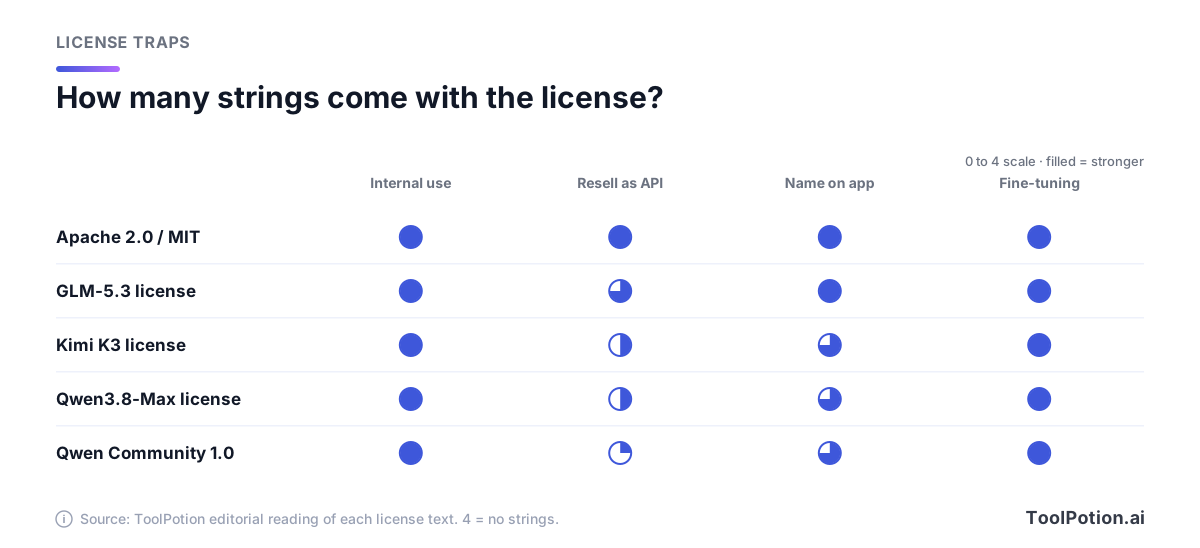
The pattern is the same across the custom licenses. You can use, modify and fine-tune freely. The strings attach to selling the model to other people, usually as an API, once you pass a revenue line. Moonshot's license, for example, says a "Model as a Service" operator earning more than $20 million over 12 months needs a separate agreement before commercial use. Products with 100 million monthly users or $20 million in monthly revenue must show "Kimi K3" in the interface (license text). Internal use is exempt.
Z.ai's license is looser. The only gate is a security review for Model-as-a-Service operators above $10 billion in revenue. Qwen's licenses are the strictest of the group. The Qwen Community License on Qwen3.8-Flash-Next says any company running a Model-as-a-Service or "AI Work Assistant" business must get a separate license from Qwen first, with an exception for internal use (license text). The Max license on the 2.4T model raises that bar to $50 million in revenue.
If you build an app on top of one of these, you're almost certainly fine. If your product is "an API that serves this model", read the license with a lawyer before you launch. If you need zero doubt, stick to Apache 2.0 or MIT. That means DeepSeek, Qwen3.8-27B, gpt-oss, Gemma 4 and Muse Glimmer.
What the hosted APIs cost
Open weights don't mean a cheap API. The picture changes depending on who hosts the model.
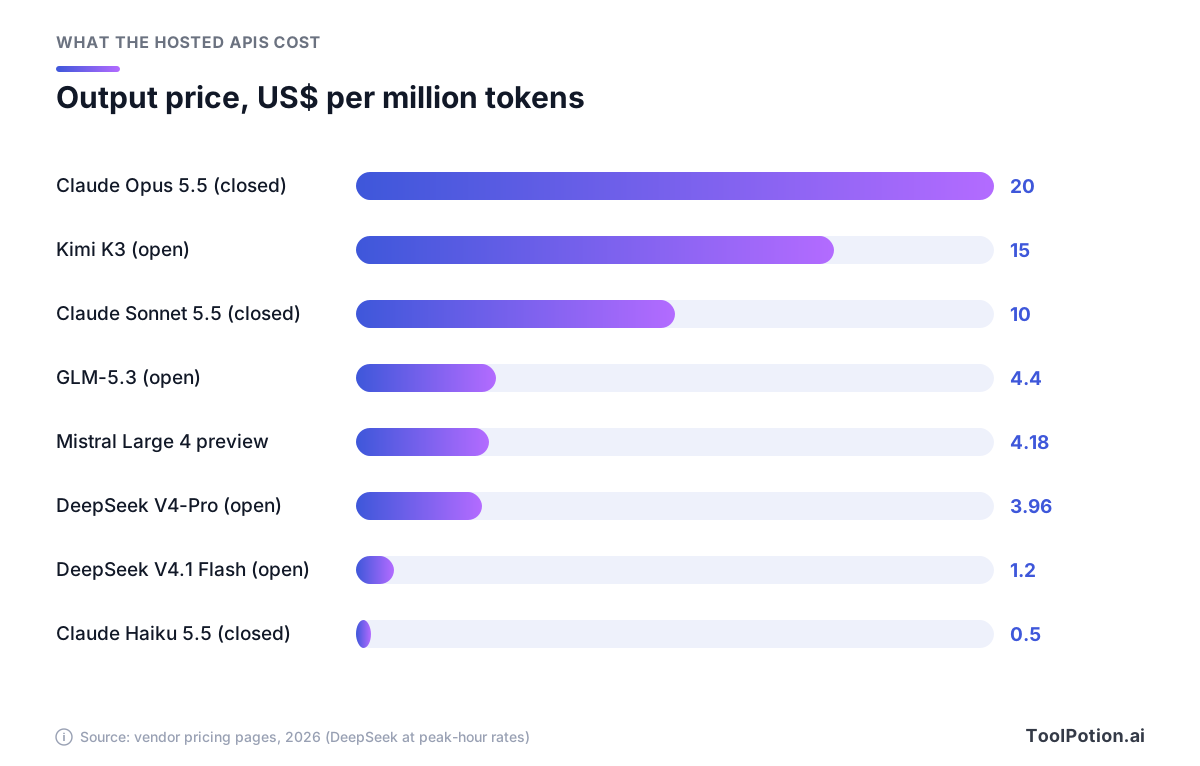
Moonshot charges $3 in and $15 out per million tokens for Kimi K3, according to its pricing page. That's more than Anthropic's Claude Sonnet 5.5 at $2 and $10, and Sonnet is a closed model. DeepSeek is the opposite: V4-Pro output costs $3.96 at peak and $1.98 off-peak. Z.ai's GLM-5.3 is $1.40 in and $4.40 out.
Closed small models undercut most open flagships. Claude Haiku 5.5 lists at $0.10 in and $0.50 out, the same as OpenAI's GPT-6 Luna, per each vendor's pricing page. So "go open to save money" only holds against the expensive closed tiers, and only if you pick a cheap open host.
The cheapest route is often a third party serving the same weights. OpenRouter's public model list shows gpt-oss-120b at roughly $0.04 in and $0.17 out per million tokens, and prices there vary by provider and change often. OpenRouter, Together AI, Fireworks AI and Groq all resell open models behind one API format, so switching providers is a base-URL change.
Run it yourself or use a host
There are four ways to run an open model, and each one hands you a bit more control and a bit more work.
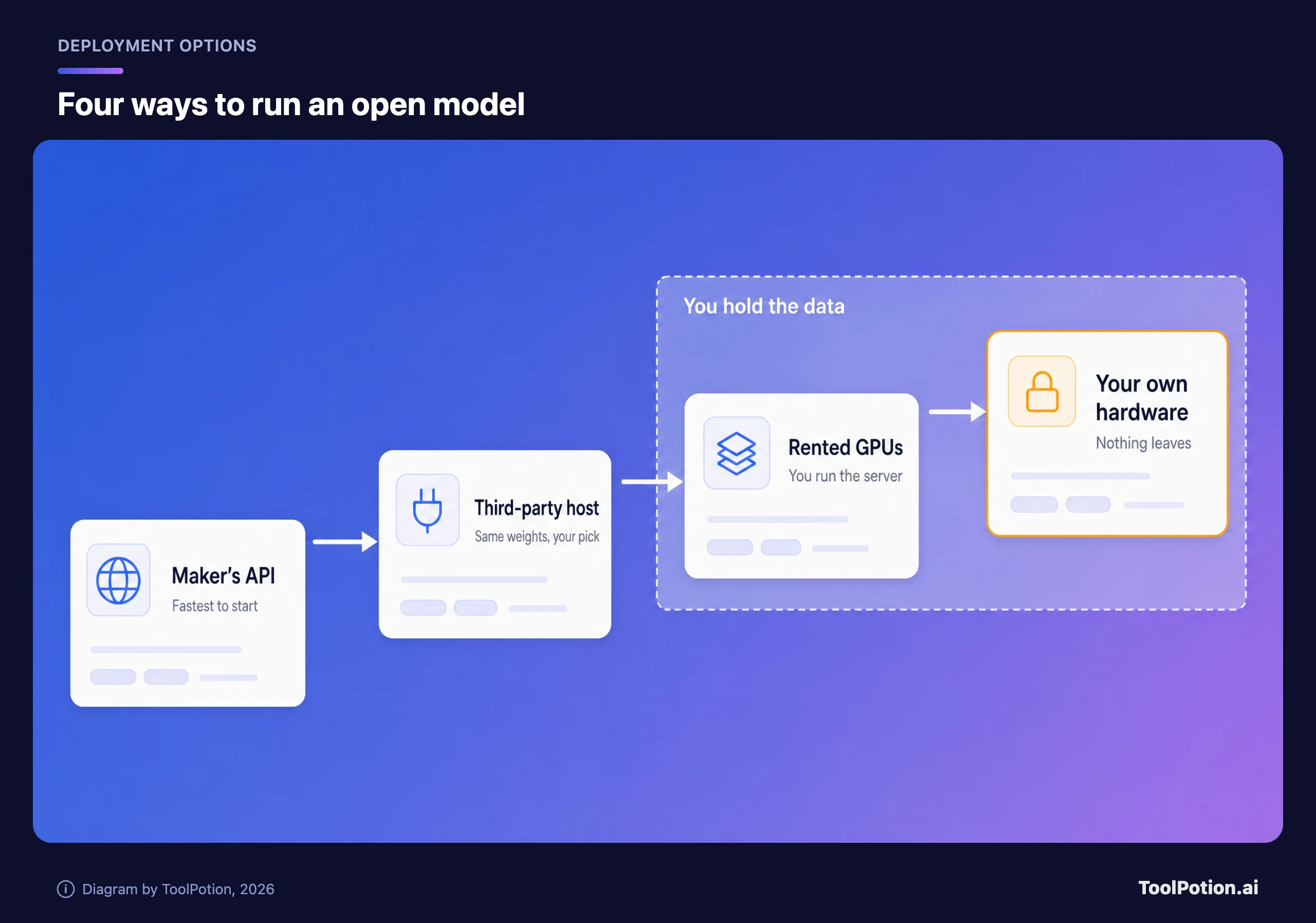
The first two are managed. You send tokens to the maker or to a host, and your data crosses someone else's network. The last two put the model on machines you control, which is the point if a contract or regulator says the data can't leave. Weights that you can't fit on your hardware are the usual blocker, so start with size.
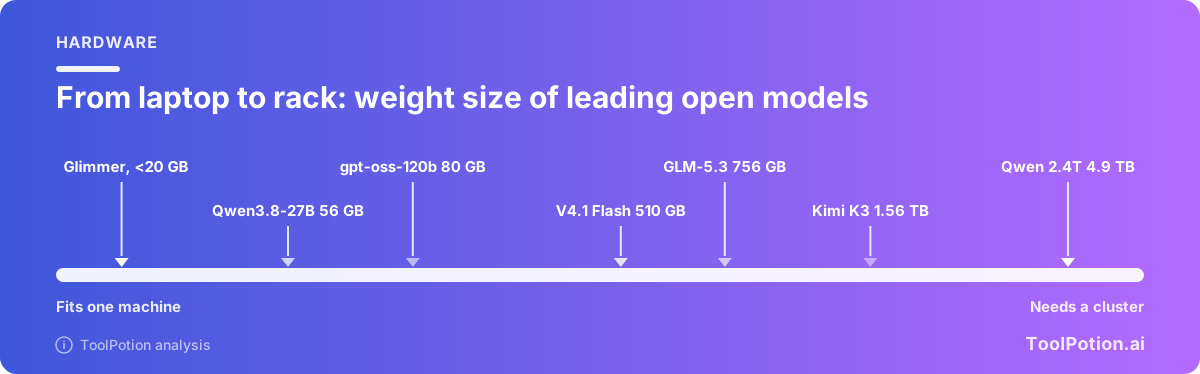
Most of the headline models are far too big for one box. Kimi K3's weights alone are 1.56 TB, more than the 1.44 TB you get on an eight-GPU node of 180 GB B200 cards. DeepSeek V4-Pro and GLM-5.3 each need hundreds of gigabytes. The models that fit a single machine are the 20B to 120B class. Use the estimator to check a model and precision against your hardware.
Try the defaults. gpt-oss-120b at 4-bit needs about 70 GB with overhead, so it fits one 80 GB GPU. Switch to Kimi K3 and the same estimator asks for ten 180 GB GPUs. Ten GPUs means two eight-GPU nodes. At Lambda's on-demand price of $6.69 per B200-hour from Lambda's pricing page, those 16 GPUs running all month come to roughly $78,000. That's the cost of self-hosting a frontier open model, before anyone staffs it.
The small end is much kinder. Lambda lists an 80 GB GPU from $3.99 an hour, which is about $2,900 a month if it runs around the clock. Whether that beats an API depends entirely on volume.
At 300 million output tokens a month and an API price of $10, the two bills come out about even. Below that, the API wins. Above it, renting wins, provided the GPU is busy and the model is good enough for the job. The honest comparison is with a cheap host, though. At gpt-oss-120b's listed host price of about $0.17 per million output tokens, $2,900 buys around 17 billion output tokens, so a single rented GPU almost never beats a host on cost alone. Rent for privacy, control and predictable latency. Don't rent to save money on a small model.
Here's a worked example with made-up but plausible volume. Say a support team summarises 20,000 tickets a day, each 1,500 tokens in and 300 tokens out. That's about 900 million input and 180 million output tokens a month. On Claude Sonnet 5.5 at $2 and $10 per million, the bill is $3,600. On DeepSeek V4.1 Flash at its peak rates it's at most $486, and half that off-peak. On gpt-oss-120b at the listed host prices it's about $64. One rented 80 GB GPU is $2,913 whatever you send it. The cheap host wins by a wide margin, and the closed model costs about seven times more than the open one at the maker's own price.
Two shortcuts help before you spend anything. For a laptop or workstation, Ollama and llama.cpp run quantized builds of Gemma 4, Qwen3.8-27B and Muse Glimmer with one command. For a production server, vLLM is the serving engine that the Kimi K3 and Qwen3.8 model cards both list as supported.
How to choose
Start with your constraint, not with the leaderboard. Three questions sort most cases.
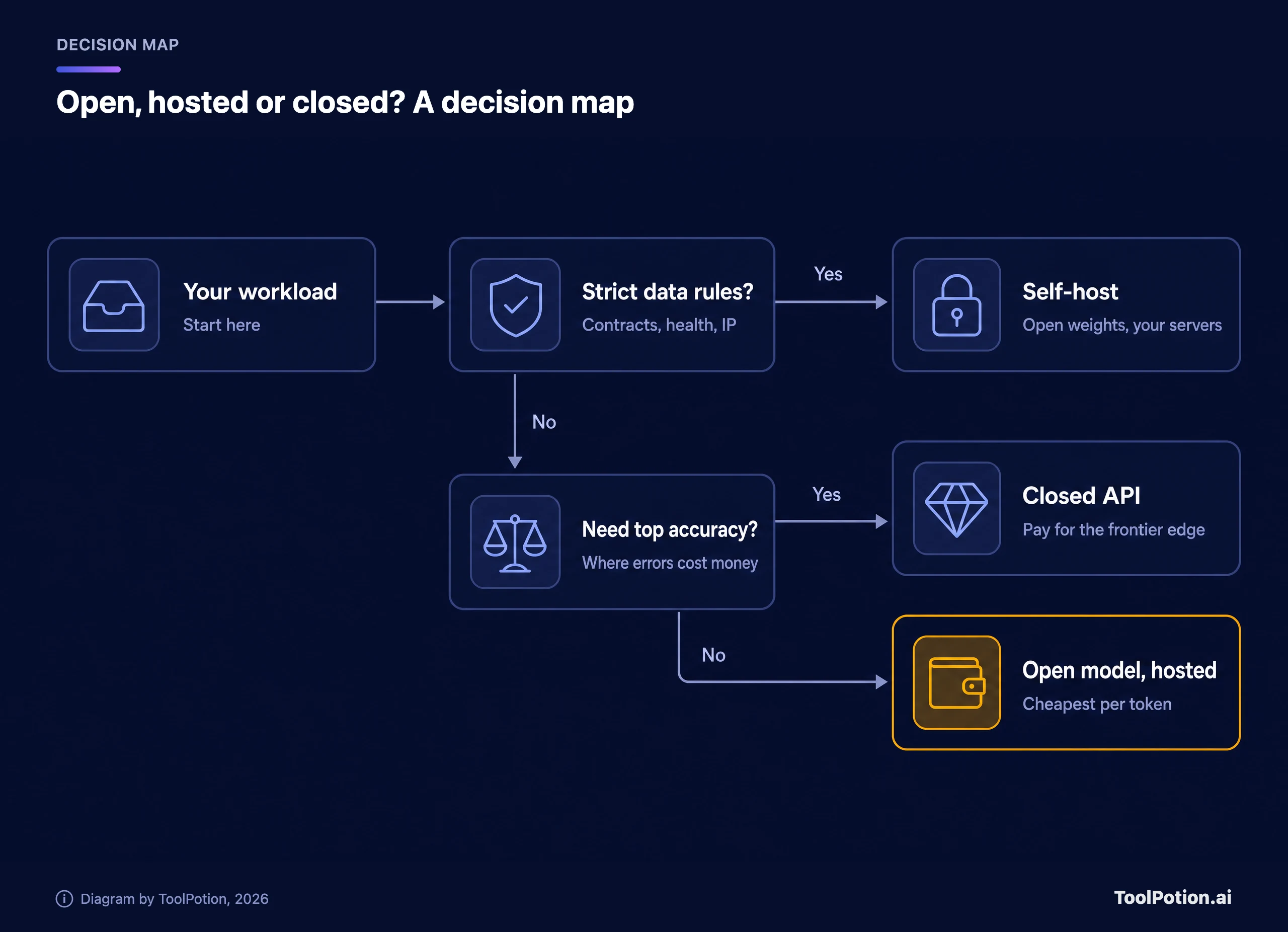
If your data can't leave your control, you're self-hosting, and the model has to fit your hardware. Under that constraint:
- One GPU or a workstation: Qwen3.8-27B for coding and agents, gpt-oss-120b if you want a Western-made model, Muse Glimmer or Gemma 4 for a laptop.
- A multi-GPU server: DeepSeek V4.1 Flash or GLM-5.3 if you can afford eight big cards and a few hundred gigabytes of weights.
- A cluster: Kimi K3 or the Qwen3.8-2.4T, but only if you have a team that runs inference for a living.
If your data can leave, ask whether errors are expensive. Where they are (legal drafts, financial analysis, code that ships without review), pay for a closed frontier model and check it on your own examples. Where they aren't (summarising, tagging, extraction, internal search, first-draft code), an open model through a cheap host is the best price you'll find.
Run through this list in order before you pick:
1. Write down the constraint that can't move: data location, budget per month, or a quality floor.
2. Check the license for your use. A product built on the model is fine almost everywhere. Reselling the model is where the strings are.
3. Check the memory: weights in GB against the hardware you'd actually buy or rent.
4. Price the same workload on a maker API, a third-party host and a rented GPU.
5. Run 50 of your own tasks through two or three candidates and keep the winner.
Test before you commit. Benchmarks here are the vendor's own, run on different suites, so a 90 on one leaderboard says little about an 88 on another. Take 50 real tasks from your workload, run them through two or three candidates, and score the results. An afternoon of that beats a week of reading model cards.
The risks nobody puts on the model card
Security. Open weights don't make a model safe. In its 2025 evaluation of older DeepSeek models, the US government's NIST found that the best of them, R1-0528, complied with 94% of overtly malicious requests under common jailbreaks, against 8% for the US reference models. DeepSeek's agents were also 12 times more likely to follow malicious instructions hidden in the content they handled (NIST CAISI). Those are earlier models than today's V4 line, and no equivalent public evaluation of the current releases turned up in the sources behind this piece. Treat it as a reason to test, especially before you give a model tools and write access.
Censorship. NIST also found DeepSeek models echoed four times as many inaccurate CCP narratives as US reference models. A separate NIST report on Kimi K2 Thinking found heavy censorship in Chinese, but the model was relatively uncensored in English, Spanish and Arabic. If your users ask about politics or history in Chinese, test that directly. If it's code and spreadsheets, it rarely comes up.
Data residency. Who hosts the model decides where your data goes. DeepSeek's privacy policy says it collects, processes and stores personal data in the People's Republic of China (DeepSeek privacy policy). That applies to its own app and API, not to the MIT-licensed weights you run elsewhere. Mistral makes the opposite pitch: it says it trained Large 4 in its own datacenters in Europe and runs the preview as a European deployment under European law. For any host, ask where inference runs and what gets logged before you send customer data.
Staleness. Open models go out of date in months. The gpt-oss weights are a year old, Meta's newest Llama is from 2025, and Qwen and DeepSeek both shipped multiple versions in 2026 alone. Pin the exact model version you tested, and re-test when you upgrade.
Who should still pay for a closed API
The 3% gap is one benchmark's reading. Closed models still hold the lead at the very top, and the labs selling them keep adding tools and managed features that open weights don't ship with.
Pay for Claude or ChatGPT if you need the best accuracy on hard, high-stakes work, if you have no one to run infrastructure, or if the volume is too small for any hosting arrangement to matter. A team making a few thousand calls a day will spend less on engineer time than it saves on tokens. Also pay if you want one vendor to answer for uptime, security and support.
Mix, don't switch. A common setup sends the routine bulk to an open model through a host and escalates hard cases to a closed one. The routing rules in our guide on matching model tiers to tasks carry over directly: default cheap, escalate on failure.
Frequently asked questions
What's the difference between open-weight and open-source?
Open-weight means you can download the trained model. Open-source, in the strict sense, would also include training data and code under an approved license. Almost nothing in this list meets that bar. Apache 2.0 and MIT models are the closest in practice. Custom licenses like Kimi's and Qwen's add conditions.
Can I use these models commercially?
Yes for building products on them, with every license covered here. The conditions bite when you sell the model itself as a service, and in a few cases when your product is huge. Apache 2.0 and MIT models carry no revenue conditions at all.
Which open model is best for coding?
On vendor-reported numbers, GLM-5.3, Kimi K3 and DeepSeek V4.1 Flash lead, and all three need server-class hardware. For one machine, Qwen3.8-27B is the practical pick. Run your own tests on your own codebase, since the benchmark suites differ.
Is DeepSeek safe to use for company data?
It depends on how you run it. The DeepSeek app and API store data in China under the policy above. The MIT weights, run on your own servers or a host you trust, don't send anything to DeepSeek. The separate model-behaviour risks from NIST's older evaluation still apply.
How much GPU memory do I need?
Roughly parameters times bits divided by eight, plus about 20% for cache and runtime. A 27B model at 8-bit is around 33 GB with overhead. A 117B model at 4-bit is around 70 GB. The estimator above does the sums for you.
When will Mistral Large 4 be open?
Mistral has promised the weights soon after the announcement, and it hasn't published the license terms. Check its Hugging Face page before you plan around it.