For most everyday questions, Google AI Mode is the best starting point, ChatGPT search is the best for talking a problem through, and Perplexity is the best when you want to read the sources yourself. None of them is reliable enough to skip the sources. Independent tests in 2025 and 2026 found wrong or unsupported answers in a large share of responses, from every vendor.
What changed this year is money. ChatGPT now shows ads to Free and Go users. Google has ads inside AI Mode. Perplexity went the other way and dropped advertising. So the choice is no longer only about answer quality. It is also about who is paying for the answer you're reading.
This guide covers what each product is today, what it costs in US dollars, how often the answers fail, and which one to open for shopping, news, academic, local and coding questions. There's a picker you can use in under a minute and a short routine for checking any answer. If you want the wider field, our Top 50 AI Search Engines board ranks the rest.
What each one is in 2026
Perplexity is an answer engine built around citations. Its pricing page promises citations in every answer (Perplexity), and its help center describes numbered links to the original sources. It also sells Comet, a Chromium-based browser with an AI assistant built in (Perplexity help). Comet launched for subscribers of the $200-a-month Max plan, then became free for everyone last year (TechCrunch). Perplexity's agent product, Perplexity Computer, goes beyond search and is outside this comparison.
ChatGPT search is a mode inside ChatGPT rather than a separate product. It searches the web on its own when your question needs current information, or you can switch it on by hand. It works on every plan, and OpenAI says people who aren't signed in can use it too (OpenAI Help). OpenAI also makes a browser, ChatGPT Atlas.
Google AI Mode is a tab inside Google Search. Google calls it its most powerful AI search experience and says it uses "query fan-out": it splits your question into subtopics and runs a search for each at once (Google Search Help). It takes text, voice, images, files and pasted URLs, and Google says it is available in more than 195 countries and territories. AI Overviews are the shorter summaries at the top of ordinary results, and AI Mode is the deeper version you can follow up on. It runs on Gemini, the model family behind the Gemini app, and the two aren't the same product.
What you pay, and where the ads are
All three have a usable free tier. The paid tiers differ in what they add, and the ad situation is now a real difference between them.
| Perplexity | ChatGPT search | Google AI Mode | |
|---|---|---|---|
| Free tier | Yes, limited usage, basic models | Yes, no sign-in needed for search | Yes, on the Fast model |
| Paid price (USD) | Pro $20/month | Go $8/month, Plus $20/month | Google AI Pro $19.99/month |
| What paying adds | Deep research, model choice | More messages and tools, no ads on Plus | Expanded access to the Pro model in AI Mode |
| Ads | None, program ended | Free and Go plans only | Yes, shopping ads in AI Mode |
The prices come from each vendor's own pages: Perplexity pricing, OpenAI pricing and Google AI plans. Perplexity's Pro plan is $20 a month. Google AI Pro bundles storage and other Google perks, which is why it costs more than a search tool alone. Google says its Pro model in AI Mode is for Google AI Plus, Pro and Ultra subscribers and has daily limits, while the Fast model stays available to everyone.
On ads, OpenAI says ads may appear for Free and Go users, never for Plus, Pro or business accounts. They sit below the response, labeled as sponsored, and OpenAI says they do not influence the answers (OpenAI Help). The test began in the US earlier this year. Perplexity told the Financial Times it doesn't plan to bring ads back, citing trust (MacRumors). Google runs ads in AI Mode and AI Overviews, and announced a shopping ad format for AI Mode, which PPC Land reports has passed 75 million daily users (PPC Land).
Ads don't prove an answer is bent. On a shopping question, though, learn to spot the sponsored label.
How an AI search answer gets made
The three work the same way underneath. They rewrite your question, run searches, read what comes back and write a summary with links. Where they differ is the search step and how strictly the summary sticks to the pages.
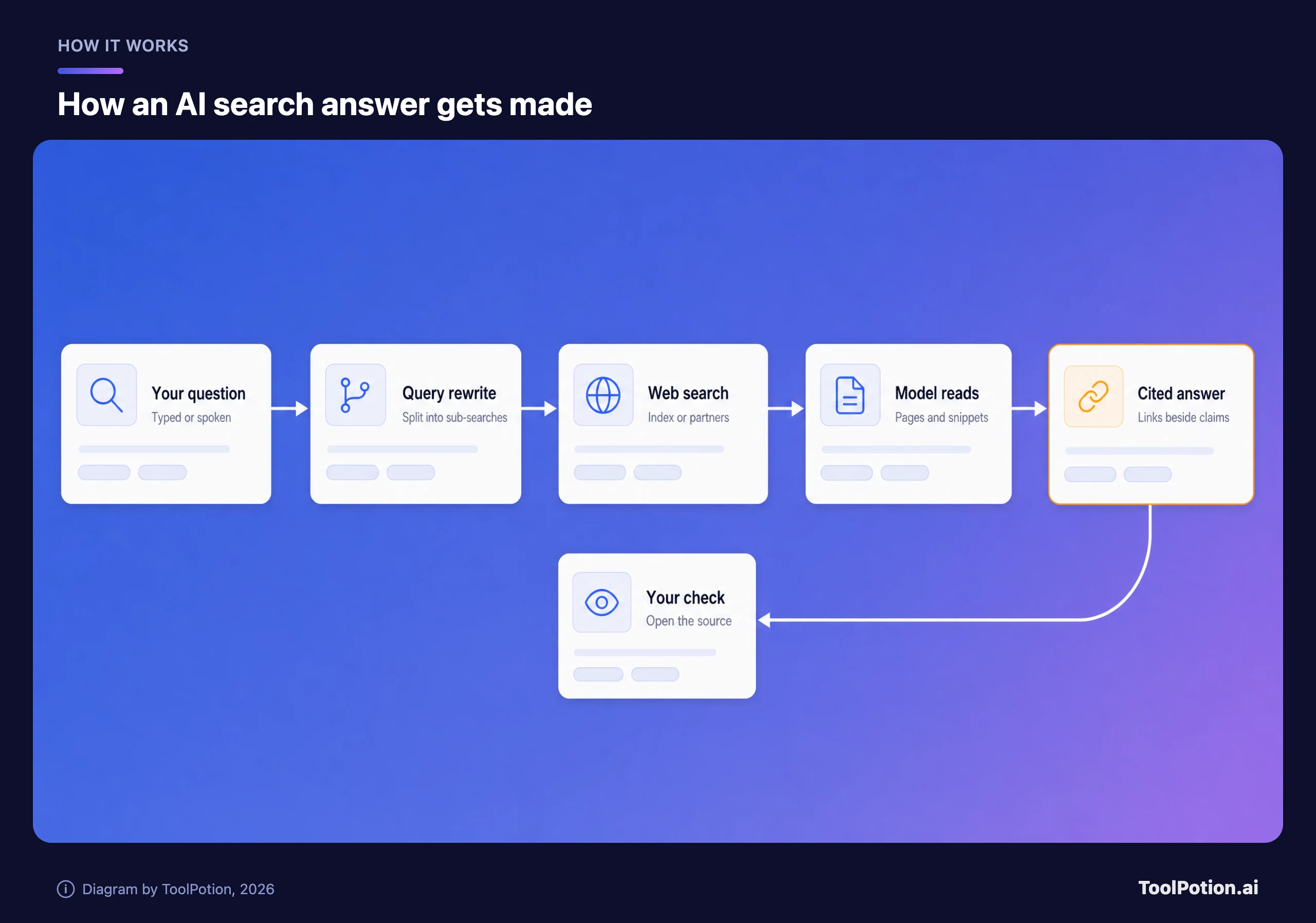
ChatGPT says it rewrites your question into targeted queries and sends them to search partners, along with a general location based on your IP address, though not the IP address itself or your account details (OpenAI Help). Google leans on its own index, and says AI Mode will show plain web links when it isn't confident in an AI response. The last box in the diagram is the one that matters to you. The model summarizes, but the link is where the claim lives.
Privacy follows the same split. Google uses interactions with its AI features to improve them, and AI Mode can pull from your search history and, if you connect them, Gmail and Photos. ChatGPT lets Free and Go users turn off ad personalization. Comet asks for keychain access to store passwords and payment details, which Perplexity says it encrypts on your device.
How often the answers are wrong
Often enough to matter. The best-known test of news answers came from the BBC and the European Broadcasting Union. Journalists from 22 public media organizations in 18 countries rated more than 3,000 answers from the free versions of four assistants. Overall, 45% had at least one significant issue, and sourcing was the biggest cause (BBC and EBU).
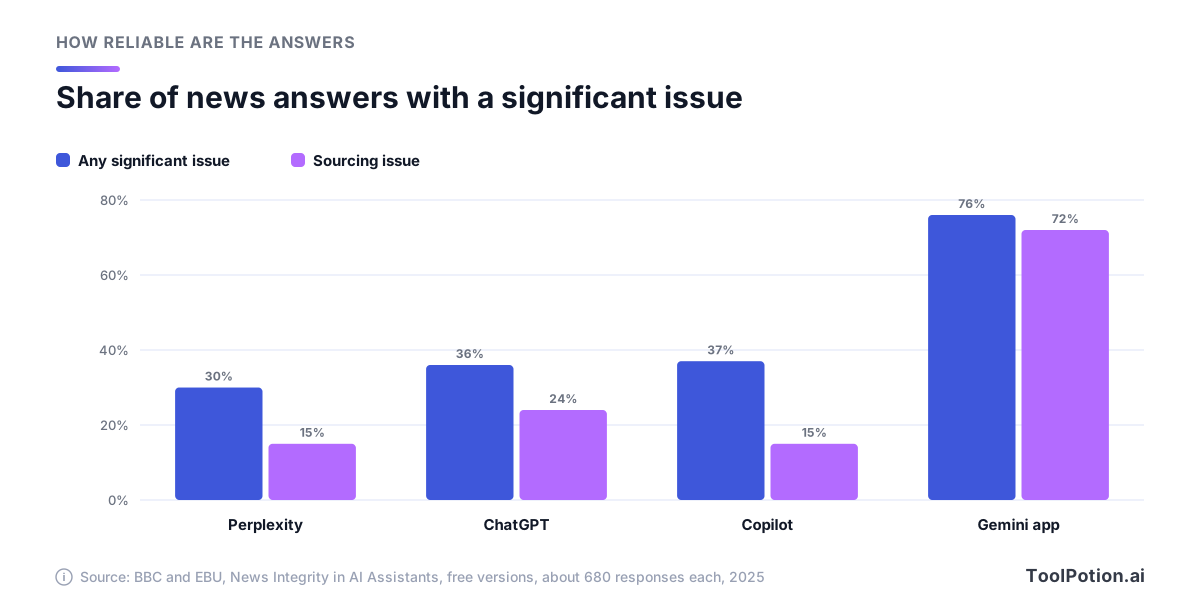
Perplexity had the lowest rate in that study, at 30%. ChatGPT was at 36%. The Gemini assistant was far behind at 76%, driven by sourcing: 72% of its answers had a significant sourcing problem, such as missing or incorrect attribution. Two caveats. The answers were collected in mid-2025, and the Gemini there is the standalone assistant, not AI Mode. Treat it as a snapshot.
The Tow Center at Columbia Journalism School tested a narrower task: give a chatbot a quote from a news article and ask for the headline, publisher, date and link. Across eight tools, more than 60% of answers were wrong. Perplexity missed 37% of the time. ChatGPT misidentified 134 of 200 articles and signaled doubt only 15 times (CJR). It also found that paid tiers were more confidently wrong than free ones. Again, that was early 2025.
Google's AI Overviews got a similar check in 2026. The AI company Oumi ran a study at the request of the New York Times, testing Overviews on a factual benchmark after Google moved them to Gemini 3. About 91% of the overviews it could assess contained the correct answer, but only 39% were both correct and fully supported by the sources they cited (Oumi). A right answer with a shaky footnote is hard to verify, which is the whole point of a citation.
Put together, the studies say the same thing from different angles. Citations raise your odds of catching a mistake, but a link next to a sentence is not proof that the page says it.
Which one for which question
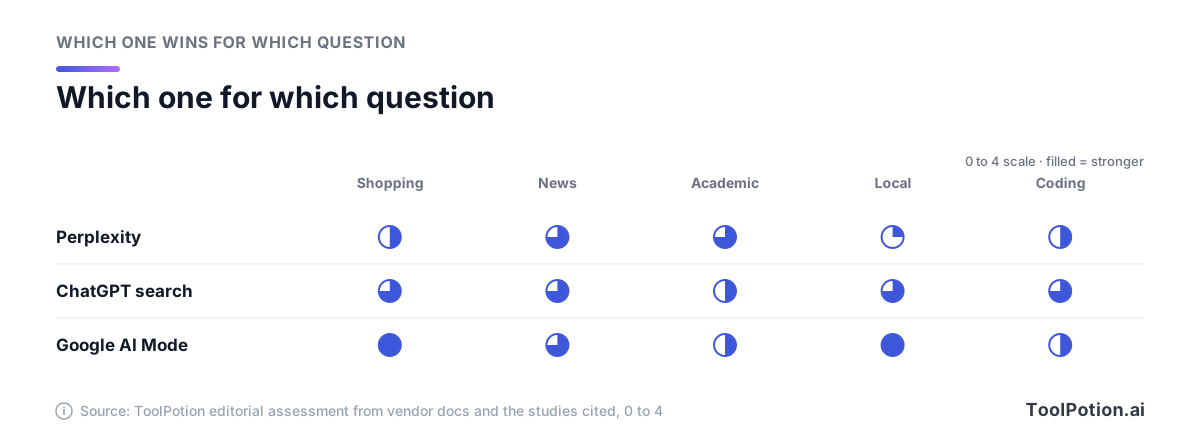
This scorecard is our judgment, built from the vendor documentation and the studies above. It isn't a benchmark, and it will date quickly.
Shopping
Google AI Mode and ChatGPT are the two to use. OpenAI's shopping research asks about budget and features, then builds a buyer's guide, and OpenAI says it works best on detail-heavy categories such as electronics and appliances (OpenAI). Google's advantage is that AI Mode sits next to its shopping listings. Both carry commercial placements on some plans, so check what's sponsored.
News
Use Perplexity or ChatGPT and open the articles. For anything breaking, read the original outlet. The studies above tested news directly, and news was where sourcing failed most.
Academic
None of the three replaces Google Scholar or a library database. Perplexity's Deep research and the research modes in the others are fine for finding the literature. Don't cite a paper until you've opened it. The directory's AI research assistants board and our roundup of research assistants cover tools built for that.
Local
Google AI Mode, because it lives inside Search next to Google's own Maps and shopping services. ChatGPT also does local results and can find restaurant reservation times through OpenTable, Resy or Yelp. Perplexity is the weakest of the three here on our scorecard.
Coding
Search is the wrong job. For coding, an AI search tool helps you find docs and error explanations, and ChatGPT's follow-up conversation suits that best. For writing code itself, see our ChatGPT alternatives guide.
Pick one in under a minute
Answer one or two questions and the picker names the tool to open first.
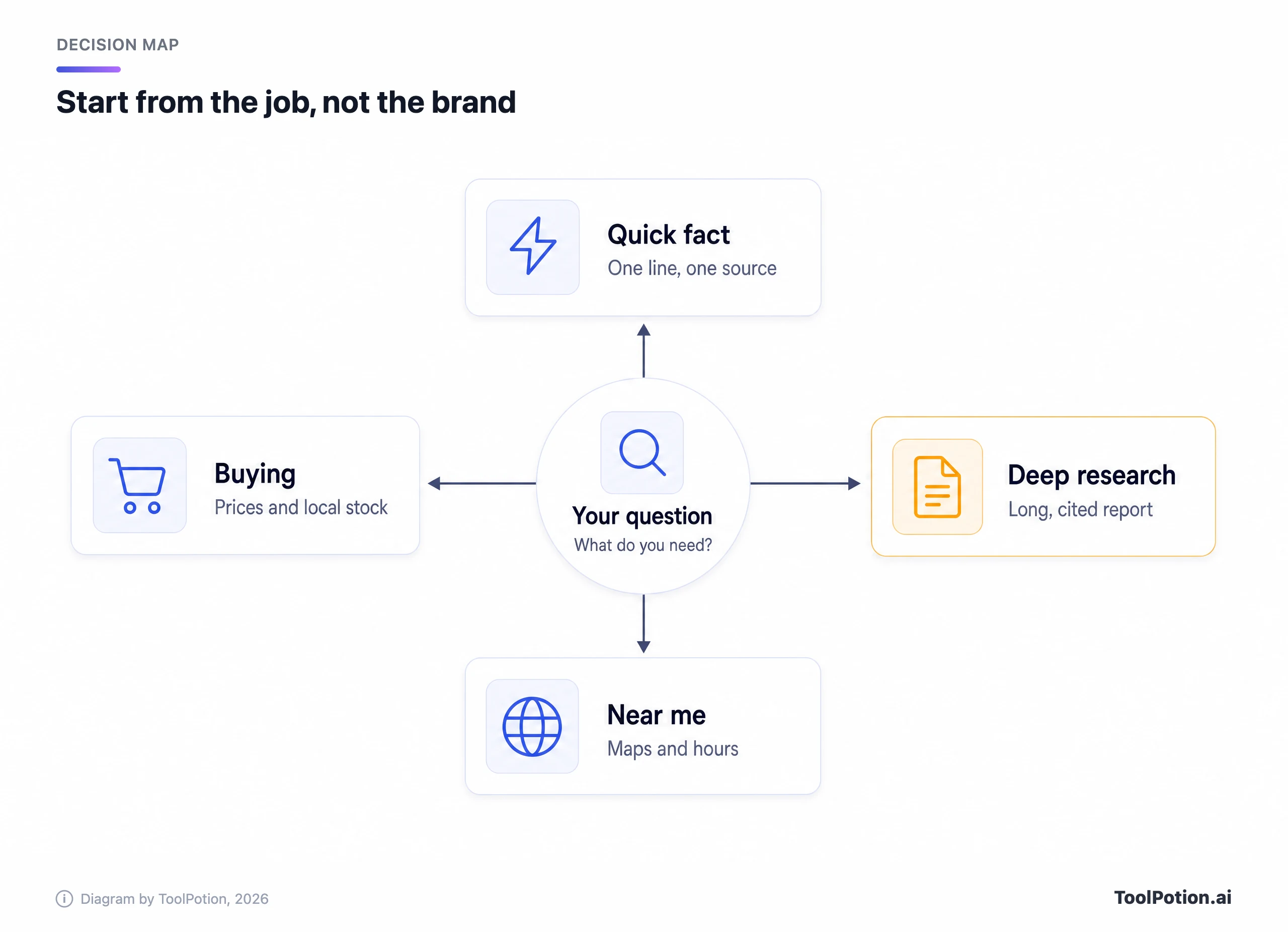
The map below is the same logic in one image. Start from the job. The brand comes second.
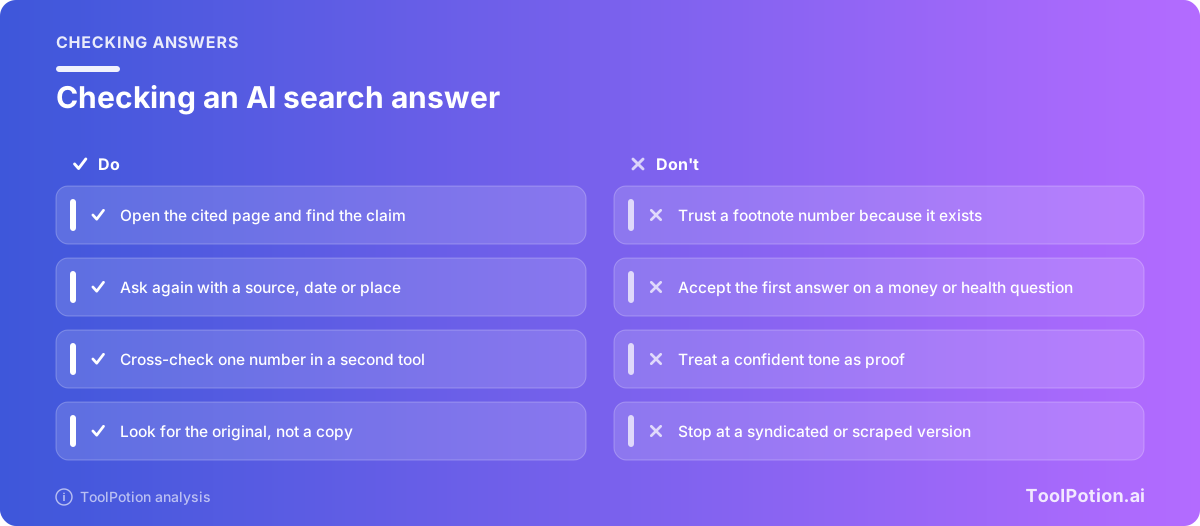
A five-minute routine for checking any answer
This works with any of the three, and it costs less time than a second search.
- Open the first cited source, not the footnote number, and find the sentence the claim rests on.
- If the claim has a number, a date or a legal or medical consequence, check it in a second tool or in the original document.
- Ask the question again with a source type, date or place: "using government sources, for the UK". OpenAI's own help page suggests this.
- Look for the original. Tow Center found tools citing syndicated and copied versions of articles.
- Treat a confident tone as zero evidence. The Tow Center found premium models were wrong more confidently than free ones.
When not to rely on AI search
Skip it for anything where a wrong answer costs real money or health: drug doses, tax filings, legal deadlines. Use the primary source and treat the AI answer as a pointer. Skip it too when you need an exhaustive list, since fan-out searches sample the web and don't audit it. And if you want privacy from a company's ad system, check the ad and personalization settings before you start.
If none of the three fits, other tools are worth a look: Brave Search for a privacy angle, Kagi for paid ad-free search, You.com and Microsoft Copilot. Developers building their own search can use the Perplexity Sonar API.
Frequently asked questions
Is Perplexity better than ChatGPT for search?
For source-first research, usually yes. Perplexity builds each answer around numbered citations and had the lowest significant-issue rate of the four assistants in the BBC and EBU study. ChatGPT is better when you want to keep talking, upload files or move into other tasks.
Is Google AI Mode free?
Yes, the Fast model is free. Google says the Pro model in AI Mode is for Google AI Plus, Pro and Ultra subscribers, with daily limits. Google AI Pro is $19.99 a month.
Does ChatGPT search show ads?
On Free and Go plans it can. OpenAI says Plus, Pro, Business, Enterprise and Edu accounts don't get ads, and that ads don't change the answers.
Which AI search is best for students?
Perplexity for finding sources and ChatGPT for working through a concept, with Google Scholar for the papers themselves. Open and read anything you plan to cite.
Can I trust the citations?
Not blindly. Studies found sources that didn't support the claim, fabricated links and copied versions of articles. Click through before you rely on a number.