If your videos face customers, pick HeyGen. If they face employees, pick Synthesia. That split isn't absolute, but it matches how each company sells itself, and it explains most of the differences in pricing, avatars and security paperwork below.
Both do the same basic trick: type a script, choose a presenter, get a talking video with no camera. In 2026 the gap isn't avatar realism so much as who each product expects to be holding the credit card. Both also sit on our AI video generators board, next to Colossyan and Fliki, if you want the wider field.
Who each one is built for
HeyGen's own pricing page is titled "Pricing Plans for Creators and Marketers" and says it serves 100,000+ businesses (HeyGen pricing). Its avatar page talks about sales videos, client explainers, ad creative and weekly social posts, and mentions bulk generation from a spreadsheet of scripts (HeyGen avatars).
Synthesia pitches the other way. Its pages are organized around learning and development, HR, sales enablement and IT, and it says it is trusted by 90% of the Fortune 100 (Synthesia avatars). It also sells avatar roleplay and survey sessions, which we didn't find on HeyGen's pages.
Neither company hides the split. HeyGen's marketing leans on speed and reach: its translate page says over 25 million videos have been translated on the platform, and a case it cites has Trivago localizing TV ads across 30 markets (HeyGen translate). Synthesia's leans on governance and scale inside big organizations. Those are vendor stories, so weigh them as such, but they tell you who the roadmap is written for.
Here's how the same script travels through each product, based on what the vendors document.
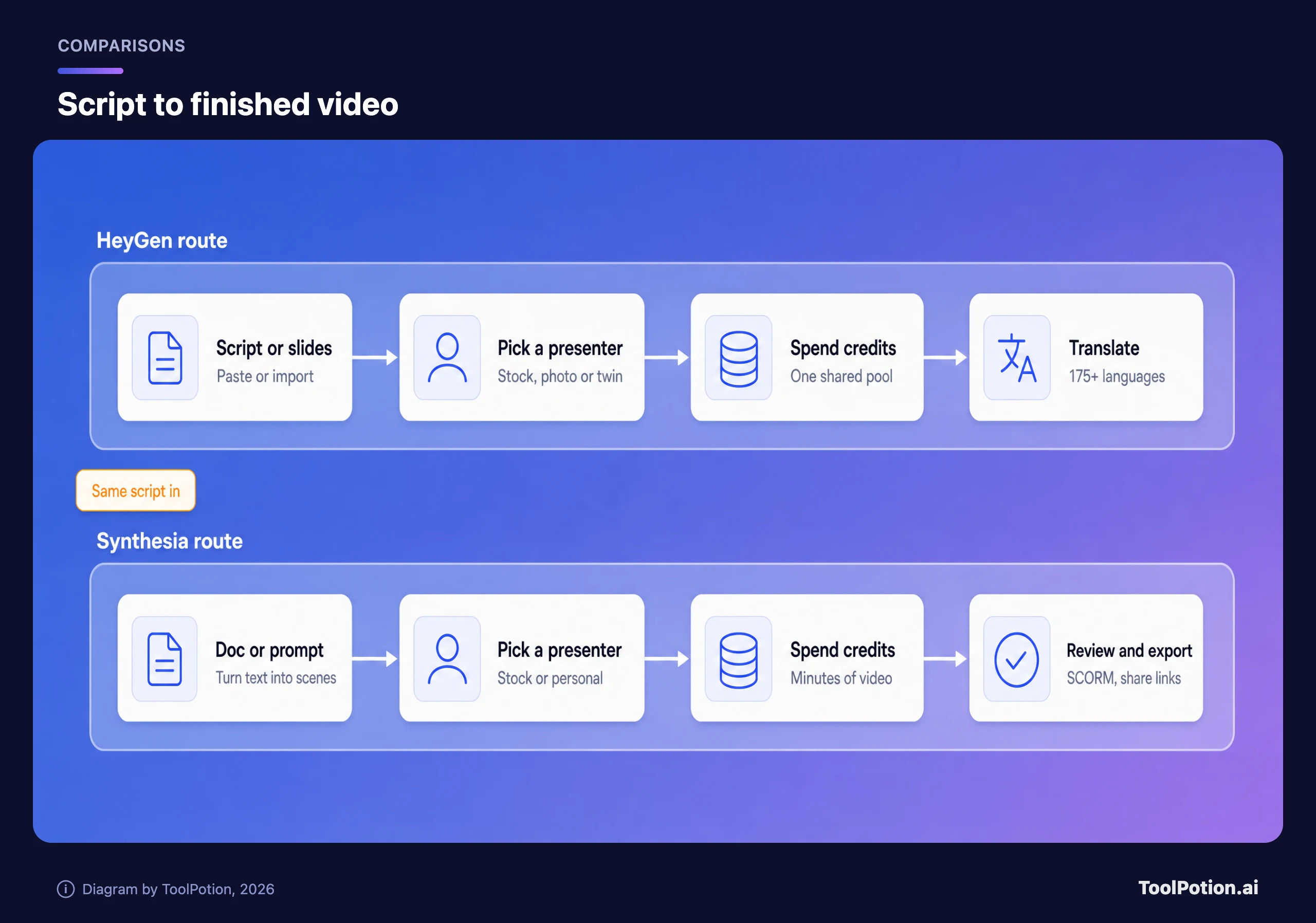
What the plans actually cost
Entry price is a tie. Both start paid plans at $29 a month. What you get for it is different, and that's where the budgeting headache sits.
HeyGen's Creator plan gives 600 credits, 1080p export, voice cloning and watermark removal. Pro is $49 for 1,000 credits and adds 4K. Business is $149 plus $20 per extra seat for 1,500 credits, five custom avatars, SSO and SCORM export. Its FAQ says Pro tiers climb to 100,000 credits for $4,300, and that a video's credit cost varies with the AI model, length and complexity (HeyGen pricing). That last point means you can't convert credits into minutes before you try it.
Synthesia is easier to forecast. Starter is $29 for 1,250 credits, which it says covers video up to about 12 minutes. Pro is $89 for 6,000 credits, or about 60 minutes. Its own estimator charges 100 credits per minute of video and 76 per minute of dubbing, and says real use varies with avatars and motion graphics (Synthesia pricing). Enterprise is custom, with unlimited video minutes.
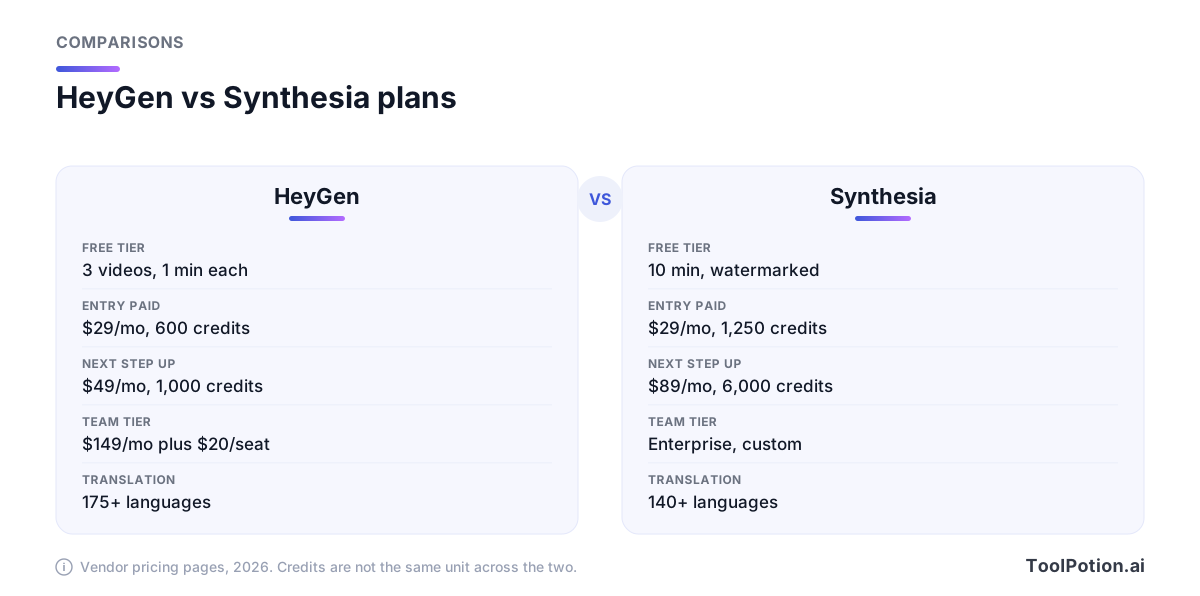
Seats and team features follow the same pattern. HeyGen charges $20 per added seat on Business and lists workspace commenting, centralized billing and automation hooks for n8n, Make, HubSpot and Zapier. Synthesia sells learner seats for roleplay at $29 each, and keeps live team collaboration, brand kits and an implementation team on Enterprise. If you're a team of two, HeyGen's structure will cost less. If you're a department of two hundred, Synthesia's will probably be what procurement expects.
The free tiers point the same way. HeyGen's gives three short videos a month. Synthesia's gives ten minutes of video with a watermark. Its paid credits stack on top of that free allowance.
Avatars, consent and translation
HeyGen offers stock avatars, Photo Avatars from a single image and Digital Twins built from your footage. It says most twins are ready in 10 to 20 minutes and that twins need verified consent from the person being recreated. Even the free plan includes one custom avatar slot. Its own pages disagree on the stock library: the pricing page says 500+ on Free and 700+ on paid plans, while the avatar page says 1,100+ (HeyGen avatars). We can't tell you which is current.
Synthesia advertises 240+ stock avatars on its avatars page, but its pricing page gives 125+ on Starter, 180+ on Pro and the full 240+ only on Enterprise (Synthesia pricing). It also has a prompt-based Avatar Builder and Personal Avatars made from a photo or short video (3 on Starter, 5 on Pro). Making one means recording a live consent statement. Synthesia says the person in the consent video must match the person in the footage and be at least 18, and that stock avatars skip the consent step because they come from actors or generated identities (Synthesia avatars).
There's one more avatar difference worth knowing. HeyGen lists its Avatar IV model on the free plan, with extended generations on paid plans, while Synthesia highlights prompt-driven scenes where an avatar acts rather than just talks. Both are vendor claims about realism, and we haven't tested either one. Judge from your own footage.
On translation, HeyGen markets 175+ languages and dialects with lip sync, up to ten target languages at once and a proofreading step (HeyGen translate). Synthesia says 140+ languages, bills dubbing from the same credit pool, and lists one-click translation among its features. If localization is the main job, HeyGen's pitch is more direct and its 175+ languages cover more ground.
Security and compliance claims
These are vendor statements, not audits we've seen. HeyGen says it holds SOC 2 Type II and meets GDPR, CCPA, the EU-US Data Privacy Framework and the EU AI Act, hosts on AWS in the US and runs annual third-party penetration tests (HeyGen security). It lists SSO on Business and SCIM provisioning on Enterprise.
Synthesia says it is SOC 2 Type II, ISO 27001, ISO 42001 and GDPR compliant and belongs to the Content Authenticity Initiative (Synthesia avatars). Its responsible AI page adds that it moderates content at the point of creation and calls itself the first generative AI company certified to ISO 42001 (Synthesia responsible AI). SAML/SSO is an Enterprise feature.
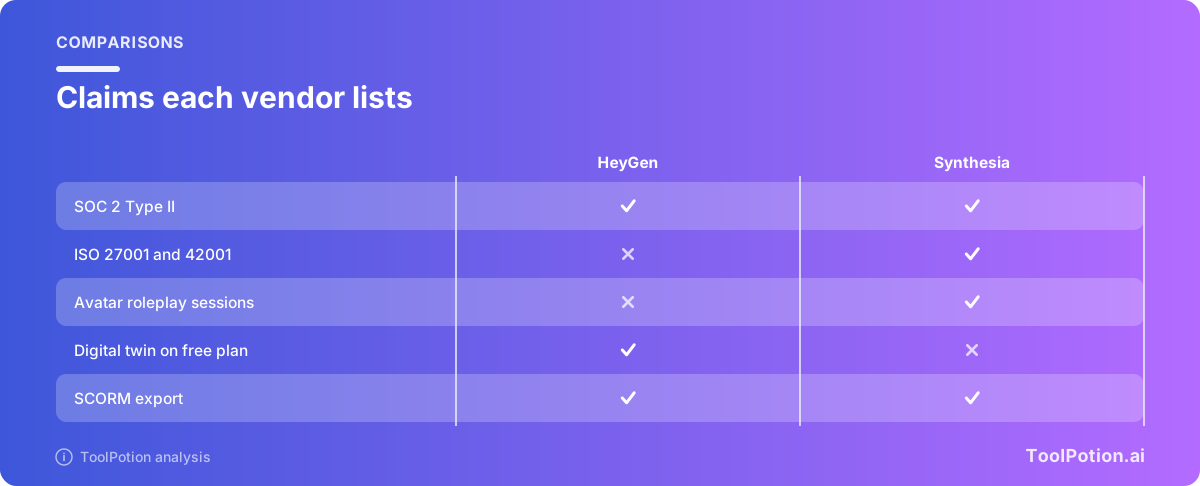
Read that matrix as "listed on the pages we read." A missing item may just mean the vendor didn't put it there. Ask for the trust report before you sign anything.
Which one to pick
Marketers, founders and agencies should start with HeyGen. The Creator plan is cheap, the digital twin is quick to make and the translation story is strong.
Training and comms teams should start with Synthesia. Predictable minutes, ISO paperwork, roleplay sessions and SCORM on the enterprise tier suit a procurement review. One catch: HeyGen's Business plan also lists SCORM export and LMS integrations at $149, so a small L&D team shouldn't rule it out.
If you can't decide, translate one real video on both free plans and compare how it sounds in your target language. That test costs nothing and beats any feature list. If neither fits, the AI avatar generators board and our ranked video generator guide cover the alternatives.
Frequently asked questions
Which one costs less to start?
At the entry level they cost the same, $29 a month. Synthesia's Starter adds about 12 minutes of video by its own math, on top of a free 10. HeyGen doesn't publish a minutes figure, so you'll need a trial to know.
Can I make an avatar of myself?
Yes on both. HeyGen builds a Digital Twin, and the free plan includes one custom avatar. Synthesia builds Personal Avatars on its paid plans (3 on Starter, 5 on Pro) and requires a recorded consent statement.
Which is better for training videos?
Synthesia is built around that use, with SCORM, SSO and roleplay on its pages. HeyGen's Business plan also offers SCORM, quizzes and LMS integrations, so it's a fair option for smaller teams.
Do stock avatars need consent?
Not for stock avatars on either platform, as far as their pages say. Consent applies when you clone a real person. Check each vendor's terms for commercial use before publishing.