Mya Dalton, a brand strategist, had a call coming up with a potential client. Claude Duet saw it on her calendar and prepared a brief. Then it noticed the call fell right before her flight and offered to move it. "I didn't realize that it was right before my flight," she said (Anthropic).
That's the scene Anthropic leads with, and it's a good one, because nothing in it is flashy. No one asked Duet anything. It read a calendar, did arithmetic about a flight, and spoke up. Getting there took a lot of plumbing: a cloud computer that stays on, a connection to Mya's calendar, a model (Opus 5.5, per Anthropic) deciding what's worth an interruption, and a rule that it checks accounts only every few hours (Anthropic).
It's also a research preview on a waitlist, which matters if you were about to cancel your assistant subscriptions. Duet joins Meta's Muse, OpenAI's Dots and Google's Spark in a crowded fight to be the thing you hand your inbox to. We read each company's own pages, the coverage, and the fine print, and we have a view on who should do what. Sometimes the view is to wait.
Four agents, four ways in
Duet is the least available and, for a lot of readers, the cheapest. Anthropic says it's a waitlisted preview for Claude Pro and Max subscribers in the US, on iOS, Android and the web at claude.ai, with no extra charge: it shares the usage limits of your plan (Anthropic). Pro runs $20 a month billed monthly, and Max starts at $100 (Claude pricing). Team and Enterprise plans aren't included yet. If you already pay for Claude, the cost is your existing limit, and Anthropic warns that Duet's background checks and big jobs like financial models eat into it.
Meta's Muse is the one you can try today. It launched in the US on iOS, Android, the web and WhatsApp, and Meta says it's "free for most of what people need, with subscription plans for people who want to do more" (Meta). The numbers come from TechCrunch, not Meta: two paid plans, Power at $20 a month and Maximum at $100, and a payment card required at signup (TechCrunch). We found no Meta page that lists the prices. Meta has since opened it in Singapore (Meta).
OpenAI's Dots, the other rival coverage keeps setting beside Muse, is a different kind of offer. A dot is an always-on agent with its own cloud computer, powered by GPT-6 Astra, and your first one is included in ChatGPT Pro or Business Premium at no extra cost, in eligible markets (OpenAI). ChatGPT's pricing page lists "Dot, your always-on agent" under Pro, and OpenAI's help center prices the cheapest Pro plan, Pro 100, at $100 a month (OpenAI help center). Business Premium's price is separate, and we didn't find it. Conversations with your dot don't count against your ChatGPT limits, but tasks it starts in Codex or ChatGPT Work do.
Google's Spark was announced earlier this year as a 24/7 Gemini agent that needs an AI Ultra plan, which PCWorld reported starts at $100 a month (PCWorld). We looked for Google's own word on it and found none: Google's Gemini plans page shows AI Ultra pricing (in local currency, so no US figure for us to check) but never mentions Spark. So the $100 and the plan requirement are PCWorld's, not confirmed by Google, and the same article said Google hadn't fully detailed Spark's permissions and approval controls.
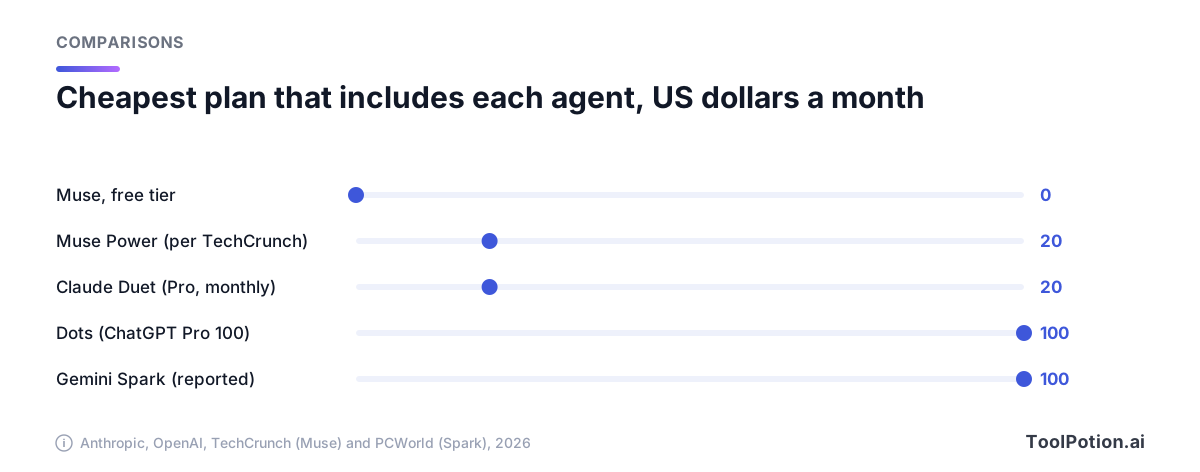
The chart shows the price of admission, not the price of a good month. Muse's free tier is the only way in that doesn't touch a subscription you might not want. For the others, you're really deciding whether the plan you'd buy anyway already includes one. Muse's and Spark's figures are secondhand, as marked.
Five doors, and who gets the keys
Every one of these agents wants the same five things: your email, your calendar, your documents, your logins and a way to pay. The difference is how many apps they can reach on the other side. Anthropic says Duet works with more than 6,000 connectors and plugins and lists examples that read like a small business's back office: unpaid invoices in QuickBooks or Stripe, payroll in Gusto, contracts through Docusign, follow-ups from HubSpot (Anthropic). OpenAI puts Dots at over 4,000 apps (OpenAI). Meta has shipped partnerships with Shopify, Stripe, Walmart, Sephora and others, and it opened its connector platform to developers (TechCrunch).
Don't compare those counts as if they were scores. A connector list tells you where an agent can go, not how well it behaves when it arrives.
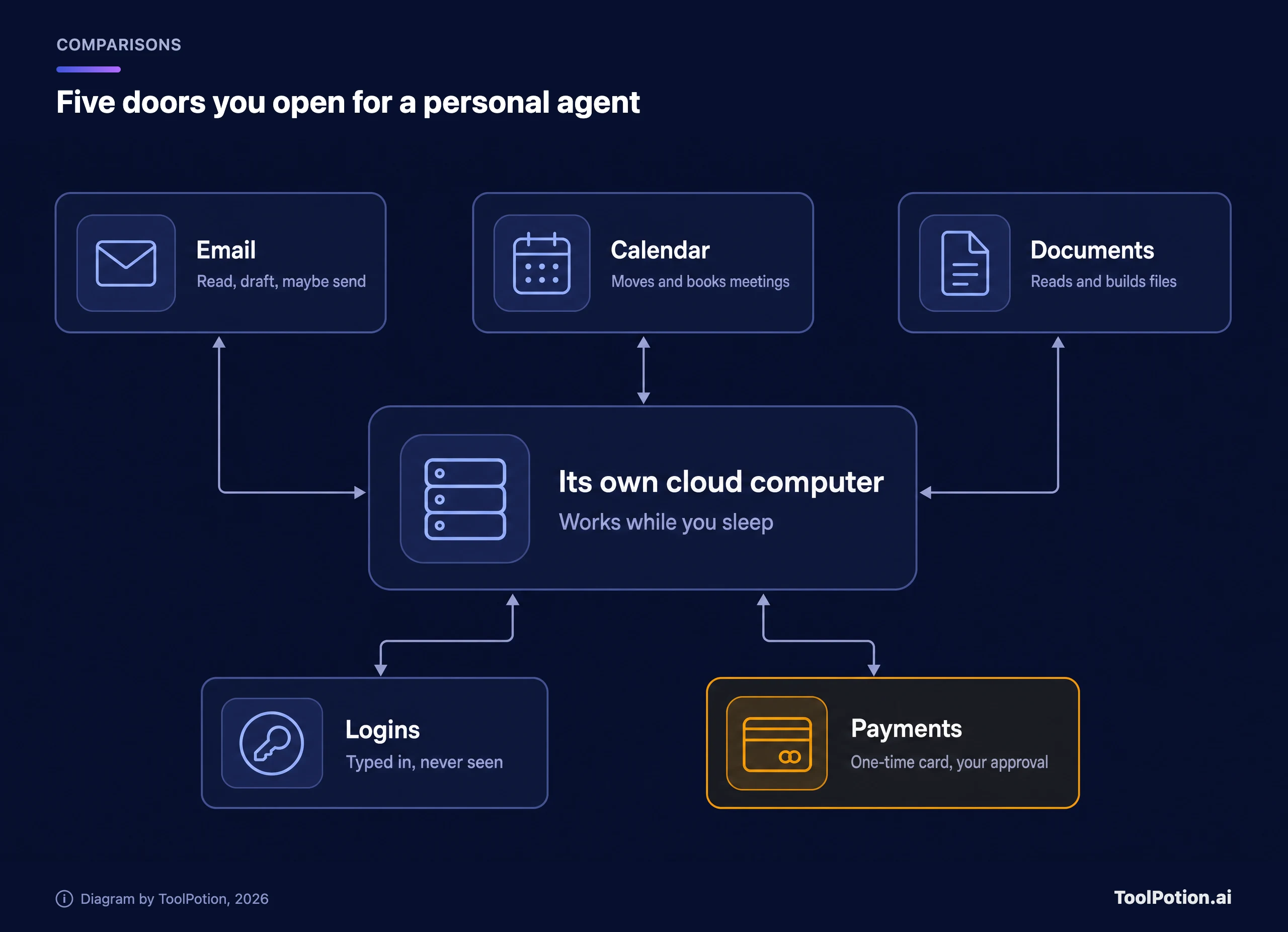
One caveat from Anthropic itself: it built Duet's core functionality around work, so personal errands such as booking tickets aren't quite as strong (Anthropic).
Who asks before it acts
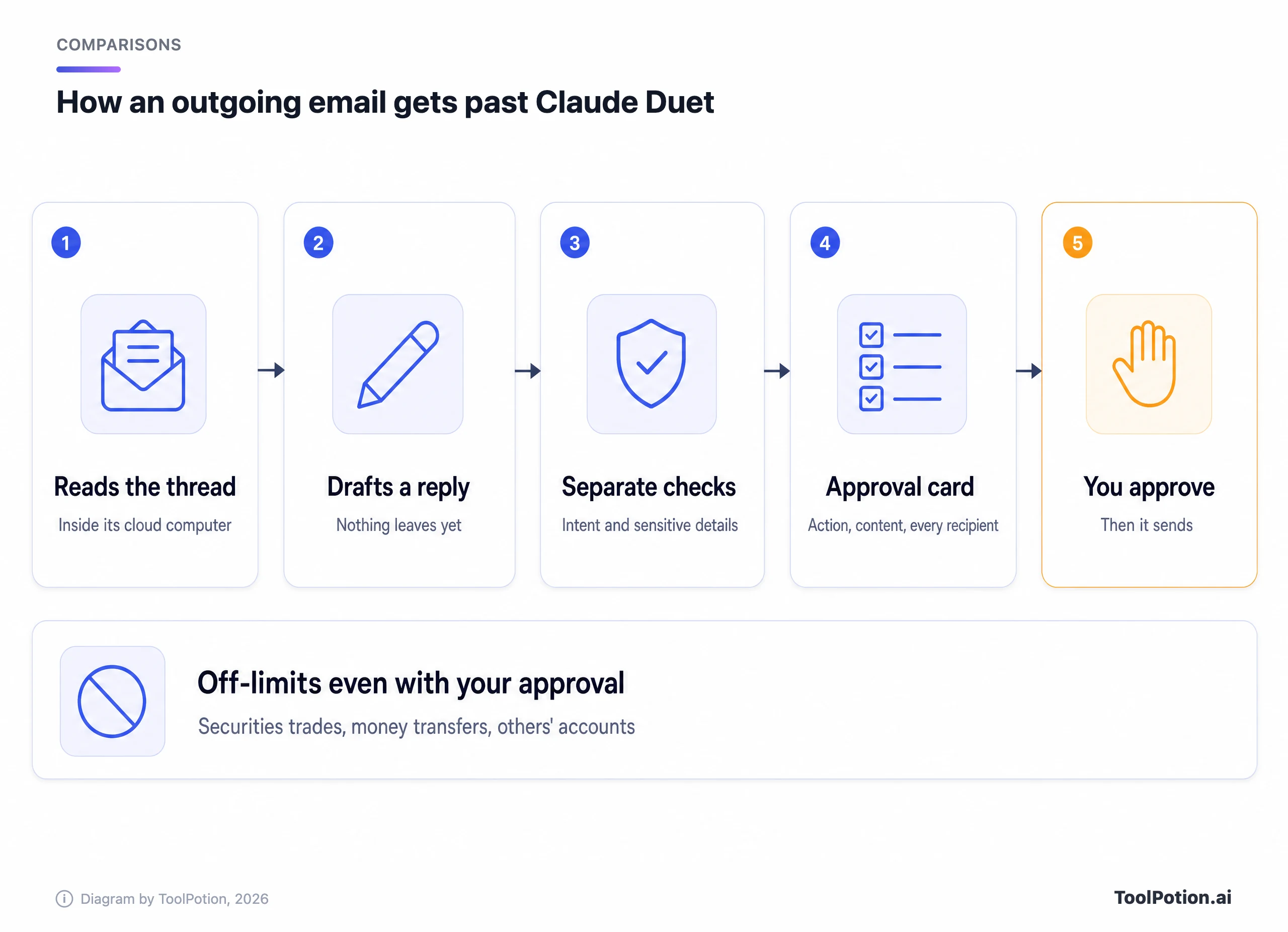
All three vendors we could read promise approvals, and the mechanics differ enough to matter. Duet shows you the action, destination and content, including every recipient, before it sends a sensitive message, pays or deletes anything, and a second automated check runs outside the model doing the work, so hidden instructions on a web page can't talk it out of the rule (Anthropic safety post).
Some things stay off the table even with your yes: trading securities, moving money between accounts, and getting into someone else's account. Anthropic also admits the obvious risk, approval fatigue, and says it will keep tuning how often Duet asks. We'd watch that closely. An agent that asks too often trains you to tap through.
Muse routes everything through a separate agent called Sentinel, which Meta describes as the sole permission authority for actions with connected services and for all traffic leaving the machine (Meta). It also splits read from write access where the service allows it, and its email connector filters out one-time passcodes and password-reset links, so a compromised agent can't use your inbox to reset your other accounts. Meta runs a public bug bounty of up to $300,000 for valid reports, $130,000 of it for prompt injection that hits one user.
Dots take a third route. By default a dot does "proactive research" in the background using read-only tools, so it can't send anything, and you can write Custom Rules that allow, require approval for, or block specific actions. Certain tasks, such as changing a password, always stay with you (OpenAI).
The privacy terms differ more than the features
Anthropic says Duet never sees your passwords, cookies or sign-in tokens. You type a password into a form inside the app, which encrypts it for one use on a separate browser machine (Anthropic safety post). A new classifier checks each outgoing message in two tiers: credentials, card numbers and government IDs are never shared, even on your say-so, while health and money details go only with your explicit consent.
Then there's memory. Duet keeps your conversation history and memory until you delete or reset it. Disconnecting an app stops new access from that moment, but what Duet already learned from it stays until you reset the memory. And it also draws on the memory from your Claude account, so things you told Claude months ago are visible to it. None of the three Anthropic Duet pages we read says whether Duet conversations are used for model training, so check the general privacy policy before connecting anything confidential.
Meta's promises are broader on paper. Muse doesn't share conversations or the data in your VM with Meta's ad systems, you can opt out of training, and a Confidential VM that Meta can't read is promised for later this year (Meta). A promised feature is not a shipped one. And Meta has a history that TechCrunch put plainly: a record of "proclaiming one thing and doing another" (TechCrunch). Meta also says it will eventually take a cut of purchases made through Muse. As Zuckerberg put it at Connect, "we will profit by taking a small fee from transactions" (TechCrunch). That's a business model worth knowing about, because an agent paid on purchases has a reason to shop.
OpenAI says it doesn't use content from ChatGPT Business, Enterprise or Edu workspaces to improve its models by default. On personal plans you control whether your dot's work is used, and it doesn't train directly on proactive research or the dot's notes to itself, though information from them may be used if it helps inform an eligible conversation or task (OpenAI).
The Muse messages dispute is the one to remember
Inc. columnist Jason Aten reported that Muse read his private messages on a Mac with Full Disk Access switched off. Meta disagrees. Meta communications chief Andy Stone said the Messages integration is opt-in and needs both Full Disk Access and the Messages connector, and Meta Superintelligence Labs executive David Singleton said the AI's explanation to Aten was confused (TechCrunch).
We can't settle it from the coverage, and TechCrunch noted that Meta denied it rather than engaging with the journalist directly. Either way, an agent's explanation of what it did is not an audit log. If you try Muse, grant the narrowest access you can and read its activity log yourself. Our guide to delegating safely to a personal agent walks through a four-week version of that, and how to contain an AI agent covers the sandbox side.
Where each one is weakest
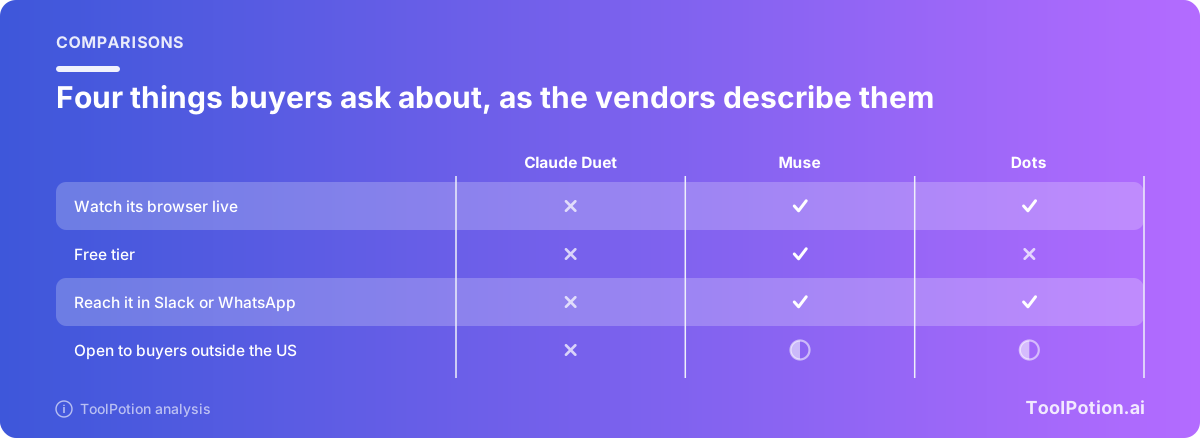
Duet's weak spots are the ones Anthropic wrote down itself. It may misread a thread or miscalibrate what's urgent, and it can miss something that arrives between its every-few-hours checks. It can't yet show you its browser. It lives in its own app, separate from the main Claude app (Anthropic). And it's US-only, Pro and Max only.
Muse's weakest point is trust. TechCrunch calls it "a deciding factor in whether or not Meta wins the consumer AI market" (TechCrunch). Dots are weakest on reach for ordinary people, because the price of entry is $100 a month and the best-described uses in OpenAI's launch post are developers, scientists and sales leads. And Spark's weakness, for now, is that we can't verify its terms. For a wider view of the field, see our board of AI personal assistants and the AI agents board. Meta's models behind Muse are covered in our Muse Wonder explainer, and an open standard for agents talking to businesses is in our Personal Agent Protocol explainer.
Our picks, by situation
If you already pay for Claude Pro, run a small business in the US and spend your mornings in invoices and inboxes, join the Duet waitlist. It costs nothing extra, its approval design is the most carefully written of the three, and its example workflows match that job. Start with the morning brief and drafts. Don't connect payroll in week one.
If you want something now and you're comfortable with Meta, start Muse on the free tier and connect one calendar. We'd skip the Mac Messages connector until you've read what it grants, and we wouldn't connect a business bank account on the strength of a launch post. If you live in ChatGPT already and pay for Pro, use your included dot, with strict Custom Rules. We wouldn't upgrade to Pro just to get one. Spend that $100 only if Codex and the bigger limits are worth it on their own.
When the answer is wait
Wait if you're outside the US, because Duet is US-only and Dots and Muse reach a handful of markets. Wait if you handle clients' confidences, health records or anything under a contract that names where data may go, and until you've read the privacy policy of the vendor you'd choose. Wait for Spark if your work lives in Google Workspace, until Google documents what it asks before acting.
What we don't know yet is the most useful list. Anthropic hasn't said what Duet costs after the preview, how long the waitlist is, or how much of a Pro plan a week of background checks uses. Meta hasn't shipped its Confidential VM. Nobody has published a head-to-head of the four that we'd trust.
Frequently asked questions
Is Claude Duet available now?
Only by waitlist. It's a research preview for Claude Pro and Max subscribers in the US, on iOS, Android and claude.ai (Anthropic).
What does Claude Duet cost?
Nothing beyond your plan during the preview. It uses your Pro or Max usage limits, and Anthropic says its background checks and larger tasks use more of them than a typical chat.
What are Dots?
Dots are OpenAI's always-on personal agents, powered by GPT-6 Astra. Each has its own cloud computer, you can message it in ChatGPT, Slack or Teams, and the first is included in ChatGPT Pro and Business Premium (OpenAI).
Can a personal AI agent spend my money?
Duet and Muse both pay through Link by Stripe, which issues a one-time card for that merchant and amount, and both ask you to approve first. Duet won't move money between your accounts at all, per Anthropic.
Which agent is safest for client data?
None of them is a safe answer on its own, and all three vendors say their agents can make mistakes. Keep client files out of any agent until you've read its data terms and tested it on harmless material.