Muse Wonder is Meta's first model that its own team calls a frontier model, and for developers it's a real option today: you can call it through an API at $4 per million input tokens and $20 per million output. The stronger Muse Wonder Full is a different story, because Meta only sells it inside a coding subscription (TechCrunch).
That split is the part worth understanding before you get excited about the benchmark charts. Both models are brand new. Many of the numbers you'll see come from Meta itself, so we've labeled who said what.
What Meta released
Meta Superintelligence Labs shipped two models, Muse Wonder and Muse Wonder Full. They're bigger than Muse Spark, the lightweight model Meta released first, and Meta says they're better at complex work like coding (TechCrunch). Meta's pitch centers on agents: software that works through a long task on your behalf. It names two traits, Active Memory (carrying what matters about you across conversations) and Active Focus (pushing through blockers instead of quitting) (Meta).
The model card lists text, image, video and audio input, text output, and a 1 million token context window (Meta model card). Meta says a fuller safety report is coming (Meta).
The context helps. Meta's consumer agent, Muse, launched only recently and ran on the lighter Muse Spark (TechCrunch). Wonder is the heavier engine Meta says will power it. TechCrunch notes this is the first frontier model since Alexandr Wang restructured Meta's AI efforts last year, and that the company hadn't shipped the kind of flagship OpenAI and Anthropic are known for. Meta's CEO calls it a model that 'brings us to the frontier' (Euronews).
Where you can use it and what it costs
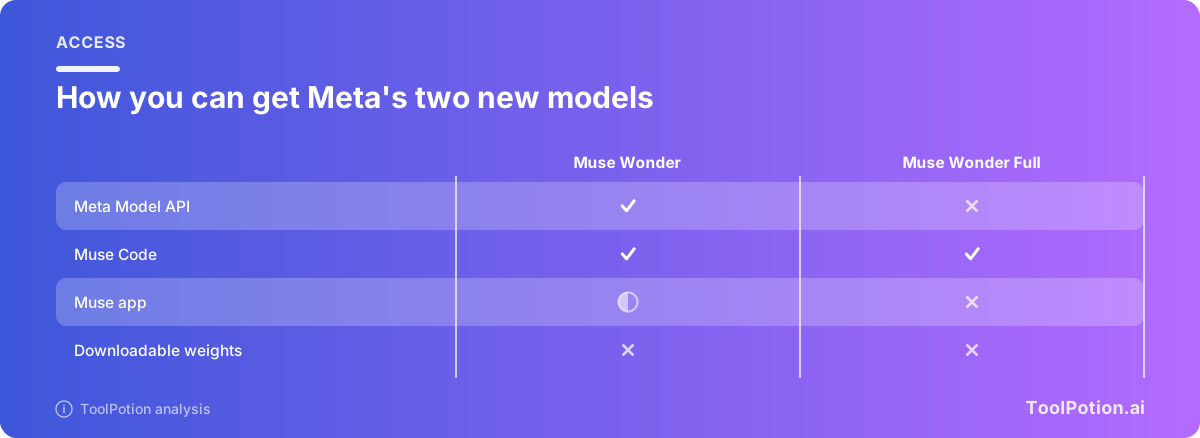
Meta says Wonder is available now through the Meta Model API and Muse Code, its coding product, while Wonder Full is limited to Muse Code subscribers. The consumer rollout comes later: Wonder will reach the Muse assistant soon, subscribers first (Meta). If you just want the assistant, our directory has the Meta AI listing, and the Meta AI Developer page covers the API side.
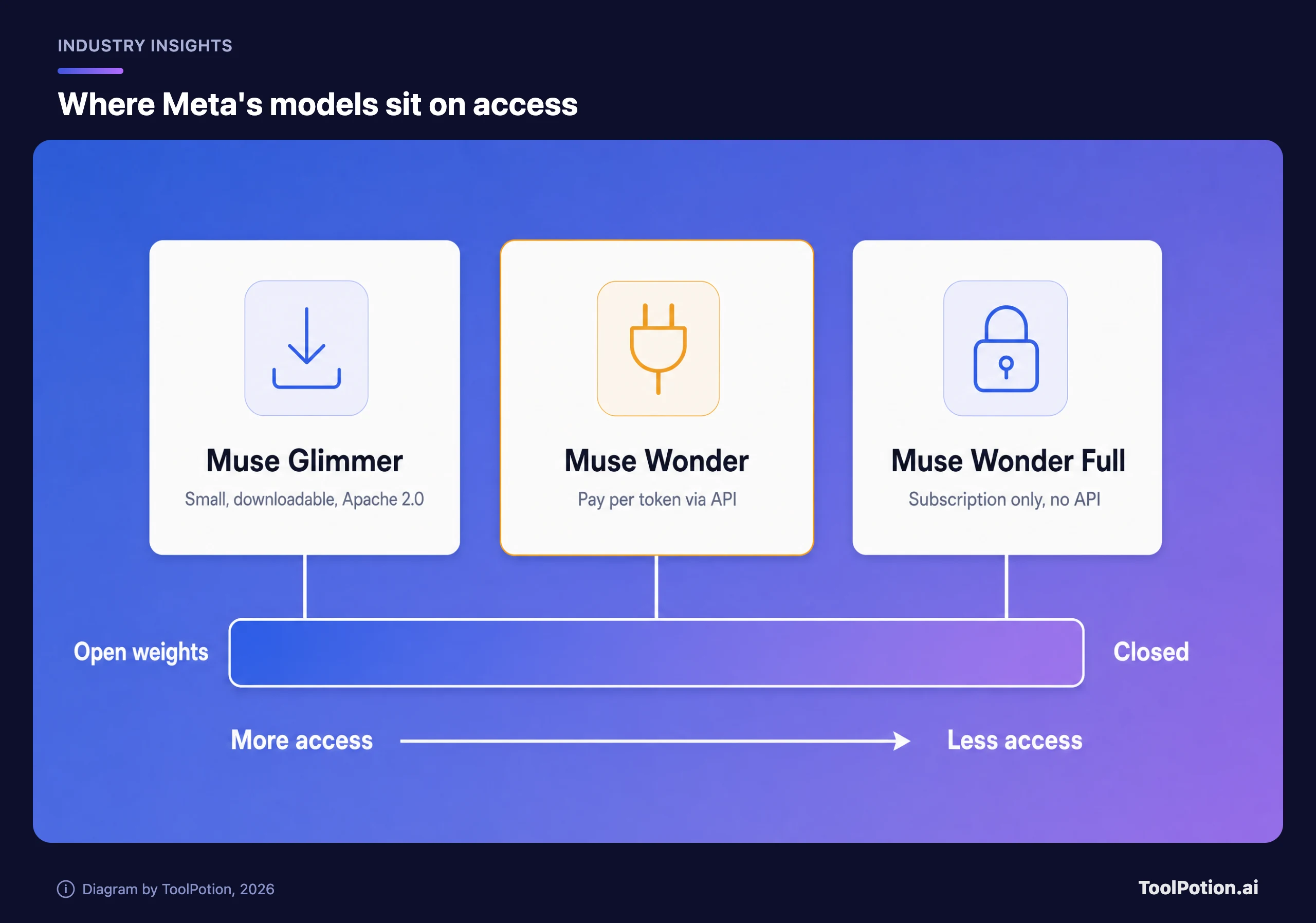
Here's where it breaks from Llama. Meta built its name on models you could download. VentureBeat reports Meta's line plainly: neither Wonder model is being released with downloadable weights (VentureBeat). The open one is the small Muse Glimmer, a 30-billion-parameter model that Meta lists on Hugging Face (Meta developers) under an Apache 2.0 license (model card).
On price, $4 and $20 is the same as Claude Opus 5.5's list rate, per VentureBeat's pricing table (VentureBeat). Wonder Full has no per-token price at all. The Muse Code plans run $5, $15, $50 and $200 a month, and Wonder Full starts at the $50 tier (Meta help center). Those plans default to Contributor mode, which lets Meta train on your prompts, code and outputs. You can switch it off at any time, and Meta describes the switch as covering future content (Meta help center).
If your code is confidential, that default matters more than any benchmark. The API route is the cleaner one: Meta's pricing page says Standard mode content isn't used for training, and Contributor mode isn't offered for Wonder on the API ([Meta pricing]({PRC})).
What Meta claims, and what outsiders found
Meta says Wonder and Wonder Full are state of the art on personal and professional agent tasks, memory and coding. Its model card compares them with GPT-6 Astra, Claude Fable 5.1 and Claude Opus 5.5 at maximum reasoning effort, and it says Wonder beats all three on MemoryBench, a benchmark Meta built itself (TechCrunch, model card). Read the fine print, though. Meta says its own runs of competitor models are best effort, and where several scores exist it used the highest one.
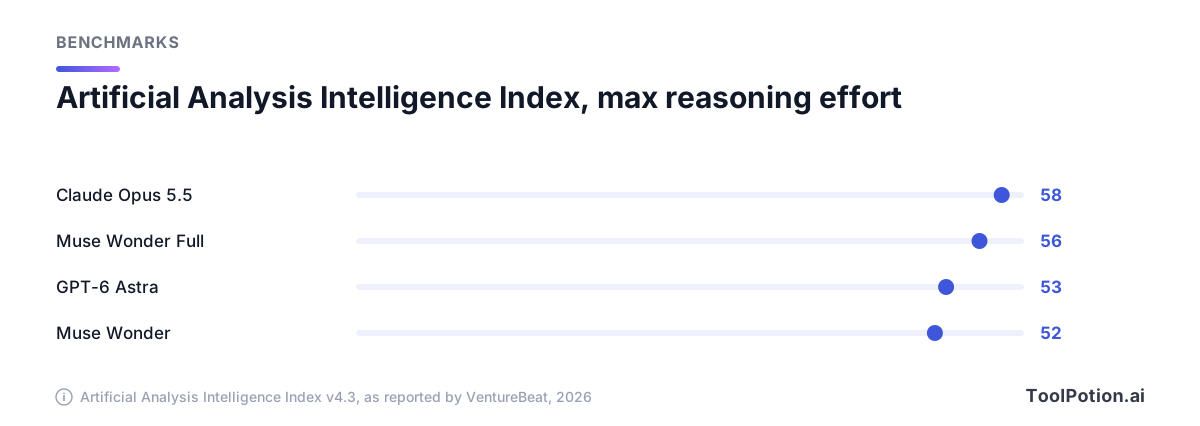
Independent numbers are less flattering, and more useful. Artificial Analysis puts Wonder Full at 56 on its intelligence index, Opus 5.5 at 58, GPT-6 Astra at 53 and Wonder at 52 ([VentureBeat]({VB}), Artificial Analysis).
On individual tests the picture splits. Wonder Full leads on SWE-Marathon, a long-running software benchmark, with 57.5 against 46.3 for Opus 5.5 and 42.5 for Astra. Opus 5.5 still edges it on the overall index, Terminal-Bench and HealthBench Pro, and JobBench is a 75.4 to 75.3 photo finish (VentureBeat). That table mixes third-party and Meta-run results, and Meta's own card says the SWE-Marathon row isn't a controlled comparison because some models ran in their vendors' coding tools (model card).
How it compares with GPT-6 Astra, Gemini and Claude
On access, Wonder sits closer to the closed labs than to old Meta. It's cheaper than OpenAI's top tier: GPT-6 Astra lists at $10 input and $50 output per million tokens (OpenAI pricing), as we covered in our GPT-6 Astra explainer. OpenAI's cheaper GPT-6 Sol lists at $2 and $10, so Wonder isn't the bargain tier there. Against Anthropic, the price is the same as Opus 5.5, so you'd be choosing on results and terms, not list cost. You can try either in the ChatGPT or Claude apps.
Gemini is the gap. Meta's model card doesn't compare against it, and we haven't seen a head to head, so we won't guess. Google Gemini stays in your shortlist on its own merits. For a wider view of the field, see our LLM leaderboard and the AI models and LLMs board.
Who should try it now, and who should wait
Try it now if you build agents or coding tools, can use the API terms, and already run your own test set. Swap Wonder in beside your current model and compare cost per finished task, because Artificial Analysis estimates Wonder's average index task at about $4.52, against $5.98 for Opus 5.5 and $3.26 for Astra ([VentureBeat]({VB})). Wait if you want a daily chat assistant, since the Muse app rollout hasn't happened yet. Skip it if you need open weights. And if you're a solo developer weighing the $200 Muse Code plan, remember that the money buys access to Wonder Full, but it also comes with the training default described above.
A fair test takes an afternoon. Pick ten tasks you already pay a model to do, run them on Wonder and on your current model, and compare three things.
- How many tasks finished correctly without you stepping in.
- What each run cost in tokens, since Wonder may think for longer.
- Whether your legal or privacy team is fine with Meta's API terms.
One more caution: it's brand new. Independent coverage is thin, Meta's safety report isn't out, and benchmark gaps this small tend to move once people test real workloads.
Frequently asked questions
Is Muse Wonder open source?
No. Neither Muse Wonder nor Muse Wonder Full has downloadable weights. The small Muse Glimmer model is the open one.
What does Muse Wonder cost?
Through the Meta Model API it's $4 per million input tokens and $20 per million output tokens. Wonder Full has no API price and is available only on Muse Code plans, which run $5 to $200 a month, with Wonder Full starting at the $50 tier.
Is Muse Wonder better than GPT-6 Astra or Claude?
Meta says it's comparable, and ahead on memory. Artificial Analysis scores Wonder Full above Astra but below Opus 5.5, while Wonder itself lands one point under Astra.
Can I use Muse Wonder in the Meta AI app?
Not yet. Meta says Wonder will come to the Muse assistant soon, starting with subscribers. Until then the assistant runs on Meta's lighter models, so you won't see Wonder's benefits in the app today.