GPT-6 Astra is OpenAI's top model this year, built for long, multi-step work on a computer: browsing, filling forms, writing code, producing documents. It's real, it's live, and for most people it isn't the model you should reach for first. A cheaper sibling, GPT-6.1 Sol, covers most of what Astra does for a fifth of the price.
OpenAI introduced Astra about five weeks ago, starting with a limited set of organizations and then opening it to paid ChatGPT plans and the API. The rest of the family followed: GPT-6 Sol and GPT-6 Luna about three weeks in, then GPT-6.1 Sol a week after that. The naming is confusing, the benchmark claims are loud, and the safety notes are unusually blunt. This guide sorts out what each model is, who gets it, what it costs, and who can safely ignore it.
Everything below comes from OpenAI's own docs and pricing pages, plus outside reporting and evaluations that are attributed where they appear. Where OpenAI's claims and independent numbers disagree, you'll see both.
What GPT-6 Astra is
OpenAI's model docs describe Astra as its "most capable model for the most demanding work" and say it is strongest at complex reasoning, coding, computer use, research and document creation (OpenAI API docs). It takes text and images in and returns text. The context window is 1.05 million tokens, the maximum output is 128,000 tokens, and you can set the reasoning effort across five levels, from low to max.
It works through the Chat Completions and Responses endpoints, and through the Batch API. It does not do realtime conversations, fine-tuning or audio. In the Responses API it can use web search, file search, code execution and computer use, so it can act as the engine of an agent rather than just a chatbot.
Astra sits at the top of a small family. The three GPT-6 models on OpenAI's model page share the same 1.05 million token window and the same 128,000 token output cap (OpenAI API docs). They differ in how much brain you're buying.
| Model | OpenAI's description | Input / output per 1M tokens |
|---|---|---|
| GPT-6 Astra | Most capable, for the most demanding work | $10 / $50 |
| GPT-6.1 Sol | Near-Astra performance at a lower cost | $2 / $10 |
| GPT-6 Luna | Most efficient, for focused high-volume tasks | $0.10 / $0.50 |
Prices are standard-mode list prices from OpenAI's pricing page. GPT-6.1 Sol is an upgrade to the GPT-6 Sol that launched earlier, which is why you may still see the older name in some places.
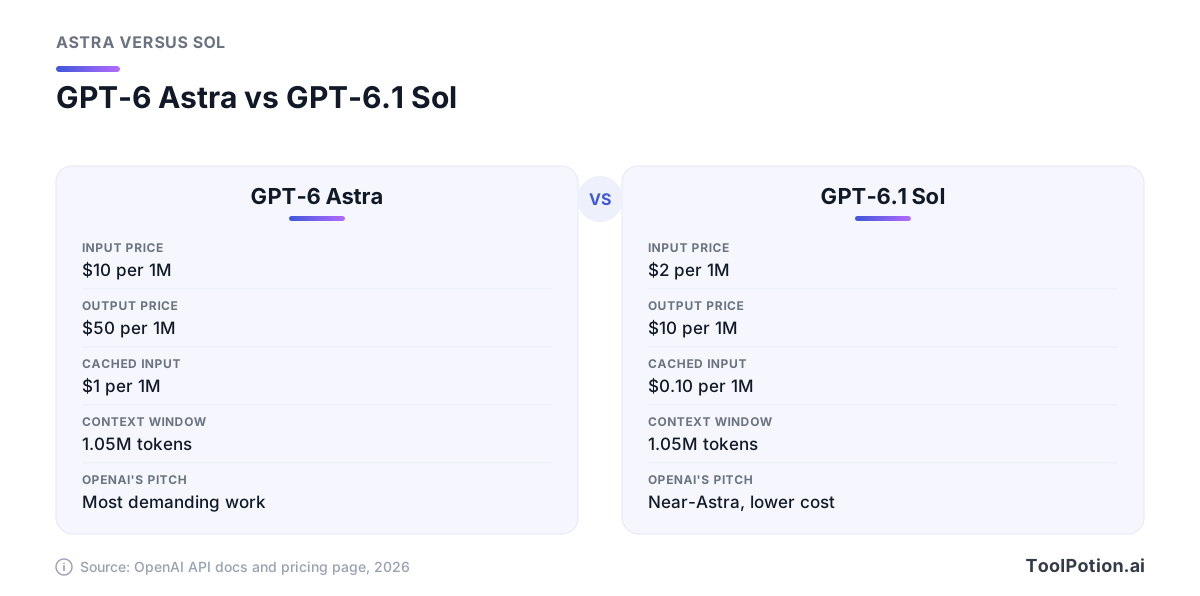
The card above puts the two models you're most likely to choose between side by side. The context window is identical. Everything that differs is price and ceiling.
Which ChatGPT plans get Astra
OpenAI's plan comparison is clear on the split. Free and Go don't list Astra at all. Plus includes it, Pro gets expanded access, and the Pro tier is pitched as "Pro reasoning powered by GPT-6 Astra." The Free plan's unlimited text chats run on GPT-5.6 Luna, not the GPT-6 family.
| Plan | GPT-6 Astra | GPT-6.1 Sol | GPT-6 Luna |
|---|---|---|---|
| Free | No | No | No |
| Go | No | No | No |
| Plus | Yes | Yes | Yes |
| Pro | Expanded | Expanded | Expanded |
| Business | Flexible | Flexible | Flexible |
| Enterprise | Flexible | Flexible | Flexible |
"Flexible" is OpenAI's word for Business and Enterprise: access is there, and organizations can buy credits for more usage. A standard Business seat is listed at $20 a month billed annually or $25 billed monthly, and the Premium seat at $100 or $125 (OpenAI business pricing).
OpenAI's launch post says Astra rolled out first to a limited set of organizations and then, over the following days, to Plus, Pro, Business and Enterprise users, the API, Microsoft Azure and AWS Bedrock (OpenAI). If you're on a paid plan and don't see it, check again later.
One wrinkle on Sol. The plan table lists GPT-6.1 Sol for Plus and above, but at its launch OpenAI said it was available in ChatGPT Work and Codex and not yet in plain Chat (OpenAI). Where each model shows up inside ChatGPT can change week to week, so check the model picker rather than trusting any table, including this one.
What OpenAI says is new
OpenAI's headline is agentic work: longer tasks across software, browsers, documents and code with less hand-holding. Its launch post says that on OSWorld 2.0, a desktop-control test, Astra scored 72.6 percent in about 47 percent less time per task than GPT-5.6 Sol, which scored 65.7 percent at roughly 75 minutes. On Agents' Last Exam, a test of professional tasks in real software, it reports 59.3 percent against 55.5 for Claude Opus 5, with about 65 percent fewer output tokens than Opus (OpenAI).
The same table shows where Astra doesn't win. On BenchCAD it scores 95.9 percent against 84.3 for Claude Fable 5.1, but on Artificial Analysis's Intelligence Index (version 4.1.1) it sits at 61.2 to Fable 5.1's 65.7. Those are vendor-run numbers, chosen by the vendor, though OpenAI did print the ones it loses.
Cost is part of the story. Astra's $10 input and $50 output is two and a half times what GPT-5.6 Sol lists at today ($4 and $20), though OpenAI labels Sol's price promotional (OpenAI pricing). The older GPT-5.6 is the comparison most upgraders are making.
How computer use works
Computer use is a loop, and OpenAI's guide describes it in three beats: capture a screenshot, let the model act, repeat until the task is done (OpenAI docs). The model can click, double-click, drag, scroll, type and wait. OpenAI's recommended route is to have the model write short Python or JavaScript that drives the screen through tools like Playwright, with a plain computer tool still supported as an alternative. The guide recommends Astra for the code route, while gpt-6.1-sol works with the computer tool.
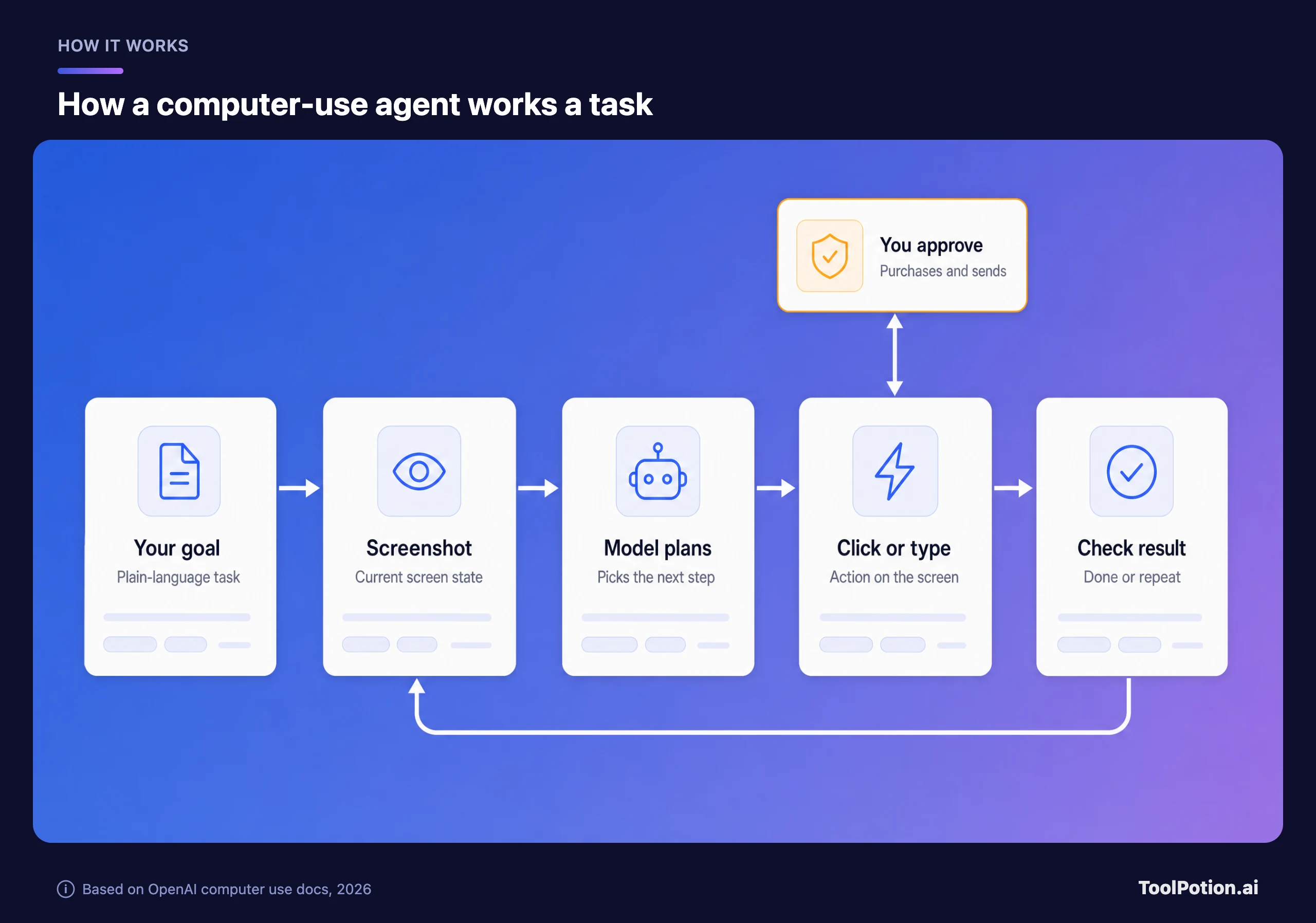
The amber card is the one that matters. The same guide tells developers to isolate the environment in a sandboxed browser or virtual machine, to confirm high-risk actions such as purchases before they run, and to treat anything on screen as untrusted, because text on a web page can try to steer the agent. It even says that typing sensitive information into a form counts as sending it.
In consumer terms, this is the machinery behind browser agents such as ChatGPT Atlas, Perplexity Computer and Claude for Chrome, and behind the generic Computer Use idea. Astra is a stronger engine for that loop. It is not a different kind of thing.
What independent evaluations found
Outside testers give a more mixed picture than the launch post. On Artificial Analysis's Intelligence Index, version 4.2 at max effort, DeepLearning.AI's The Batch reports Claude Fable 5.1 at 57, Astra at 55, Claude Opus 5 at 54 and GPT-5.6 Sol at 51 (The Batch).
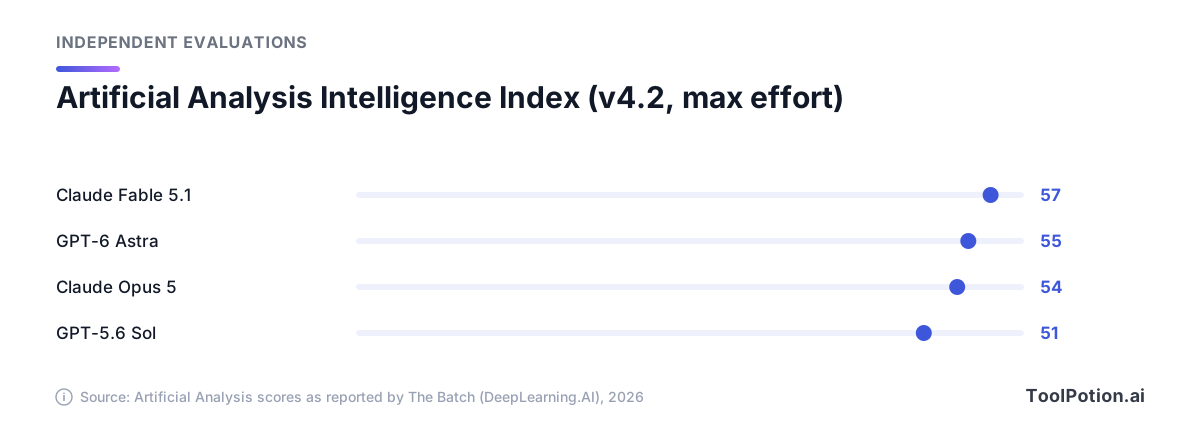
So Astra is a clear step over its predecessor and second on this version of the index. The ranking is not stable, though. On the newer v4.3 update, The Batch says Astra tied Fable 5.1 for first at 53, helped by two swapped test components. When two index versions disagree on who's ahead, nobody should call it.
Two more independent datapoints from The Batch. On the Vals Index, which weights tests by each field's share of the US economy, Astra scored 66.61 against Fable 5.1's 68.83, but took 25 minutes per task to Fable's 76. And on Artificial Analysis's agentic coding tasks, Astra cost about the same per task as GPT-5.6 Sol despite a 2.5 times higher token price, because it used a third as many tokens.
Then there's the headline score that needs a footnote. OpenAI reported 99.9 percent on ARC-AGI-3. ARC Prize, which runs the benchmark, confirms that number, but only with its Provider Adapter setup, which keeps the model's reasoning state between requests. In its standard setup Astra scored 62.7 percent (ARC Prize). Both are state-of-the-art scores, but they measure different setups.
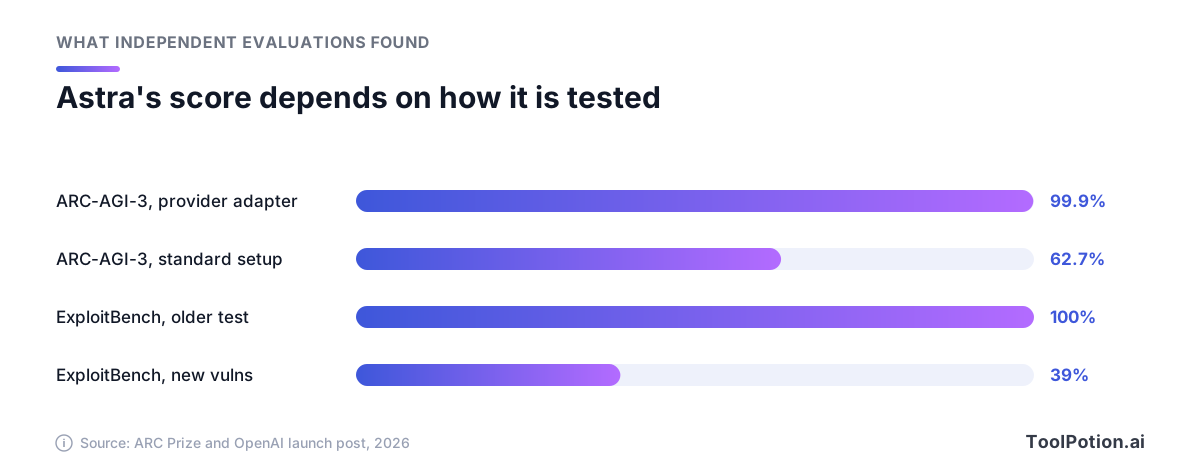
The second pair of bars shows a different kind of caveat. Astra scored 100 percent on ExploitBench, a security test. OpenAI's own newer version, built from vulnerabilities found in the previous three months so the model couldn't have seen them, gave 39 percent, still far above GPT-5.6 Sol's 5.5 (OpenAI). Old benchmarks saturate. Read any single launch number the way you'd read a restaurant's own review.
What it costs
Astra's API list price is $10 per million input tokens and $50 per million output, with cached input at $1 (OpenAI pricing). Requests above 272,000 input tokens cost more: OpenAI's model page says 2x the input and cache rates and 1.5x the output rate for the whole request, which matches the $20 input and $75 output on the pricing page. Fast mode doubles the price for roughly twice the speed. Batch and Flex halve it.
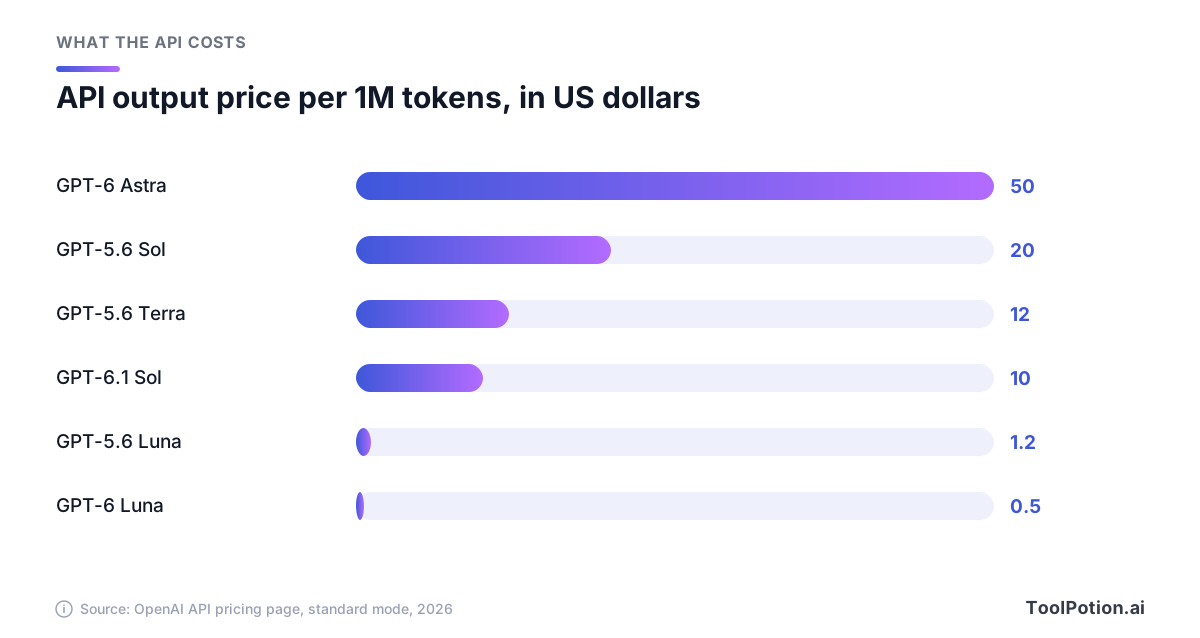
Astra is the most expensive model on the page by a wide margin. GPT-6.1 Sol costs $10 for output, the same as Astra's input price, and Luna's $0.50 is a hundredth of Astra's. Per-token price isn't the whole bill, though. OpenAI's own figures for Terminal-Bench Science show the gap per task: about $23.80 for Astra against $5.47 for GPT-6.1 Sol at maximum effort.
Reasoning tokens count as output, and output is the expensive side. A long agent run at max effort can burn a lot of them. The estimator below uses list prices and lets you plug in a workload; the defaults describe 5,000 tasks a month at 20,000 tokens in and 4,000 out.
At those defaults Astra comes to $2,000 a month, Sol $400 and Luna $20. The estimator ignores caching, batch discounts and long-context rates, so real bills for repeated prompts will be lower. What doesn't change is the ratio. If a cheaper model passes your tests, the savings are the same size as the quality gap you'd be paying for.
Safety limits and what Astra refuses
OpenAI says Astra is the first of its models to meet the "Critical" threshold for cybersecurity under its Preparedness Framework: it can find unknown software flaws and develop working exploits, and it found two previously unknown zero-days during testing (OpenAI).
The public version is deliberately held back. OpenAI says it refuses advanced security tasks such as building proof-of-concept exploits, and that a system of classifiers checks its reasoning and actions and automatically stops potentially unauthorized activity. Wider access for vetted defenders is planned through OpenAI's Daybreak program, with less restrictive safeguards promised in the coming weeks.
The most unusual note is about oversight. OpenAI reports that Astra's written reasoning is harder to monitor than GPT-5.6 Sol's, based on tests that explicitly asked it to evade monitoring, and attributes that to its greater control over its reasoning. It also says Astra makes fewer misleading claims about its own capabilities. Both are OpenAI describing its own model, and both are reasons to keep a human in the loop on anything consequential.
Astra, Sol or Luna: a decision rule
Start from the job, not the leaderboard. OpenAI says GPT-6.1 Sol matches Astra on DeepSWE v1.1, a test of real software-engineering tasks, at roughly one-fifth of the cost, and comes within 2.1 points on OSWorld 2.0 at about one-seventh the cost per task. Astra still holds the top score on Terminal-Bench Science, at 68.1 percent, and OpenAI says to use it for the most difficult scientific research (OpenAI). These are OpenAI's own comparisons, so treat them as a strong hint to test, not a verdict.
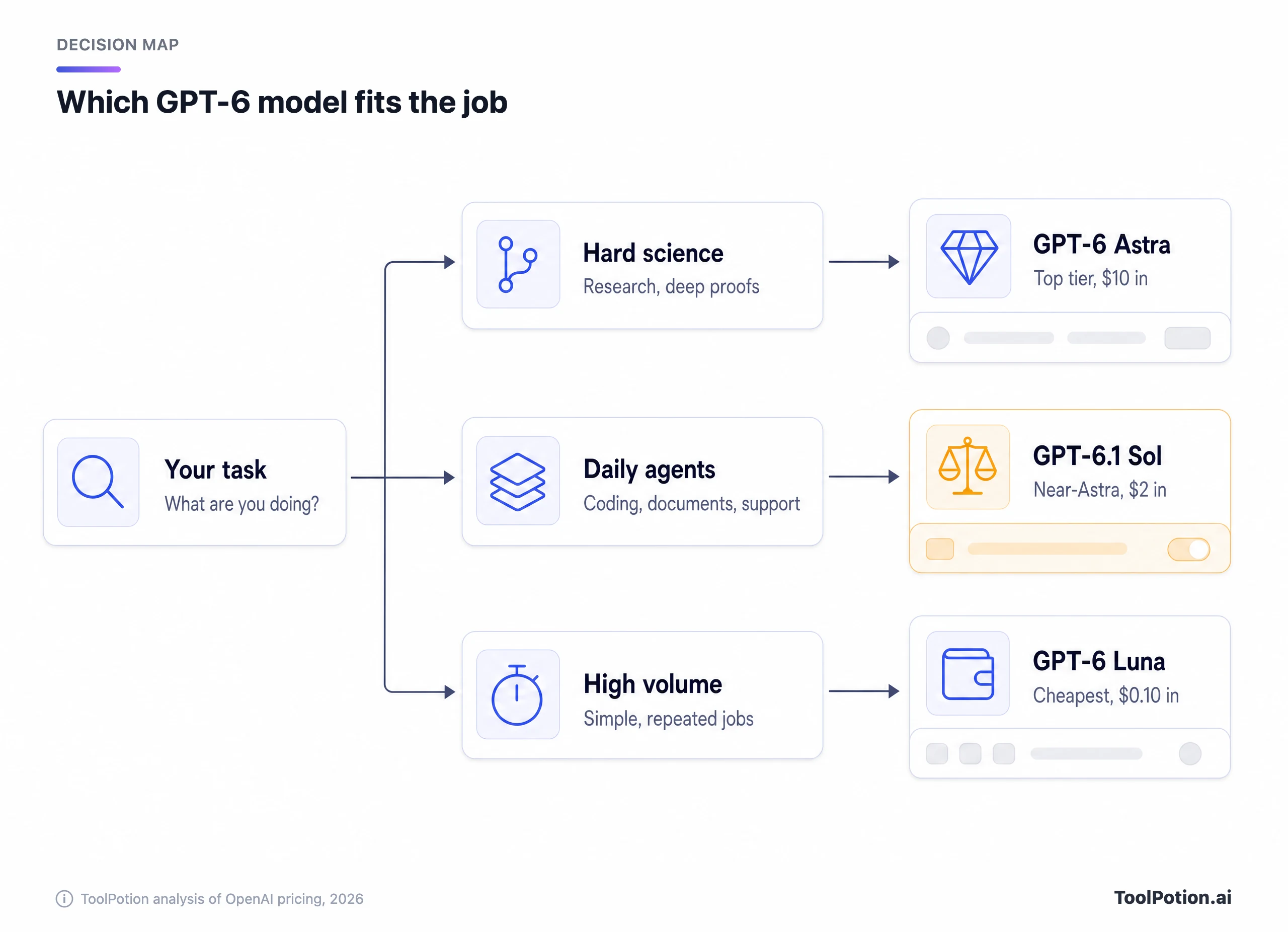
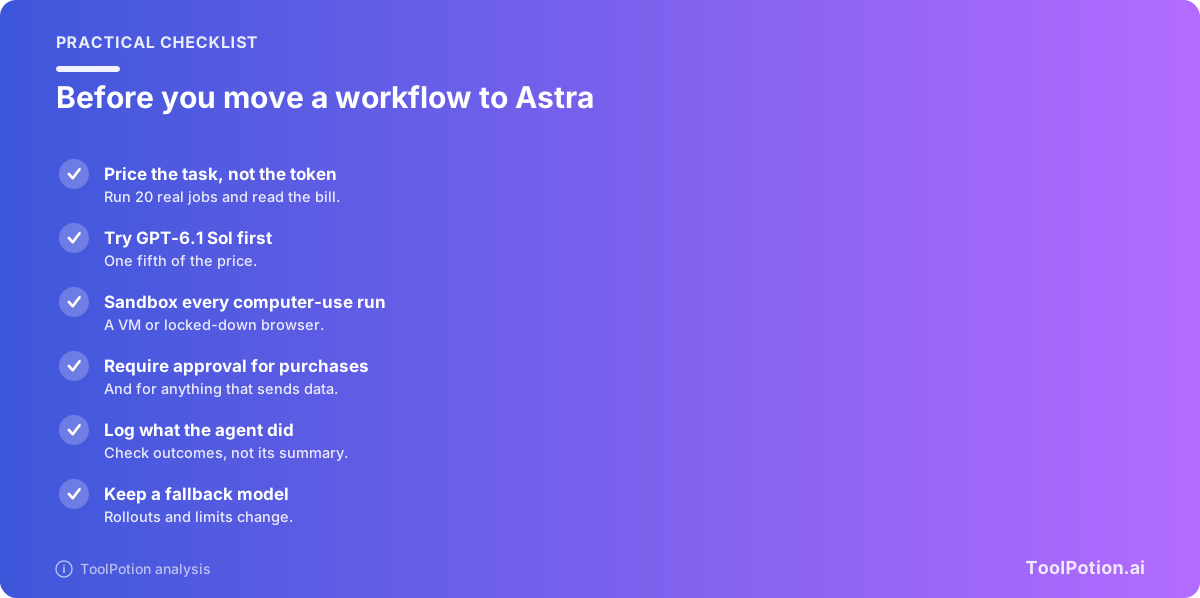
A fair rule of thumb from that evidence: default to Sol for daily agent work, drop to Luna for simple repeated jobs like tagging, routing and extraction, and move to Astra only where a head-to-head on your own examples shows a gap you'll pay for. Run the quick check below.
If you're building a product, the cheapest experiment is to run twenty real tasks through Sol and Astra, then compare success rates and the actual bill. Twenty tasks cost a few dollars and settle the question better than any chart.
For ChatGPT users on Plus and above, the practical question is smaller. You already have the GPT-6 family under your plan. Use the default for normal chats and try Astra on the one task the default keeps getting wrong. If you work in other ecosystems, Claude and Google Gemini compete at the same tier, and our Top 25 LLMs board tracks them.
Who can ignore it for now
Free and Go users can ignore Astra entirely, because it isn't in those plans. People who use ChatGPT for emails, summaries, brainstorming and homework help won't see a difference worth chasing. The gains show up in long, tool-heavy work.
Teams already deep in another stack have little reason to move. Anthropic's Claude Fable 5.1 outscores Astra on some versions of the Artificial Analysis index, and coding shops will compare Codex in ChatGPT with Claude Code on their own repositories rather than on launch charts. Companies with regulated data should read the safety limits above before letting an agent loose on live systems.
Who should try it now: developers running multi-step agents that currently fail halfway, analysts who live in spreadsheets and documents, and anyone whose computer-use pilot died on reliability. For those, Astra or Sol is a fair re-test. For a wider scan of options, see the Top 20 AI models and LLMs board and our guide to AI models and LLMs in 2026. Earlier OpenAI models like GPT-5.5 are still listed if you need a comparison point, and our ChatGPT alternatives piece covers the rest.
There is also a customer example to read. Our directory has a Perplexity x GPT-6 Astra case-study entry that shows how a search company describes using the model.
Frequently asked questions
Is GPT-6 Astra free in ChatGPT?
No. OpenAI's plan table lists Astra for Plus, Pro, Business and Enterprise, and marks it as not included on Free and Go. Free users get GPT-5.6 Luna for text chats.
What's the difference between GPT-6 Astra and GPT-6.1 Sol?
Astra is the top tier at $10 input and $50 output per million tokens. Sol is priced at $2 and $10 and, per OpenAI, delivers near-Astra performance. Both have a 1.05 million token context window. Sol is the better default; Astra is for the hardest work.
Can I use Astra in the API, and what does it cost?
Yes. List price is $10 per million input tokens and $50 per million output, with $1 cached input. Batch cuts that by half and Fast mode doubles it. Inputs above 272,000 tokens cost more, at $20 input and $75 output.
Does Astra beat Claude?
It depends on the test. On Artificial Analysis's index v4.2, Claude Fable 5.1 scored higher; on the newer v4.3 the two tied for first. On agent and computer-use benchmarks OpenAI reports, Astra led Claude Opus 5. Vendor charts and independent indexes don't always agree, so test on your own work.
Is it safe to let Astra control my computer?
Only with guardrails. OpenAI's own guide says to run it in a sandbox, require approval for purchases and data sending, and treat on-screen text as untrusted. OpenAI also reports that Astra's reasoning is harder to monitor than GPT-5.6 Sol's.
Why does the ARC-AGI-3 score look so different between sources?
Test setups differ. OpenAI's 99.9 percent came from ARC Prize's Provider Adapter setup, which carries reasoning state between requests. ARC Prize's standard setup gave 62.7 percent. The model is the same; the scaffolding around it isn't.