Description
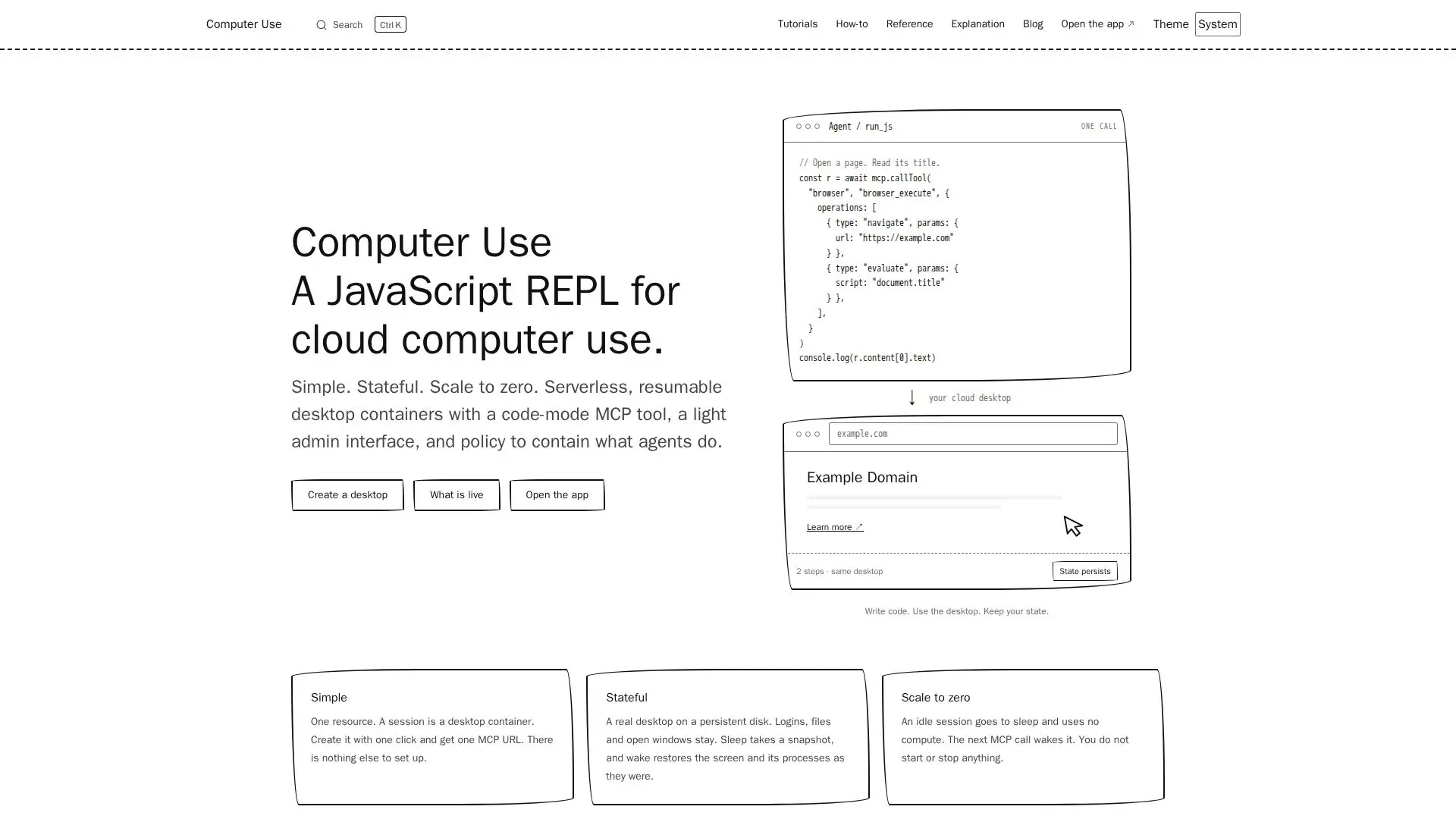
Computer Use is a platform that offers serverless, resumable desktop containers designed for cloud computing. These containers are stateful, allowing users to maintain their desktop state across sessions. The platform features a code-mode MCP tool, enabling agents to execute JavaScript programs that interact with the desktop's capabilities, such as browser operations, desktop control, and shell commands.
Read More
The desktop environment includes an XFCE interface with applications like Chromium, a terminal, a file manager, and a text editor. Users can create sessions with a single click, receiving an MCP URL to connect agents. The system scales to zero, meaning idle sessions go to sleep, conserving compute resources until reactivated by an MCP call.
Computer Use also provides a light admin interface for managing sessions, including creating, monitoring, and deleting them. Policies can be applied to sessions to restrict agent actions, written in Rego within the app's editor. The platform is ideal for scenarios where software lacks APIs, offering a screen-based interface for agents.
Pricing details are not explicitly mentioned, but the platform supports integration with agents like Claude, allowing seamless interaction with the desktop environment. Computer Use is suitable for developers and organizations looking to leverage cloud-based desktop environments with controlled agent operations.
- CategoryAI DevOps & Cloud Tools
- Pricing ModelNot specified
- DeploymentCloud
- PlatformsWeb
Computer Use's Core Features
Serverless desktop containers
Stateful session management
Code-mode MCP tool
XFCE desktop environment
Browser, desktop, and shell capabilities
Light admin interface
Policy management with Rego
Integration with agents like Claude
How to use Computer Use?
Sign in: Access the platform using Google or GitHub.
Create session: Initiate a desktop container with one click.
Use desktop: Interact with the XFCE environment and applications.
Connect agent: Use the MCP URL to link agents like Claude.
Computer Use's Use Cases
- Cloud Computing
- Agent Integration
- Policy Management
- Resource Conservation
- Desktop Interaction