In its most recent results, Fiverr counted 2.4 million annual active buyers, down from 3.3 million a year earlier (Fiverr). Each remaining buyer spent more: $373 a year, up 12.9%. Fewer clients, bigger tickets. That pair of numbers is a fair summary of what the freelance data now says, and OpenAI has recently published a study, co-written with Upwork, that tries to explain it from the demand side.
The study is called Work at the Frontier: AI's effect on freelance work. We read the full report, then lined it up against the peer-reviewed research on freelance platforms since ChatGPT launched, and against what Upwork and Fiverr told investors. Our read: the shrinking categories are real and well documented, the growing ones are narrower than the cheerful version suggests, and nobody has shown that AI is what raises a freelancer's hourly pay.
Chat use and freelance demand barely overlap
The authors took more than 36,000 sampled ChatGPT conversations and sorted them into Upwork's own category scheme. Then they set that mix against what clients post on Upwork. The two look nothing alike. Content writing is 14.5% of the sampled conversations and professional and business writing another 10.2%; on Upwork they are about 1.3% and 0.4% of postings. Video and animation, graphic design, QA testing, mobile development and web development are the reverse: big on Upwork, small in ChatGPT.
The headline test is across 63 matching subcategories. In 43 of them (68.3%), either heavy ChatGPT use went with a falling share of Upwork postings, or light use went with a rising share. The other 20 went the opposite way. Content writing is the cleanest example of the first pattern. Its share of ChatGPT activity in 2025 was roughly three times its share of Upwork postings in 2023, and its postings fell at more than twice the rate of the marketplace overall between 2023 and 2025. Video and animation, with little ChatGPT use, grew by about a third relative to the marketplace.
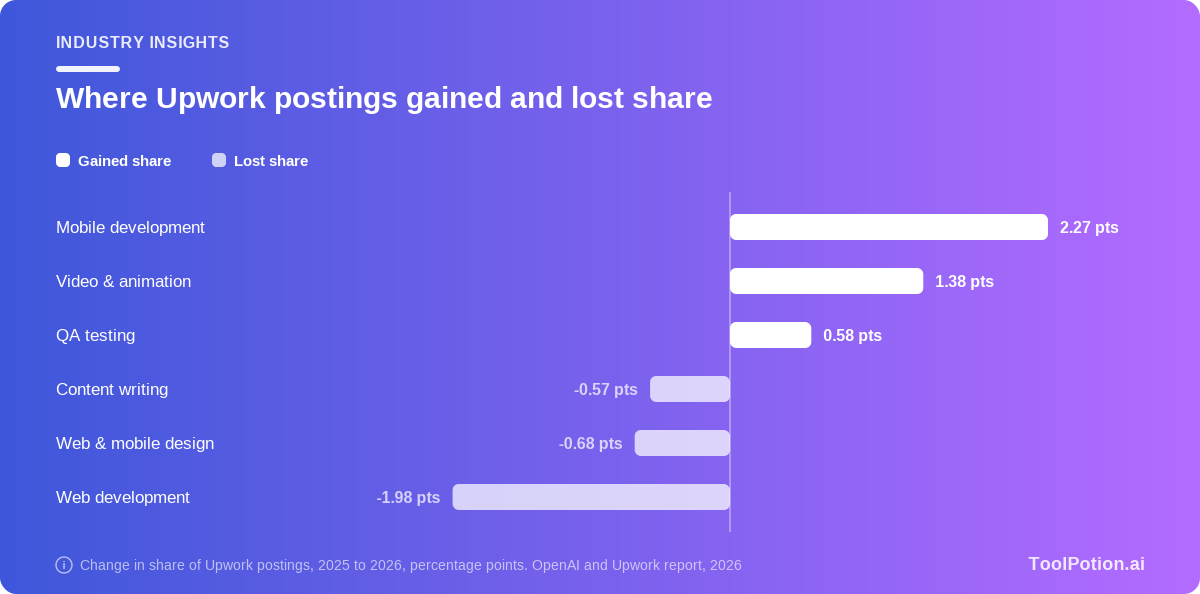
Web development is the odd one in that chart. The report lists it among the categories far bigger on Upwork than in ChatGPT (5.2% of postings against 0.5% of conversations), yet it lost more share than any other category in the exhibit, nearly two points. The authors say only that client needs, production processes and specialized software also shape which work gains or loses. We'd like to see coding agents tested as an explanation. The report doesn't test them.
The authors are careful about their own conclusion. OpenAI's summary of the study says: "The findings do not point to a simple substitution story." The two datasets are not matched, neither covers the whole labor market, and the report calls its comparison descriptive.
Two interested authors
OpenAI sells ChatGPT. Upwork sells freelancer hours and describes itself as a human and AI-powered work marketplace. Both gain from findings that show AI creating work for people, and both are on the byline (three of the six authors work at Upwork). That doesn't make the numbers wrong. It does mean we read the framing with a pencil.
Two examples of what a pencil finds. The report's introduction says AI-related postings carry higher stated project budgets "and hourly rates, even within narrowly defined work categories." Its own pricing exhibit puts the adjusted gap in posted hourly rates at 1.5%, and the body of the report calls it "negligible," so the introduction oversells. And "AI-related" is decided by Upwork's internal pipeline, which the appendix describes as a GPT-powered LLM with structured prompting. An AI company's tool is labeling which jobs count as AI jobs. We'd want an outside group to replicate that step before leaning on it.
Independent studies found the same losers
The OpenAI report arrives late. Several academic teams had already measured the same thing on other platforms, and none of these papers was written by OpenAI or Upwork. One caveat on our side: we worked from the published abstracts, so the table says what the authors report finding, not what we'd conclude from their methods.
| Study | Data | What it found |
|---|---|---|
| Hui, Reshef and Zhou, Organization Science, 2024 | One large online platform | Freelancers in highly affected occupations saw lower employment and earnings after ChatGPT and image generators. The authors found no evidence that top freelancers were shielded, and suggestive evidence that they were hit harder. |
| Demirci, Hannane and Zhu, Management Science, 2025 | A leading global platform | Job posts for automation-prone writing and coding fell 21% within eight months of ChatGPT, against manual-intensive jobs. Image-creation posts fell 17% after image generators arrived. The remaining automation-prone jobs were more complex and paid more. |
| Teutloff and coauthors, J. of Economic Behavior and Organization, 2025 | A leading platform, 116 skill clusters | Demand for substitutable skills such as writing and translation fell 20% to 50% against the counterfactual trend. Among complementary skills, machine learning programming grew 24%, AI-powered chatbot development nearly tripled, and novice demand declined in general. |
| Liu and coauthors, Information Systems Research, 2026 | A leading platform | Submarkets whose skills match core LLM functions contracted. Supply fell less than demand, so competition rose, most in programming-intensive submarkets, which the authors attribute to freelancers moving into programming. |
| Qiao, Rui and Xiong, HICSS, 2025 | Online labor markets, by occupation | After ChatGPT's launch, translation and localization freelancers lost work volume and earnings. Web development freelancers gained both. |
Read the table twice and a pattern shows. Writing, translation and image work lose. Demirci's team adds that the surviving writing and coding jobs skew toward more complex, better-paid briefs, and Teutloff's points to a shift toward specialized expertise. Building things with AI (chatbots, machine learning) gains, and the OpenAI report adds integrations. Its report lands in the same place from a different angle.
The last row disagrees with the newest data, and we'd rather say so than smooth it over. Qiao's team found web development work and earnings rising after ChatGPT's launch. The OpenAI and Upwork exhibit has web development losing nearly two points of share in the latest year it charts, more than any other category shown. These are different data and different time windows, and the Qiao abstract doesn't name its platforms, so all we can say is that they disagree. Qiao's paper also argues that each occupation has an inflection point, before which AI helps human workers and beyond which it replaces them. We think web development may have crossed its own as coding models improved, but that is our reading, and nobody in the table tested it.
A caution on all of this: every study here counts postings or contracts on a platform, not careers. Postings can fall because clients switched to a chat window, because they switched platforms, or because budgets tightened for reasons unrelated to AI. The academic teams use before-and-after designs with comparison groups to narrow that down, and they are cautious in print (Hui's abstract calls its evidence on top freelancers "suggestive").
Rates barely moved. Scope did.
Here is the finding we'd put on a sticky note. In the OpenAI and Upwork data, fixed-price budgets for AI-related jobs are about 70% higher than for other jobs, and still about 52% higher after controlling for work subcategory and posting month. Posted hourly rates differ by about 9% raw and roughly 1.5% adjusted. Hired hourly contracts for AI-related work log about 41% more hours in their first 90 days.
So clients are buying bigger projects and more hours, not paying more for each hour of the same work. The report says as much: the larger budgets "may therefore reflect larger or more intensive projects." If you freelance by the hour, the posted rates show almost no premium for AI-related work, so don't expect the same hour to sell for more.
Upwork's own research arm tells a more mixed story, and these are vendor numbers from a survey plus Upwork's platform data. Its Future Workforce Index says freelancers doing AI work earn 34% more per hour than those not incorporating AI. In the same release, generative AI and creative production work saw contract starts grow 90% year over year while per-contract earnings fell 13%, and AI-augmented professional services (domain experts folding AI into their field) grew 72% in volume with earnings up 22% (Upwork). Stanford economist Nick Bloom, a member of Upwork's Economic Advisory Council, put the split this way: "The value is not showing up evenly; it is concentrated in more complex work where people are applying expertise, judgment, and business context on top of AI."
We'd treat the 34% as a sorting result. Freelancers who already do complex work are the ones using AI on the job, so they earn more, and Upwork's release doesn't say it controlled for that. It is different from a raise any freelancer can claim by adding "AI" to a profile headline. The 13% drop in per-contract earnings for generative AI and creative production work is the warning about the crowded end of AI work.
Fewer clients at both marketplaces, and Fiverr is hurting more
Upwork's most recent results show gross services volume of $914.1 million, down 10.1% from a year earlier, and active clients of 717,000, down from 794,000. Spend per active client rose 8% to $5,418. The bright spot is volume from freelancers with AI skills, up 55% year over year to an annualized run rate of nearly $450 million (Upwork).
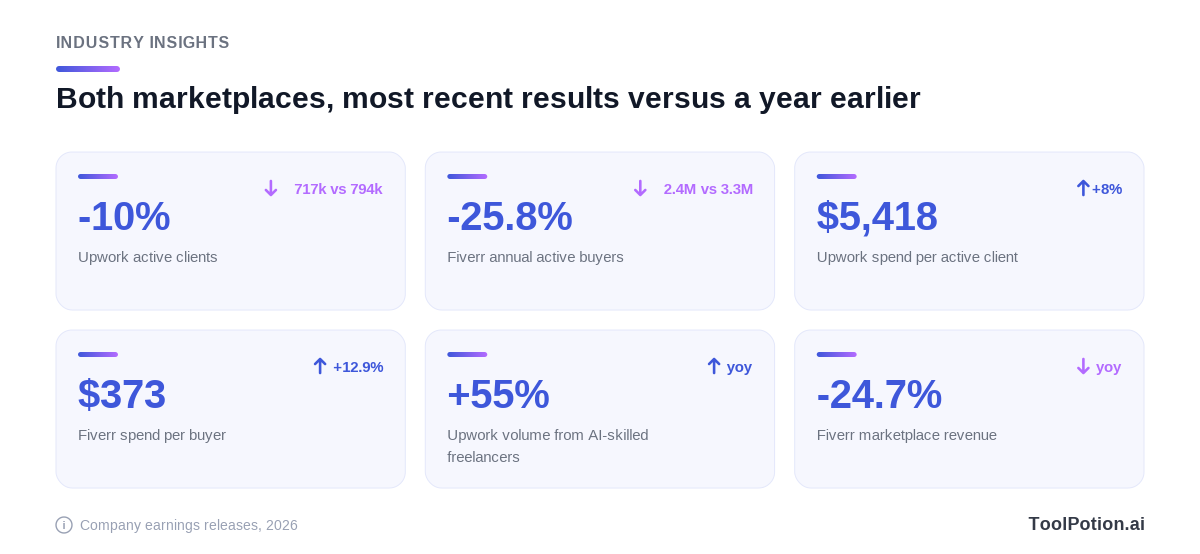
Fiverr's marketplace is shrinking faster. Marketplace revenue fell 24.7% to $55.4 million, though total revenue fell only 15.8% because the Services segment grew 3.4%. Guidance for the full year is a 12% to 13% decline in total revenue, a range the company raised this quarter. Fiverr also says projects of $1,000 or more were 16% of completed projects' gross order amount over the trailing twelve months, which fits the upmarket push its CEO describes.
Fiverr blames part of this on how buyers arrive. Management cites "ongoing demand and search traffic headwinds across the marketplace stemming from AI-related disruption to traditional SEO and SEM" and expects a steeper traffic decline than it previously forecast through 2027. That is a claim about discovery, not about whether the work still gets bought. Neither company says how many departed clients now do the job in a chat window, and we doubt either wants to. The filings can't separate AI substitution from a soft economy, and anyone who says they can is guessing.
One more number sits oddly beside the rest. Upwork says its new MCP server, which lets AI agents browse and hire on the marketplace, has seen AI agents make nearly 50 million requests, driving more than $3 million in estimated annualized Connects revenue. Upwork is betting that software becomes a client class. If it does, the freelancer's competition for attention gets stranger.
How freelancers are adapting
Liu and coauthors attribute the rise in competition in programming to skill transitions: ChatGPT lowers the human-capital barrier, incumbent freelancers (high-skilled ones especially) move in. The OpenAI report cites a separate study of exposed freelancers who shift away from their old domains and bid on higher-value contracts, with the catch that domain-specific skill limits how far they can move. And Upwork's survey of 2,400 skilled U.S. knowledge workers says 38% now freelance, up from 28% a year before. That is Upwork's number and a survey, so we'd hold it loosely.
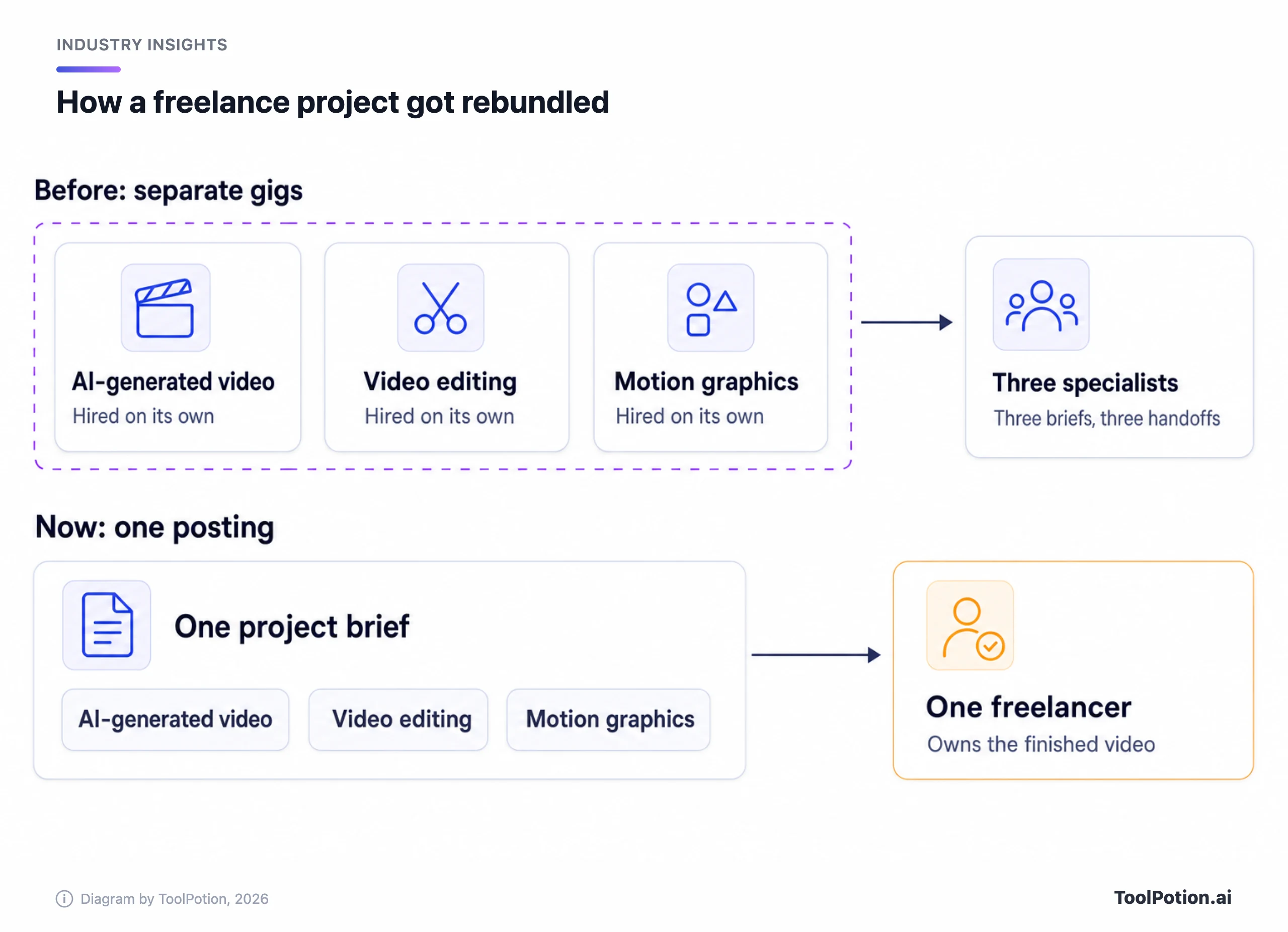
The report's most useful finding for a working freelancer is about bundling. In AI-related postings, historically uncommon task pairs make up 8.4% of all pairs, against 2.4% in other postings. One example in the report is a single brief asking for AI-generated video, editing and motion graphics. Clients are buying one person who can deliver the finished thing.
The squeeze on novices is the part we'd worry about. Teutloff's team found demand for novice workers declined in general, even among the skills that complement AI. For the employee side of that debate, see our look at AI entry-level jobs in 2026. Freelance data and payroll data are different instruments, but both ask who gets the first rung.
If we freelanced today
Start by sorting your services with one test: could a client get an acceptable draft of this by typing a paragraph into a chat window? If yes, the evidence says that service is where demand is shrinking. If it needs tools, delivery or judgment, it's where demand is holding.
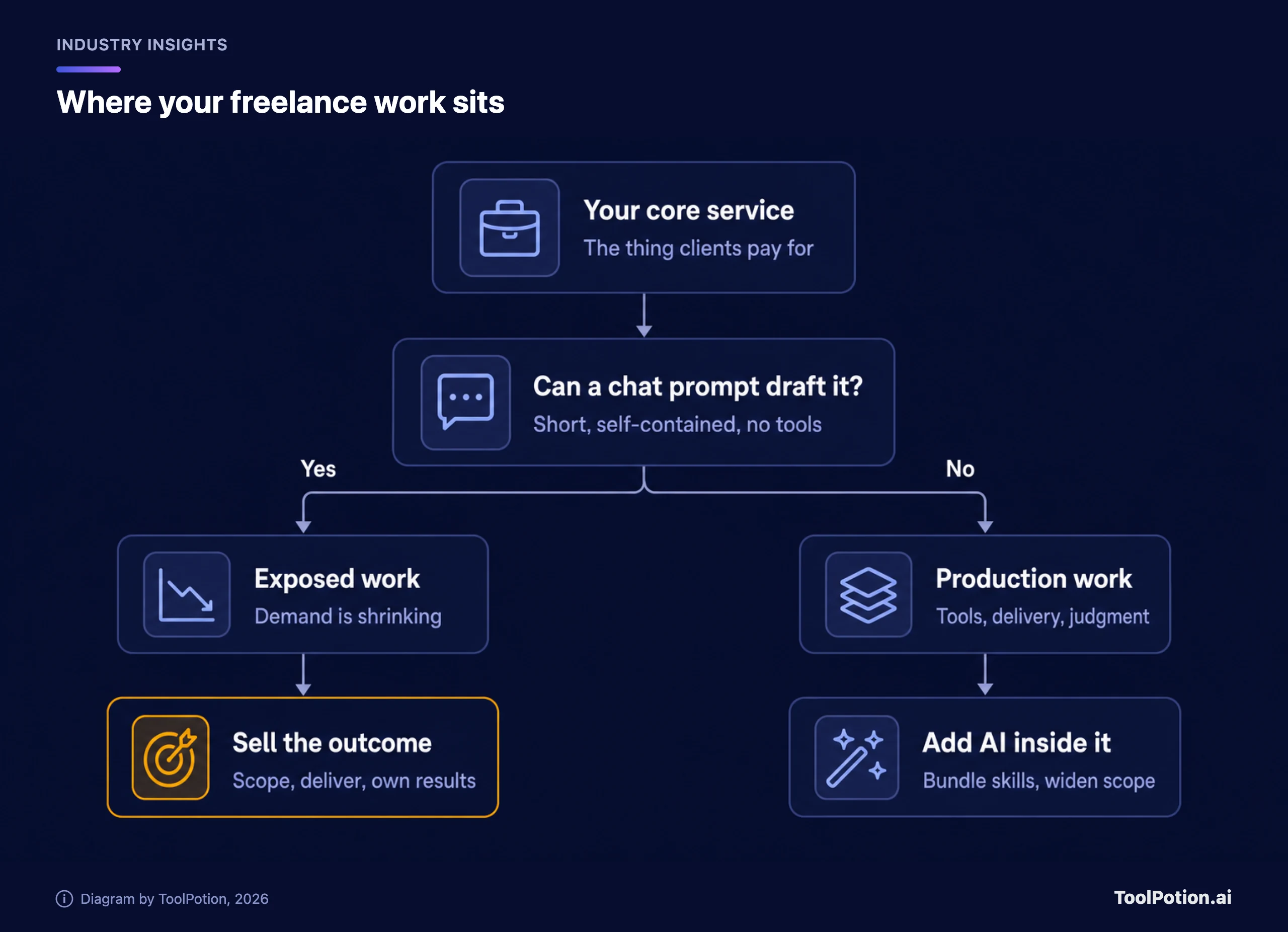
Then work through the list below. It follows the data, not a trend piece's advice.
- Stop selling drafts. Sell a finished, scoped result. Fixed-price budgets show the biggest AI gap in the report (about 52% higher after adjustment), and a fixed price keeps the speed AI gives you instead of cutting your hourly pay.
- Add one adjacent skill to your next proposal. If you edit video, learn enough AI-assisted motion work to quote the whole thing. If you write, offer the research, the build of the page and the measurement, not only the words.
- Avoid the commodity end. Generative AI and creative production work is where contract starts grew 90% and per-contract earnings fell 13%, per Upwork. Racing there on price is a bad trade.
- Pick one tool per job and learn it well. If you're choosing between ChatGPT and Claude for drafting and research, we set out the trade-offs in ChatGPT vs Claude vs Gemini. Builders have Cursor and Claude Code. Video editors have Runway, and image work has Midjourney or Canva.
- Keep a human check on translation. DeepL gives a fast first pass, and our DeepL, Google Translate and ChatGPT comparison shows where each one slips. Reviewing and localizing is the paid part now.
A word on auto-bidders. Tools like Upwex and Fiverr Mate automate proposals and gig SEO. We're skeptical. An auto-bidder moves work onto the client, who now reads twenty near-identical pitches, and we haven't found data showing that they win jobs. Our house view is that AI should remove work, not hand it to someone else. The full list of what's out there is on our AI tools for freelancers board, with the AI writing assistants and AI video generators boards for the two categories this data touches most.
If you want a quick read on where you stand, tick what's true below. It is our own checklist, built from the findings above, and not a validated score.
Numbers to watch next
Upwork guided to $742 million to $750 million of revenue for the full year, which implies the volume decline continues. Fiverr has promised its 2027 guidance with its next results and has already warned of margin pressure, so that number will say how long it expects the squeeze to last. Both companies are building for agent clients. If the Upwork MCP figures grow by an order of magnitude, the "who is the client" question gets harder to answer.
The most useful thing OpenAI could do next is release posting-level data so outside economists can test the classification. Until then, we'd act on the bundling finding with the caveat that Upwork's own pipeline labeled the jobs, and we'd ignore any pitch that promises an AI pay rise.