The best data we have says AI is making it harder to get a first job in the occupations it touches most, and that the damage shows up as fewer openings rather than layoffs. A Stanford study that tracks millions of payroll records finds that workers aged 22 to 25 in the most AI-exposed jobs have an employment level 19% below where it would be had they kept pace with their less-exposed peers (Stanford Digital Economy Lab). Workers aged 26 and older in those jobs show no comparable gap.
That is not the same as "AI is taking all the jobs." The authors call their numbers early and descriptive, other researchers see no economy-wide disruption, and some of the trends began before ChatGPT. Americans seem to sense the unease anyway: an AP-NORC poll found 64% think AI is developing too fast (AP).
This piece lays out what the credible research says, where it disagrees, which roles carry the most exposure, and what a junior worker or a hiring manager can do about it. Every figure below comes from a source we opened this year, and we name the source each time.
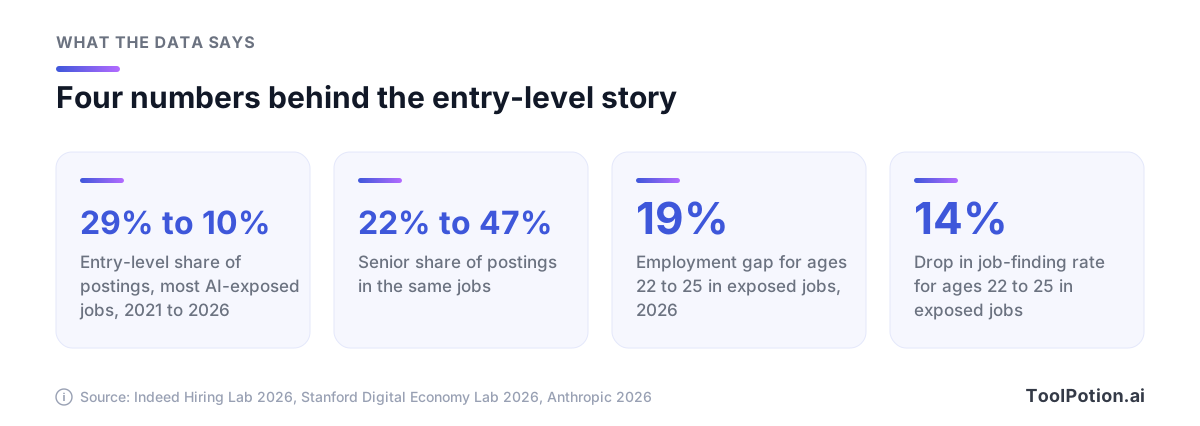
Those four numbers come from three different studies with different methods, so don't add them up. Read them as one pattern seen from different angles: fewer junior openings in the jobs where AI is best at the first draft.
What the Stanford study found
The study is called "Canaries in the Coal Mine?" and its authors, a team at Stanford's Digital Economy Lab, first published it in 2025. The latest revision uses ADP payroll data through 2026 and finds the gap has widened steadily since the first release (Stanford). Their own wording is that these are "early, descriptive indicators" and not causal estimates.
The split is stark. From late 2022 to 2026, employment for ages 22 to 25 fell 11% in the two most AI-exposed quintiles of occupations and grew 10% in the three least-exposed quintiles (Stanford update). The study finds no comparable gap for workers aged 26 and up, and says the effect runs mainly through reduced hiring of young workers rather than more separations.
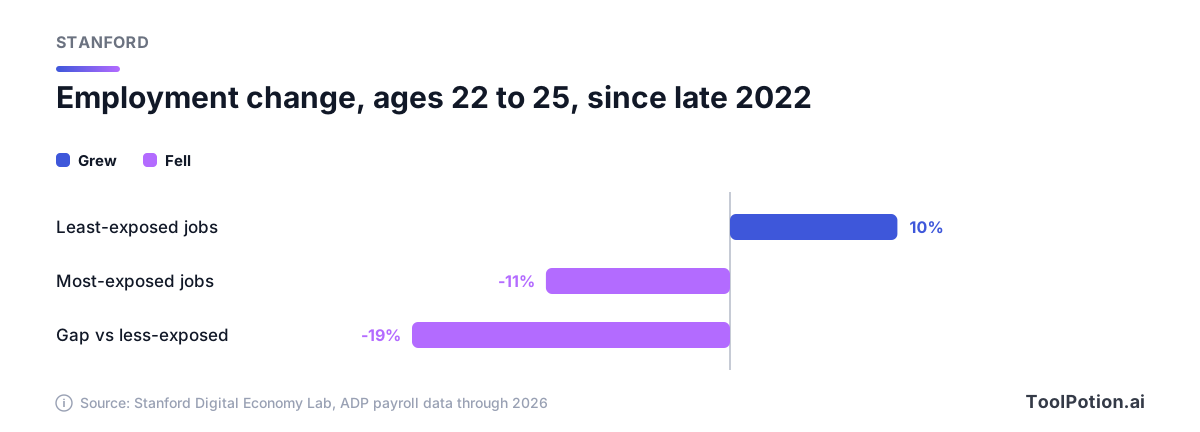
The bars show why the headline gap is bigger than either number alone. One group lost ground while the other gained, so the distance between them is wider than the 11% drop.
The authors offer a mechanism. Young workers bring codified knowledge, the kind taught in classrooms and written in documentation, and that is the kind AI replicates well. Experienced workers rely on tacit knowledge picked up over years. The study finds declines concentrated where AI substitutes for labor and employment that is flat or rising where AI complements it (Stanford). One test ruled out an obvious rival explanation: AI-exposed jobs are, on average, less sensitive to interest rates than other jobs, and the researchers say they "do not find strong support" for the idea that rate changes explain the entry-level drop (Stanford on interest rates).
Other data that points the same way
Anthropic's economists reached a similar place by a different route. Their 2026 paper built an "observed exposure" measure that blends what language models can do with how people actually use Claude at work. Computer programmers rank first at 75% task coverage, and data entry keyers come in at 67%. For ages 22 to 25, the paper reports a 14% decline in job-finding rates in exposed occupations since ChatGPT launched, though it calls the result only marginally statistically significant (Anthropic).
Indeed's Hiring Lab looked at job postings. In the most-exposed occupations (software development, IT support, data and analytics, marketing and finance), the entry-level share of postings fell from 29% to 10% between 2021 and 2026, while the senior share rose from 22% to 47% (Indeed Hiring Lab). The same analysis found advertised pay growing faster in exposed jobs, 46% since 2021 against 25% in the least-exposed ones, but almost all of that premium goes to experienced roles.
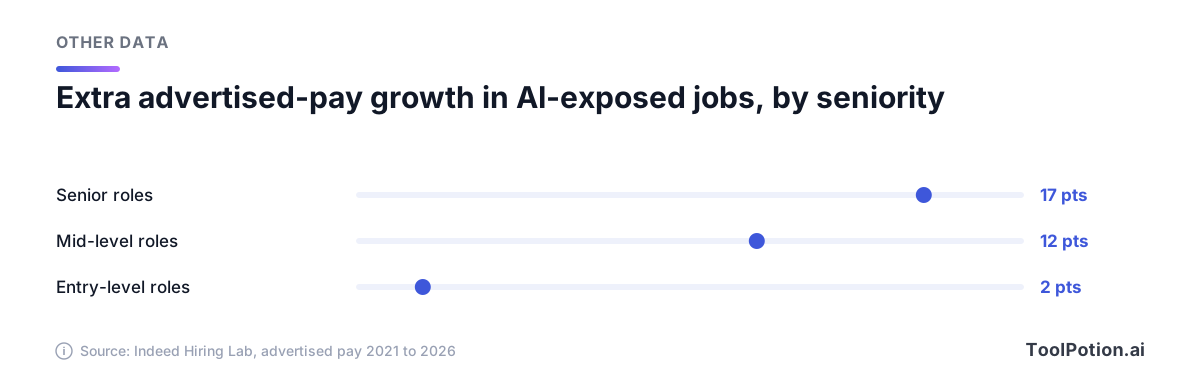
The dots say that the people AI helps most are the ones who already know the work. Entry-level postings in exposed jobs get a 2-point pay bump over low-exposure jobs, mid-level roles get 12 points and senior roles get 17. Indeed's own summary is that AI "has been acting more as a complement to skilled workers than a replacement."
LinkedIn's data fits the picture at a coarser level. Its 2026 grads guide says the seasonally adjusted hiring rate for US entry-level workers fell 6% over the winter quarter compared with the same stretch a year earlier, and that many students graduate without much experience of how AI fits into day-to-day work, even as employers look for those skills (LinkedIn).
Where the evidence is mixed
Start with the skeptics, because they have real data too. The Yale Budget Lab tracks how the mix of occupations is changing and how long people stay unemployed. Its report says that while anxiety over AI and jobs is widespread, "our data suggests it remains largely speculative," and its executive director Martha Gimbel told Fortune there are no major macroeconomic effects at this point. The same Fortune report cites Oxford Economics, using Challenger, Gray & Christmas data: AI was blamed for about 55,000 announced US job cuts in the first 11 months of 2025, only 4.5% of the total. It raises the possibility of "AI washing," where firms blame AI for cuts with other causes (Fortune).
Anthropic's paper agrees on the big picture: no systematic rise in unemployment among highly exposed workers since late 2022. Its authors describe the young-worker hiring slowdown as an early warning that appears in hiring before it appears in unemployment (Anthropic).
Then there are the caveats inside the Stanford work. The effect is more pronounced in the ADP sample than in national survey benchmarks, it shrinks when you control for education, and some of the divergence started before generative AI took off (Stanford).
The newest numbers on graduates are not catastrophic either. The New York Fed's latest reading has recent graduates (ages 22 to 27) at about 5.6% unemployment, with underemployment at 42%, edging up (New York Fed).
Economists are also moving. Indeed's latest quarterly survey of economists found a diffusion index of 55.6 for AI displacement risk to college-educated workers (above 50 means rising risk), and 45% of the panel called AI's net employment effect a minor negative. Panelists expected administrative assistance and software development to see the largest declines (Indeed Hiring Lab).
Public mood is running ahead of the data. In the AP-NORC poll of 2,140 adults, 27% said AI is developing at about the right pace and 8% said too slowly, and about 8 in 10 said it is extremely or very important for the government to keep AI under human control (AP). Worry about work is part of that. Worry is not evidence of displacement, but it does shape how young people and parents read the job market.
Three things would change our read. A rise in unemployment among young workers in exposed jobs, which would mean the hiring slowdown is turning into job loss. Entry-level postings recovering in exposed occupations. Or the Stanford gap shrinking once more data on 2026 hiring arrives. Until one of those happens, the careful position is the one above.
Our read: the claim that AI is quietly thinning the bottom rung in a handful of occupations is well supported. The claim that AI is causing a general jobs collapse is not. Anyone who tells you the data settles the cause is ahead of the research.
Which roles are most and least exposed
Exposure follows the task, not the industry. Anthropic's list of the most covered occupations is topped by programmers, customer service representatives and data entry keyers. At the other end, about 30% of workers have zero coverage in its data, including cooks, motorcycle mechanics, lifeguards, bartenders and dishwashers (Anthropic).
The figure below is our editorial placement of common entry-level jobs on two questions: how much of the work is routine and written down, and how much AI is used to do those tasks. It is a judgment aid, not a measurement, so move any dot your own experience disagrees with.
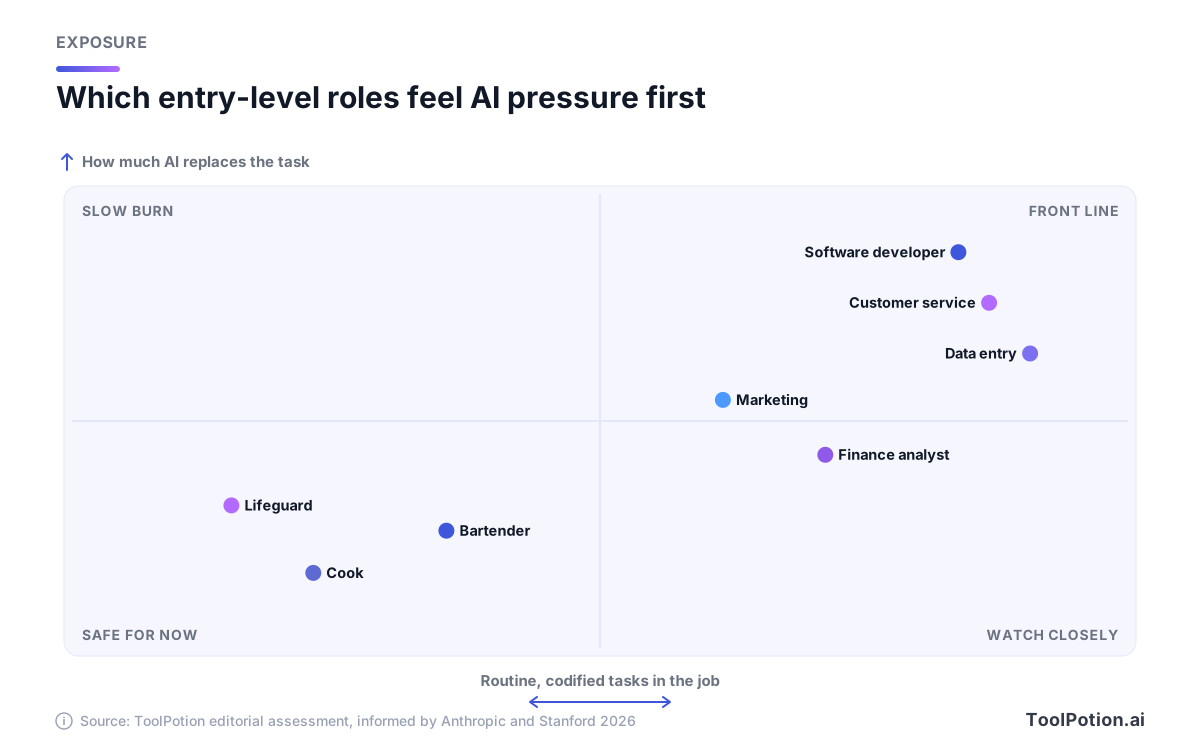
The cluster at top right is where early-career hiring has already thinned. Marketing and finance sit in the middle, and Indeed's posting data puts both in its most-exposed group. The bottom-left roles depend on hands, presence and real-time judgment, which is why they barely register in the exposure data.
One catch: low exposure is not the same as high pay or good prospects. Highly exposed workers also earn 47% more on average, according to Anthropic, so the jobs under pressure are often the ones people trained hardest to reach. Pick a lane on fit, not fear.
Why the squeeze hits hiring, not layoffs
A company rarely announces that it replaced a junior with a model. It just doesn't open the requisition. A senior engineer who can get a decent first pass from an AI tool has less reason to ask for another associate, so the headcount that would have been added never appears in anyone's layoff numbers.
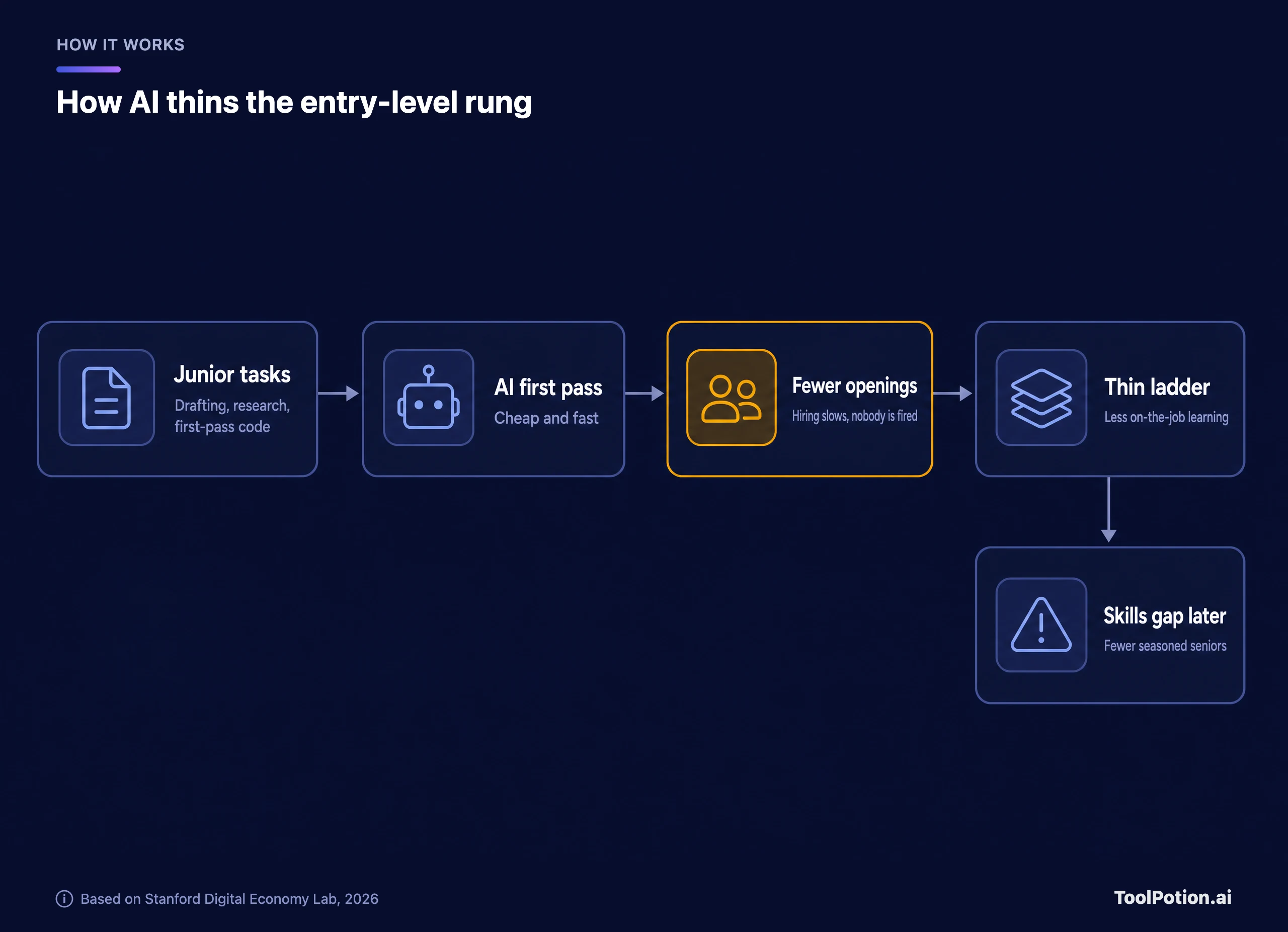
The long-run worry sits on the right side of that diagram. Entry-level jobs have always been where people learn the tacit part of the work. In an essay for MIT Technology Review, USC's Georgios Petropoulos argues that automating junior tasks risks damaging how organizations build skill, and he suggests paid co-ops, apprenticeships and employer incentives to keep early-career hiring alive (MIT Technology Review).
What employers say they want from juniors
Employers report that AI skills are moving into entry-level job requirements fast. NACE, which surveys employers about college hiring, found that more than a third of entry-level jobs now require AI skills, nearly triple the share in its fall survey. 28% of employers said they are seeking early-career talent who can use AI, and nearly 60% are assigning interns projects that use AI tools (NACE).
Students are not all keeping up. NACE's 2026 student survey drew more than 17,000 students, and among its graduating seniors 31% called AI skills of little or no importance to their careers, 40% called them very or extremely important, and 50.5% were not yet building those skills (NACE).
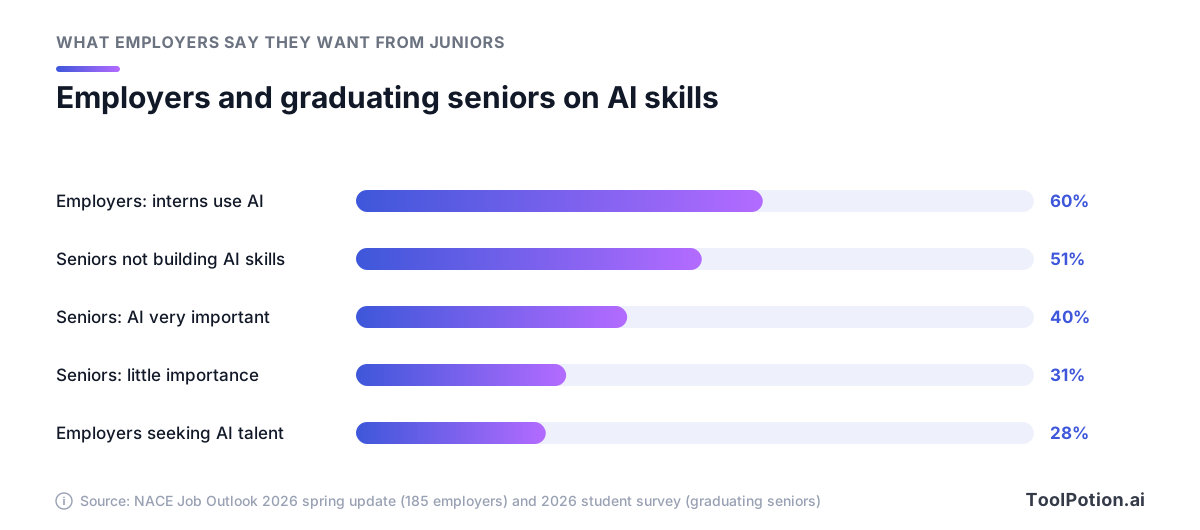
The meters show a mismatch worth acting on. Employers are testing AI skills on interns while half of graduating seniors haven't started. One caution: the employer figures come from 185 organizations that chose to respond, so treat them as a direction, not a census. NACE's survey also found that more than half of employers say AI is not reducing entry-level tasks, and only 11% discussed AI replacing positions.
Skills and tools that make a junior more hireable
The skills NACE employers describe are applied ones: picking the right AI tool for the task, writing good prompts, and checking and revising what comes back (NACE). Nobody is asking a new graduate to train a model. They want someone who can use one and catch its mistakes. Petropoulos puts the winning combination as AI fluency plus domain expertise (MIT Technology Review).
Here is a practical order of operations for the next 30 days.
- Pick one target role and read ten recent postings for it. Note which tools and tasks come up more than once.
- Learn two general assistants well. ChatGPT and Claude are the obvious pair, and our ChatGPT alternatives guide helps if you want a third option for comparison.
- Use AI for a real piece of work and keep the receipts: a research memo, a data cleanup, a small app. Write down what the AI got wrong and how you caught it. That verification story is what interviewers remember.
- If your target is technical, practice with a coding assistant such as GitHub Copilot, Cursor or Claude Code, and be ready to explain code you didn't type. Our AI coding assistants board ranks the field.
- If your target is writing, research or operations, add a research tool like Perplexity, a workspace assistant like Notion AI and an editor like Grammarly, and show a before and after on a real document.
- Take one structured course so the skills are on paper: Google Prompting Essentials or AI For Everyone on Coursera, or LinkedIn Learning. The wider AI learning board has more.
- Tighten the application. A resume builder from the AI resume builders board such as Resume Worded and a practice partner from the interview prep board such as Interview Sidekick can help, as long as the final words are yours.
Courses alone won't separate you, since everyone else is taking them too. What separates people is a short, concrete portfolio and an honest account of how they used AI. For more on the job-search side, see our guide to AI tools for job seekers.
Before you commit to a path, check how exposed the job you're aiming at is. The quiz below turns the findings above into five questions.
The result is a prompt to think, not a forecast. A high score doesn't mean avoid the role. It means you'll need stronger proof of work and a clear way to show you can supervise AI output.
Four career moves that fit the evidence
The research suggests a few moves with real logic behind them. None of them is guaranteed.
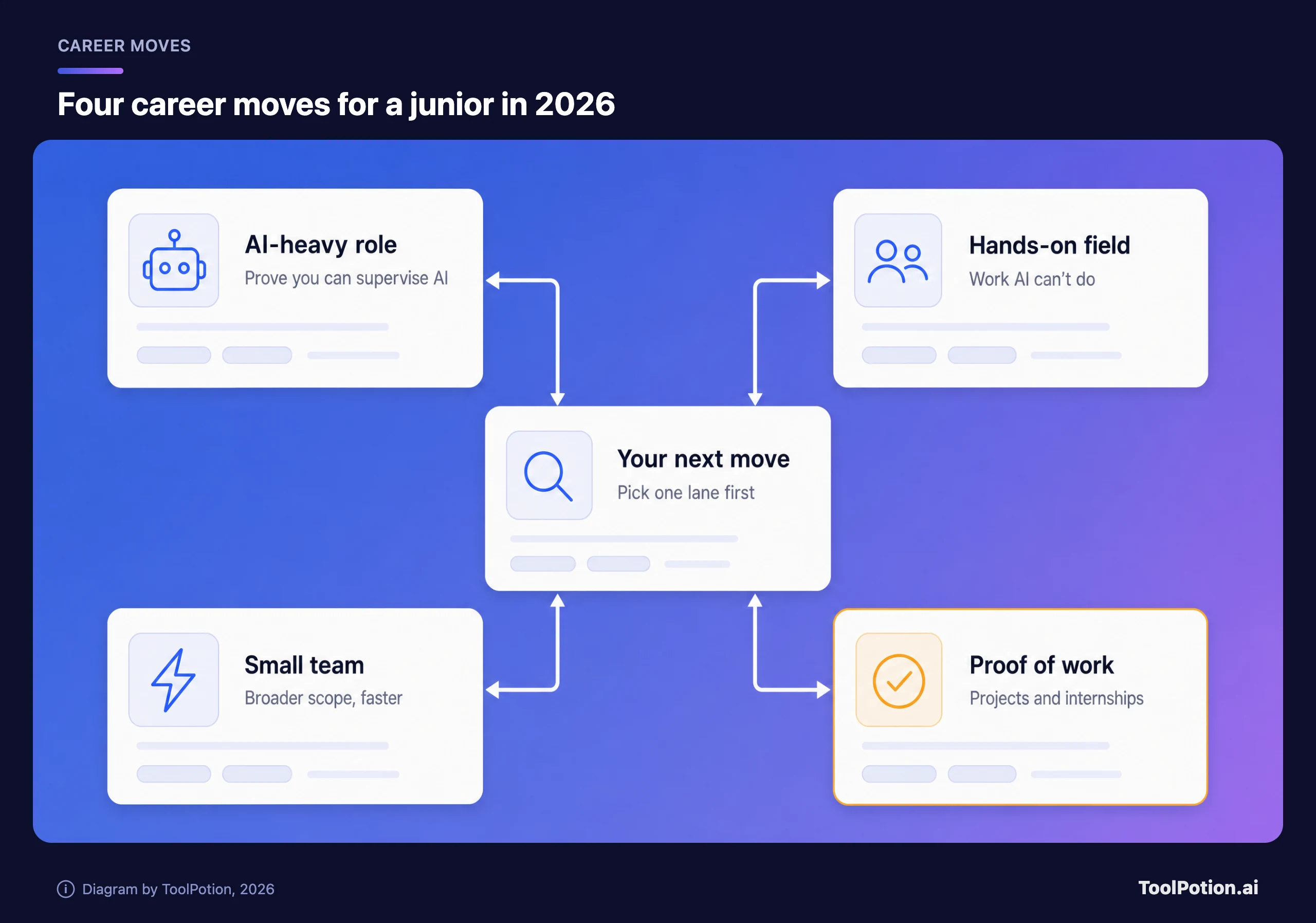
An AI-heavy role works if you can show you supervise the tools well, since that is the skill employers are adding to job posts. A hands-on field is the hedge, because those roles show the least coverage in Anthropic's data. A small team often hands juniors broader scope earlier, though we have no hiring data on it, so treat that as a reasoned bet. Proof of work cuts across all three: projects and internships are what turn a thin resume into a credible one.
Who should worry most? Someone aiming at software development, customer support or data entry through a standard application pipeline and relying on a degree alone. Who can relax a little? Someone headed for work that needs physical presence, licensing or constant human contact. Even they should learn the basic tools, because the NACE numbers say requirements are spreading.
If you hire juniors
The research is also a warning for managers. If the junior rung disappears, so does your future supply of seniors with tacit knowledge. Indeed's data shows the senior share of postings in exposed jobs already rose to 47%, and those people had to come from somewhere.
Three moves stand out. Redesign the junior role around supervising AI output and handling exceptions, rather than doing the first draft by hand. Pair every junior with a named senior and give them real review work from week one. And write postings that say which AI skills you actually use, since vague demands push good candidates away. NACE's finding that nearly 60% of employers give interns AI-based projects suggests this is already standard practice for the leaders.
Frequently asked questions
Is AI really taking entry-level jobs?
It is reducing hiring in some occupations, which is not the same as firing people. The strongest evidence is the Stanford payroll study and Indeed's posting data, and both show fewer openings for juniors in exposed jobs. No source we read shows a general jobs collapse.
Which entry-level jobs are safest from AI?
Jobs that need physical presence or constant human contact show the least exposure in Anthropic's data, such as cooks, bartenders and lifeguards. Safe does not mean well paid, so weigh pay and growth as well.
Should I still study computer science or accounting?
The evidence says entry-level hiring in software and related fields has softened, but it doesn't say the skills are worthless. Stanford's authors note effects shrink when you control for education, and hiring slowed more for juniors than for experienced staff. If you go in, plan to show AI-assisted projects and real internships.
Do employers actually want AI skills from new graduates?
Yes, and the share is growing. NACE found more than a third of entry-level jobs now require AI skills, though only 16.5% of job descriptions mention them explicitly. The skills are applied ones: choosing the right tool, prompting well and checking the output.
Is AI the reason for the weak graduate job market?
It is one candidate. Stanford's team tested interest rates and found they don't explain the pattern, and Stanford's authors say some trends began before generative AI took off. Treat any single-cause story with suspicion.