PJM's independent market monitor says about $6.3 billion of the $16.4 billion in capacity charges from the grid's latest auction traces to data centers, according to Insurance Journal's report on the results. On the same grid, Microsoft's president Brad Smith has promised: "We'll pay our way to ensure our datacenters don't increase your electricity prices" (Microsoft). Bloomberg ran another version of that vow under the headline Microsoft Vows to Pay Its Own Way to Power Data Centers.
Can both statements be true at once? Yes: that's the puzzle. We spent the research time on utility filings, regulator orders and grid-operator reports, because the headlines tend to pick a side. The evidence so far is mixed, uneven by region, and mostly about wholesale markets, not the line items on a household statement. (We covered the local fights over siting in our post on why towns resist AI data centers, so this piece stays on money.)
How does a utility price a data center?
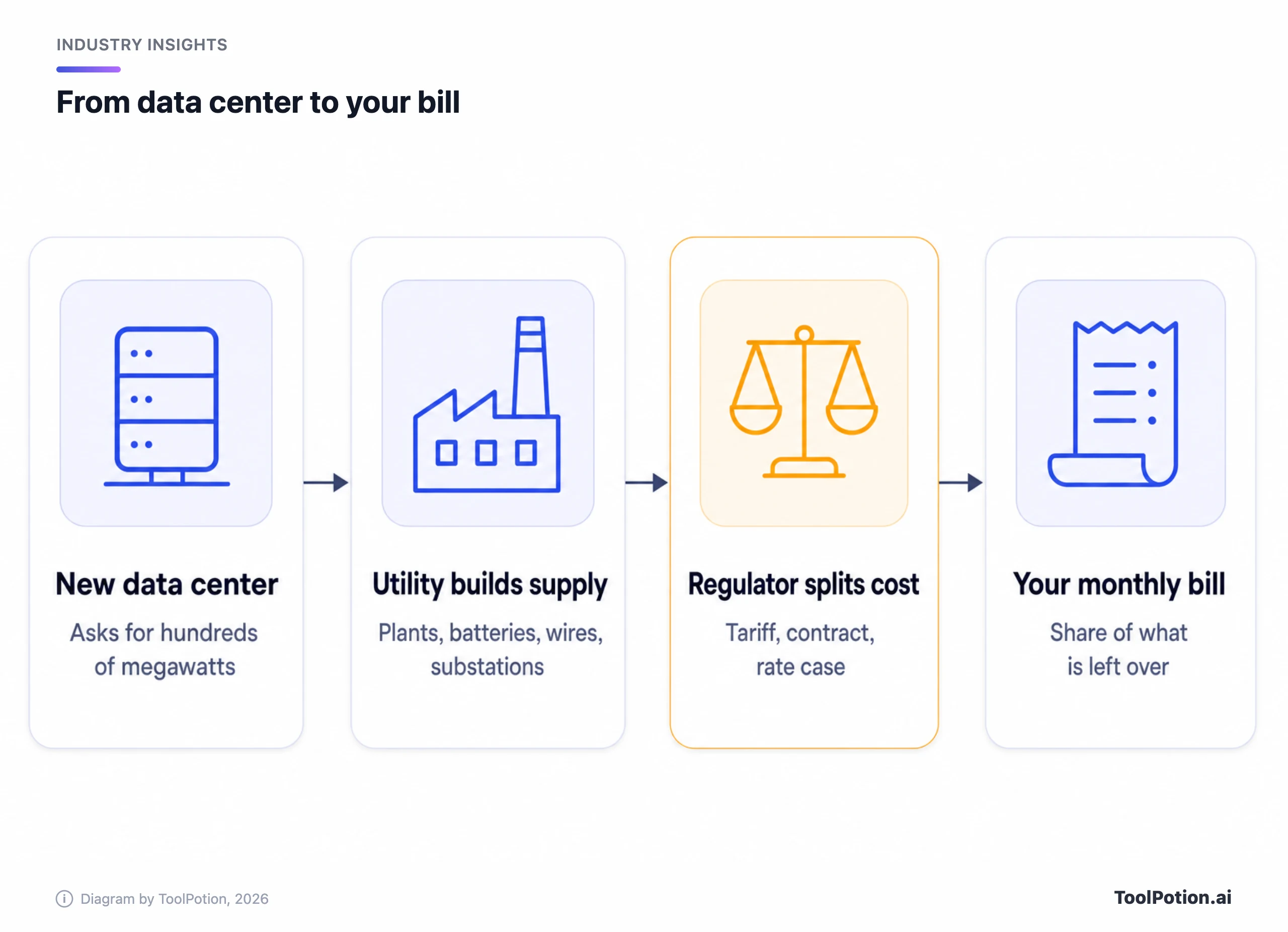
A house pays a monthly charge plus a rate per kilowatt-hour, and the rate is set in a rate case that spreads the utility's costs across every customer class. A data center asking for hundreds of megawatts breaks that arrangement. It needs new generation or contracts, new transmission and sometimes a new substation, all before it uses a kilowatt-hour.
Regulators have two broad ways to handle it. The first is a dedicated large-load tariff or a special contract, usually with a minimum bill the customer owes whether or not it uses the power, so the utility isn't left holding a plant built for a tenant that shrinks. The second is to let the new load join the existing pool and trust the next rate case to sort out who owes what. Arizona commissioner Lea Márquez Peterson put the stakes plainly in a Utility Dive interview: "We have been talking for years that growth must pay for growth, and I think customers are asking for proof."
Her state hasn't adopted one statewide tariff. It uses energy supply agreements and plans to develop its large-load approach inside upcoming rate cases. That is typical: there is no national rulebook, so the answer to "will it hit my bill" depends on your utility's filings.
The evidence on bills is mostly wholesale so far
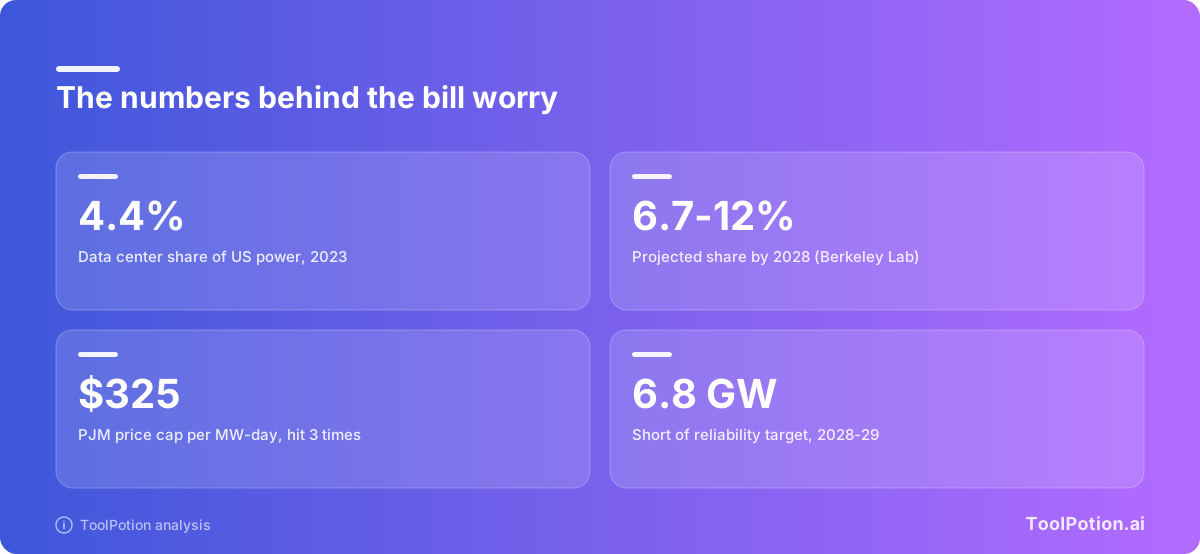
There is evidence about wholesale prices, which is where the clearest numbers sit. PJM, the grid operator serving about 67 million people in 13 states and Washington, D.C., buys capacity (a promise that power plants will be available) years ahead in an auction. Its 2028-29 auction cleared at $325 per megawatt-day, the maximum its price cap allows, and fell about 6.8 gigawatts short of the reliability target. It was the third straight auction to hit the ceiling (a cap PJM says keeps costs down but also dulls the incentive to build plants). Without the cap, PJM's own simulation put the price at $554.72.
The market monitor, Monitoring Analytics, attributes about $6.3 billion of that auction's $16.4 billion to data center demand, and almost $30 billion across the last four auctions, per Insurance Journal. Its president, Joseph Bowring, wants data centers pulled into a separate auction so other customers aren't covering the extra cost. The utilities' trade group sees the same squeeze from another angle: Edison Electric Institute president Drew Maloney said PJM customers "are left to pay high capacity costs while also facing the risks of undersupply."
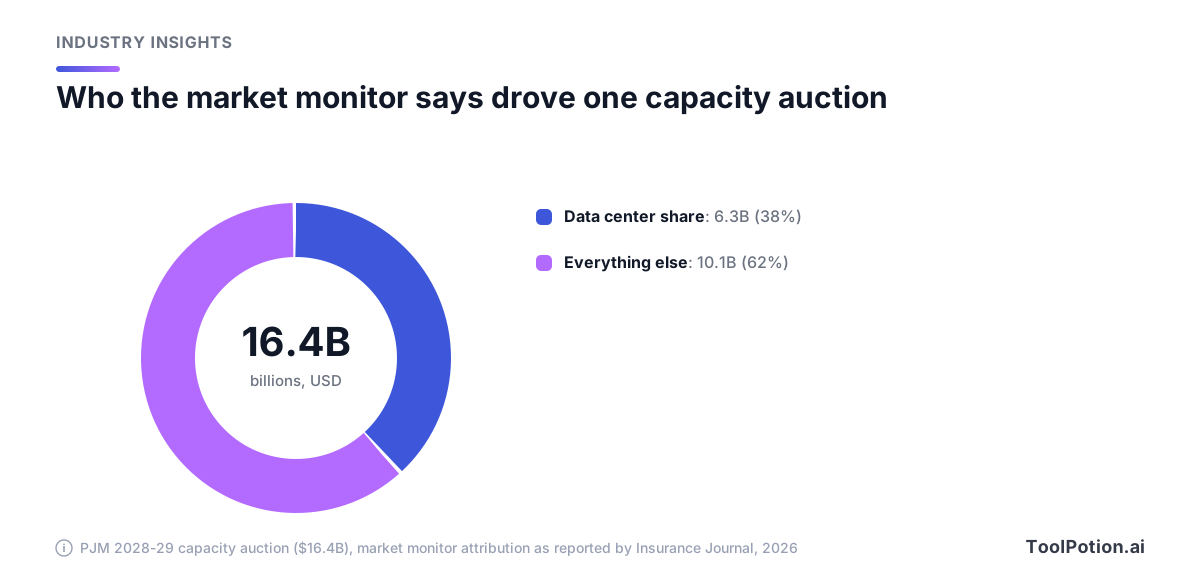
Now the caveats, because they are large. PJM's own auction report for the delivery year before this one says its $16.4 billion total "does not equate to a total cost to load" because customers hedged through self-supply or bilateral contracts don't face the auction price. Capacity is one line among generation, transmission and distribution charges. And the monitor's attribution is an estimate of what demand growth did to the price, not a count of dollars that landed on residential bills.
Advocacy groups have gone further. In a 2025 report, the Natural Resources Defense Council said "By 2028, an average family in the region will be paying around $70 a month extra on their electricity bills because of forecasted data center growth," as E&E News reported. That is an advocacy projection, now over a year old, built on forecasts of load that may not arrive. We'd treat it as an upper scenario. We'd also notice that we found no regulator-published figure for what a typical household has paid so far because of data centers, which is itself a finding.
The load behind all this is real. Berkeley Lab's report, summarized by the Department of Energy, found data centers used about 4.4% of US electricity in 2023 and expected 6.7% to 12% by 2028. The AI products that drive it (ChatGPT, Claude, Google Gemini, Microsoft Copilot, Meta AI and Grok among them) are all in our directory, and every one of them is a customer of this grid, directly or through a cloud.
Pay-their-own-way pledges do not settle it
Not on their own. Microsoft's plan from earlier this year, titled Community-First AI Infrastructure, says it will ask utilities and commissions to set its rates high enough to cover the electricity costs of its data centers, including the infrastructure, so those costs are not passed to residential customers. It also promises to contract for power early and pay for the transmission and substation upgrades. It points to a Wisconsin rate structure for "Very Large Customers" as the model it supports (per the company's post). It's a good commitment; we'd rather see it than not.
Look at the verb, though: Microsoft will ask regulators to set the rate. The commission decides, in a proceeding with its own evidence and its own politics. The broader Ratepayer Protection Pledge from President Trump, which tech companies and utilities including Google and AES Indiana signed earlier this year, is described by Utility Dive as a voluntary commitment that state regulators are working out case by case. Voluntary pledges are worth having. They are not tariffs.
There is a structural gap too. A pledge can cover what one company's own facility costs the utility. It can't reach a regional capacity price that every customer on the grid pays, whoever caused it. That is why the biggest dollar figure in this story, the PJM auction, sits outside what any single company's promise controls. The monitor's remedy, separate procurement for large loads, is a market-design change; in 2025 PJM softened a proposed bring-your-own-generation requirement from mandatory to voluntary, E&E reported.
Who pays when a utility builds for a single customer?
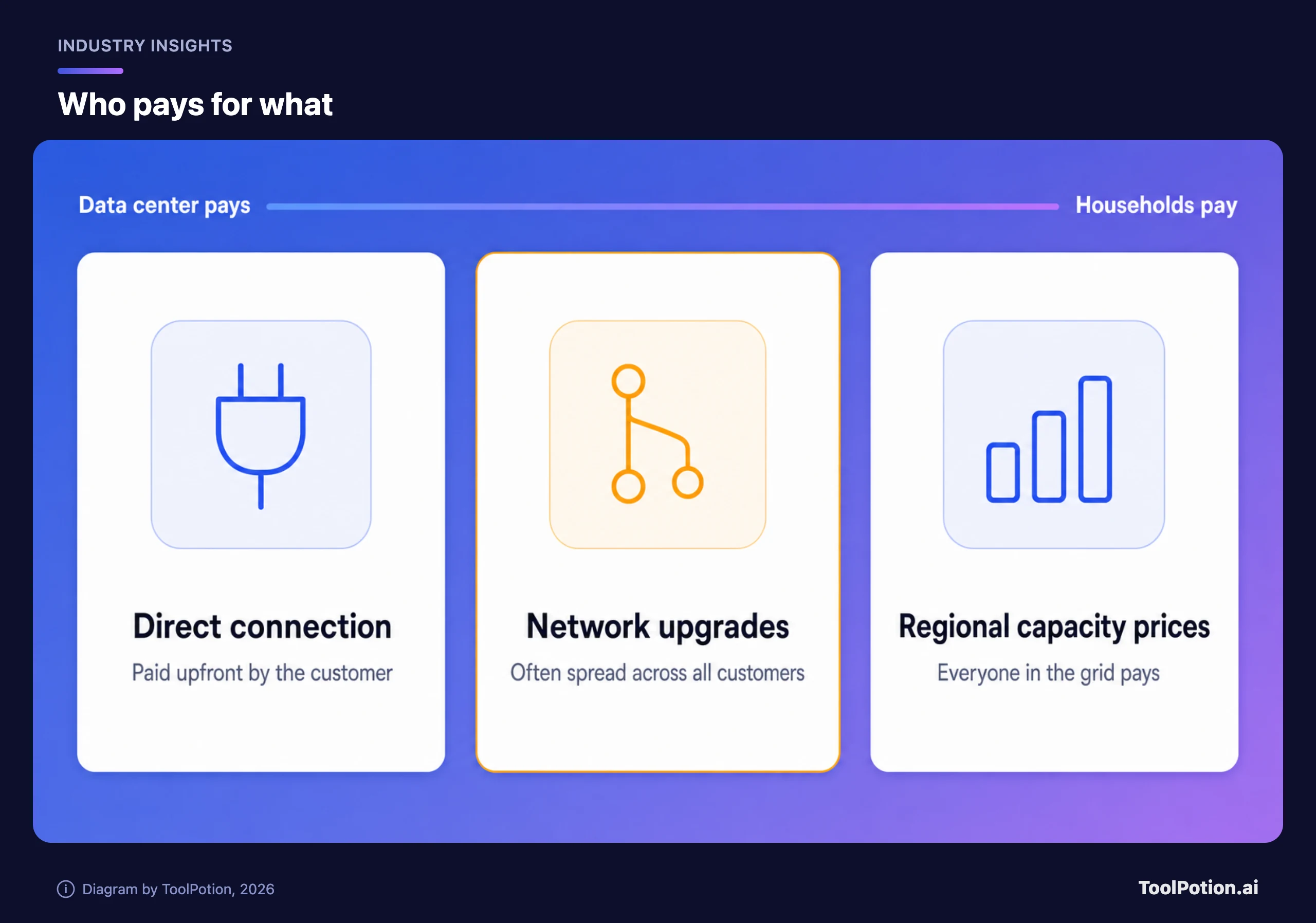
The best worked example we found is in Indiana, because the commission's decision and the arguments around it are well documented. Regulators there approved AES Indiana's plan to serve a 390-megawatt Google data center in Monrovia, with new generation, storage and grid equipment at an estimated project cost of about $737 million, per Utility Dive.
Google pays about $32 million upfront for its direct connection. But $73.8 million in network upgrades goes into the transmission rate base, recovered from all customers including residential ones. The vote was 5-0, and the order said that "although the Customer may be the impetus for the network upgrades being made, this does not preclude the upgrades from providing system-wide benefits."
AES says Google's contract is built to "reimburse at least 100%" of incremental direct costs, that Google will pay $300 million toward fixed costs at the minimum demand level and about $770 million at expected demand, and that revenue will "more than offset" residential customers' share. AES vice president Patrick Maguire said customers' rates are not affected by those transmission investments at all. Ben Inskeep of the Citizens Action Coalition, a consumer group, answered: "Instead of making the cost causer pay, AES Indiana has decided to spread the costs out to other ratepayers, and our commission has unfortunately approved that."
Both sides can be right about the arithmetic. They disagree about what counts. Much of the contract is redacted, including monthly demand charges and riders, and the utility's cost-of-service study isn't due until its 2029 rate case. Critics also flag that Google's rate assumes a 90% load factor, which they describe as a 10% discount. We think that is the model case for what to demand: a public contract, a minimum bill, and a clear answer on network upgrades. Indiana got the first two partly and the third by argument.
The risk when a data center is never built
This is the part most pledges skip. Utilities plan generation around the load requests they receive, and many requests are speculative. That NRDC report also warned, per E&E News, that "PJM residents will be on the hook for skyrocketing prices, even if these data centers don't get built." (TechCrunch has run a video under the headline why the data center you dread might never be built.) For households the cancelled project is not obviously good news if a plant was already planned around it.
One clause is the fix: a minimum bill. It's the first thing we'd look for. If the customer owes a floor whether or not it shows up, the risk of overbuilding stays with the company that asked for the power.
A second route is to skip the shared grid. A BloombergNEF analysis reported by the Guardian counts 181 GW of on-site gas-fired capacity proposed at data centers in the US, UK and mainland Europe because of grid connection delays. Fewer connections to the shared system could mean fewer shared costs. But BloombergNEF's Mark Daly said developers describe the gas plants as temporary while the economics could keep them running, so the long-term bill and emissions picture is unsettled.
Five checks a homeowner can run
You can't audit a tariff over a weekend, but you can find out whether your utility has one. We'd start here.
- Search your state commission's docket list for "large load", "data center" or "extra-large customer" tariffs. If one exists, read the summary for a minimum bill and a contract length.
- Check your next rate case notice. Rate cases are where costs get allocated, and public comment periods are open to residents.
- Read your statement for supply or capacity charges. In PJM states those lines are where auction results show up first, with a lag of a year or more.
- Ask your commission whether network upgrades for a new large customer will be charged to all customers, as in Indiana.
- Be wary of any single number promising your exact increase, ours included, because forecasts of load keep changing.
If you're in a deregulated state, shopping for a supplier changes only the supply portion, not the delivery charges where upgrades land. Our pick for most readers is to ignore the national headlines and read one document: your utility's most recent rate case summary.
Utilities themselves are a growing category of buyers for AI software. If you want to see the other side of this, browse our Energy & Utilities board or the hub of AI tools for energy and utilities. To follow siting rules by state, the Regbase data center map tracks development regulation, and the AI World: Data Centers conference is where operators talk about power. For more on what AI infrastructure costs the companies themselves, see Amazon's push to cut token budgets.
Frequently asked questions
Is the Ratepayer Protection Pledge legally binding?
No. Utility Dive calls it a voluntary commitment, and state regulators are working out how to apply it case by case.
Are capacity charges the same as my whole bill?
No. They are one component, and PJM says its auction total is not a total cost to customers, because hedged load doesn't face the clearing price. How much reaches you depends on your utility and supplier.
How much US electricity do data centers use?
About 4.4% in 2023, and a projected 6.7% to 12% by 2028, according to Berkeley Lab's report as summarized by DOE.
Can a regulator make a data center pay more than a house?
Yes, in principle. Commissions set rates by customer class from cost evidence, and Indiana law, for instance, requires large-load customers to reimburse at least 80% of project costs reasonably allocable to them. What counts as allocable is the fight.
Does Microsoft's pledge cover other companies?
No. It is Microsoft's own commitment. Other companies make their own commitments, and the Ratepayer Protection Pledge that Google and AES Indiana signed is a separate document.