"If your work does not benefit from current AI tooling, that is a finding, not a failing," Amazon told its software engineers in a memo that CNBC reported. It's an unusual sentence from a company that sells AI to other businesses, and it's easy to squeeze into a headline: Amazon tells engineers to use less AI.
The memo is more careful than that headline, and the argument around it matters more than the memo. Tokens are now a line on engineering budgets, and managers everywhere are being asked what Amazon has just answered in public: how do you know the spending is buying anything? What follows is what the memo says and leaves out, what a seat really costs on four major tools, and where a cap helps or hurts.
Tokenmaxxing is a leaderboard problem
CNBC defines tokenmaxxing as developers using AI "as much as possible with little regard for output." The word has a small history at Amazon. According to CNBC, the company shut down an internal leaderboard earlier this year after discovering that employees were tokenmaxxing to climb the ranks. I-Programmer's account, which leans on Financial Times reporting, says the board was called Kirorank, ran for only a few weeks and was never officially sanctioned. People invented menial tasks for AI agents to run, and Amazon paid for the tokens.
Amazon wasn't alone. The same report says Meta closed an employee-built board earlier this year where staff competed for titles like Token Legend, ranked by how many tokens they burned in Claude Code. It also recalls an earlier leaked message from Amazon senior vice president Dave Treadwell asking staff to stop "using AI just for the sake of using AI."
Nobody had to be dishonest for this to happen. Put a number on a screen, rank people by it, and the number goes up.
What the memo says, and what it doesn't
Per CNBC, the memo circulated internally before Amazon posted it on its website. It revises how Amazon describes the job of software development engineers and their managers. Its core finding is about measurement. Token usage, the rate of AI-tool adoption, and counts of code changes or reviews all remain "deeply flawed" ways to judge a team's AI use, the memo says, because they can drive higher costs and too much complexity.
It stops short of banning the numbers. They should be read "with care and judgment" next to other data, and the memo's preferred yardstick is stated plainly: "We believe that it is best to measure, and be measured by, long-term outcomes."
An Amazon spokesperson told CNBC the company hasn't instituted caps on token usage. That matters, because "use less AI" overshoots what was reported. Nothing in the coverage we read describes a quota, a budget per engineer or a dollar figure. Amazon hasn't said what it spends, and none of the reporting could say either.
Marc Brooker, a vice president and distinguished engineer at AWS, gave CNBC the logic in two parts. The company looks at things like feature velocity (how many launches, how many successful changes in production) and treats the spend as an investment. What it doesn't want, he said, is "wasted effort" on problems that don't matter, and he conceded that it's sometimes hard to know which those are, so some appetite for experimentation stays.
Read that way, the memo is closer to a performance-review policy than a cost-cutting one. The line we'd underline is the one quoted at the top. An engineer who can explain where AI doesn't yet help is, in the memo's words, "demonstrating the judgement we are asking for." That's a company telling managers not to punish people for turning a tool off.
Why a company that sells AI would hold back
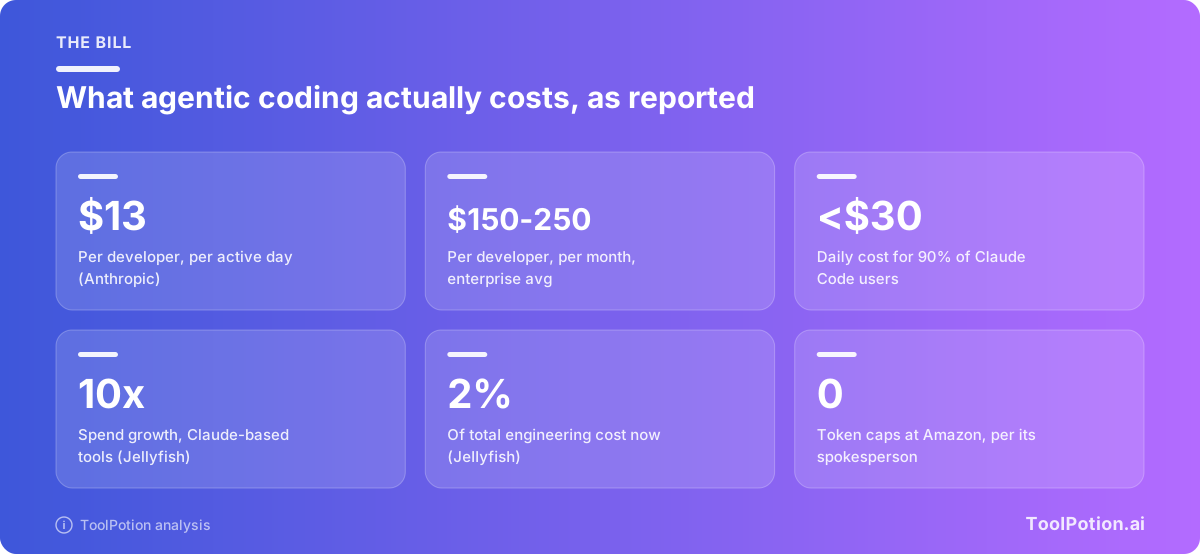
Cost is the plain answer, and the numbers are growing faster than budgets. Jellyfish, which makes tools for engineering teams, published a report on agentic coding tools that TechCrunch covered. Among Jellyfish's customers, spending on Claude Code and other tools built on Anthropic models is up 10x since the start of the year, and now equals about 2% of total engineering cost. Two percent is small, but Jellyfish chief scientist Nicholas Arcolano told TechCrunch that "that 10x growth is growth that most CFOs didn't plan for."
Anthropic's own docs put a floor under the individual number. Across enterprise deployments, the average cost of Claude Code is around $13 per developer per active day and $150 to $250 per developer per month, and 90% of users stay below $30 a day (Claude Code docs). That's an average for a vendor's own customers, so treat your own pilot as the real number.
Two more reasons are our inference, and nothing in the reporting states them. A metric built on code changes and reviews can bury reviewers in output nobody asked for. And an engineer chasing a usage number has little reason to ask whether a task needed a model at all. Neither the memo coverage nor the reporting around it mentions security as a driver, so we won't pretend it was one.
Microsoft's buyouts and a vendor selling the meter
Amazon's memo landed in the same week as other stories about companies squaring AI with the books, and they aren't the same story. Microsoft offered voluntary buyouts to a group of around 60,000 eligible employees, about 27% of its workforce, while it balances a costly AI infrastructure build-out against capital efficiency. CNBC ties that to infrastructure and cash flow, not to anyone's token use. The same article does say Microsoft is trying to charge clients based on how much AI they actually use, which is the meter turned around.
Then there's the company with the most to gain from you spending more. Anthropic released reporting tools that let a manager see what a team produced over a date range, what it cost and where workflows broke down, plus pooled group budgets so teams can manage token spend. TechCrunch calls it a clear attempt to prove return on investment. Whatever you think of the motive, the product shows what buyers now ask for: a cost per outcome rather than a cost per seat.
Find out what a seat actually costs
Start with a pilot group and a baseline, and do it before anyone writes a cap. The vendors have all moved toward metered usage, so the sticker price of a seat tells you less each year. Here's what each major tool meters, from the vendors' own pages.
| Tool | What's metered | Where you cap it |
|---|---|---|
| GitHub Copilot | Tokens, converted to AI credits at $0.01 each. Business pools 1,900 credits per user per month, Enterprise 3,900 | User, cost-center and organization budgets in dollars |
| Cursor (Teams) | Weekly pool per paid seat for Cursor's own models. Third-party models bill from a shared prepaid balance | Team monthly limit, plus default and per-member limits |
| Claude Code | API tokens. Teams and Enterprise draw on seat allowances | Spend limits in admin settings, or Console workspace limits |
| Codex (ChatGPT) | Shared allowance with ChatGPT Work, then credits | Credits you buy, and the usage dashboard to watch pace |
A few details we found in the docs that a pricing page won't tell you. Copilot's paid-usage policy is on by default for Business and Enterprise, so spend beyond the pooled credits continues unless an admin explicitly disables it (GitHub docs). Inline completions stay unlimited even under a $0 budget. Copilot code review is priced by effort level: GitHub estimates $0.05 to $1 for Lite and $1.50 to $25 for Max, around $10 on average, with Actions minutes on top (GitHub models and pricing). Those are estimates, and the docs say size of the pull request moves them.
If you're weighing the editors themselves, Cursor vs GitHub Copilot vs Windsurf covers that. Cursor's Teams plan sells Premium, Super and Ultra seats at $30, $100 and $200 a month, each with its own weekly pool for Cursor's own models that doesn't transfer between teammates. Third-party models, Claude included, aren't in the pool: they bill from a shared prepaid balance at API list price plus a $0.25 per million token Cursor rate (Cursor docs). Claude's Enterprise plan is $20 per seat per month plus usage billed at API rates (Claude pricing). The Codex pricing page tells you plainly that API token prices are separate from subscription usage and shouldn't be used to estimate included tasks.
Route the routine work to a cheaper model
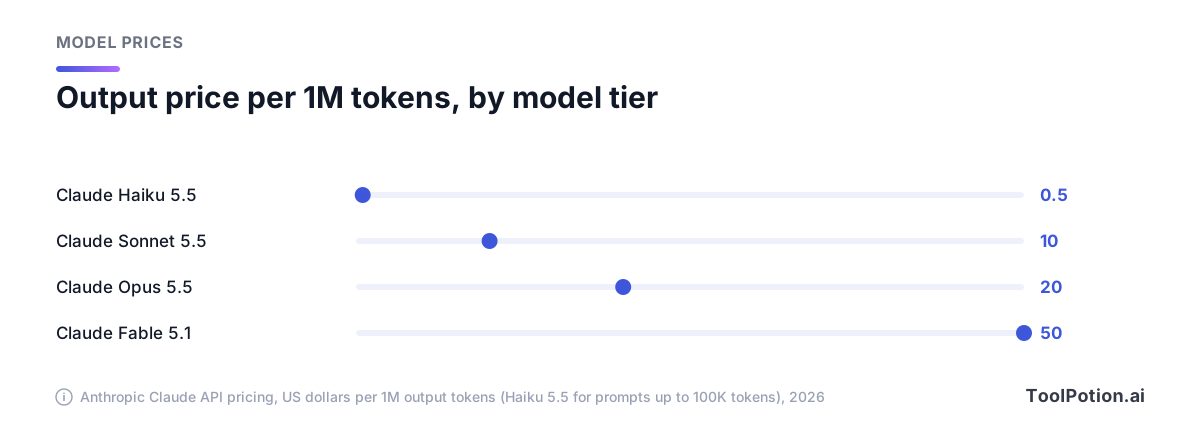
The biggest lever in the docs isn't a cap. It's the model. On Anthropic's API price list, Claude Haiku 5.5 charges $0.50 per million output tokens for prompts up to 100,000 tokens (it rises to $2.50 beyond that), Sonnet 5.5 $10, Opus 5.5 $20 and Fable 5.1 $50. That's a 100x spread between the bottom and the top of one lineup, and GitHub's and Cursor's tables list the same output prices.
Anthropic's own cost guidance agrees with the arithmetic. Sonnet "handles most coding tasks well and costs less than Opus," it says, with Opus reserved for architectural decisions or multi-step reasoning, and model: haiku for simple subagent tasks (Claude Code docs). Our longer take on matching tiers to tasks is in which AI model tier for which task, and the terminal agents are compared in Claude Code vs Codex vs Gemini CLI.
Here's the saving at list prices, with the share of work a small model can take as your own guess. Prices are Anthropic's list prices for short prompts.
Output tokens are only part of a bill, and the small-model share is an assumption you'll have to earn with your own tasks. Renaming variables and writing test scaffolds probably qualify. A migration plan for a payments service probably doesn't.
Caps, in the order we'd set them
- Turn on usage reporting for a pilot group and read two weeks of it before choosing any number.
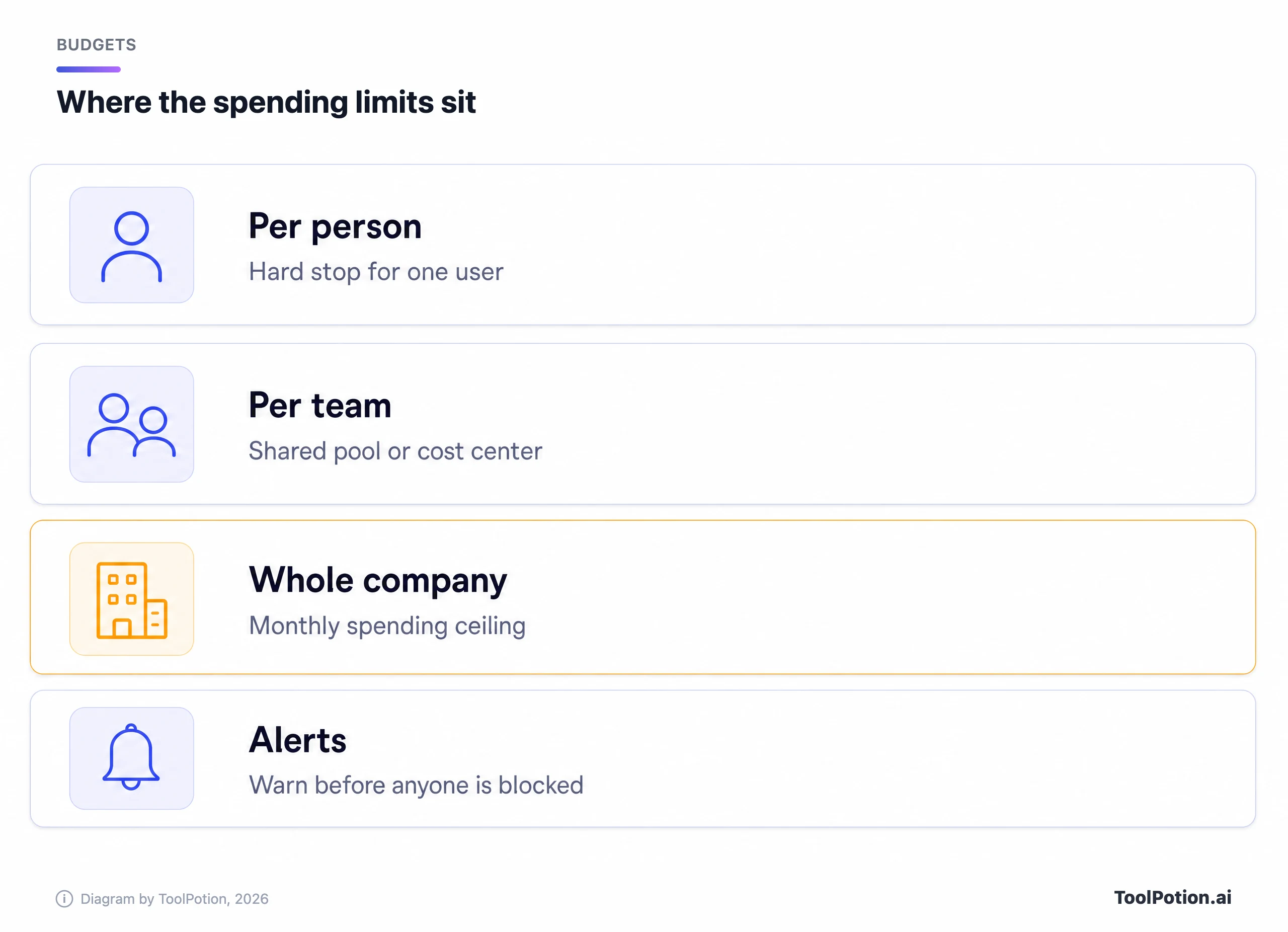
- Set alerts first. GitHub can email and show a banner at 75%, 90% and 100% of a budget (GitHub docs).
- Add a company-wide monthly ceiling you could live with if every seat maxed out, so that a runaway agent loop costs a known amount.
- Only then add team or person limits, and make them soft where the tool allows. GitHub's user-level budget always hard-stops, and its docs warn that overlapping budgets can block people from a tool they rely on.
- Move default models down a tier for routine work and make the premium model a deliberate choice.
The Claude Code docs also give per-user rate-limit starting points by team size, for instance 15,000 to 20,000 tokens per minute per user for 100 to 500 users. Those are throttles, not budgets, and the docs call them recommendations to adjust.
When rationing is smart, and when it's false economy
We'd ration waste and never ration attempts. A cap that makes a developer think twice before pasting a whole repository into the top model is doing its job. A cap that makes the same developer skip the AI-generated test run, or avoid the agent for the hard refactor where it pays best, costs more than it saves.
Run the numbers. If agentic tools equal around 2% of engineering cost, as Jellyfish reports, then cutting the bill in half saves 1% of engineering cost. An engineer slowed by 1% gives that back. Rationing only wins when it removes spend that produced nothing, which is exactly Amazon's point about wasted effort.
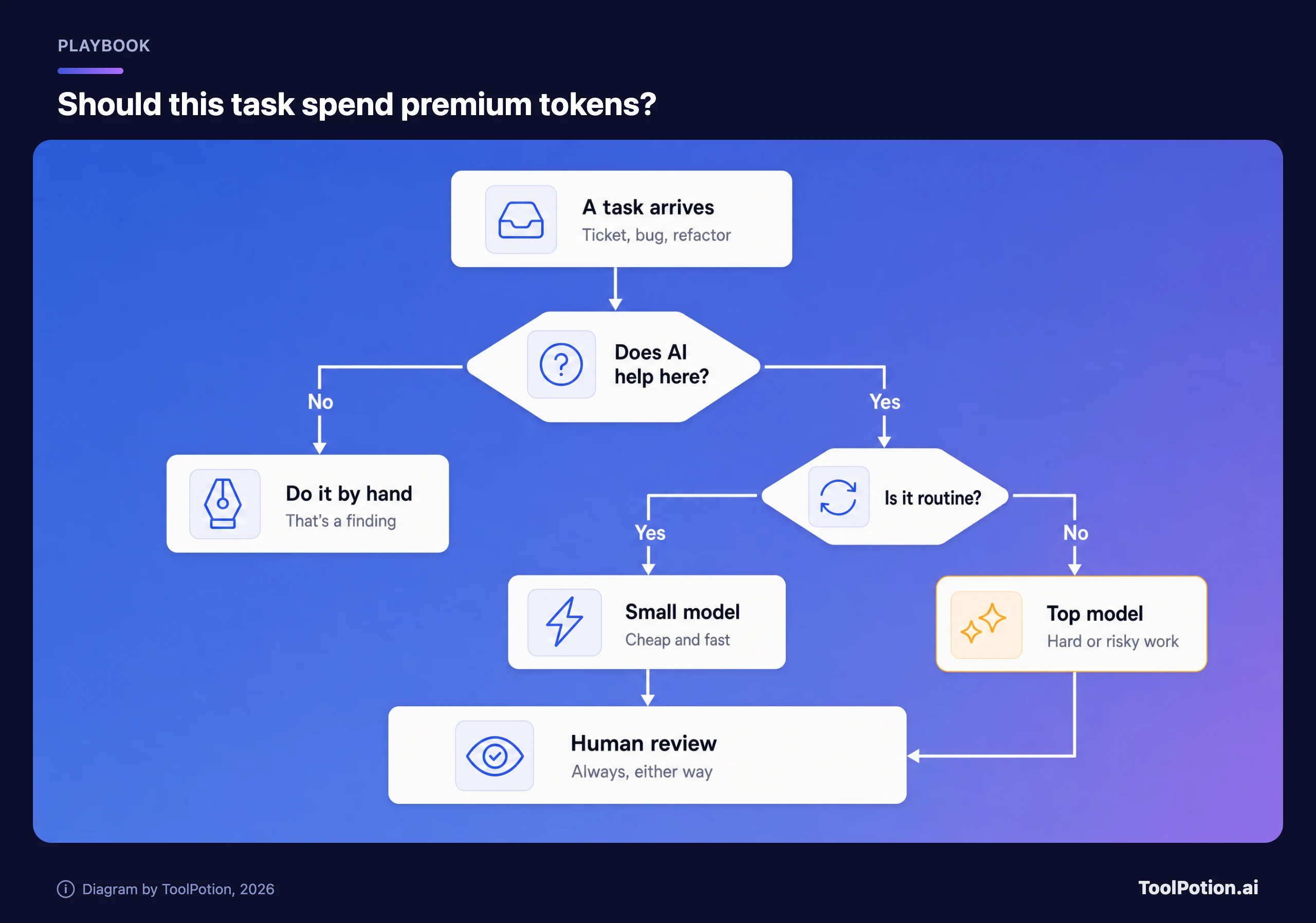
Rationing is smart for background automation nobody reads, for the top model on routine jobs, and for per-person leaderboards. It's false economy for code review, tests and onboarding. If the AI review step is what catches the bad merge, throttling it is a bet against your own safety net, and our guide to AI code review tools and the ToolRank board for review and testing show how many alternatives exist before you cut anything.
What we wouldn't cut
Human review stays whichever model wrote the code. Amazon's memo warns against measuring review counts, but it doesn't suggest skipping reviews. Training stays too, since the person who knows when to reach for the cheap model is the one who has been shown what each model is for. And experimentation stays, because Brooker's own admission is that nobody can tell in advance which problems matter.
Do track outcomes the way the memo does: launches, successful changes in production, time from request to merge. Raw tokens belong in the cost column, and nowhere near a performance review. If you haven't written down what your team is and isn't allowed to feed these tools, our AI usage policy template is a start, and the pricing models explainer and stack audit cover the subscription side.
Reading the pricing pages for GitHub Copilot, Cursor, Claude Code and Codex leaves us with one rule: the seat price is only the entry fee. Pull a recent month of usage per person from whichever tool you run, sort it, and look at the top five rows. If they are your best engineers, leave them alone. If it's one script in a loop, you've found your cap.