Luke Buckmaster, reviewing Prime Video's Castle Walls for the Guardian, guessed at the prompts behind it. The opening shot of an eagle in a cage reads as "make it look cinematic," he wrote, then a longshot of the castle as "make it more cinematic," then riders arriving as "make it MORE MORE MORE cinematic" (The Guardian). That's a joke, but it's a precise one. It describes a show where every frame was asked to be impressive and nobody asked what the scene was for.
Two AI-made productions got their reviews in the same few days. Castle Walls, which Prime Video released worldwide earlier this year as the first fully AI-generated long-form drama on a major streaming platform (GamesBeat), and an episode of Odyssey, Elon Musk's answer to Christopher Nolan, made with Grok Imagine. Critics were savage. We think they were right about the work and wrong, or at least aimed at the wrong target, about the tools.
Two reviews, one diagnosis
Peter Bradshaw gave Grok's Odyssey one star and called it "ponderous and inert" with "classical-age Call of Duty graphics" (The Guardian). His sharpest complaint wasn't about pixels. Every dramatic moment, he wrote, "is all as motiveless and meaningless as the movement of shapes on a laptop screensaver." That is a complaint about intent. A shot can be sharp and still say nothing.
Buckmaster's complaint about Castle Walls is the same one in a different costume. Sunsets arrive when characters say goodbye, a full moon hangs over every night ride, and orange light pours through the castle doors on cue. He also hated the people, who looked "like Vaseline-smeared Madame Tussauds creations slowly melting in the sun." And the script, written by humans, didn't help: lines like "If I am the sheaf, you are the sword" were his example of banal writing (The Guardian).
The most interesting review came from the side that wanted to be impressed. TechCrunch's Anthony Ha admitted the Odyssey was "not as spectacularly ugly as I'd expected" and that "there were moments when I might have thought these were real actors sailing across a real sea." Then the turn: the footage "feels completely airless, offering viewers no sense of momentum, no reason to care about anyone or anything on-screen" (TechCrunch). Ha concedes the shots and still checks the time bar. We'd call that a missing editor, not a missing GPU.
The tools made shots, and nobody made a film
The tone of the wider coverage fits. The Telegraph's reviewer, quoted in the Guardian's round-up, wrote of the Odyssey: "You can feel your eyeballs twitch as it unfolds in all its sloppy gruesomeness" (The Guardian). Buckmaster put the mood more gently: "Viewers understandably seem less interested in what the technology promises than in what it threatens to take away: art imbued with humanity." Whatever the models can do, viewers are looking for the humanity, and a film made to prove a point doesn't supply any.
Here's our thesis. Today's video models are shot generators. A film is a long run of decisions about what to withhold, when to cut, where a performance breathes, and none of that arrives in a prompt box. Both of these read like pipeline demos with a plot attached.
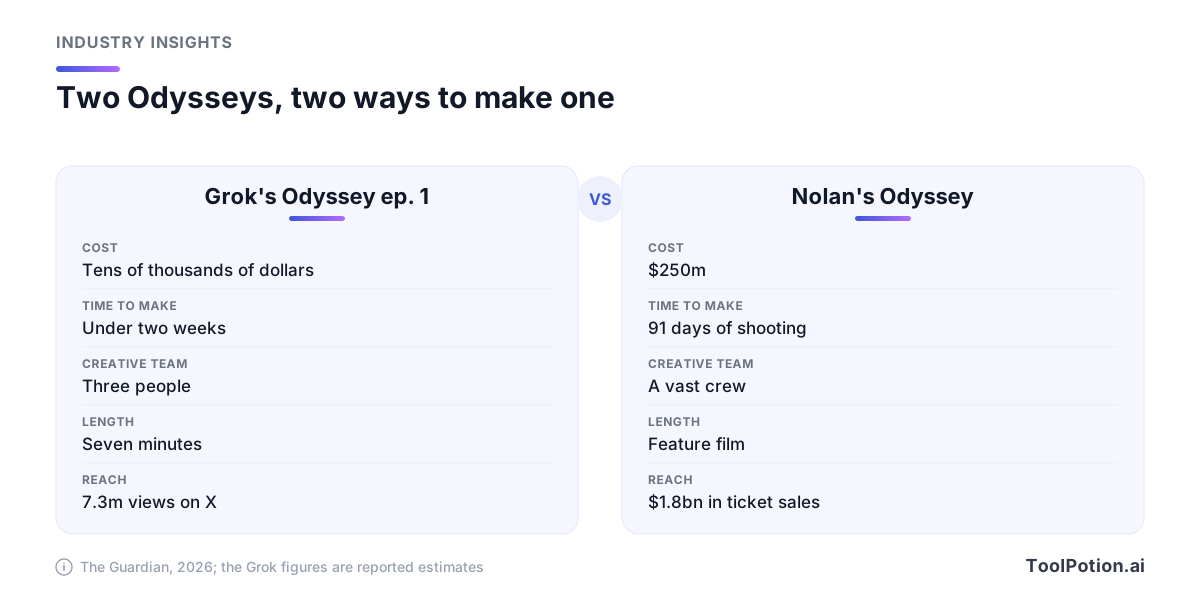
The makers more or less said so. Xavier Collins of Wonder Studios, which made the Odyssey episode, told the Guardian the brief was "help us understand the technology, where it's strong, where it could use improvement." The episode took under two weeks with a team of three and reportedly cost tens of thousands of dollars (The Guardian). That's a lab exercise released as a film, and the reviews treated it as a film.
Castle Walls has a stranger story. Its studio, AI Yapım (the AI arm of Ay Yapım, an International Emmy winner), says it built its own video model, AYDNA, trained only on Ay Yapım's licensed catalogue (the Guardian describes "a melange of generative video tools," so it wasn't necessarily the only one in the pipeline). The two episodes were made roughly two years apart in AI terms, the first assembled shot by shot with inpainting, per the studio's press release as relayed by GamesBeat. Human writers wrote it, human voice artists did the dubbing, the performances weren't AI-generated, and human artists drew the character sketches first. So this wasn't an experiment in removing people. It had people at every stage. The result still got "Vaseline-smeared." Our read is that a rights-clean model and a credentialed studio fix the legal question and leave the craft question where it was.
The reports disagree on length: GamesBeat's account of the press release says two 15-minute episodes, the Guardian's review says 17 minutes each. We couldn't reconcile that, and we found no separate Amazon announcement: the account comes from the studio. It doesn't change the argument.
The best case for the tools
The strongest objection is that we're judging a technology by its two worst showcases. Fair. Bradshaw grants, dryly, that "as we are always being told, AI is continuously improving," and Collins said the goal is for the last episode to be "radically better than the first." Buckmaster calls the technology "amazing," says it "will profoundly alter the state of motion pictures," and suggests AI may end up like early silent films, a stage before more sophisticated uses (all in the reviews linked above).
More to the point, working filmmakers already use it where a single clip is enough. In 2025 Runway's creative director Jamie Umpherson told AFP that "Some use it for storyboarding or previsualization," and "others for visual effects or inserts." Lionsgate's Michael Burns gave the example of making a 10-second clip "with 10,000 soldiers in a snowstorm" to decide whether a scene was worth shooting, which would once have cost millions (AFP via Qatar Tribune). That was 2025, but the practice has deepened since. In 2026 Lionsgate took an equity stake in Runway, and Burns, now the studio's vice chairman, said it will "expand the use cases of Runway technology across our production operations" (Señal News).
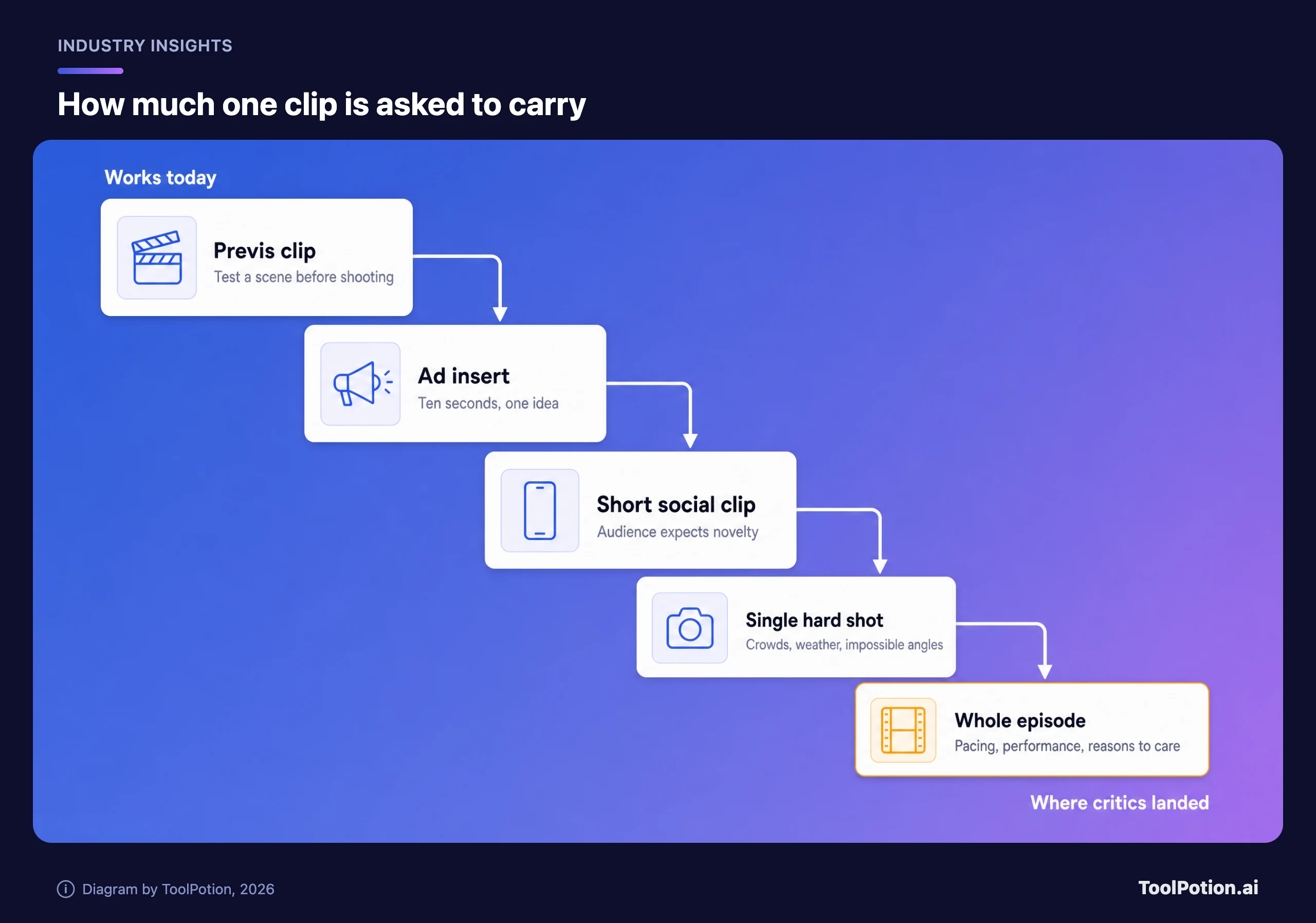
We'd go further. Ha thought a few individual shots could pass for real, and Buckmaster was "briefly intrigued" by the Castle Walls opening images before the faces arrived. The complaints that stuck were about pacing and purpose. The Guardian notes Wonder has also worked with Google DeepMind on an AI-generated video for a Lewis Capaldi track (The Guardian). Short, directed, human-led work keeps turning up where the long ones fail.
What this means if you're buying
Don't read the reviews as a verdict on Runway, Google Veo 3.1 or Kling AI. Castle Walls leaned on a studio's own model, and the Odyssey used Grok Imagine, which lives inside xAI's Grok assistant. We'd treat the failures as a warning about scope instead. Pick the tool for the clip you need, then keep the thing people watch for (the story, the cut, the voice) in human hands.
Some practical rules that follow from the reviews:
- Generate in shots of a few seconds and edit them yourself. Pacing is the failure both critics named, and you can only fix pacing in the edit.
- Budget for a writer and an editor before you budget for credits. Castle Walls had writers and still read as banal.
- Check where the model's training data came from. AYDNA's maker chose a licensed catalogue on purpose, and that's a fair question to put to any vendor.
- Say plainly when footage is generated. Viewers are already hostile, and our guide to labeling AI-generated content covers what platforms and laws require.
For a side-by-side of the main models, see our Sora, Veo, Runway and Kling comparison, our 25 best AI video generators and the AI video generators ToolRank board.
What nobody has shown yet is a whole watchable film from this process. Wonder plans improvements for the next Odyssey episode, and Musk promised a full-length movie before the year ends (The Guardian). When it lands, check one thing: whether anything in it was cut because a person decided it should be.