The wording behind the headlines is short. The government would require platforms to ban "material or conduct that simulates emotional intimacy and encourages or fosters a child’s dependence on it in place of human relationships" (The Guardian). It accepted the amendment from crossbench MP Kate Chaney as Australia's digital duty of care bill passed the House of Representatives, and the headlines said Australia wants to ban chatbots from faking intimacy. The sentence says something narrower.
The ban has two conditions, and both are about children
Read the clause slowly. A chatbot that simulates emotional intimacy is not enough to trigger it. The material or conduct also has to push a child toward dependence, and the dependence has to be "in place of human relationships." A friendly tone is not what this wording describes.
We could not open the amended bill text, so everything here about the clause comes through the Guardian's report of it. We found no definition of "emotional intimacy" in the government pages we read. Prime minister Anthony Albanese gave the motive in a speech: "the stories we hear about people identifying a chatbot, a non-person as their best friend, should be a huge wake up call for every member of this parliament to be prepared to act" (The Guardian).
Games, apps and chatbots, including the general-purpose ones
The clause sits inside a much larger bill. The minister's release says the Digital Duty of Care "will set minimum safety standards for online services such as games, apps and AI chatbots" (Minister for Communications). Providers would have to take reasonable steps to keep Australian users safe, and under-18s get extra protection from material, conduct and features that are harmful to them (Department of Infrastructure). The department's news item names "games, social media platforms and artificial intelligence chatbots" (Department of Infrastructure).
Nothing in that language limits the duty to companion apps. A general assistant such as ChatGPT or Claude is an AI chatbot too, and a dedicated companion like Replika or Character.AI is the obvious target. Where the line falls between an assistant that is warm and a companion that is clingy is not answered anywhere we looked, and eSafety itself says the lines between the two are starting to blur.
The minister says the introduced bill clarifies that professional news material and entertainment media are exempt (Minister for Communications). The industry group DIGI had read the earlier exposure draft as leaving "private conversations with adults" as the only exception (DIGI).
Rules Australia already has
This would not be the first Australian rule to reach chatbots. The age-restricted material codes took effect earlier this year, and eSafety says Australia's codes and standards cover "certain generative AI as well as AI chatbot and companion services" (eSafety). The regulator has already turned to companion apps. In a transparency report on four services, Commissioner Julie Inman Grant said such apps were "entrapping and entrancing impressionable young minds" (eSafety). Character.AI then introduced age assurance for Australian users and removed the chat function for its under-18 experience, and Chub AI withdrew from Australia, according to the same release.
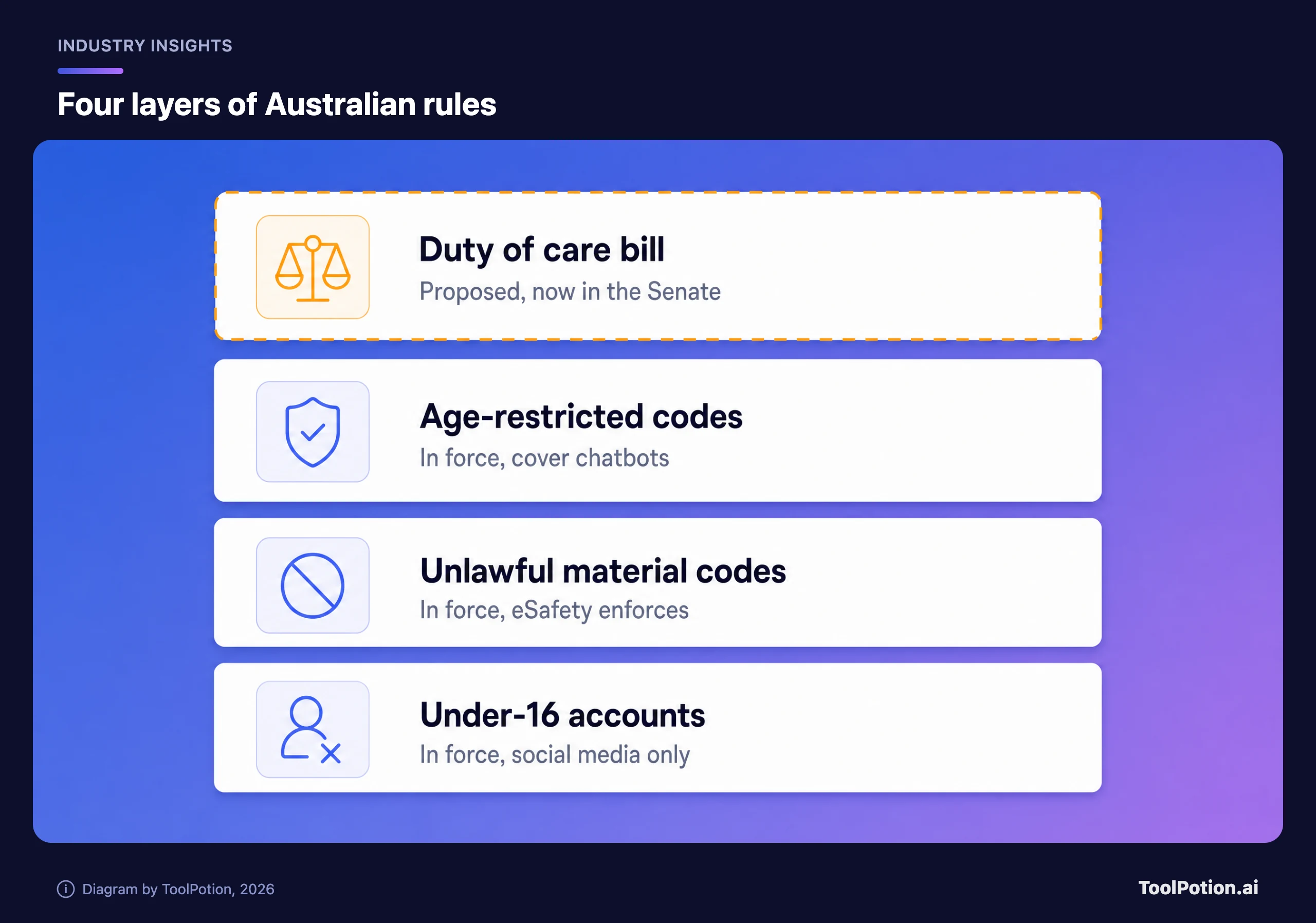
The under-16 social media rule is a different animal. It stops under-16s from holding accounts on platforms such as Facebook, Instagram, Snapchat and TikTok, and eSafety calls it "a delay to having accounts" rather than a ban (eSafety). It concerns accounts, not conversations. The intimacy clause is aimed at something none of these rules touches: what a chatbot does to a child's relationships, not what it says.
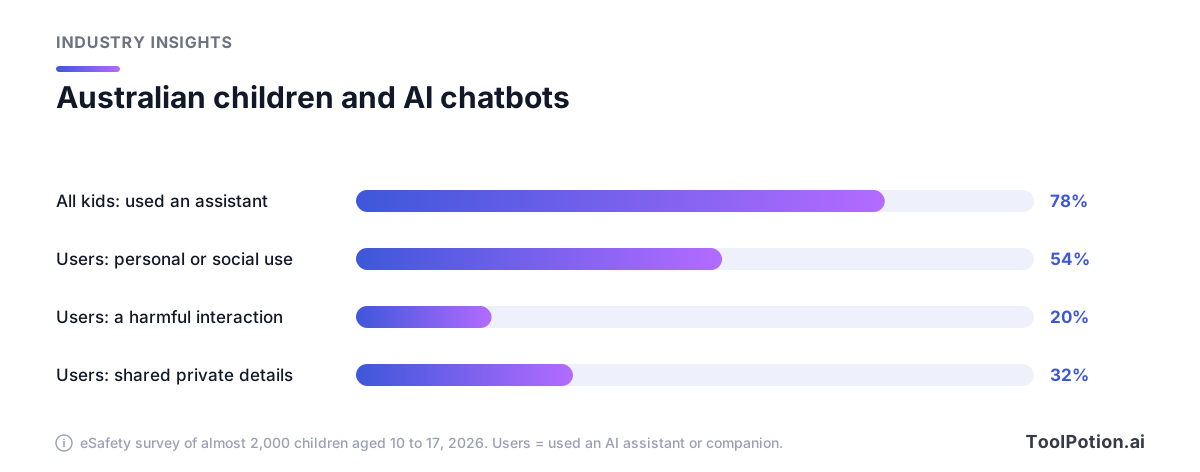
The regulator's own numbers show the scale. A survey of almost 2,000 children aged 10 to 17 found 78% had used an AI assistant. Among the children who had used an assistant or companion, 54% had done so for personal or social reasons, 20% reported a potentially harmful interaction and 32% had shared personal or sensitive information (eSafety).
Penalties up to $109.2 million, and no start date we can confirm
The government says failing the duty would "attract penalties of up to $109.2 million" (Minister for Communications), and the department's page adds "if the legislation is passed" (Department of Infrastructure). eSafety converts 300,000 penalty units to $109.2 million AUD in its under-16 guidance (eSafety), so we read the figure as Australian dollars. The comparable ceiling under the existing codes is $54.6 million, by eSafety's latest figure (eSafety). The bill also lets the minister add harms later. The release says Parliament will have scrutiny over any new ones, and DIGI had warned that too much of the duty's reach was left to the minister and the commissioner.
The timeline has three parts we can state. The government hopes to pass the bill by the end of 2026, a Senate inquiry set up by the Greens is due to report near the end of the year, and the Coalition has said it will not vote for it (The Guardian). The Greens support the bill, and Labor says it is open to amendments, so the clause could change.
The start date is a gap in our reading. We couldn't open the bill, and neither the minister's release nor the department's pages give a commencement date or transition period. Until someone publishes one, nothing here tells an operator when it would have to comply.
California and the EU ask for less
Compare that with the American and European approaches. California's SB 243 defines a companion chatbot as a system that can meet "a user’s social needs" and "sustain a relationship across multiple interactions." Its duties are procedural: a clear notice that the chatbot is not human when a reasonable person could be misled, a published suicide-prevention protocol, and, for users the operator knows are minors, a reminder every three hours to take a break (California Legislature). Users can sue for the greater of actual damages or $1,000 per violation.
The EU AI Act asks that people be told they are interacting with an AI system (Article 50) and separately prohibits systems that exploit vulnerabilities due to age to distort behavior in a way likely to cause significant harm (Article 5). Our post on the Digital Omnibus changes covers how those obligations are being timed.
California and Brussels regulate disclosure and process, which a company can document. The Australian clause regulates an effect on a child, which is harder to prove. We think that is the right target and a vague definition is the wrong way to aim at it: an operator can't build a feature test around that phrase until someone says what it looks like.
The critics, and one gap in the debate
Opponents of the bill as a whole are loud. The opposition and One Nation voted against it in the House, and political opponents accused Labor of an "Orwellian" system of "censorship," which communications minister Anika Wells strongly denied (The Guardian). Industry's complaint is discretion. DIGI, whose members include Apple, Google, Meta and Microsoft, wrote that "Too much of the Duty's reach is left to the Minister and the Commissioner" (DIGI). That was about the exposure draft, before the chatbot amendment existed.
The sharpest gap is in complaints. Telecommunications ombudsman Cynthia Gebert said the framework "risks leaving Australians in the safe place they are now, where they get automated responses or escalation procedures that don’t go anywhere" (The Guardian). Kate Chaney, who moved the intimacy amendment, backed the draft law in an opinion piece before the bill was introduced and wants penalties "large enough to influence global technology companies," according to the summary on her site (Kate Chaney MP).
We didn't find anyone arguing against the intimacy clause specifically.
What to watch if you build or use these apps
For companion apps outside Australia, the practical risk is the one eSafety already showed. A service that can't or won't age-check Australian users has one other option, and Chub AI took it by leaving the country. If you use these tools yourself, see where Replika, Character.AI and the rest rank, and our guide to chatbot parental controls for what families can set now. Our privacy framework covers what these services keep.
- The Senate inquiry report, which should show whether senators want the intimacy wording defined or left to the regulator.
- The final text of the clause after any amendments, and whether it keeps the two conditions (simulated intimacy plus a child's dependence).
- The commencement date in the passed Act, which we couldn't find in anything we could open.
- Any eSafety guidance on how it will judge dependence, because that guidance, not the clause, is what operators will build against.
Frequently asked questions
Would Australia ban AI companion apps?
No ban on companion apps is proposed. The clause targets conduct that simulates emotional intimacy and pulls a child away from human relationships. The wider bill sets safety duties, backed by penalties of up to $109.2 million.
Is the digital duty of care law in force yet?
No. It has passed the House of Representatives and goes to the Senate. The government wants it done by the end of 2026, but the Coalition opposes it and the outcome is open.
Does the under-16 social media rule cover chatbots?
Not directly. It requires age-restricted social media platforms to take reasonable steps to stop under-16s having accounts. Chatbots fall under eSafety's age-restricted material codes instead, which have applied since earlier this year.
Does the law apply to chatbots made outside Australia?
The bill is about services used by Australians, and the minister's release speaks of protecting Australian users. Overseas companies already face eSafety's codes. How the new duty would be enforced against them is a question we couldn't find answered.