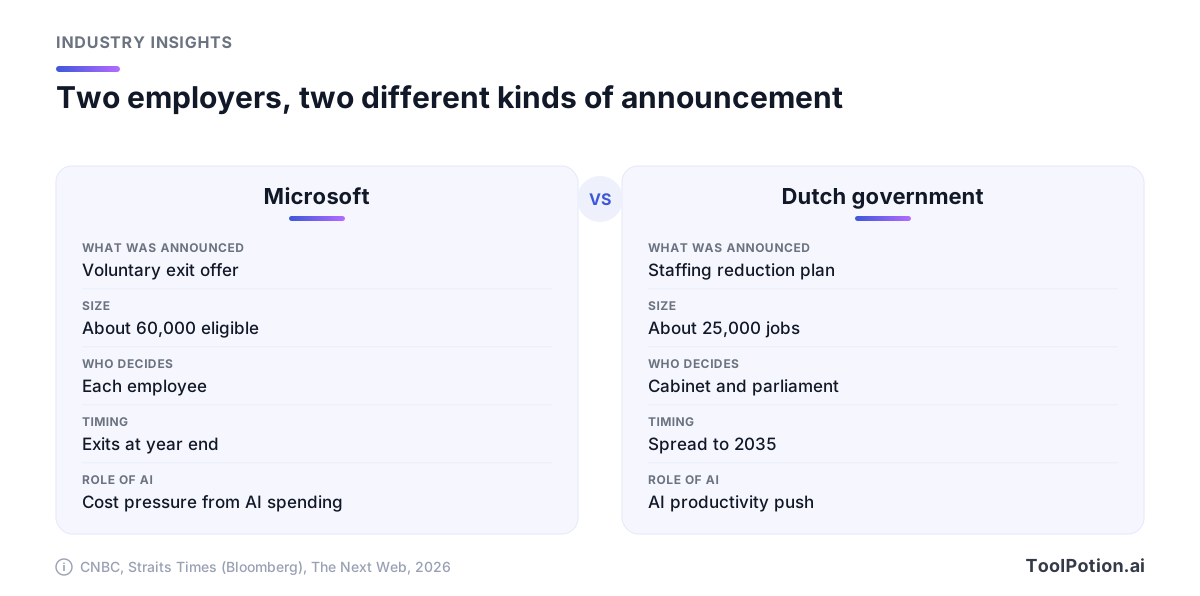
Microsoft told staff in the US, Canada, India and the UK that they can take a buyout and leave at year end. Around 60,000 people are eligible, according to a person familiar with the matter who spoke to CNBC, about 27% of a 223,000-person workforce. Around the same time, the Dutch government said it wants about 25,000 fewer central government jobs by 2035, with AI named as one of the tools for getting there.
Two announcements, two headlines that say "AI is cutting jobs." They are very different documents, and the difference matters if you work for either organization, or for any employer that is about to copy the wording.
Microsoft is asking, not telling
The offer is called a Voluntary Exit Offer, and it is voluntary. Employees at an experience level of 70 or below can apply, which per CNBC reaches up to vice president level. Those who accept leave on the last day of the year, and the person briefed on the plan told CNBC that Microsoft has no target number this time. Some marketing, sales and engineering teams have decided not to take part, the same source said.
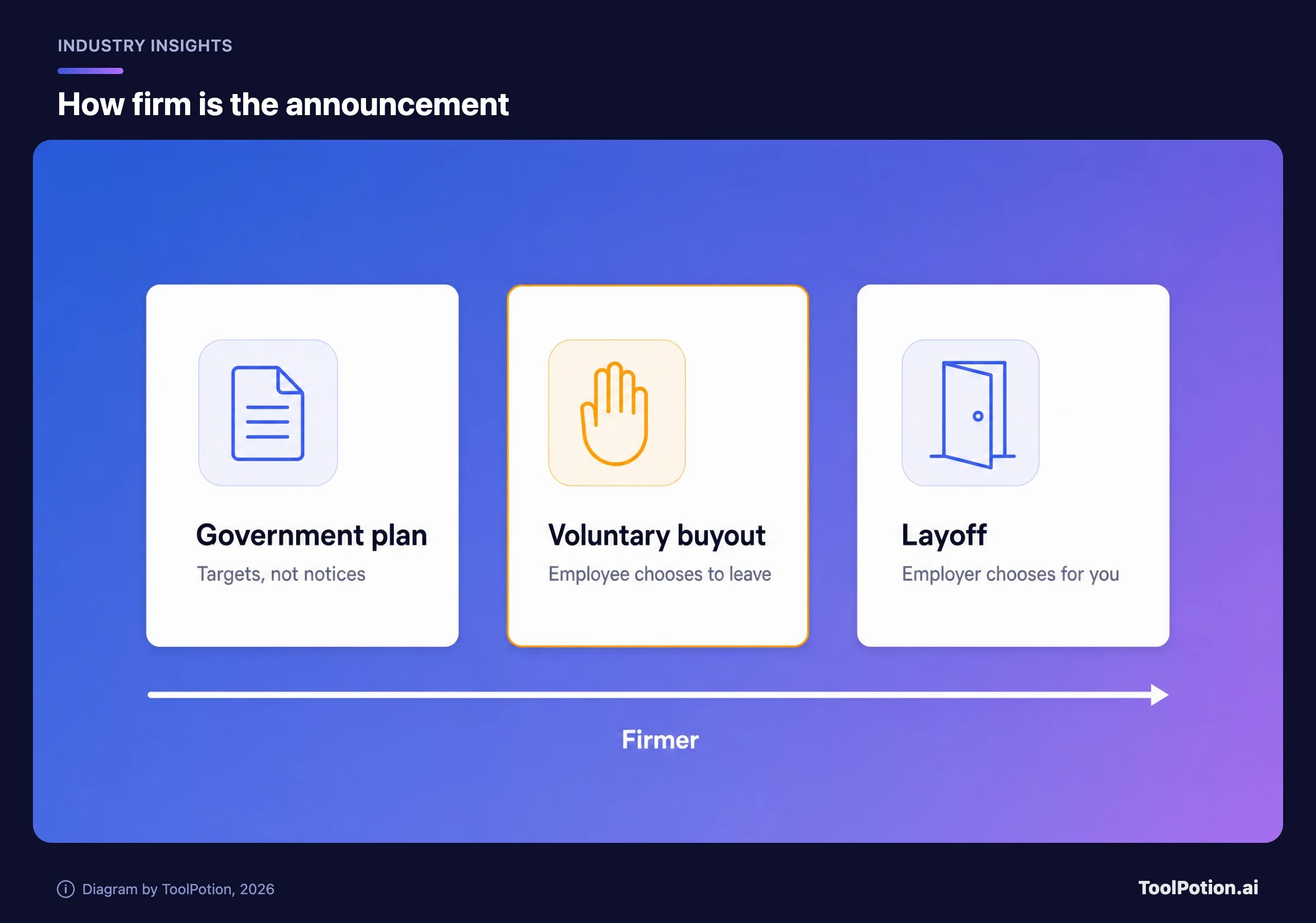
It follows a first-ever voluntary retirement program earlier this year, which more than 30% of eligible people took, and then a plan to lay off 4,800 employees (both per CNBC, which links Microsoft's own statements). So Microsoft has now tried an offer, a layoff and a bigger offer inside one year. A buyout is not a layoff, but it isn't a gift either.
Here's what is odd about the framing. CNBC's headline says AI "leads to" an efficiency push. The article body says something narrower: Microsoft is balancing a costly AI infrastructure build-out against capital efficiency. Capital spending for the latest quarter was expected to top $50 billion, compared with $34.9 billion a year earlier. The memo from chief people officer Amy Coleman, in the part CNBC quotes, does not mention AI:
The Voluntary Exit Offer reflects an important part of how we're evolving our approach to change: creating greater flexibility and, where possible, more ways for employees to shape their next chapter.
Microsoft does say it has given programmers, sellers and supply chain workers AI tools and seen results, and it wants the right talent for its newest growth areas. But on the evidence we could read, the cause stated for the offer is the bill for AI, not AI doing people's jobs. Those are different stories for the person deciding whether to sign.
The Netherlands has a number and a deadline far away
The Dutch plan is the opposite shape: a big number, a long runway, few specifics. In a government statement, per The Next Web, the cabinet put the cut at an estimated 25,000 full-time jobs in central government, spread over several years. Savings should reach €900 million in 2027 and €3.5 billion a year from 2035. DutchNews puts it at 16% of the civil service by 2035 in a plan announced by State Secretary Eric van der Burg.
His framing, reported by Bloomberg via the Straits Times: "We cannot keep doing what we have been doing." The state, he said, must be "simpler, smarter, and smaller."
The reasons given are a mix. Central government headcount hit a record of about 160,000 at the end of 2025 (per Bloomberg; 25,000 is 16% on DutchNews's count), 41% above 2018 even though earlier cabinets promised to shrink it. Ministries, inspectorates and implementing agencies are expected to be hit hardest, and Bloomberg reports that Van der Burg's letter to parliament warned some departments of reductions of 45% or even 60%. Police and defence are exempt, per Bloomberg and The Next Web. Rules come first: the cabinet is scrapping 500 a year, and fewer rules means fewer people to apply them. AI enters through a series of non-binding parliamentary motions asking the cabinet to raise government productivity by 20% with it, and through pilots already running (The Next Web, Straits Times).
Notice what's missing. There's no list of which jobs AI replaces, and the cabinet's AI plans themselves arrive in 2027. DutchNews also reports Van der Burg admitting that not all the reductions can be made up by efficiency, and that "some choices will have to be made regarding what the government should be doing less or not at all." That sounds like a smaller state with AI as one lever, more than a robot clerk for every clerk.
We looked for a reaction from civil service unions or employee groups, for both stories, and none of the pieces we opened quoted one. That silence may just be timing. Until someone speaks for the people affected, treat anything described as their view with suspicion.
What the wider evidence says
If AI were already erasing office jobs at scale, you'd see it in payroll data. A Stanford Digital Economy Lab study finds "no evidence of widespread, economy-wide job displacement." It also finds that employment of workers aged 22 to 25 in AI-exposed occupations is 19% below where it would be had it kept pace with less-exposed peers, with the effect coming mainly through reduced hiring rather than more people being let go. The authors call these early, descriptive indicators and not causal estimates.
An earlier analysis from Yale's Budget Lab took the whole labor market and concluded it had not "experienced a discernible disruption" since ChatGPT's release. We covered the entry-level side in what the data says about AI and entry-level jobs.
Put the two together and the picture is uncomfortable but not apocalyptic: the pressure lands first on people trying to get in, and employers can use AI as a reason for decisions that have other drivers too. Microsoft's capex bill and a record Dutch headcount are both real. We'd take the stated reasons at face value and still not assume AI is the whole cause.
If you work in a role like these
Two readers need different advice. One has an offer in hand with a deadline. The other has a headline and a date in 2035.
If you hold an offer, don't decide on the news cycle. Read the written terms, including pay, benefits, health coverage and what the exit does to anything unvested, then get independent advice from a financial or legal adviser who isn't paid by your employer. Ask your manager plainly whether your team is expected to shrink, because the person briefed on Microsoft's plan said some teams are staying put. Nobody can tell you how the job market will treat you in six months, so don't let anyone, including us, pretend to.
If you're in the plan stage, you have time and should use it on evidence. Our first-week plan shows how to start using AI at work without waiting for a mandate, and Microsoft's own assistant, Microsoft Copilot, is the one many employers already license, while ChatGPT and Claude are what people bring in themselves (our three-way comparison covers which suits which job). Teams that write down what they allow help everyone, which is what our AI usage policy template is for.
Then check where you stand. The checklist below is a rough conversation starter, not a prediction about anyone's job.
Whatever you score, three habits pay off. Keep a dated record of what you've produced and what AI tools helped with, since results are what a manager can defend. Learn what your own contract and local law say about notice and consultation, and if you have a union or works council, tell them early rather than late. And keep an eye on the dates that matter: Microsoft's decision window closes before year end, and the Dutch cabinet's AI plans are due in 2027.