Search is turning from a list of links into a single answer, and the platforms that sit between you and your audience are changing the deal on who gets paid and who gets visited. The durable response is dull and effective: own a channel where readers can find you without anyone's algorithm, decide on purpose which AI crawlers may use your work, and publish pages that an answer engine can quote cleanly.
This matters now because the news all arrived within days of each other in 2026. Google is paying some publishers for AI contributions, Reddit is closing its open feeds, and Instagram, YouTube and Spotify are handing creators and listeners AI controls over what gets seen. This guide turns that news into a plan you can run this week, whether you publish a newsletter, a channel, a store blog or a podcast.
It's a practical playbook, not a prediction. Where a number comes from a report, we say whose report it is. Where Google, OpenAI or Perplexity documents a control, we link the documentation. For the SEO tooling side, our best AI SEO tools roundup covers the software. This piece covers the strategy those tools serve.
Search used to end on your site
In classic search, a person typed a query, scanned ten links and clicked one. The click was the product. Your analytics, your ad slots, your email signup box all lived on the other side of it.
An AI answer changes the middle of that path. The reader gets a synthesized response with a few cited sources, and the click becomes optional. Some readers still click through, and Google says pages shown as supporting links in AI Overviews and AI Mode count inside your ordinary Search Console Web traffic. But the reader who clicks has often already got the gist, so the visit is smaller in number and warmer in intent.
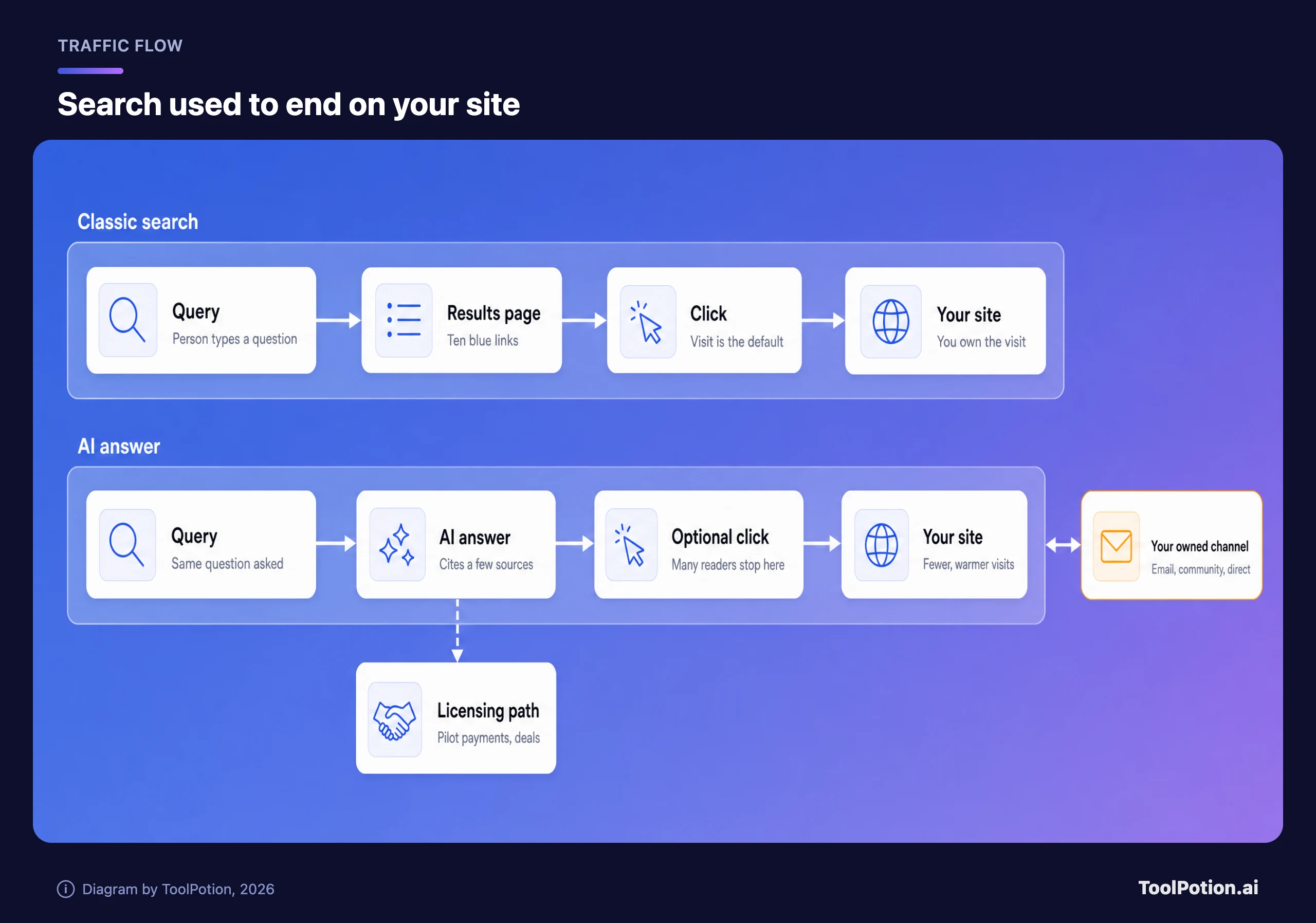
The diagram also shows the side path that's new this year: licensing. If your content feeds the answer, someone may pay you for it. Whether that someone pays enough is the next question.
What the platforms pay, and what they're closing
Google's pilot is the clearest data point. According to The Information, as reported by The Verge, around 100 publishers have joined a program that pays based on how much their content contributed to AI Overviews, AI Mode and the Gemini chatbot. One publisher that joined at the start reportedly earned over $1 million in a year. One that joined a few months ago has earned roughly $50,000 to $60,000, per the same report. Google hasn't published these figures itself, as far as we can find.
Those are the encouraging numbers, and they rest on a single report. Early joiners and later ones are seeing very different checks, and nobody outside the pilot can model yours.
The Verge also notes that the UK ruled Google must let publishers opt out of appearing in AI search features, and that the European Union opened an investigation into the impact on web traffic. If those hold, opting out becomes a real lever instead of a theoretical one.
Reddit shows the other posture. It is ending RSS feeds later this year and public API access in early 2027, TechCrunch reports, citing large-scale scraping and automated abuse. The same story says Reddit's 'other revenue,' which includes AI licensing, grew 24% year over year to $43 million, and that AI assistants that answer questions from Reddit will need commercial deals once the open door shuts. Whatever the motive, the effect for anyone who built on Reddit feeds is the same: the open web is shrinking and access is turning into a paid product.
The lesson for a small publisher is uncomfortable. You probably can't negotiate with Google or OpenAI today. You can decide what your own site allows, and you can stop depending on a pipe somebody else is about to meter.
The assistants coach you toward each platform's own goals
While access tightens, the platforms are handing creators AI help. Instagram's Edits app now has a creative assistant that pulls in your account data, which The Verge lists as likes, views, retention and shares. You can ask why one video worked and another didn't, or what hook to use. YouTube just updated its own AI creator dashboard, which the same article describes as telling creators how to maximize engagement.
That's useful, and it's also a closed loop. Both assistants optimize for engagement on that platform. The Verge raises the obvious worry that when everyone optimizes toward the same metrics, content converges and the advantage of following the advice shrinks.
The audience side is shifting too. YouTube will let viewers build a custom feed from a text prompt using Gemini, pinned as a tab on the home page next to the regular recommendations. Spotify's Taste Profile lets US Premium listeners aged 18 and up edit their recommendations in plain language, with Home changing within a few hours. And ChatGPT now suggests third-party apps mid-conversation, with 16 launch partners including Notion and Vercel, plus an enterprise marketplace of 30-plus partners.
Read together, discovery is splitting. Your audience will increasingly tell an assistant what it wants, and the assistant will decide what to surface. Here's how the features compare.
The pattern in the last column is the point. Almost every control sits with the platform or with the viewer, and almost none sits with you. That's why the strategy below starts with what you hold.
Sort your channels into owned, rented and licensed
A channel is owned if you can reach the person tomorrow without asking anyone's permission. An email list qualifies. So does a site with direct visitors, and so does a community you run on infrastructure you control. A channel is rented if a platform decides who sees your post. Social feeds, video platforms and marketplaces all fall here. Licensed is the newest layer: AI companies or search engines paying for the right to reuse your work.
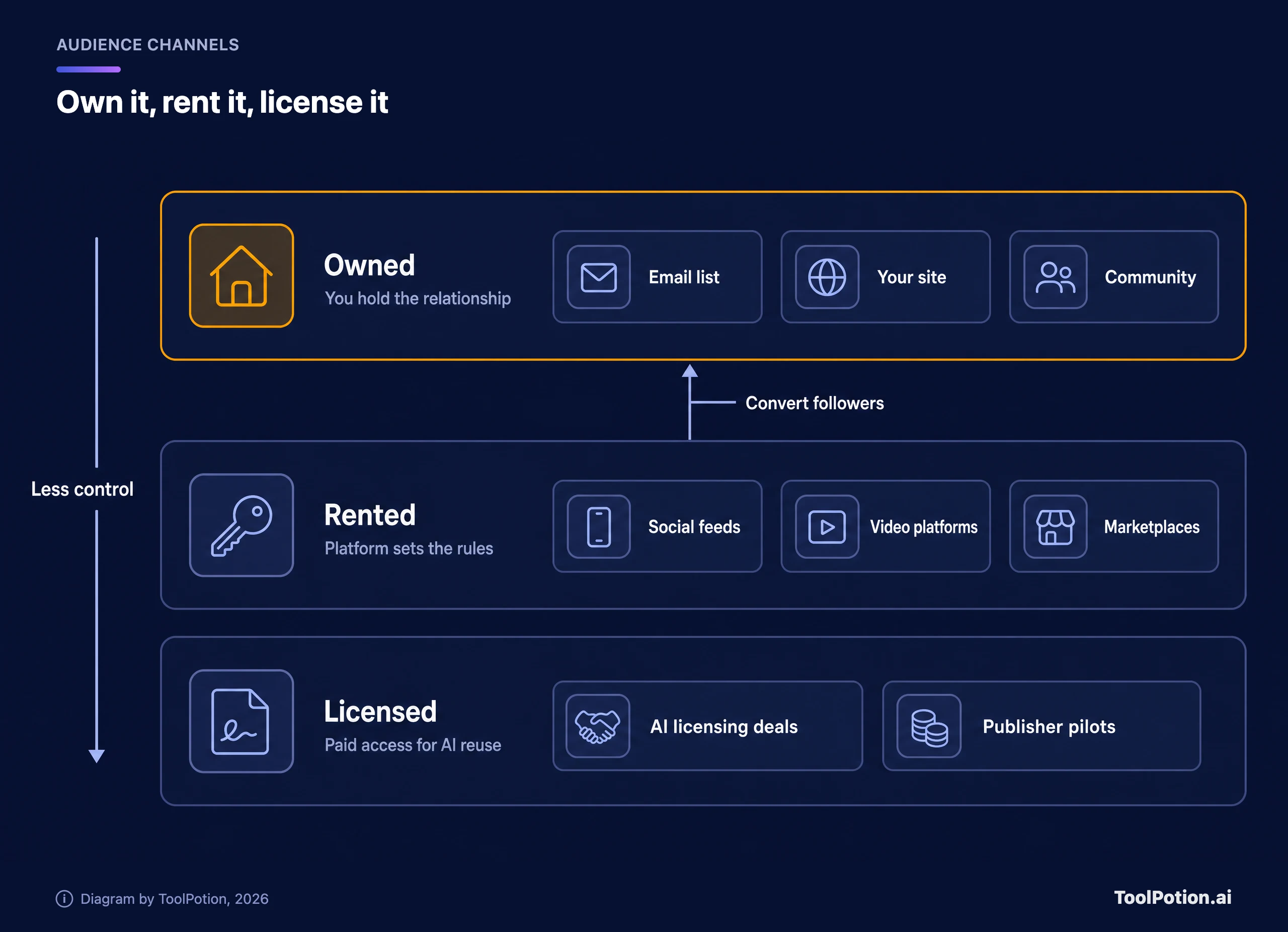
Rented channels are still worth using. They're where discovery happens. The mistake is treating a follower count as an asset when the platform can reorder it overnight. Every rented post should have a job, and the job is usually to move a person to a channel you own.
For email, a platform like beehiiv or Mailchimp is the usual start, and you can see how established AI newsletters like Superhuman AI and Axios AI+ hold an audience in our directory. For community, a Discord server such as Midjourney's shows what a creator-run space can grow into.
Try the calculator below with your own analytics split. It's a heuristic, not a forecast: it adds search and social shares to show how much of your traffic sits on channels you rent, then applies an assumed drop in search clicks that you set yourself.
If rented traffic is above roughly 70%, a single policy change at one platform can hurt you badly. Between 40% and 70%, you're exposed but not fragile. Under 40%, you've already got a base. Those bands are our rule of thumb, so adjust them to your risk tolerance.
Set a bot-access policy on purpose
Most sites have no written decision about AI crawlers. They either block everything because it feels safe, or allow everything because they never looked. Both are choices made by default. The better move is one decision per bot, based on what each bot actually does.
OpenAI runs three. Its crawler documentation says OAI-SearchBot surfaces sites in ChatGPT's search features and that opted-out sites won't be shown in ChatGPT search answers. GPTBot collects content for training generative models. ChatGPT-User handles actions a person triggers, and robots.txt rules may not apply to it. Each setting is independent, and OpenAI says it can take about 24 hours after a robots.txt update for its search systems to adjust.
Google's Google-Extended token controls whether crawled content can be used to train future Gemini models and for grounding in Gemini apps. Google states it doesn't affect inclusion in Google Search and has no bearing on Search ranking. AI Overviews are governed instead by ordinary Search controls: the AI features guide points to nosnippet, data-nosnippet, max-snippet and noindex.
Perplexity's documentation splits its bots in two. PerplexityBot surfaces and links sites in Perplexity results and, per the company, isn't used to crawl for foundation-model training. Perplexity-User fetches pages when a person asks, and Perplexity says it generally ignores robots.txt for those requests because a user initiated them.
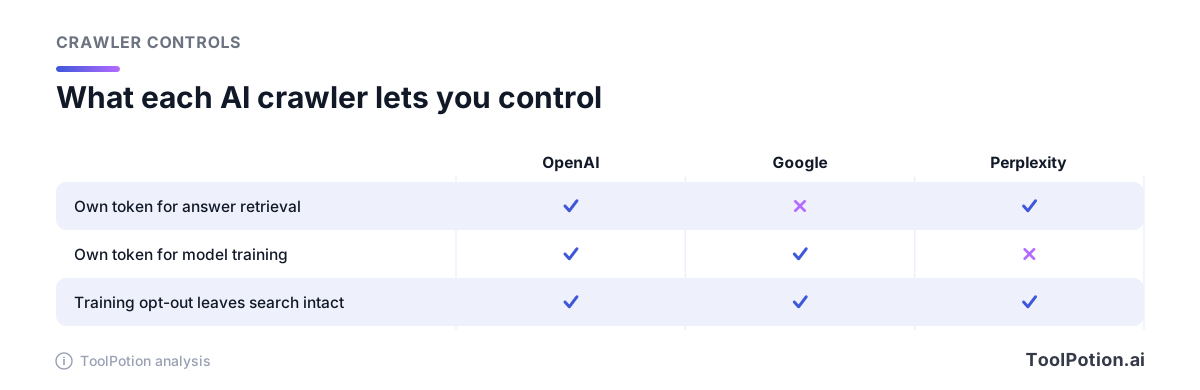
Here's a sensible default for a publisher who wants citations but not free training data. Allow the search bots (OAI-SearchBot and PerplexityBot), disallow the training token (GPTBot) and Google-Extended (Gemini training and grounding), and leave Googlebot alone. A robots.txt for that looks like this.
User-agent: OAI-SearchBot
Allow: /

User-agent: PerplexityBot
Allow: /

# OpenAI model training
User-agent: GPTBot
Disallow: /

# Gemini training and grounding only. Does not affect Search or AI Overviews.
User-agent: Google-Extended
Disallow: /
Notice what that file doesn't do. Disallowing Google-Extended won't pull you out of AI Overviews or AI Mode, because those follow Googlebot and Search controls. To limit what Google shows from a page, use nosnippet, data-nosnippet, max-snippet or noindex instead, and know that each costs you visibility.
A store or a service business may want the opposite emphasis and allow everything, because being named in an answer is the whole point. A paywalled publisher with licensing ambitions may block more. If you do plan to negotiate, a written policy and clean server logs are your evidence of what you control.
Publish pages an AI answer can cite
Google is blunt that there's no special trick. Its guidance says there are no additional requirements to appear in AI Overviews or AI Mode, and you don't need new machine-readable files or AI-specific markup. A page must be indexed and eligible to show with a snippet. That means the first audit is boring: make sure nothing you want cited carries a stray noindex or nosnippet.
After that, the work is editorial. Answer engines quote pages that state a thing plainly, name where it came from and say who wrote it. Lead each section with the answer, put the number and its source in the same sentence, and date your claims. Original data beats paraphrase, because there's nothing else to cite.
Structured data helps machines read what's on the page, with limits. Google recommends JSON-LD, says it doesn't guarantee rich results, and says not to mark up information readers can't see. Schema.org's Article type gives you author, datePublished, dateModified and publisher, which are the properties worth getting right on every post. Complete and accurate beats exhaustive.
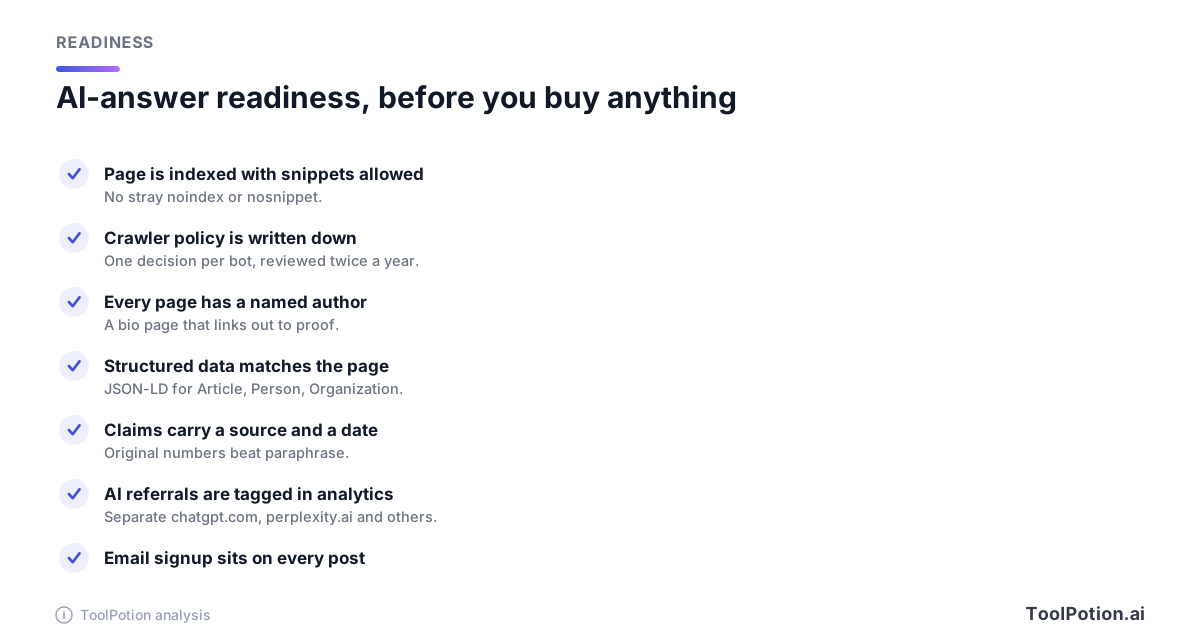
Author pages carry more weight than they used to. A named person with a bio that links to proof of the work is something a reader can verify, and that's the same quality a model leans on when it chooses between near-identical pages. If you'd like help drafting and checking this at scale, the AI SEO tools board ranks the options, and Semrush, Ahrefs and Frase are well-known names to compare.
Measure AI referrals before you optimize for them
You can't manage what your analytics lump into 'direct.' Start by splitting out the referrers you can see. Chat assistants and answer engines send traffic from their own domains, such as chatgpt.com and perplexity.ai, so a segment on those hostnames gives you a baseline in a week. In Search Console, AI Overviews and AI Mode appear inside the Web search type with everything else, per Google, so don't expect a separate report.
Track three numbers each month: visits from AI referrers, how many of those land on your email signup, and how many of your target pages get cited when you search for your own questions. The third is manual. Open Perplexity and ChatGPT, ask the ten questions your customers ask, and note which of your pages appear. It takes an hour and tells you more than a dashboard.
Keep one eye on server logs too. If a bot you disallowed is still fetching, that's a policy question to raise. If a user-triggered fetcher shows up despite robots.txt, that's expected behavior per the vendor documentation above, and you'll handle it with firewall rules rather than robots.txt if you need to.
Pick a plan by business type
The same strategy lands differently depending on how you make money.
- Independent creators on YouTube, Instagram or Spotify should treat the platform assistants as free analytics and nothing more. Use them to learn what hooks work, then put the signup link in every video description and bio.
- Publishers with ad revenue should write the bot policy first, then watch the Google pilot and the UK and EU actions before deciding whether to opt out of AI features. An opt-out costs visibility, and the payments so far vary wildly.
- Ecommerce and service businesses want to be named in answers. Allow the search bots, keep product and pricing facts on indexable pages with matching structured data, and test whether ChatGPT's app suggestions fit your category.
- Newsletter operators already own the best channel. Spend effort on archive pages that answer questions in plain language, since those are what get cited and send new readers back to the signup form.
- Community builders hit the Reddit problem most directly. If your audience gathers on someone else's forum, mirror the best threads into a space you run.
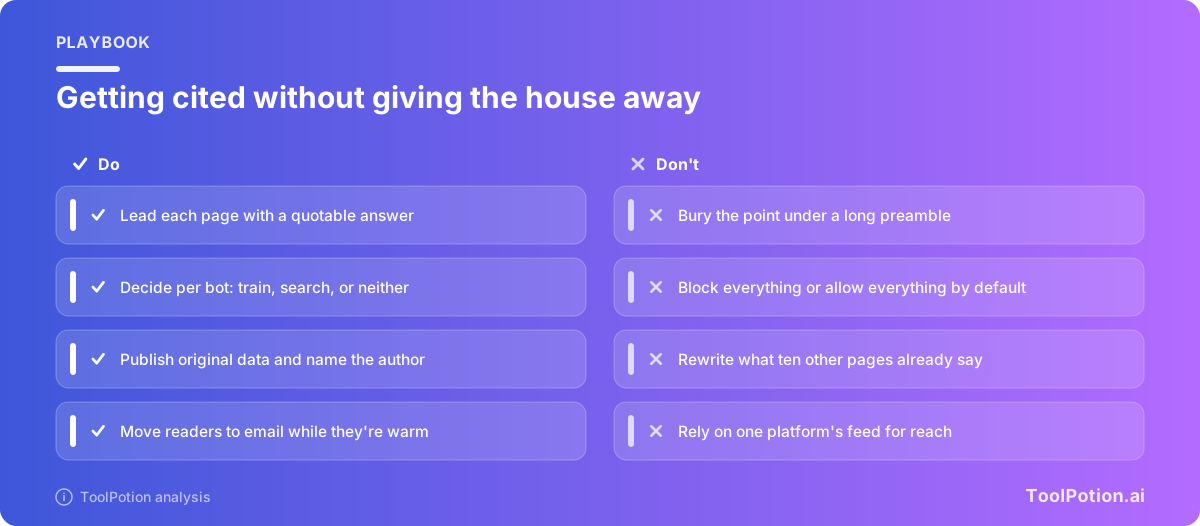
If you're unsure where to start, start with email. Add a signup to your five best-performing pages, send one useful message a week and watch the share of traffic that comes back on its own. Our content creators board and the best AI tools for content creators guide cover tools for the production side, and AI news readers shows how others build a habit audience. Our list of top AI YouTube channels shows what a rented channel looks like at scale.
Frequently asked questions
Do I need special markup to appear in Google's AI Overviews?
No. Google's guidance says there are no additional requirements or special optimizations. Your page needs to be indexed and eligible to show with a snippet, so check for noindex and nosnippet first.
Does blocking Google-Extended remove me from Google Search?
No. Google states that Google-Extended doesn't affect inclusion in Search and has no bearing on ranking. It controls use for Gemini training and grounding, and it doesn't remove you from AI Overviews or AI Mode, which follow Search controls.
Should I block GPTBot?
It depends on whether you mind your content being used for training. Blocking GPTBot is independent of OAI-SearchBot, so you can disallow training and still allow ChatGPT's search features to cite you.
Can I get paid for AI use of my content?
Possibly, but not reliably. Google's pilot reportedly covers around 100 publishers with very uneven payouts, and Reddit's AI licensing sits inside a $43 million revenue line, per TechCrunch. Small publishers should assume no payment for now and keep a written bot policy ready.
How do I know if AI answers send me traffic?
Segment referrers from chatgpt.com, perplexity.ai and similar hostnames in your analytics. Google's AI features are counted inside your regular Web search traffic in Search Console, so they won't appear as their own line.
Is the traffic calculator a prediction?
No, it's a rough heuristic. It adds your search and social shares to show rented exposure and applies a drop in search clicks that you choose, so the output is only as good as your assumption.