GPT-6.1 Terra is OpenAI's new mid-priced model, and if you only use ChatGPT to chat, you probably won't see it yet. It's built for screens, documents and images: filling in forms, reading technical drawings, drafting text, clicking through apps. It sits between GPT-6 Luna and GPT-6.1 Sol, and it replaces the GPT-5.6 Terra that came before it.
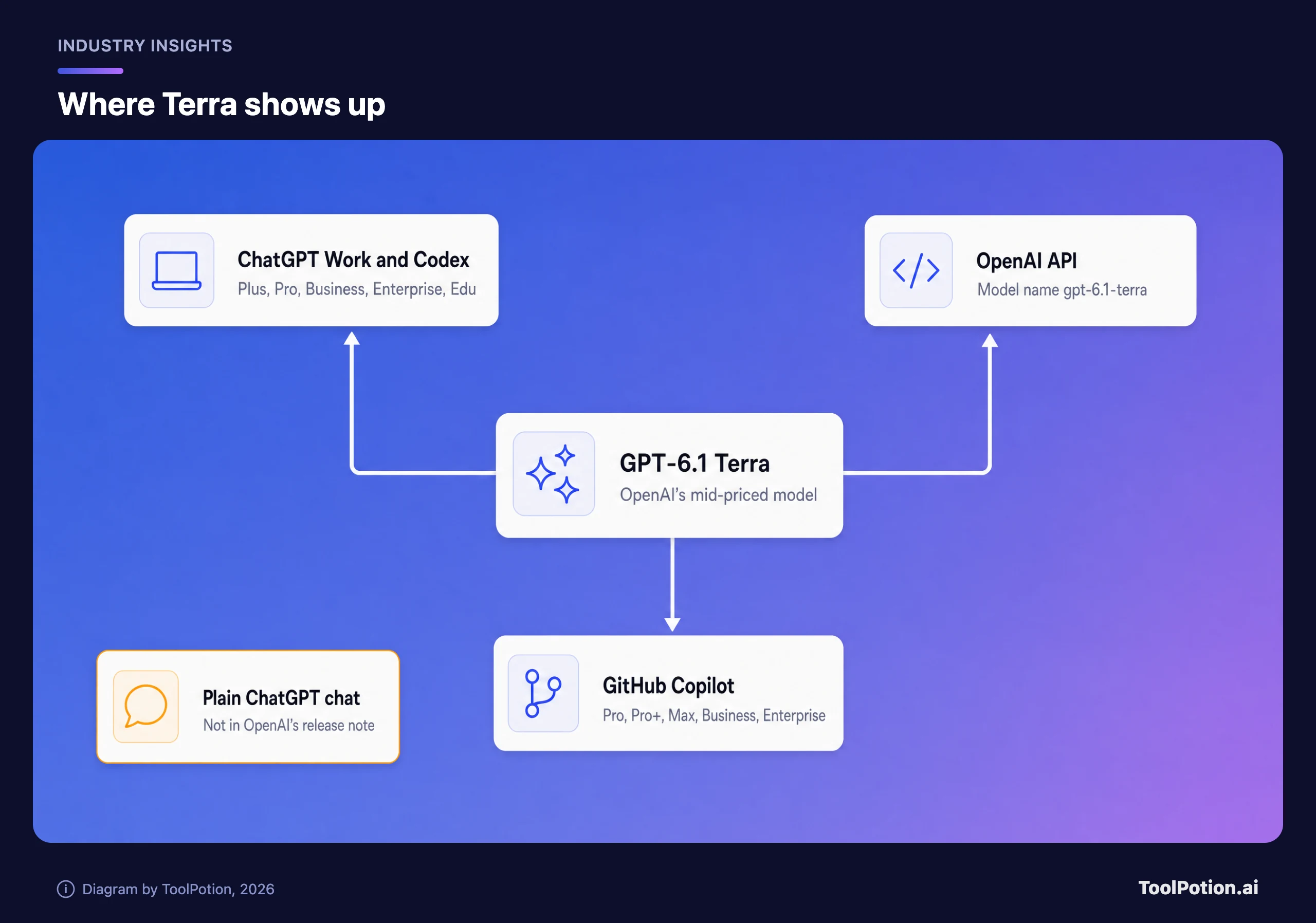
Whether you should care depends on where you work. OpenAI's release note lists Terra in ChatGPT Work and Codex and doesn't mention plain chat. It's also in the API and in GitHub Copilot. We read OpenAI's release notes, model docs, pricing page and safety addendum, GitHub's changelog and pricing table, and the outside coverage we could find. Most of that coverage repeats OpenAI's own numbers, so we point out the few independent ones as we go. If you're catching up on the family, our GPT-6 Astra explainer covers the top tier, and why OpenAI shelved GPT-6.1 Astra covers the one 6.1 model that never shipped.
Is GPT-6.1 Terra a new model or a new tier?
A bit of both. Terra was already a tier in the 5.6 generation, listed at $2 per million input tokens and $12 per million output tokens in GitHub's model table. The new Terra replaces it, according to InfoWorld, at half the price. OpenAI's model page describes it as a "fast, efficient model for visual reasoning, precise computer use, and clear, natural writing."
The specs match the rest of the GPT-6 line. Text and images go in, text comes out. The context window is 1.05 million tokens, the output cap is 128,000 tokens, and there are six reasoning-effort settings from none to max, with medium as the default. Its training data runs into 2026. Fine-tuning isn't supported. OpenAI's suggested jobs are matching product photos to catalog entries, interpreting technical drawings, acting on application screens, and drafting or revising text, which is a fair picture of the whole pitch: work that happens on a screen and doesn't need a research-grade brain.
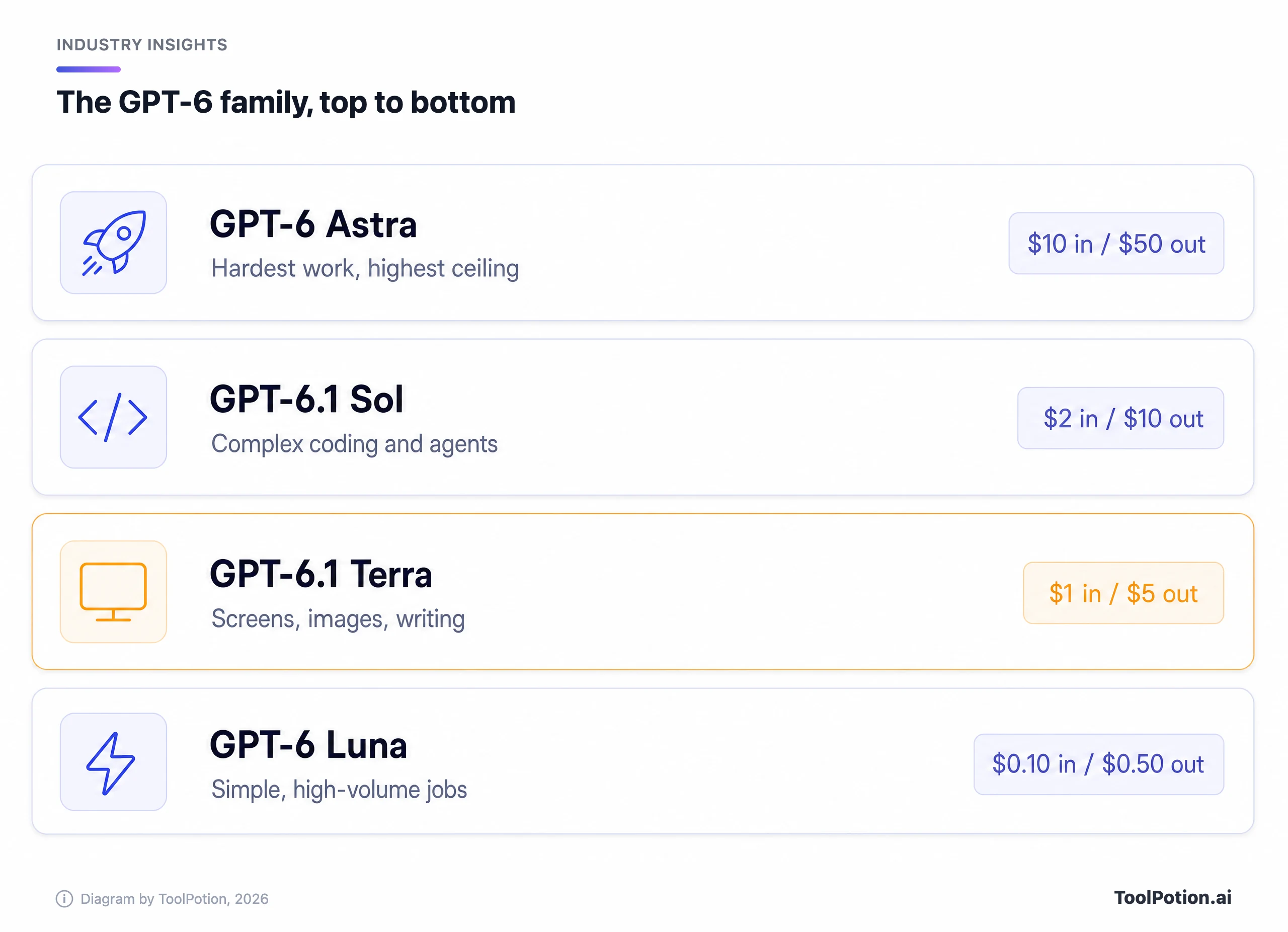
OpenAI's own framing, as DataCamp relays it from the launch post, is that Sol and Astra remain the better choice for the most complex coding tasks. Terra gets the volume work. That split tells you more about OpenAI's intent than the benchmark charts do.
Who gets Terra in ChatGPT, and on which plans?
OpenAI's ChatGPT release notes say Terra is rolling out in ChatGPT Work and Codex for Plus, Pro, Business, Enterprise and Edu plans, subject to your region and workspace settings. You pick it from the model list, and your plan's overall usage limits don't change. InfoWorld and DataCamp list the plans without Business, but OpenAI's own note includes it.
Free and Go aren't mentioned. Neither is plain ChatGPT chat. OpenAI hasn't said whether Terra will reach either, and the only hint is how it handled Sol, which its launch post said was "not yet available in Chat" (OpenAI). Our read: Terra follows the same path, but that's an inference, not a promise.
Two odd specifics from the note are worth knowing. Some Plus and Pro users may find Terra at Medium effort where the default Power presets in Work used to give them Sol at Light, so your default can change without you choosing anything. And Terra doesn't support UAE inference residency, a restriction OpenAI ties to where inference runs rather than where you are.
The plan-comparison table on OpenAI's ChatGPT pricing page hadn't caught up when we read it. It still listed GPT-5.6 Terra and not the new one, and its Pro tier was still described as running on GPT-6 Astra. Trust the model list in your own account over any table. DataCamp adds that OpenAI says the same plan allowance covers substantially more tasks with Terra than with Sol or Astra, which would be the real reason to switch if you keep hitting limits in ChatGPT or Codex.
Can I use Terra in the API, and what does it cost?
Yes. The model name is gpt-6.1-terra, and the OpenAI Platform lists it at $1 per million input tokens and $5 per million output tokens. Here is the family on OpenAI's pricing page, standard processing, prompts under 272,000 tokens.
| Model | Input | Cached input | Output |
|---|---|---|---|
| GPT-6 Luna | $0.10 | $0.01 | $0.50 |
| GPT-6.1 Terra | $1.00 | $0.05 | $5.00 |
| GPT-6.1 Sol | $2.00 | $0.10 | $10.00 |
| GPT-6 Astra | $10.00 | $1.00 | $50.00 |
All prices are per million tokens. The fine print on the model page: prompts above 272,000 input tokens cost double on input and cache and 1.5 times on output for the whole request. Batch and Flex are 50 percent cheaper, Fast mode is double, and regional processing adds 10 percent. Cache writes cost $1.25 per million tokens with 30-minute retention. Tool calling requires the Responses API, where computer use, web search, file search, code execution and MCP are all supported. The Free API tier gets no access, and the lowest paid tier is capped at 5,000 requests and 1 million tokens a minute.
Does Terra show up anywhere else?
GitHub Copilot, on day one. GitHub's changelog says Terra is generally available to Copilot Pro, Pro+, Max, Business and Enterprise users, in the model picker of VS Code, Visual Studio, JetBrains, Xcode, Eclipse, the Copilot CLI, the cloud agent, the Copilot app, github.com and the mobile apps. GitHub describes it as built for everyday agentic coding and terminal work at lower cost than Sol. In early testing it solved noticeably more terminal and C# tasks than GPT-5.6 Terra, which is a comparison with its predecessor, not with Sol.
It's billed at provider list pricing under usage-based billing, and GitHub's table matches OpenAI's $1 and $5. Business and Enterprise admins control it through the model policy, and new models are switched on by default unless an administrator has turned that default off. If you run GitHub Copilot for a team, that default is the line to check before your developers find the model on their own.
OpenAI's numbers are a direction, not a scoreboard
The launch comparisons lean on OpenAI's previous Terra, and the gains over it are large. Here are the max-effort scores InfoWorld and DataCamp report from the launch post.
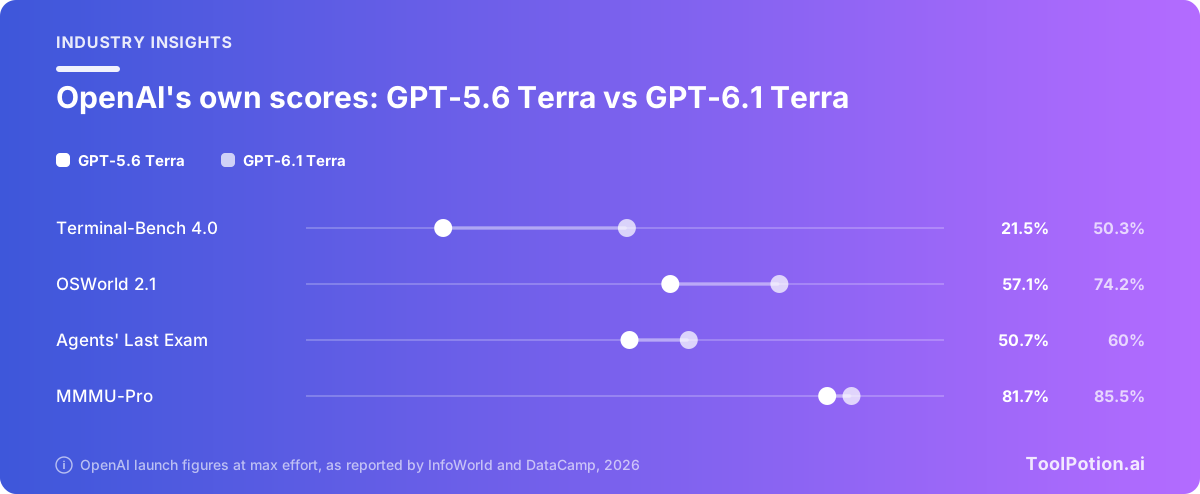
The more interesting lines are against the bigger models. On Agents' Last Exam, a test of professional tasks, InfoWorld reports Terra at 60.0 percent for $1.01 a task, against 59.3 for Astra at $7.24 and 58.6 for Sol at $2.00. That's a tie at a fraction of the price. It also reports Claude Opus 5.5 ahead at 63.2 percent, and on OSWorld 2.1 Anthropic's Claude Sonnet 5.5 at 83.9 percent against Terra's 74.2. Terra isn't the best computer-use model in that comparison. It's the cheapest one that's close.
DataCamp's writer is blunter about OpenAI's headline of roughly nine times lower cost per task than Opus 5.5 at max effort: "I found this comparison a little artificial or selective." Opus is a premium tier, so a big ratio was easy to produce. OpenAI's error-rate claim deserves the same care. The drop from 53.6 percent to 16.7 percent at low effort comes from OpenAI's internal set of prompts built to trigger mistakes, and OpenAI's safety addendum says those cases aren't representative of real error rates.
Independent numbers exist, and they're less glamorous. Artificial Analysis scores Terra at 51 on its Intelligence Index at max effort, 12th of 52 on its model page. Sol scores 55 and Astra 57 on the same index. The part that should change your behavior is how fast the score falls as you lower the effort setting.
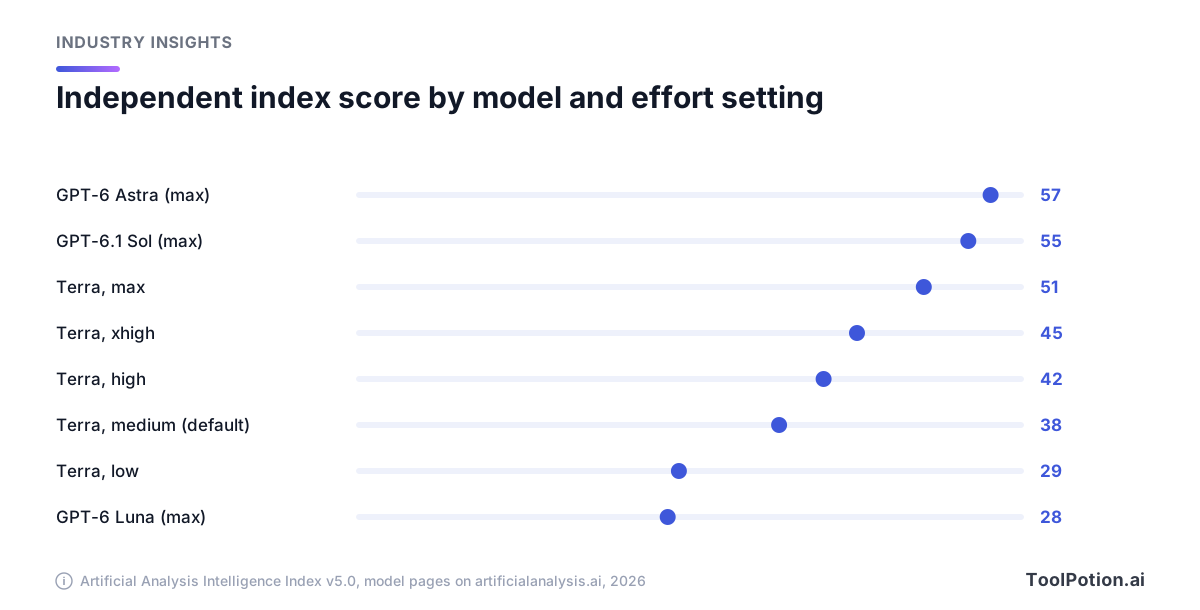
Medium is the API default. At 38 on Artificial Analysis's medium-effort page, out-of-the-box Terra sits closer to Luna at 28 than to Sol at 55. On its coding agent index, Terra at xhigh in Codex scores 48 against 54 for Sol at max, which squares with OpenAI's own advice about hard coding.
The cheaper price holds, up to a point
Per token, yes. InfoWorld lists Anthropic's Claude Sonnet 5.5, the rival it names, at $2 and $10, so Terra undercuts it by half. Per finished task, it depends on the effort setting. Artificial Analysis's page shows Terra at max effort writing 99 million output tokens across its test suite, against a median of 64 million for comparable models, and it calls the model somewhat verbose. The result is $0.96 a task for Terra at max, about 24 percent under Sol's $1.27.
Dropping one notch changes the picture. Artificial Analysis lists xhigh at 45 points for $0.40 a task, and medium at 38 for $0.17, about what GPT-6 Luna costs at max effort ($0.15) and ten points higher. Our reading is that xhigh or high is where Terra earns its slot, and max is where it stops being a bargain. That's an argument from other people's measurements, not ours.
Cheaper tokens also leave the human costs alone. Greyhound Research's Sanchit Vir Gogia told InfoWorld that in an illustrative coding workload, "5.4 additional review seconds erase the inference saving." Pareekh Jain, CEO of EIIRTrend & Pareekh Consulting, was more upbeat: "Enterprises need AI models that balance intelligence, speed and cost." He sees Terra aimed at invoice processing, document analysis and routine coding. Both can be right.
The safety picture barely moves
OpenAI's addendum says it treats Terra as Critical for cybersecurity and High for biological and chemical capability, and it ships with the same safeguards stack as Sol and Astra. On OpenAI's production safety benchmarks Terra performs on par with the old Terra, with small dips in the extremism, hate and sexual-content-involving-minors categories that OpenAI calls not statistically significant. Like Astra and both Sols, it made no attempt to bypass Codex's Auto-review monitor. One caveat the addendum includes: on image-input tests Terra shows a statistically significant regression in hate and extremism against the old Terra, which OpenAI says is in line with prior launches.
So the cheap model carries the expensive model's classification. If the safety questions that sank GPT-6.1 Astra made you wary of the 6.1 line, note that Terra and Sol are 6.1 models that did ship. Nobody has said the two cases are connected, and all of these results are OpenAI's own. None of the coverage we read includes an outside safety evaluation of Terra yet.
Our advice: Terra for volume, Sol for hard code
If you only use plain ChatGPT chat, there's nothing to switch. If you live in Work or Codex, we'd leave Sol on anything that involves hard code or research, and give Terra the repetitive screen, document and drafting jobs, at xhigh rather than max. That's also the rough split our guide to which AI model tier fits which task argues for, and the Top 50 LLMs board shows where the rivals sit. For developers building products, Terra is the first model in this family we'd test as the default for volume computer-use work, with Luna underneath for the simple jobs.
A fair test takes an afternoon, and it's the only evidence that will settle this for your work.
- Pick three jobs you repeat every week, such as filling a form from a PDF, summarizing a screenshot, or drafting a reply.
- Run each on Sol and on Terra at the same effort, then at one level higher on Terra.
- Count the corrections you make, not the seconds it took.
- Check the model list in your account, because the Power presets in Work may have moved you to Terra already.
Compared with ChatGPT, Claude and Gemini, Terra's pitch is narrower than any of them. It's a worker model, not a chat product. For coding agents specifically, our terminal coding agents comparison shows how the harness matters as much as the model.
What's still open is whether OpenAI brings Terra to plain chat and the Free plan, and when its plan table stops listing the old Terra. Watch that table, and the first independent coding evaluation that tests Terra below max effort.