Relay lasted five years. The workflow-automation app, built as an alternative to Zapier, shut down entirely this year, and the reason TechCrunch gives has nothing to do with a market crash: OpenAI, Google and other bigger platforms built similar automation into their own tools, and Relay lost its reason to exist on its own (TechCrunch). No lender pulled a loan. No share price fell. A product people paid for just stopped.
That's the claim we want to push back on, because every headline right now asks the same thing. TechCrunch reports Alphabet's shares fell 8% after its latest results (TechCrunch). Anthropic's IPO filing is being read line by line. CNBC reports that data-center and neocloud companies have been getting pummeled (CNBC). If you pay $20 a month for a chatbot, though, "does the bubble pop?" is a question for somebody else. A pop would hurt your apps. It would also be one of several ways they disappear, and so far not the main one.
Our view is simple enough to say up front. A funding squeeze wouldn't kill the AI apps most people use. It would change how they charge, thin out the products nobody can afford to host for free, and speed up an absorption that's already underway. The apps at risk are the ones a bigger product can swallow. If you protect yourself against that, you've protected yourself against a pop as well.
The funerals started before the crash
TechCrunch keeps a running list of AI products that didn't make it, and it's a strange document to read in a boom. Huxe, an audio app from former NotebookLM developers, shut down this year partly because larger platforms such as Spotify started offering similar experiences. Notion Mail, from Notion, is scheduled to close because its own users were using separate AI agents for their inboxes. ChatGPT Atlas, OpenAI's stand-alone browser, lasted less than a year before its best features were folded into ChatGPT, and the Operator agent went the same way (TechCrunch).
The products that closed over money cite running costs, not a credit crunch. The list says OpenAI's video app Sora "struggled with high operating costs and user-retention challenges" before it closed. The Decoder reported a two-stage shutdown, the web and app version first and the API months later, and said OpenAI wants to point its compute at coding tools and enterprise customers instead (The Decoder). Figgs AI, a role-play service that reportedly drew more than a million users, shut down after its developers said keeping it free had become too expensive to sustain.
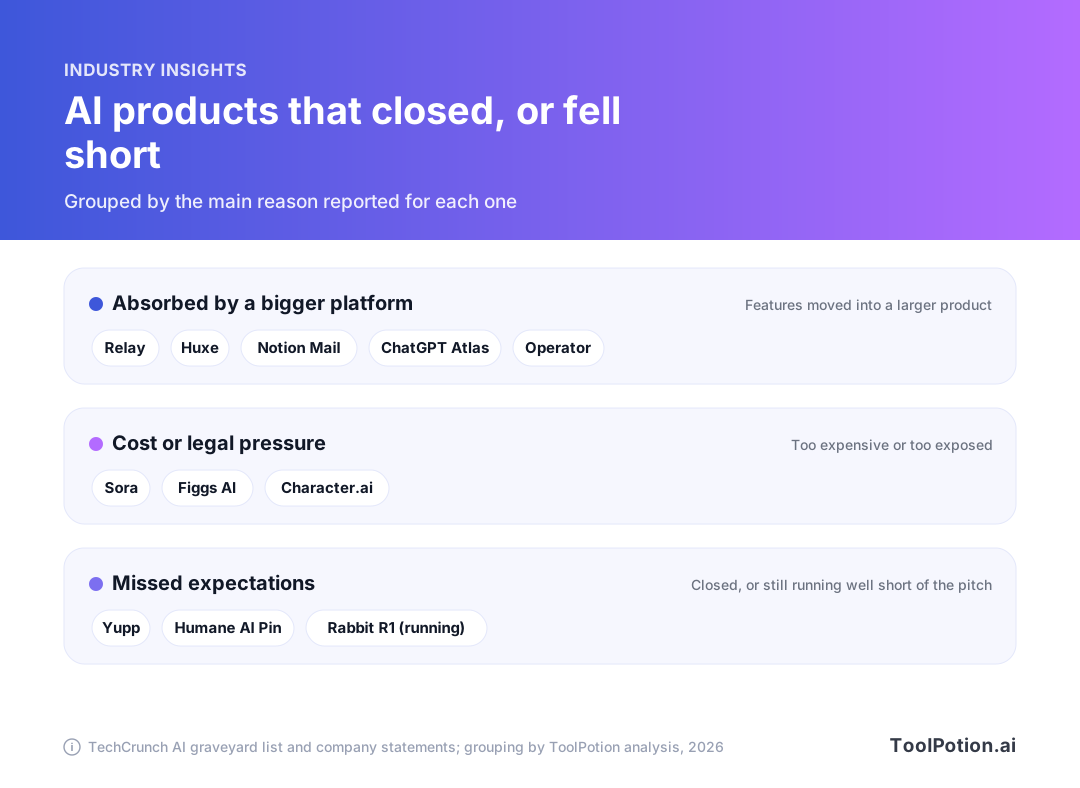
Five of the ten closures on the map above were absorbed rather than defeated. (Rabbit R1, in the last group, is still running.) That's the pattern a squeeze would push harder. Character.ai is the other kind of ending: the chatbot service filed for bankruptcy recently, citing legal, regulatory and operational headwinds, and Disney is the opening bidder at $20 million for a license to some of its characters. The app keeps running during the sale, which TechCrunch expects to wrap up within weeks. If you have chats in Character.AI, that's your cue to export them.
What the Anthropic filing says, and what it doesn't
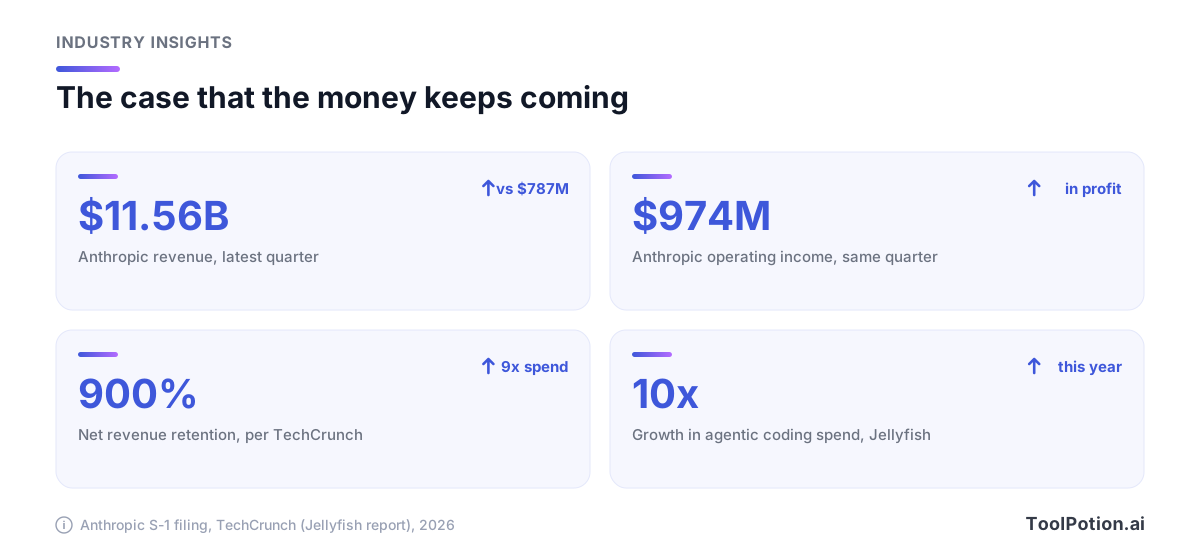
The number that went around first was a net loss above $80 billion for the part of 2026 the filing covers. Most of it isn't what it sounds like. Anthropic's S-1 filing carries a $72.4 billion line for the change in fair value of convertible notes, derivative liabilities and SAFEs, and TechCrunch's reading is blunt: "The charge is non-cash, meaning no money left the company" (TechCrunch). Operating results are a different picture. The filing shows revenue of $11.56 billion in its latest quarter against $787 million in the same quarter a year earlier, and operating income of $974 million after five straight quarters of operating losses. It also shows about $132 billion in cash and short-term investments at the end of that quarter, the same figures CNBC reported (CNBC). Over the full six months the company still had an operating loss of $693 million, so the turn to profit is one quarter old.
We aren't going to tell you what that means for a share price, and nobody should take that from a blog about subscriptions. For the person paying for Claude, the readable part is narrower. A company holding that much cash can carry its flagship consumer app through a rough patch without touching the price.
Where a squeeze would show first is the free product. On Alphabet's earnings call Google said it's taking ads in its AI Mode answers to international markets (TechCrunch). Alphabet isn't squeezed: its own release puts Search & other revenue up 12% and says query growth was the fastest in five years, though TechCrunch notes that 12% follows 17% and 19% growth in the two prior quarters. But it's the usual shape of how a free AI product pays for itself: not a shutdown, an ad. Jai Das of Sapphire Ventures, who has watched tech since the 1990s, told CNBC that if the Anthropic listing underperforms, "it'll be a little bit of a house of cards." Brad Bernstein of FTV Capital said a weak result would mean that "Everything is going to have to sort of be reset" (CNBC). How much of that reset would reach small AI apps, and how fast, is something none of the people quoted could say, and neither can we.
How a squeeze would reach your card
The first sign won't be a price rise. It will be a change to the meter. In 2025 Cursor moved its Pro plan from a 500-request limit to $20 of included model usage, and then apologized: "Our recent pricing changes for individual plans were not communicated clearly, and we take full responsibility." The company's own explanation was cost. It wrote that "the hardest requests cost an order of magnitude more than simple ones," while noting that most users' costs had stayed fairly constant, and offered refunds for surprise charges (Cursor). Weeks later Anthropic added weekly limits to Claude Pro and Max, driven partly by people running Claude Code around the clock, which it said would touch fewer than 5% of subscribers (TechCrunch). Neither move needed a crash. Both were a vendor finding out what its heaviest users cost.
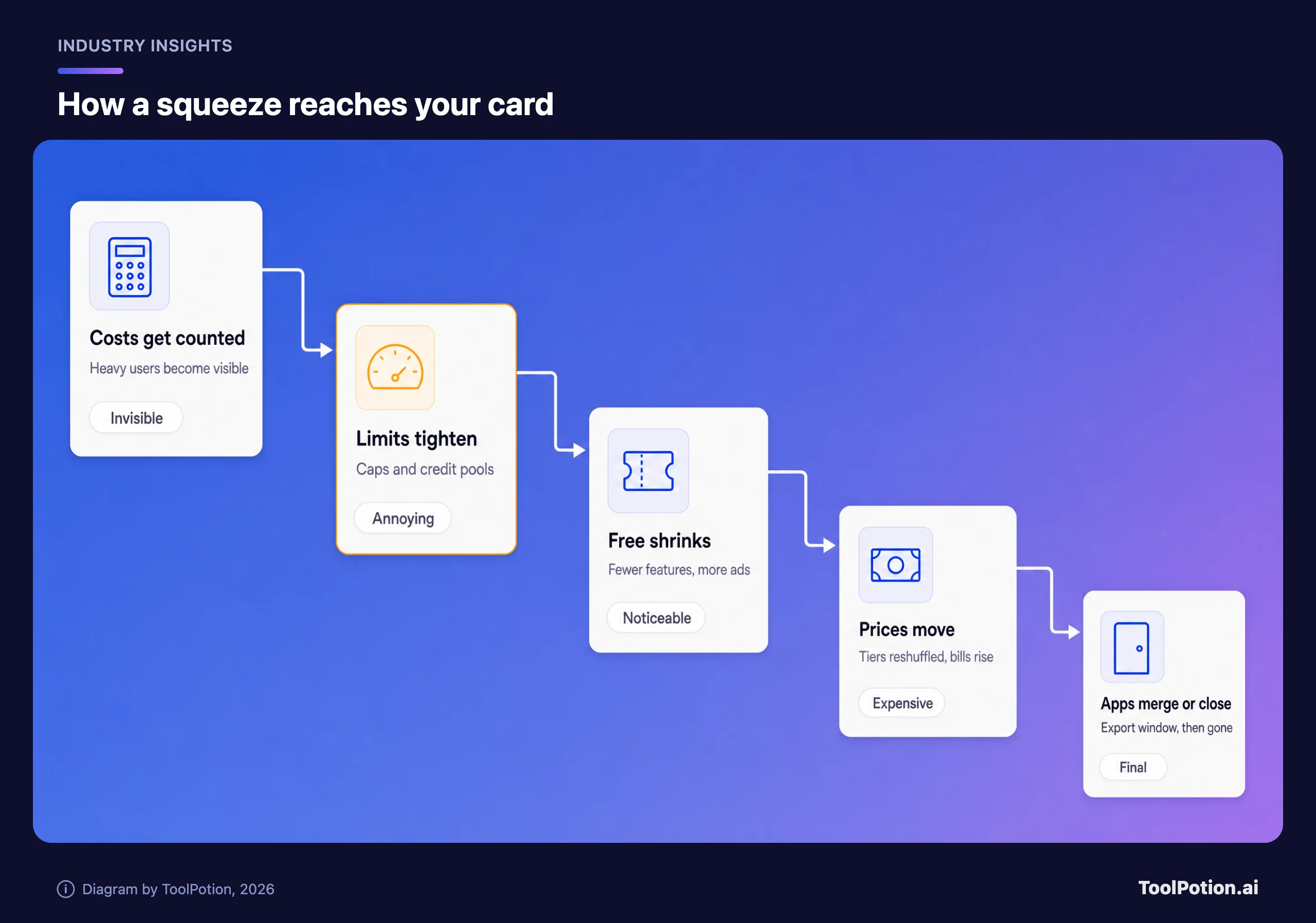
A tighter budget would walk the same staircase faster. We'd expect the sticker price of a flagship plan to hold for a long while and what it buys to shrink: smaller credit pools, a heavier model that needs a top-up, a free tier that gets ads or loses its best feature. That's also where the exposure sits unevenly, as the table shows. Our explainer on credits, seats and tokens covers how those meters differ.
| What changes | Already seen | Who feels it first |
|---|---|---|
| Usage caps and credit pools | Cursor's $20 usage pool, Anthropic's weekly limits | Heavy daily users |
| Free tiers shrink or add ads | Figgs closing under free-tier cost, ads in Google's AI answers | Casual and free users |
| Side products close | Sora, Atlas, Operator | Fans of a niche product |
| Small apps fold into platforms | Relay, Huxe, Notion Mail | Paying customers of one-job apps |
Then there's the least forgiving outcome. When Humane shut its AI Pin business, it gave owners until the end of the month, roughly ten days, before the devices stopped working, and refunds went only to people who had bought within the previous 90 days (TechCrunch). Software gets more notice, but not much more: going by The Decoder's dates, Sora's app had about four weeks from announcement to shutdown.
Who should worry, and who shouldn't
We'd worry least about the flagships. ChatGPT, Claude and Gemini's main apps are where the labs are steering their compute, and the filings and shutdowns above point the same way. We'd worry most about a stand-alone app that does one job a flagship could add in an update: AI email, AI summaries, workflow glue, audio digests. Those are the products on the left of our map.
Tools built on top of the labs sit in between. Cursor and other coding assistants buy models from the same companies they compete with, so a lab's cost change arrives as their pricing change. That isn't a reason to avoid them. It's a reason to expect their plans to keep moving, and to read the next pricing email as news. Our AI coding assistants board is a decent place to see who else is in that group, and the AI chatbots board does the same for general assistants.
What does absorbed look like from a customer's chair? Usually you aren't told your app failed. You get an email saying the features now live inside a bigger product, often on a plan that costs more than the one you had, and a date after which the old app stops. That's a fine outcome if the bigger product is good. It's a bad one if you chose the small app for a reason, such as a workflow or a price, that the big one doesn't share.
One caveat on the flagship rule. Atlas and Sora were OpenAI products, and they closed. A lab's name on the box protects the core app, not the experiments around it.
The best case against us
The strongest objection is that we're describing a squeeze that may never arrive. Anthropic reported an operating profit in its latest quarter. TechCrunch reports 900% net revenue retention at the company, which TechCrunch glosses as the same customers' spending growing nine times, and a Jellyfish report cites 10x growth in spending on agentic coding tools since the start of the year (TechCrunch). Das, the same investor who talked about a house of cards, compares today's build-out to the fiber glut of the dot-com years, when the infrastructure eventually got used even though plenty of companies went under in the meantime: "Long term, I don't think there is a lack of demand" (CNBC).
There's a plainer version of the optimist case too. Models get cheaper to run every year, and a vendor that sees costs falling has less reason to raise your bill. If that holds, the caps and credit pools we described might loosen as easily as tighten, and the main thing a subscriber needs is a short list of alternatives.
Cheaper competition makes the same point from the other side. CNBC reports that Snowflake is experimenting with low-cost open-weight models from Moonshot AI, DeepSeek and Zhipu (CNBC), which is the sort of pressure that pushes prices down, not up.
We think that case is right about the top and wrong about the middle. If the money keeps flowing, flagship plans probably stay generous and the labs keep competing on price. Fine. Relay, Huxe and Notion Mail all closed in that world. Abundant money funds the big platforms' ability to build your app's features for free, and that's what ended them. A squeeze would change the timing and add price pressure on top. It wouldn't change who's in danger.
A one-evening plan
None of this needs a spreadsheet. It needs a few habits, in roughly this order.
- Export from the app you couldn't replace in a week, today. Look in settings for a data export, download your files and history, open one of them to check it's readable, and put a reminder in your calendar to do it again every month. Our guide to exporting your data before an app shuts down has the details. When Sora announced its shutdown, users were told to download their content before the cutoff, and OpenAI said it hadn't yet decided whether a final export window would exist. Don't plan around grace periods.
- Choose monthly billing for anything from a young company or a one-job app. An annual discount is a loan to the vendor, and Humane's 90-day refund rule shows how that ends. Pay annually only for a flagship you'd keep either way, and read the refund terms first.
- Keep your prompts, system instructions and project notes in a plain text file you own. The tool should be a window onto them, not the only place they live.
- Write down what each automation or custom agent does, in a paragraph, outside the vendor's builder. That layer is the one you can't export, so you'll be rebuilding it.
- Pick a fallback for each paid tool and try it once while nothing is wrong. Switching under a deadline is where the lost afternoons go.
- Read plan emails. Cursor's change reached people as a post and an email, and Anthropic's limits as an email to subscribers. A changed meter is the first thing a squeeze moves.
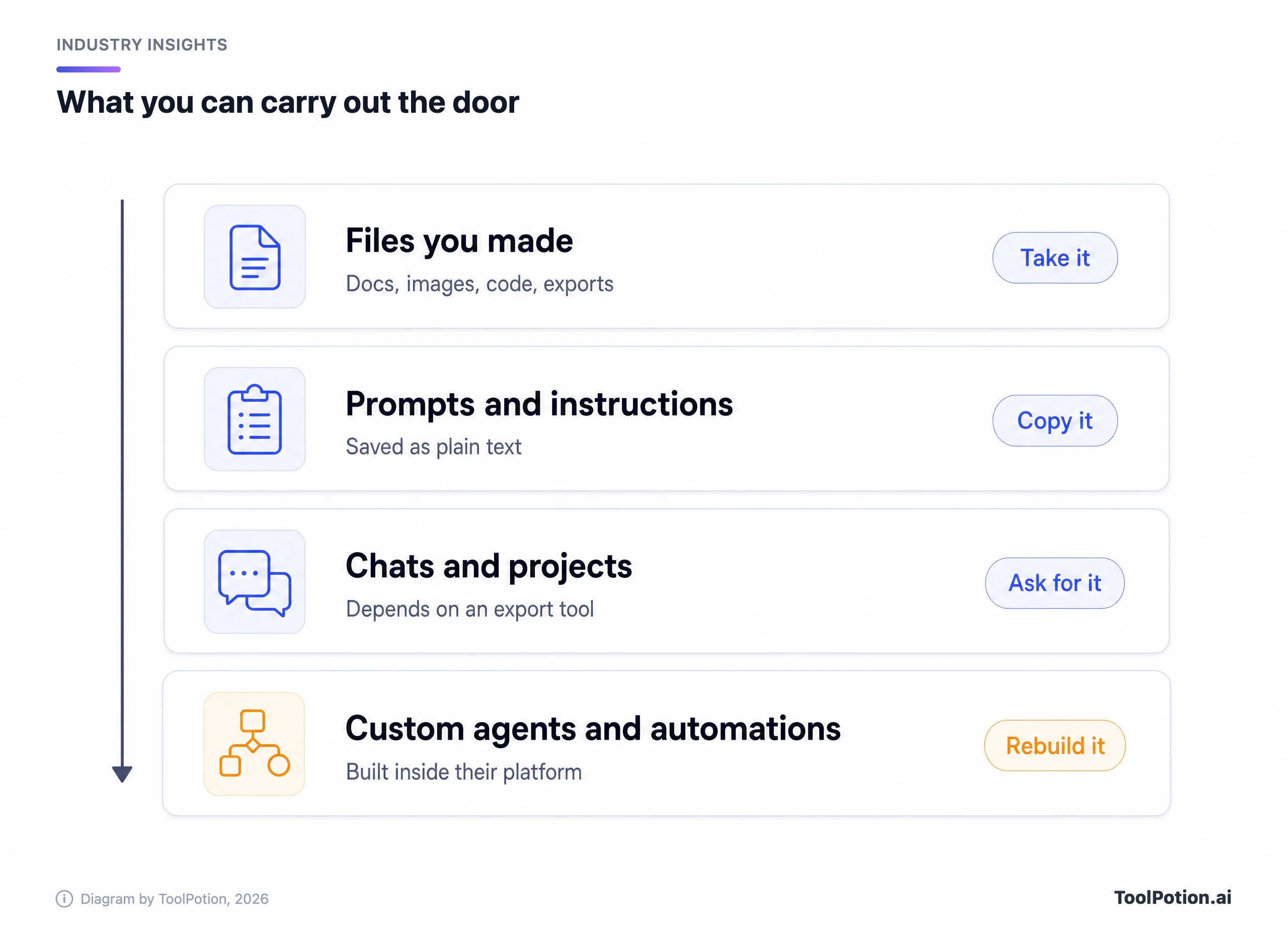
The diagram sorts what you have by how easily it leaves. Most people have plenty in the top two layers and a surprising amount in the bottom one. If a tool is mostly costing you money for convenience you don't use, our AI tool stack audit is the way to find what to cut, and the real cost of free AI tools explains why the free tier of a struggling app is the worst place to keep anything you care about.
If you want the wider picture first, every ToolRank board ranks tools by category, which makes it easier to line up a fallback before you need one.
Here's a quick way to see where you stand.
Before you close the tab, export one thing. Pick the app whose disappearance would cost you the most, find the export option in its settings and run it now. If there's no export option, that's the answer to which app you should be moving off first.