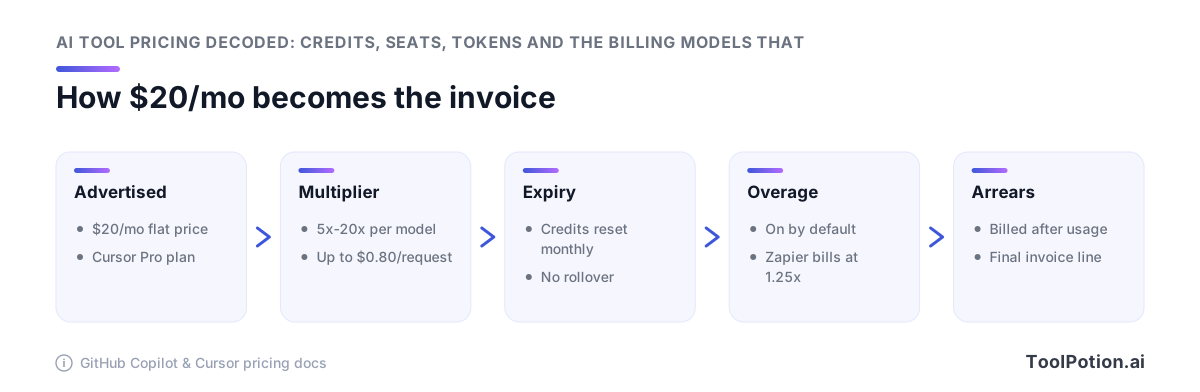
An AI credit is worth exactly $0.01 on GitHub Copilot, expires at 00:00:00 UTC on the first of the month, and buys a different amount of work depending on which model you point it at (GitHub Copilot docs). That single sentence contains three separate ways your bill can surprise you, and Copilot is one of the clearer ones.
The advertised price on an AI pricing page is a floor.
It's working as designed, and it's working at scale: 78% of IT leaders surveyed got hit with unexpected AI-feature or consumption charges in the past 12 months, and 61% cut planned projects because of unplanned SaaS cost increases (Zylo's 2026 SaaS Management Index). Below, six billing models pulled from primary vendor documentation, the specific clause in each one that converts a $20 plan into a $400 invoice, and what to ask before you enter a card.
Why AI pricing broke the old SaaS rulebook
Treat the number on the pricing page as a deposit. Old SaaS math was boring in a good way: 40 seats times $15 equals $600, every month, forever. AI tools broke that by tying your bill to how much compute your work happens to consume, and the amount of compute is decided by a model, a router, or an agent that keeps working while you're at lunch.
The seat price stopped being the price
Look at how the vendors themselves describe it. Cursor's pricing page still lists Pro at $20/month and Teams at $40/user/month, then adds that "Every plan includes a set amount of model usage" and that on-demand usage past that is "billed in arrears" (Cursor). Billed in arrears means nobody asked you first. GitHub is more explicit about the conversion rate: 1 AI credit equals exactly $0.01, Copilot Pro at $10/month includes 1,500 credits, and those credits expire at 00:00:00 UTC on the first of the month with no carryover (GitHub Docs).
The seat still exists. It just sits on top of a meter that neither you nor your finance team can forecast from the plan name alone.
Metered pricing is now the market norm. Spend on AI-native applications grew 108% year over year, and 393% at organizations with more than 10,000 employees, against roughly 8% growth in total SaaS spend, measured across 40M+ licenses and $75B under management (Zylo). Most of that money is going into tools that meter.
Business units hold the card
78% of the 218 IT leaders Zylo surveyed got hit with unexpected AI-feature or consumption charges in the past 12 months, and 61% cut planned projects because of unplanned SaaS cost increases (Zylo). Those are the people whose job is watching this. They still got surprised.
The structural reason sits in the same report: business units control 81% of SaaS spend while IT directly manages just 15% (Zylo). A marketing lead expensing a $20 plan isn't going through procurement, and the credit top-up they click three weeks later isn't going through anyone. Multiply that by the 13,174 AI apps in our directory and you get spend that no single person in the company can see, let alone approve.
The six billing models, decoded
Every AI pricing page you'll open in 2026 is running one of six meters, or two of them stacked. Learn the tell for each and you can classify a page faster than you can find the FAQ link that explains it.
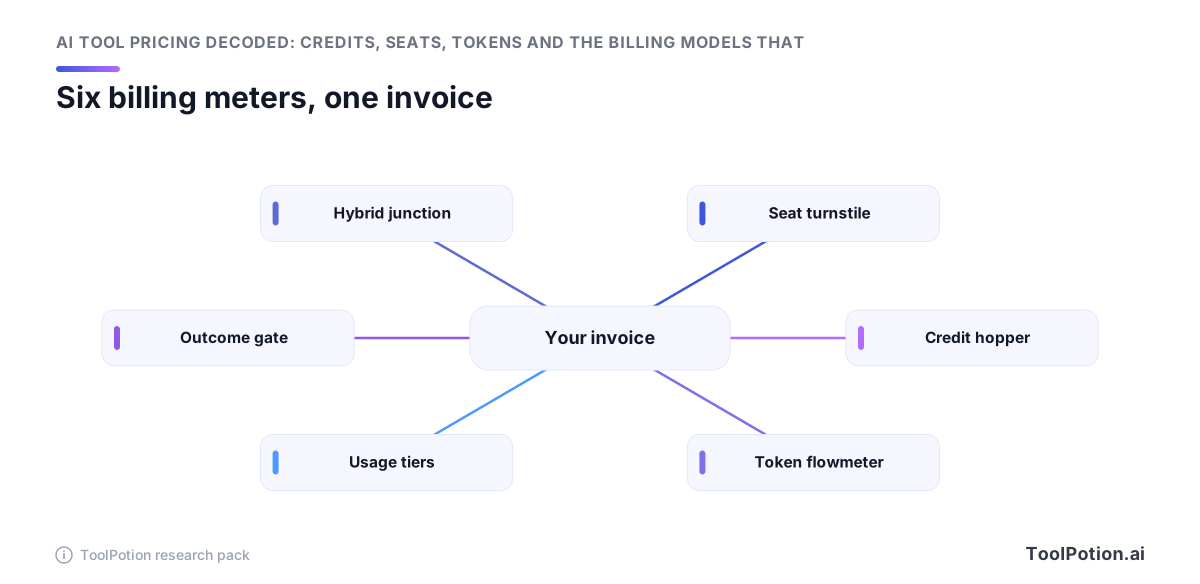
| Model | What it meters | Tell on the pricing page | Where the surprise hides |
|---|---|---|---|
| Per-seat | Named users per month | Price shown as "$X/user/month" | What a seat entitles you to, which the vendor can change |
| Credits | A vendor-minted unit | "Includes N credits" with a conversion table elsewhere | Expiry, and per-model burn rates |
| Tokens | Input and output words | Prices quoted per million tokens | Output costs several times input |
| Usage tiers | Volume bands | A plan grid with jumps in the included quota | The step up between bands |
| Outcome | A defined result | "You only pay when it works" | Who writes the definition of "works" |
| Hybrid | Seat plus consumption | A seat price and the phrase "included usage" | On-demand overage billed after the fact |
Per-seat: predictable price, unpredictable entitlement
You pay per named user, monthly. The invoice is easy to forecast. What's shifted is the entitlement behind the seat, since the seat now gates access to a pool of compute that the vendor sizes and resizes. Anthropic's consumer plans are the clearest case: Claude runs a session limit that resets every five hours plus a weekly limit, with Claude Code, chat and Cowork all drawing from one pool, and the Max tiers are sold as relative 5x and 20x multiples of Pro rather than stated message counts (Claude pricing). Your price is fixed. Your allowance is a ratio.
Credits: a currency the vendor mints and expires
A credit is whatever the vendor says it is, which is why Flexera groups credits and tokens together as the consumption layer bolted onto the old subscription (Flexera). GitHub is unusually honest about the conversion: 1 AI credit equals $0.01, Copilot Pro at $10/month includes 1,500 credits, Pro+ at $39 includes 7,000, and Max at $100 includes 20,000. Those credits don't carry over. They reset at 00:00:00 UTC on the first of the month (GitHub Docs). Two things to check on any credit page: the dollar value of one credit, and whether unused ones die at month end.
Then check the burn rate, because a credit buys different amounts of work depending on the model you pick (GitHub Docs).
Tokens: paying by the word, in and out
Token pricing is the rawest form, and the one every other model is quietly built on top of. The asymmetry is what gets people: Claude's published rates put Sonnet 5 at $2 per million input tokens against $10 output, Opus 5 at $5 and $25, Fable 5.1 at $10 and $50 (Claude pricing). Output runs 5x input across the line. A short prompt that kicks off a chatty agent run is a cheap input and an expensive bill, which is exactly why agent-style tools blow through allowances that chat interfaces never touch.
Usage tiers: cliffs disguised as plans
Tiers look like per-seat pricing with a quota attached, and they behave like per-seat pricing right up until you cross a band. Stripe's own taxonomy of AI pricing structures walks vendors through picking between these shapes, which tells you the tier boundaries are set by revenue design rather than by cost (Stripe). Copilot's own ladder shows the cliff: going from 1,500 to 7,000 credits costs you a jump from $10 to $39 a month (GitHub Docs). If your usage sits just above a band, you're paying for a lot of headroom you won't use.
Outcome pricing: you pay for a result someone else defines
The pitch is that you only pay when the AI succeeds. The catch is that the vendor writes the success criteria. Intercom's Fin charges $0.99 per outcome, and the ladder underneath runs four rungs at two prices: a resolution is $0.99, a procedure handoff to a human is $0.99, disqualifying a prospect is $0.99, and qualifying one is $9.99. Non-Intercom helpdesks carry a 50-outcome monthly minimum (Fin pricing). Fin also defines a billable resolution as "No further help is requested after Fin's last answer" (Fin pricing). Customer silence bills the same as customer satisfaction.
Zendesk got there first, announcing outcome-based pricing for AI agents on August 28, 2024 with a promise that you'd "only incur costs for issues that are resolved autonomously by AI" plus a free starter allowance, and published no rate, no definition of a qualifying resolution, and no size for that allowance (Zendesk). That's over a year old now, so ask for current terms in writing.
Hybrid: seat plus meter, which is now the default
Assume any tool you're evaluating is hybrid until proven otherwise. Cursor sells Hobby free, Pro at $20/month and Teams at $40/user/month, and states that every plan includes a set amount of model usage with on-demand usage "billed in arrears" after the included amount runs out (Cursor). Billed in arrears means charged after you've spent it. Most AI coding assistants now work this way, and the seat price is the smaller half of your real bill.
AI credits vs tokens: what a credit buys
A credit is a currency unit whose work value floats. GitHub is the clearest example because it publishes the exchange rate outright: 1 AI credit equals $0.01 USD, and your plan's allowance is just that dollar figure divided by a penny (GitHub Copilot billing docs).
GitHub's arithmetic: 1 credit = $0.01, and it expires
Run the numbers on all three individual plans and the pattern falls out fast.
| Plan | Price/month | Included credits | Dollar value of credits |
|---|---|---|---|
| Copilot Pro | $10 | 1,500 (1,000 base + 500 flex) | $15.00 |
| Copilot Pro+ | $39 | 7,000 | $70.00 |
| Copilot Max | $100 | 20,000 | $200.00 |
All figures from GitHub's billing documentation. Pro+ and Max both hand you roughly 2x your subscription price in credit value, which sounds generous until you read the expiry clause: included AI credits don't carry over between months, and the balance resets at 00:00:00 UTC on the first day of each calendar month. Buy Max for a heavy September and use a third of it, and the other $130 of value evaporates at midnight UTC on October 1. The expiry clause charges you for planning ahead.
Budget credits the way you'd budget a use-it-or-lose-it FSA. Front-load the expensive work early in the month so you can see your burn rate while there's still time to change models.
Why the same credit buys different amounts of work
Past the included allowance, Copilot bills your usage in AI Credits at per-token rates that vary by model (GitHub Docs). The credit is fixed at a penny while the token price underneath it floats. Two developers can burn identical credit balances in the same week and one gets three times the output, purely on model selection.
The legacy request-based system made this visible in a way the token system hides. Overage was $0.04 per premium request, but model multipliers meant an advanced reasoning model could consume 5x or 20x a standard request, turning one "request" into $0.20 or $0.80. Copilot code review carried a 13x multiplier (GitHub Docs). If you're still on an annual Pro or Pro+ plan under those legacy terms, a code review costs you 52 cents before you've written a line.
Before you commit a month of credits to one default model, compare AI models on what each charges per token rather than on benchmark scores.
The output-token premium nobody budgets for
Here's the multiplier that wrecks estimates. Anthropic's published API rates put Sonnet 5 at $2 per million input tokens against $10 per million output, Opus 5 at $5/$25, and Fable 5.1 at $10/$50 (Claude pricing). Output costs 5x input at every tier.
You feel that ratio the moment an agent starts writing code instead of reading it. A 2,000-token prompt that produces a 20,000-token refactor across six files is a rounding error on the input side and the entire bill on the output side. Verbose agents are expensive agents, and "be concise" in a system prompt is a real cost control.
The conversion you want taped to your monitor is short. Dollars to credits is fixed and published. Credits to tokens depends on your model. Tokens to work depends on how much the model decides to say back.
Six mechanisms that turn an advertised price into a surprise bill
Bill shock comes from six specific clauses, and each one has a phrase you can search for on a pricing page before you enter a card number.
Model multipliers
The same action costs different amounts depending on which model handled it, and the model picker is often a dropdown you forgot you changed. GitHub's legacy request-based billing is the cleanest illustration: overage ran $0.04 per premium request, but advanced reasoning models carried 5x or 20x multipliers, so one request could bill $0.20 or $0.80, and Copilot code review carried a 13x multiplier (GitHub Docs). Same button, same click, twenty times the price. Search the page for "multiplier" and read the table before you trust any per-unit number.
Non-rollover expiry
Your allowance is a use-it-or-lose-it monthly grant, so a light January doesn't fund a heavy February. GitHub says it plainly: included AI credits don't carry over and reset at 00:00:00 UTC on the first of each calendar month (GitHub Copilot Docs). The practical effect is that bursty work, which is most real work, pushes you into overage while you're still paying for credits you never touched.
Overage on by default, caps off by default
Most tools ship with the meter running past your allowance and no spend limit set, which means the default configuration is the expensive one. Cursor states the default outright: on-demand usage lets you keep using models after your included amount is consumed, billed in arrears (Cursor). Nothing in that sentence stops at a ceiling. The result shows up in the survey data, where 78% of 218 IT leaders got hit with unexpected AI-feature or consumption charges in the past 12 months (Zylo).
Set a hard cap on day one, on every tool, even if you think you'll never reach it. It takes two minutes and it's the only mechanism on this list you control unilaterally.
Price revealed after execution
Some agents decide how much work a request deserves, then tell you what it cost. Replit's effort-based pricing, announced June 18, 2025, hands that judgment to the agent and shows the price after the work is done, with the blog post committing only to simple changes "typically" costing less than $0.25 (Replit). "Typically" leaves the rate undefined. When there's no ceiling per action, a single ambiguous prompt can turn into an unbounded run, and you find out at the receipt.
Two meters running at once
A plan can have more than one limit, and the tighter one wins on the day you need throughput. Anthropic's consumer plans run a session limit that resets every five hours alongside a weekly limit tied to your account, with Claude Code, Claude.ai chat and Cowork all drawing from the same pool (Claude pricing). The Max tiers are described as 5x and 20x Pro, which are relative multiples rather than published message counts (Claude pricing). You can be well under your weekly budget and still be locked out on a Tuesday afternoon.
Billed in arrears
Nothing pre-authorizes the charge, so the first hard signal that usage went sideways is the invoice. Cursor states it on the pricing page: every plan includes a set amount of model usage, and on-demand usage past that is "billed in arrears" (Cursor). Arrears billing plus no cap plus an agent that decides its own effort is the full combination that produces a four-figure surprise, and plenty of tools ship all three at once.
Bill shock in practice: four scenarios with real numbers
Here's what those mechanisms cost when they fire on a real invoice.
The coding subscriber whose 500 requests became '$20 of usage'
On June 16, 2025, Cursor swapped the Pro plan's 500 fast requests for "$20 worth of usage per month" billed at underlying API rates (Cursor). Same $20 price. Completely different quantity. Cursor's own numbers put that allowance at roughly 225 Sonnet 4 requests, 550 Gemini requests, or 650 GPT-4.1 requests at median usage (Cursor), so a developer who kept working the way they always had, on the most capable model available, lost more than half their monthly volume without changing a single habit.
The fallout was public. CEO Michael Truell wrote that "we recognize that we didn't handle this pricing rollout well and we're sorry," and that the communication "was not clear enough and came as a surprise to many of you"; Anysphere refunded unexpected charges racked up between June 16 and July 4, 2025 (TechCrunch). Refunds only exist because the bills were real. Assume the next vendor that reprices this way won't offer them.
The vibe coder who spent $1,000 in a week
Replit's effort-based pricing lets the agent decide how much work a request deserves, and you find out the price after it's done (Replit). Then Agent 3 shipped and the per-request effort went up. One user told The Register they burned $1,000 in a week, saying "effort-based pricing never ran me as much before but Agent 3 has been exceptionally high" (The Register). Replit had already conceded the structural point a month after launch: the model "can end up being more expensive over the lifetime of a project" (The Register). A model upgrade is a price change when the agent controls effort, and nobody sends you a repricing email for it.
The support team paying 10x for the same 'outcome'
Intercom's Fin advertises $0.99 per outcome. The ladder underneath runs at two prices: a resolution is $0.99, a procedure handoff to a human is $0.99, disqualifying a prospect is $0.99, and qualifying a prospect is $9.99 (Fin). Route sales traffic into the same bot that handles refunds and your blended rate climbs 10x on the outcomes you most want it to produce. If you run Fin on a non-Intercom helpdesk there's also a 50-outcome monthly minimum (Fin), which is a floor of about $49.50 whether or not the volume shows up. Before you deploy any of the customer-facing AI chatbots sold on outcome pricing, price your real ticket mix against the full ladder, rung by rung.
The cloud account with no anomaly alarm that could fire
AWS and Google Cloud customers have been hit with surprise AI bills they couldn't see building (The Register). Anomaly detection works by comparing today against your baseline, and a new AI workload has no baseline. The first month of spend is definitionally normal. By the time there's enough history for a threshold to mean anything, you've already paid two invoices at the new rate.
Set a hard budget on day one instead of trusting detection to catch the spike.
The definitional fight hiding inside outcome pricing
Outcome pricing sounds like the fair one. You pay when the thing works, so the vendor carries the risk of a bad model day. The catch is that the vendor also writes the definition of "works," and that definition decides your bill more than the headline rate does.
When silence counts as success
Intercom's Fin publishes its rule plainly, which is more than most competitors do. A billable resolution is when "No further help is requested after Fin's last answer" (Fin AI Agent Pricing). Read that as a billing trigger and it's a silence detector. The customer who gave up, closed the tab, and went to a competitor's site looks exactly like the customer whose problem got solved.
The rate is also less uniform than "$0.99 per outcome" implies. Fin charges $0.99 for a resolution, $0.99 for a procedure handoff to a human, $0.99 for disqualifying a prospect, and $9.99 for qualifying one (Fin AI Agent Pricing). That's a 10x spread inside a single per-outcome price, and the expensive rung fires on the interaction your sales team wanted anyway. Non-Intercom helpdesks carry a 50-outcome monthly minimum on top (Fin AI Agent Pricing).
Pricing announced without a price
Zendesk went first on this model publicly, announcing outcome-based pricing for AI agents on August 28, 2024 with a promise that customers "only incur costs for issues that are resolved autonomously by AI" and "a starter usage level included at no additional cost" (Zendesk newsroom). The announcement gave no per-resolution rate, no definition of a qualifying resolution, and no size for that starter allowance. It's over a year old now, so check the current terms in your quote rather than the press release.
Before you sign with any of the outcome-priced agent platforms, get four things in the contract, in writing: the exact event that triggers a charge, whether a reopened ticket refunds or rebills, what happens when the agent escalates to a human, and the size of the included allowance in units you can count.
If a rep won't put the resolution definition in the order form, that's your answer on the rate too.
The pre-purchase checklist: twelve questions before you enter a card
Answer these from the pricing page first. Anything you can't answer from published docs is a question for the sales rep, and a refusal to answer it in writing tells you what the contract will look like.
Questions about the meter
- Get the dollar value of one unit. If the vendor won't state an exchange rate the way GitHub does (1 AI credit = $0.01), you can't price anything.
- Find out whether the unit changes price by model. Model multipliers are the most common conversion from cheap advertised rate to expensive real one.
- Establish who decides how many units a request costs, you or the agent. If it's the agent, the price is revealed after the work runs.
- Check whether unused units expire. GitHub's included credits don't carry over and reset at 00:00:00 UTC on the first of the month (GitHub Docs).
- Count how many meters run at once. Claude's consumer plans run a five-hour session limit and a weekly limit simultaneously, with Claude Code and chat drawing from the same pool (Claude pricing).
Question six is the one buyers skip: what happens to output tokens. Output costs 5x input across Anthropic's published API rates, $2 vs $10 per MTok on Sonnet 5 and $5 vs $25 on Opus 5 (Claude pricing). A verbose agent run bills against what it wrote.
Questions about the ceiling
Seven, whether overage is on by default and whether you can switch it off before your first invoice. Eight, whether there's a hard cap, a soft cap, or just a warning email. Nine, the timing of the charge. Cursor says "On-demand usage allows you to continue using models after your included amount is consumed, billed in arrears" (Cursor pricing), which means you find out what you spent after you've spent it.
Ten, whether anyone on the team has unilateral authority to raise the cap. Business units control 81% of SaaS spend while IT directly manages 15% (Zylo), so the person clicking "increase limit" is usually not the person who sees the invoice.
Questions about the exit
Eleven, the notice period, and whether cancelling mid-cycle refunds unused credits or voids them. Twelve, the dispute path if the bill is wrong and how long you have to raise it. Anysphere refunded unexpected charges between June 16 and July 4, 2025 after its pricing change went badly (TechCrunch), but that was goodwill, and goodwill doesn't appear in an order form.
Run the twelve against two or three shortlisted vendors before you commit to one. You can browse pricing across 18,982 listings in our directory to build that shortlist, and the tools that answer all twelve on a public page tend to be the ones whose invoices match their pricing pages.
The invoice already landed: what you can actually do
Start with the vendor before you call your card issuer. Most surprise AI bills get refunded or credited without any legal pressure, because the vendor knows the billing terms were confusing and would rather keep you than argue. Cursor did exactly that after its June 16, 2025 pricing switch, offering refunds for unexpected charges incurred between June 16 and July 4, 2025 while CEO Michael Truell said publicly that communication "was not clear enough and came as a surprise to many of you" (TechCrunch).
Ask first, and ask in writing
Email support instead of opening the chat widget. You want a written record with a timestamp, because that record is what a card issuer or a state AG complaint form will ask for later.
Four things belong in that first message: the exact dollar amount and date of the charge, the specific plan term you believe was misapplied, a request for the usage log that produced the number, and a deadline for reply. Ask for the log even if you think you know the answer. Vendors that bill on consumption almost always have per-request records, and the ones that won't share them are telling you something about the meter.
If support declines, escalate to the account rep before you dispute the charge. Disputes get accounts suspended, and you may still need the tool running while the argument plays out.
Where the law stands after click-to-cancel was vacated
The FTC's negative option rule (the "click to cancel" rule) is gone. The Eighth Circuit vacated it in its entirety in July 2025 on procedural grounds (Cooley), so the specific cancellation-flow requirements it would have imposed don't apply to your vendor.
You still have real footing, though. ROSCA, Section 5 of the FTC Act and roughly 30 state auto-renewal laws survived the ruling untouched, and federal and state regulators are expected to keep enforcing against undisclosed or misleading recurring charges (WilmerHale). A state AG complaint costs you fifteen minutes and lands on a vendor's legal team, which is a faster path than most people expect.
Why waiting can be a real strategy
The unit economics are moving in your favor. Epoch AI put the decline in LLM inference prices at anywhere from 9x to 900x per year depending on which capability benchmark you measure, with GPT-4-level science performance dropping about 40x per year (Epoch AI, data through February 2025). That means the credit allowance your vendor sold you in 2025 costs them dramatically less to serve now. Bring that to your renewal and ask for more included usage at the same price. It's a reasonable ask, and it's cheaper for them to grant than to lose the seat.
Frequently asked questions
What is the difference between AI credits and tokens?
Tokens are the unit the model actually consumes, and vendors publish token rates directly: Claude's API lists Sonnet 5 at $2 per million input tokens and $10 per million output, with Opus 5 at $5/$25 and Fable 5.1 at $10/$50, so output runs 5x input across the lineup (Claude pricing). A credit is a vendor currency layered on top of tokens, and its dollar value can be fixed while its work value floats. GitHub pegs 1 AI credit at exactly $0.01 (GitHub billing docs), yet once you pass your included allowance those credits are spent at per-token rates that vary by model (GitHub models and pricing). Same credit, wildly different amount of work, depending on which model you pointed it at.
Do unused AI credits roll over to the next month?
Usually no. GitHub states plainly that included AI credits do not carry over between months and reset at 00:00:00 UTC on the first day of each calendar month (GitHub billing docs), which means a Copilot Pro subscriber's 1,500 credits at $10/month are use-it-or-lose-it. Check the expiry clause before you buy a bigger tier to cover an occasional heavy week, because you're paying every month for headroom that evaporates on schedule. Prepaid top-up credits sometimes have longer lives than plan-included ones, so read the two policies separately.
Why is my AI coding assistant bill higher than the subscription price?
Because the subscription buys an allowance, and the allowance is denominated in dollars or requests that convert to model work at rates you don't control. When Cursor moved its $20/month Pro plan from 500 fast requests to "$20 worth of usage" on June 16, 2025, its own post put that at roughly 225 Sonnet 4 requests or 650 GPT-4.1 requests at median usage (Cursor blog). Model multipliers do the same thing on GitHub's legacy request-based billing, where overage ran $0.04 per premium request but advanced reasoning models consumed 5x or 20x, turning one request into $0.20 or $0.80, and Copilot code review carried a 13x multiplier (GitHub multiplier reference). If you're comparing AI coding assistants, price the model you'll really use.
What does 'billed in arrears' mean on an AI pricing page?
It means the charge lands after the usage happens rather than being authorized before it. Cursor's pricing page spells it out: "Every plan includes a set amount of model usage. On-demand usage allows you to continue using models after your included amount is consumed, billed in arrears" (Cursor pricing). There's no pre-approval step and no ceiling implied by the phrase, so the first time you see the number is on the invoice. In a survey of 218 IT leaders, 78% got hit with unexpected AI-feature or consumption charges in the past 12 months, and 61% cut planned projects because of unplanned SaaS cost increases (Zylo 2026 SaaS Management Index).
Can I set a hard spending cap on AI tool usage?
Rarely, and almost never by default. Replit's effort-based pricing, announced June 18, 2025 and rolled out to Core and Teams subscribers on July 1, 2025, lets the agent decide how much effort a request warrants and shows you the price only after the work is finished, with the blog offering just that simple changes "typically cost less than $0.25" (Replit blog). After Agent 3 shipped on September 10, 2025, one user told The Register they spent $1,000 in a week (The Register). If a hard ceiling matters more to you than uninterrupted throughput, a plan that throttles instead of billing is the safer shape: Anthropic's consumer plans run a five-hour session limit and a weekly limit at the same time, with Claude Code, Claude.ai chat and Cowork drawing from one pool (Claude pricing). Otherwise, set a budget alert yourself and treat vendor caps as optional until you've turned one on and tested it.
Is outcome-based AI pricing cheaper than per-seat pricing?
Only at low volume, and only once you've pinned down what counts as an outcome. Intercom's Fin advertises $0.99 per outcome, but the ladder runs at two prices: resolution, procedure handoff and prospect disqualification are $0.99 each while prospect qualification is $9.99, a 10x spread inside one headline price, and non-Intercom helpdesks carry a 50-outcome monthly minimum (Fin pricing). Fin also defines a billable resolution as "No further help is requested after Fin's last answer," so you're paying on customer silence rather than confirmed problem-solving (Fin pricing). Zendesk announced outcome-based AI agent pricing on August 28, 2024 without publishing a per-resolution rate, a definition of a qualifying resolution, or the size of the included allowance (Zendesk newsroom), which is a good reason to get the definition and the rate in your contract before you sign.