Four finance AI workflows clear the bar in 2026: reconciliation, forecasting, expense categorization and audit prep. Everything else is a pilot with a good demo.
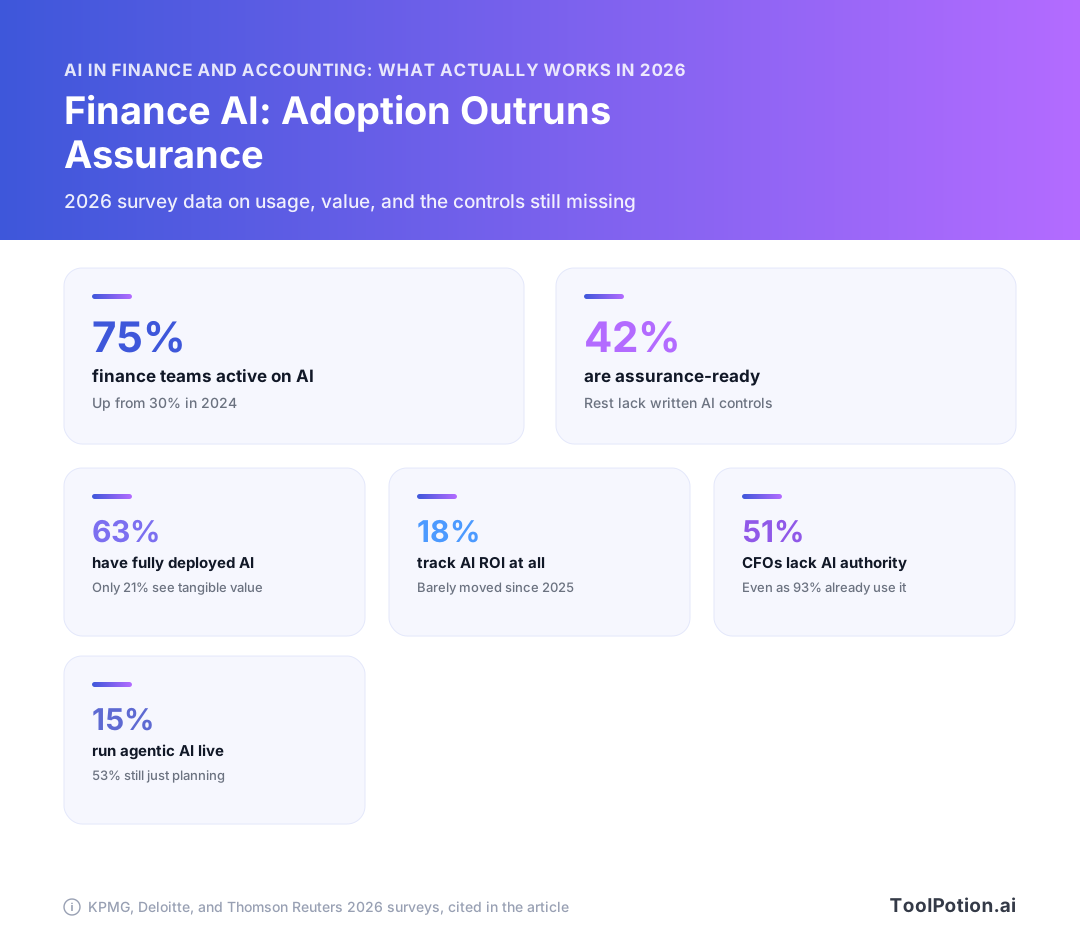
The adoption numbers won't help you pick. KPMG says active AI use in the finance function hit 75% in 2026, up from 30% in 2024. Deloitte's Finance Trends survey of 1,326 leaders found 63% fully deployed but only 21% seeing tangible value. Thomson Reuters found 18% track ROI in any manner at all. Those aren't contradictions, they're three definitions of the word "adoption."
So this piece filters on controls instead: what COSO's February 2026 GenAI guidance requires, what a vendor's accuracy footnote actually measured, and which of our directory's 309 finance and banking tools survive both tests.
The 2026 adoption numbers contradict each other, so read them by definition
When one survey says 93% and another says 14%, both can be right. They're counting different things, and almost none of them say so in the headline.
Pilot use, deployed use and core-workflow use are three different questions
KPMG's Global AI in Finance 2026 found active use of AI in the finance function more than doubled from 30% in 2024 to 75% in 2026, with 71% of finance leaders saying AI meets or exceeds ROI expectations. "Active use" there covers anything running, including a controller pasting variance commentary into a chat window. Thomson Reuters, asking about organization-wide GenAI use, got 40%, up from 22% a year earlier, and only 15% for agentic AI with 53% planning or considering it. Same year, same profession, three-times spread. The question wording did that, not the market.
So before you quote a number, find the definition: does it count anyone who tried a tool, anyone whose company bought one, or a workflow that survived a month-end close with an auditor looking at it? Only the third tells you anything about your own roadmap.
The deployment-to-value gap nobody reconciles
Deloitte's Finance Trends 2026 survey of 1,326 global finance leaders is the one to keep on hand, because it asked both halves. 63% have fully deployed AI in finance, 21% believe those investments delivered tangible value, and 14% have fully integrated AI agents. Deployment is roughly three times value. That gap is the actual state of finance AI in 2026, and it's the number you should carry into any vendor call.
Almost nobody is measuring ROI at all
Here's the part that makes every adoption chart shakier than it looks: only 18% of respondents knew their organization was tracking AI ROI in any manner, roughly flat year over year, and most who track it measure internal operational metrics rather than business outcomes. Self-reported satisfaction with unmeasured spend is a mood, not evidence.
Two habits help. Read every stat against the survey's own definition before repeating it, and treat any figure from a vendor's sponsored study as a marketing claim until you find the footnote. We apply the same filter to the 309 finance and banking AI tools in our directory and to the AI trend reports we track, which is why the shortlist in the next section is short.
Reconciliation: the auto-match rate you'll actually get
Plan for 60% to 80% of accounts auto-certified, and build your business case at the bottom of that band. The vendor number you'll hear in the demo is "up to 98%" auto-certification with 99% match accuracy. Observed customer deployments land between 43% and 85%, which makes 60–80% the honest planning assumption (Numeric). If your close staffing model only works at 90%, the project fails before the first month-end.
Marketing ceiling vs. observed customer range
That 43% floor and 85% ceiling are the same software. The spread is your data, not the vendor's model.
A 98% figure is achievable on a narrow slice: high-volume, low-variance accounts like bank cash and credit card clearing, with clean one-to-one matching and a materiality threshold set generously. Extend the same tool to prepaid expenses, intercompany, accrued liabilities and inventory, and the certified percentage drops hard because those accounts need judgment, not matching. Ask any vendor which account types their reference customer's percentage covers. If the answer is "cash and AR," you've learned the number is a subset rate, not a portfolio rate.
What drives the gap: data hygiene, subledger coverage, materiality thresholds
Three things decide where you land, and you control all of them before signing anything. Subledger coverage comes first: accounts whose supporting detail lives in a spreadsheet or a system without an API can't be auto-certified at any accuracy, so count them and subtract them from your denominator now. Data hygiene comes second, meaning consistent reference IDs, stable vendor naming and a bank feed that doesn't restate prior periods. Materiality thresholds come third, and they're the lever people quietly pull to make the dashboard look good.
Raise your auto-certify threshold from $500 to $5,000 and your rate jumps without a single improvement in the underlying matching. Your auditor will notice. Set the threshold from your existing SOX documentation and leave it there for the pilot, then measure. Our directory's AI case studies with disclosed outcomes are worth reading with the same filter: check whether the reported rate names the account types and the threshold, because most don't.
The acceptance criteria to write into your pilot
Write these into the order form, not the kickoff deck. Run one full quarter-end, all three months, across your real account portfolio.
- Auto-certification rate of at least 65% across all balance sheet accounts in scope, measured at your current materiality threshold with the threshold frozen for the pilot period.
- False-certify rate of zero on accounts above materiality, where a false certify means the tool certified a balance a reviewer later had to reopen. This is the number that ends the pilot, not the match rate.
- Every certification produces an exportable audit trail showing the source records matched, the rule or model version applied, and the human who approved the exception queue.
- Override percentage tracked monthly and reported to you, so you can see the drift before your auditor does.
If the vendor won't commit to a measured rate on your data, price the deal as if you'll get 43%.
Forecasting: real speed gains, very uneven accuracy gains
Buy FP&A AI for cycle time, not for a better number. KPMG's March 2026 survey of 1,013 senior finance leaders across 20 countries found decision-making speed improved for 71% and decision quality for 70%, while forecasting accuracy improved for 64% (KPMG). That 64% is the softest of the three, and it hides a spread wide enough to break a business case.
Decision speed improves more reliably than forecast accuracy
Speed and quality gains come from work that AI does well: pulling actuals from four systems into one variance view, drafting the commentary, rerunning a scenario in minutes instead of a day. None of that requires the model to predict anything. It requires the model to assemble and explain, which is the part it's good at.
So write your success criteria in days, not basis points. Close-to-forecast turnaround, number of scenarios run per cycle, hours of analyst time spent on data assembly. If your only acceptance test is forecast error, you're betting on the weakest of KPMG's three measured outcomes.
Why banking sees 71% and healthcare 44%
Forecast-accuracy gains ranged from 71% in banking down to 44% in healthcare in the same KPMG data (KPMG). The gap tracks how much clean, high-frequency, structured history the sector has. Banking has daily transaction data and decades of it, priced and time-stamped. Healthcare forecasting depends on payer mix, contract terms and reimbursement timing that live in text and change by contract.
Ask your vendor which of those two worlds their reference customers came from. A 71% result in a data-rich sector tells you almost nothing about your revenue forecast if your inputs are contract PDFs.
Where FP&A copilots stop: the assumption layer stays human
The model can extrapolate your bookings trend. It can't decide that the new pricing tier changes churn, that the Q3 hiring plan slips six weeks, or that a customer renegotiating in November should be haircut by 30%. Those assumptions drive the forecast, and they come from people who talk to sales and ops.
Scope the tool to everything below the assumption line and keep the assumptions in a reviewable register with an owner and a date on each one.
Expense categorization: the closest thing to a solved workflow
If you're piloting one finance AI workflow this quarter, make it transaction coding and expense-policy review. The task is narrow, the ground truth is written down in your own policy doc, and every decision the agent makes leaves a reviewable trail.
Why policy checks suit an agent better than judgment does
A policy check is a lookup against rules you wrote. Does this $340 dinner have a receipt, a business purpose, and attendees under the per-head cap? That's deterministic reasoning over structured fields plus a receipt image, and the failure modes are visible to a reviewer in seconds. Compare that to a forecast, where nobody can tell you whether the number was wrong until the quarter closes. Coding sits closer to the policy end: merchant, amount, department, GL account, with historical coding as the label set.
The volume helps too. You get thousands of near-identical decisions a month, which is exactly the shape that makes an accuracy rate meaningful rather than anecdotal.
What the vendor's own accuracy definition actually measures
Ramp publishes ~85% reduction in manual reviews at 99%+ accuracy for its policy agent, and it defines accuracy in the footnote: agent-recommended approvals that human reviewers also approved, from an internal analysis dated 7/1/25 (Ramp Support). Read that definition twice before it goes in a business case. It scores agreement on approvals, so it says nothing about the expenses the agent wrongly flagged, and nothing about violations it approved that a reviewer waved through anyway. The disclosed methodology puts Ramp ahead of most of the field, which mostly publishes a percentage with no denominator. Ask every vendor on your shortlist for the same footnote, and treat a refusal as an answer.
Human-in-the-loop design for the exceptions that remain
Route the 15% the agent won't clear to a named reviewer, log the override rate, and set a threshold that triggers retraining when overrides climb. That override percentage is one of the drift KPIs COSO calls for in its February 2026 GenAI guidance (Deloitte Heads Up). Among the 550 AI agents listed in our directory, the ones worth your time are those that hand you that log without a support ticket.
Audit prep: evidence your auditor can actually test
Ask any audit-prep vendor one question before you look at the demo: what does the export look like when my engagement team asks how this number was produced? If the answer is a chat transcript, you're buying a productivity tool, not an audit-prep tool.
No GenAI-specific PCAOB standard, but AS 1105 and AS 2301 already apply
There's no PCAOB standard written for generative AI. That's not a gap you get to sit in. The existing standards on audit evidence and risk assessment already set the bar for AI-assisted work (Fieldguide), which means an AI-produced schedule gets evaluated on sufficiency and appropriateness exactly like a spreadsheet a staff associate built by hand. Your auditor doesn't need a new rule to reject it.
COSO filled in the governance half on February 23, 2026, with the first formal extension of its Internal Control–Integrated Framework into AI, sorting GenAI use cases into eight capability types including ingestion, transformation, posting and judgment (Journal of Accountancy). Ingestion and transformation are the easy ones to defend. Judgment is where the questions get long.
What sufficient appropriate evidence means when a model produced it
It means the output has to trace back to a source document your auditor can open. Extraction is the workflow where this holds up best, because the underlying PDF or invoice is still the evidence and the model is a faster pair of eyes over it. If you're shopping that layer, our directory tracks 217 document and PDF extraction tools, and the ones worth your time will show you a page-and-coordinate reference for every field they pull, not a summarized answer.
Sebastian Stöckle, KPMG International's Global Head of Audit Innovation & AI, put the test plainly: "AI only delivers real value when it can be explained and controlled" (KPMG).
Retention, logging and reproducibility to specify up front
Write these into the contract, because retrofitting them after a deployment is expensive. Ask for the model and version identifier stamped on every run, the prompt or configuration used, immutable lineage from output field back to source document and page, an exportable log of who reviewed and approved each item with a timestamp, and a retention window matching your audit retention policy rather than the vendor's default. Ask what happens to your logs when the vendor upgrades the underlying model mid-year.
Then keep watching them. COSO's guidance asks for continuous monitoring of model performance with KPIs like transaction volume, transaction size and override percentages, because set-and-forget controls don't catch drift (Deloitte). Override rate is the one to put on a dashboard. If your reviewers are quietly correcting the model on 30% of items, you have a control finding waiting to be written and a business case that never landed.
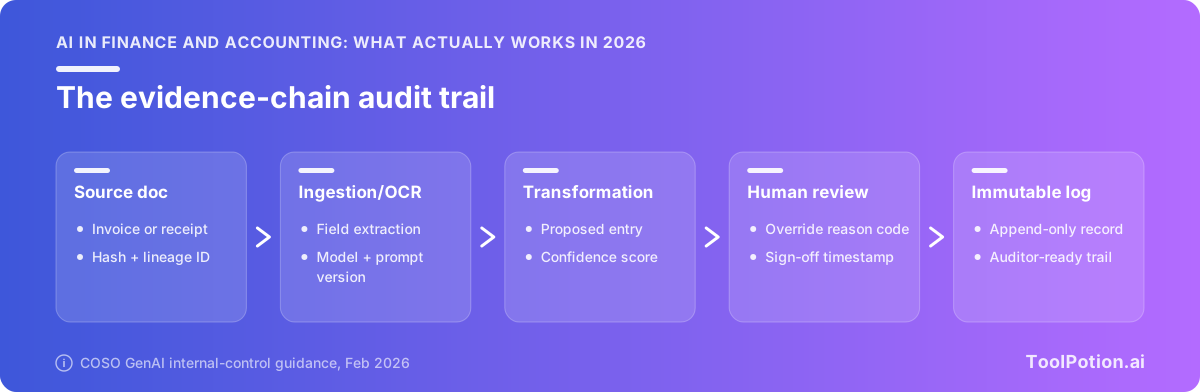
The controls checklist that filters your shortlist
Hand this to every vendor before the second demo. Most of it comes straight out of COSO's 'Achieving Effective Internal Control Over Generative AI', published February 23, 2026 as the first formal extension of the Internal Control–Integrated Framework (2013) into AI governance (Journal of Accountancy). It's the closest thing you have to a written standard, and vendors selling into finance should already know it.
COSO's eight GenAI capability types, and which ones your use case touches
COSO sorts GenAI use cases into eight capability types: ingestion, transformation, posting, orchestration, judgment, monitoring, regulatory intelligence and human-AI interaction (Journal of Accountancy). Make the vendor tell you which ones their product performs, in writing.
The line that matters is posting and judgment. A tool that only ingests documents and transforms them into a draft is a different control problem from one that writes to the ledger or decides whether an exception is acceptable. Expense coding usually touches ingestion, transformation and judgment. Reconciliation auto-certification touches posting. If a vendor's answer is "all eight," they haven't read it either.
From point-in-time assurance to continuous monitoring
Your old SOC-style walkthrough doesn't cover a model that drifts between quarters. COSO's guidance calls for continuous monitoring of model performance instead of static, point-in-time assurance, with KPIs prioritized around transaction volume, transaction size and override percentages to catch drift. Set-and-forget controls are explicitly insufficient (Deloitte Heads Up).
The override-rate and drift KPIs to demand in the contract
- Override rate by user and by transaction type, exportable monthly, not just visible in a dashboard.
- Model version history with dates, so you can tie a change in error rate to a specific release rather than guessing.
- Accuracy measured against your data during a parallel-run period you define, with the denominator written down.
- A named threshold that triggers review. Pick a number now (say, override rate above 8% in any month) and put it in the contract.
Assurance readiness is the variable that predicts results
KPMG found only 42% of organizations are fully assurance-ready, and the gap in outcomes is not subtle: those firms report error-reduction improvements at 33% against 6% for non-ready peers, and confidence in scaling AI at 42% against 14% (KPMG).
AI only delivers real value when it can be explained and controlled. Assurance readiness differs sustained performance from hidden risk. — Sebastian Stöckle, Global Head of Audit Innovation & AI, KPMG International
Run the checklist before you shortlist, not after. Our finance and banking category has 309 listings, and the checklist cuts that to a handful faster than any feature comparison will.
Read every accuracy claim against its own footnote
Every performance number in a finance AI demo is a measurement, and a measurement without its population, its definition of correct and its date is a marketing asset. The footnotes are usually published. Almost nobody reads them.
Three questions that deflate most numbers
Ask these in order, in writing, before the second demo.
- Which transactions were counted? Not the total volume, the subset the number was computed over.
- What made an answer correct? Somebody defined a ground truth. Get that definition verbatim.
- When was it measured, and on whose data? A single internal analysis from last year is not a service level.
Denominators, dates and self-selected comparisons
Ramp's policy agent publishes roughly an 85% reduction in manual expense reviews at 99%+ accuracy, and its own documentation defines that accuracy as agent-recommended approvals that human reviewers also approved, from an internal analysis dated 7/1/25 (Ramp Support). That's a measure of agreement on the approve path. It says nothing about the expenses the agent flagged wrongly and a reviewer had to unwind, which is the error type your controller cares about.
Reconciliation claims fail differently. The auto-certification figure is stated as a ceiling, "up to 98%", while customer deployments land in a 43% to 85% range (Numeric). A ceiling is a fact about the best account in the best month at the best customer.
What a credible disclosure looks like
It names the sample size, the scoring rule and the date, the way Ramp does, and it reports the false-approval rate alongside the accuracy rate. Ask for the number computed on your own last quarter of data during the pilot. A vendor that won't run that test has told you what its footnote would say.
Why the demos die at month-end close, and the pilot design that prevents it
A demo runs on a curated extract. Last quarter's clean subledger, a dozen well-formed invoices, no intercompany, no manual journal posted by the tax team at 11pm on day three. Close is the opposite population, and every failure mode a sales engineer would screen out of a call shows up at once, on a deadline, in front of your controller.
Retrieval construction dominates accuracy more than model choice does
Swap one frontier model for another on the same finance question set and the answers shift a little. Change how documents get chunked, which period's file gets pulled, and whether footnotes travel with the table, and the answers shift a lot. Most wrong answers in finance QA are retrieval failures in a fluent sentence: the tool found the FY24 schedule when you asked about FY25, and the prose reads perfectly either way.
COSO's February 2026 guidance treats ingestion and transformation as capability types separate from judgment, each carrying its own controls (Journal of Accountancy). Test the pipeline on your own ugly source files. The vendor's sample set tells you almost nothing.
Experienced reviewers capture most of the gain
Put the tool in front of your two strongest seniors before you roll it to the staff. Field research quantifying AI's time savings for CPAs points the same direction: the hours land with people who already know what a right answer looks like and can spot a wrong one in seconds (Journal of Accountancy).
Skip the review layer and you get the Deloitte result: a refund of more than $60,000 to the Australian government over a report containing AI-generated errors (CFO Dive).
Cost, unclear value and weak risk controls kill agentic projects
Model capability is rarely what stalls these programs. Deloitte's Finance Trends survey of 1,326 finance leaders found 63% had fully deployed AI in finance while only 21% saw tangible value, and 14% had fully integrated agents (CFO Dive). Thomson Reuters puts agentic adoption at 15% against 53% planning or considering (Thomson Reuters). In Deloitte's Q2 2026 CFO Signals, 59% of CFOs named balancing deployment pressure against risk their top challenge and 51% said they lacked governance authority (Deloitte).
A 90-day pilot with the numbers written down before you start
- Pick one workflow and one entity. Reconciliation for a single subsidiary beats a finance-wide rollout you can't measure.
- Baseline it for two closes before the tool touches anything: hours spent, exception count, rework rate, days to certify.
- Agree the acceptance threshold in writing with your controller and your external auditor's engagement partner, and put a date on it.
- Monitor override rates weekly, along with transaction volume and transaction size, which is the drift signal COSO's continuous-monitoring expectation is built around (Deloitte Heads Up).
- Write the kill criterion on day one. Something like: if auto-certification sits below 55% at day 90, or reviewer override exceeds 15% for three consecutive weeks, we stop and renegotiate.
Then publish the result internally, numbers included, the way how teams document real deployments in our directory do it. Only 18% of organizations track AI ROI in any manner (Thomson Reuters), so a single written baseline puts you ahead of four out of five buyers at renewal time.
Frequently Asked Questions
Is AI reliable enough to do bookkeeping without a human reviewer in 2026?
No, and the control frameworks now assume you'll keep a reviewer. KPMG puts active AI use in the finance function at 75% in 2026, up from 30% in 2024, but only 42% of organizations are fully assurance-ready, and those that are report error-reduction gains at 33% versus 6% for the rest (KPMG, May 11, 2026). COSO's February 2026 guidance treats "set-and-forget" controls as explicitly insufficient and pushes continuous monitoring of model performance instead (Deloitte Heads Up). Unreviewed output already has a price tag: Deloitte refunded over $60,000 to the Australian government over a report containing AI errors (CFO Dive).
What auto-match rate should I expect from AI reconciliation software?
Plan for 60% to 80% auto-certification, not the number on the slide. Reconciliation vendors market "up to 98%" auto-certified with 99% match accuracy, while observed customer results land in a 43% to 85% range (Numeric). Write the rate into your acceptance criteria and measure it on your own historical ledger during the pilot, not on demo data, then re-measure after three closes since match quality drifts as your transaction mix changes (Deloitte Heads Up on COSO).
What does the February 2026 COSO guidance require for AI used in financial reporting?
COSO published "Achieving Effective Internal Control Over Generative AI" on February 23, 2026, the first formal extension of its 2013 Internal Control–Integrated Framework into AI governance, and it sorts GenAI use cases into eight capability types: ingestion, transformation, posting, orchestration, judgment, monitoring, regulatory intelligence and human-AI interaction (Journal of Accountancy). The operational demand is a move from point-in-time assurance to continuous monitoring, with KPIs like transaction volume, transaction size and override percentages used to detect model drift (Deloitte Heads Up). Classify every tool you run by capability type, set a threshold for each KPI, and log overrides from day one, because a posting or judgment tool carries far heavier control expectations than an ingestion tool.
Will my auditor accept workpapers prepared with generative AI?
Yes, if you can show how the output was produced and who checked it. The PCAOB hasn't issued a generative AI standard, and its existing standards on audit evidence and risk assessment already set the bar for sufficiency, appropriateness and reviewability (Fieldguide). Retain the prompt, the source documents the tool retrieved, the model and version, the date, and the preparer and reviewer sign-offs, so the workpaper stands on its own without anyone re-running the model. Expect the questions to get sharper: PwC has told the PCAOB to make AI in audit its foremost priority (Big4 News).
How do I calculate ROI on an AI finance tool when only 18% of organizations track it?
Capture the baseline before the pilot starts, because you can't reconstruct it later. Only 18% of professionals knew their organization tracked AI ROI in any manner in 2026, roughly unchanged from 2025, and most of those measure internal operational metrics rather than business outcomes (Thomson Reuters, Feb 9, 2026). The gap that creates is visible in Deloitte's Finance Trends survey of 1,326 finance leaders: 63% have fully deployed AI in finance and 21% believe it delivered tangible value (CFO Dive). Track four numbers across a fixed window: hours to close, exception rate, cycle time per transaction, and fully loaded cost including the review time the tool creates. KPMG's finding that 71% of finance leaders say AI is meeting or exceeding ROI expectations measures expectations, so don't substitute it for your own numbers (KPMG).
Which finance workflow should I automate first?
Expense categorization and policy review, mostly because it's the one workflow where a vendor publishes what its accuracy number means: Ramp reports roughly 85% fewer manual reviews at 99%+ accuracy, defined as agent-recommended approvals that human reviewers also approved, from an internal analysis dated 7/1/25 (Ramp). Reconciliation comes second since the achievable match rate sits well under the marketed one and needs a paid pilot on your data (Numeric). Forecasting comes later: 44% of CFOs at $1B+ companies already use AI for planning and budgeting (Deloitte Q2 2026 CFO Signals), but accuracy gains swing hard by sector, from 71% in banking to 44% in healthcare (KPMG). Narrow the field before you demo anything, since our directory alone carries 550 AI agents and very few were built for a controlled close.