Counsel Health's own FAQ asks a question that a $625 million acquisition makes awkward: "Can Counsel serve as my primary care physician (PCP)?" The answer, from Counsel's site: "Today, we recommend maintaining an in-person PCP for annual physicals, vaccinations, and ongoing management of chronic conditions."
What Oura agreed to buy is less obvious. TechCrunch calls Counsel an "AI-native primary care company," and the label has stuck. We read Counsel's pages, its terms of service and privacy policy, Oura's announcement and Google's healthcare launch to see what sits behind it. Our short version: it's a free AI chat in front of a pay-per-visit physician group, useful for some jobs, and the answers about liability and data are less settled than the marketing.
A $625 million price and two closing dates that don't match
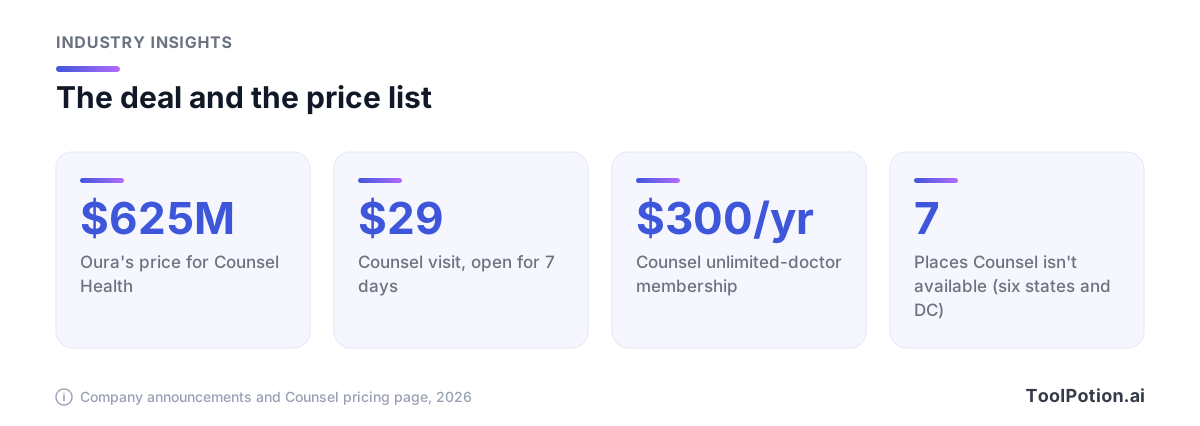
Oura says it will acquire Counsel for $625 million in cash, per Counsel's own release, a few weeks after it postponed an IPO of up to $2.2 billion indefinitely, citing "uncertainty in the IPO market," per TechCrunch. Counsel had raised a $25 million Series A a year earlier, led by Andreessen Horowitz and GV. Counsel's CEO, Muthu Alagappan, becomes Oura's chief clinical AI officer, and TechCrunch, citing Bloomberg, says Counsel's 70 employees join Oura too.
Now the loose end: when it closes. Oura's own announcement says the deal is "expected to close near the end of this year," and Counsel's release says "before the end of the calendar year." TechCrunch says before the end of 2027, and doesn't explain the date. Those can't all be right. We'd go with the two companies and read the 2027 line as a probable slip, but until the deal closes, Counsel is still a separate company with its own policies.
Meanwhile the product already exists. Counsel has been inside the Oura app through Oura Labs, where members can chat with the medical AI and, when needed, with a physician.
What happens after you type a question
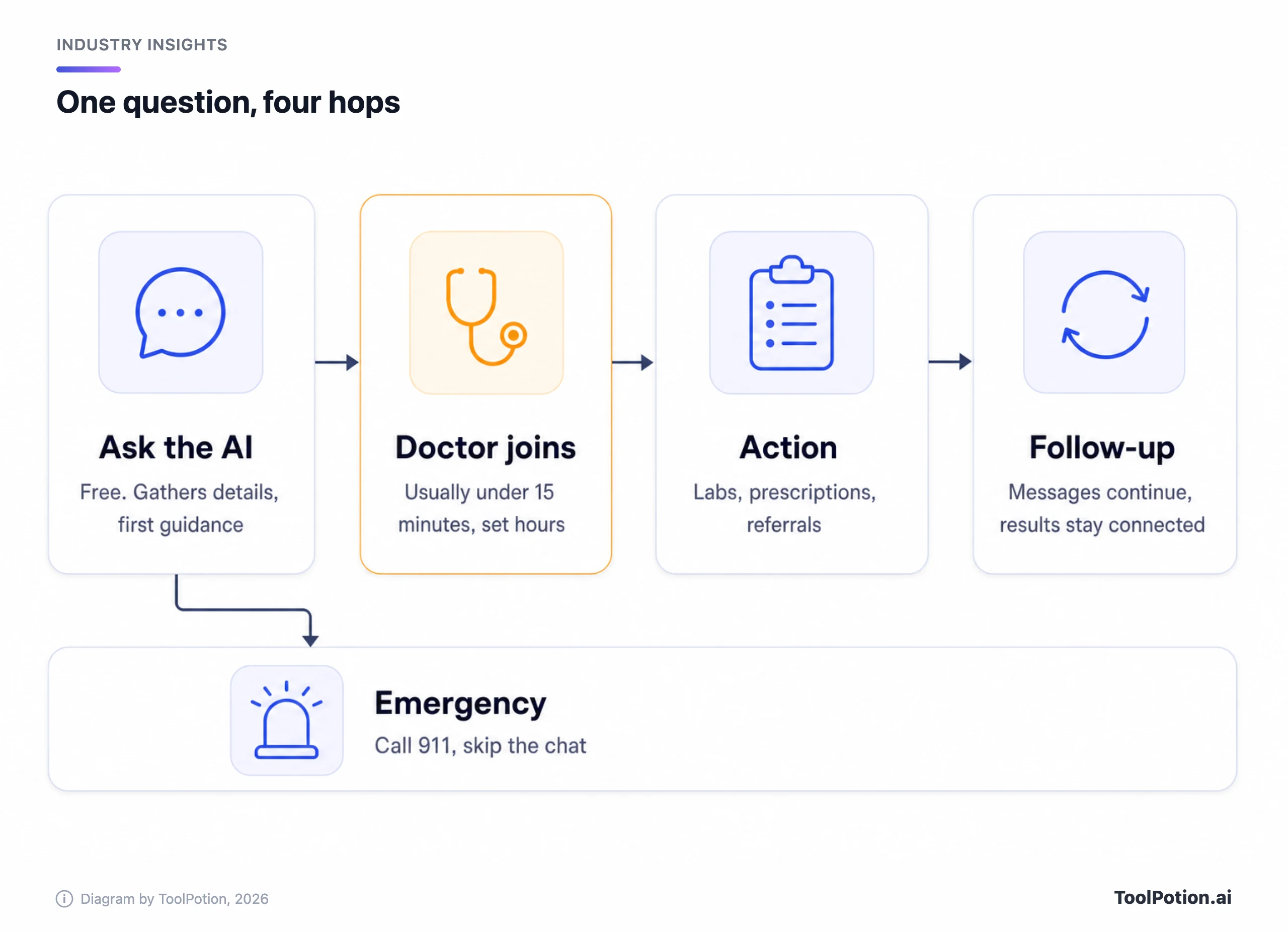
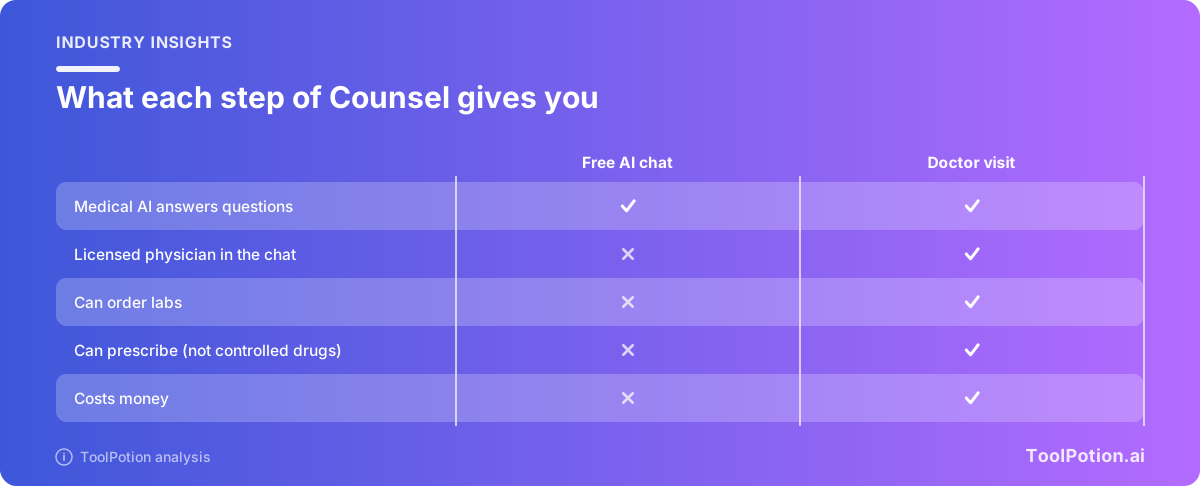
Counsel's site describes four steps. You start with a free conversation with the AI, which gathers details and gives initial guidance. If the situation needs more, a doctor joins the same chat with one click, usually in under 15 minutes during clinical hours of 8am to 9pm, seven days a week. The doctor can order labs, prescribe, or refer. After that, results and follow-up messages stay in the same thread.
The money part is plain, and we like that. A doctor visit is $29 and stays open for seven days. The alternative is a $300 yearly membership with unlimited doctor visits, which by our math pays for itself at about ten visits. Counsel says it doesn't require insurance. A listed price on the front page beats "contact sales" by a mile.
The limits are quieter. Counsel is for adults only (18+). It isn't available in Arkansas, Kansas, Mississippi, Rhode Island, Washington, West Virginia or DC; people there go on a waitlist. Its FAQ says its physicians can prescribe "if appropriate" but don't prescribe controlled substances. Oura's announcement adds that the physicians can "diagnose, treat, order labs, and prescribe when appropriate."
Primary care is a stretch
Go back to that FAQ answer. Counsel calls itself a first point of contact for "nearly everything else," meaning everyday questions, lab testing, urgent care and refills. That's real value. It's also urgent care plus messaging, which is a narrower job than primary care. Annual physicals, vaccinations and chronic disease management stay with someone you can see in person, by Counsel's own account. We'd read "AI-native primary care" as a marketing frame and judge the service on the narrower thing it does.
The evidence that it does that job well is thin. Oura's announcement offers two stories. Sue, 68, asked whether to take her GLP-1 injection while recovering from food poisoning, and a physician told her to delay a day. Maria, 59, lives with multiple sclerosis and used the combined data to make sense of surgery recovery. Both are warm, and both are chosen by the company that's selling the thing. Oura also says more than half of Counsel users in Oura Labs have shared their ring data with a physician, which tells you about willingness to share and nothing about outcomes.
In everything we read, we found no published numbers on how often a physician changes the AI's first answer, how often it sends people to an emergency room, or what went wrong. Counsel's site links an "AI report" and a research page on using an LLM as a judge; we didn't evaluate them and they aren't a patient-outcome study. Until such numbers exist, a vendor's description of its safety is a claim, not a result.
Google's healthcare launch is aimed at clinics and insurers, not at you
It would be easy to lump Oura's deal and Google's Gemini for healthcare together as one wave. They aren't the same product. Google's post, from Cloud CEO Thomas Kurian, describes an agent for providers and health plans, now in preview. Its examples: building a patient timeline from scattered records, preparing charts before a visit, assembling prior-authorization packets for insurers, and explaining plan benefits to members. Google says clinicians spend nearly 28 hours a week reconciling information by hand.
It connects to hospital systems through connectors. Google says the Epic and Oracle Health ones give authorized users read-only access with no write-back to the chart, and that the agent inherits each user's existing permissions. Google also says Gemini for healthcare is "built to support HIPAA compliance" and keeps humans in charge of multi-step work. That's a back-office tool for organizations that already hold your records. You won't open it and ask about a rash.
Zocdoc is the third name in the coverage. Bloomberg ran a video segment titled "Zocdoc Brings AI to Healthcare," but the page wouldn't open for us, so we won't describe what Zocdoc built. The other two stories are clear enough: a consumer front door (Counsel) and a clinic back office (Gemini). Counsel's FAQ says its AI differs from chatbots like ChatGPT because they can't connect to your medical records or bring a physician into the conversation. That's the pitch, not a test result. The general-purpose assistants are a separate question; we compared them in ChatGPT vs Claude vs Gemini.
On the clinician side of our directory, ambient scribes such as Freed and DeepScribe do the note-taking job, and Dr.Oracle is a medical answer tool built for professionals.
Who answers if the advice is wrong
Read the terms, because the company's marketing and its contract tell different stories. According to Counsel's terms of service, clinical services come from Counsel Medical Group, P.A. and affiliated medical groups, which are "independent medical groups." Counsel Inc. "do[es] not provide medical advice, care, and/or treatment." The AI's output is described as "for informational purposes only" and not a substitute for professional medical advice. And the same document says: "LLMs are known to hallucinate and at times return false information."
Oura's announcement calls Counsel's AI "supervised by board-certified physicians." The terms say something narrower: "we do not review every Output." We'd read "supervised" as a physician being one click away, which is how Counsel's FAQ describes it, not as a doctor reading each answer before you see it.
Then comes the money. Counsel's liability, the terms say, will not exceed the fees paid in connection with your use during the preceding twelve months, and disputes go to individual binding arbitration with a class-action waiver, though you can opt out by written notice within 30 days of first using the service. For someone who only used the free chat, that cap reads as zero on its face. Whether a court would enforce a clause like that for medical care isn't something we can tell you, and it's a fair question for a lawyer.
The regulator question has a hole too. The FDA's general wellness policy restates the 21st Century Cures Act carve-out: software "for maintaining or encouraging a healthy lifestyle and is unrelated to the diagnosis, cure, mitigation, prevention, or treatment of a disease or condition" isn't a device. A sleep score fits that description, in our reading. A chat about what could explain weeks of tiredness, answered by a service whose physicians can diagnose and treat, is about a condition. We found no FDA statement about Counsel either way, and whether it needs any clearance is a legal call we won't make. None of the announcements we read say who the medical groups answer to after the sale.
Your ring data and the HIPAA question
HIPAA applies by who holds the data, not by what the data is. Under the federal definition, a covered entity is a health plan, a health care clearinghouse, or a health care provider that transmits health information electronically in connection with covered transactions such as insurance billing. A ring maker isn't on that list. By that definition, your sleep and heart data in the Oura app isn't HIPAA-protected just because it's health-related.
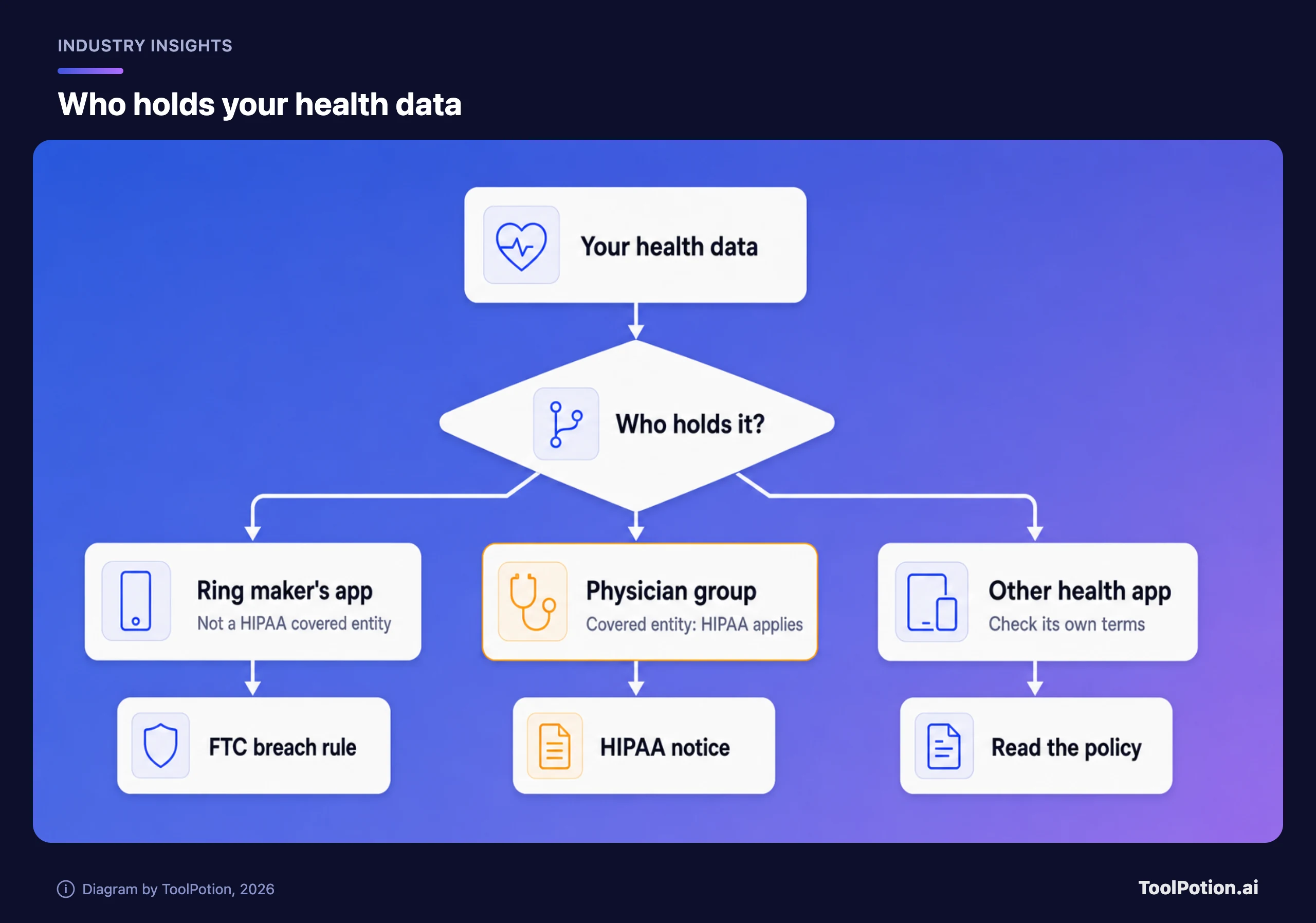
Counsel's physicians are a different case. The medical group publishes a HIPAA notice of privacy practices that covers health information you give it and lists "remote monitoring data" among what it holds, and Counsel's privacy policy says it follows that notice when it holds protected health information "in its capacity as a covered entity." Our reading: what you tell a Counsel doctor, and ring data a physician pulls into your care, is probably treated as a medical record. The original data in the Oura app stays under Oura's own terms. That's our reading of those documents, not legal advice, and we'd ask both companies to confirm it in writing.
Outside HIPAA there's still a rule. The FTC says its Health Breach Notification Rule applies to "most health apps and similar technologies" that HIPAA doesn't cover. Under the rule's definitions, health care services include any online service, app or connected device that tracks things like sleep, vital signs or symptoms, and a breach includes an unauthorized disclosure, not just a hack. A ring app sits close to that description; whether Oura's app qualifies is for Oura and the FTC to say. It's also a notification rule: after a breach, a company must tell affected consumers, the FTC and, in some cases, the media. It doesn't say what the company may do with your data on a normal day. For that there's the FTC Act, and the FTC's guidance says its ban on misleading consumers about what happens to their health information applies to HIPAA-covered and non-covered companies alike.
On normal days the documents disagree. Counsel's FAQ says: "We never sell your data nor do we use it to train any AI models." The privacy policy, last revised in 2024, says that in the AI health coach feature, "We and our LLM partners may use your data" for "improving the quality of our AI models and responses." The terms of service, revised in 2025, go further: you grant Counsel an "irrevocable, perpetual" right to use what you type and what the AI replies, for purposes "such as data analysis, training artificial intelligence programs." The privacy policy also lets Counsel use de-identified or aggregated data "for any purpose," and the HIPAA notice doesn't mention training models either way. Defaults are policy, and the FAQ isn't the policy. We'd treat the contract as the answer and the FAQ as marketing until Counsel says otherwise in writing, and we'd ask before sharing a year of ring data.
Oura's promise is consent: only with your permission can Counsel physicians see your Oura data and past conversations. That's Oura's statement, and we can't check it from outside. After the close, one company will hold the ring, the app and the care, and "privacy, consent, and safety designed in from the start" is a plan, not a setting you can check.
A fair design, and the incentive to watch
The good part is real. Oura points out that a typical U.S. primary care visit lasts about 18 minutes, and a doctor sees a snapshot. A physician with weeks of trended sleep and heart-rate data, plus your history, can do better than you reciting your sleep from memory. A price of $29, a clinician within minutes, and a free first question is a fair design. We'd rather see that than a chatbot that gives a confident answer and no one to check it.
The part to watch is the incentive. The free AI answer sits at the top of a funnel that ends at a paid visit, and the same company will soon sell the ring, the membership and the care. That deserves scrutiny at a company whose consumer brand rests on health insights, especially with no published safety numbers, a training-data statement that depends on which document you read, and a liability cap tied to what you paid. We'd wait for those to change before treating it as primary care. Published escalation and error rates, and one plain sentence on model training, would change our mind.
If you use a service like this at all, the narrow use is the sensible one Counsel itself describes: a question, a lab result, a refill, with a physician in the chat and an in-person doctor still on your list. For anything urgent, Oura's announcement says Counsel "is not for emergencies," and Counsel's FAQ says to call 911 or go to the nearest emergency room.
Questions to ask before you start
- Find out when a physician actually reads your case, and what the AI answers on its own.
- Ask which entity holds your records, and find its HIPAA notice of privacy practices.
- Check whether anything you type trains a model, whose model it is, and which page of the policy says so.
- Check whether anything you type trains a model, whose model it is, and which document says so: the FAQ, the privacy policy and the terms can differ.
- Price a month of messages, and note which states, ages and drugs are excluded.
- Confirm you can export or delete your chats and records if you leave.
- Name the person you'd see in person for exams and vaccines, and learn the emergency rule.
- Read the dispute clause, and note any window for opting out of arbitration (Counsel's is 30 days from first use).
For our broader take on asking chatbots about symptoms, see using AI chatbots for health questions without getting hurt, and for what's working in clinics, AI in healthcare. Our boards for medical and clinical AI and symptom checkers list the tools people actually use, and if you paste health details into a general chatbot, see how assistant memory works first. And before you share ring data with anyone, read the privacy policy again after the deal closes: Oura and Counsel both say that's by the end of this year, and TechCrunch says 2027.