"We are 100% out of China," Jensen Huang said in 2025, as CNBC recounts. The numbers since are murkier (and Nvidia has changed how it counts). Nvidia says its H200 shipments to China were under 1% of data center revenue in its latest reported quarter. A short seller, Culper Research, alleged in a report that more than 20% of Nvidia's fiscal 2026 compute revenue was driven by China, "supported by 'illegal GPU diversion and Southeast Asian intermediaries.'" Nvidia's own reports can't referee that, because in 2025 the company began sorting regional sales by customer headquarters instead of billing location and stopped reporting Singapore at all.
Four outlets have now published new pieces on the chip trade. Reuters says a Chinese university bought H200 chips despite a US blacklist. Bloomberg says Moonshot, the company behind Kimi, rents Nvidia's top chips in China, citing documents. The Financial Times looked at Singapore's role, and The New York Times at how Trump officials clashed over Megaspeed. All four sit behind paywalls we couldn't get through. For those we can report only what the headlines say, so the detail below comes from CNBC, Wired, The Next Web and older Reuters and Bloomberg reporting we could read. Where a claim rests on a story we haven't read, we say so.
One disclosure before the routes. Nvidia's CEO is at the center of a separate scandal, and we're leaving that story aside. The part that belongs here is Megaspeed, the Singapore cloud firm linked to a woman who was once an executive there (we aren't naming her). Wired reports that US intelligence agencies warned top officials they believed she was a Chinese intelligence asset. The New York Times reported that she was a spy for China's Ministry of State Security, according to CNBC. Beijing calls that a smear.
A university the blacklist already named
We can't tell you which university the new Reuters story is about, or how it got the chips; we can tell you it isn't the first. Earlier this year Reuters reported that four Chinese universities, two of them linked to the People's Liberation Army, bought Super Micro servers carrying restricted AI chips over the previous year, going by procurement data. Beihang University posted a notice for a workstation with four Nvidia A100s. Harbin Institute of Technology posted one for eight. Both are on the US export blacklist, which Reuters says makes it hard for American companies to get a license to supply them. "It was not clear how the servers were sourced," the report adds.
Separately, Reuters says three people tied to Super Micro, including a co-founder, were charged with helping smuggle at least $2.5 billion of US AI technology to China. The company wasn't named in the indictment and says it was the victim of the individuals' scheme. Those are charges, not verdicts.
The H200 version of this story started earlier. A Reuters review of more than 100 tenders and academic papers found H200 chips already reaching Chinese buyers through the grey market, even before Beijing had said whether it would allow legal sales. "Dozens of universities and research institutes nationwide have bought or sought to acquire H200 chips," it reported, and a PLA medical university had issued a tender for eight. We think those tenders are the best public evidence there is. A buyer has to write down what it wants, on a procurement site, in its own language.
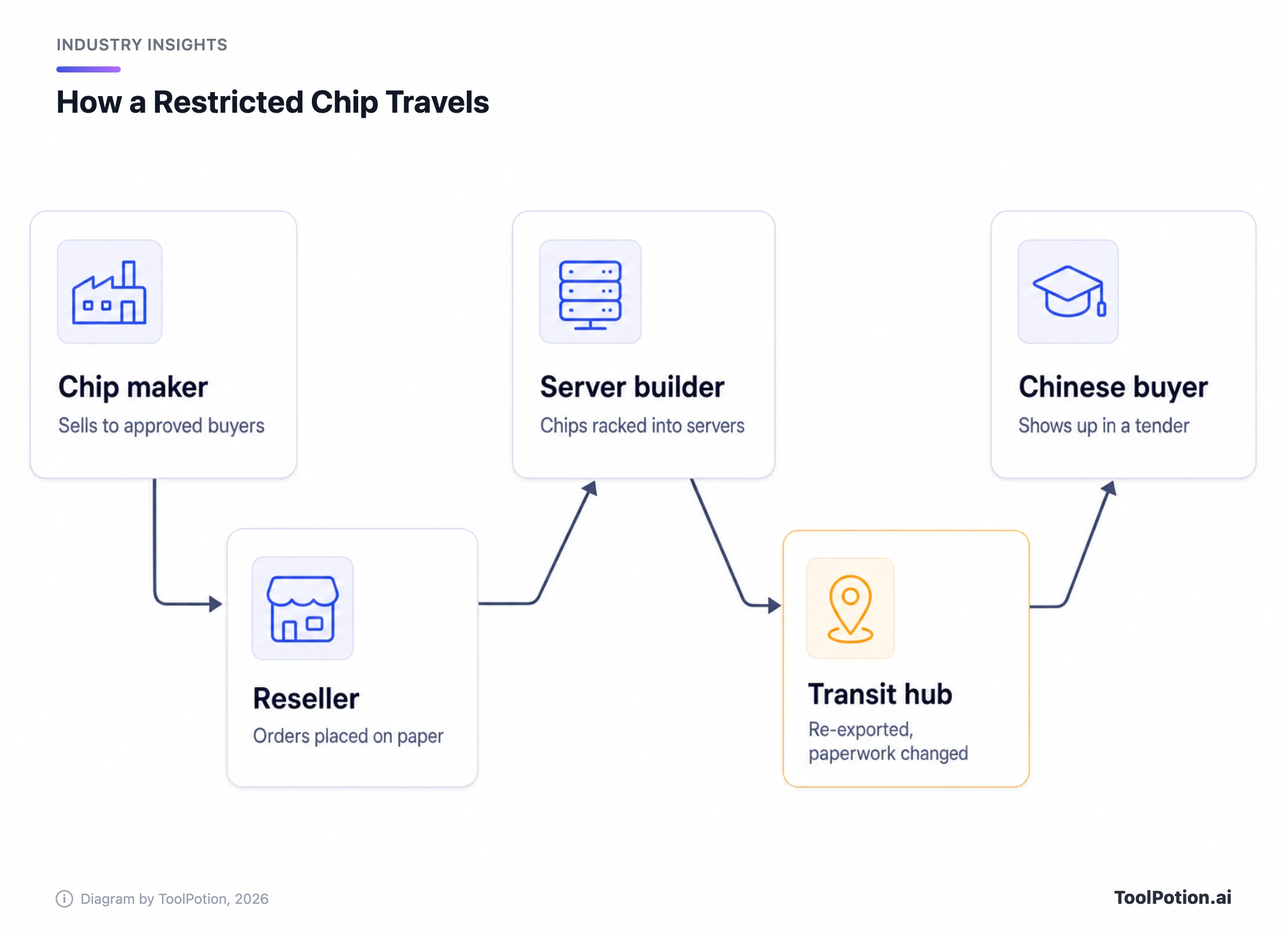
The physical route needs several hands, and Nvidia's sales model supplies them. Tom's Hardware, in a report from late 2025, notes that Nvidia sells most data center GPUs through distributors, system integrators and regional partners, which makes the final destination hard to check once chips sit inside finished servers. It lists past schemes it says US authorities uncovered: misdeclared shipments, shell companies, and accelerators physically pulled out of servers after inspection. It also repeats an allegation that DeepSeek set up "ghost" data centers in Southeast Asia to pass audits. That one is an accusation, and we haven't seen DeepSeek answer it in anything we read.
Singapore, and a customer called Megaspeed
Megaspeed used to be 7Road International, a Chinese gaming company with state ties, according to Tom's Hardware. It rebranded in Singapore and became, per the same report, Nvidia's largest buyer in Southeast Asia. Bloomberg reported that an audit requested by the US government last year initially couldn't account for about 50,000 chips Megaspeed had bought, as Wired summarizes it. CNBC adds that Megaspeed has been accused of diverting restricted chips to Chinese companies and that the company denies it.
Megaspeed said on LinkedIn, as Wired quotes it, that US authorities found "no evidence of any violations concerning the illicit transfer of chips or any illegal activities." Nvidia's line, given to Tom's Hardware, is similar: it says it has "repeatedly visited Megaspeed's facilities and observed a cloud service permitted under the export rules, with no evidence of diversion."
Then the paper trail gets odd. The New York Times reported that a Commerce Department investigation centered on Megaspeed was moved to the Justice Department after an email from Nvidia's general counsel to Commerce asking about it, CNBC relays. Singapore's government had confirmed it was investigating possible export violations, Tom's Hardware reported in late 2025. The FT headline says the scandal "exposes Singapore's role" in the trade. We can't judge that without the text. We'd say only that a country with a lot of data centers and a lot of Chinese-owned companies is exactly where this kind of cloud business would set up, whether or not any given firm did anything wrong.
Renting is the route nobody has banned
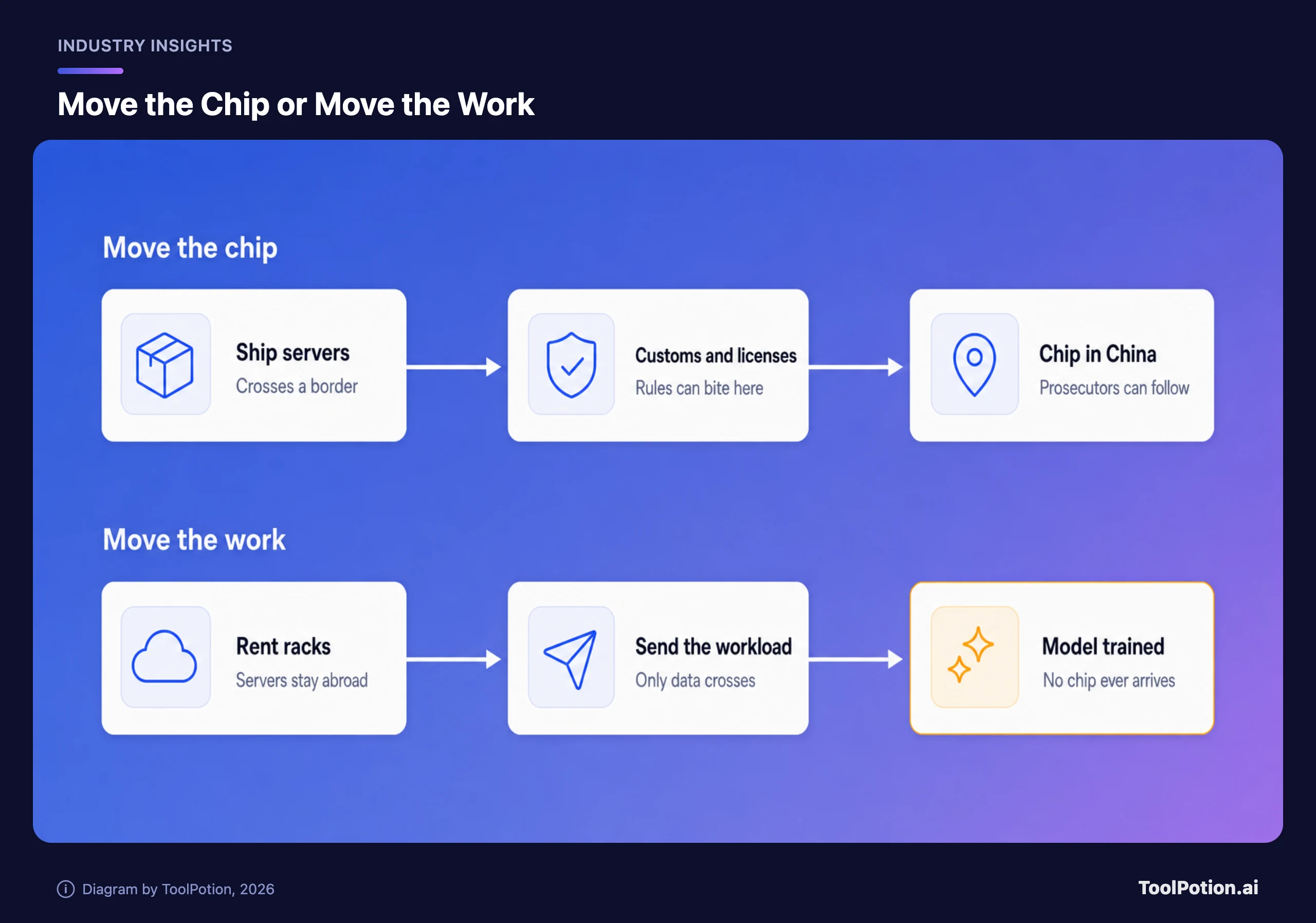
Is it really legal? As far as the sources say, yes. CNBC describes a loophole that lets Chinese companies rent Nvidia GPUs in data centers even when they can't buy them. A Chinese company could lease computing power in Europe from a non-Chinese neocloud or data center operator that is exempt from the export controls. No chip crosses a border. No one smuggles anything.
The Next Web, summarizing Bloomberg reporting from earlier in 2026, says the Commerce Department's enforcement arm was reviewing how Chinese AI firms reach Nvidia hardware overseas and building two lists: countries that run black markets moving chips into China, and countries where Chinese firms use chips remotely. The second list is unusual because remote access is not, at present, illegal. In the same report, Alibaba reaches Nvidia chips in Malaysia through Megaspeed, with the two not dealing directly: per documents Bloomberg reviewed, Alibaba routes it through a Singaporean shell controlled by a Cayman Islands entity that Alibaba ultimately owns. Both companies declined to comment or didn't respond. We found no later report that either list was finished or acted on.
Nvidia doesn't hide it. "By design, the export rules allow clouds to be built and operated outside controlled countries," a spokesperson told Tom's Hardware in late 2025, adding that winning those clouds "will decide the AI race." Our view is that both things are true. The clouds are legal and they bring in real money; they are also a way around a ban the US says it wants.
Kimi's compute, and what we can't see
Moonshot is the clearest case study. In 2026 Bloomberg reported that Moonshot trained Kimi K3 on a 20,000-chip Nvidia cluster supplied by Alibaba, which is both an investor and a cloud provider to the company. As Asia Tech Review lays out Bloomberg's reporting, people close to Moonshot said the chips were H200s. Alibaba denied that and confirmed only that it rented some Nvidia capacity to Moonshot. US government official Michael Kratsios said they were Blackwell chips, which can't be sold to Chinese buyers. A person familiar with Moonshot's buying said the company has a channel to Blackwell chips without saying whether that means renting (legal) or buying (not).
That is one cluster described three ways, and the accounts don't agree. The new Bloomberg headline says Moonshot rents the top chips in China. We haven't read it, so we can't say whether the chips are in China, whether they are the same ones, or what the documents are. Moonshot is the story to watch for exactly that reason: it is the one where the chip generation, the location and the legal route are all still disputed. We'd treat every one of them as unproven until a document or a court says otherwise.
What the rules say, and where they stop
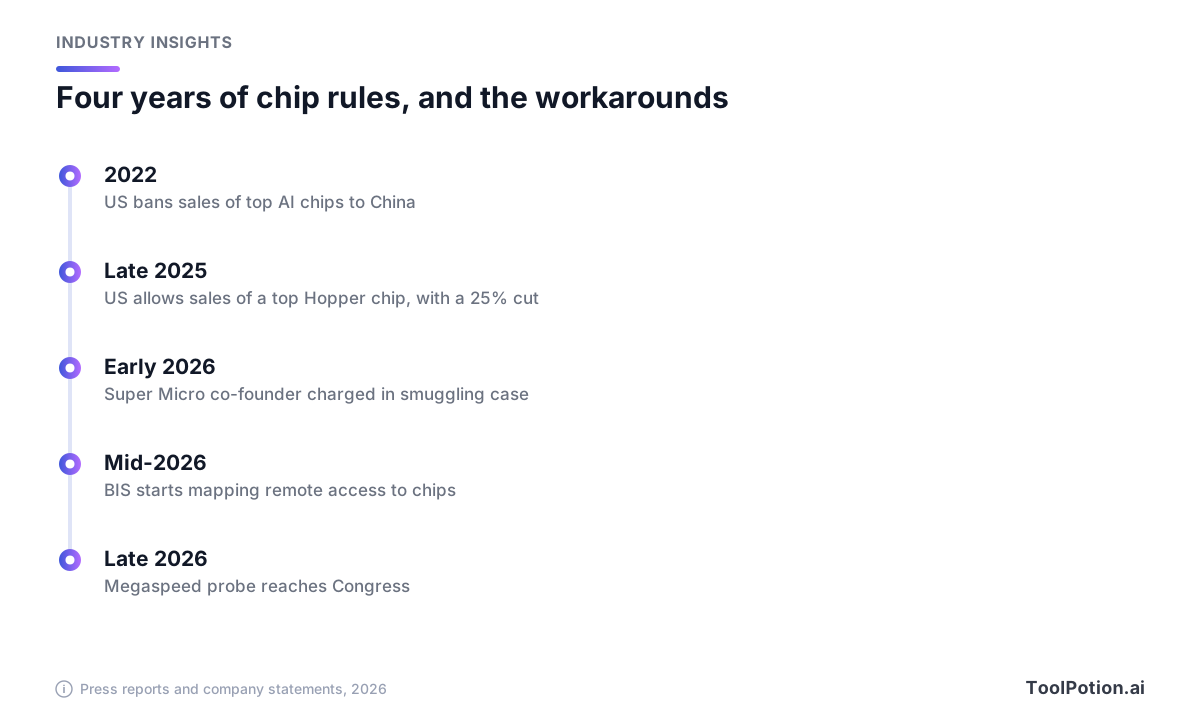
The Export Administration Regulations are blunt about listed parties. Part 744 of the rules says §744.11 imposes license requirements on entities listed in its Supplement No. 4, and §744.23 covers "supercomputer" end uses. The chip controls themselves date to 2022. Nvidia's answer to each round was a new China-only part: A800 and H800, then the H20, which Washington limited after reports that DeepSeek was using restricted Nvidia chips, with Nvidia booking $5.5 billion in costs for canceled orders, CNBC reports.
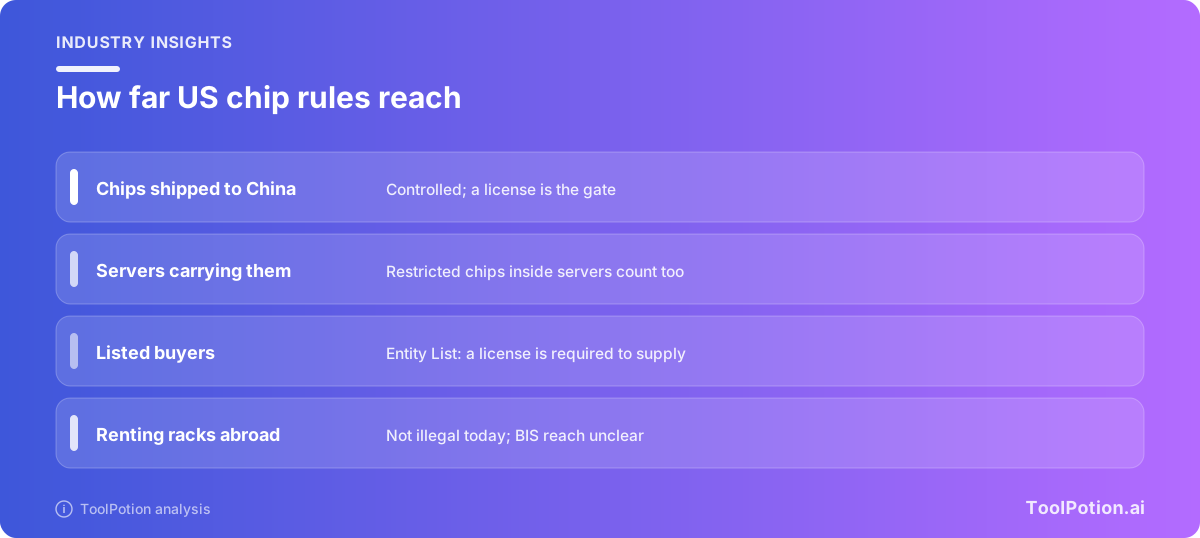
Then policy turned. Late last year Trump said Nvidia could ship H200 chips to China if the US took a 25% cut. The US has licensed H200 sales to Alibaba, Tencent, ByteDance and others, but analyst Patrick Moorhead told CNBC that Beijing hasn't approved large-scale imports. The Next Web notes the awkward result: officials say smugglers are moving the same model the government allowed. We think that is the weakest point in the rules. When a chip is legal to sell with a license, a diverted unit and a licensed unit look alike on a purchase order, and enforcement has to prove where each one went.
The bigger gap is rental. The Next Web reports BIS built its powers around the movement of physical goods, so it's unclear whether the agency can police cloud-computing deals at all. It adds that the House has passed bipartisan legislation to grant that authority. That is the Remote Access Security Act (H.R. 2683), which Congress.gov shows passing the House early in 2026 and landing in the Senate Banking Committee, with no Senate action listed since. The report also says Commerce shelved its own draft rules, including one curbing sales to Malaysia and Thailand over diversion fears. Nvidia and its peers, the report says, are certain to fight limits on overseas data center access.
What officials want to add
Congress is trying to attach several chip bills to the annual defense bill, CNBC reports: the AI Overwatch Act, the MATCH Act and the Chip Security Act, all aimed at stopping US chip technology from reaching adversaries. The defense bill hasn't passed. Congress.gov shows the Chip Security Act (H.R. 3447), which directs Commerce to require location verification on covered chips, cleared a House committee 42 to 0, and the House version of the AI OVERWATCH Act (H.R. 6875) cleared it 42 to 2. Senators Elizabeth Warren and Jim Banks said it is "time for Congress to take decisive action to pass key bills like the AI Overwatch Act in the NDAA that will cut off pathways through which China accesses advanced chips."
Moorhead told CNBC the proposals could give Congress oversight of chip export licenses or require chipmakers to install mechanisms that track where chips are. "Every China license now gets read through this story," he said. A House member who co-chairs the AI task force, Jay Obernolte, said he hopes the scandal doesn't become a distraction from the export-control talks. We didn't read the AI Overwatch or MATCH texts, so treat our summary of them as CNBC's.
Our read is simple: location tracking is aimed at the hardware route and would help there. It does nothing about a rented rack in Malaysia. Only the authority bill the House passed, or something like it, reaches that, and Congress.gov lists no Senate action on it. If the defense bill carries tracking and no cloud authority, we'd expect the next Megaspeed to be a rental business.
If you use DeepSeek, Kimi or Qwen
Nothing we read says ordinary users are exposed. The rules we read govern exports of chips and dealings with listed parties, and we're not lawyers. What users can lose is something else: price, access and trust in a hosted service if the rules change. The labs named above include the makers of DeepSeek (see also DeepSeek V4.1 Flash and V4 Pro), Kimi K3.1 Pro and the Kimi app, and Alibaba, whose models include Qwen3.8 and the Qwen app. Naming a lab here is not an accusation. Alibaba denies the H200 claim, and the DeepSeek allegations above are allegations.
- Treat any statement about what hardware trained a model as a claim until the lab confirms it. Three conflicting accounts of one Moonshot cluster is a good reason.
- If you can, run open weights you've downloaded. They keep working whatever happens to a hosted service. Our open-weight models guide covers what's worth running and what to rent.
- If you build on a hosted Chinese API, keep a second provider wired in. A rule that targets remote access would hit hosted services first, and BIS is already mapping those countries.
- Compare before you commit. The Top 50 LLMs board, the AI models and LLMs board and our top AI models write-up rank the Chinese models next to the American ones, and the LLM hub lists the rest.
We'd keep using these models for work that doesn't touch sensitive data, and we wouldn't build a product on one hosted endpoint. One thing to check next: whether the defense bill passes with tracking, cloud authority, both or neither. Congress hasn't voted yet.