Google's pricing page lists Gemini 4 Carbon at $2 per million input tokens and $10 per million output tokens. A few lines further down, the same page says both figures double when the introductory period ends, which is within weeks (Google AI developer pricing). Google's launch post leads with the lower number. We'd budget with the higher one.
Carbon is the top model in Google's Gemini 4 line. It reached the public about two weeks after a limited run for security teams (Google), and it arrived with a preview feature called /swarm in Google Antigravity. Below are the questions we'd want answered before touching any of it: what a swarm is, who can run one, what it costs, where it stumbles, and how it lines up against Claude Fable 5.2 and GPT-6 Astra. Everything comes from Google's pages, GitHub's changelog, Artificial Analysis and press reports. We haven't run Carbon ourselves.
A swarm is a coordinator, workers and a verifier on one board
Google's Antigravity docs describe it plainly. When you type /swarm and a task, your current conversation becomes the coordinator. It splits the work into pieces that don't collide (one worker per file or package, say), gives each worker a public brief and a clean context, and usually adds a verifier for every two to four workers. The verifier reads the diffs, runs the tests and reports problems to the worker that wrote the code (Antigravity docs).
Everyone talks on one shared board. Workers don't message each other privately. A worker with nothing to do goes to sleep and uses no tokens until someone mentions it, and a monitor worker speaks up only if the whole team has gone quiet before the work is finished. Google's launch post puts the pitch in one line: it is "turning a single prompt into a coordinated team of agents you can track in real time".
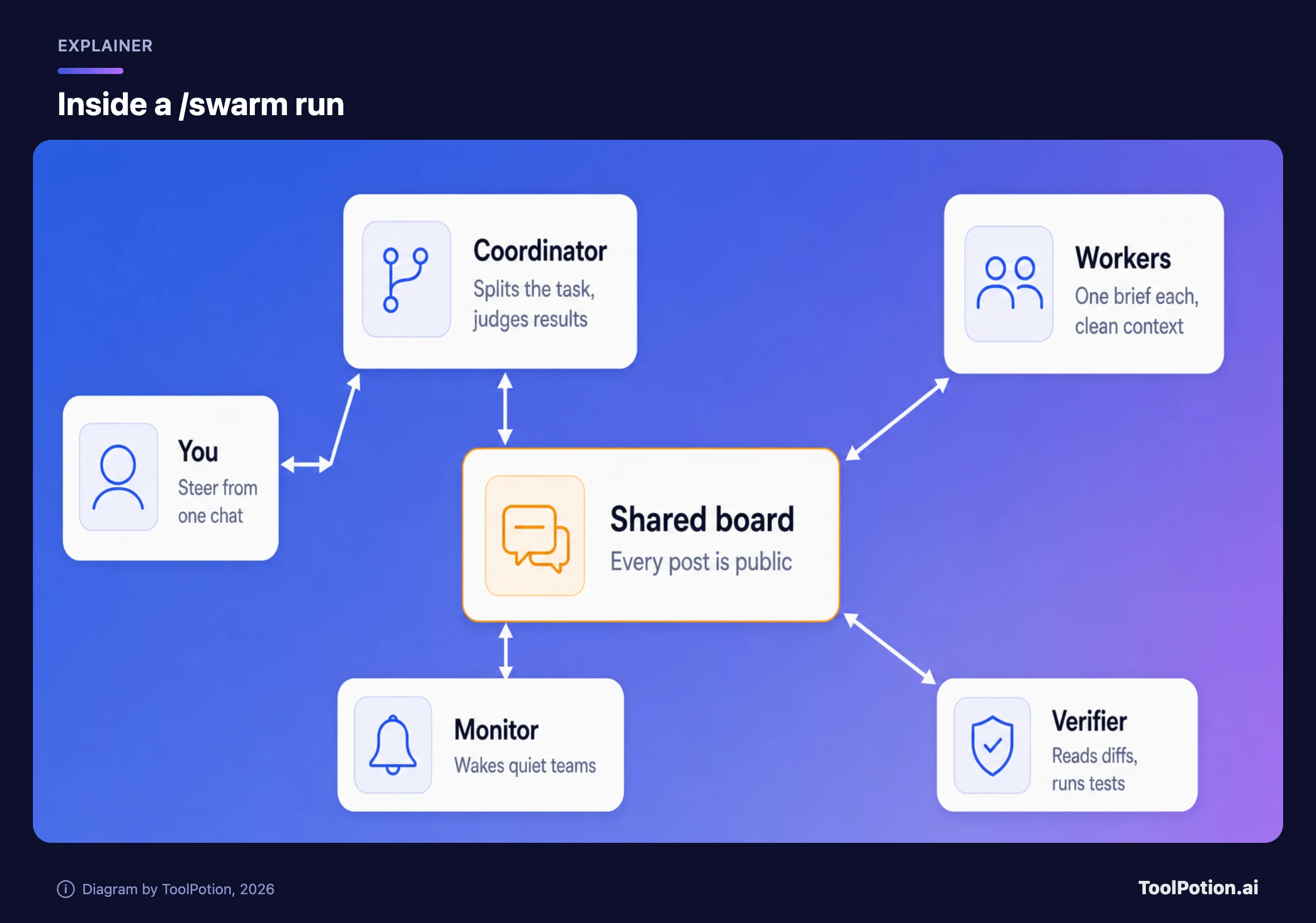
Workers run on the same model as your conversation unless you ask for another, and the docs include a sample prompt that puts the verifier on a different model from the workers. Google's launch post suggests Carbon for the roles that need the deepest reasoning (architecture, coordination, auditing) with faster, lighter models doing the parallel work. When several workers edit at once, the coordinator can give each its own copy of your repository.
Google also sorts swarm against its siblings. Subagents handle one side task. /boost is for problems that are hard rather than big. /teamwork runs multi-milestone projects behind a scoping interview and audit gates. /swarm is for work that is "large but divides cleanly". That last phrase is the test we'd carry around. Five workers on a task that doesn't split are five agents waiting on each other, and you pay for all of them.
Swarm is open to Pro, Carbon mostly to Ultra
Swarm is in preview, and Google says it works on Google AI Pro and AI Ultra plans in both the Antigravity App and the Antigravity CLI. Carbon is narrower. Per Google's launch post, the API is open to all paying developers and enterprises through Google AI Studio and Gemini for business (the Gemini Enterprise app is the business front door). On the consumer side it's rolling out to Google AI Ultra subscribers in Antigravity, the Gemini app and AI Mode in Search.
Google's US subscription page lists Argon, the lighter sibling, under AI Pro at $19.99 a month, and Carbon under Ultra, which starts at $99.99 a month for five times Pro's usage limits and runs to $199.99 for twenty times (Google). Put the two pages together and a Pro subscriber can start a swarm but not on Carbon, and Antigravity's own model table agrees: Carbon is ticked for Ultra and Enterprise, not for Pro (Antigravity docs). Neither the launch post nor the subscription page says when, or whether, Pro will get it. Free users get nothing: the pricing page marks Carbon "Not available" on the free API tier, and Business Insider says both Carbon and Argon are limited to paying users.
GitHub Copilot is the other door. Carbon is generally available there for Copilot Pro+, Max, Business and Enterprise, selectable in the model picker in VS Code, Visual Studio, JetBrains IDEs, Xcode, Eclipse, the Copilot CLI, the coding agent, github.com and the mobile apps, with a gradual rollout (GitHub changelog). The changelog doesn't mention swarm, so we'd treat GitHub Copilot and the Copilot CLI as ways to use the model, not the feature.
One default deserves a look if you administer a team. Under default model enablement, GitHub says, new models are automatically enabled unless an administrator has turned off the global default or explicitly disables the model. Carbon bills at provider list price, so a developer who picks it from the dropdown spends your money at the model's rate. Fable 5.2 works the other way: its policy stays off until an administrator enables it (GitHub changelog). Check the Carbon policy before the rollout reaches your org.
The price doubles within weeks
On the Gemini API, Carbon's standard rate is $2 in and $10 out per million tokens while the introduction lasts, then $4 and $20. Thinking tokens count as output. Cached input is $0.10 now and $0.20 later, and only implicit caching works (explicit caching isn't supported). Batch and Flex run at half the standard rate, Priority at $3.60 and $18 now. Google Search grounding gives 5,000 free requests a month (shared across Gemini 3 and newer models), then $14 per 1,000. Argon carries the same per-token prices, so its saving is in tokens, not rates (pricing page).
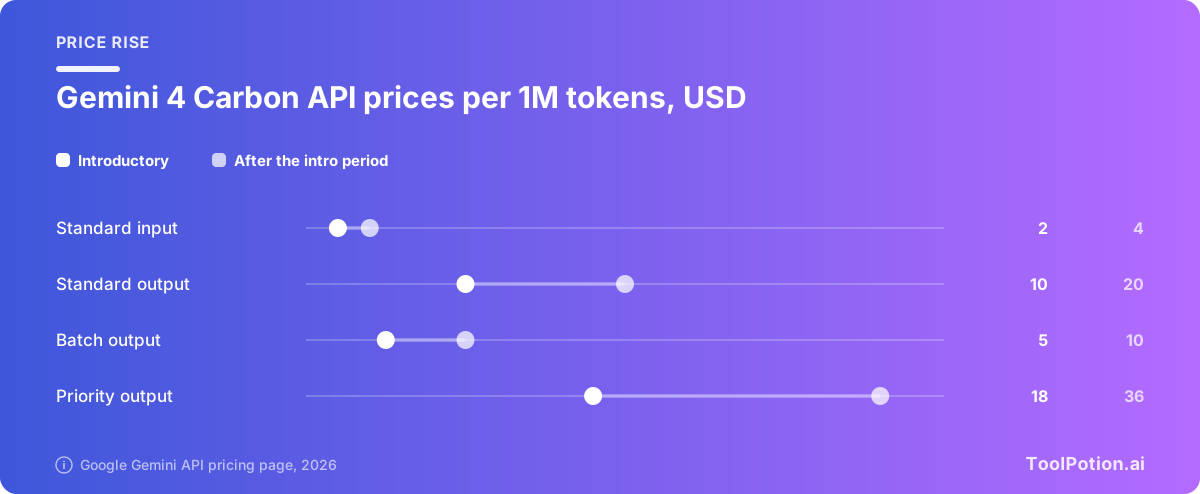
Even doubled, Carbon stays cheaper per token than the two rivals below. Per token is not per job, though, because models burn different numbers of tokens on the same work, and the measured numbers in the next section cut against the headline.
A swarm is harder to price. On a subscription you pay in quota, and the docs are blunt: "Every worker is its own agent, so a swarm uses quota much faster than a single conversation." A worker that runs out of quota pauses and stays paused until someone posts to the board, its model is switched, or you message it. It doesn't restart when your quota refreshes (Antigravity docs). Google doesn't say how many tokens a typical swarm run burns. Quota that refills on a schedule, with no per-run number attached, is exactly the kind of cost we dislike. Until Google publishes one, we'd treat a swarm as a multiplier on whatever one agent costs you.
Inside Copilot the picture is simpler. The model is billed at list price under usage-based billing, and GitHub's pricing table carries the same $2 and $10 with the same doubling at the end of the introductory period (GitHub Docs).
Where does Carbon fall short?
Google is open about the main one. Carbon spends more thinking tokens than Argon to explore and verify, "which increases per-turn token use and latency" (Google AI docs). The migration notes say hard prompts "can take several minutes" and tell developers to set client timeouts of at least 15 minutes, raise max output tokens to 32,768 or more because Carbon can spend more of the limit on thinking, and stop sending temperature, top_p and top_k, which are ignored.
Artificial Analysis, an independent benchmarking outfit, measured the same trait. Its page calls the model "notably slow per task and very verbose". Carbon wrote 205 million tokens across the Intelligence Index against a median of 72.8 million for comparable models, and took 25.3 minutes per task against a 12.7 minute median (Artificial Analysis).
The model page lists text output only. No image generation, no audio generation, no Live API (model page). Prompt injection is the other loose end. Google reports a 0% attack success rate on the Gray Swan indirect-injection benchmark, then adds that it knows "prompt injection robustness remains an area for continued improvement" (Google). We think that sentence deserves more weight than the 0%, because agents that read web pages and PDFs are the use case Google is selling, and a swarm reads more of them at once.
Then there's the evidence. Most of the praise in the launch post comes from companies Google chose to quote. One customer cites "16 real bug fixes" in its codebase as the basis for a 94% resolution rate, a sample so small that one more miss would change the number by six points. Kit Langton of OpenCode calls Carbon "a preferred planning model for our hardest tasks", which is a useful endorsement from a person who builds coding tools, but it's one voice in a post written by the vendor. We're not convinced by the demos either: the 906,000-triangle office reconstruction and the Eiffel Tower exhibition are Google's own runs. We'd wait for results from people who aren't in the press release.
Cheaper per token than Fable 5.2 and Astra, not always per task
On list price, Carbon wins by a distance. At the introductory rate Carbon costs a fifth of GPT-6 Astra per token and a quarter of Claude Fable 5.2, which reached GitHub Copilot a day before Carbon did (GitHub changelog). After the doubling it is two-fifths and a half. The vendors' own pages (OpenAI, Anthropic) give the numbers in the table below.
| Model | Input / output per 1M tokens | Where you can use it | Measured cost per task |
|---|---|---|---|
| Gemini 4 Carbon | $2 / $10 now, $4 / $20 later | Paid Gemini API, Google AI Ultra, Antigravity (Ultra), Copilot Pro+, Max, Business, Enterprise | $7.76 |
| GPT-6 Astra | $10 / $50 (inputs up to 272K) | OpenAI API, GitHub Copilot | $6.24 |
| Claude Fable 5.2 | $8 / $40 | Claude API, Copilot Pro+, Max, Business, Enterprise | $26.54 |
The last column is Artificial Analysis's average cost to run its Intelligence Index, and for Carbon it uses the doubled rate. Per task, Carbon ($7.76) costs more than Astra ($6.24) despite the lower per-token price, because it writes so many more tokens. Fable 5.2 is far dearer at $26.54 and slowest of the three at 48 minutes a task, but it also tops the page's comparison chart with a score of 65 against Carbon's 60 and Astra's 57 (Artificial Analysis). One caveat: the index lists Carbon at high thinking and the other two at max. At the introductory price Carbon's figure would roughly halve, to about $3.90 by our arithmetic, which would put it under Astra for as long as the discount lasts.
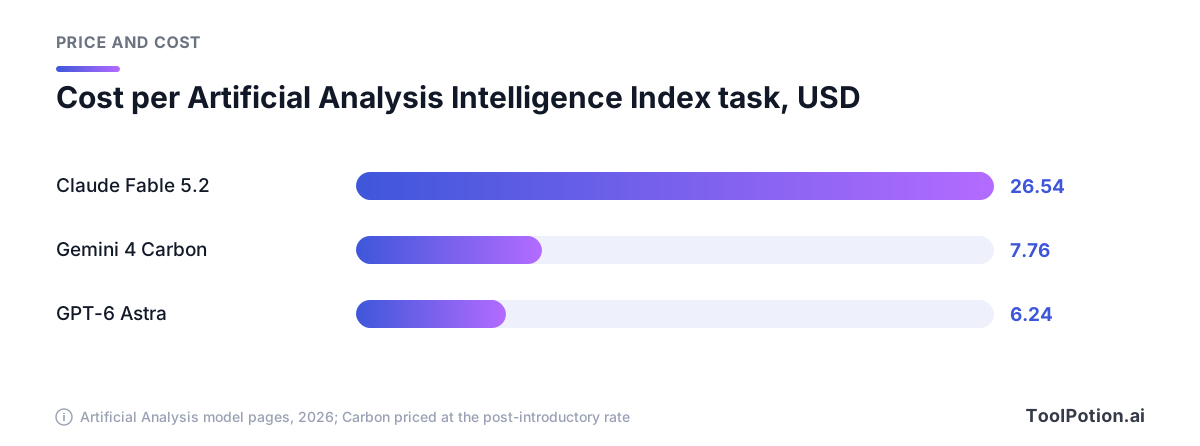
Google's own claim is different. It says Carbon ranks first on Cursor's CursorBench 4.0, Perplexity's WANDR and Zapier's AutomationBench at more than twice as cheap per task as the next best external model (Google). Those are different tasks from Artificial Analysis's, and Google picked which ones to cite. Both can be true. We doubt the saving carries over to your repository without a test.
Data terms differ too. GitHub's changelog says Claude Fable 5.2 "requires data retention by default" to run Anthropic's safety classifiers, with zero data retention available only to certain eligible enterprise customers (GitHub changelog). Google's pricing page says content sent on the paid Gemini API tier isn't used to improve its products. Defaults are policy, and on this one Google's is friendlier.
The calculator below uses list prices. Fill in token counts from your own runs, not ours, since the three models burn very different amounts on the same job.
When would we reach for it?
Our pick for daily work is Argon. Google says so itself: Argon "remains the ideal choice for the majority of software engineering and knowledge work", while Carbon is "built for tasks that test the limits of a model's intelligence" (Google). Carbon earns its tokens on multi-package migrations, root-cause hunts across subsystems and security audits, the jobs the docs name. A swarm earns its quota only when the task splits into pieces that don't touch each other.
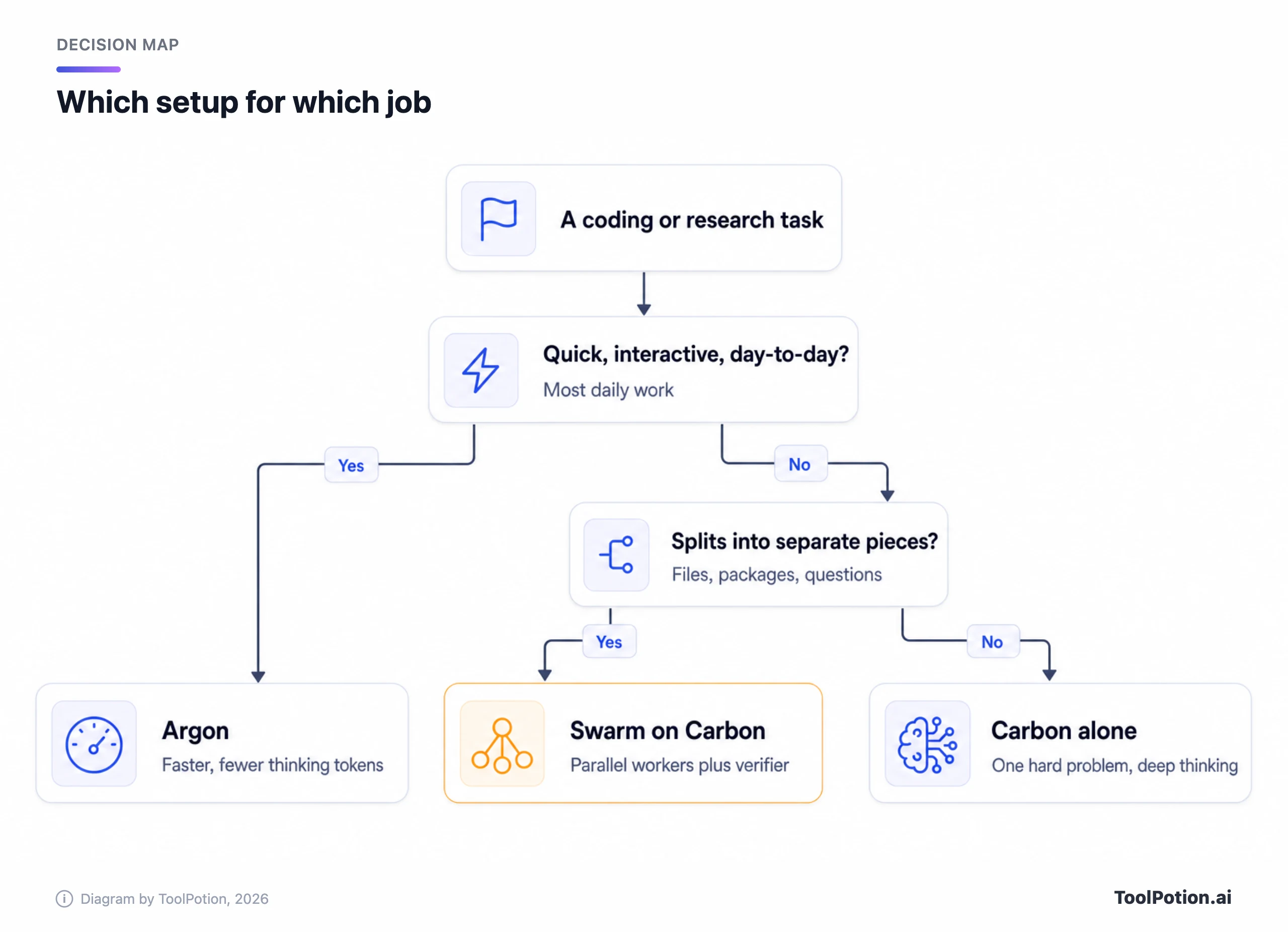
- Run the job on Argon first. Most won't need more.
- If Argon falls short, try Carbon at the default medium thinking level, then at high. Google's own advice is to test all three levels and pick the lowest one that meets your bar (Google AI docs).
- Start /swarm only for work that divides by file, package or question, and ask for the verifier on a different model from the workers.
- Budget at $4 and $20, not $2 and $10.
On money, we'd skip Ultra if Carbon is the only reason to buy it. Starting at $99.99 a month, it is a lot to pay for one model when the API sells it by the token on a prepaid balance. Try it there with a small budget, and look again if you find yourself running agents all day. If your team lives in an editor, Copilot's picker is the lowest-friction test; our Copilot Fusion piece covers what model routing there means for cost, and our Cursor, Copilot and Windsurf comparison covers the editors themselves. Anyone shopping for agent tools can browse every ToolRank board for AI agents or the AI agents hub.
Hydrogen is a report, not a product
Google may have something lighter coming, but so far it's a report and nothing more. Business Insider says Google is letting staff test a fast model called Hydrogen, citing an internal message in which an engineer called it "very capable, fast and efficient". An employee told the outlet it resembles Google's Flash models, the cheaper workhorses. BI says it's unclear whether a public release would be free or paid, and Google declined to comment (Business Insider). There is no announced name, price or date. If a swarm's lighter workers are where your bill would go, Hydrogen is the model to watch. We wouldn't plan around it.
Frequently asked questions
Is Gemini 4 Carbon free to try?
No. Google's pricing page marks it not available on the free API tier, and in the Gemini app it requires Google AI Ultra. The cheapest way in is a paid API balance.
Does Google train on my API data?
Google's pricing page says content on the paid tier is not used to improve its products. The free tier is a different matter for other models, but Carbon isn't offered there.
Can Carbon generate images or speech?
No. It accepts text, image, video, audio and PDF input and returns text only, with image generation, audio generation and the Live API marked unsupported on its model page.
How big is the context window?
One shared window of 1,048,576 tokens for input, thinking and output. A normal response is capped at 65,536 tokens by default, and background execution with long decode lets a single response run up to the window minus your input.
Does /swarm work in the Gemini app?
Google's docs list the Antigravity App and the Antigravity CLI only.
What should we do before the introductory price ends?
Rerun one of your own tasks on Carbon at the three thinking levels, then price the token counts at $4 and $20. That second number is the one you'll live with.