Amazon's staff note on the day it cut 14,000 corporate jobs said the company needed to be "organized more leanly, with fewer layers and more ownership" in the age of AI (TheWrap). Two days later its CEO told analysts the cuts were "not really financially driven, and it's not even really AI-driven, not right now. It's culture."
Same company, same cuts, two explanations in one week. Keep that pair in mind, because it is the cleanest specimen we have of what a Bloomberg headline is getting at when it calls "delayering" the new code word for "AI took your job." We haven't read past that headline, so we treat it as a hypothesis, and our view is that it's about half right. Delayering (taking out management layers) is an old move that companies make in bad years and good ones. AI is now attached to it, sometimes as a cause and often as a label. The job of a careful reader is to tell which.
This piece goes through what Amazon, Qantas and Canva said, what the tallies of announced cuts show, which roles sit in the path, and what a manager or an individual contributor can do about it. We've already covered Microsoft and the Dutch government cutting jobs for AI and what the data says on AI and entry-level jobs, so we won't retell either.
Amazon said AI, then said culture
Start with the earlier statement. In a 2025 memo, CEO Andy Jassy wrote that "we will need fewer people doing some of the jobs that are being done today, and more people doing other types of jobs," and that "in the next few years, we expect that this will reduce our total corporate workforce as we get efficiency gains from using AI extensively across the company" (Amazon). That is a forecast, and a plain one.
When the 14,000 cuts landed, Beth Galetti, the company's senior vice president of people experience and technology, wrote that "this generation of AI is the most transformative technology we've seen since the Internet." Then came the earnings call. Jassy said Amazon's growth had added layers that can weaken "the ownership of the people that you have who are doing the actual work," and that it's "important to be lean, important to be flat" (TheWrap).
A later round followed in 2026: Amazon confirmed another 16,000 corporate cuts in a message from Galetti to employees, which CRN Asia reported (it puts the cut at about 4.5% of roughly 350,000 corporate staff; we couldn't find the message itself on Amazon's newsroom). The line quoted there was that the company had been "reducing layers, increasing ownership, and removing bureaucracy." AI doesn't appear in the passages we read, and she said a new rhythm of broad cuts every few months is "not our plan."
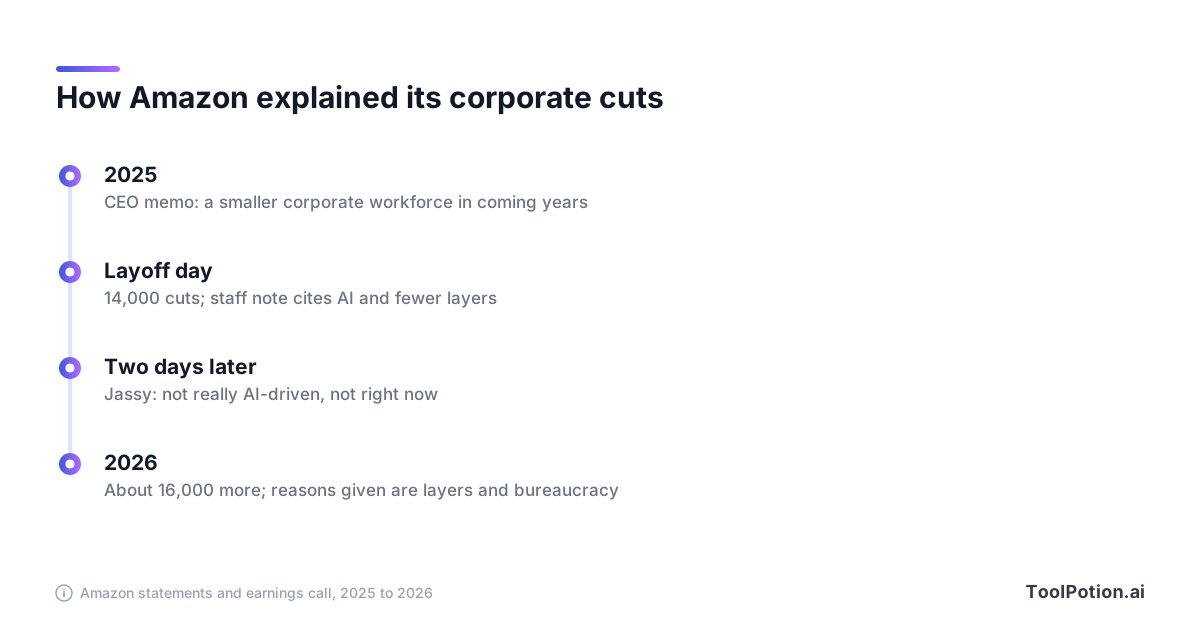
We think the most informative words in that whole sequence are "not right now." Jassy didn't say AI is irrelevant to Amazon's headcount (his own memo says the opposite). He said it wasn't the mechanism for this round. That's a more honest answer than most executives give, and it implies something readers should hold onto: a cut can be justified by where AI is expected to go without being caused by anything AI has done yet.
Qantas is mostly an outsourcing story
Qantas is the case the Guardian headlined as an "AI-driven overhaul." The airline says it signed a multi-year agreement with Accenture to "modernise its back-end systems, processes and data, as it steps up investment in technology and AI," and some of the services will move to Accenture's India-based team. About 850 Australian jobs are affected, starting in finance, procurement, human resources and marketing. Qantas has about 32,000 employees, and the first changes take effect around the middle of next year (Guardian).
CEO Vanessa Hudson called the scale and speed of change "unprecedented and unlike anything businesses have seen in generations." Fine. But read the mechanism: the work is leaving for another company's staff in another country. Nothing in the reporting we read says what share of those tasks software will do. Offshoring is ordinarily a labor-cost decision, and a technology contract is how it gets done. Calling the whole package "AI-driven" is the company's framing and the headline's, not a finding.
The Australian Services Union drew its own line. Assistant national secretary Scott Cowen said AI is "having a huge impact on workers across the country, but the cost of technology change should not be borne by the workers who have kept the airline running for years." The union also said Qantas had earlier promised it had no plans to move jobs offshore. The Guardian adds context any honest account needs: unemployment at its highest in nearly five years, rising living costs, and elevated oil prices from the Iran conflict pushing companies to cut costs.
Canva fits the same pattern from a different side. It told staff 1,271 roles, 22% of the company, would be cut, changed or relocated. Co-founder Melanie Perkins wrote that "our growth has slowed for the first time in a decade" and that "small changes won't be enough" (Forbes Australia). The memo excerpts in that report don't mention AI. Perkins's stated reasons are slower growth and the need to cut through bureaucracy with smaller teams. The report separately says Canva reorganized around AI, delayed products over the cost of serving AI to mostly non-paying users, and cut its revenue-growth projection from 30% to 20%. It doesn't say AI replaced anyone, and neither do we. The Guardian counts about 4,550 corporate roles targeted across NAB (2,500), Canva (about 1,200 in its count) and Qantas in a month.
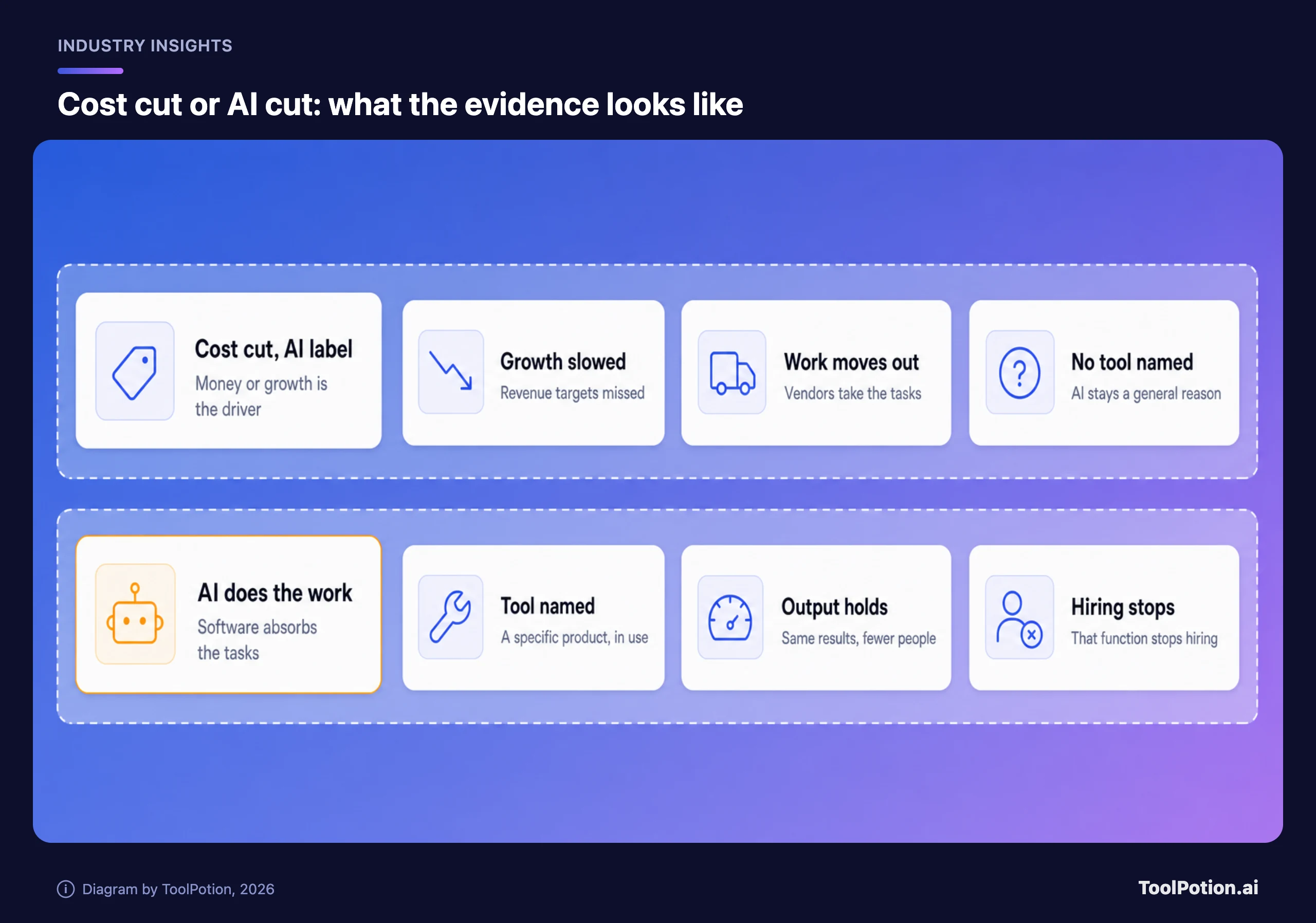
The diagram shows how we sort these. Qantas and Canva sit mostly in the top lane today: slowed growth, work moved to vendors, no named product doing the tasks. Amazon's 2025 memo is the closest any of them comes to the bottom lane, and even there the company later said this round wasn't it.
The tally says economy, and the economy is winning
Outplacement firm Challenger, Gray & Christmas tracks the reason employers give for each announced U.S. cut. Through the latest report, employers have announced 617,189 cuts in 2026, down 44% from the same stretch of 2025. AI has been cited for 121,401 of them, about 20%. Market and economic conditions, at 130,531, has overtaken AI as the leading reason for the year, and AI was cited for just 1,265 cuts in the latest month, its lowest of 2026 (latest monthly report).
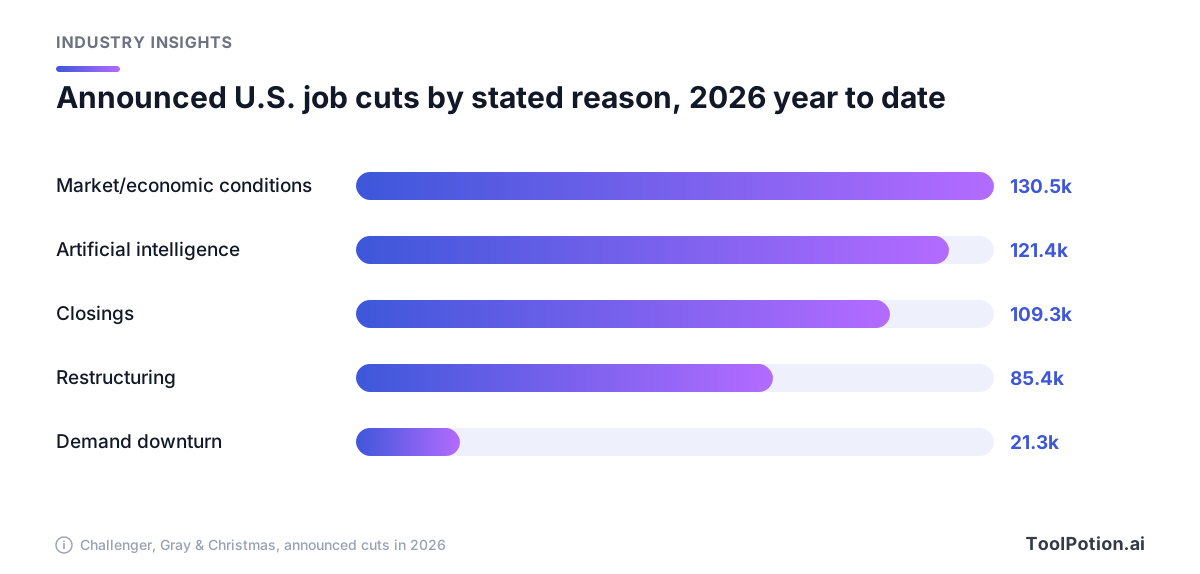
A few reports earlier the story ran the other way. At mid-year AI led the reasons table, and Andy Challenger said "AI is the dominant force as companies are restructuring around it" in tech (mid-year report). Technology still leads every sector, with 171,501 cuts, 28% of the total. His latest read: "The reasons employers give have shifted from technology to the economy."
Notice what that sentence concedes. These are reasons given, so the tally measures labels, and labels drift with the news cycle. We doubt the underlying work changed this much in a few months; what changed is which explanation sounds best on an earnings call. We can't prove why the wording moved; the pattern fits companies choosing the explanation that draws the least scrutiny.
Independent economists have been saying the same thing for a while. Oxford Economics wrote early in 2026 that "a rising number of firms are pinning job losses on AI," but "other more traditional drivers of job layoffs are far more commonly cited," and that if AI were replacing labor at scale, productivity growth "should be accelerating. Generally, it isn't" (Oxford Economics). Yale's Budget Lab found in 2025 that the broader labor market "has not experienced a discernible disruption since ChatGPT's release 33 months ago," while cautioning that it's too soon to tell (Yale Budget Lab). Both are about the whole economy, which can look calm while one function inside one company is hollowed out. They're a check on the headline, not a refutation of it.
Four tests before you believe an AI label
Our rule: an AI explanation earns belief when the company can answer questions that a cost cut can't. Which product now does the work? Does the work still exist inside the company or has it moved to a vendor? Is the output holding with fewer people? Is money visibly shifting toward AI?
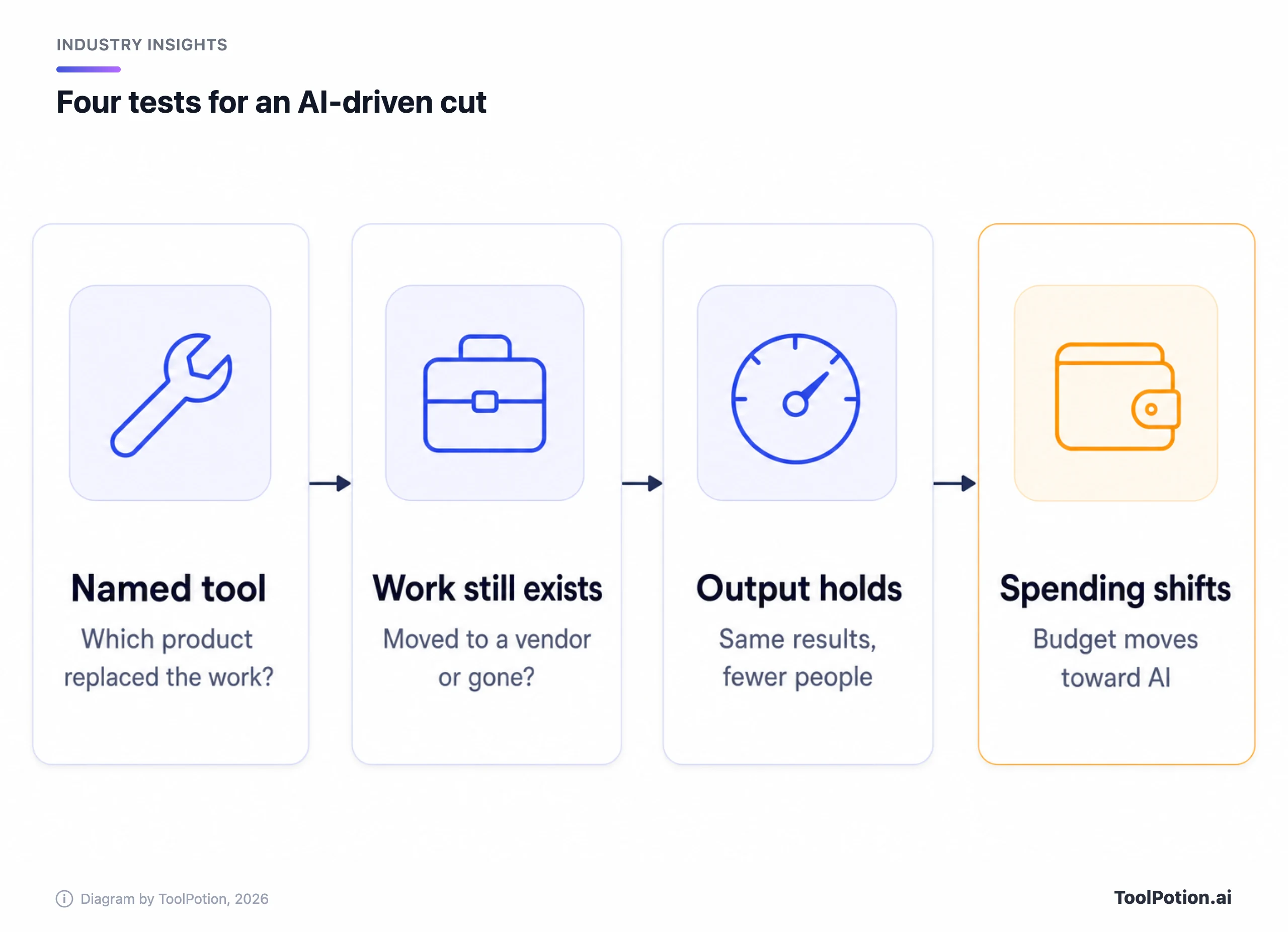
By those tests, none of the announcements we read for this piece passes all four in public. A press release that says "AI" and names no product, no function and no metric fails the first test on its face. We'd treat it as restructuring until shown otherwise.
The roles in the line of fire
Look at what Qantas actually named: finance, procurement, HR and marketing. Those are corporate functions built around repeatable processes, with a lot of coordination in them, and that is where a vendor can take over a process (and where AI tools are aimed first). Amazon's talk of layers points at a related thing: people whose job is passing information and decisions up and down a chain. Jassy's complaint was that decisions that "should be made quickly and right at the front line" were slowing down.
So the exposed work is coordination, and the title on the door matters less. Assembling status reports, running scheduling and approvals, summarizing meetings, relaying a decision from one team to the next. Tools already target all of it: Microsoft 365 Copilot and Gemini Enterprise sit inside the documents and inboxes where that work happens (our cost comparison of the two has the numbers), Notion AI drafts and summarizes inside the workspace, and Otter.ai and Fireflies.ai write up the meeting afterward. Our meeting-notes board ranks the field if you want to see the options.
Whether any company has actually removed a management layer because those tools work is the open question. We haven't seen one say so with evidence: a named tool, a function, a before-and-after. If one does, that's the announcement to read closely.
Who looks safer? People who own a decision with consequences, a customer relationship, a supplier negotiation or a regulatory sign-off. Work where being wrong costs money and somebody has to be named. That's an argument for what to do, which is next.
What a manager can do now
- Write down how your week splits between deciding, coaching, and relaying information. If relaying is the largest slice, that slice is what a flatter structure removes first.
- Take the span question to your own boss before someone else raises it. Ask how many direct reports the company expects per manager in a year, and what tools it expects them to use.
- Keep a short log of decisions you made that nobody else would have, with outcomes. In a restructuring that log is evidence; "I coordinated the team" isn't.
- Pick one tool in your function's path and learn it properly. ChatGPT and Claude are the general-purpose starting points, and Claude Cowork is the agent-style option for multi-step file work. Our AI agents board shows what else is ranking.
- If you run the team, resist the urge to hide behind the AI label when you cut. The Qantas union's complaint was as much about a broken promise as about technology.
The same advice applies if you manage people in HR or recruiting, one of the functions Qantas named: our HR manager board shows which tools are being adopted in that job. Adoption by itself doesn't prove replacement. It does tell you what your company will point to.
What individual contributors can do
Flatter organizations mean wider spans, which means less manager attention per person. We'd plan for that rather than hope it doesn't happen. Write your own priorities and send them up before you're asked. Make your outcomes measurable in a sentence a skip-level could repeat. Document the processes you own, because a documented process is easy to hand to a vendor, but the person who can explain its exceptions is hard to replace.
And a caution about the loudest advice online: nobody can promise that learning a tool saves your job. What it does is make you the person who can run the new process instead of the person described in the old one, which is a better seat in either story. For the early-career version of this question, see our look at the entry-level data.
The checklist below is ours, not a validated model; treat the score as a prompt for a conversation with yourself, nothing more.
What we're watching
Three things will tell us more than any headline. First, Qantas has said it will consult staff and unions before final decisions, so the consultation outcome (how many of the 850 roles survive, and whether the work is described as automated or only transferred) will show how much of this was AI. Second, the firm's next report: if AI-cited cuts stay near their lowest level while tech cuts keep climbing, the label is fading faster than the layoffs. Third, Jassy's "not right now." The day Amazon names a function, a tool and a headcount in the same sentence, we'll know the qualifier has expired.