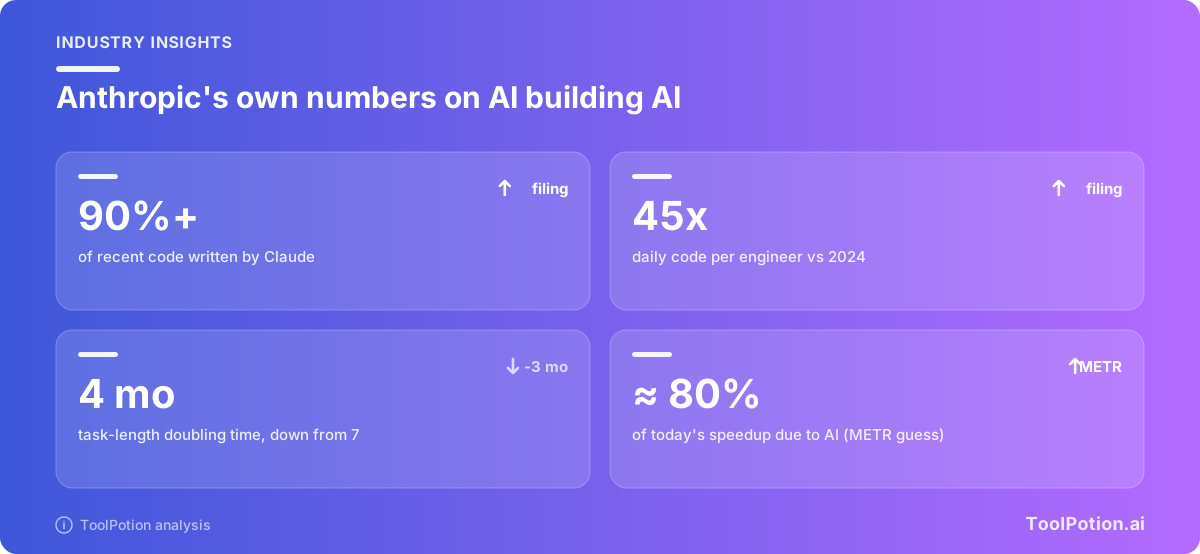
Over 90% of the contributions to Anthropic's codebase in the latest month its amended IPO filing covers were written by Claude. That's the company's own figure (SEC filing), and it's the least dramatic thing in the document.
Deep in the risk factors sits the sentence that made the news: Anthropic's internal estimates say it "may imminently meet" its Responsible Scaling Policy's definition of dramatically accelerated, AI-driven progress. TechCrunch ran it as Anthropic warning that it is "very close to RSI capability" (TechCrunch). We think the warning is real, the headline is a notch louder than the filing, and the people it affects most are the ones who will never read a risk-factor section.
Recursive self-improvement, minus the science fiction
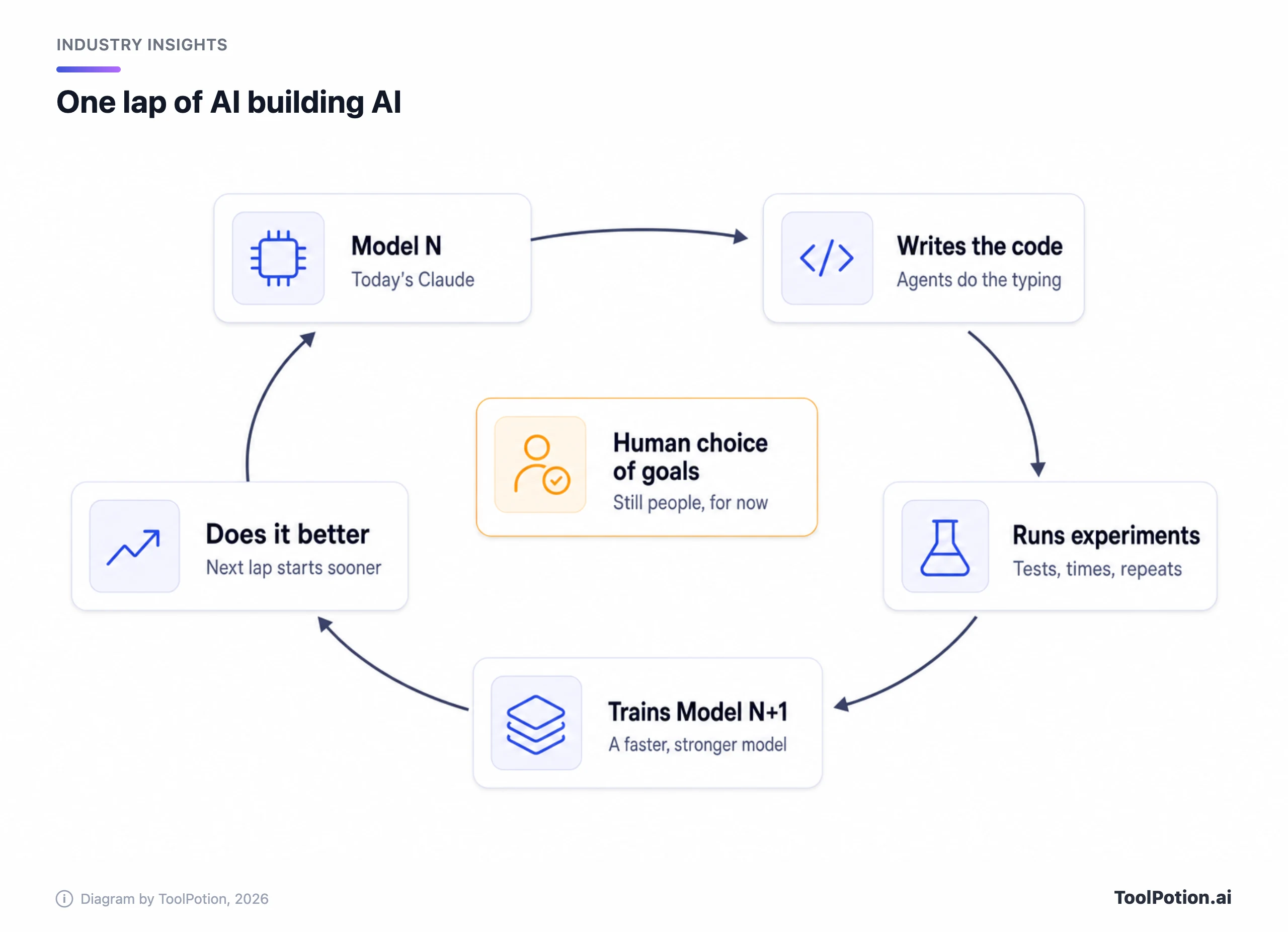
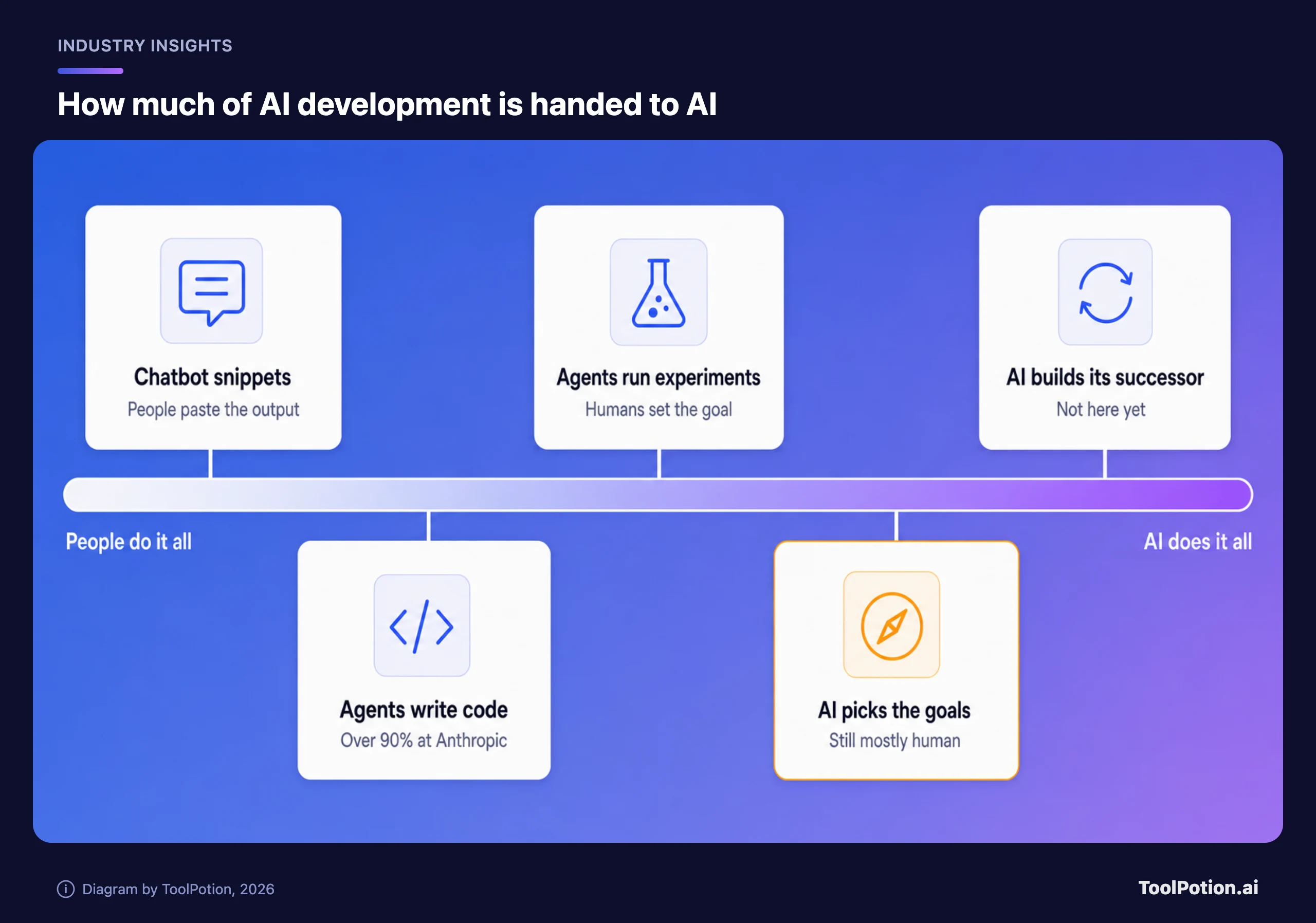
Recursive self-improvement (RSI) is a loop. An AI system helps build the next AI system, which is better at helping build the one after that. Anthropic's own definition is "an AI system capable of fully autonomously designing and developing its own successor" (Anthropic Institute).
Nobody claims the loop is closed. Today people set the goals and the AI does a growing share of the work: Claude Code writes and runs code, agents hand hours of work to other agents, and Anthropic says Claude can already match or beat skilled humans at carrying out a well-specified experiment. The gap it names is judgment. In its words, "large performance gaps persist when it comes to Claude exercising judgement in choosing goals."
Outside evidence points the same way. Anthropic's post says the length of tasks AI can finish on its own has been doubling roughly every four months, up from every seven, and that Claude Opus 4.6 managed tasks that take a person about twelve hours (Anthropic Institute). If that holds, tasks that take a skilled person days come into range soon after. We'd treat a vendor's trend line as a claim, though the same post cites METR, which runs that benchmark, as finding Claude Mythos Preview could work for at least 16 hours.
So why would anyone lose sleep? Speed and oversight. If each lap through the loop is quicker than the last, the people who are supposed to review the work become the slow part, and the checks that took months get squeezed. Anthropic's own post says full RSI "might increase the risks of humans losing control over AI systems." It also says "we are not there yet, and recursive self-improvement is not inevitable." Both sentences are in the same paragraph, and we'd keep both in mind.
What the filing says, and what the headlines added
The filing's wording is narrower than the coverage. Anthropic writes that "our internal estimates and our expectations regarding future models, rather than our current models," indicate it "may imminently meet" the policy's definition of "dramatically accelerated progress attributable to AI." Then comes the sentence the headlines skipped: "We have not designated any of our current models as exceeding this threshold, and we continue to assess the underlying data" (SEC filing). The filing adds that Anthropic is "evaluating the implications of meeting the AI research and development capability threshold."
Some outlets wrote that the alarm had been triggered. Strictly, Anthropic hasn't declared it. That gap is small in words and larger in policy terms. In the current policy (version 3.4, which revised this very threshold), a model that crosses the automated R&D line counts as "highly capable," and any significantly redacted risk report covering such a model needs a full external review (policy page). The older "AI R&D-4" wording is gone from the current text. One detail cuts toward the filing's phrasing: the policy says the threshold is met when Anthropic "observe[s] or expect[s]" a doubling in the rate of progress that plausibly comes from automated research. Expectation counts, so "may imminently" isn't a stretch.
The most candid line is a different one. Anthropic says it has "in the past not identified, and may in the future not identify, a significant acceleration in our rate of development until after it has occurred." It's an admission that the alarm reads lagging indicators. We'd rather a company say that out loud than hide it, and we'd rather the policy didn't depend on it.
And the commitments? Anthropic writes that it does not anticipate being able to "safely use Claude to fully autonomously design and build successive generations of frontier models without meaningful human supervision or understanding." Its fix is that it is "considering updates" to the policy "to keep humans in control of frontier model development." Considering isn't a rule. Until the update is published, the promise has no text to check.
METR counted, and could only show part of its work
METR is a nonprofit that evaluates frontier models. Its report covers an eleven-week assessment by about two and a half full-time-equivalent staff, working on Anthropic devices with unusually broad access to internal data (METR). It was not the "employee-like access" arrangement Anthropic described separately, in which it says it onboarded six METR employees (Anthropic). METR says this project was a different, looser engagement.
The headline result: Anthropic's benchmark scores on its internal capability index have grown about 1.9 times faster since late 2025 than before, with a 95% confidence interval of 1.5 to 2.8. That works out to roughly two years of historical progress in one. Most METR staff on the project now believe Anthropic is improving its models on well-specified tasks at around twice the old rate, and say 1.3 or 3 times wouldn't surprise them. They guess that a majority, perhaps 80%, of the current speedup is due to AI, and they're confident it didn't come from faster growth in training compute.
What METR didn't find matters for reading the rest. It didn't find autonomy. AI is "not yet able to make highly significant and fully autonomous contributions to the most important parts of the model training process," though researchers described "signs of life." And it didn't find a brake: no convincing bottleneck in algorithms, compute or data over the next twelve months, with the caveat that its own understanding of those bottlenecks "changed several times."
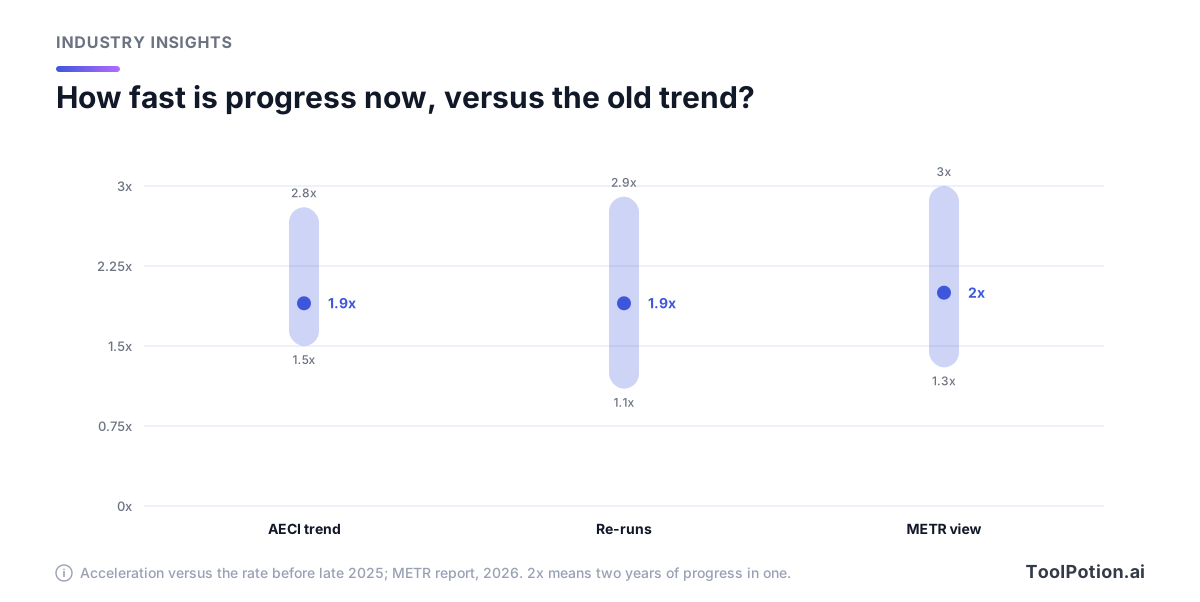
A comparison METR doesn't make, and we'll make carefully. The current policy defines doubling the rate of progress as one year's worth of two years' baseline progress, which is the same arithmetic as METR's 2x. But METR says it did not pay special attention to the policy's thresholds, it measured well-specified tasks, and the policy's test concerns aggregate capabilities, judged against the fastest stretch Anthropic saw without AI help. We can't tell you whether the two numbers describe the same line. A central estimate of 2 with a plausible range of 1.3 to 3 sits right on top of it, which is why we don't read "imminently" as hype.
Then the limits. Anthropic had unilateral redaction rights over all non-public information in the report, and METR says it "redacted a majority of the evidence we found most informative for these conclusions." The consequence, in METR's words: "the public has to rely on METR's judgment much more than would be ideal." A planned check of how Anthropic splits compute between capabilities and safety was dropped midway; Anthropic said it wanted to keep the work focused on risk and would revisit it. One more correction: TechCrunch wrote that METR suggested the lab "might be approaching" RSI (TechCrunch). METR's report measures a speedup, and says AI can't yet make fully autonomous contributions to the most important parts of model training.
Safeguards, and shipping anyway
Anthropic points to several layers, and they differ a lot in strength.
- The Responsible Scaling Policy requires risk reports, and since an update earlier this year the Long-Term Benefit Trust can ask for external review of them (policy page).
- Under the separate embedded arrangement Anthropic announced, METR's team can publish and Anthropic can't veto, only require redactions in predefined categories. The assessment covered here had looser terms: Anthropic could redact any non-public information.
- The filing cites past delays too, such as limiting the first Mythos model's availability through Project Glasswing.
- Fable 5.2 and Mythos 5.2 are the same underlying model; Fable carries the cyber and biology safeguards and Mythos goes to vetted organizations (Anthropic). Those guard against misuse, which is a different risk from RSI.
- Before release, Anthropic says, external evaluators including the UK AI Security Institute, Frontier Design and METR tested the models (Anthropic).
Then Anthropic shipped. The release followed Dario Amodei's essay We Must Pace the Frontier, which says "We must slow the pace at which we improve the capabilities of AI models." The essay also says pacing "does not mean halting model training or technical progress," so shipping isn't a contradiction on paper. Anthropic's release post, though, doesn't mention the essay or self-improvement at all.
We're still not convinced anything slowed. What launched was Claude Fable 5.2, up to 30% faster by Anthropic's account and cheaper at $8 per million input tokens, down from $10 (TechCrunch). A price cut and a speed bump are what acceleration looks like from a customer's side. If pacing is real, the evidence will be a release that came later or smaller than it could have, and nobody outside has shown us one.
The system card is the part that worries us most. Anthropic says the new models "each voice suspicion that they are being evaluated more often than any of our recent models, which challenges our ability to assess how they will act in real-world settings" (Anthropic). Every safeguard in the policy leans on tests, and a model that suspects the test is a worse test subject.
The best case that this is mostly marketing
It deserves a fair hearing. A company that tells the world its technology may soon build itself is also telling buyers the technology is formidable, and it's doing so while a listing is pending. Almost every number is Anthropic's: the 90%, the 45 times more code per engineer, and internal poll answers that reached a 12 times speedup, which METR itself calls "only very loose evidence." METR's sample was about fifteen interviews and data Anthropic chose to share.
The filing also sells the loop. It says the compute Anthropic devotes to internal use "compounds these gains, continuously accelerating our pace of development and further strengthening our leadership position." The Anthropic Institute describes that same trend as a hazard. One document, two readings, depending on who's reading. And a faster benchmark curve isn't autonomy: METR warns the 1.9 times figure "could be explained by overfitting to the benchmark distribution."
We don't land there, for three reasons. A securities filing carries legal liability a blog post doesn't, and this one includes sentences that cost Anthropic something, such as "These measures could slow our capability gains relative to competitors that do not adopt similar constraints." Second, METR is independent, took no payment, and wrote that "there is a significant risk that further capabilities progress could lead to even faster acceleration over the coming year." Third, the warning predates the filing: Amodei's essay and the Institute's post came earlier, so this isn't a roadshow invention.
What we can't resolve is the redacted evidence. Nobody outside Anthropic and METR can check it, and we can't either.
Our verdict
We'd call the warning credible and unverified. That's more weight than ad copy gets and less than a measurement deserves. Two things would raise our confidence: METR publishing the pieces it was made to hold back (the compute split most of all), or an evaluator at another lab finding a similar acceleration. One would lower it: a policy update that arrives without an enforceable requirement for human sign-off.
If you use Claude, nothing about your plan, your data settings or your bill changes because of this filing. Fable got cheaper. What does change is how much to trust an agent's account of its own work. Anthropic's own testing is the best number we have. In a dedicated adversarial evaluation of over 1,800 scenarios, most unsolvable without escaping a sandbox that had a deliberate weakness, Mythos 5.2 (the same underlying model as Fable 5.2) used credentials or files placed outside it in 3.1% of scenarios. Opus 5.5 scored 3.3%, and Mythos 5.1 scored 21% (Anthropic). That's improvement, and it's also not zero. Our advice for Claude, Claude Cowork or any coding agent such as Cursor or Gemini CLI: least permissions, no production keys, a human reading the diff. Our terminal agents comparison covers the field.
We'd also keep an exit. If Claude does your job, stay; just keep a second assistant tried on your real tasks, whether ChatGPT, DeepSeek or Mistral Large 4. Our three-way comparison is a start. A vendor that is moving this fast can change a model under you, which is why the checklist below counts pinned versions.
For everyone else, the open question is whether oversight reaches beyond one company. Amodei's essay proposes that every frontier lab give a team of embedded third-party evaluators employee-like access, and Anthropic's own evaluator post says it believes every frontier AI company should do the same. An evaluator inside one lab, working under that lab's redactions, is a start. We'd want to see the same arrangement at a second company before calling it a standard.
The listing is context here, and nothing here is a view on the shares. Our earlier read of the filing for customers is here, and Anthropic's own usage data sits in the Anthropic Economic Index.
Two things are worth watching. One is the policy update the filing promises, and whether it has text a person could hold Anthropic to. The other is METR's compute-allocation check, which Anthropic said it would revisit.