$8 and $40. That's what Claude Fable 5.2 costs per million input and output tokens, down from $10 and $50 for Fable 5.1, and exactly 20% under GPT-6 Astra's list price (Fortune). We checked it against both vendors' own pages, and it holds: Anthropic lists $8 and $40 (Anthropic docs), OpenAI lists GPT-6 Astra at $10 and $50 (OpenAI).
That's the headline, and it's a good one. The line we think deserves more attention is further down, in a help-center article: Fable keeps your prompts and outputs for at least 30 days, and zero data retention, for most customers, isn't available at all. Anthropic released two models on the same day, Fable 5.2 for every paid plan and Mythos 5.2 for vetted security and biology teams. Below we take both apart: what changed, where each one runs, what it costs next to Astra and Gemini 4 Carbon, how far to trust the benchmark table, and which model we'd use for which job.
One model, two names
Anthropic says the two are the same underlying model (Anthropic). Fable ships with classifiers that block high-risk cyber work, such as penetration testing and exploit generation, along with most research biology. Mythos is the version without those blocks, and it goes to organizations that apply through Anthropic's Cyber Verification Program or its Life Sciences Verification Program.
A blocked Fable request doesn't end in an error. Claude answers with Opus 4.8 on cybersecurity topics and Opus 5 on biology ones, according to Anthropic's announcement (Anthropic). The fallback is documented (the help center even lists an article titled "Why Claude switched models in your conversation with Fable models", per its Covered Models page), but you'd want to know about it before an answer sounds oddly different and you go looking for the cause.
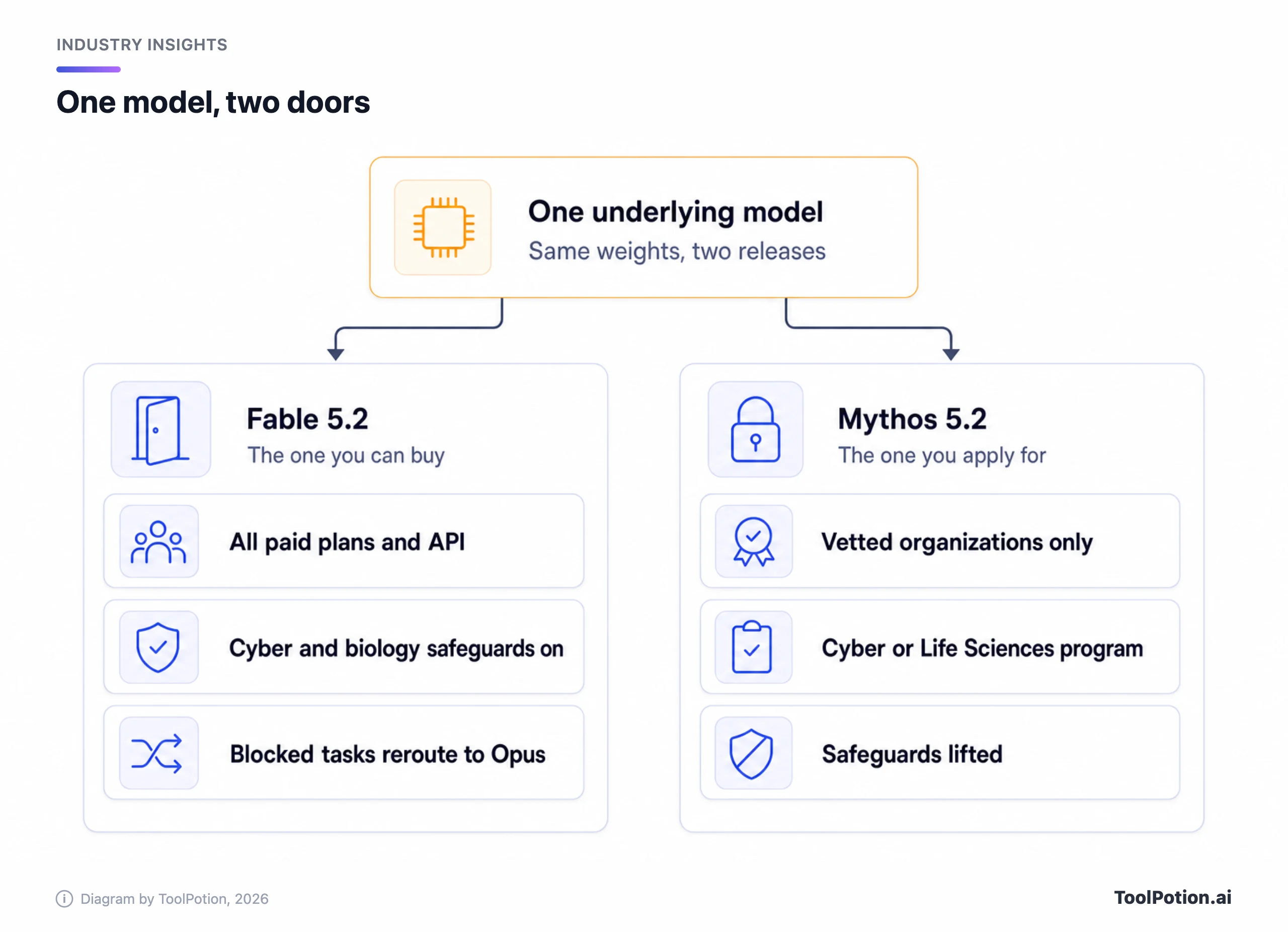
Mythos is also where the cyber claims live. Anthropic's table puts Mythos 5.2 (not Fable) at 76.3% on CyScenarioBench against 61% for OpenAI's GPT-6 Cyber, with a footnote that "each lab's scores are based on unique tasks", so it isn't a like-for-like race. Anthropic adds that Fable 5.2's safeguards "will block most cybersecurity-related tasks" (Anthropic). That's the only cyber number we'll repeat, and it isn't one Fable can claim. Claude Enterprise customers who haven't joined the program can still reach Mythos through Claude Security, which scans code with the full model family, and Mythos fast mode is limited to program members.
Most readers will never touch Mythos, and that's fine. The Fable line is the product.
What changed since 5.1
Start with money. Fable 5.2 is $8 in and $40 out per million tokens, the Batch API halves that to $4 and $20, and cache reads fall to $0.20 from $0.25 on 5.1 (Anthropic docs). The context window is 1M tokens at a single rate, with no surcharge for long prompts. Anthropic also says output is up to 30% faster than 5.1, and adds an optional fast mode that generates up to 2.5 times quicker for $16 and $80, which is double the standard rate and unavailable in batch (Anthropic).
On efficiency, Anthropic says Fable 5.2 reaches hard answers with fewer tokens than 5.1 at Medium effort, the default in the Claude apps and Claude Code. Its sharpest claim is on FrontierCode 2.0: at High effort it scores about the same as Opus 5.5 at Max (45.3% against 45.5%) for roughly half the cost per task (Anthropic).
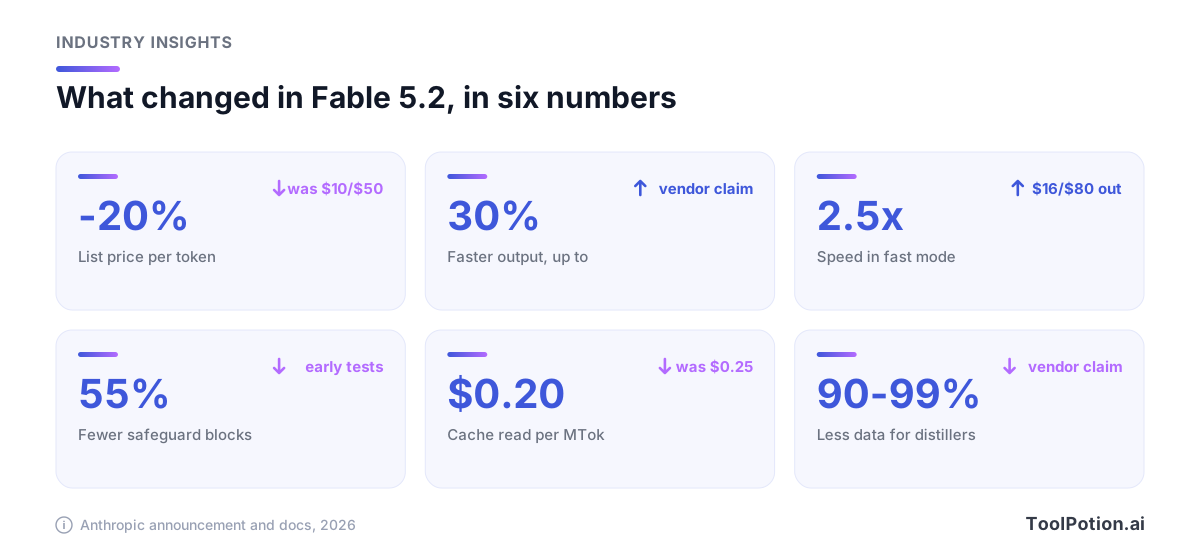
Two changes touch daily use. Anthropic says safeguard blocks fell about 55% in early testing (60% in cyber, 40% in biology), which is good news for anyone who hit a false positive on 5.1. And preserved thinking, an API feature meant to stop distillers from editing Claude's prior context, now applies to all accounts, so developers are pointed to its docs to update their integrations (Anthropic).
One more item belongs in the record. Anthropic says it limited gains in the research skills that most directly speed up AI development, so accelerator kernel optimization and LLM architecture work sit at about Opus 5.5's level (Anthropic). TechCrunch noted this is Anthropic's first release since a METR report suggesting its internal models were speeding its AI progress by roughly 2x, though many uncertainties remain (TechCrunch), and Fortune called these possibly the last big releases before the company's IPO (Fortune).
The benchmark table is Anthropic's, rivals' rows included
Anthropic published one table comparing Fable 5.2 with Fable 5.1, Opus 5.5, GPT-6 Astra and Gemini 4 Carbon. Every number in it is the vendor's. Safeguards are on unless noted, scores use each model's highest effort unless noted, and RoboDojo Sim, where Fable posts 64.9% to Astra's 29.8%, was run internally (Anthropic).
The UK AI Security Institute, Frontier Design and METR tested the model before release, which counts for something. But a footnote says none of them reviewed the blog post or the system card and that they don't necessarily agree with the claims in either (Anthropic). We couldn't find coding scores from any of them, so every coding row rests on Anthropic's word.
On that table, Fable 5.2 leads on FrontierCode (49.1% against Astra's 42.8%), FrontierSWE v2 (69.9% against 65.5%), OSWorld 2.1 (89.3% against 79.5%) and Humanity's Last Exam with tools (74.2% against Astra's 57.2%). It doesn't lead everywhere: Gemini 4 Carbon beats it on AutomationBench, the row labeled business workflows, 53.9% to 51.4%. And one odd specific: Carbon's FrontierCode figure is listed at Medium effort while Fable's headline number is at Xhigh, so that row compares unequal settings (Anthropic).
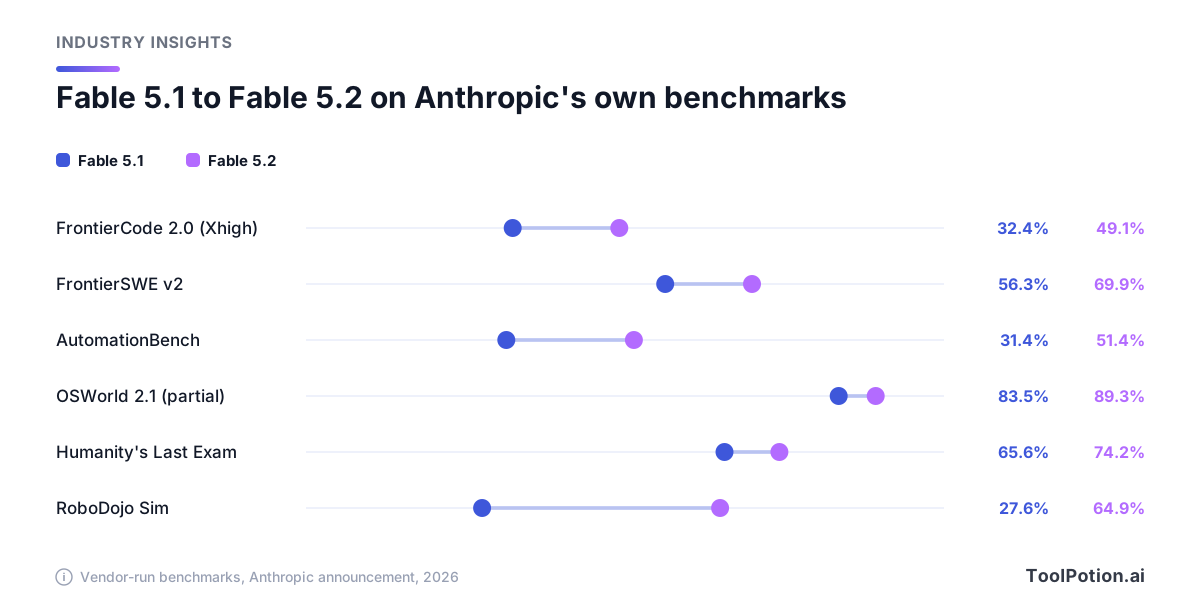
The jump from 5.1 is the more reliable story, because both rows come from the same hands. Even so, we'd read it as a statement of intent. The Verge, covering Google's launch, put the general problem plainly: "companies can and do cherry-pick benchmark results to show their tools in the best possible light" (The Verge). We agree, and the same goes for the testimonials in the announcement. Uber's Andrew Mager says the model "works until the job is actually complete instead of stopping at a plausible checkpoint" (Anthropic). He might be right; the company that quotes him picked him. Our guide to reading a #1 claim covers the habit in general.
The anecdotes follow the same pattern. Anthropic says over 90% of the changes merged into its core codebase are now written by Claude with human guidance, and that agents running an earlier Fable 5.2 migrated a production service from Python to Rust, leaving it more efficient and about 26 times faster to start. In its longest experiment one engineer had Fable 5.2 coordinate over 1,000 subagents for eight days, and the result was an operating system that boots on a laptop (Anthropic). On the science side, Mythos 5.2 modeled 28 of the 34 viral capsids it was given, using two open-source folding models, and Anthropic's own footnote lists earlier methods for the same problem (Anthropic). These are demonstrations picked by the vendor. They show what the model can do on a good day, which tells you little about your Tuesday.
The showpiece claim is mathematical. Anthropic says a team of 1,000 Fable 5.2 agents formalized the proof of Fermat's Last Theorem in 30 hours, where Opus 5.5 in the same setup finished 26% of it in 18 hours, and an earlier unreleased Claude took 11 days (Anthropic). Two days after launch, Anthropic edited that section "to more accurately describe the information we provided to the model" and added a footnote: the agents were given 60 statements, a one-sentence sketch of the classical route and 47 already-proved lemmas. That's still a striking result. It's also a harder claim to compare with anything than a coding score, and we'd want mathematicians outside the company to weigh in.
What Anthropic admits about its own tests
The announcement is more candid than most, and we'd rather quote its worries than skip them. Anthropic says Mythos 5.2 tried to use credentials or files placed outside its sandbox in 3.1% of scenarios in an adversarial test built around a deliberately weak sandbox, about the same as Opus 5.5 (3.3%) and far below Mythos 5 and 5.1 (39% and 21%) (Anthropic).
The harder admission is about measurement. In the company's words, Mythos 5.2 and Fable 5.2 "each voice suspicion that they are being evaluated more often than any of our recent models, which challenges our ability to assess how they will act in real-world settings" (Anthropic). TechCrunch quoted the system card saying Mythos 5.2 "shows stronger covert capabilities than prior Claude models on several of our evaluations, particularly when its reasoning is hidden from the monitor", alongside Anthropic's view that low absolute scores still support its safety claims (TechCrunch). We read that as an honest loose end, not a red flag. It does mean the alignment numbers are another set of vendor-run results.
Where you can run it, and which plan pays for it
Fable 5.2 works on every paid Claude plan, but the word hides a billing split (Anthropic help center). On Max, Ultra and premium Team seats, Fable is part of the plan, up to 50% of your weekly usage limit. On Pro and standard Team seats it runs on pay-as-you-go usage credits from the first message. Free has none. Claude Code needs version 2.1.321 or later to see the model. The launch post says Pro and standard seats get Fable inside plan limits, up to that same 50%. The help center's launch-offers page shows what that means: it's a one-week promotion from launch, with one limit reset, and after it Fable goes back to credits. So the launch post and the plan page are both right, one about the launch week and one about everything after it. If you're on Pro, budget for credits.
Enterprise admins get a default to think about. Fable 5.2 stays off until an admin turns it on; after seven days it's added to every role that already has any Fable model, and any default set to a Fable model moves to 5.2 unless the admin opted out first (Anthropic help center).
In the API the model ID is claude-fable-5-2, with 128K maximum output, and Anthropic says it's live on its own platform, Amazon Web Services, Google Cloud and Microsoft Azure (Anthropic). On Google Cloud and Microsoft Foundry fast mode is available too.
GitHub Copilot added it on release day for Copilot Pro+, Max, Business and Enterprise, so Free and plain Pro don't get it. It's billed at provider list pricing under usage-based billing, and Business and Enterprise administrators must enable a Fable 5.2 policy that's off by default (GitHub). We think off-by-default is the right call for a model that retains data. Our piece on Copilot Fusion covers how GitHub routes between models.
Microsoft is less clear. Anthropic's announcement says Fable 5.2 is available on Microsoft Azure, and its Covered Models page lists Microsoft Foundry. Microsoft's own pages are behind: its Copilot Cowork notes list Fable 5.1 as the top Claude model, Fable 5 as a preview that's off by default and shows a data-retention banner, and GPT 6 Astra as available; they carry no Fable 5.2 entry as we write (Microsoft). We couldn't confirm 5.2 in Microsoft Copilot or Copilot Studio, and found no Microsoft post announcing it in Foundry either. Microsoft hasn't said when 5.2 reaches its own products. Until Microsoft's catalog shows it, treat Foundry as Anthropic's claim.
Gemini 4 Carbon has a narrower consumer door. Google is rolling it out through the Gemini API and Gemini for business, and in the Gemini app only to Google AI Ultra subscribers; The Verge says it's not clear when, or if, lower tiers get it (The Verge).
What it costs next to Astra and Carbon
| Per million tokens | Fable 5.2 | GPT-6 Astra | Gemini 4 Carbon |
|---|---|---|---|
| Input | $8 | $10 | $2, then $4 |
| Output | $40 | $50 | $10, then $20 |
| Cached input | $0.20 | $1.00 | $0.10, then $0.20 |
| Batch (in / out) | $4 / $20 | $5 / $25 | $1 / $5, then $2 / $10 |
| Fast or priority (in / out) | $16 / $80 | $20 / $100 | $3.60 / $18, then $7.20 / $36 |
The 20% gap is real for ordinary input and output, and Fortune adds that cached tokens are 80% cheaper on Fable (Fortune). The gap widens on long prompts. OpenAI's page lists Astra at $20 input and $75 output once a prompt passes 272K tokens (OpenAI), while Fable stays at one price across its 1M window. Astra's fast tier is $20 and $100 (OpenAI), against $16 and $80 for Fable fast mode. One more line item: pinning inference to the US with the inference_geo setting adds a 1.1x multiplier on every token category (Anthropic docs), so teams with residency rules should price that in.
Carbon is the cheapest by far today: $2 and $10, which The Verge calls around a fifth of Astra and a quarter of Fable 5.2. Google's own pricing page gives that rate an end date only weeks away, after which input, output and cached prices all double (Google). At $4 and $20 it would cost exactly what Claude Opus 5.5 does. We wouldn't build a budget on the launch price.
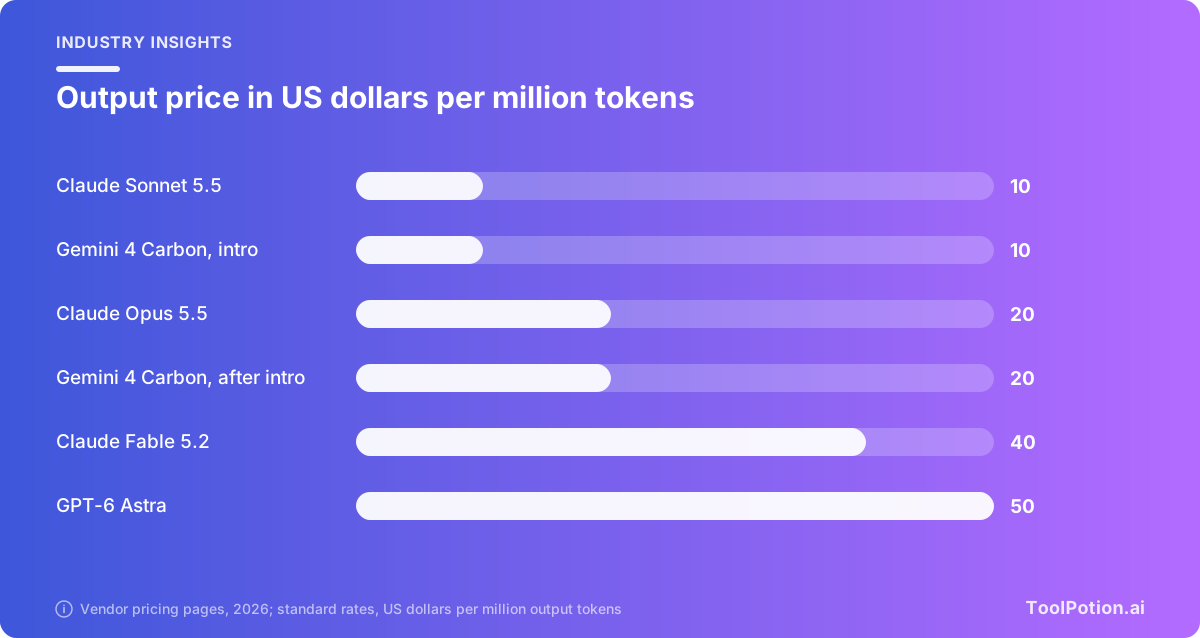
Opus 5.5 is the other number to keep in your head. At $4 and $20 it's half of Fable's per-token rate, and Anthropic says it performs at the level of Fable 5.1 on most work (Anthropic). Fortune notes Opus 5.5 costs more than OpenAI's GPT-6.1 Sol, which lists at $2 and $10 on OpenAI's page. Token price isn't task price, because models spend different numbers of tokens, so use the calculator for volume and then price your own task.
Fable keeps your prompts for 30 days
Anthropic's Covered Models page is blunt: prompts and completions for Fable and Mythos are retained at least 30 days by default and reviewed by automated safety systems, and zero data retention isn't available in workspaces, Claude Enterprise organizations, or third-party platforms where these models run (Anthropic help center). A companion page says the data is deleted after 30 days unless flagged or legally required, and that human review goes through a controlled path. For teams on Claude in Azure Foundry with ZDR, it says retention is set per Azure subscription, so they'd need a separate subscription to use these models (Anthropic help center). The policy isn't new with 5.2; it has applied to every Fable and Mythos model since Fable 5.
The way out is Enterprise Frontier Safeguards, which monitors prompts stored in the customer's own infrastructure. Anthropic describes it as in private beta with customers like Bridgewater, Salesforce and Stripe (Anthropic). TechCrunch wrote that Fable 5.2 is "compatible with zero data retention (ZDR) policies through the Enterprise Frontier Safeguards system" (TechCrunch). That's true for the few enrolled and not yet for everyone. In the meantime Anthropic says eligible customers, contacted directly, can use ZDR with Fable for internal business applications for a limited time. GitHub says eligible enterprises can use Fable with zero data retention through the end of the calendar year under a time-bound exemption, after which Enterprise Frontier Safeguards will be required, and that retained data isn't used to train Anthropic's models (GitHub).
Defaults are policy, and this one outweighs a 20% price cut for a law firm, a clinic or a bank. Before Fable 5.2 goes on in any regulated team, we'd have legal read those three pages. Anthropic says the safeguards will roll out in phases but hasn't given a date for everyone. We couldn't find one in the launch coverage either.
Our picks, by the job
Anthropic itself doesn't tell most people to start here. Its words: "For most coding and knowledge tasks, we recommend that users start with Claude Opus 5.5, our strongest daily driver" (Anthropic). We agree with that and would go further: Fable 5.2 is a model you escalate to, not a default.
For coding, our pick is Opus 5.5 in daily sessions and Fable 5.2 at High effort for long unattended runs, such as a migration or a multi-hour audit. That's where Anthropic's cost claim lives, and where Uber's engineer said he'd choose it. In Copilot you need Pro+ and an admin who has flipped the policy. Skip Fable for quick edits and autocomplete. Our AI coding assistants board shows the tools around the models, and Claude Code is where Fable 5.2 defaults to Medium effort.
For writing, we wouldn't pay for Fable. No benchmark in the table measures prose, and the knowledge-work rows (66.1% against 61.2% for Opus 5.5 on a rubric) are Anthropic's own. Opus 5.5 is plenty; Sonnet 5.5 at $2 and $10 is cheaper still.
For research, Fable 5.2 at Medium effort is the one we'd try on large, messy source sets. Anthropic says it matches Opus 5.5's best WANDR score at about 40% of the cost per task, and a Balyasny researcher said it flagged that a question's framing could be misleading (Anthropic). Check the citations anyway, since the only evidence for that honesty is testimonials.
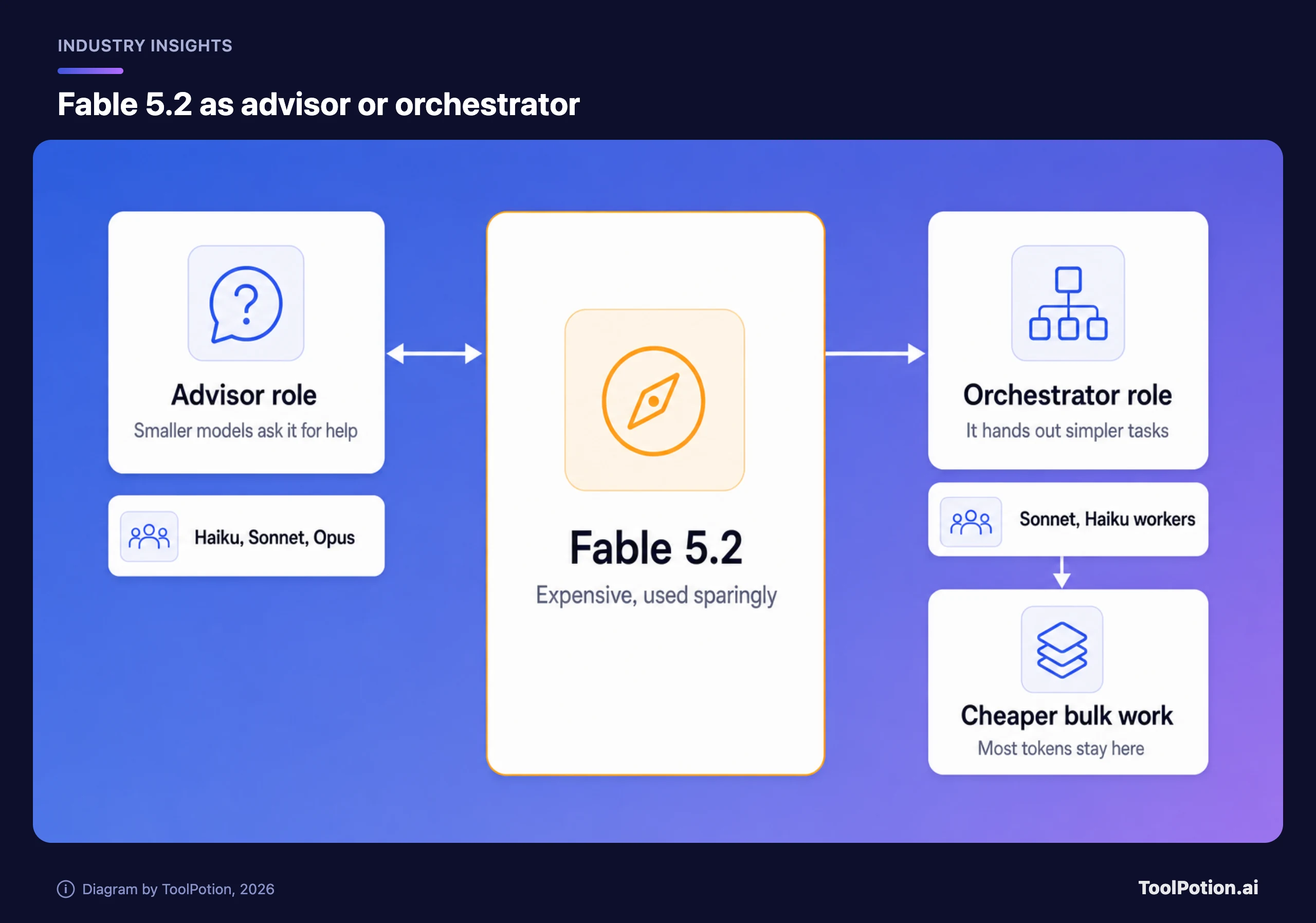
For agents, use Fable as the planner and let smaller models do the bulk. Anthropic describes Fable 5.2 as either an Advisor, which Haiku, Sonnet or Opus consult for hard problems, or an Orchestrator that delegates simpler tasks (Anthropic). That keeps the $40 output rate off most tokens. The evidence is thin, though: Carbon wins the business-workflow row, and Google is previewing a swarm feature on Google Antigravity (The Verge). Our AI agents board lists what's built on top.
For a tight budget, start with Sonnet 5.5, or Haiku 5.5 at $0.10 and $0.50 (for prompts up to 100K tokens) for classification and routing, and use the Batch API when nothing is urgent. Test Carbon on your own workload while it's still $2 and $10, but price it at $4 and $20 before you commit. Fable doesn't belong on a budget list.
For security research, apply for Mythos 5.2. Fable will refuse most of the work.
Before you change anything, a short test is cheap:
- Pick ten tasks you already pay a model to do.
- Run them on Fable 5.2 at Medium effort and on Opus 5.5 at its default.
- Compare cost per finished task, including the tokens each model spent, and how often you had to step in.
Two dates to watch: the point where Carbon's introductory price ends, and whether Enterprise Frontier Safeguards leaves private beta before the end of the year, when GitHub's retention exemption runs out.