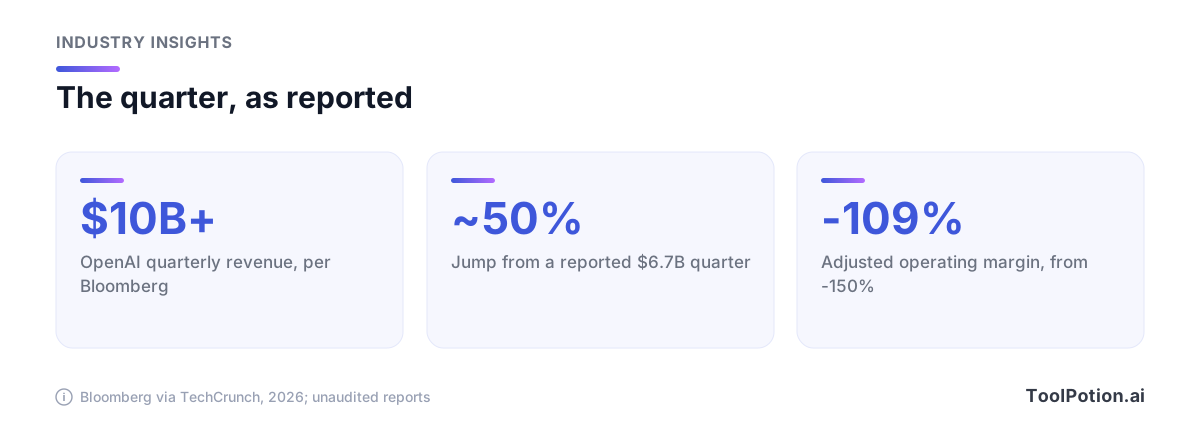
OpenAI's quarterly revenue topped $10 billion for the first time, according to Bloomberg's report as relayed by TechCrunch, which cites anonymous sources. TechCrunch's own hedge is "If true." The same report also carries a loss figure, and that pairing is what matters if you pay for ChatGPT.
We read the reports, OpenAI's own plan pages and its ads documentation. Bloomberg broke the figures; everything below attributed to Bloomberg comes through TechCrunch's report. These are reported figures, not an audited filing. OpenAI is private and hasn't published these numbers.
The numbers, as reported
TechCrunch's summary of the Bloomberg piece: revenue crossed $10 billion, an almost 50% jump from the $6.7 billion the company reportedly booked in the quarter before. That is a sharp change in pace: growth between the first and second quarters was previously said to be about 18%. One wrinkle: TechCrunch gives the second-quarter base as $6.7 billion in one paragraph and $5.7 billion in another, so read the 50% as approximate.
The loss side improved too, on that account. Adjusted operating margin narrowed from -150% to -109%, the report said. By our own arithmetic (it is not in the report), a -109% margin on revenue just over $10 billion implies an adjusted operating loss of roughly $11 billion for the quarter. "Adjusted" follows a definition of the company's choosing, and we haven't seen it.
Annualized, TechCrunch says Bloomberg puts OpenAI's revenue run rate at $50 billion. Anthropic, for its part, said a day earlier that its run rate had reached $81 billion as of the end of its latest month. TechCrunch adds a note: the two companies count differently, because Anthropic includes sales made by its cloud partners and OpenAI counts only its share of some partner sales. We wouldn't set the two numbers side by side.
Why this leak, and why now
TechCrunch frames the number as a recovery. OpenAI, it says, is "bouncing back from the doldrums it experienced earlier this year", after growth that slowed to about 18% for a quarter while Anthropic took the enterprise lead. A rebound story helps to a company that sells to businesses, and it lands the day after Anthropic published a bigger run rate and TechCrunch says Anthropic's own IPO is likely soon.
We can't say who spoke to Bloomberg, and TechCrunch's own phrase is "if true." We'd treat the $10 billion as plausible and the $50 billion annualized figure as softer, since annualizing one strong quarter assumes it repeats. Neither tells you anything about your next invoice.
Who gains, and who pays for it
The winners are easy to name. Enterprise buyers get a vendor with money to keep pushing agents and business products. Advertisers get a new surface, with OpenAI's ads FAQ saying placement is decided by relevance and advertiser bids. Subscribers on Plus and above get ad-free chat, per OpenAI.
The people who pay are on the bottom two rungs. Free and Go users are the ones who see the ads, and keeping their plans running is the reason OpenAI's FAQ gives for them. There's also an inconsistency on the free tier itself, and it's the kind of footnote we look for. The pricing page lists "Unlimited text chats with GPT-6" for Free, subject to abuse guardrails, while the Free tier FAQ names GPT-5.6 Luna as the model free users get. Both pages are OpenAI's, and they didn't agree in the versions we read. Plan terms in this market change faster than the help center is edited.
Where the money comes from
Neither report we could read splits revenue by product. We can say what OpenAI sells: subscriptions to individuals and teams, enterprise contracts, API usage, and since earlier this year, ads on its two cheapest plans. The company's own ads announcement says "our enterprise and subscription businesses are already strong", and says ads are meant to become one part of a "diverse revenue model". It gives no shares, and nobody we could cite has published any.
What TechCrunch does say is where the momentum came from. OpenAI "has recently benefited from a combination of tighter pricing, discounts, improving models, and a greater focus on building more enterprise-focused products and AI agents that can help people complete tasks." It also notes that OpenAI says it has over a billion users, but finds it "reasonable to assume most of those are free users or subscribers to its cheapest plans." A billion mostly non-paying users is a cost center that needs an answer, and the answer OpenAI picked is ads.
Enterprise is the part Anthropic is winning, per the same article, which says Anthropic "has taken the lead in capturing the enterprise market". If you're weighing the two assistants for work, our ChatGPT vs Claude vs Gemini comparison and the page for Claude cover the product side. We covered Anthropic's side of the money in our read of its S-1.
Growing fast and still losing
A company can raise revenue 50% in a quarter and still lose billions. OpenAI's ads FAQ points at the cost side without giving a number: ChatGPT is used by "hundreds of millions of people", and keeping Free and Go "fast and reliable requires significant infrastructure and ongoing investment."
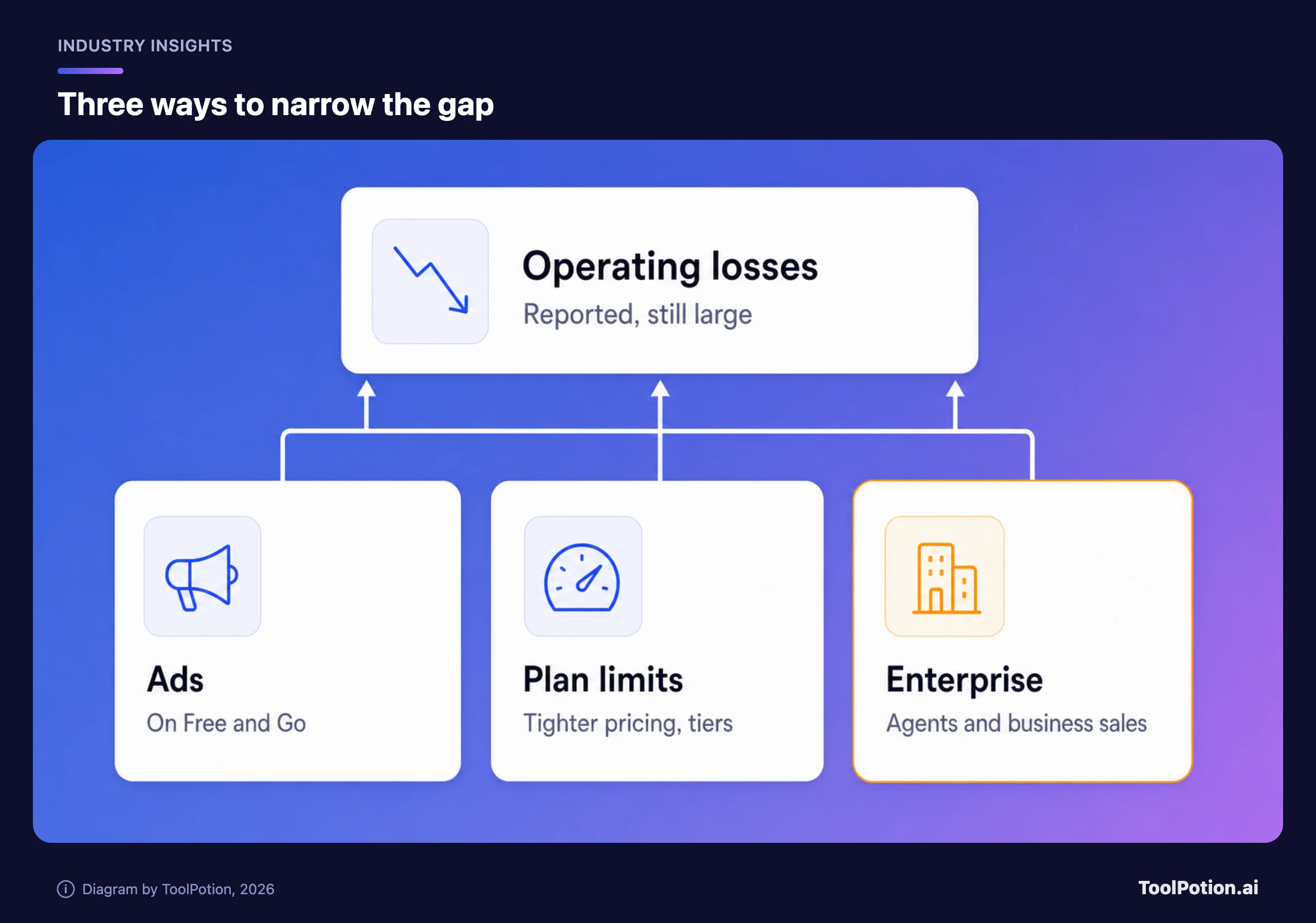
So the pressure on you has three sources. Ads on the cheap plans. Limits and tiers on the paid ones. And a push toward the enterprise and agent products where the contracts are bigger. All three look set to continue (nothing in the reports says otherwise), and the first two are the ones an individual feels.
Ads are the part you can already see
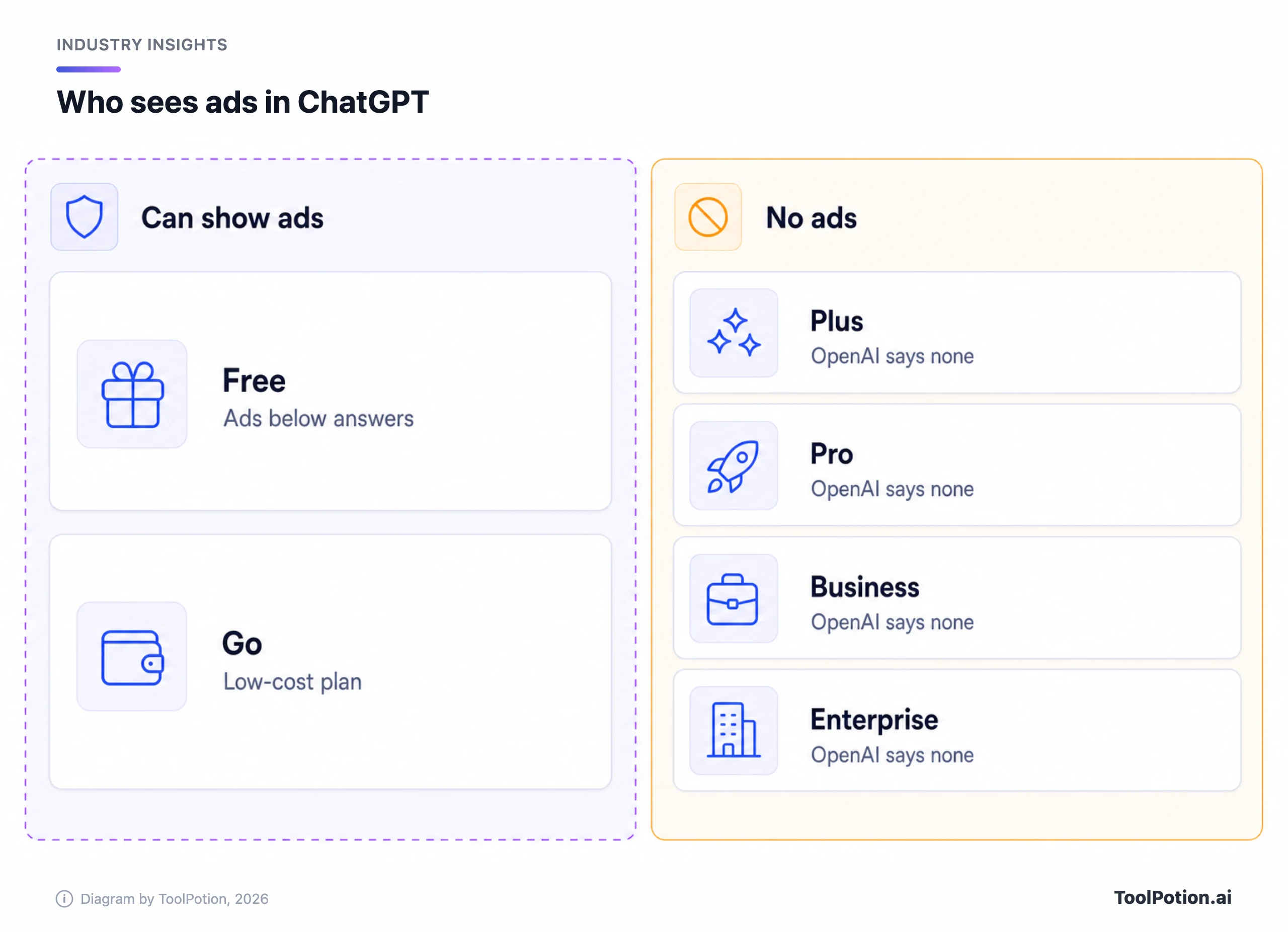
OpenAI's ads FAQ says ad testing began in the United States earlier this year and is rolling out gradually in select regions. Ads can appear for Free and Go users. Plus, Pro, Business, Enterprise and Edu accounts "will not have ads." Accounts identified as under 18 don't get them.
The format today is one ad unit below a ChatGPT response, plus a multi-image ad format being tested during image generation. The line "Ads do not influence the answers ChatGPT gives you." comes from OpenAI's ads announcement. The FAQ words it as "Ads do not influence ChatGPT's answers" and adds that ads run on separate systems from the chat model. It also says conversations aren't shared with advertisers and that advertisers see only aggregated results. Those are OpenAI's claims, and an outside audit hasn't confirmed them. One detail to read twice: the FAQ says ads are chosen using "the context and intent of your current conversation," plus broader ChatGPT activity when personalization is on. You can turn personalization off, but ads then still use the context of your current chat.
We covered the advertiser side in ChatGPT Ads in 2026. For a user the decision is simpler. If you're on Free or Go and the ads bother you, turn personalization off first. On Free there is also an ads-free switch in settings that removes ads and lowers your message limits and tool access; Plus is the paid way out. We'd be wary of anyone who says the free tier will stay ad-free: OpenAI promises only a way not to see ads, and on Free that way costs you limits.
A price ladder with a hole in it
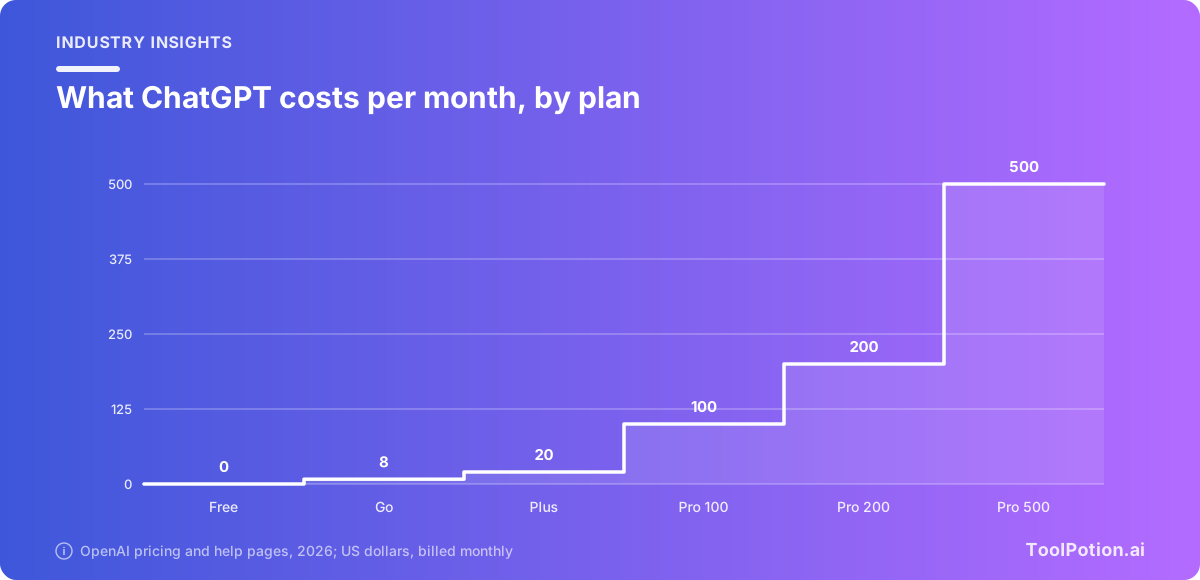
Here are the current monthly prices from OpenAI's pages, in US dollars. Plus is $20 per OpenAI's Plus page. Go launched in the US at $8 in OpenAI's announcement of ads and Go earlier this year; the live pricing page showed us a local-currency price, so check yours. Pro comes in three sizes: $100, $200 and $500, the last of which includes Ultrafast versions of GPT-6 Astra and GPT-6.1 Sol, according to the Pro tiers page.
Plus is $20 on OpenAI's own page, and we'd bet it stays put while limits and model access carry the changes. The odd specific is the Pro 200 plan. Its help page says a reduction in allowance announced by email earlier this year "is canceled", that new Pro 200 subscriptions are available again, and that existing subscribers with the lower allowance had it doubled. Price stayed at $200. A company cutting an allowance and reversing within weeks tells you the limits are being tuned live against demand, and against what subscribers will tolerate.
Is $20 safe, then? Probably, for now. The harder question is what $20 buys. The pricing page lists projects, scheduled tasks and custom GPTs under Plus, yet the Free tier FAQ says new GPT creation and publishing aren't available on personal accounts, "including Free, Go, Plus, and Pro." Existing GPTs keep working, and creation stays open in Business, Enterprise and Edu workspaces. So one rung of the ladder lost a feature while its price stayed the same. Our read: the sticker holds and the contents change.
Pro is where the contents are easiest to see. On the pricing page it adds a choice of three usage tiers, Pro reasoning on GPT-6 Astra, longer Codex and Work sessions, and an always-on agent called Dot, and the Pro tiers page says the biggest plan gets the faster Ultrafast models. You pay for speed and session length.
The step from $20 to $100 is the biggest gap on the ladder. If you outgrow Plus, you've no middle rung. That looks deliberate, and we think it's overpriced for anyone who isn't running Codex or Work for hours a day. For GPT-6 Astra specifically, see what it costs and when Sol is enough. For the agent side, ChatGPT Work explained lays out the plan limits.
What we'd expect, and what we'd do
Revenue growth at this pace usually buys a company room to be generous. This one has a reported loss of that size, so we expect the opposite: tiers, caps and ads, tuned continuously. Nothing in the reports says prices will rise tomorrow. Our view is a forecast from the pattern, and OpenAI hasn't announced any of it.
- Check which plan you're actually on and whether ad personalization is on. It's in settings, and it takes a minute.
- If you use ChatGPT a few times a week, stay on Free. The Free tier FAQ says users get GPT-5.6 Luna with web search, file uploads and image creation, and ads can appear.
- If you use it daily for work, pay for Plus. It is the cheapest paid plan with no ads, at $20 on OpenAI's page.
- Don't buy Pro 200 or Pro 500 on a hunch. Buy Pro 100 for a month first if your Plus limits keep running out, because the allowances have already changed once.
- If your company pays, ask your admin whether Business or Enterprise is cheaper per seat than several Plus accounts. Those plans have no ads and carry the contracts OpenAI is chasing.
The table is sortable. Prices and ad status come from OpenAI's own pages, and the last column is our judgment. If you're deciding between assistants entirely, the Top 200 AI Chatbots board ranks them, and our GPT-6.1 Terra piece covers the newest model on the ChatGPT side.
What would change our read? Three things: an audited figure from OpenAI or its backers; a Plus price move (we'd call that the clearest tell of real pressure); or ads reaching a paid plan, which OpenAI has said it won't do. Any of those would be news for readers, and we'll update this piece if one lands.
A fair objection: ads and limits may simply be good product management (every free service has them), and a company with a billion users has to charge someone. Fair. The trouble is the order of operations. The cheap tiers get squeezed first, and they are plans we'd guess belong more often to students, people outside the US and anyone on a tight budget; OpenAI's own pages say Go exists to widen access. Is a plan with ads still access? For many people, yes. If you use ChatGPT for health questions, note that OpenAI says ads are not eligible to appear near personal health, mental health or politics. Advertisers in areas like financial services can still qualify if they pass its checks, just not next to sensitive content. That is a promise about a test, not a permanent rule.
The next number to look for
We'd like to know what share of that $10 billion comes from subscriptions you and we pay for, because the reports we read don't say. If subscriptions are a small slice, the ads and limits will keep tightening on the free and cheap tiers. If Bloomberg's figures turn out different once OpenAI or its backers publish something audited, the story changes. Until then, the thing to watch is the Free and Go terms on OpenAI's help pages, both of which were edited in the days before we read them.