ChatGPT ads are a real, buyable channel in 2026. OpenAI now runs a self-serve auction with click and conversion bidding, a pixel plus a server-side Conversions API, and a US minimum of $25 a day. It's also still a beta with no published benchmarks and last-touch reporting, so for most brands the right move is a bounded test paid for out of an experiments budget, with search spend left alone.
Speed is the reason to pay attention now. Ads began as a US test for a subset of Free and Go users earlier this year. By the time OpenAI's ad business reached a $1 billion annualized run rate, ads were live in more than 40 countries and self-serve buying was rolling out across India, Europe, the Middle East and North Africa (CNBC). Free users make up the vast majority of ChatGPT's 1 billion weekly active users, per the same report. Amazon has since started letting select US brands run ChatGPT ads through Amazon itself (CNBC).
Below are the formats, the rules, the buying mechanics and the early evidence, followed by a call on who should test now, a first-campaign plan with a budget planner, and eight questions for your rep.
What a ChatGPT ad looks like, and who sees it
The ad sits below the end of ChatGPT's response, labeled and visually separated from the answer (OpenAI Help Center). The standard format is a chat card: a title of 3 to 50 characters, a body of up to 100 characters, an image of at least 640 by 640 pixels and a landing page, according to OpenAI's developer docs. Retailers can upload a product feed instead, which produces product cards and a multi-product carousel. One unit can hold items from one advertiser or several, and OpenAI ranks them on "a combination of factors, including relevance and advertiser bids".
The path from question to reported sale has six steps. Watch where the dashed line falls, because everything inside it stays away from advertisers.
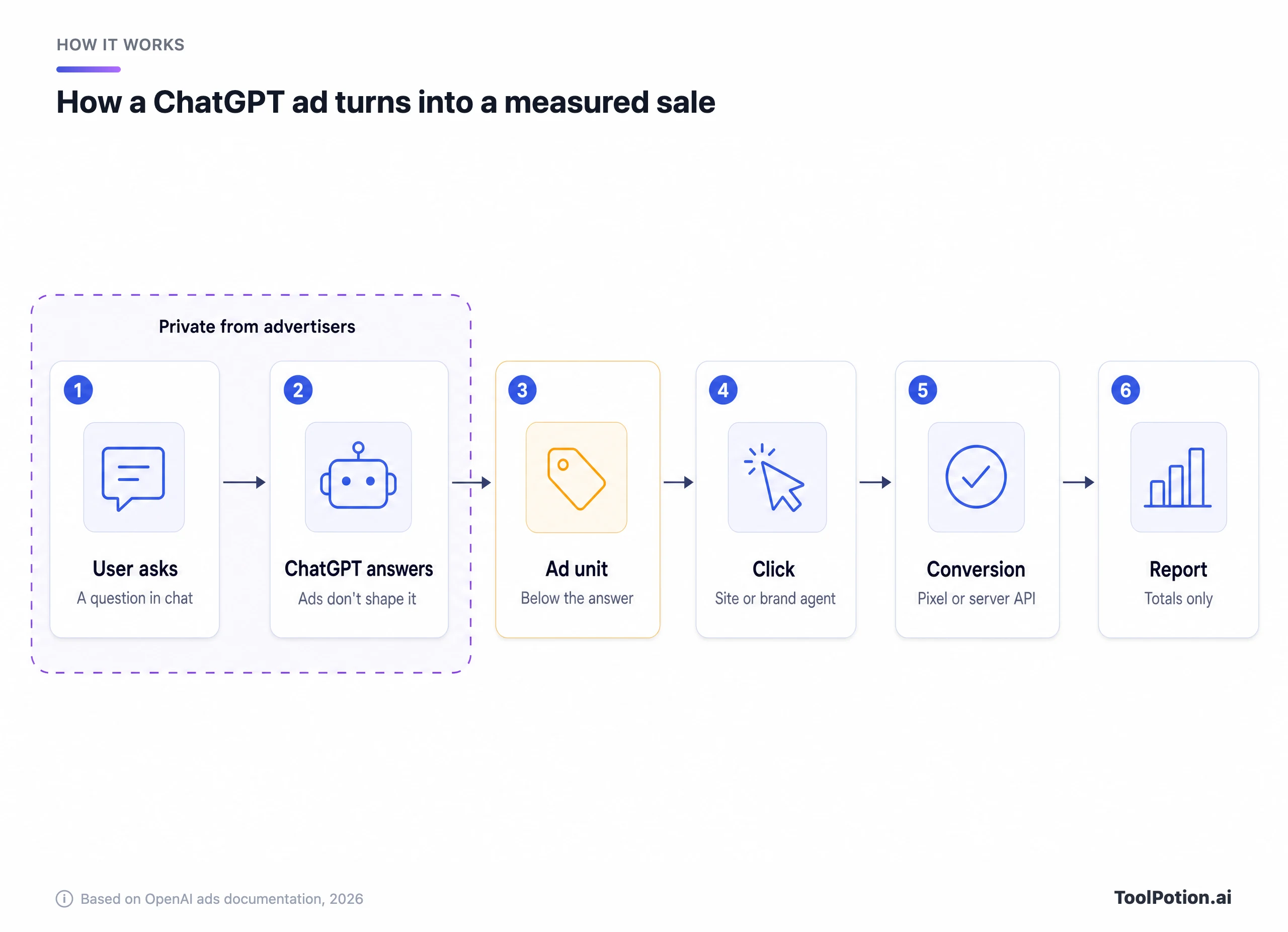
OpenAI says ads run on separate systems from the chat model and that advertisers can't shape, rank or alter its answers. What comes back to you is the click, the conversions your pixel or server API reports, and totals in Ads Manager. Some clicks will open a labeled chat with a business's own AI agent instead of a website (OpenAI is testing these Sponsored Agents with select US advertisers, Storyboard18 reported). There, the advertiser sees only the messages the user sends it.
Ads go to the Free plan and the low-cost Go plan. Plus, Pro, Business, Enterprise and Edu accounts don't see them, and neither do accounts that OpenAI knows or predicts belong to someone under 18 (OpenAI). Temporary Chats carry no ads, and during the test ads don't appear in the ChatGPT Atlas browser. The help center also describes ads in logged-out sessions, restricted to ads suitable for all audiences. Free users who'd rather skip ads can switch to an Ads-Free mode with lower message limits.
The label now reads "Ad" instead of "Sponsored", Search Engine Roundtable reported, and OpenAI's policy bans ads that imitate ChatGPT's look or voice. Write like an advertiser, because the reader knows you are one.
How the rollout moved through 2026
OpenAI expanded fast, and the order matters if you sell outside the US. The timeline counts weeks from the start of the US test, so read it as a sequence.
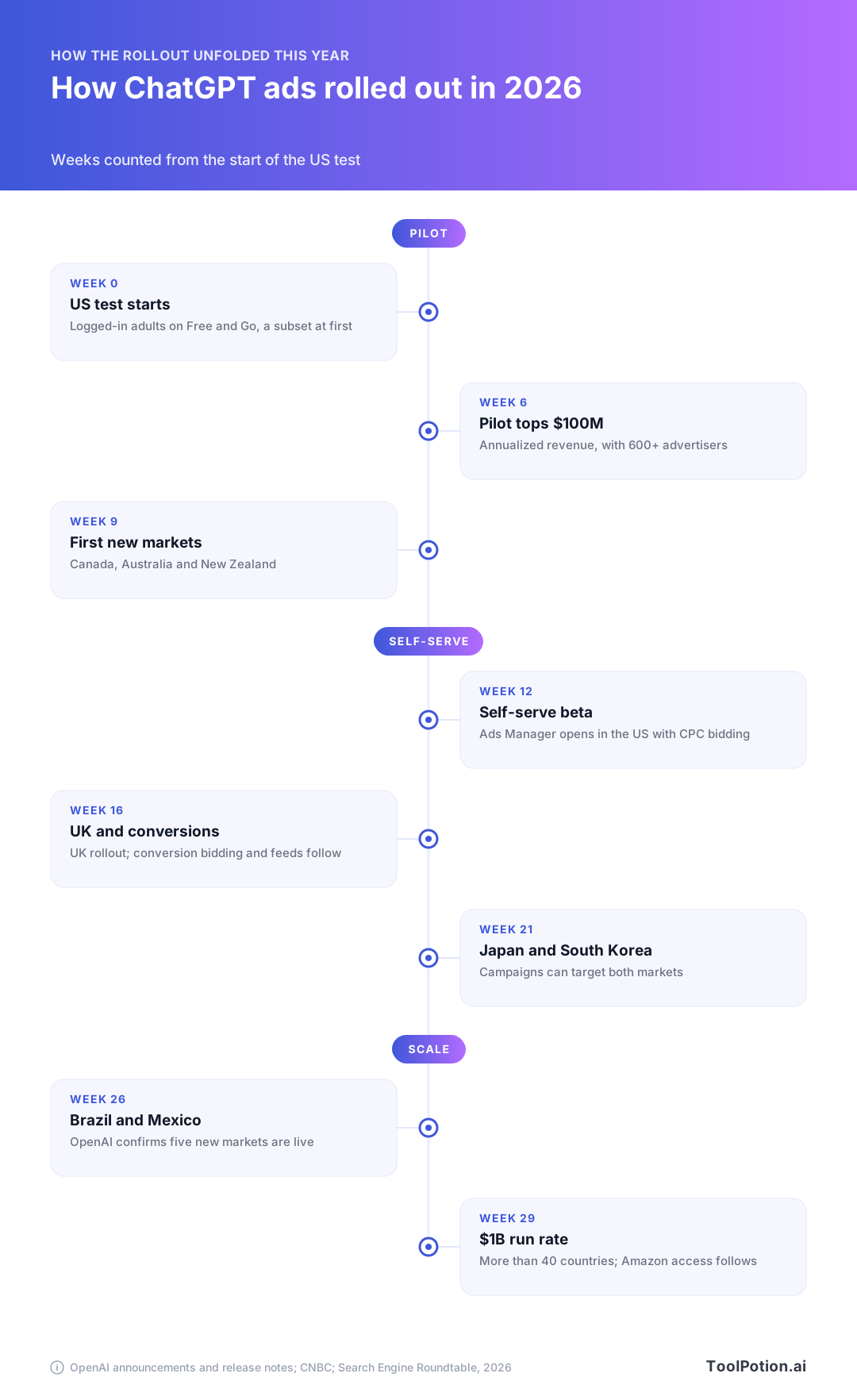
Markets arrived in batches. Pilots in Canada, Australia and New Zealand came first. The UK followed, then Japan and South Korea, and later in the year OpenAI confirmed ads were live in Brazil and Mexico as well. Buying tools trailed reach. Self-serve Ads Manager opened as a US beta together with CPC bidding, shortly after the pixel and Conversions API launched (OpenAI), and conversion-optimized bidding came after that.
Where ads serve and where you can buy aren't the same list. To use self-serve Ads Manager, the legal entity that advertises and pays has to be based in a country on OpenAI's availability list, which runs to 63 countries, including all 27 EU member states and the six Gulf states. Personalization is the other gap. OpenAI says personalized ads aren't available at first in the European Economic Area or Switzerland, so ads there can't draw on past chats or memories.
Targeting, and what OpenAI says it won't do with chats
Targeting works more like contextual advertising than search. OpenAI picks ads using the context and intent of the current conversation, the ad's landing page, title and copy, the advertiser's context hints and targeting selections and, when a user has ads personalization switched on, selected data from their wider ChatGPT use such as past chats and memories.
The controls you set are few, per OpenAI's targeting docs:
- You can target countries and regions, with up to 2,500 location IDs per list. Ads Manager has also added US state, DMA and ZIP code targeting, Search Engine Roundtable reported.
- Platform targeting splits the iOS app, the Android app and the web.
- Custom audiences come from emails, phone numbers or mobile advertising IDs. Inclusion lists and bid multipliers need at least 25,000 matched users, while exclusion audiences have no minimum.
- Context hints describe the ad, up to 2,000 per ad group, and OpenAI states plainly that they aren't exact-match keywords.
So there's no keyword auction to port over from Google. Negative keywords did arrive later for exclusions, according to an advertiser cited by Search Engine Roundtable, but you can't buy a query.
On user data, OpenAI's commitments are specific. Advertisers never receive chats, chat history, memories, names, emails, precise location, IP addresses or sensitive information. They get aggregate results such as views and clicks. OpenAI also says it never sells user data to advertisers, and ads data that a user deletes is kept for up to 30 days before removal. Our privacy framework for AI tools covers the user side.
Category rules will shape more test plans than targeting does. During the initial test period, ads are mostly limited to consumer verticals: lifestyle and household goods, local services, travel and experiences, and digital products or education (OpenAI ad policies). Financial services, health and legal advertisers are reviewed case by case in the US only and may need proof of licensure, and finance ads outside the US are generally prohibited. Political ads are banned, as are ads for alcohol, tobacco, individual job listings and housing rentals or sales. Whatever the category, ads stay away from sensitive conversations such as mental health or emotionally reliant chats. General medical, legal and financial advice chats are a different matter: a policy update this year stopped blocking them by default.
Read one more clause before signing. Version 1.6 of the policy lets OpenAI decline, restrict or remove advertisers that conflict with its "advertising principles, business interests, or competitive position". If your product competes with anything OpenAI sells, raise it with your rep before you build creative.
How buying works: self-serve, partners and a $25 floor
There are four ways in. Ads Manager is the self-serve beta. Dentsu, Omnicom, Publicis and WPP buy as agency partners, and Adobe, Criteo, Kargo, Pacvue and StackAdapt are technology partners, with OpenAI's system making every delivery decision (OpenAI). Amazon sets up and manages campaigns for the select US brands in its program. Large advertisers can also go straight to OpenAI's sales team.
Pricing started as CPM in the first phase of the pilot. CPC arrived with self-serve, and conversion bidding followed. OpenAI's developer docs and help center lay out the combinations, and they disagree on conversion campaigns: the developer docs list click billing only, while the Ads Manager help article lets you choose impressions or clicks.
| Campaign objective | You pay for | Bid options |
|---|---|---|
| Impressions | Impressions (CPM) | Fixed bid |
| Clicks | Valid clicks (CPC) | Fixed bid or Maximize clicks |
| Conversions | Clicks per developer docs; impressions or clicks per Ads Manager help | Fixed bid or Maximize conversions |
OpenAI's help center nudges conversion campaigns toward impression billing, saying that choosing clicks "will lower your conversions". That may be true, but with impression billing you pay whether or not anyone clicks. Get a click-billed baseline first, then test impressions against it.
Budgets behave differently from search. A daily budget is the average you want to spend per day over seven days, so one day can spend up to twice the figure and a week up to seven times it (OpenAI Help Center). The minimum varies by market and currency. In the US it's $25 a day. OpenAI warns that spend can fluctuate during the beta and that conversion campaigns won't necessarily use the whole budget (OpenAI Help Center). Its advertiser page currently promises $500 in ad credit to new advertisers who spend $500, without listing terms, so ask.
Measurement runs on OpenAI's pixel and Conversions API, and OpenAI calls the server-side API more reliable than the pixel alone. You choose a 7-, 14- or 30-day click window and either no view-through or a one-day view-through window. When a click and a view both qualify, the click gets the credit. Attribution is last-touch, spend data lags by seven to eight hours, and conversions can take 24 to 48 hours to appear (OpenAI Help Center). Custom conversion events can't be a conversion campaign's goal yet, and OpenAI gives no recommended bid.
Native mobile SDKs aren't supported, so app advertisers depend on partner integrations. Search Engine Roundtable has reported AppsFlyer and Adjust for app installs, plus Triple Whale and Hightouch connections for ecommerce data. Storyboard18 says HubSpot and Shopify integrations are starting too, along with AI-suggested copy and images inside Ads Manager.
How it compares with Google, Copilot and Perplexity
ChatGPT isn't the only assistant selling space next to its answers. Google's AI surfaces are the ones most marketers already pay for, so start there. The card lines up the two on attributes both companies document.
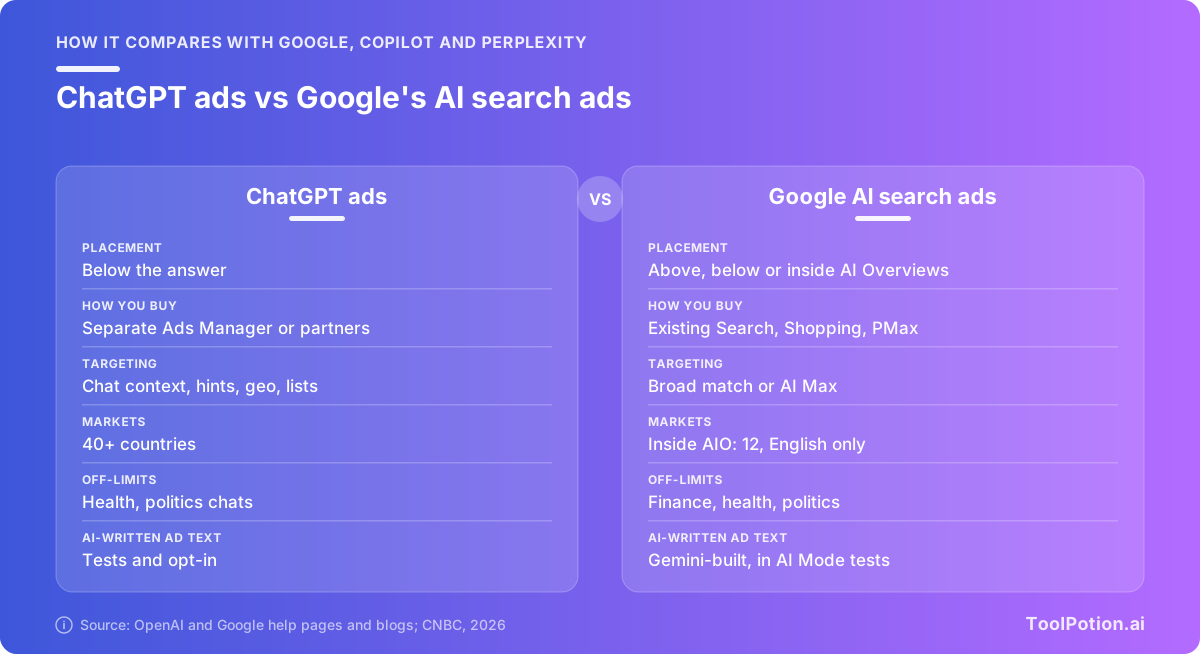
Google's edge is plumbing. Text and Shopping ads from existing Search, Shopping and Performance Max campaigns can already show above, below or inside AI Overviews, provided you use broad match or keywordless targeting such as AI Max (Google Ads Help). Above and below works in all 200-plus markets with AI Overviews. Inside the overview is narrower: English only, in 12 countries that include the US, India, Canada and Australia. Google also keeps ads out of AI Overviews for sensitive verticals such as finance, healthcare and politics.
In AI Mode, Google is testing Conversational Discovery ads and Highlighted Answers, two formats that pair the advertiser's creative with an "independent AI explainer" written by Google Gemini and keep the "Sponsored" label, Google said at its Marketing Live event. That's a different bet from OpenAI's. Google lets its model talk about your product inside the ad, while OpenAI keeps the answer and the ad in separate boxes.
Microsoft Copilot shows ads to people who use it without a Microsoft 365 subscription, and personalized ads there can draw on chat history and saved memories, per Microsoft's Copilot privacy page. You reach it through Microsoft Advertising. Microsoft says AI Max for Search campaigns (an open pilot in that post) suits ads in Copilot Search and Copilot Answers, and a format called Offer Highlights lets brands surface details like free shipping or in-store pickup inside a Copilot conversation (Microsoft Advertising).
Perplexity is the odd one out. When it first experimented with ads, it used sponsored follow-up questions and paid placements beside the answer. Today its advertising page pitches Perplexity as a research tool for ad teams and doesn't mention buying ads on it, and its cookie notice says it doesn't use tracking technologies to sell third-party ads on its services. Anthropic has gone further and said Claude will stay ad-free, CNBC reported.
For most advertisers, Google's AI surfaces are the cheaper first step, because the campaigns you already run qualify. ChatGPT needs a new account, new creative and new tracking. That's the cost, and it's also why a ChatGPT test can tell you something your Google data can't. For the assistants themselves, see our AI search engines board, the top AI search engines guide and our ChatGPT alternatives breakdown.
What early results say, and what they don't
The revenue story is strong. CNBC reported that the pilot passed $100 million in annual recurring revenue less than two months after launch, with more than 600 advertisers. Delivery was still sparse at that stage. About 85% of US Free and Go users were eligible, but fewer than 20% were shown an ad on a given day. Roughly 200 days after launch, OpenAI was at a $1 billion run rate.
Click-through rates are the only third-party performance data in public view. Similarweb's figures, reported by Search Engine Roundtable, put ChatGPT ads well above typical display.
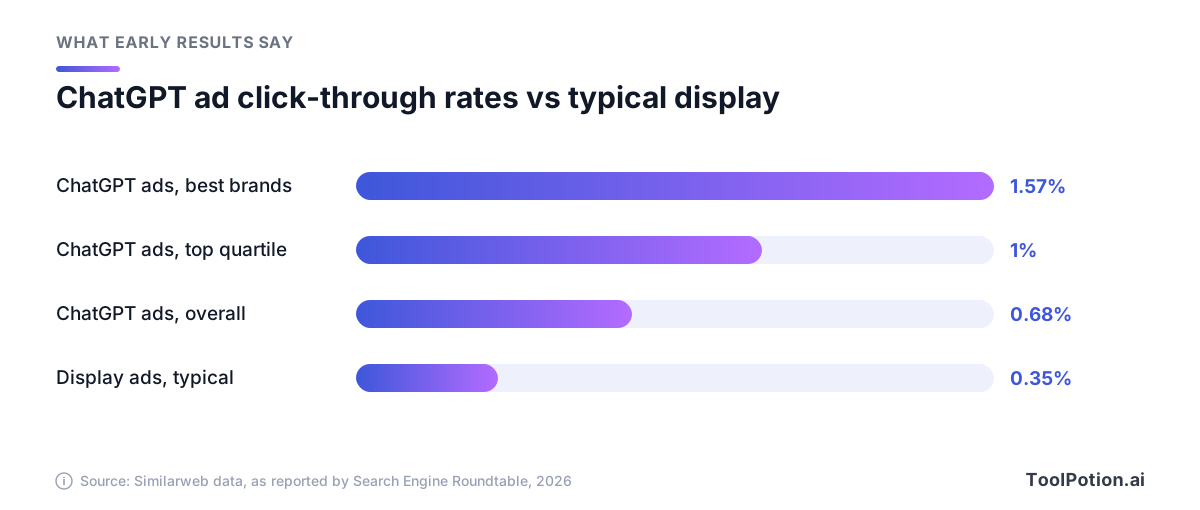
An overall CTR of 0.68% is roughly double the 0.35% Similarweb cites for display, and the best brands reach 1.57%, with a peak of 5.4% (Search Engine Roundtable). That's encouraging, with two caveats. A click rate says nothing about what happens on your site, and Similarweb's full report is gated, so its method isn't public.
The only conversion-flavored claim comes from OpenAI itself. In an email to advertisers quoted by Search Engine Roundtable, it said one global DTC brand doubled its CTR and cut its CPC by 50% after moving from standard ads to product-feed ads. That's one unnamed brand in a vendor's email. It's a good reason to test feeds first, and a poor basis for a forecast.
The skeptical side has evidence too. Early in the pilot, two agency executives told The Information they hadn't yet been able to prove the ads drove any measurable business outcomes, Search Engine Roundtable reported. Reporting has improved since, but OpenAI still says it has no performance benchmarks across advertisers, industries or campaign types. There's a forecasting gap as well. OpenAI projected $2.5 billion in ad revenue this year, according to Adweek, while Emarketer expects all standalone chatbots in the US combined to earn less than $1 billion from ads over the same period.
Trust, brand safety and the organic question
OpenAI's promise to users is answer independence: ads don't influence answers and run on systems separate from the chat model. It says the pilot showed no impact on consumer trust metrics and low ad dismissal rates (OpenAI). Those are OpenAI's own measures, and it hasn't published the numbers behind them.
For advertisers, the brand-safety questions are more practical:
- The answer above your ad may recommend a competitor, since it's written without regard to who paid.
- Units can carry several advertisers, so you can share the space with a rival. Search Engine Roundtable has documented two ads from two different advertisers in one footer.
- OpenAI is testing AI-written descriptive headings above ads, and Storyboard18 reports an opt-in feature that adapts your headlines and descriptions to the conversation and translates them. If your category has approved claims, leave that opt-in off.
- Brodie Clark of SERP Alerts caught ads loading for one advertiser and then switching to another. Ask how that first, brief impression is billed on a CPM buy.
OpenAI reviews ads, landing pages and advertisers with machine learning systems, LLMs and classifiers among them, and ads or pages its systems can't evaluate aren't eligible to run. The developer docs add that the destination must be reachable by OpenAI's ad crawlers. A landing page behind a login wall or a heavy script will stall your launch, so check it first.
Paid placement doesn't buy organic visibility. OpenAI's shopping help page says product results in ChatGPT search are "selected independently" and aren't ads or influenced by partnerships, and merchants are ranked on factors like availability, price and quality. Product feeds even carry separate flags for search eligibility and ads eligibility. Treat them as two programs with two owners: one person bidding, another making sure the products, reviews and pages that assistants cite are accurate.
To see where you stand organically, Microsoft Clarity's AI Visibility report shows which of your pages are referenced in AI answers and how often. Trackers such as HubSpot AEO and Profound monitor how brands appear in ChatGPT, Gemini and Perplexity, and Profound adds Copilot, Claude and Google AI Overviews. Our best AI SEO tools roundup and the Marketing & SEO board list more.
Who should test now, and who should wait
Test now if you sell consumer products, travel, local services or apps in a market where ads serve, you keep a product feed, and your conversion tracking already works server-side. That's the profile OpenAI built the beta around, and feed ads are where its one performance claim sits. Retailers with years of search CPA history get the cleanest comparison.
Wait if you're B2B with a long sales cycle. A 30-day click window and last-touch reporting won't connect a ChatGPT click to a deal that closes months later. Wait too if you're a finance, health or legal brand outside the US, since the policy shuts you out, or if your main markets are in Europe and your plan depends on personalized targeting. Political and alcohol advertisers aren't eligible at all.
Agencies sit in the middle. A holding-company or partner buy gets clients access and support, but write the test design below into the brief so the channel is judged on incremental sales instead of last-touch credit.
The decision tree runs the same logic in three questions or fewer.
If you land on "fix measurement first", do that before anything else. Without the pixel or the Conversions API you get impressions, clicks and spend, and none of those can tell you whether the channel pays.
A first-campaign test plan
A first test should answer one question: does ChatGPT produce conversions at a cost you'd accept from search? The six steps run in order, and the last one is a decision with a number attached.
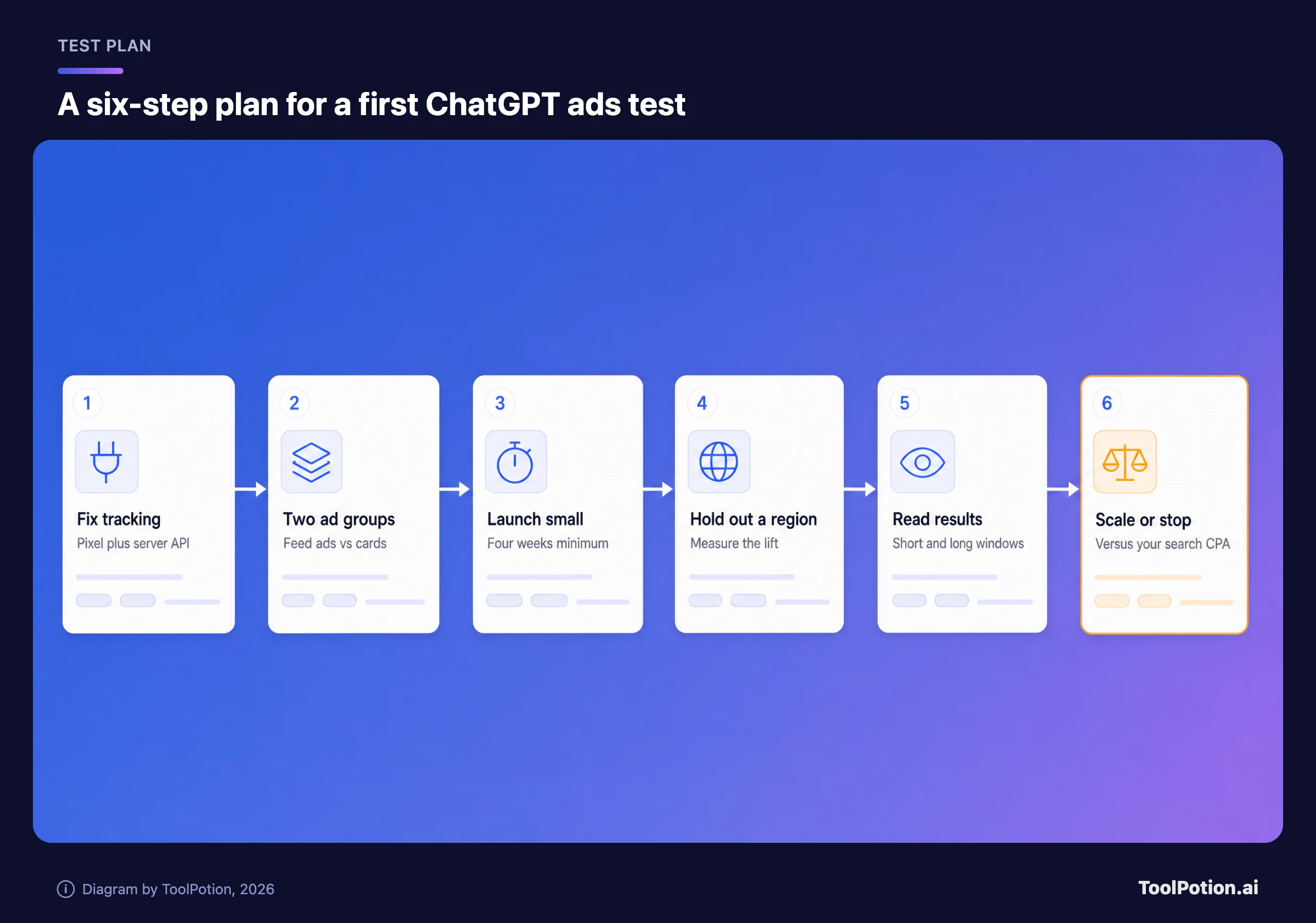
Size the budget so the result is readable. At $50 a day for four weeks you'll spend about $1,400, and any single day can hit $100 because of the seven-day averaging. Start on a clicks objective with Maximize clicks while conversion data builds, then move to conversion bidding once events flow, since there's no recommended bid to anchor a conversion campaign. A test at the $25 US floor is possible, but it'll take a long time to say anything.
Run two ad groups so you learn more than whether it worked. Put product-feed ads in one and standard chat cards in the other. Write titles that answer the kind of question people ask ChatGPT (50 characters fits a product and one reason to pick it), rotate a few images, and write context hints that plainly describe the product and its uses. Hints aren't keywords, so 2,000 synonyms is wasted effort.
Measure against a holdout. Last-touch reporting will credit ChatGPT with some sales that would have happened anyway, so exclude one region with a geographic exclusion and compare its sales with similar regions that saw ads. New product-feed campaigns only exclude at country level, so run the regional holdout on the chat-card group, or hold out a whole country if you sell in several. Read results at both the 7-day and 30-day click windows, wait 48 hours before judging any single day, and report view-through separately so one-day views don't inflate the total.
Then set guardrails. Upload existing customers as an exclusion audience (exclusions have no size minimum), add negative keywords where your account offers them, for topics you don't want near your brand, cap total spend at an amount you can afford to write off, and keep AI copy customization off until you've seen what it writes.
Plug your own numbers into the planner. Its defaults are placeholders, since OpenAI has no benchmarks to offer, so start from your search CPC and conversion rate.
At the defaults, $50 a day for 28 days buys about 933 clicks and 28 conversions at $50 each, just short of the 30-conversion bar we use as a rule of thumb for a first read. Either run six weeks or raise the daily budget, and decide which before launch so nobody kills the test because week one looked bad.
What to ask your OpenAI rep or agency
Sales calls for a new channel run on enthusiasm. Bring these eight questions and get the answers in writing.
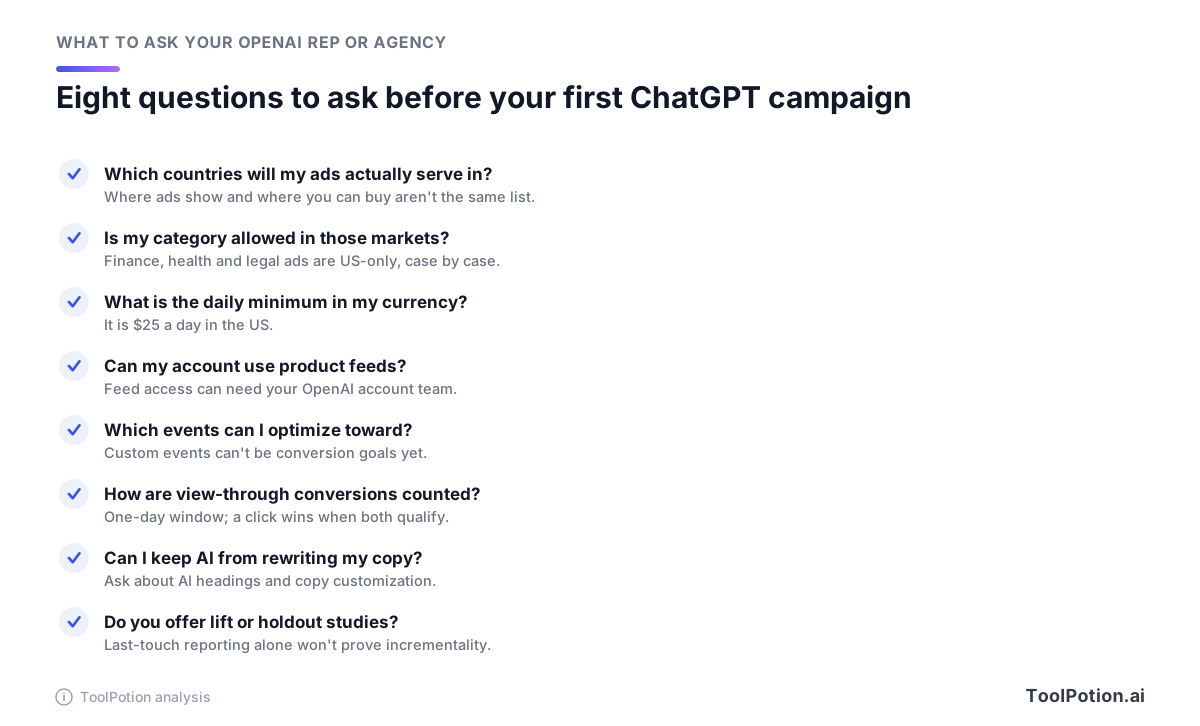
The last question matters most. If there's no lift study on offer, your regional holdout is the only incrementality evidence you'll have, so build it in from day one. Agencies sizing up the rest of their AI stack can browse our board of AI tools for marketing and creative agencies and the best AI marketing tools guide.
Frequently asked questions
Do ChatGPT Plus subscribers see ads?
No. Plus, Pro, Business, Enterprise and Edu are ad-free. Go, the cheaper paid plan, does show ads, so paying for ChatGPT doesn't by itself remove them.
Can advertisers read my ChatGPT conversations?
No, according to OpenAI. Advertisers get aggregate numbers such as views and clicks. By default ChatGPT can't see the ads shown to you either, unless you share one with it through the Ask ChatGPT option on the ad.
What is the minimum budget for ChatGPT ads?
In the US the minimum daily budget is $25, and other markets set their own minimums by currency. Because the daily budget is a seven-day average, a $25 campaign can spend up to $50 on one day and $175 over a week.
Can I target ChatGPT ads by keyword?
Not in the search sense. You add context hints that describe the ad, and OpenAI matches ads to conversations. Product-feed campaigns are coarser still on location, since new ones support geographic targeting and exclusions only at country level.
Are ChatGPT ads available in Europe?
Partly. The UK has had ChatGPT ads since earlier this year. In the EU, self-serve buying is rolling out, CNBC reported, but OpenAI says personalized ads aren't available at first in the EEA or Switzerland. That restriction doesn't name the UK, which sits outside the EEA.