In 2020, Uma Mirkhail, a crisis translator who works with Afghan refugees, was helping a Pashto-speaking woman whose asylum bid a US court had denied. Going through the documents, she found the reason in one pronoun. The woman's written statement said "we" where her interview had said "I". An automated translation tool had swapped them. In the interview she had come through one particular event alone, and in the paperwork she suddenly had company, and according to Rest of World that discrepancy was big enough for a US judge to deny the claim. The report doesn't say which tool did it. It does say AI tools for Pashto lag behind languages like English and Mandarin. That was reported in 2023, and the tools have changed since, but the habit hasn't.
Few mistranslations cost that much. The habit behind them is common, though: one translator gets used for everything, the same way, for a restaurant menu and a rental contract alike. We read the vendors' pricing and data pages, the independent evaluations we could find and what working translators say about all of it, and the pattern is plain enough. The right tool depends on the job, and for a couple of jobs the right tool is a person.
So this is organized by job: a sign on a phone, an email, a long document, a website, a conversation and a document you shouldn't paste anywhere. We compare DeepL, Google Translate and ChatGPT, with Claude where it matters. Prices are copied from each vendor's page in the currency that page showed us, with the billing basis noted. Where a number is our own arithmetic, it says so.
Nobody has run the clean head-to-head
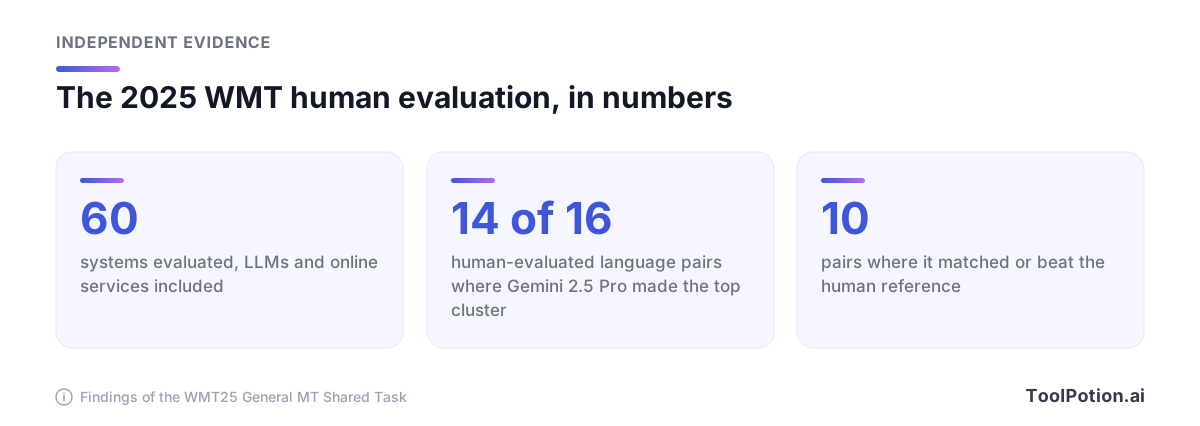
The closest thing the field has to a referee is the annual WMT shared task. The 2025 round evaluated 60 systems across 30 language pairs, with professional annotators rating the output for half of those pairs. Its headline result: Gemini 2.5 Pro landed in the top cluster for 14 of the 16 pairs that got human evaluation, and matched or beat the human reference in 10. GPT-4.1 and Claude 4 were also in the field, finishing in the top group for some pairs and lower for others.
Two cautions. The public online services in that evaluation are anonymized as ONLINE-B, ONLINE-G and ONLINE-W, so the paper can't tell you whether Google Translate beat DeepL, or the reverse. And the models were last year's. OpenAI's pricing page now lists a GPT-6 family, so read the result as a direction, not a scoreboard. The authors also titled their paper "Time to Stop Evaluating on Easy Test Sets", and reported that even the best systems still stumble on non-standard input, specialized terminology and gender agreement in some language pairs. Speech was the hardest domain they tested.
The study closest to a three-way comparison of products you can use today is smaller. A 2025 BMC Medical Education paper had three bilingual clinicians per language blind-rate translations of critical-care teaching material from DeepL, Gemini, Google Translate and Microsoft Copilot into Chinese, Spanish and Ukrainian, against a professional medical translator. The authors tested the free versions of each tool, on model generations older than today's, so treat it as a snapshot. Gemini scored best in Spanish, Copilot in Ukrainian, and the human in Chinese. Google Translate scored lowest in Spanish and Ukrainian. The authors' own conclusion: "No single MT tool performed best across all metrics and languages".
That is the finding worth keeping, because it undercuts every "DeepL is more accurate" claim you'll read, including DeepL's. Accuracy changes with the language pair and the text. And the professionals who do this for a living are wary of the whole question. The American Translators Association warns that machine output "may appear accurate to the general observer, making errors harder to detect for those without linguistic expertise" (ATA statement). Corinne McKay, a certified French-to-English translator and former ATA president, put the buyer's side of it in a 2024 post for the association, though she also grants that machine translation with a human reviewer can be a good option for understanding what a text says: "Just because you can translate with ChatGPT or other AI tools, should you?" (ATA).
We found no 2026 independent test that runs all three on the same documents, and we'd distrust any article that claims one. What follows leans on what can be verified: features, limits, prices and data terms from the vendors, plus the evidence above about where machines go wrong.
A sign or a menu: Google, because of the camera and the offline packs
This is Google's job. Its Lens camera mode overlays translations on menus and signs, and the Translate app lets you download languages for use without a connection on Android and iOS (Google, 20 years of Translate). Google says Translate now covers almost 250 languages. Google's help page for image translation is candid about the limit that matters for menus: small, unclear or stylized text lowers accuracy, which describes most chalkboard specials. The app is free.
DeepL lists image translation among its features, and ChatGPT's mobile app will read a photo and answer questions about it. Both are fine in a pinch. Neither gives you the live overlay or the offline packs, at least on the pages we read, and with no connection at a train station the offline packs are the whole point.
The email to a client
Here the tools get close, and the difference is control. DeepL's plan table lists a formal/informal switch and an optional Write Pro add-on, which is €6.99 per user per month billed annually, for rewriting tone. ChatGPT has no switch but takes instructions, so "warm, but not casual, they've been a client for ten years" actually changes the output. It has a free tier and paid plans, so for one email the cost is nothing.
Our pick is DeepL when the email is short and plain, and ChatGPT when tone is the hard part. In both cases, add one step if you can't read the target language. Paste the translation into a different engine and translate it back to English. McKay describes a client whose engine "translated" the Swiss town of Aubonne as "Augood". A round trip catches that sort of thing in seconds, though not the subtler errors, like a polite register that comes out curt.
One more catch before you paste a customer's name into anything. DeepL's privacy policy says the free Translator and Write may use submitted content to train its models, and that its terms bar personal data of any kind on the free tier (DeepL privacy policy). Client emails are full of personal data. That is a Pro-plan job.
Forty pages of contract or manual
Document upload is where the limits start to bite. Google's web Translate takes .docx, .pdf, .pptx and .xlsx files up to 10 MB, PDFs up to 300 pages, and not on mobile. Text inside images and scanned PDF pages is left untranslated (Google help). DeepL's limits scale with the plan, per its pricing page (euros as shown for Germany, VAT included, annual billing):
| DeepL plan | Price per user | Files per month | Max file size | Glossaries |
|---|---|---|---|---|
| Free | €0 | 1 | 5 MB | 1 (5 entries per pair) |
| Individual | €7.49 | 3 | 30 MB | 1 (5 entries per pair) |
| Team | €24.99 | 20 | 30 MB | 5 (1,000 entries per pair) |
| Business | €49.99 | 100 | 100 MB | Unlimited, fair use |
ChatGPT's limits are of a different kind. Its upload help page allows very large files, and caps Free users at three uploads a day. It describes asking questions about files, summarizing and rewriting them. It doesn't promise a translated file with your layout intact, so a typeset manual with tables and figures is awkward there, and a long contract means checking that nothing was silently skipped.
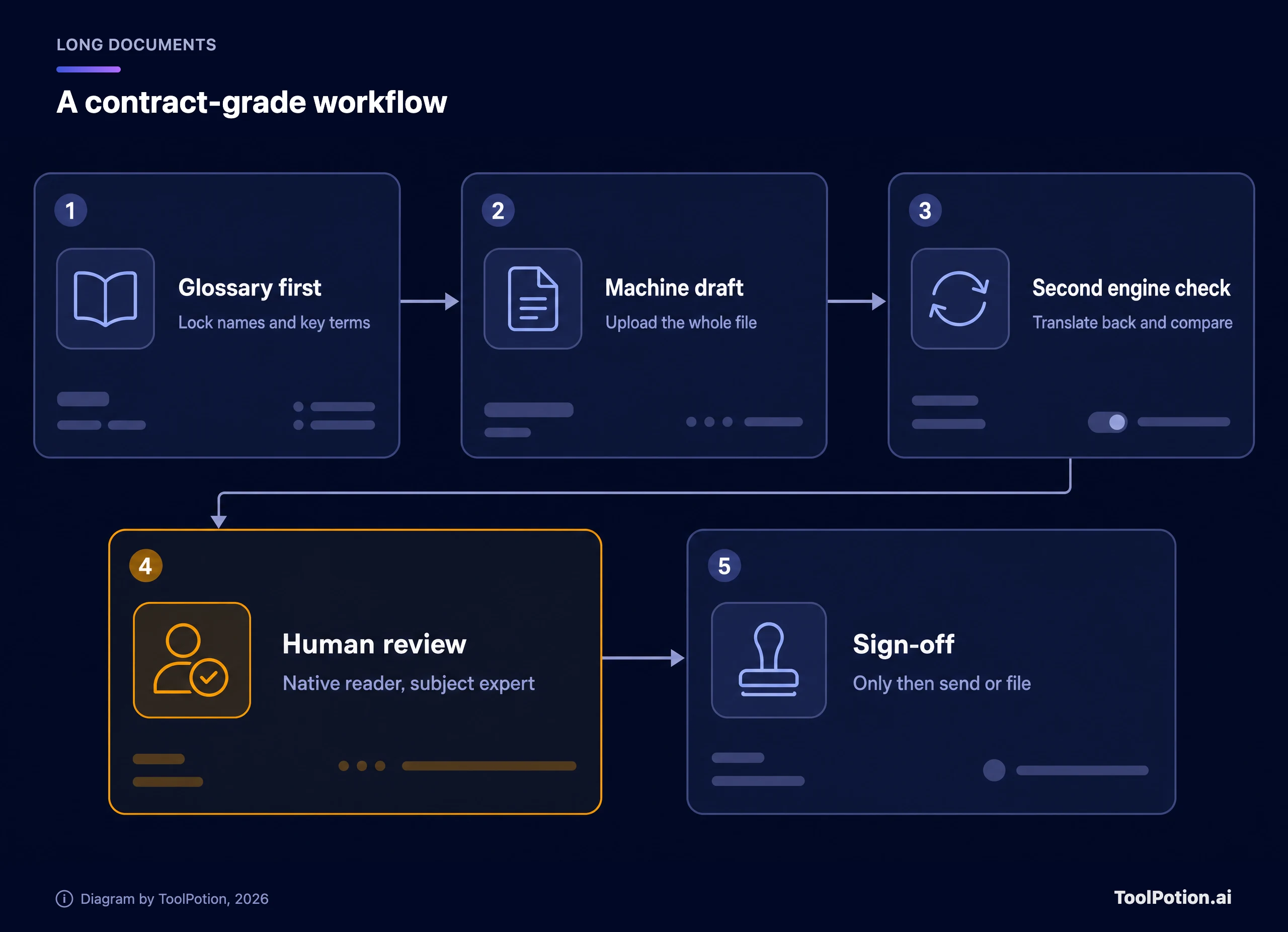
For a manual or help center where a wrong word is an annoyance, our pick is DeepL with a glossary. The glossary is the feature that matters, because it is what keeps your product name and your three key terms from drifting between page 3 and page 31. A five-entry glossary on Free and Individual is a demo, so a real manual wants Team, with its 1,000 entries per language pair.
For a contract, we wouldn't stop at a tool. The ATA statement names legal work among the fields where no one can afford the risk of AI-generated mistranslation (ATA), and the reason is structural: legal concepts differ between jurisdictions, and a fluent sentence can carry the wrong one. Use a machine to learn what a counterparty's draft says and to prepare your questions. Then pay someone qualified before you sign, and tell them which tool produced the draft so they know what kinds of errors to hunt for.
The same logic runs in reverse for your own documents. If you send a client a translated manual, you own its mistakes. A cheap safeguard is to have one native reader skim just the headings, warnings and numbers, since those are where a wrong word costs the most. An hour of that beats a full retranslation, and it catches the errors machines make most confidently.
A website or an app is a price-per-character fight
If you're translating at volume, price per character decides, and the gap is large. DeepL's API Developer tier gives a one-time credit of 1 million characters. Growth is $26 a month on annual billing with 12 million characters a year included and $27.50 per additional million, capped at 50 million a month (the page shows US dollars). Our calculator below treats the 12 million a year as 1 million a month, which is our simplification. Google Cloud's Neural Machine Translation costs $20 per million characters after the first 500,000 each month, which are free (Google Cloud pricing). Google also sells an LLM translation model at $10 per million characters in and $10 out, and document translation at $0.08 a page.
OpenAI bills by token. The API price page lists GPT-6.1 Terra at $1.00 per million input tokens and $5.00 per million output tokens, and the smaller GPT-6 Luna at $0.10 and $0.50. At roughly 250 tokens per 1,000 characters of English, with output as long as input, our arithmetic puts a million characters at about $1.50 on Terra and 15 cents on Luna.
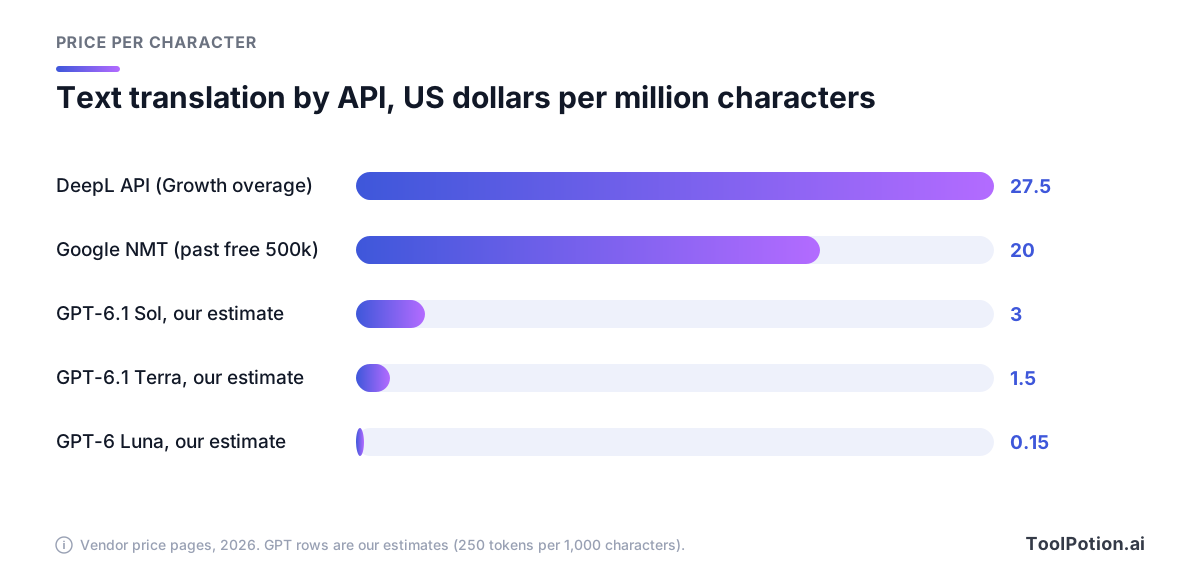
That's roughly a 180-fold spread between the cheapest and dearest rows, and it isn't a quality difference. It is a pricing-model difference. The LLM figure also moves with the language: Thai, Hindi and Korean text takes many more tokens per character than English, so plug in your own.
What the chat-model price doesn't buy is the plumbing. DeepL's API table lists tag handling, so HTML and app strings with placeholders survive, plus 2,000 glossaries on Growth and CAT-tool integration. Google's Cloud Translation doesn't charge for creating a glossary. With a raw LLM you write that guardrail yourself, and variables like {name} or %s are exactly what a language model likes to translate.
Data terms differ by tier too. The DeepL page lists "No data training" as a Growth feature and not under Developer. Google says it doesn't use content sent to the Cloud Translation API to train its features, and that text is held briefly in memory to produce the result (Google Cloud data FAQ). One thing to settle early is who owns the review. A cheap engine with no reviewer produces cheap-looking pages in a language you can't read, and search engines and customers notice. Our advice for a site or app: run 50 of your real strings through two engines with your glossary loaded, have a native reader mark them, and only then look at the price.
A live conversation is Google's second job
Google leads here, and it's recent. Its Translate app now has a live mode, powered by Gemini audio models, that Google says works through any headphones and preserves the original speaker's tone and cadence. Google also reports that over a third of live sessions run past five minutes (Google), which suggests people use it for real conversations and not only to ask directions. For back-and-forth with someone who doesn't share your language, or a lecture you can't follow, we'd use that. The Gemini Live assistant is the nearby option if you want to talk to the AI itself.
DeepL's answer is DeepL Voice, for conversations and meetings. Its paid Translator plans list 30 minutes of Voice per user per month, which fits scheduled calls better than wandering a market. Its privacy policy says the audio, transcript and translation are deleted once the translation is done, unless your organization sets a retention period. ChatGPT's voice help says you can ask it during a Voice conversation to speak a different language. That's a capable assistant doing interpretation on request, not an interpreter product.
A caution from the WMT results: speech was the hardest domain, probably because transcription errors flow straight into the translation. A noisy room makes all of this worse. For anything with consequences, such as a hospital intake, the profession's position is unambiguous, and we turn to it next.
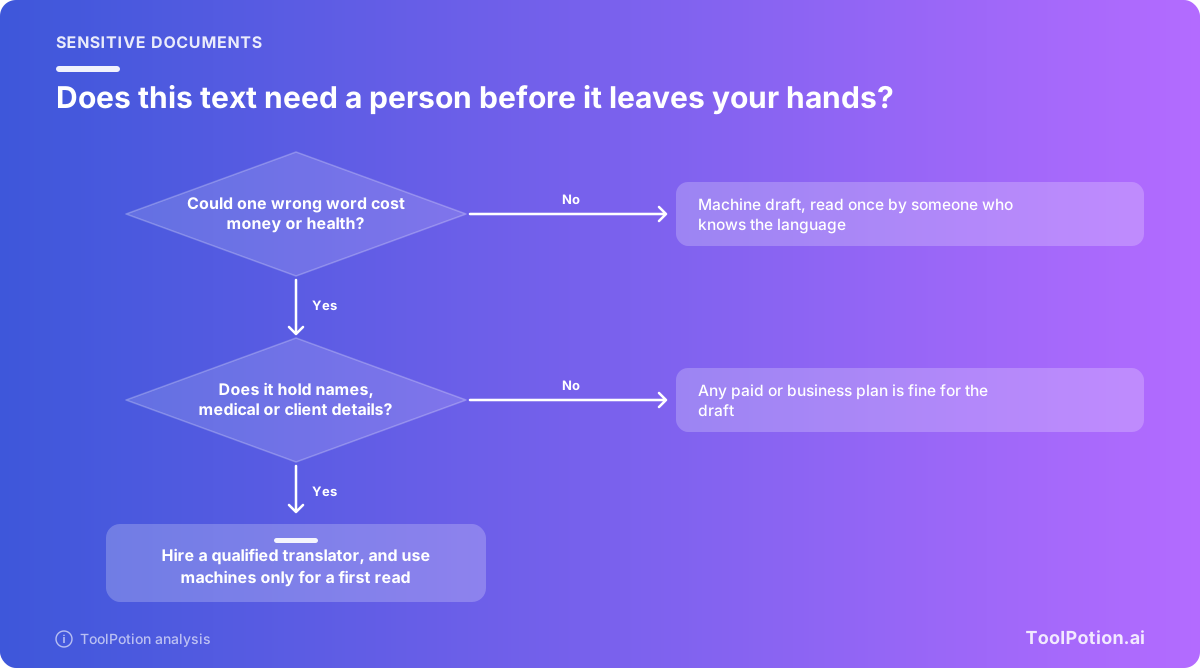
A sensitive document needs a person, not a plan
Start with where the text goes, because the answer changes by plan. On free DeepL, the privacy policy says content is processed "for a limited period of time to train and improve" its networks, and forbids personal data. On DeepL Pro and the API, the same policy says texts are kept only temporarily, deleted after the translation, and not used to improve the service.
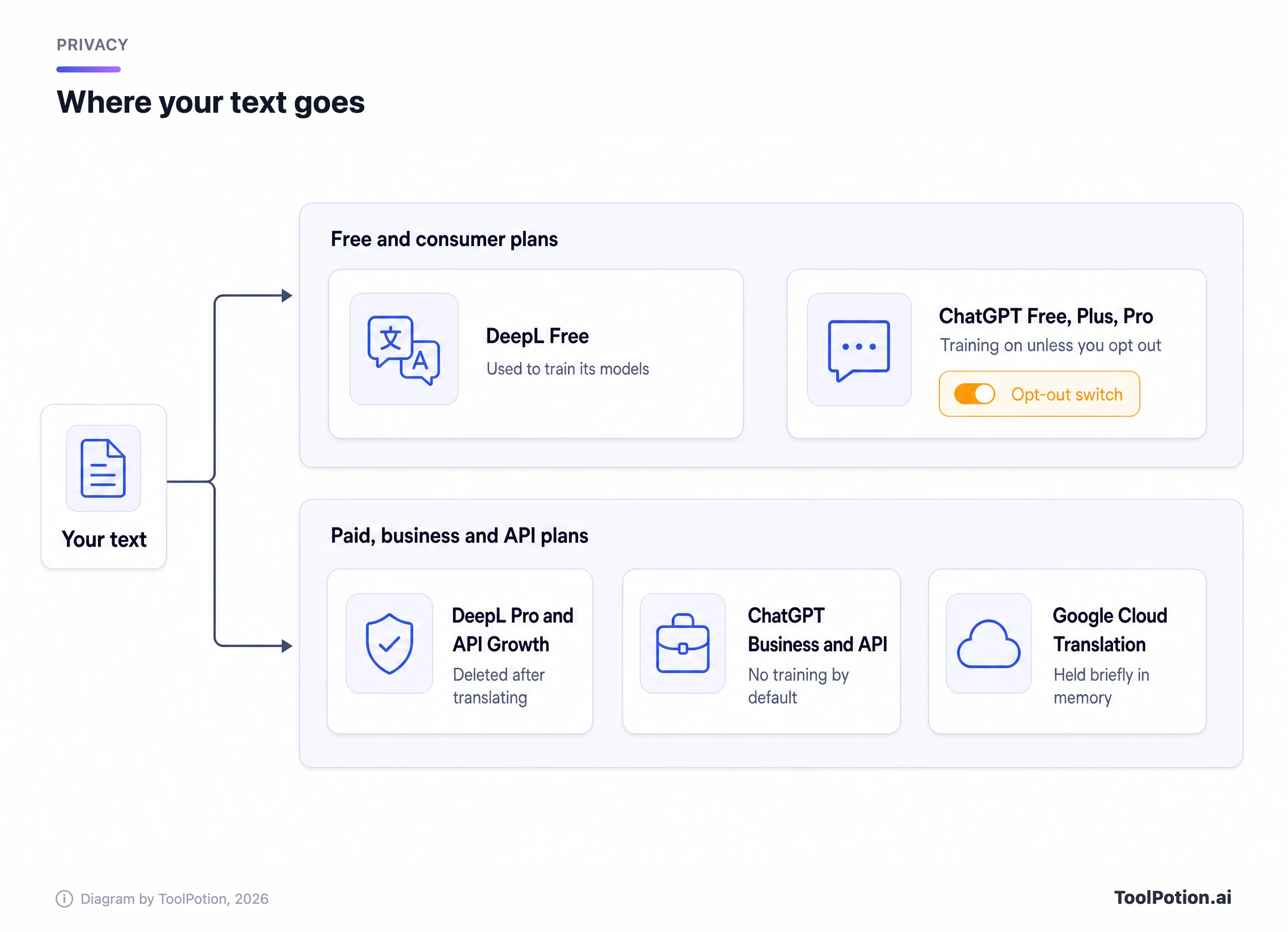
OpenAI's individual plans (Free, Plus, Pro) may use your content to train models unless you switch off "Improve the model for everyone" in Settings. Feedback is a loophole worth knowing: a thumbs-up or thumbs-down can send the whole conversation into training even after you've opted out. ChatGPT Business, Enterprise, Edu and the API don't train on your inputs by default (OpenAI help). Google's Cloud Translation terms, quoted above, are the strictest in writing. For the consumer Translate app and website we couldn't find a retention statement on the pages we opened, so we can't tell you what happens to a pasted text there. Treat that as an open question and keep confidential documents out.
The ATA also lists confidentiality as a risk in its AI statement: tools "may require users to input text into platforms that may store, process, or even repurpose the data". McKay writes that her family-law clients ask whether she uses automated translation at all, because they fear their evidence will end up on a provider's servers.
Then the accuracy problem. Sara Haj-Hassan of Tarjimly, a nonprofit that connects refugees with volunteer translators, told Rest of World in 2023: "Machine-learning translations are not yet in a place to be trusted completely without human review." Ariel Koren of Respond Crisis Translation put the working rule better: "The machine, it can be your friend that you use as a helper, but if you’re using that as the ultimate [solution], if that’s where it starts and ends, you’re going to fail this person." The ATA statement names healthcare, legal, financial and public-sector translation as fields where no one can afford the risks. We agree, and that includes the vendors' premium tiers. A Pro plan settles where your text goes. It says nothing about whether the translation is right.
Where Claude fits
Claude took part in the WMT25 evaluation too, ranking as high as a tie for second to fourth in one language pair and as low as ninth to fourteenth in another. Claude isn't marketed as a translation product, and we found no translation-specific limits or pricing to compare, so it appears here as an option inside chat, not as a column in the tables. Like ChatGPT, it can be told who the reader is and what register you want. And you don't have to pick: DeepL says its translation is now available inside Microsoft Copilot, ChatGPT and Claude through MCP, and its policy says content sent that way is used only for the translation and not stored. For how the three assistants compare outside translation, see our ChatGPT vs Claude vs Gemini comparison.
Our picks, by the job you actually have
| Job | Our pick | Watch for |
|---|---|---|
| Sign, menu, label | Google Translate | Stylized fonts, no connection without offline packs |
| Email to a client | DeepL, or ChatGPT for tone | Personal data on free tiers, register errors |
| Manual, help pages | DeepL Team with a glossary | Free limits: 1 file, 5 MB, 5-entry glossary |
| Contract, medical or legal text | A qualified translator | Machine output that looks right and isn't |
| Website or app, high volume | DeepL or Google API, or an LLM API if price rules | Placeholders, data terms by tier |
| Live conversation | Google Translate live translate | Noise, long sessions, anything high-stakes |
If your job isn't on that list, the tree below asks the same questions we did. For subtitles and dubbing, which is a different class of tool, start with our AI subtitles and dubbing board. To compare more engines, see our top AI translation tools review, every ToolRank board for translators and the tools ranked for translators.
Frequently asked questions
Is DeepL more accurate than Google Translate?
It depends on the language pair and the text. The one independent study we found that included both, in a medical setting, saw no single winner across Chinese, Spanish and Ukrainian, and Google Translate ranked lowest in two of the three. Claims that one is better everywhere come from the vendors.
Is ChatGPT good enough to replace a dedicated translator app?
For tone-sensitive messages and for cheap, high-volume API work, yes, and it is far cheaper per character. For camera translation, offline use, and layout-preserving documents, no. Neither it nor the others replace a human for legal or medical text.
Is it safe to paste a work document into DeepL Free?
Not if it contains personal or confidential data. The free tier may use content to train models and its terms forbid personal data. DeepL Pro and its API delete texts after translating and don't train on them.
Which of these works offline?
Google Translate, through downloadable languages on Android and iOS. We didn't find an offline mode on the DeepL or ChatGPT pages we read.
When should I pay a human translator?
Whenever a wrong word has a legal, medical or financial cost, and for anything you'll sign, file or publish. The American Translators Association keeps an online directory of certified translators you can search by language and specialty.