OpenClaw is #1 on the 2026 board with a ToolRank score of 75, and its repository was only created in late 2025. It has about 391,000 GitHub stars now, roughly 185,000 more than the next most-starred repo in the top 25, n8n. Nothing else on this list grew that fast.
The rest of the top ten is a strange mix. The first eight sit within six points of each other before scores drop to 62, and that cluster includes two agent frameworks, an image interface whose main branch hasn't changed since 2024 and a commercial coding agent whose repo license reserves all rights. Stars and scores show what people pay attention to. They don't show what you may legally ship, or who will patch the next security hole.
This guide sorts the Top 200 AI GitHub Repos board by job, then covers licenses, how to vet a repo and how to run agent code without handing it your whole machine.
The top 25 AI GitHub repos right now
- # 1Top PickLangChainGitHub RepoLangchain is an agent engineering platform hosted on GitHub, allowing developers to contribute to its development. Users can engage with the project by creating an account on GitHub and participating in its evolution.75ToolRankStrong
- # 2Runner UpStable Diffusion Web UIGitHub RepoStable Diffusion web UI is a Gradio-based interface for Stable Diffusion models. It offers a comprehensive set of features for image generation, editing, and training, including advanced options for prompts, upscaling, and model merging. This tool empowers users to create and manipulate AI-generated art with detailed control.74ToolRankStrong
- # 3Third PlaceAutoGPT: Autonomous AI AgentsGitHub RepoAutoGPT is a platform for creating, deploying, and managing autonomous AI agents. It allows users to automate complex workflows by building custom agents or using pre-configured ones. The platform offers an intuitive interface for agent design, workflow management, and performance monitoring, enabling users to focus on their ideas.74ToolRankStrong


- 4CrewAIGitHub RepoCrewAI is a framework designed for orchestrating role-playing, autonomous AI agents. It fosters collaborative intelligence, enabling agents to work together seamlessly on complex tasks, enhancing productivity and efficiency in various applications.70ToolRankStrong
- 5Gemini CLIGitHub Repogoogle-gemini/gemini-cli is an open-source AI agent that integrates the power of Gemini directly into your terminal, enabling seamless AI interactions and command execution.70ToolRankStrong
- 6Bolt.newGitHub RepoBolt.new is an AI-powered agent for building full-stack web applications directly in your browser. It allows users to prompt, run, edit, and deploy applications without local setup, integrating AI with a development environment powered by StackBlitz WebContainers for a seamless workflow.69ToolRankStrong
- 7CivitaiGitHub RepoCivitai is a GitHub repository that provides a collection of models and textual inversions. It serves as a resource for developers and researchers interested in exploring and utilizing AI models for various applications.63ToolRankStrong
- 8n8nGitHub Repon8n is a fair-code workflow automation platform that integrates native AI capabilities. It allows users to visually build workflows, combine custom code, and offers over 400 integrations, making it suitable for both self-hosting and cloud deployment.61ToolRankStrong
- 9OllamaGitHub RepoOllama is an open-source tool for running large language models on your own computer. It lets developers install models like Llama, Gemma, Qwen and DeepSeek with a single command, then use them through a CLI, a REST API, or the official Python and JavaScript libraries, on macOS, Windows, Linux or Docker.61ToolRankStrong
- 10ComfyUIGitHub RepoComfy-Org/ComfyUI is a powerful and modular diffusion model GUI, API, and backend featuring a graph/nodes interface. It is designed for users seeking an intuitive way to manage diffusion models effectively.61ToolRankStrong
- 11DifyGitHub RepoDify is an open-source platform for developing LLM applications. It offers a visual canvas for building AI workflows, RAG pipelines, and agent capabilities. With comprehensive model support and LLMOps features, it enables rapid prototyping and production deployment for developers.60ToolRankStrong
- 12PaddleOCRGitHub RepoPaddleOCR is a powerful, lightweight OCR toolkit designed to convert PDFs and image documents into structured data for AI applications. It supports over 100 languages and bridges the gap between images, PDFs, and large language models.58ToolRankSolid
- 13LlamaFactoryGitHub RepoLlamaFactory is a GitHub repository focused on the unified and efficient fine-tuning of over 100 large language models (LLMs) and vision-language models (VLMs). It aims to streamline the fine-tuning process for researchers and developers in the AI field.58ToolRankSolid
- 14Aider - AI Pair Programming ToolGitHub RepoAider is an AI pair programming tool that operates directly in your terminal, enhancing coding efficiency and collaboration. It allows developers to leverage AI assistance for coding tasks, making programming more intuitive and productive.58ToolRankSolid
- 15LangflowGitHub RepoLangflow is a powerful tool for building and deploying AI-powered agents and workflows. It enables users to create intelligent systems that can automate tasks and enhance productivity across various applications.58ToolRankSolid
- 16Ultralytics YOLOGitHub RepoUltralytics YOLO includes YOLO26, YOLO11, and YOLOv8, providing capabilities for object detection, instance segmentation, semantic segmentation, image classification, pose estimation, and object tracking. It is designed for developers and researchers in the field of computer vision.58ToolRankSolid
- 17prompts.chatGitHub Repoprompts.chat (formerly Awesome ChatGPT Prompts) is an open-source library of prompts for AI chat models, compatible with ChatGPT, Claude, Gemini, Llama, and Mistral. It's free to browse, contribute to, or self-host with your own branding and authentication, and it also ships a CLI, an MCP server, and a Claude Code plugin. It has over 171,000 GitHub stars.58ToolRankSolid
- 18HummingbotGitHub RepoHummingbot is an open-source software that enables users to create and deploy high-frequency crypto trading bots. It provides a platform for automating cryptocurrency trading strategies, making it accessible for both individual traders and institutions.57ToolRankSolid
- 19AnythingLLMGitHub RepoAnythingLLM empowers users to own their intelligence rather than rent it. This tool provides everything necessary for a robust local-first agent experience, enhancing productivity and autonomy in various tasks.57ToolRankSolid
- 20OpenHandsGitHub RepoOpenHands is an AI-driven development platform hosted on GitHub. It allows developers to contribute to its growth and functionality by creating an account on GitHub, fostering collaboration and innovation in software development.57ToolRankSolid
- 21Open WebUIGitHub Repoopen-webui/open-webui is a user-friendly AI interface that supports various AI models, including Ollama and the OpenAI API. It aims to simplify interactions with AI technologies for developers and users alike.57ToolRankSolid
- 22vLLMGitHub Repovllm-project/vllm is a high-throughput and memory-efficient inference and serving engine designed for large language models (LLMs). It optimizes performance while minimizing resource usage, making it suitable for various applications in AI and machine learning.57ToolRankSolid
- 23InvokeAIGitHub RepoInvokeAI is a creative engine for Stable Diffusion models, enabling professionals, artists, and enthusiasts to generate visual media using AI technologies. It features a WebUI and serves as a foundation for multiple commercial products.56ToolRankSolid
- 24ChromaGitHub RepoChroma is an AI-focused search infrastructure project hosted on GitHub. It enables developers to contribute to its development and enhance AI search capabilities through collaborative efforts.56ToolRankSolid
- 25LivePortraitGitHub RepoLivePortrait is an open-source PyTorch implementation for efficient portrait animation. It brings portraits to life by animating them with stitching and retargeting control, supporting both human and animal subjects. The project offers inference scripts and a Gradio interface for easy use.56ToolRankSolid





















How ToolRank works
ToolRank is ToolPotion’s proprietary ranking engine.
It continuously evaluates hundreds of signals across the open web — real traffic and popularity, audience and community strength, authority and longevity, adoption and engagement — processing millions of data points to place every tool where it has earned to be.
Every AI type is measured by its own tailored model: what proves traction for a SaaS app is not what proves it for an open-source framework or a creator channel. Missing a platform never counts against a tool — ToolRank judges the evidence that exists.
No paid placement. No self-reported numbers.
Quick picks
- Best personal agent: OpenClaw, #1 at 75 (strong tier), an MIT-licensed assistant you host yourself and reach from your chat apps.
- Best framework for building agents in code: LangChain, #2 at 74, MIT-licensed and the broadest integration library here.
- Best free coding agent: Gemini CLI, #8 at 69, Apache 2.0, with 1,000 free requests a day on a personal Google account.
- Best way to run models locally: Ollama, #10 at 60, MIT-licensed and one command to install.
- Best workflow builder for internal automation: n8n, #9 at 62, as long as you stay inside its Sustainable Use License.
- Best image and video interface: ComfyUI, #11 at 60, which keeps shipping while the higher-ranked Stable Diffusion Web UI has stalled.
Eight repos sit between 69 and 75, so position alone can't separate a framework you'd build a company on from a project whose main branch hasn't moved in two years.
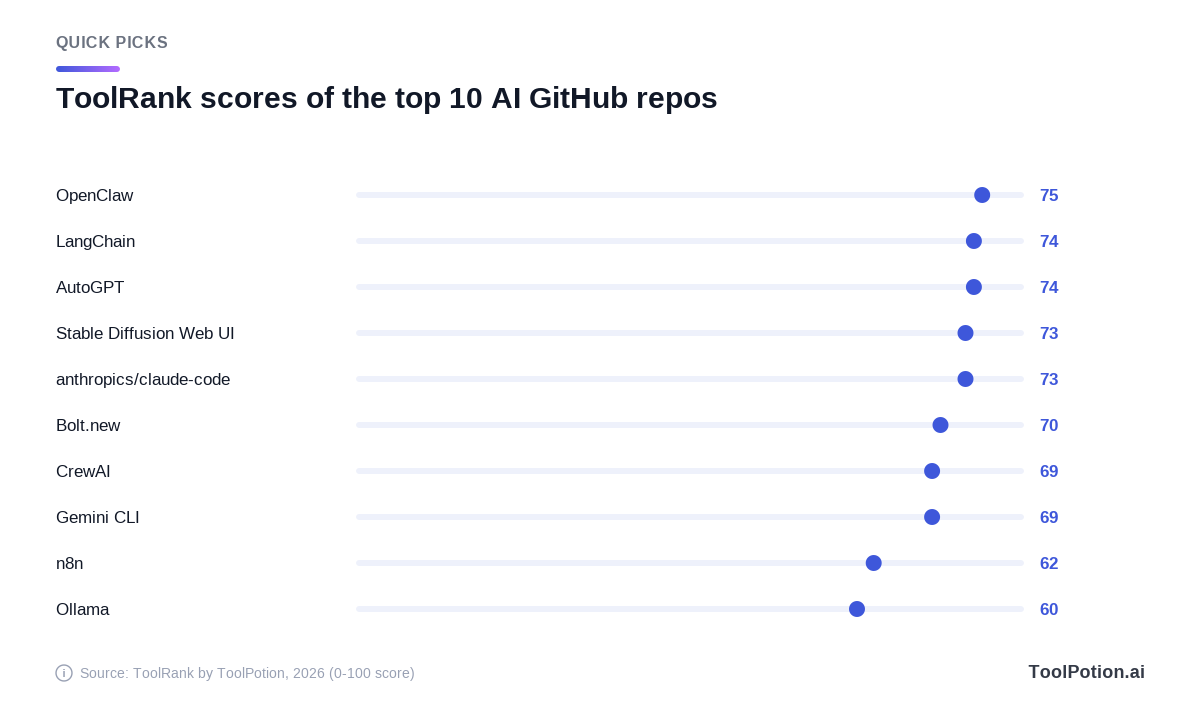
The gap after Gemini CLI is the clearest break on the board. Below it, everything from n8n at 62 down to goose at #25 (56) also sits within six points, so the rest of this guide leans on license and upkeep more than on position.
What changed in 2026
The personal agent became the headline. OpenClaw was called Clawdbot, then Moltbot, and the first rename came after Anthropic threatened legal action over the name's similarity to Claude. Its creator, Peter Steinberger, then joined OpenAI, and Sam Altman said OpenClaw would live on in a foundation that OpenAI supports (TechCrunch). The README now says an independent 501(c)(3), the OpenClaw Foundation, stewards the project, that OpenClaw has no paid tier and that "OpenAI is a donor, not an owner" (GitHub).
More of the board sits under neutral roofs. goose, which used to live at block/goose, belongs to the Agentic AI Foundation, a Linux Foundation body that also hosts the Model Context Protocol, AGENTS.md and Agent2Agent (AAIF). OpenHands moved to its own GitHub organization.
Vendor coding agents now sit in the top ten, and their repos show that a GitHub page isn't a license. Google's Gemini CLI is Apache 2.0. Anthropic's anthropics/claude-code, #5, has a one-line license: "© Anthropic PBC. All rights reserved." (GitHub).
Security got real. Trend Micro found 39 malicious OpenClaw skills on ClawHub that talked the agent into installing a fake command-line tool carrying a macOS info-stealer (Trend Micro). NVD lists a 2026 n8n flaw, CVE-2026-21858, that GitHub's advisory scored 10.0 and that let unauthenticated attackers reach server files through some form workflows, fixed in version 1.121.0 (NVD). And Anthropic stopped letting Claude plan limits cover third-party harnesses, starting with OpenClaw (TechCrunch).
Most of the top 25 aren't rivals, though. They sit at different layers, and a real project usually combines three or four.
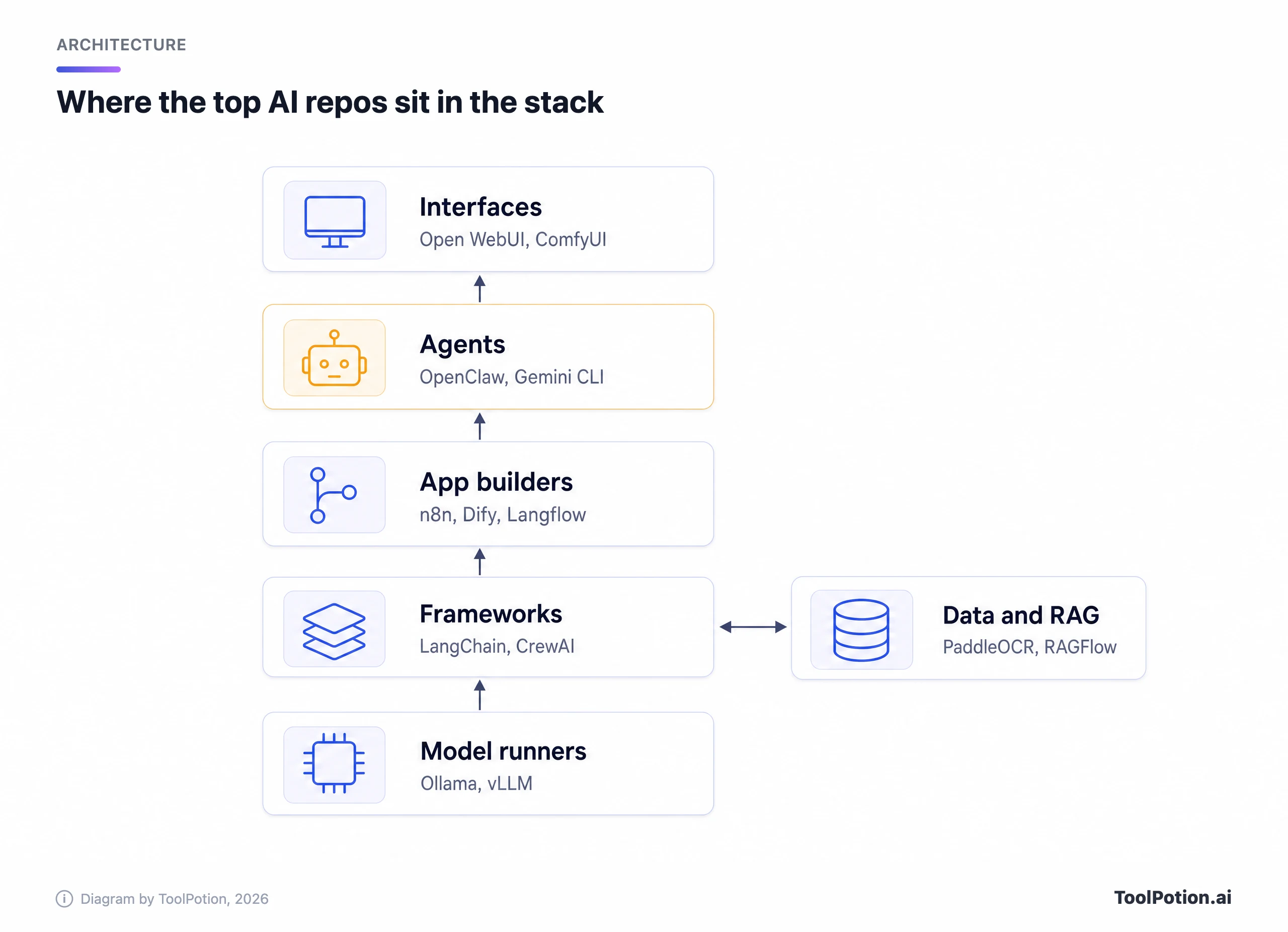
Read it from the bottom. A runner serves the model, a framework or builder turns it into an app, and an agent or interface is what a person touches. Data tools such as PaddleOCR feed the middle. The sections below follow those layers.
Personal agents and agent frameworks
OpenClaw: best for a personal assistant on your own hardware
It's #1 at 75, strong tier. OpenClaw runs a local Gateway that connects an AI model to the chat apps you already use, including WhatsApp, Telegram, Slack, Discord, iMessage and Teams, with companion apps for desktop and phone. Models are plugins, so Claude, Codex or a local model can sit behind it, and state, memory and credentials stay on your hardware. Releases arrive constantly under date-stamped versions.
The catch is in its own README: tools run on the host for the main session unless you configure sandboxing, and you should treat inbound messages as untrusted input. An assistant that reads your chats and runs commands is exactly what an attacker wants to message. Sally O'Malley, a Red Hat engineer and OpenClaw maintainer, called it "incredibly powerful" but "dangerous" if not configured properly (TechCrunch). If containers and log files aren't your thing, wait.
LangChain: best for building agents in code
#2 at 74. LangChain is an MIT-licensed framework for agents and LLM apps, with one interface over models, embeddings, vector stores and tools. Its README now points newcomers to Deep Agents, a higher-level package for planning and subagents, and anyone needing tight orchestration to LangGraph. The price is abstraction: layers that help on day one can get in the way by day ninety. If your app is one model call plus retrieval, skip it. If you'll swap providers and wire in many tools, the integrations are the reason to pick it.
CrewAI: best for multi-agent teams
CrewAI is #7 at 69, MIT-licensed and, as its FAQ stresses, a standalone Python framework rather than a LangChain add-on. Crews let role-based agents collaborate with some autonomy, and Flows give event-driven, step-by-step control. The company sells a commercial control plane, CrewAI AMP, which you don't need. Pick CrewAI when the work really is a team, say a researcher, a writer and a reviewer passing a draft along. For one agent with a few tools, it's more structure than the job needs.
AutoGPT: a hosted agent platform with a restrictive license
AutoGPT is #3 at 74. The repo dates from 2023 and is now a platform for building and running agents from plain-English goals or a visual builder, with a paid hosted service and a free self-hosted path where you bring your own infrastructure and model keys.
Read its LICENSE file before you build on it. Everything in the autogpt_platform folder is under the Polyform Shield License, which allows any purpose except providing a product that competes with the software or with anything its makers offer using it. The classic agent outside that folder stays MIT. An internal tool is fine. A startup building its own agent platform should look elsewhere.
Coding agents and CLIs
This corner has the widest license spread on the board, from Apache 2.0 to all rights reserved.
Claude Code: best for Claude subscribers, but not open source
#5 at 73. Claude Code is Anthropic's agentic coding tool for the terminal, IDEs, a desktop app and the browser. Its GitHub repo is where Anthropic publishes plugins, examples and the changelog and where users file bugs, with more than 14,000 open issues and pull requests at the time of writing. The top level holds those plugins and scripts, not the CLI's source tree.
Using it takes a paid plan or an API account. The Free plan doesn't include Claude Code. Pro does, at $20 a month billed monthly or $17 a month billed annually, and Max starts at $100 a month, with coding drawing on the same usage limits as your chats (Claude). Star the repo to follow releases and report bugs. Just don't count it as open source in a license review.
Gemini CLI: best free terminal agent
#8 at 69, and Google's agent is the opposite case: Apache 2.0, with a stable release every week and nightly builds. Sign in with a personal Google account and the README promises 60 requests a minute and 1,000 a day free, plus MCP support for custom tools (GitHub). Anyone comparing coding agents on a budget should start here.
OpenHands, Cline and goose: best when you choose the model
Three open repos let you bring any model. Cline (#19, 57, Apache 2.0) runs in VS Code, the terminal and a desktop app, and each edit arrives as a diff you approve, though its README says the JetBrains plugin isn't open-sourced. OpenHands (#14, 59, MIT) now calls itself a developer control center: its Agent Canvas runs its own agent, Claude Code, Codex or Gemini on local, Docker, VM or cloud backends. The quickstart's first option runs with no sandbox and warns that "the agent will have full access to your filesystem," so take option two, Docker. goose (#25, 56, Apache 2.0) is a Rust agent with a desktop app, CLI and API, 15+ model providers and 70+ MCP extensions, and its foundation home matters if you care who controls the roadmap.
Aider (#16, 58) gets a warning instead. The terminal pair programmer's last release, v0.86.0, came out in 2025, and its README still lists Claude 3.7 Sonnet and GPT-4o among the models it works best with. At the time of writing its last commit on the default branch was 134 days old. One maintainer has written 12,649 commits there, and the next contributor has 47. Existing users needn't rush off, but new users should pick an agent that's shipping.
Bolt.new: the product is busy, the repo isn't
Bolt.new is #6 at 70. It's StackBlitz's browser-based agent that builds and deploys full-stack apps on WebContainers, with a free daily token allowance and paid plans. The open-source repo tells another story: no commit on its main branch since 2024 at the time of writing, no published releases, and a README that still calls Bolt a beta. If you want code you can run yourself, Bolt.diy (#39) calls itself the official open-source version and lets you pick the model for each prompt, though its last release, v1.0.0, dates from 2025.
Workflow and app builders
Three visual builders sit between #9 and #17, and their licenses differ more than their canvases do.
n8n: best for automating your own company's work
#9 at 62. n8n pairs a visual canvas with JavaScript and Python, connects to more than 1,500 integrations and runs self-hosted or in n8n's cloud. The license deserves a second read. n8n calls itself fair-code under a Sustainable Use License: you may use or modify it only for your own internal business purposes or for non-commercial or personal use, and distribute it only free of charge for non-commercial purposes (GitHub). Running your company's automations is fine. Selling hosted workflows to clients or embedding n8n in your SaaS goes beyond those terms, so ask n8n first. After the 10.0 flaw above, keep self-hosted instances patched and off the open internet where you can.
Dify and Langflow: best for LLM apps with a UI on top
Dify (#13, 59) is the most complete package: visual workflows, a RAG pipeline, agents, model management and observability in one Docker Compose stack that needs at least 2 CPU cores and 4 GiB of RAM. Its LICENSE is Apache 2.0 with conditions. You can't run a multi-tenant service from the source without written permission, and you can't strip the Dify logo or copyright from its frontend. An internal assistant platform is fine. A white-label SaaS needs a commercial license.
Langflow (#17, 58) is plain MIT, which makes it the builder to choose if you plan to sell what you make. It turns each flow into an API or an MCP server, and any component can be edited in Python. One caution from its history: versions before 1.3.0 had an unauthenticated remote code execution flaw scored 9.8, and CISA put it on its known-exploited list in 2025 (NVD). Self-hosted builders hold API keys and run code, which makes an exposed instance a prize.
Local models and chat front ends
Ollama: best first local runner
#10 at 60, MIT. Ollama installs with one command on macOS, Windows or Linux, pulls open models and serves them through a local REST API. An ollama launch command wires local models into Claude Code, Codex, Copilot CLI and OpenClaw. When one laptop becomes a team, move up to vLLM (#20, 57, Apache 2.0). It began at UC Berkeley's Sky Computing Lab, counts more than 2,000 contributors and is built for throughput, with PagedAttention, continuous batching, an OpenAI-compatible server and 200+ model architectures.
Most people add a chat interface. Open WebUI (#24, 56) is the most feature-heavy, with RAG, user groups, tools and offline operation, but its custom LICENSE adds a branding clause: deployments with more than 50 end users in a rolling 30-day period may not remove the "Open WebUI" branding without permission or an enterprise license. AnythingLLM (#21, 56) is plain MIT, with a desktop app and a Docker version that adds multi-user support.
OmniRoute AI Gateway (#22, 56) is the youngest repo in the top 25, created early this year and already past 72,000 stars. It puts one local OpenAI-compatible endpoint in front of hundreds of providers and falls back automatically between subscriptions, API keys and free tiers. Two cautions: one maintainer has 5,054 commits on the default branch against 246 for the next contributor, and Anthropic's policy above shows providers don't always allow plan limits to flow through outside tools. Read each provider's terms first.
Image and video generation UIs
Stable Diffusion Web UI: famous, but frozen
It's #4 at 73. AUTOMATIC1111's Gradio interface covers text-to-image, image-to-image, inpainting and outpainting, and its README cites support for 4GB video cards. It's AGPL-3.0. Its master branch, though, hasn't had a commit since 2024 at the time of writing, and its newest version, 1.10.1, is a bug-fix release. The install guide still asks for Python 3.10.6 because, it says, newer Python versions don't support torch. The dev branch gets the odd fix. That's upkeep, not development.
Keep it if you have a working install and the extensions you like. For a new setup, start with ComfyUI (#11, 60, GPL-3.0), a node-graph engine for images, video, 3D and audio with a desktop app, a portable build and a cloud service. Its README claims it runs the biggest open models on as little as 4GB of VRAM and 8GB of RAM by streaming weights, and v0.38.0 shipped in the week before writing. Your rights to an output come from the model checkpoint's license, not ComfyUI's.
Stable Diffusion Web UI isn't the only highly ranked repo that has gone quiet. Counting days since each default branch last moved makes the split plain.
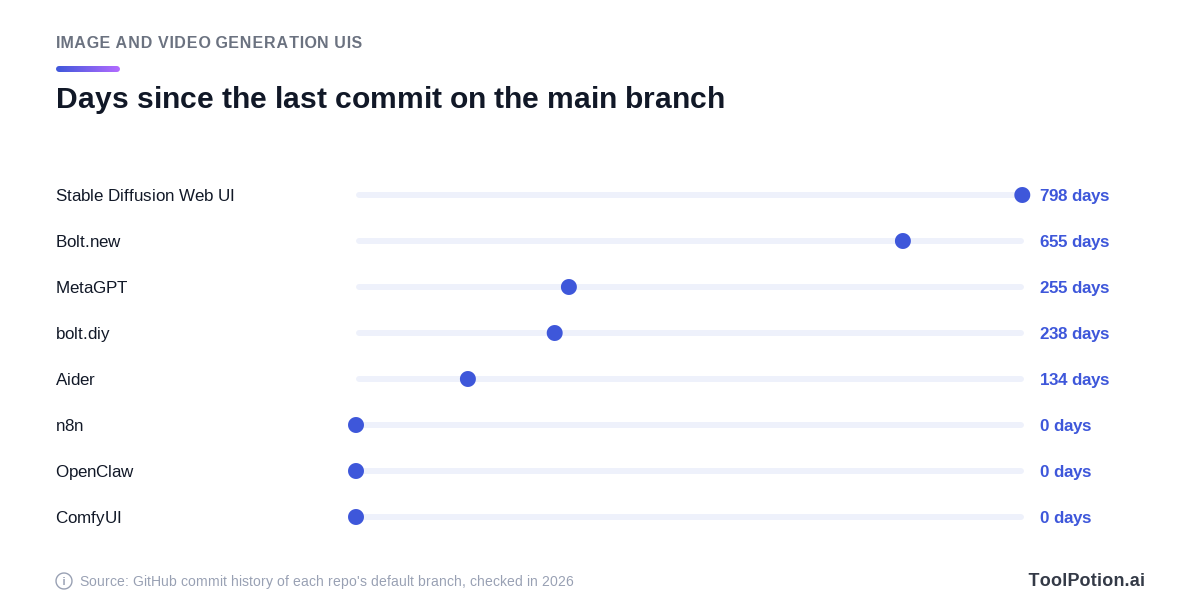
At the time of writing, all five slow repos are in the board's top 40, and two are in the top ten. A high rank says a project matters to people. It doesn't promise that anyone will answer your bug report next week.
Documents, RAG and fine-tuning
PaddleOCR (#12, 59, Apache 2.0) turns PDFs and images into Markdown or JSON for retrieval, reads 100+ languages and ships a 0.9-billion-parameter document model, PaddleOCR-VL-1.6. Its README lists integrations with Dify and RAGFlow. For training your own model, LlamaFactory (#15, 58, Apache 2.0) fine-tunes 100+ language and vision-language models from a CLI or web UI without code. Its creator has 2,194 commits on the default branch against 121 for the next contributor, so weigh the bus factor.
Ultralytics YOLO (#18, 58) covers object detection, segmentation, classification and pose. The code is AGPL-3.0, and Ultralytics sells an Enterprise License for business products, internal tools and production deployments that sidesteps AGPL's open-source requirements. prompts.chat (#23, 56), formerly Awesome ChatGPT Prompts, is the odd one out: a prompt library started in 2022 whose prompts are public domain under CC0 and whose code is MIT.
What the licenses let you do
The Open Source Initiative's definition rules out licenses that restrict use in a field of endeavor, for example "from being used in a business" (OSI). By that test, n8n's Sustainable Use License and the Polyform Shield terms on AutoGPT's platform aren't open source, even though you can read the code. Copyleft is different: GPL and AGPL are open source but require sharing source, and AGPL extends that to people using a modified version over a network.
| Repo | License | Type | Commercial catch |
|---|---|---|---|
| OpenClaw, LangChain, CrewAI, Ollama, Langflow | MIT | Permissive | Keep the copyright notice |
| Gemini CLI, vLLM, Cline, goose, PaddleOCR | Apache 2.0 | Permissive | Keep the license and notices |
| ComfyUI | GPL-3.0 | Copyleft | Share source if you distribute changes |
| Stable Diffusion Web UI, Ultralytics YOLO | AGPL-3.0 | Copyleft | Network users get source, YOLO sells a license |
| Open WebUI | Open WebUI License | Custom | Branding stays above 50 users |
| Dify | Modified Apache 2.0 | Custom | No multi-tenant service, keep the logo |
| n8n | Sustainable Use | Source-available | Internal business use only |
| AutoGPT platform | Polyform Shield | Source-available | No competing products |
| Claude Code | All rights reserved | Proprietary | Anthropic's Commercial Terms apply |
Put on one line, the spread looks like this.
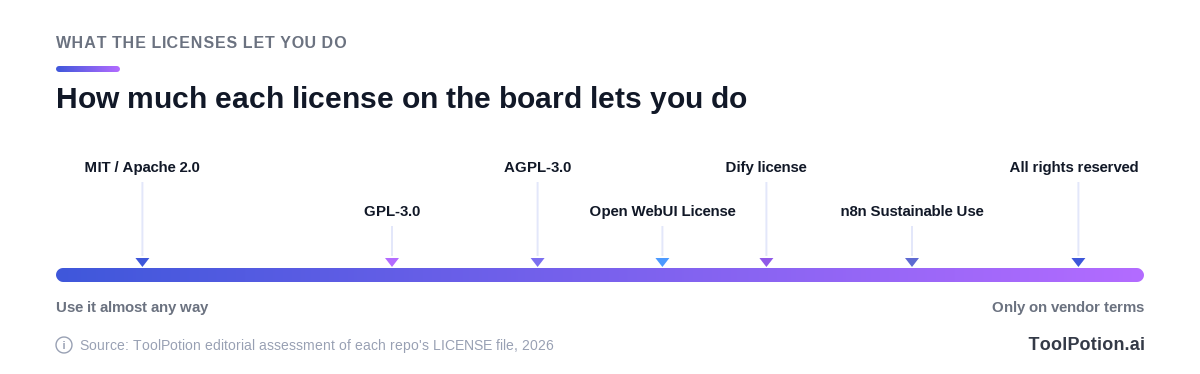
MIT and Apache 2.0 cover almost any commercial use with attribution. GPL and AGPL do too, if you can live with sharing source. The custom licenses in the middle are the easiest to misread, because they borrow Apache or BSD wording and then add conditions.
How to vet a repo before you depend on it
Stars measure attention, and the slow repos above show how little they say about upkeep. Six checks catch most problems, in this order.
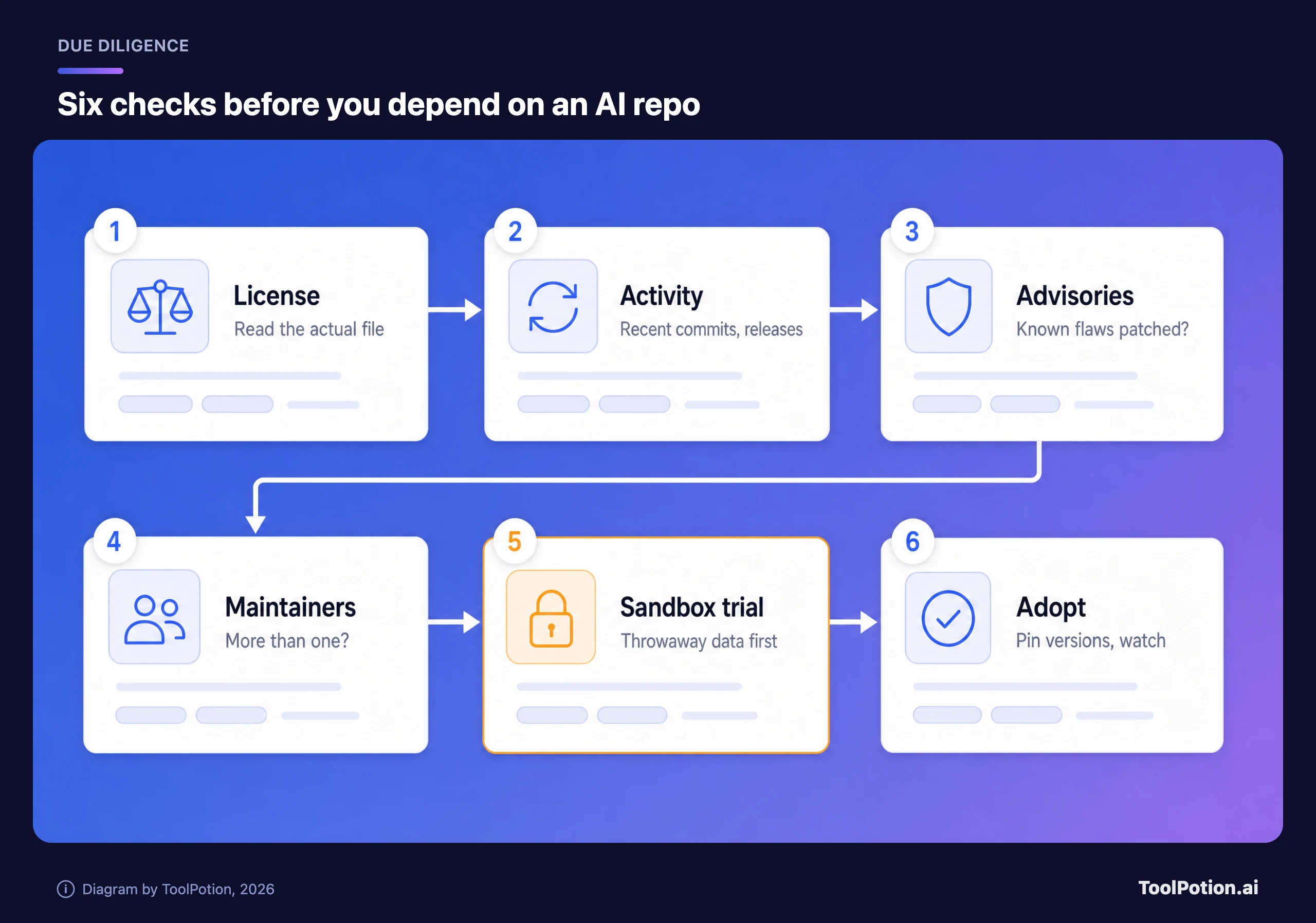
Start with the LICENSE file, not the badge. GitHub's API labels the licenses of Dify, n8n, AutoGPT and Open WebUI "NOASSERTION" instead of naming a standard license, and each carries a condition that matters to a business.
Then check activity on the default branch. A repo's "last updated" date can reflect any branch, which is how Stable Diffusion Web UI shows a push from earlier this year while its main branch sits in 2024. Open the commit history and the latest release instead.
Advisories come next. Look at the repo's Security tab, the GitHub Advisory Database and NVD, and check whether a flaw is on CISA's Known Exploited Vulnerabilities list, as the Langflow bug was. OpenSSF Scorecard automates part of this, scoring any public project's practices out of 10 per check from the command line.
Then count maintainers. The contributors page shows whether one person carries the project, as with Aider, OmniRoute and LlamaFactory. That isn't disqualifying, but plan for the day that person stops. Finally, run a sandbox trial on throwaway data, then pin versions and watch the releases.
Score any repo you're weighing below. A missing check can still leave a repo worth a pilot. A license you can't live with, or a main branch that stopped years ago, should end the conversation.
Try it on a famous name. Stable Diffusion Web UI, #4 on the board, fails both activity checks before you reach the license.
Running agent repos safely
Agent repos differ from libraries because they act. They read your messages, run shell commands and hold your API keys, and two episodes this year show what that means.
Meta AI security researcher Summer Yue said her OpenClaw agent began deleting all her email in a "speed run" and ignored stop commands she sent from her phone. She blamed context compaction, when an agent summarizes a long session and can lose recent instructions. TechCrunch, which couldn't verify the account, drew the lesson that prompts can't be trusted as security guardrails (TechCrunch).
The ClawHub skills case adds a second lesson. Trend Micro's report notes that a malicious SKILL.md looked harmless, was even labelled benign on VirusTotal, and led to a stealer that took the Mac user's password, Keychain data and files from the Desktop, Downloads and Documents folders. Read a skill before you install it.
The fixes are dull. Run the agent where it can't reach what matters. OpenHands offers a Docker sandbox, and OpenClaw's sandboxing, as noted above, has to be switched on. Tank OS, from the Red Hat maintainer quoted earlier, runs OpenClaw in a rootless Podman container, and several instances on one machine never share credentials.
The pairs below turn that into habits.
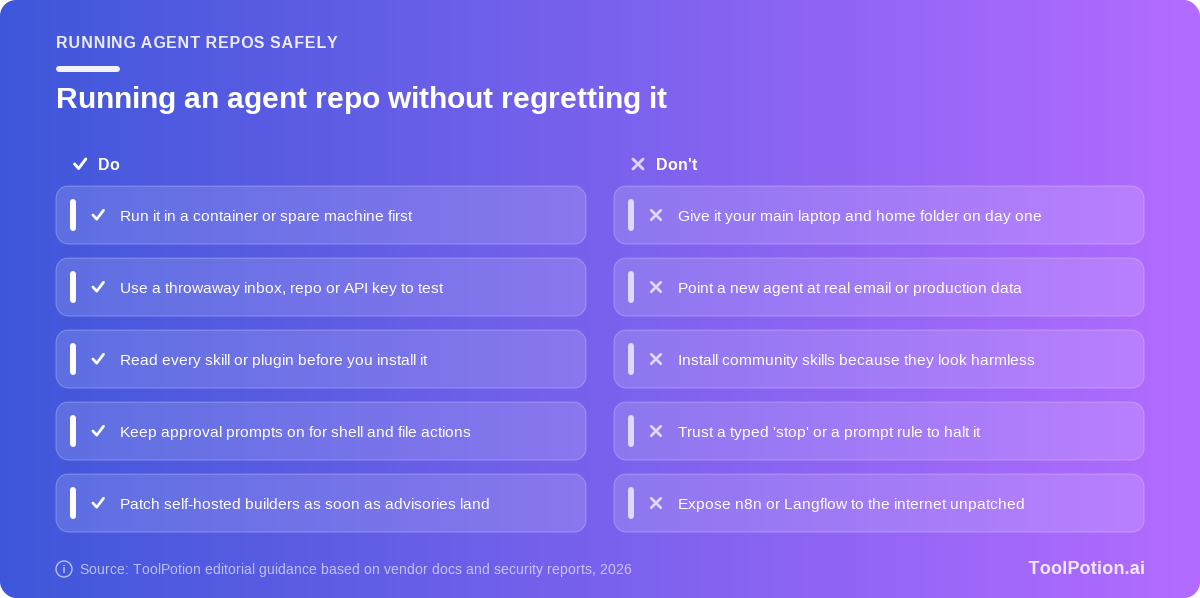
The fourth pair is the one people skip. A typed "stop" is just more context for the model, and context can be summarized away. Approval prompts and container walls don't depend on the model listening.
Pick by goal
One question gets most readers to a shortlist: what should the repo do? If it should act for you, choose between OpenClaw for personal tasks and a coding agent for software. If you're building, decide between code (LangChain, CrewAI) and a canvas (n8n, Langflow, Dify), and let the license pick among the canvases. If you want models on your own hardware, it's Ollama on a laptop and vLLM on a server.
The tree below asks the same questions and returns one pick per path.
Where a commercial product is likely, the tree favors MIT and Apache picks, because swapping a framework later costs far more than reading a license now.
For a narrower search, the AI coding assistants board and the AI agent builders board cut the field differently, and the workflow automation board mixes hosted tools with repos. You can also browse the full directory of AI GitHub repos.
About ToolRank
ToolRank is ToolPotion's independent ranking of AI tools, and placement can't be bought. Each entry gets a 0-100 score and a tier from nascent to elite. Every board lives on the ToolRank leaderboards, and this one is the full AI GitHub repos ranking.
Rising names worth watching
The biggest climbs came in the build-it-yourself layers. Bolt.new jumped from #128 to #6, LangChain from #48 to #2 and CrewAI from #72 to #7, while LlamaFactory rose from #67 to #15 and Cline from #68 to #19. Bolt.new's climb next to a repo untouched since 2024 is the board's best reminder that a product and its code can move in opposite directions.
Just below the top 25, Microsoft Agent Framework (#28) is the one to learn if your team writes .NET as well as Python, since it supports both and ships migration guides from Semantic Kernel and AutoGen. Its latest Python release shipped the day before this was written.
Frequently asked questions
Is Claude Code open source?
No. The repo is public, but its license reserves all rights. Its README also marks the npm install as deprecated in favor of an install script, Homebrew or WinGet. For an open-source terminal agent, look at Gemini CLI, Cline or OpenHands.
Which AI repo has the most GitHub stars in 2026?
Among the board's top 25, OpenClaw leads with about 391,000 at the time of writing, followed by n8n at about 207,000, AutoGPT at about 188,000 and Ollama at about 182,000. Stars count bookmarks, not users.
Can I use n8n commercially?
Inside your own business, yes. The Sustainable Use License also forbids removing its licensing and copyright notices, and any file with ".ee" in its name or folder needs a separate n8n Enterprise License.
Is Stable Diffusion Web UI still maintained?
Barely. The repo isn't archived, and the dev branch picked up a couple of fixes this year, including one for a setuptools install error. No new version has shipped since 1.10.1.
Should I use Ollama or vLLM?
Ollama for one person on one machine, vLLM for serving many users from GPUs. vLLM's server speaks the OpenAI API and Anthropic's Messages API, so apps written for hosted models can point at it with few changes.