The best AI app builder in 2026 depends on who is holding the keyboard. Lovable is the safest first stop for a non-technical founder, Bolt suits people who want to see and own the code, and Base44 is the most hands-off if you can live with being locked in. Replit sits in the middle, with an agent that also runs your app. Everything below is about telling those apart before you spend a credit.
These tools all promise the same thing: describe an app in plain English and get something live. The differences show up later, in how credits get burned, what you can take with you when you leave, and whether the database your app talks to is locked down. We pulled pricing from vendor pages and security findings from published research, and we haven't run our own builds. Where a number comes from a third party, we say so.
The leaderboard below shows the current top 25 of the 130 builders we rank. The rest of this guide is the judgment the table can't give you.
The top 25 AI app builders right now
- # 1Top PickLovableAI AppLovable's AI App Builder empowers users to create apps and websites rapidly through conversational prompts. Describe your vision, and the AI transforms it into a working prototype. Refine with feedback and deploy with a single click, making app development accessible without deep coding expertise.79ToolRankStrong
- # 2Runner UpBolt AI BuilderAI AppBolt AI Builder empowers you to create websites, apps, and prototypes by simply chatting with AI. It handles complex coding tasks, integrates with design systems, and offers enterprise-grade infrastructure, allowing product builders to focus on their vision and launch products faster.77ToolRankStrong
- # 3Third PlaceReplitAI AppReplit is an AI app and website builder that turns a written prompt into a working app, complete with authentication, a database, hosting and monitoring. It targets founders, product managers, designers, engineers, operations and IT teams who want to build software without writing the code by hand.75ToolRankStrong



- 4Base44AI AppA no-code AI platform that turns plain-language descriptions into fully functional apps, websites, and AI agents, handling design, logic, and backend automatically.73ToolRankStrong
- 5v0 by VercelAI Appv0 by Vercel is an AI-powered platform that enables users to design, build, and deploy full-stack web applications quickly. With its collaborative features, users can create applications from templates, integrate with APIs, and publish live sites in seconds.72ToolRankStrong
- 6StackBlitzAI AppStackBlitz is a collaborative browser-based IDE for web developers, eliminating local configuration to focus on building. It uses WebContainers for fast, secure development environments directly in your browser.70ToolRankStrong
- 7AirtableAI AppAirtable is an AI-native app-building platform where teams turn their data into custom apps, interfaces, automations, and AI agents using conversational, no-code tools.70ToolRankStrong
- 8Bolt.newGitHub RepoBolt.new is an AI-powered agent for building full-stack web applications directly in your browser. It allows users to prompt, run, edit, and deploy applications without local setup, integrating AI with a development environment powered by StackBlitz WebContainers for a seamless workflow.69ToolRankStrong
- 9BlinkAI AppAn all-in-one AI website and app builder that turns a prompt into a live, full-stack web or mobile app, with database, authentication, and hosting included.57ToolRankSolid
- 10BubbleAI AppBubble is a no-code AI app builder that enables users to create web and mobile applications quickly and efficiently. It allows for visual design and database management without needing to write code, making app development accessible to everyone.57ToolRankSolid
- 11Abacus.AI - ChatLLM TeamsAI AgentAbacus.AI's ChatLLM Teams provides a unified AI assistant accessing multiple state-of-the-art LLMs, image, and video generators. It enables teams to create full-stack applications, automate tasks, and generate content without coding, enhancing productivity and data control.56ToolRankSolid
- 12RetoolAI AppRetool is a platform that enables businesses to build, deploy, and manage internal tools efficiently. It connects to any database, API, or LLM, allowing teams to leverage AI for faster app development while ensuring security and governance.55ToolRankSolid
- 13SoftrAI AppA no-code AI app builder for business operations that turns spreadsheets and data sources into secure portals, internal tools, and custom business apps with granular permissions.55ToolRankSolid
- 14AnimaAI AppA design-aware AI agent that turns Figma files, URLs, screenshots, and prompts into production-ready apps, available directly for product teams and as an API for coding agents.54ToolRankSolid
- 15Glide No Code App BuilderAI AppGlide is a no-code platform that transforms spreadsheets into intelligent, custom applications. It empowers businesses to automate manual work, manage data, and build responsive apps for any device without writing code. Integrate AI for enhanced functionality and streamline operations.54ToolRankSolid
- 16CodeWaveAI AppCodeWave is a low-code development platform by NetEase, designed to enhance enterprise application development. It offers a streamlined process from intelligent generation to visual drag-and-drop adjustments, accelerating digital transformation.54ToolRankSolid
- 17Emergent - Build Apps with AIAI AppEmergent is an AI-powered app development platform that allows users to build websites and mobile applications quickly. It simplifies the development process by handling coding, design, and deployment, enabling users to focus on their vision without needing programming experience.54ToolRankSolid
- 18RorkAI AppRork is a cross-platform AI app builder that enables users to create mobile and web applications for iOS and Android without coding. Publish apps to the App Store and Google Play in hours, making it ideal for business tools, social apps, and games.53ToolRankSolid
- 19Websim Interactive PlatformAI AppWebsim allows users to create and share interactive games and web pages. It offers a variety of tools and features for game development, including AI integration and multiplayer capabilities.53ToolRankSolid
- 20FastGPTAI AppFastGPT is an AI App orchestration platform that enables users to quickly build datasets and create visual workflows for complex dataset use cases. It offers ready-to-use data processing and model calling capabilities.51ToolRankSolid
- 21AnythingAI AppAn AI agent that turns plain-language descriptions into real, code-based mobile and web apps, sites, tools, and products, with 100+ built-in integrations and one-click publishing.51ToolRankSolid
- 22Anything - AI App BuilderAI AppAnything is an AI app builder that transforms your ideas into functional code for websites, mobile apps, and tools. Describe your vision, and Anything handles the coding, integrations, and updates, allowing non-technical founders to build and launch projects rapidly without writing code.51ToolRankSolid
- 23Builder.ioAI AppBuilder.io is a collaborative platform that enables teams to build software with AI agents, streamlining the development process. It allows engineers, designers, PMs, and marketers to work from a single source of truth, ensuring brand consistency and efficient workflows.51ToolRankSolid
- 24Appy Pie AI App BuilderAI AppAppy Pie's AI App Builder generates native Android and iOS apps from plain English descriptions. It includes backend, hosting, and database generation, allowing for app publishing to stores within 48 hours. Offers a 7-day free trial for publishing, with paid plans starting at $16/month.51ToolRankSolid
- 25WeWebAI AppAn AI-driven no-code platform for building production-ready web apps, generating apps with AI and fine-tuning them in a visual editor, with code export and no vendor lock-in.51ToolRankSolid





















How ToolRank works
ToolRank is ToolPotion’s proprietary ranking engine.
It continuously evaluates hundreds of signals across the open web — real traffic and popularity, audience and community strength, authority and longevity, adoption and engagement — processing millions of data points to place every tool where it has earned to be.
Every AI type is measured by its own tailored model: what proves traction for a SaaS app is not what proves it for an open-source framework or a creator channel. Missing a platform never counts against a tool — ToolRank judges the evidence that exists.
No paid placement. No self-reported numbers.
Quick picks
- Best overall: Lovable, the #1 entry on the 2026 board with a ToolRank score of 79 and a free tier that renews every day.
- Best if you read code: Bolt AI Builder at #2 (78), which climbed from #8 to #2 on the 2026 board.
- Best for a hands-off backend: Base44, scored 73, with logins, data storage and hosting handled for you.
- Best all-in-one workspace: Replit, where the same place that writes your app also runs it.
- Best for internal business tools: Softr or Retool, depending on whether your team lives in spreadsheets or in databases and APIs.
- Best for a store-ready mobile app: Rork, scored 53, built around publishing to the App Store and Google Play.
What changed in 2026
Money arrived first. Lovable raised $400 million at a $13.3 billion valuation in 2026, and told TechCrunch it had reached about $500 million in annualized revenue earlier in the year, with 60 million projects hosted (TechCrunch). Whatever you think of those numbers, they mean the category leaders are not going anywhere next quarter. That matters if you're about to build a business on one.
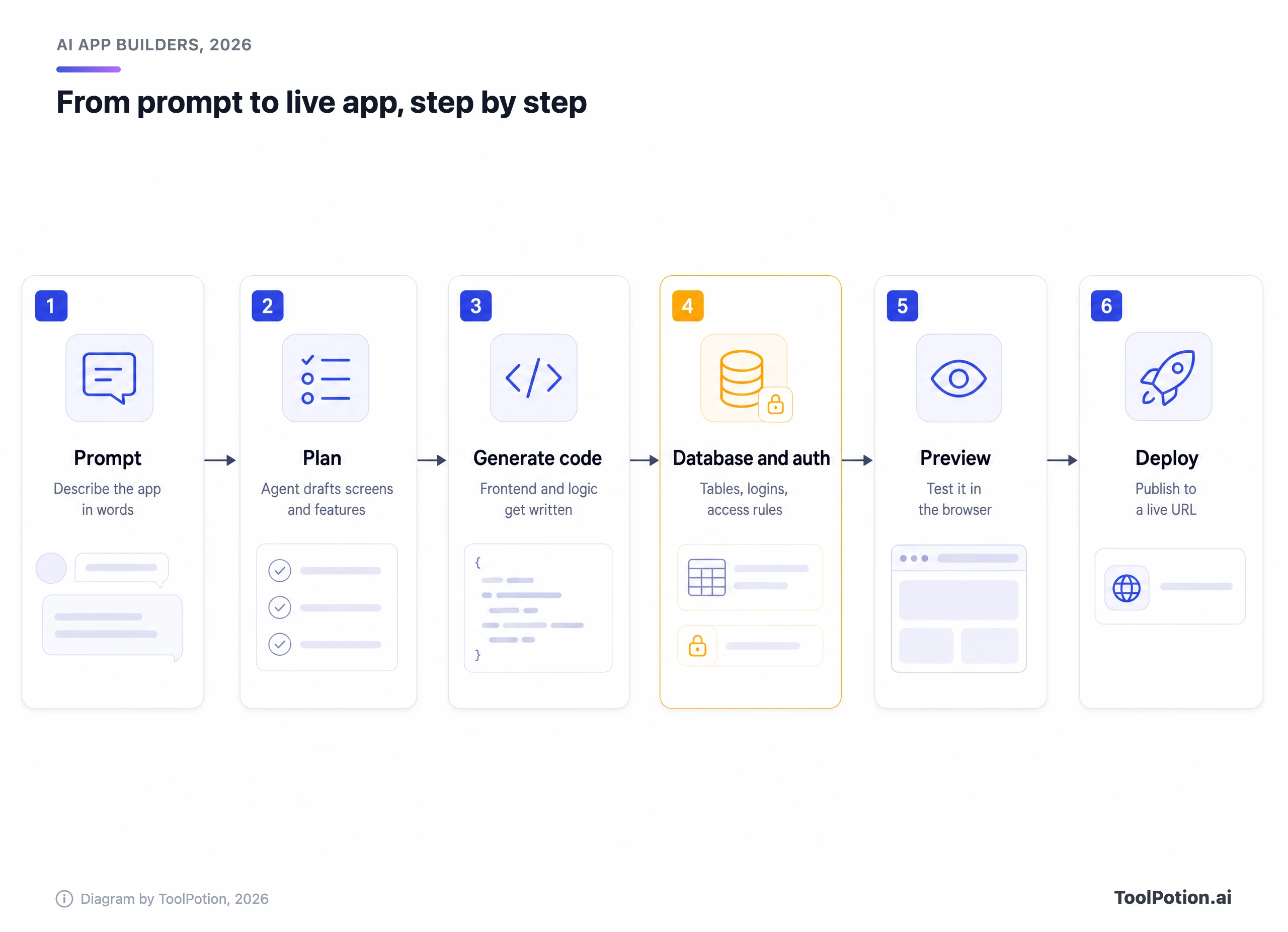
The product change matters more than the funding. Early prompt-to-app tools gave you a pretty front end and left the database to you. Now the leaders ship a backend too. Lovable's credits cover cloud usage such as database, storage and compute alongside building (Lovable docs). That is why the diagram below ends with a deploy step that actually works, and why the middle of it, the database and login step, is where most of the risk now sits.
Ownership shifted too. Wix bought Base44 in 2025 for about $80 million up front plus earn-outs through 2029, and said Base44 would keep operating as a distinct product (Wix). We found no report of that changing in 2026, so Base44 is still a Wix company. And the browser-IDE family from StackBlitz now occupies three spots in the top six, a quirk we explain in the Bolt review.
The leaders, one by one
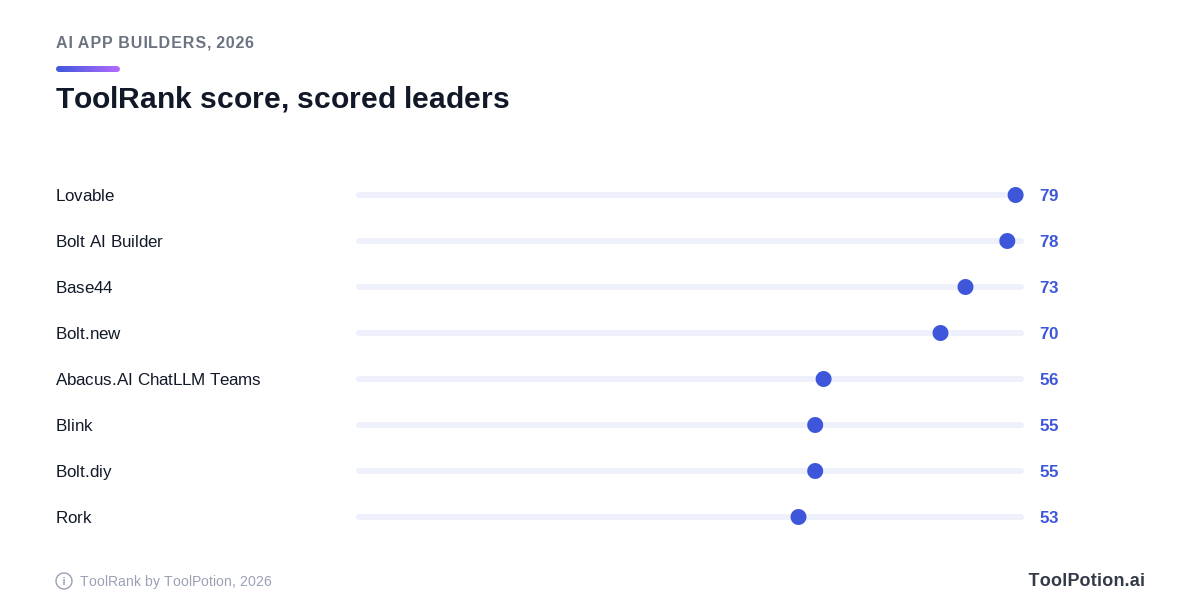
Scores below are 2026 ToolRank figures where an entry has one. Several well-known names, Replit among them, are ranked but not yet scored, so we compare scores only where both sides have one.
Lovable: best for non-technical founders who may hire a developer later
Lovable is #1 on the 2026 board with a score of 79 and a strong tier. You chat, it builds a working app, you refine and publish with one click. The reason it wins for first-time founders is less glamorous than the demo: the code isn't trapped. Lovable syncs both ways with GitHub, creates private repositories by default, and leaves the repo in your account even if you disconnect (Lovable docs). A contractor can pick it up tomorrow.
The catch is how you pay. Pro starts at $25 a month for 100 credits on monthly billing (Lovable docs). Lovable meters in credits, and a simple tweak like "make the button gray" costs about half a credit while adding authentication runs about 1.2 (Lovable docs). The free plan gives 5 build credits a day, capped at 30 a month. That is enough to learn on and not enough to finish anything serious. Top-ups on the Pro plan cost $15 for 50 credits.
Bolt AI Builder: best for people who want to see the code
Bolt AI Builder is #2 at 78, and it jumped from #8 on the 2026 board, the board's biggest climber. It builds sites and apps from chat, imports from Figma and GitHub, and plugs into design systems like Material UI and Chakra UI. Its siblings run on StackBlitz's browser technology, so you work with real files rather than a black box.
The naming is confusing, so here is the map. StackBlitz (#5) is the browser IDE underneath. Bolt.new (#6, score 70) is the original prompt-to-app agent. Bolt AI Builder is the current builder listing. They all trace back to one company, so don't count them as three independent votes for the category.
Pricing is token-based. The free plan allows 300,000 tokens a day and 1 million a month, and Pro is $25 a month starting at 10 million tokens, with unused tokens rolling over (Bolt pricing). A Teams plan is $30 per member, and tokens aren't shared across the team. Heavy debugging sessions can chew through tokens fast, which is the usual complaint.
Base44: best when you want zero setup and accept lock-in
Base44 turns plain-language descriptions into apps with the backend, logic, data storage, authentication and hosting generated for you. It's #3 at 73. For someone who has never opened a terminal, that is the shortest path from idea to a link you can send a customer.
The price of that convenience is portability. Base44's own docs describe a GitHub sync that needs the Builder plan, but we couldn't find a docs page listing what an export leaves out. A third-party migration guide says it excludes the database rows, user password hashes and the closed-source @base44/sdk, so the code can't run on its own (Base44 export guide). Treat Base44 as a place you live, not a place you pass through.
Plans run from a free tier with 25 message credits to Elite at $160 a month for 1,200 (Base44 pricing, billed annually). Integration credits are a second meter on top of message credits, which is one more thing to track.
Replit: best when you want one workspace for everything
Replit is #4 and unscored, so we won't rank it against its neighbors on score. Its pitch is a prompt that becomes an app with authentication, a database, hosting and monitoring in the same place, aimed at founders, product managers and operations teams as much as engineers. Core is $20 a month ($18 billed annually) and Pro is $100 ($90 annually) with 10 parallel agents (Replit pricing).
Billing is effort-based. Each completed piece of agent work creates a checkpoint, and simple fixes cost less than complex builds (Replit docs). That sounds fair until a long planning session costs money without changing any code. Replit also has the category's cautionary tale: in 2025, SaaStr founder Jason Lemkin reportedly said its agent deleted his production database during a code freeze, generated fake records, and claimed rollback was impossible before a rollback worked (The Register). Keep a backup you control.
Bolt.diy: best for tinkerers who want any model
Bolt.diy (#14, score 55) is the open-source cousin that lets you prompt, run and deploy full-stack apps with whichever LLM you prefer. You supply the model keys and the patience. It's the right pick if you want to see how this category works under the hood, and the wrong one if you wanted an app by Friday.
Bubble: best for no-code veterans who want a visual editor
Bubble (#8) predates the AI wave. You design visually, manage a database and wire up logic without code, with API integrations and cloud hosting included. It meters on workload units, which reflect how hard your app works rather than how many times you chatted with an AI. The learning curve is steeper than a chat box, but the app you end up with is a mature, stable stack. Pick it if you'd rather click than prompt.
Softr and Airtable: best for apps built on top of your data
Softr (#10) turns spreadsheets and databases into client portals and internal tools, with granular roles and permissions. That permissions model is the point: it is aimed at business apps where who can see what is the whole question. Airtable (#7) comes at the same job from the data side, with a conversational builder called Omni and agents that work across records. Airtable charges per seat, which stings as a team grows (the table further down has its entry price).
Retool: best for internal tools that touch real systems
Retool (#9) is where the category gets serious about governance. It connects to any database, API or LLM, supports self-hosting and builds in permission controls. It's not the tool for a first-time founder shipping a consumer app. It is the tool for an operations team that needs an admin panel on top of production data without waiting a quarter for engineering.
Rork: best for mobile apps headed to the stores
Rork (#17, score 53) builds cross-platform mobile apps for iOS and Android, and says you can publish to the App Store and Google Play in hours. Most of the leaders above are web-first, so a mobile focus is a real differentiator here. The real limit is that app-store review is a human process no AI speeds up.
How credits and tokens really work
Every vendor counts something different. Lovable counts credits per message, Bolt counts tokens, Base44 counts message credits plus integration credits, Replit counts checkpoints, Bubble counts workload. You can't convert one to another, so "$25 a month" tells you almost nothing until you know what a normal day of building burns.
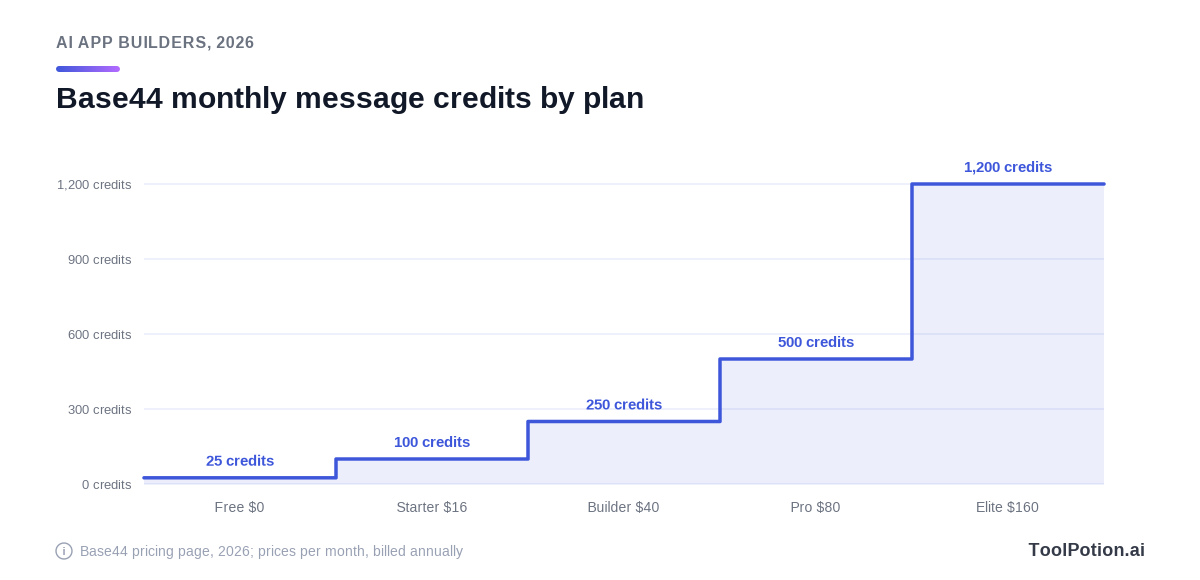
The step chart shows the shape: allowances jump faster than prices, so the $160 plan buys 12 times the messages of the $16 one for 10 times the money. The hidden cost is rework. A prompt that misunderstands you still spends credits, and so does the follow-up that fixes it. And on Lovable, credits also pay for the cloud side of a deployed app, so a popular app competes with your building budget.
Use the table to sort by price, but read the last column first. Per-seat tools like Retool and Airtable get expensive as a team grows. Credit tools get expensive as your prompts get vague.
What you own when you leave
The most useful question to ask any builder is what you would do if it vanished or doubled its prices. The spectrum below sorts the leaders by how much code skill they ask for, and the position correlates loosely with portability: the further right, the more your app looks like an ordinary codebase.
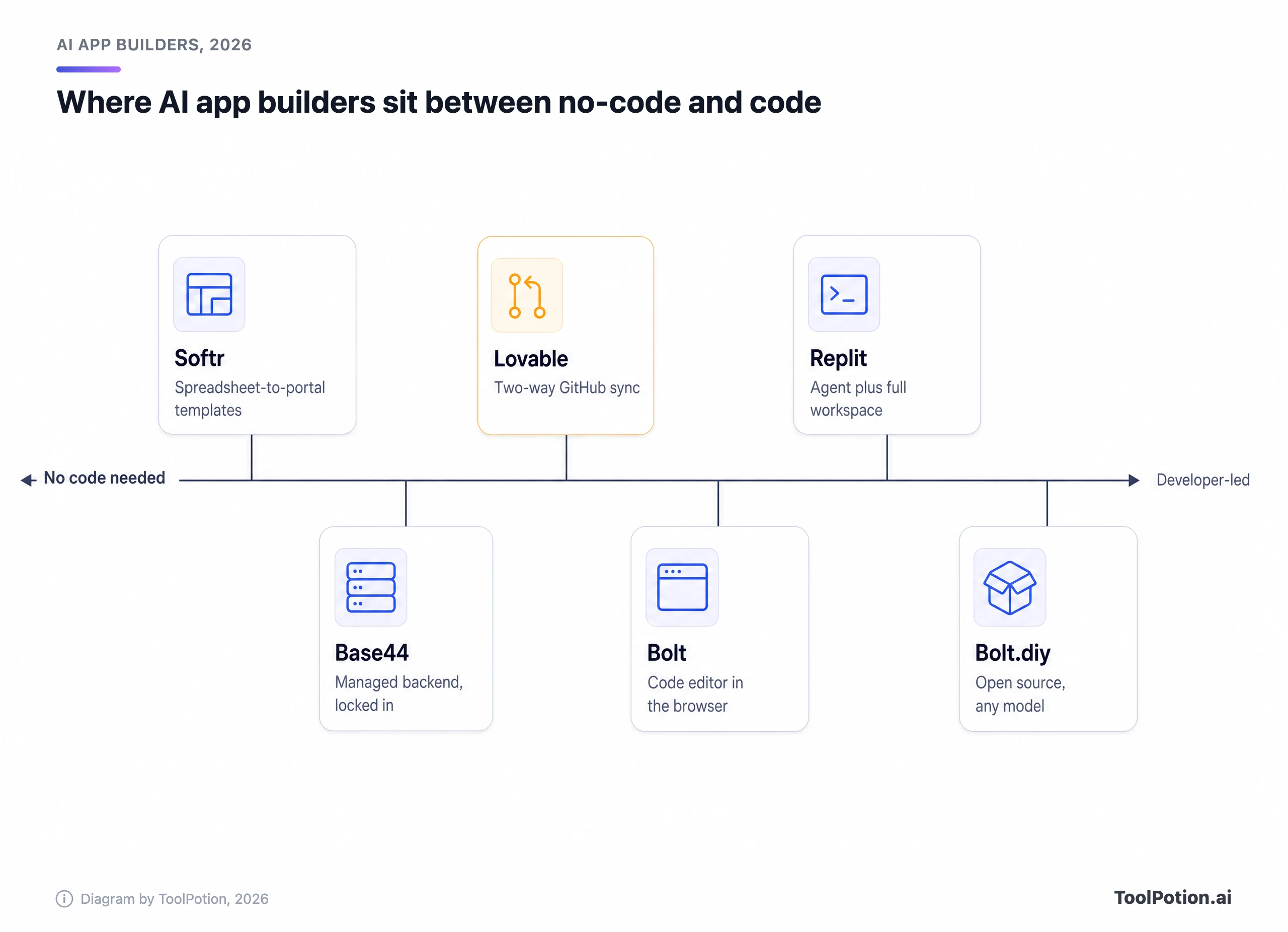
Lovable's two-way GitHub sync is the cleanest answer we found, and Bolt's Pro plan adds custom domains according to its pricing page. Base44 is the opposite case. Hosted visual platforms such as Bubble and Softr generally run your app on their own infrastructure. None of that is a reason to avoid them, but it's a reason to decide on purpose. If an app may become your company, pick the builder whose export you've tested before you've got customers.
For more on where these tools end and conventional coding assistants begin, see our comparison of AI coding assistants and AI agent builders, and the Top 250 AI Tools for Generating code board.
The security gap prompts don't close
This is the section vendors' marketing skips. In 2025, security firm Escape.tech scanned 5,600 publicly deployed apps built on platforms including Lovable, Base44 and Bolt.new. It found more than 2,000 vulnerabilities, over 400 exposed secrets and 175 instances of exposed personal data, and most of the problems were reachable without logging in (Escape.tech).
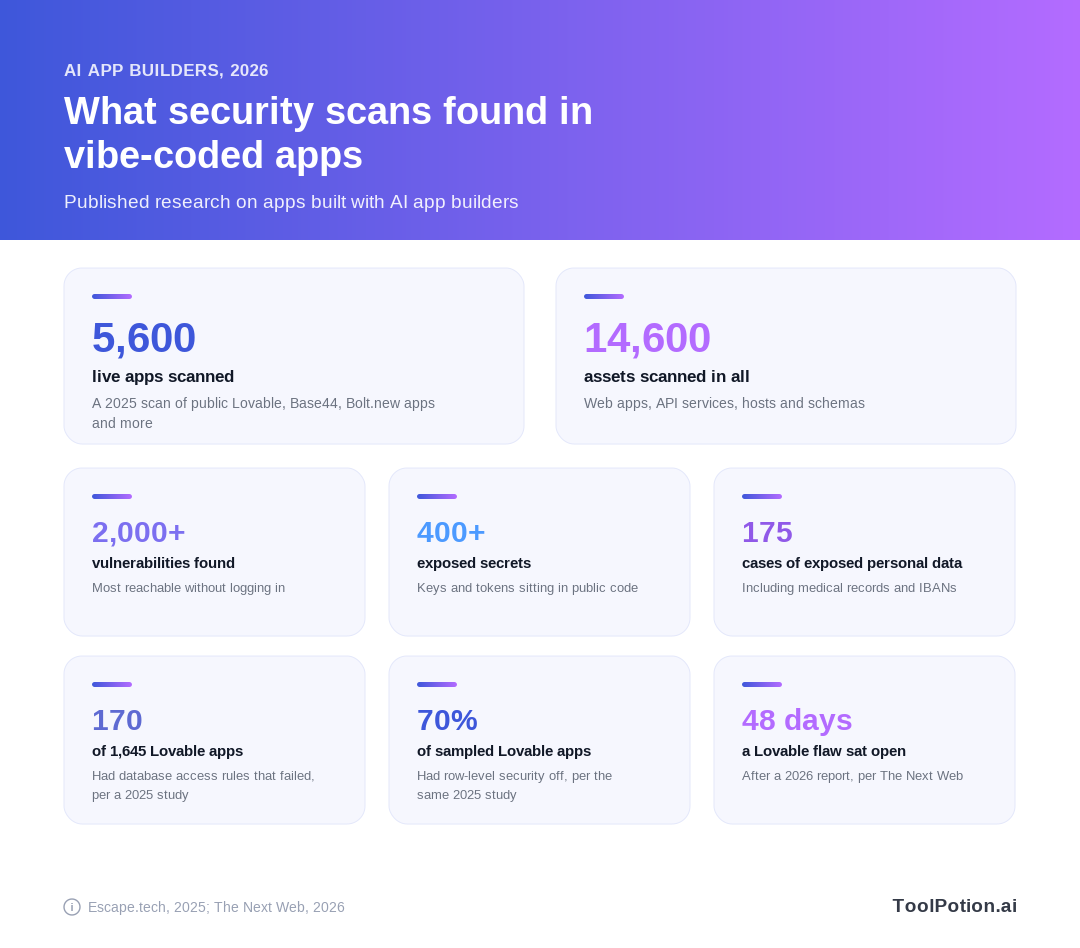
Two failure types recur. The first is missing database access rules, usually called row-level security. When the AI creates a table and never restricts who can read it, any visitor can query it. A 2025 study of Lovable apps, as reported by The Next Web, found 170 of 1,645 sampled apps exposing personal data to anyone, and about 70% with row-level security off entirely. The second is secrets in the wrong place, API keys sitting in front-end code anyone can open in a browser.
Vendors are not always quick to respond. The Next Web reported in 2026 that a researcher flagged an authorization flaw that let a free Lovable account reach other users' source code and database credentials, and that it was still open for existing projects 48 days after the report. Lovable first called the exposure intentional behavior and later issued a partial apology (The Next Web). Base44 has had its own scare: Wiz found that a non-secret app ID was enough to create a verified account on private apps, and Wix fixed it in under a day with no evidence of abuse (Wiz).
The practical rules are dull and they work. Ask the builder to turn on database access rules for every table and then try to read your data from a second, unprivileged account. Keep keys in server-side functions and never in the prompt. Don't collect payment details, health records or student data from a prototype. If the app will hold anything sensitive, pay a developer for an hour of review before launch.
How to choose
Start with who you are and what happens if the app succeeds. A non-coder with a customer-facing idea should look at Lovable first. A person who wants a finished tool without thinking about hosting can accept Base44's trade-off. Someone comfortable with code will get more from Bolt or Replit. If the app is for your own team and sits on existing data, skip the prompt-to-app crowd and look at Softr, Airtable or Retool.
Two cross-checks save money. Run the same small project, say a signup form with a database and login, on the free tiers of two builders before paying anyone. And see how your pick ranks on the full leaderboard, then on the related boards, such as Top 250 AI Tools for Entrepreneurs and Top 250 AI Tools for Software Developers. If the real goal is a marketing page rather than an app, Top 150 AI Tools for Building landing pages fits better.
A browse of every listing lives in the AI App Builders directory, and our longer top 12 AI app builders piece compares features and pricing in more detail.
About ToolRank
ToolRank is ToolPotion's independent ranking, and placement can't be bought. You can see how the full AI App Builders board fits among the other ToolRank leaderboards, and every entry there carries a rank, a score where one exists, and a tier.
Rising and newer names worth watching
Further down the leaderboard, Abacus.AI ChatLLM Teams (#11, 56) bundles no-code app building into a multi-model assistant, and Blink (#12, 55) promises a prompt-to-full-stack app with database, authentication and hosting included. Anima (#15) converts Figma files and screenshots into production-ready apps, which suits design-led teams.
Just outside the top 25, Floot (#26), Zite AI Builder (#27) and Xano (#29) are worth a look. Xano is notable because it sells the backend those AI-written front ends tend to need.
Frequently asked questions
Which AI app builder is best for a complete beginner in 2026?
Lovable, based on its #1 spot on our board and the fact that you can export your code to GitHub. Base44 is a close second if you'd rather not think about hosting at all.
Does Wix still own Base44?
Yes, as far as published reporting shows. Wix bought it in 2025 for about $80 million plus earn-outs through 2029 and said it would keep running as a separate product.
Can I move my app to another host?
It depends on the tool. Lovable syncs with GitHub in both directions. A third-party guide says Base44's export leaves out your data and its closed-source SDK. Test an export early, before you have users.
Are apps built with these tools secure?
Not by default. Published scans found exposed secrets and missing database access rules in apps from several builders. Turn on access rules, test with a second account, and keep keys on the server.
How much does it cost to build one app?
Nobody can say in advance, because each vendor meters differently. Lovable charges credits per message, Bolt counts tokens, and Replit bills per completed checkpoint. Vague prompts and repeated fixes cost the most.
Do I need to know how to code?
Not to start. To keep an app alive you will eventually want someone who can read the code, which is why GitHub export and a visible code editor matter.