Most lists of AI security tools treat the category as one shelf. It isn't. A cloud posture platform, an email filter and a code scanner protect different things, and they use AI for different jobs. The 2026 leaderboard below is easier to read once you split it by layer: Wiz for cloud, Darktrace for network and beyond, Abnormal AI for email, Qualys for vulnerabilities, Snyk for code.
That's the frame for everything here. Below the leaderboard you'll find quick picks, what changed in 2026 (a lot of it is ownership), a plain account of where AI earns its keep and where it's gloss, twelve short reviews, and a decision tool for security leads and IT managers who need a first shortlist rather than a bake-off.
One more thing up front. Almost none of these vendors publish prices. Where a vendor does, we cite the page. Where it doesn't, we say so instead of guessing.
The top 25 right now
- # 1Top PickWizAI AppWiz is an AI-powered cybersecurity platform that integrates code, cloud, and runtime to enhance security across all cloud and AI applications. It automates risk reduction and threat response, enabling security teams to operate at AI speed and protect their environments effectively.72ToolRankStrong
- # 2Runner UpMicrosoft SentinelPlatformMicrosoft Sentinel is a cloud-native SIEM platform designed to enhance security operations by detecting threats faster, automating responses, and reducing costs with a data lake. It integrates with Microsoft Defender for a unified security experience.70ToolRankStrong
- # 3Third PlaceGoogle Security OperationsAI AppGoogle Security Operations, formerly Chronicle, empowers security teams to detect, investigate, and respond to threats with Google's speed, scale, and intelligence. It offers a unified experience across SIEM, SOAR, and threat intelligence to enhance detection, investigation, and response capabilities.70ToolRankStrong


- 4Microsoft Defender for CloudPlatformMicrosoft Defender for Cloud is a security solution and CNAPP that protects cloud-native application development across multicloud and hybrid environments. It offers end-to-end visibility, risk prioritization, and remediation capabilities, ensuring secure infrastructure and application lifecycle management.69ToolRankStrong
- 5Microsoft Defender XDRPlatformMicrosoft Defender XDR is a comprehensive cybersecurity platform that unifies extended detection and response capabilities. It protects organizations by correlating signals across sources, providing actionable insights to accelerate threat detection and response.69ToolRankStrong
- 6DarktraceAI AppDarktrace is an AI cybersecurity platform that interrupts cyber-attacks in seconds, including ransomware and email phishing. It uses Adaptive AI to learn from unique business data, enabling organizations to detect and respond to threats effectively.69ToolRankStrong
- 7Microsoft Security CopilotAI AppMicrosoft Security Copilot is an AI-powered cybersecurity solution that provides insights and automation to help teams defend at machine speed. It integrates with Microsoft security products to enhance threat detection and response capabilities.68ToolRankStrong
- 8Abnormal AIAI AppAbnormal AI is a behavioral AI security platform that protects email, identity, and AI, effectively stopping insider threats. Trusted by over 4,500 organizations, it automates critical security decisions to combat sophisticated cyber attacks.65ToolRankStrong
- 9SAS Fraud ManagementAI AppSAS Fraud Management is a cloud-native solution designed to detect, prevent, and manage fraud in real-time. It leverages AI, machine learning, and predictive analytics to enhance fraud detection accuracy and improve customer experiences.61ToolRankStrong
- 10Cisco AI DefenseAI AppCisco AI Defense is a comprehensive AI security solution designed to protect enterprises from the unique risks associated with AI development and deployment. It offers end-to-end protection, ensuring the safety and security of AI applications across multi-cloud environments.60ToolRankStrong
- 11Amazon MacieAI AppAmazon Macie is a data security service that uses machine learning and pattern matching to discover and protect sensitive data. It provides automated data discovery, cost-effective visibility, and enhanced security for data stored in Amazon S3.60ToolRankStrong
- 12Cortex XDRAI AppCortex XDR by Palo Alto Networks enhances endpoint security with AI-driven threat detection and response. It integrates data from multiple sources to prevent and mitigate cyberattacks effectively, reducing investigation time and operational overhead.59ToolRankSolid
- 13Lacework FortiCNAPPAI AppLacework FortiCNAPP is a comprehensive cloud-native application protection platform. It leverages AI to secure applications from code to cloud, ensuring robust protection against evolving cyber threats.59ToolRankSolid
- 14Kount Identity & Fraud ServicesAI AppKount, part of Equifax, offers advanced identity and fraud services to help businesses detect and prevent fraud, verify identities, and safeguard revenue using AI, machine learning, and real-time analytics.59ToolRankSolid
- 15Tenable One Exposure Management PlatformAI AppTenable One is an AI-powered exposure management platform that unifies security visibility, insight, and action across the entire attack surface, helping organizations manage cyber risks effectively.59ToolRankSolid
- 161Password Unified AccessAI App1Password Unified Access is an identity security platform that helps security teams discover, secure, and audit access across humans, AI agents, and machines. It integrates five products to close visibility and governance gaps.59ToolRankSolid
- 17Okta Identity Threat ProtectionAI AppOkta Identity Threat Protection uses AI-driven risk evaluations to provide real-time identity threat assessment and automated responses, ensuring continuous protection across your environment.59ToolRankSolid
- 18Cortex XSOARAI AppCortex XSOAR by Palo Alto Networks automates security operations, unifying incident response, threat intelligence, and workflow automation to enhance SOC efficiency and reduce remediation time.58ToolRankSolid
- 19FortiAI AssistAI AppFortiAI Assist leverages generative AI to enhance security operations, enabling teams to make informed decisions, respond to threats, and streamline complex tasks. It is designed to improve cybersecurity efficiency and effectiveness.58ToolRankSolid
- 20Proofpoint AI Security PlatformAI AppProofpoint's AI Security Platform provides comprehensive protection for enterprise AI use, ensuring secure AI adoption with intent-aware security and data context. It offers unified discovery, runtime policy enforcement, and audit trails to protect sensitive data and govern AI interactions.57ToolRankSolid
- 21FortiAI ProtectAI AppFortiAI Protect by Fortinet uses real-time AI to block emerging threats and prioritize responses with contextual risk assessment. It minimizes false positives and detects hidden threats, including shadow AI, while enforcing secure AI usage through real-time controls and policies.57ToolRankSolid
- 22Project Perception | Microsoft SecurityAI AgentProject Perception by Microsoft Security uses AI agents for agentic security, enabling multi-agent workflows and defense. It integrates with Microsoft Defender to provide proactive, continuous protection with human oversight.56ToolRankSolid
- 23Snyk AI Security PlatformAI AppSnyk AI Security Fabric is an independent validator that ensures AI-generated code, agents, and applications are trustworthy. It helps organizations innovate securely by validating and governing AI development processes.56ToolRankSolid
- 24IdiraAI AppIdira is Palo Alto Networks' identity security platform, built from its CyberArk acquisition. It unifies privileged access management with machine and AI-agent identity security, discovering, controlling and governing every human, machine and agentic identity across hybrid cloud environments. It targets security and IT teams at enterprises managing AI-driven privilege growth and compliance.56ToolRankSolid
- 25Qualys Cybersecurity PlatformAI AppQualys offers a comprehensive cybersecurity platform that helps businesses identify, assess, and mitigate risks. With tools for vulnerability management, threat detection, and compliance, it provides a unified approach to managing cyber threats and enhancing security posture.56ToolRankSolid















How ToolRank works
ToolRank is ToolPotion’s proprietary ranking engine.
It continuously evaluates hundreds of signals across the open web — real traffic and popularity, audience and community strength, authority and longevity, adoption and engagement — processing millions of data points to place every tool where it has earned to be.
Every AI type is measured by its own tailored model: what proves traction for a SaaS app is not what proves it for an open-source framework or a creator channel. Missing a platform never counts against a tool — ToolRank judges the evidence that exists.
No paid placement. No self-reported numbers.
Quick picks
- Best for cloud estates is Wiz, the #1 entry on the 2026 board and now part of Google Cloud.
- Best for catching what rules miss on a network is Darktrace, #2 on the board with a ToolRank of 68.
- Best for stopping business email compromise is Abnormal AI, #3 with a score of 66.
- Best for vulnerability backlogs across a mixed estate is Qualys.
- Best for developers shipping AI-written code is Snyk, which also has a free plan.
- Best for small teams on a budget is Aikido Security, with a free tier and a paid plan starting at $300 a month.
What changed in 2026
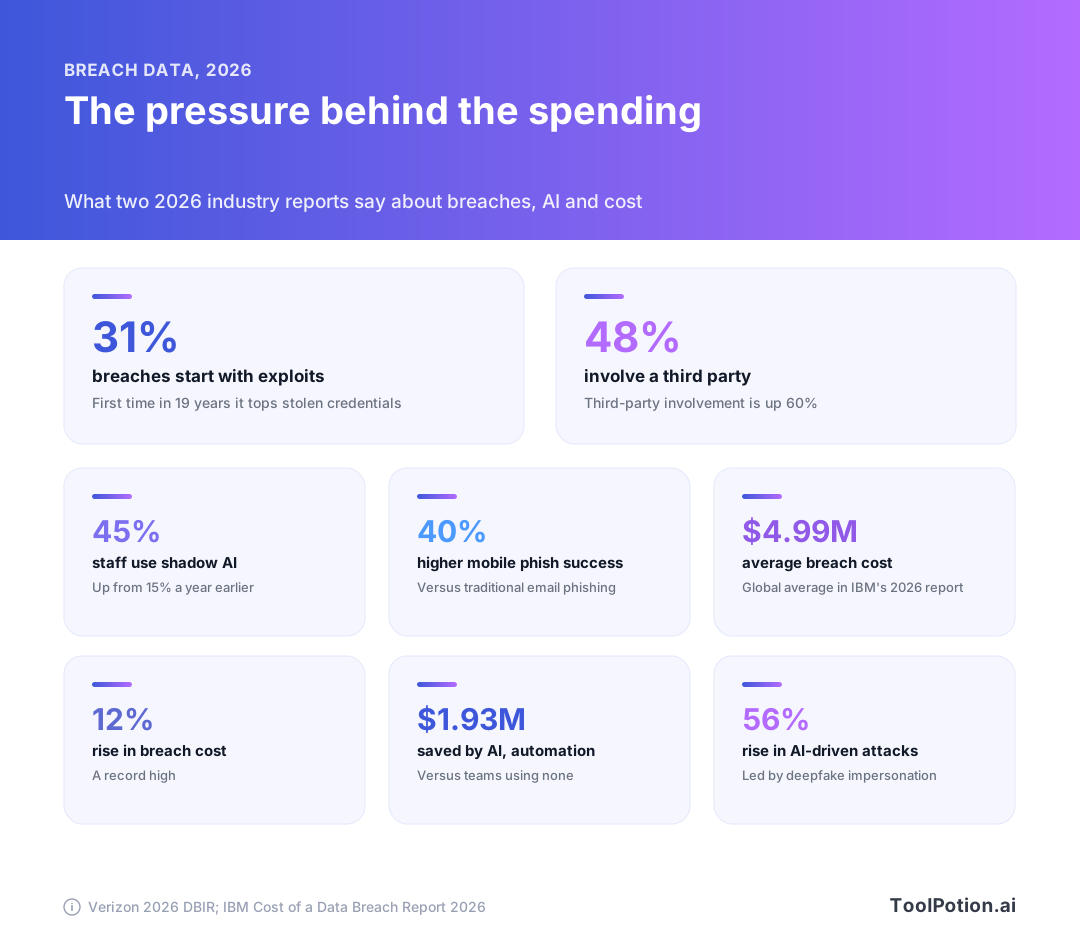
Start with the pressure. Verizon's 2026 breach report found that nearly a third of breaches begin with an exploited vulnerability, the first time in 19 years that beat stolen credentials. Third-party involvement rose to 48% of breaches. And employee use of shadow AI jumped from 15% to 45% in a year. IBM puts the average breach at $4.99 million, a record, while teams using AI and automation extensively saved about $1.93 million against teams using none.
The second change is who owns what. Google completed its Wiz acquisition in 2026. Wiz keeps its brand and still works across AWS, Azure, Oracle and Google Cloud, according to Google. Palo Alto Networks closed its CyberArk deal and the identity platform is now branded Idira. Promptfoo, the open-source AI red-teaming tool, announced it is joining OpenAI. Thoma Bravo took Darktrace private, and Egress belongs to KnowBe4.
If you're buying, ownership matters more than it used to. A tool that was independent last year may now be a feature of a bigger platform with a different sales motion. Ask about roadmap and support commitments before you sign a multi-year deal.
The third change is new territory. Vendors now sell security for AI itself: agent governance, prompt-injection testing, shadow AI discovery. Treat these as a separate line item from AI-assisted defense. Different problem, different buyer.
Where AI actually helps, and where it's gloss
Strip the marketing and AI does a handful of jobs in security. It learns what normal looks like and flags departures from it. It groups and ranks piles of alerts so analysts don't read all of them. It drafts an investigation summary. In a few products it takes a containment action on its own.
The middle job, triage, is where the evidence is strongest, because alert volume is the daily pain of every security team. Detection by anomaly has a longer track record but a familiar cost: unusual isn't the same as malicious, so tuning never really ends. Autonomous response is the part to question hardest. It's powerful when it's right and expensive when it isn't, and every vendor here says analysts keep control. Ask exactly what that control looks like.
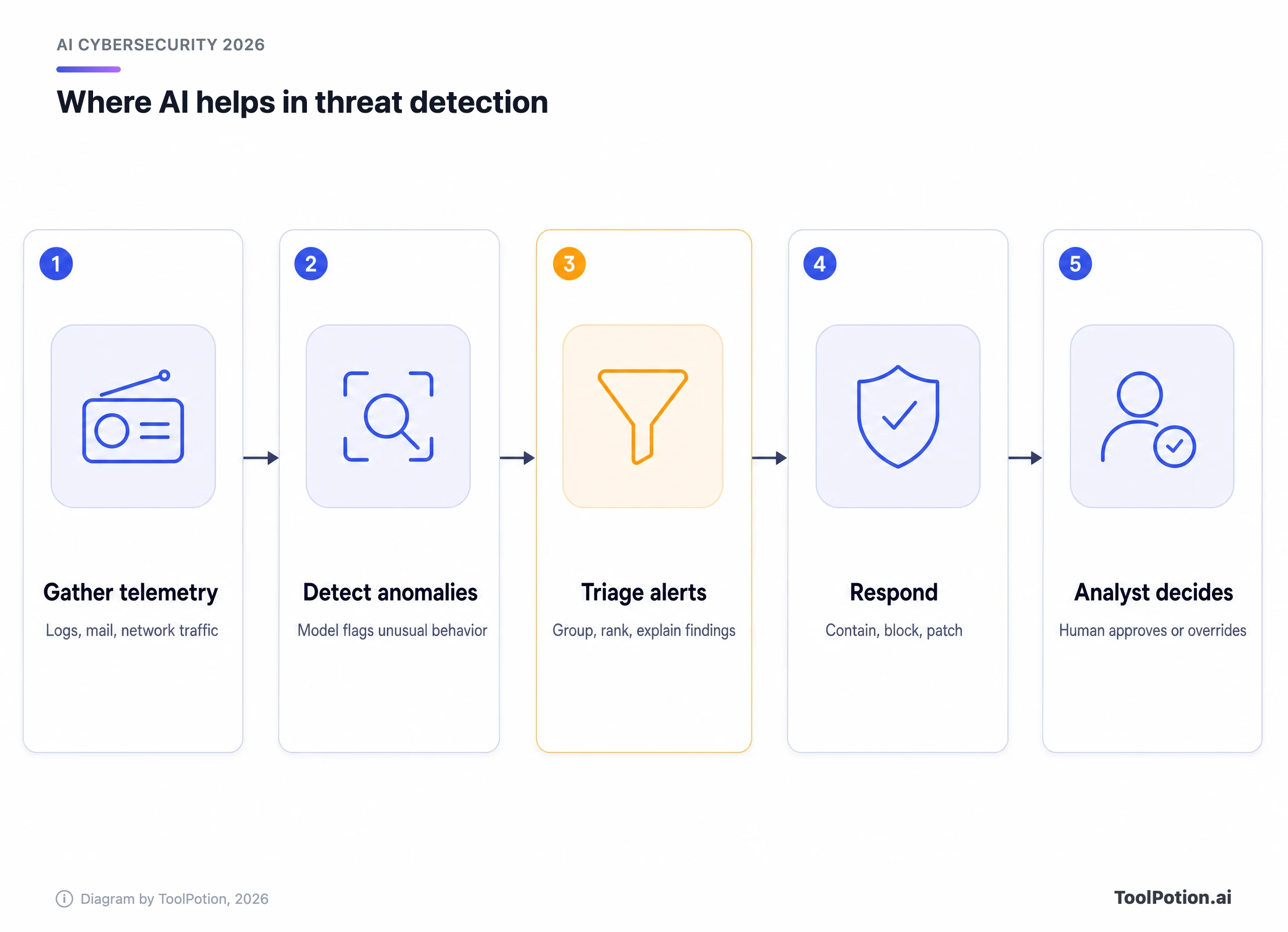
Marketing gloss tends to cluster in two places. One is the word "autonomous," which often means a rule that fires automatically after a model score crosses a threshold. The other is detection claims with no named data source. A vendor that can say what it learns from (mail headers, flow records, cloud audit logs) is usually describing a real mechanism.
Use that sequence as a test. When a vendor says "AI-powered," find the step. If the answer is vague, you're paying for the adjective.
Which layer each tool protects
Security stacks are layered, and most tools on this board are strong in one layer and thin in the rest. The stack below is how we group them. Code and AI apps sit at the top, the newest layer and the one growing fastest. Identity and exposure sit at the bottom, where old problems like stale privileges and unpatched servers still cause most of the damage.
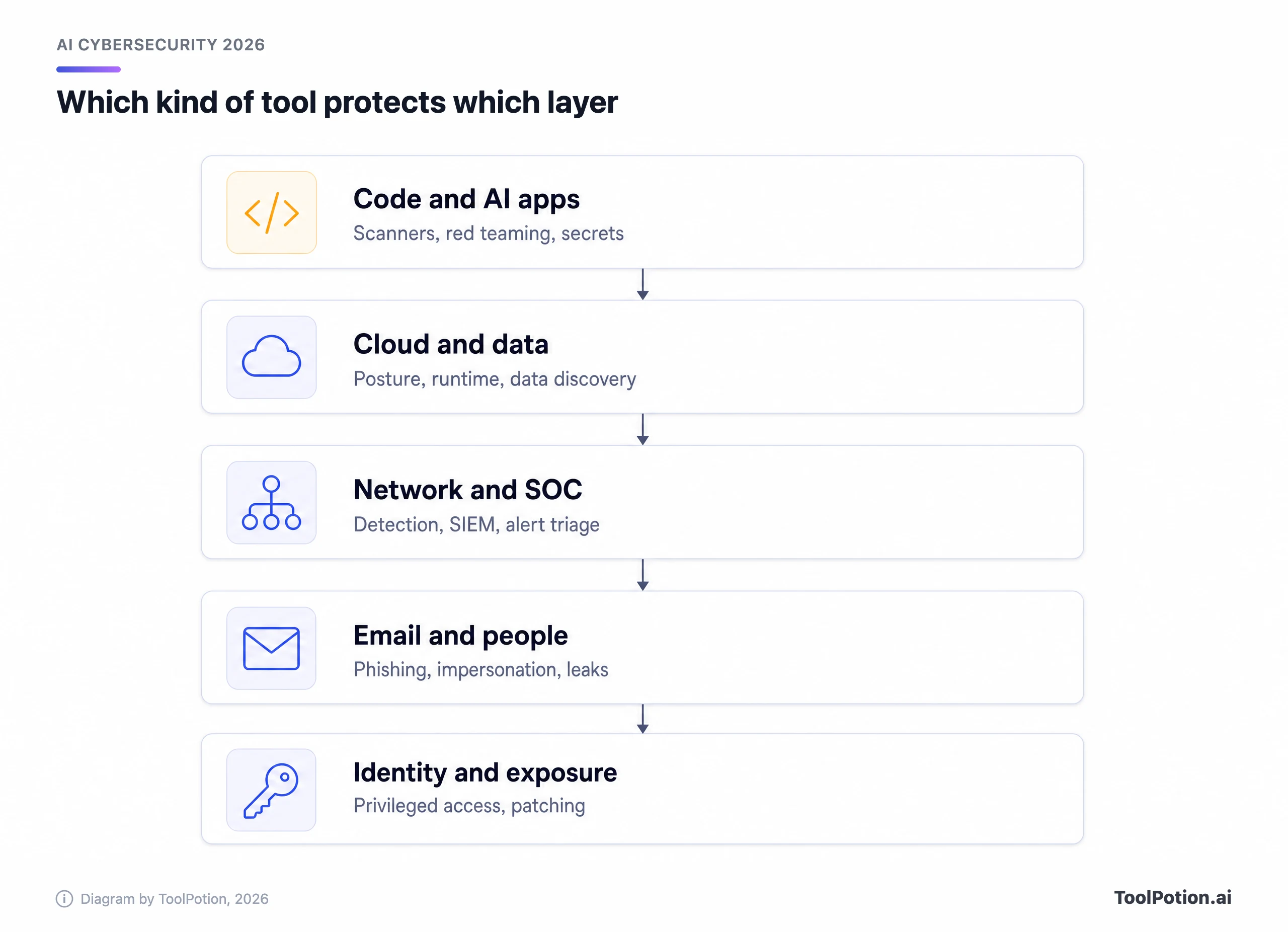
Platforms blur the lines, and Darktrace in particular sells across network, email and cloud. Still, buying by layer is the cleanest way to avoid paying twice for the same coverage.
The leaders, one layer at a time
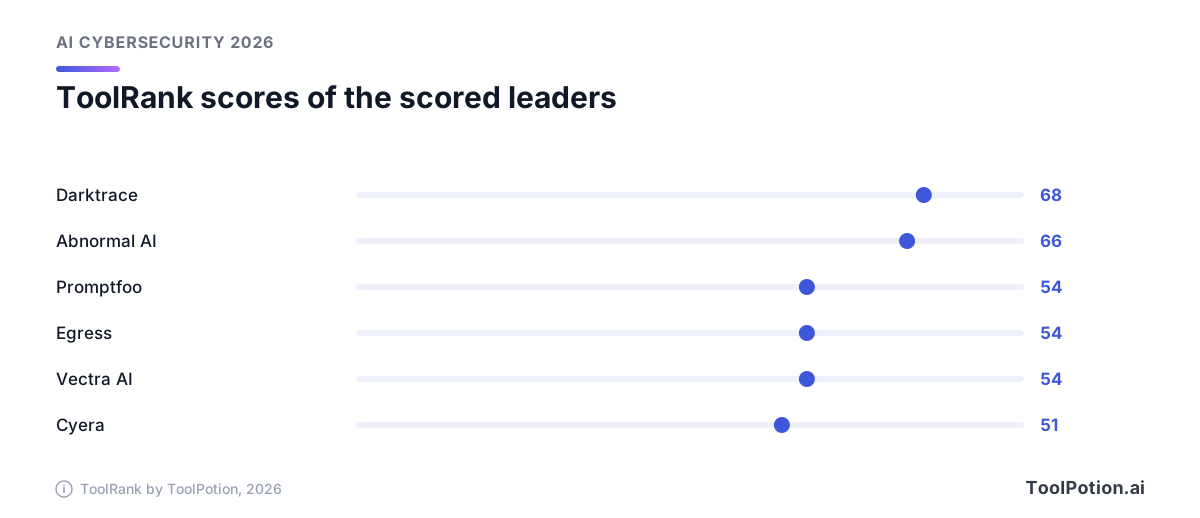
Only some entries carry a ToolRank score in 2026. Where a score exists we use it, and where it doesn't we don't compare. The chart shows the six scored tools in the top 25.
Wiz: best for cloud security
Wiz is #1 on the 2026 board and has no ToolRank score yet. It builds one graph from code, cloud and runtime so a security team can see which misconfiguration is actually reachable and dangerous. The pitch is agentless visibility and risk prioritization, and AI is mostly in the prioritizing. The catch is the new owner. Google says Wiz stays multicloud, but long-term neutrality is something you'll want in writing if you run mostly on AWS or Azure. Pricing isn't published.
Darktrace: best for self-learning network detection
Darktrace is #2 with a ToolRank of 68, in the strong tier. Its Self-Learning AI builds a model of normal behavior for each organization, then flags and can interrupt deviations across network, email, cloud and operational technology. Operational technology is on its listed use cases too, which matters if you run factories or utilities. The catch is the one every anomaly engine has: expect a tuning period and a hard conversation about which automated actions you'll allow. Pricing is quote-based.
Abnormal AI: best for email and identity attacks
Abnormal AI is #3, scored 66 and strong tier. It connects by API to Microsoft 365 and Google Workspace and builds a baseline for each sender and recipient, which suits impersonation attempts that carry no malicious link to scan. Its board listing says more than 4,500 organizations use it. A fair worry is overlap with the email protection you already pay Microsoft for. Run it in parallel on real mail before deciding what it replaces.
Qualys: best for vulnerability management across a mixed estate
Qualys is #4 and unscored. It's the veteran here (the company dates to 1999), and its real strength is breadth: servers, endpoints, cloud and compliance in one asset inventory. The AI story is about remediation. Its TruRisk Eliminate product scores how likely a patch is to break something, using crowd-sourced patch outcomes, and can apply low-risk patches automatically (Qualys explains the approach). Given that exploited vulnerabilities now lead breach entry, a safer patching path is a practical use of AI. Pricing isn't published.
Snyk: best for AI-generated code
Snyk is #5, unscored. In 2026 it repositioned around AI-built software: its Evo products govern coding agents and validate what they write. Pricing is public, which is rare in this category. A Free plan covers 5 projects, Team starts at $25 a month for up to 10 developers, and everything agentic needs an enterprise contract on a credit model, per Snyk's plans page. The catch is cost sprawl once you add capabilities. Model it per active contributor before you commit.
Sumo Logic: best for SIEM alert triage
Sumo Logic is #6. Its cloud SIEM now has Dojo AI agents, and the SOC Analyst Agent, generally available in 2026, investigates alerts and returns evidence-backed verdicts. That's the triage step from the diagram above, productized. The vendor's own claims about faster response times are unverified, so test on your alert mix. It suits teams that already want logs and SIEM in one place.
Proofpoint: best for large email and data programs
Proofpoint, at #7, is the heavyweight in people-centric security. Its current pitch spans email, collaboration tools, data protection and, newly, security for AI agents and interactions. That breadth suits large organizations that want one vendor, and it's less natural for a ten-person IT team. Expect a sales process. Its main email competitor on the board is Mimecast at #17, and the leaderboard has both.
Idira: best for privileged and machine identities
Idira is #8. It's the CyberArk lineage under Palo Alto Networks, which describes it as built on CyberArk's legacy. It covers privileged access for people, workloads and AI agents, with just-in-time access and secrets management. If your breach story is stolen credentials or over-permissioned service accounts, this is the layer to fund. Transition risk is real, so ask about support continuity.
Promptfoo: best for testing your own AI apps
Promptfoo is #9, scored 54 and solid tier. It's the odd one out, since it attacks your AI app before attackers do, with automated red teaming for prompt injection, data leaks and rule violations, wired into CI/CD. Founders report more than 350,000 developers have used it, and say it stays open source after the OpenAI deal. That makes it a cheap place to start. The open question is how neutral a tool owned by a model vendor will stay when you test other vendors' models.
Aikido Security: best budget AppSec bundle
Aikido Security is #11. It folds code, cloud and runtime checks into one dashboard and filters out noise so developers see fewer false alarms. According to its pricing page, a free Developer plan covers two users and ten repositories, and the Basic plan is $300 a month. For a startup that's far friendlier than a quote form. The limit is depth: enterprises with strict compliance will outgrow it.
Egress: best for outbound email mistakes
Egress holds #12 with a score of 54, solid tier. Now part of KnowBe4, it focuses on the half of email risk others skip: wrong recipients, accidental leaks and data exfiltration, alongside phishing defense. That matters most to regulated teams that handle sensitive client or patient data. Pricing isn't listed.
Vectra AI: best for network detection and response
Vectra AI is #14, scored 54 and solid. Vectra says it was named a Leader in Gartner's 2026 Magic Quadrant for network detection and response. It's the closest rival to Darktrace for SOC teams, and the one to put in a proof of concept beside it. Its pitch is detection and investigation help for security teams, so compare it with Darktrace on your own network traffic.
The leaders side by side
The table collects what's documented. Sort by rank, layer or owner. "Not listed" means the vendor doesn't publish a price, not that it's expensive.
How to choose
Buyers tend to stall on two decisions. One is platform versus specialists. The other is comparing products whose prices are hidden. Consolidation cuts consoles and contracts, but it can leave a weak module bundled in with a strong one. Specialists are sharper and add integration work. A reasonable middle path is one platform for the layer you care most about plus a specialist where the platform is visibly thin.
Start with the layer where a breach would hurt most, not with the vendor list. A company that lives in Microsoft 365 and has weak mail controls should look at email before it looks at anything glamorous. A cloud-native startup shipping AI features has a different first purchase. The tool below walks through it in two questions.
Three situations come up a lot. If you have no dedicated analysts, favor products that triage for you and avoid anything that needs a tuned SIEM. If you have a SOC, ask whether a tool reduces alerts or adds a new console. If you're in a regulated field, check data residency and what the vendor does with your telemetry. Our boards for security analysts, IT managers and DevOps engineers re-sort the same universe by role.
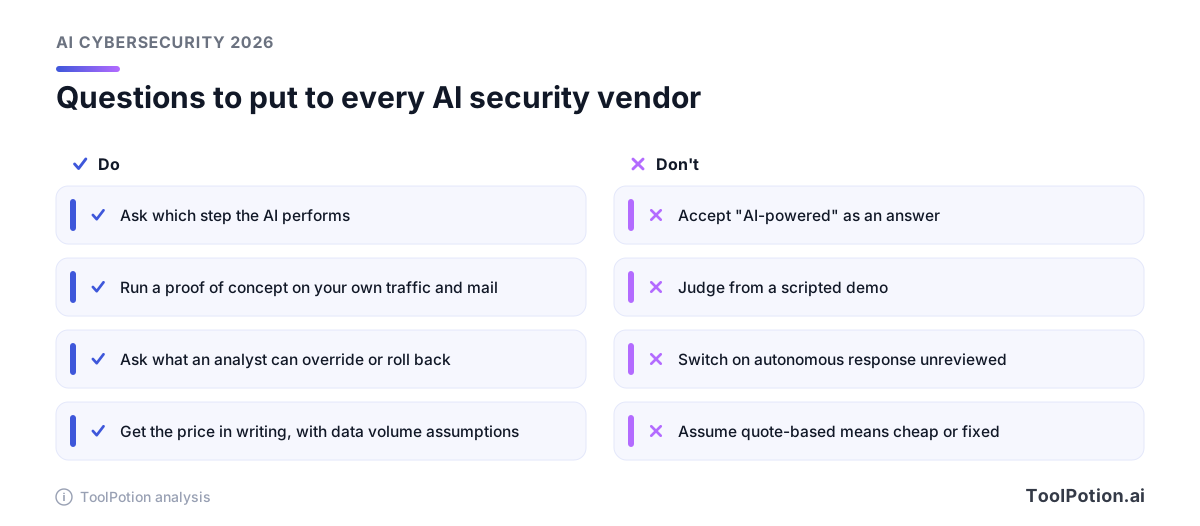
Questions to put to every vendor
A proof of concept is the only fair test. Give two vendors the same two weeks, the same data and the same analysts, then count how many alerts each sends to a human and how many of those turn out to matter. Vendor demos are built to avoid exactly that comparison.
Pricing is the first friction. Most vendors here quote by seats, data volume or assets, so two quotes are rarely comparable. Get the assumptions in writing.
For a broader view, the Security and Privacy board covers tools outside this category, and the full directory hub lists everything we track here.
About ToolRank
ToolRank is ToolPotion's independent ranking of AI tools. Placement can't be bought, and scores and tiers are shown where available. See all boards at /en/top, or return to the Top 150 AI Cybersecurity Tools leaderboard.
Rising and newer names worth watching
Just outside the top 25 is Orca Security, an agentless cloud platform at #26, followed by Semgrep for code scanning at #27. XBOW at #28 and Strix at #32 both sell autonomous penetration testing, an area where AI is moving quickly and where you should ask hard questions about scope and safety controls.
Inside the top 25, Cyera at #23 has a score of 51 (solid tier) and focuses on discovering and classifying sensitive data. Varonis at #18, Aqua Security at #21 and Checkmarx at #25 are established names in data, container and application security. We haven't reviewed them at length here, but they belong on a longer list.
Frequently asked questions
What is the best AI cybersecurity tool in 2026?
There isn't one. Wiz leads the 2026 board for cloud, Darktrace and Abnormal AI carry the highest ToolRank scores, and the right pick depends on the layer you need to protect first.
Is Wiz still independent?
No. Google completed its acquisition in 2026. Google says Wiz keeps its brand and continues to support AWS, Azure, Oracle and Google Cloud.
How much do AI cybersecurity tools cost?
Most are quote-based, so there's no public number for Wiz, Darktrace, Abnormal AI or Qualys. Snyk lists a Free plan and Team from $25 a month, and Aikido lists a free tier and Basic at $300 a month.
Does AI replace a security analyst?
Not on the evidence here. AI shortens triage and investigation, but vendors describe analysts approving or overriding actions. Treat any claim of fully autonomous security with suspicion.
What should a small team buy first?
Pick the layer with the weakest controls today. For many small teams that's email, then code scanning. Free tiers from Snyk and Aikido let you try the code layer without a purchase order.
What is the difference between detection and triage?
Detection decides that something looks wrong. Triage decides which of the many wrong-looking things deserves a person's time first.