The best AI writing assistant in 2026 depends on which job you're hiring it for. Grammarly leads our AI writing assistants leaderboard because it fixes and polishes text wherever you type. QuillBot sits second as the paraphraser, and Jasper is third because marketing teams will pay for copy at volume.
Those three do different things. So do the rest of the top ten: a fiction partner, a voice dictation app, a line editor, a budget copy generator. Put them in one list and they look like rivals. In practice you'd rarely choose between a tool that corrects your grammar and one that writes ad variations, because you need one or the other on a given day.
The leaderboard below shows the current top 25. What follows is the part a list can't give you: which job each leader does, what it costs according to the vendors' own pricing pages, where it falls short, and how to pick without paying for three subscriptions.
The top 25 right now
- # 1Top PickGrammarlyAI AppGrammarly offers AI writing assistance to enhance your writing skills. With personalized guidance and text generation, it helps users write clearly and effectively across various applications and websites.91ToolRankElite
- # 2Runner UpQuillBotAI AppQuillBot is an AI-powered writing tool designed to enhance your writing by providing paraphrasing, summarizing, and grammar checking features. It aims to improve clarity and coherence in your text.75ToolRankStrong
- # 3Third PlaceGemini for Google WorkspaceAI AppGemini for Google Workspace integrates AI capabilities into Gmail, Docs, Sheets, and more, enhancing productivity and efficiency. It offers enterprise-grade security and allows teams to run AI agents securely across applications, transforming workflows and improving collaboration.73ToolRankStrong


- 4Jasper AI Marketing PlatformAI AppJasper is an AI platform designed for marketing teams, enabling them to orchestrate intelligent agents for end-to-end workflows. It enhances content creation, maintains brand consistency, and automates marketing processes, delivering measurable impact and efficiency.72ToolRankStrong
- 5OpenAI PrismAI AppOpenAI Prism is a free LaTeX editor and AI-native workspace designed for scientists. It integrates ChatGPT and Codex to enhance scientific writing and collaboration, providing AI-assisted proofreading, citations, and formatting.65ToolRankStrong
- 6Verse by VerseAI AppVerse by Verse is an AI-powered tool that helps users compose poems by collaborating with artificial intelligence. It offers a unique platform for creativity, allowing poets to explore new styles and ideas with AI assistance.60ToolRankStrong
- 7Rytr AI WriterAI AppRytr is a free AI writing assistant that generates original content, sounding like you, not a robot. It offers over 40 use cases and templates to streamline writing workflows, including text editing, content expansion, and grammar checking. Save time and money on content creation.58ToolRankSolid
- 8WordtuneAI AppWordtune is an AI writing assistant that paraphrases, rewrites, corrects grammar, adjusts tone, and summarizes documents, articles, webpages, and videos, helping users express themselves clearly in English.57ToolRankSolid
- 9ProWritingAidAI AppProWritingAid is an AI-powered writing assistant and editor that helps storytellers craft, polish, and elevate their work. It offers in-depth analysis, actionable feedback, and tailored suggestions to improve grammar, style, and reader engagement. Works with popular writing apps, providing a comprehensive toolkit for writers.56ToolRankSolid
- 10Sudowrite AI Writing PartnerAI AppSudowrite is an AI writing partner designed for fiction writers, helping to generate ideas, descriptions, and prose. It assists with outlining, drafting, revising, and editing, aiming to make the writing process faster and more engaging for novelists and screenwriters.55ToolRankSolid
- 11WPS AIAI AppAn AI application from Kingsoft Office (WPS) that adds large-language-model capabilities to office work, including AI document writing, one-click PPT generation and AI spreadsheet processing.53ToolRankSolid
- 12Hemingway EditorAI AppHemingway Editor is a writing app that makes your writing bold and clear by highlighting lengthy or complex sentences, adverbs, passive voice, and common errors so you can simplify and tighten your prose.53ToolRankSolid
- 13AIPal: Web CopilotAI AppAIPal is an AI-powered tool that enhances web browsing by integrating advanced AI models like GPT-3.5 and GPT-4. It facilitates seamless chatting, writing, replying, and translating across webpages, offering personalized interactions and efficient content management.52ToolRankSolid
- 14Wispr FlowAI AppWispr Flow is an AI-powered voice dictation tool that enhances writing speed and clarity. It allows users to dictate text seamlessly across various applications and devices, making it a convenient solution for anyone looking to improve their writing efficiency.52ToolRankSolid
- 15HyperWriteAI AppHyperWrite is an AI writing assistant designed to help users create, edit, and refine text. It offers tools for content generation, research, and rewriting, including an AI document editor. HyperWrite provides features like personalized sentence completions, email responses, and custom AI tool creation, all powered by advanced AI technology.52ToolRankSolid
- 16TextFX by GoogleAI AppTextFX is a suite of tools designed to enhance your writing by providing creative possibilities and new perspectives on text. Developed in collaboration with Google, it leverages AI to empower users without writing for them.51ToolRankSolid
- 17gpt_academicGitHub Repogpt_academic provides a practical interactive interface for large language models like GPT and GLM. It enhances the experience of reading, editing, and writing papers, and supports Python and C++ project analysis and translation.51ToolRankSolid
- 18AnywordAI AppAnyword is an AI writing platform designed for enterprise marketing teams to create on-brand content that drives measurable business results. It enhances content performance by integrating A/B-tested data, achieving a 30% lift in outcomes.51ToolRankSolid
- 19WritecreamAI AppWritecream offers a comprehensive platform with over 75 AI tools to generate SEO-optimized articles, ad copy, and cold emails quickly. Lexi, the AI SEO agent, automates the content workflow, making it efficient and effective for users.51ToolRankSolid
- 20SaplingAI AppSapling is an AI-powered language model toolkit designed for enterprises, developers, and customer-facing teams. It provides grammar checking, autocomplete, AI detection, and more through an API and SDK, enhancing communication and productivity.50ToolRankSolid
- 21Type.ai: Free AI book writer and editorAI AppType.ai is an AI-powered writing tool designed for storytellers. It helps writers create, edit, and organize long-form content like books, novels, and screenplays. With features like a document editor and AI integration, it supports creative writing processes.50ToolRankSolid
- 22Toolsaday - AI PlatformAI AppToolsaday is an AI-powered platform designed to streamline content creation and daily tasks. It offers tools for writing, paraphrasing, story generation, and text-to-speech, helping users save time and enhance creativity. Trusted by over 700,000 users, it generates millions of words and saves thousands of hours.50ToolRankSolid
- 23Voilà AI AssistantAI AppVoilà AI Assistant is an all-in-one AI tool that seamlessly integrates into your workflow. It helps you create, write, brainstorm, research, and automate tasks across any website or document, boosting productivity and saving time with features like instant email replies and a comprehensive prompt library.49ToolRankSolid
- 24LexAI AppLex is an AI-powered word processor that helps modern creators write faster, clearer, and smarter. With collaborative features and powerful AI editing tools, it enhances your writing flow and allows for real-time feedback and collaboration.49ToolRankSolid
- 25Compose AICompose AI is an AI writing assistant that automates writing tasks, offering sentence autocompletion across various platforms. It learns your writing style to provide personalized suggestions, significantly reducing typing time and increasing efficiency for professionals. The tool aims to help users write faster and save valuable time.48ToolRankSolid



















How ToolRank works
ToolRank is ToolPotion’s proprietary ranking engine.
It continuously evaluates hundreds of signals across the open web — real traffic and popularity, audience and community strength, authority and longevity, adoption and engagement — processing millions of data points to place every tool where it has earned to be.
Every AI type is measured by its own tailored model: what proves traction for a SaaS app is not what proves it for an open-source framework or a creator channel. Missing a platform never counts against a tool — ToolRank judges the evidence that exists.
No paid placement. No self-reported numbers.
Quick picks
- For most people, Grammarly. It's #1 on the 2026 board, the free plan covers the basics, and Pro is listed at $12 a month.
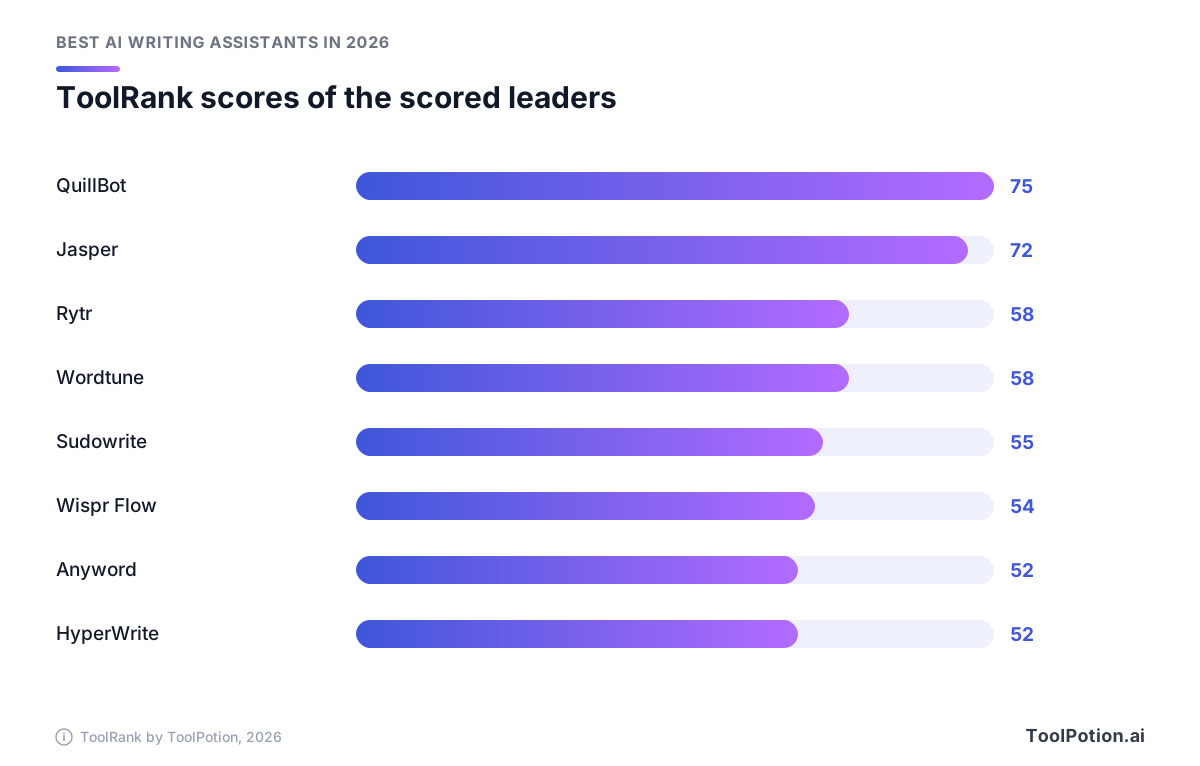
- If you rewrite and summarize a lot, QuillBot is #2 on the board with a ToolRank score of 75 (strong tier), the highest among the scored leaders.
- Marketing teams get the most from Jasper, with brand voices and agents at $59 per seat a month on annual billing.
- On a small budget, look at Wordtune ($4.89 a month billed annually) or Rytr, which has a free tier.
- Novelists should start with Sudowrite, built for fiction and from $10 a month.
- Anyone who thinks faster than they type should try Wispr Flow, a dictation app with a free tier.
What changed in 2026
Writing assistants stopped being browser add-ons. In 2025 Grammarly launched Docs, a writing surface with a set of task-specific agents, among them a proofreader, a paraphraser, a citation finder and an AI detector (Grammarly). Its parent company then renamed itself Superhuman, though Grammarly stays the product name and the company says it has more than 40 million daily users (Grammarly).
The 2026 twist is proof of process. Superhuman added agent-specific attribution to Grammarly Authorship, which records which parts of a document a person wrote and where an AI agent was used for research, generation or revision feedback (Grammarly). It's on by default in Docs. It's a direct response to the detector problem covered below.
Demand is the other story. Pew found that about half of U.S. adults now use AI chatbots, and 38% of employed adults use them for tasks at work (Pew Research Center). A general chatbot now covers plenty of casual writing, so the specialists compete on jobs it does badly: staying consistent with a brand, editing a 90,000-word manuscript, working inside Word.
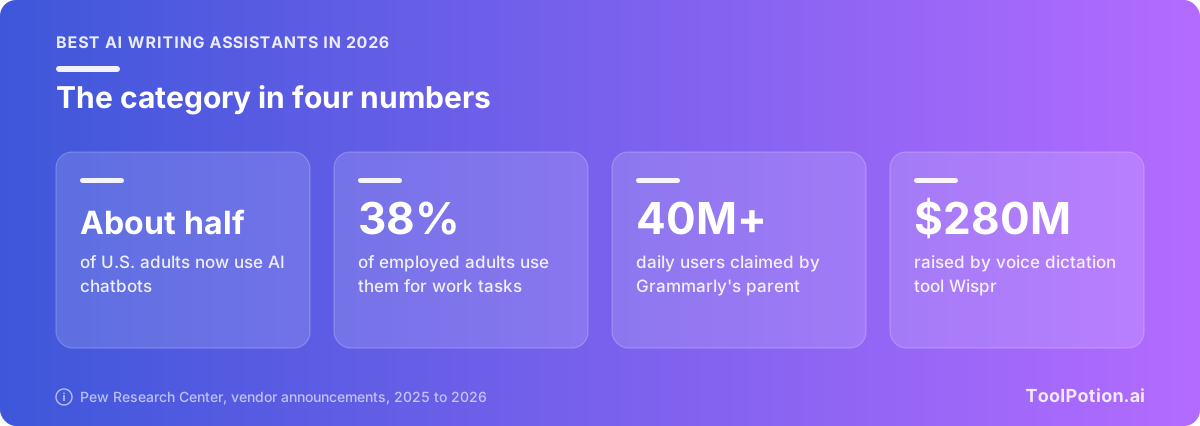
Money followed. Wispr, the maker of the dictation app Wispr Flow, raised $280 million at a $2 billion valuation in 2026 (Yahoo Finance). Voice is now treated as a writing interface, not a niche accessibility feature.
Pick the job before the tool
Most bad purchases here come from comparing tools that don't compete. A grammar checker and a marketing copy generator both get called "AI writing assistants," yet one reads what you wrote and the other produces what you didn't.
Think of the workflow in six stages: idea, outline, draft, revise, polish, publish. Each kind of assistant has a home. Dictation helps early, when getting thoughts out of your head matters more than wording. Fiction partners work on structure and scenes. Copy generators produce first drafts of short, repetitive formats. Rewriters sharpen sentences you already have. Correctors catch what's left before you hit send.
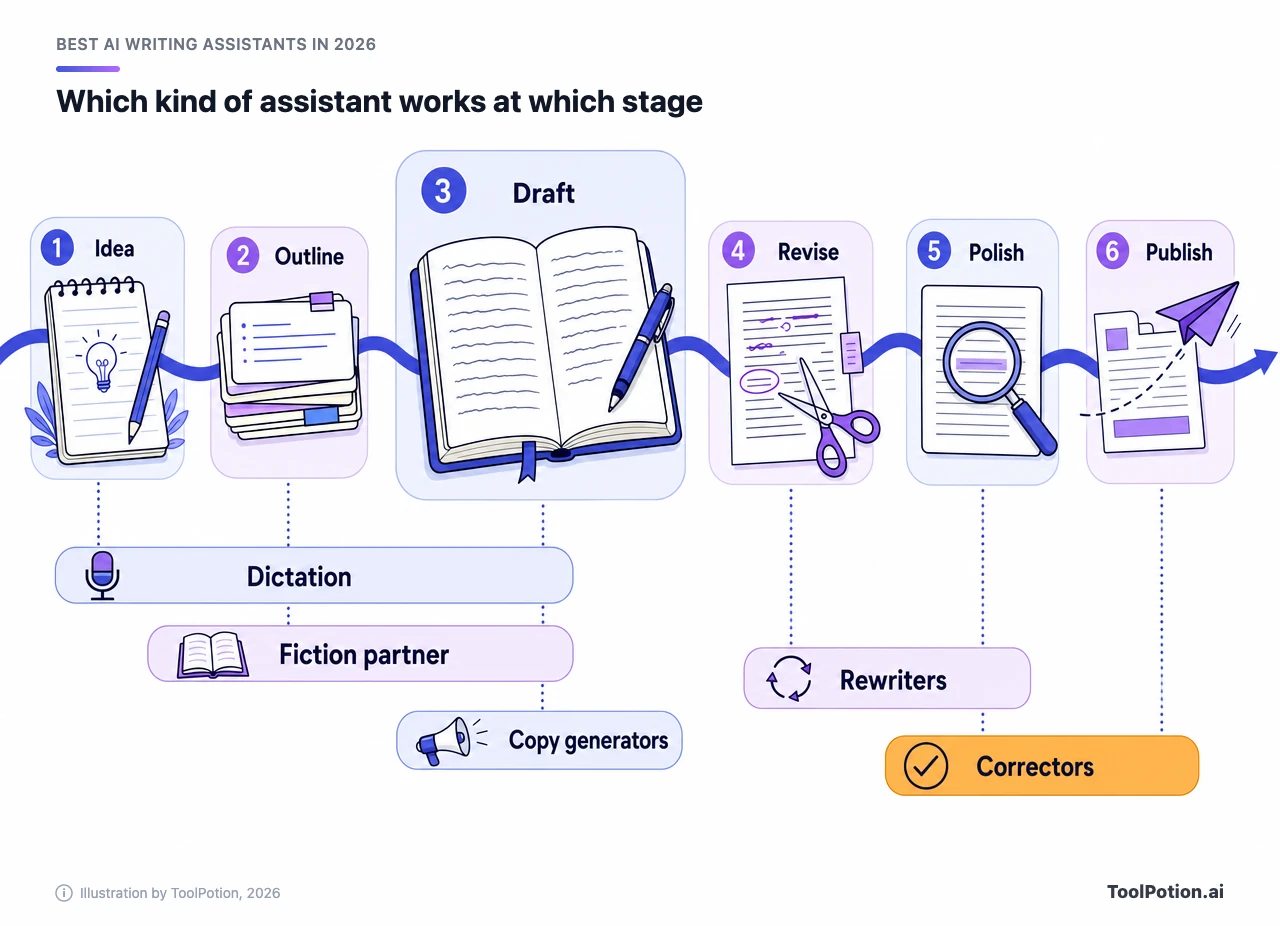
The leaderboard's own labels follow the same split. Grammarly sits in the directory's grammar checker category, QuillBot in paraphrasing, Jasper and Rytr in copywriting, Sudowrite in story generators. If you want to see more of any one kind, the full AI writing assistants hub lists everything in the category, and the grammar checkers board and writing and editing board go deeper on the correcting end.
The leaders, reviewed
Six of the top ten carry a ToolRank score. Grammarly, ProWritingAid, WPS AI and Hemingway are ranked but unscored, so the chart below leaves them out and adds the scored names just behind.
Grammarly: the default for a reason
It's #1 on the 2026 board and the tool most people mean when they say "writing assistant." It checks grammar and tone as you type in browsers and desktop apps, rewrites full sentences and now drafts text from prompts.
The free plan gives you spelling, grammar and tone detection plus 100 AI prompts a month. Pro is listed at $12 a month (the page doesn't say whether that's an annual rate), adds sentence rewrites, plagiarism and AI-text detection and raises the prompt allowance to 2,000 (Grammarly pricing). The catch is that it's a polisher. If you need a thousand product descriptions, you'll want something else.
QuillBot: the paraphrasing specialist
QuillBot is #2 with a ToolRank score of 75, strong tier, and it climbed from #4 on the board. The directory describes it as paraphrasing, summarizing and grammar checking in one place, with academic writing, professional email and language learning among its use cases.
The risk is the category itself. Paraphrasers are the kind of tool most likely to collide with an institution's integrity rules, so check your school's policy before you lean on one for coursework. We couldn't verify current QuillBot prices from its own pricing page, so we've left them out. Look at the plan page directly before you buy.
Jasper: built for teams with brand rules
Jasper is #3 at a score of 72, also strong tier. It isn't a sentence-level helper. It's a marketing platform with agents, a canvas and stored brand voices.
The Pro plan is $69 per seat a month, or $59 on annual billing, with a 7-day trial and two Brand Voices. Business is custom-priced, carries a 12-month minimum and adds API access, a no-code agent builder and a bulk content grid (Jasper pricing). For one freelancer that's steep. For a team trying to keep dozens of writers on the same voice, it's the point.
Rytr: the cheap first-draft machine
Rytr climbed from #13 to #4 and has a ToolRank score of 58, solid tier. It generates short copy from templates (the listing says more than 40 use cases), and its pitch is price. The free plan allows 10K characters a month, and the Unlimited plan is listed at $7.50 a month on the page's yearly option, which it pitches as two months free and ties to a 12-month commitment (Rytr pricing).
Treat the output as a first draft. Anyone who needs a distinct brand voice should look at Jasper or Anyword instead.
Wordtune: sentence-level rewriting at the lowest price
Wordtune is #5, score 58, solid tier, and it does what the name suggests: you select a sentence and it offers alternatives in different tones. It can also summarize documents and web pages.
Pricing is the draw. Free gives you 10 rewrites a day. Advanced is $6.99 monthly or $4.89 billed annually, and Unlimited is $9.99 monthly or $6.99 billed annually (Wordtune plans). The free daily cap is small, so you'll know within a day whether it fits.
ProWritingAid: for people who edit for a living
ProWritingAid is #6 and unscored. It's the one to try if your work is long: reports, books, anything where a line-by-line report is more useful than inline squiggles.
The pricing page shows the widest monthly-versus-yearly gap in this group. Premium is $30 a month, but $10 a month billed yearly at $120, with a $399 lifetime option. Premium Pro is $36 monthly or $144 a year. The free plan is tightly capped, at 500 words of text per line-editing run and two runs a day (ProWritingAid pricing). Don't pay monthly.
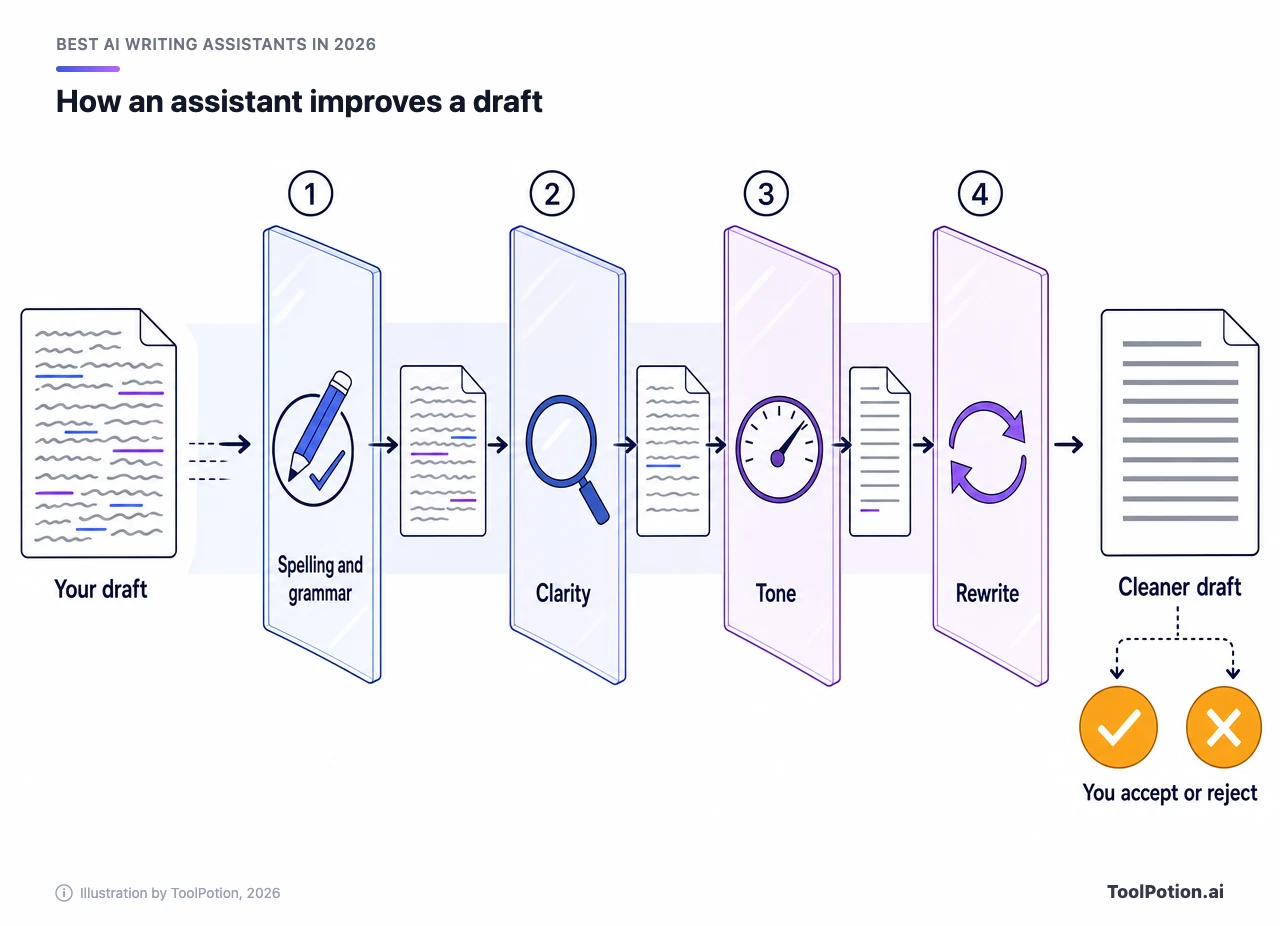
The picture above shows what every one of these correcting tools has in common. Layers of checks run in order, each one thinning out the marks on the page, and you decide what survives. Grammarly and ProWritingAid cover most of them. Hemingway sticks to clarity, and that's a feature.
Hemingway Editor: one job, done bluntly
Hemingway Editor is #10 and unscored. It marks long sentences, adverbs and passive voice so you cut them. The free web editor does that, and a paid Hemingway Editor Plus adds AI fixes for grammar and tone, with a 2-week trial. We couldn't find a price on the page, so there isn't one here (Hemingway).
It's the cheapest fix for bloated business writing. It won't draft anything for you.
Sudowrite: the fiction partner
Sudowrite is #7 at a score of 55, solid tier. It's built for novelists. It runs a model called Muse made for fiction, a Story Bible that tracks characters and plot, and tools for describing scenes, drafting the next few hundred words and brainstorming (Sudowrite).
Plans are Hobby and Student at $10 a month with 225,000 credits, Professional at $22 with 1,000,000 and Max at $44 with 2,000,000, and every plan has a free trial without a card (Sudowrite pricing). Professional and Max add developmental edits, line edits and beta reads, and Max adds a 12-month credit rollover. It won't write your book for you. Sudowrite's own guide frames the writer as the one who directs the creative vision.
Wispr Flow: dictation that cleans itself up
Wispr Flow is #8, score 54, solid tier. You talk, it types into whatever app is open and tidies the speech on the way. It runs on Mac, Windows, iOS and Android and supports more than 100 languages.
Free gives you 2,000 words a week on desktop and 1,000 on mobile. Pro is $12 a month billed annually or $15 monthly (Wispr Flow pricing). The honest limit: dictation helps you get a draft down faster, not make it better. Pair it with a corrector.
Anyword: copy you can score before you publish
Anyword is #11 with a ToolRank score of 52, solid tier. It targets marketing teams and attaches performance predictions to the copy it writes. Starter is $49 monthly or $39 on annual billing for one seat, Data-Driven is $99 or $79 for three seats, and there's a 7-day trial capped at 2,500 words (Anyword pricing).
The predictions are the selling point, and also the thing to question. A score is a model's guess about your audience, not a measurement of it. Treat it as a tiebreaker between two headlines.
What they cost
Prices spread by a factor of twelve. Polishing and rewriting tools sit between roughly $5 and $12 a month. Tools built for marketing teams start much higher.
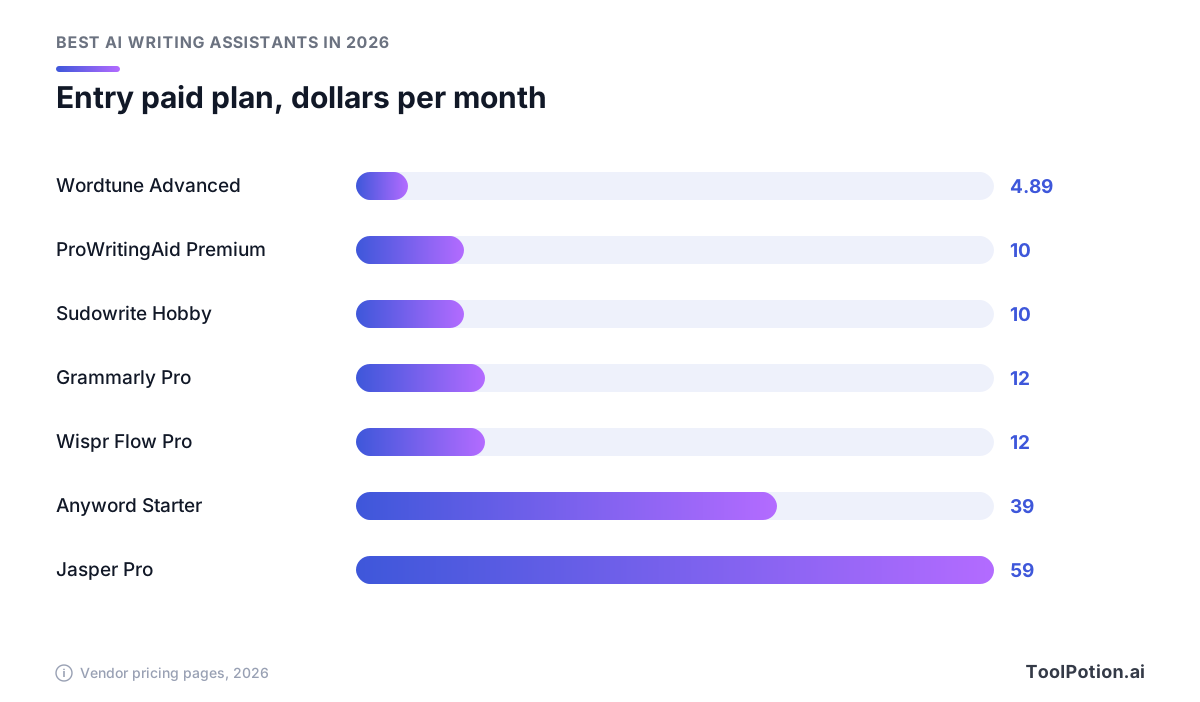
The cheap end makes sense. A corrector works on text you've already written, so the value is small per use. A marketing platform replaces billable hours, so vendors charge for it. Both can be right for you. Paying Jasper prices for a student essay isn't.
Check the billing basis before comparing. ProWritingAid, Wordtune, Anyword and Wispr Flow all advertise a lower annual rate than their monthly one, and the chart uses that annual rate. Sudowrite's $10 is its monthly price (yearly is advertised as up to 50% off). Grammarly's page lists $12 without naming a billing basis, so the chart shows it as listed, and Rytr's $7.50 is its yearly-option price. Prices change, so confirm on the vendor's page.
How to choose
Start with what you actually write, then how often. The short version: if you write mostly emails and documents, a corrector like Grammarly covers most of it. If you rewrite a lot of your own sentences, add a rewriter (Wordtune or QuillBot). If you produce marketing copy by the hundred, pick a copy platform. If you write fiction, use a fiction partner. If typing is your bottleneck, try dictation.
The quiz below walks through it in two or three questions and lands on one of the eight tools in this article.
Run the free tier first. Grammarly, Wordtune, Rytr, ProWritingAid and Wispr Flow all have one, and Sudowrite, Anyword and Jasper offer trials. A day with your own writing tells you more than any review, including this one. The sortable table below has the entry prices in one place.
If you want the same thing narrowed by role, our AI tools for writers board overlaps with this one on 18 of its top 50 entries, and the copywriter and blogger boards cover the marketing end. For a single task, see the boards for writing emails, blog posts and marketing copy. Our earlier top AI writing assistants guide is a shorter companion.
AI detectors, honest writers and academic integrity
If you write for school or publishing, one fact matters more than any feature: AI detectors are unreliable. A Stanford-led study found that detectors consistently misclassify writing by non-native English speakers as AI-generated while judging native samples accurately (arXiv). Vanderbilt turned off Turnitin's AI detector in 2023 after estimating that, at the vendor's claimed 1% false-positive rate, about 750 of the 75,000 papers it submitted in 2022 could have been wrongly flagged (Vanderbilt).
That cuts both ways. A corrector can make human text look more machine-like, and a paraphraser can make machine text look human. Neither fact is a reason to avoid the tools. It's a reason to keep your drafts, use version history and read your institution's rules, which differ a lot. Process records such as Grammarly's Authorship exist for exactly that reason, and are worth switching on if you write under an integrity policy.
About ToolRank
ToolRank is ToolPotion's independent ranking for AI tools, and placement can't be bought. Every board shows a 0-100 score and a tier for each scored entry, and you can browse them all on the ToolRank leaderboards page.
Rising and newer names
Two of the top five have moved most. Rytr climbed from #13 to #4, and QuillBot went from #4 to #2. Lower down, WPS AI at #9 adds language-model writing to the WPS Office suite, which makes it the obvious pick if your documents already live there. HyperWrite at #12 (score 52) and Writecream at #13 (score 51) are the budget generalists, and Sapling at #15 pitches grammar and autocomplete to customer-facing teams.
Just off the widget, Axios HQ is #26, a writing tool for internal communications, and TextCortex is #27. Both are narrower than the leaders and worth a look if the use case matches. The full board goes to 200.
Frequently asked questions
What is the best AI writing assistant in 2026?
For most people, Grammarly. It's #1 on the 2026 board, works in the apps you already use and has a usable free plan. For rewriting, QuillBot is #2. For marketing copy, Jasper is #3.
Is there a free AI writing assistant that's actually useful?
Yes. Grammarly's free plan covers grammar and tone with 100 AI prompts a month. Wordtune's gives 10 rewrites a day, Rytr gives 10K characters a month, and Wispr Flow gives 2,000 dictated words a week on desktop. All are small enough to push you toward paying if you use them daily.
Can I use QuillBot or Grammarly for schoolwork?
It depends entirely on your institution and often on the instructor. Policies vary widely, and some schools allow grammar correction while restricting paraphrased or generated text. Read the syllabus, and ask if it's unclear.
Do AI detectors work?
Not reliably. Research shows they misclassify non-native English writing as AI, and at least one major university has switched Turnitin's detector off over false positives. If you're accused, version history and tools that record how a document was written are your best evidence.
Which tool is best for fiction?
Sudowrite is the one built for it. It tracks your characters and world in a Story Bible and plans start at $10 a month. A general chatbot or an editor like ProWritingAid can still help with revision.
Is Jasper worth $59 a month?
Only for teams. Per seat on annual billing, it costs nearly five times Grammarly Pro's listed $12. The extra money buys brand voices, agents and workflows, which matter when many people publish under one name. A solo writer won't use enough of it.