ElevenLabs leads the 2026 AI voice agents board, with Vapi, Sierra and Bland close behind. But the rank matters less than one decision: who is going to build and run the thing. A developer platform, a managed enterprise agent and a phone-system add-on can all answer a call, and they could hardly be more different to buy.
That split drives everything below. Developer platforms like Vapi, Retell AI and LiveKit give you the parts and expect you to assemble them. Managed agents such as Sierra and Bland run the whole call for you. Contact-center suites like Dialpad put the AI inside the phone system you already staff.
The leaderboard below shows the top 25 right now. This guide is the judgment it can't give: who fits which team, what the per-minute prices really mean, and where the pitfalls sit.
The top 25 AI voice agents right now
- # 1Top PickElevenLabs AI Voice GeneratorAI AppElevenLabs offers a powerful AI voice generator and voice agents platform. Create lifelike speech, clone voices, and generate audio in over 70 languages. Utilize secure APIs and SDKs for seamless integration into your projects, empowering creators and enterprises with advanced synthetic voice technology.80ToolRankElite
- # 2Runner UpAmazon Lex AI Chat BuilderPlatformAmazon Lex is a fully managed AI service for building chat interfaces. It enables the creation of chatbots, voice assistants, and virtual agents, leveraging generative AI for scalable and secure interactions across applications.72ToolRankStrong
- # 3Third PlaceSierra AI AgentsAI AgentSierra empowers businesses to build advanced AI agents for enhanced customer experiences. It enables personalized interactions across multiple channels, automates workflows, and provides deep insights into agent performance, all while offering outcome-based pricing for measurable value delivery.71ToolRankStrong



- 4VapiAI AgentVapi is a platform that enables developers to build, test, and deploy advanced voice AI agents quickly. It streamlines the creation of conversational voice experiences, allowing businesses to enhance customer interactions efficiently.69ToolRankStrong
- 5Bland | Enterprise Voice AIAI AppBland offers an enterprise voice AI platform for building, deploying, and monitoring human-sounding AI phone agents. It emphasizes security, reliability, and compliance for regulated industries, featuring self-hosted models, sub-second latency, and seamless integration with existing enterprise stacks.69ToolRankStrong
- 6NICE CXone: AI Customer Experience PlatformAI AppNICE CXone is an AI-powered customer engagement platform that unifies data, AI agents, and orchestration to automate and resolve customer journeys at enterprise scale. It supports seamless integration with existing systems and offers robust security and compliance features.58ToolRankSolid
- 7VoiceflowAI AgentVoiceflow is an enterprise conversational AI platform for building, launching, and scaling chat and voice AI agents. It empowers teams to design intelligent workflows, deploy integrated agents across channels, and iterate for continuous improvement, enhancing customer support and CX.57ToolRankSolid
- 8Retell AI Voice Agent PlatformAI AppRetell AI offers a production-ready AI voice agent platform for automating phone calls at scale. Build, test, deploy, and monitor human-like AI agents that handle complex conversations, execute tasks, and integrate seamlessly with existing systems, boosting operational efficiency and customer engagement.57ToolRankSolid
- 9DialpadAI AppDialpad is an AI-native contact center and business communications platform. It unifies voice, chat, SMS, email, and meetings with real-time AI insights and autonomous AI agents that resolve customer requests across channels.56ToolRankSolid
- 10Observe.AIAI AppObserve.AI is a comprehensive AI platform designed to enhance customer experience. It automates customer service with Voice AI, assists frontline teams in real-time, analyzes conversations, improves QA, and orchestrates workflows with governance for complex CX operations.55ToolRankSolid
- 11PolyAI Voice AI AgentsAI AppPolyAI offers an enterprise platform for building, running, and adapting lifelike voice AI agents. It empowers builders with tools for complex conversations, ensuring compliance, brand consistency, and real-time iteration. Ideal for customer engagement across various industries.55ToolRankSolid
- 12SynthflowAI AppSynthflow is an AI voice agent platform designed for automating phone calls in enterprises. It enables businesses to deploy custom AI agents that handle customer interactions, improving efficiency and support while maintaining high security and compliance standards.55ToolRankSolid
- 13QuoAI AppQuo, formerly OpenPhone, is an AI-powered business phone system for startups and small businesses. It unifies calls, texts, voicemails, and contacts in one shared space and includes Sona, an AI voice agent that answers calls 24/7.54ToolRankSolid
- 14LiveKitAI AppLiveKit is an open-source framework and developer platform designed for building, testing, deploying, and observing voice, video, and physical AI agents. It offers a reliable infrastructure that scales with your projects, enabling rapid development and deployment.53ToolRankSolid
- 15Cresta AI AgentsAI AppCresta provides a unified platform for human and AI agents, enhancing customer experiences and driving measurable business outcomes. It helps organizations save money, increase revenue, and build customer loyalty through advanced AI technology.53ToolRankSolid
- 16Five9 Cloud Contact CenterAI AppFive9 provides a reliable cloud contact center solution that empowers organizations to deliver exceptional customer experiences. It offers AI-powered tools, omnichannel support, and workforce optimization to enhance customer satisfaction and drive business results.53ToolRankSolid
- 17CartesiaAI AppCartesia offers AI that learns and interacts like humans, featuring real-time text-to-speech with Sonic-3.5 and speech-to-text with Ink-2. Their voice agents are designed for interactive applications, providing natural, expressive voices in over 40 languages with low latency and long-context reasoning.53ToolRankSolid
- 18CloudTalk - AI Call Center SoftwareAI AppCloudTalk is an AI-powered call center software designed for SMBs, offering high-quality calls, international coverage, seamless integrations, and advanced analytics. It supports sales and support teams with local numbers in 160+ countries, call routing, and AI voice agents.52ToolRankSolid
- 19Cerence AI for AutomotiveAI AppCerence AI delivers conversational and agentic AI-powered user experiences for the automotive industry, enhancing safety, personalization, and global usability. With advanced language models, Cerence enables natural, multimodal, and safe interactions in vehicles, transforming the driving experience.51ToolRankSolid
- 20Telnyx InfrastructureAI AppTelnyx offers a comprehensive platform for real-time AI, combining global telephony, dedicated AI infrastructure, and full customizability. It enables the design and deployment of AI-powered agents for enhanced customer support and global communications.51ToolRankSolid
- 21SoundHound OASYSAI AgentOASYS is SoundHound AI's conversational AI platform for building and operating voice-native AI agents. It replaces the company's earlier Amelia product, letting businesses design, test, deploy and monitor agents that handle calls and chats for contact centers, drive-thrus, IT help desks and other high-volume interactions across industries, rather than a single vertical.51ToolRankSolid
- 22NiCE Cognigy AI AgentsAI AgentNiCE Cognigy offers generative and conversational AI agents designed to enhance customer service. These AI-powered solutions help businesses deliver personalized, fast, and exceptional support across phone, chat, and messaging channels, improving customer satisfaction and operational efficiency.50ToolRankSolid
- 23ParloaAI AgentParloa is an AI agent management platform designed for contact centers, enhancing customer service through personalized AI agents. It eliminates wait times and fosters loyalty by managing millions of conversations in any language, transforming customer interactions into meaningful relationships.50ToolRankSolid
- 24REGAL | Voice AI Agent PlatformAI AppRegal empowers businesses to build, enhance, and manage sophisticated voice AI agents. Designed by contact center experts, it offers human-like AI interactions, seamless integrations, and handles complex workflows efficiently. Achieve better customer experiences and operational efficiency with Regal's enterprise-ready automation.50ToolRankSolid
- 25Smith.ai 24/7 AI ReceptionistsAI AppSmith.ai provides 24/7 virtual receptionist services combining AI and live agents to handle calls, qualify leads, and book appointments for small businesses, especially law firms. Founded in 2015, it integrates with over 7,000 business tools for seamless operations.50ToolRankSolid

















How ToolRank works
ToolRank is ToolPotion’s proprietary ranking engine.
It continuously evaluates hundreds of signals across the open web — real traffic and popularity, audience and community strength, authority and longevity, adoption and engagement — processing millions of data points to place every tool where it has earned to be.
Every AI type is measured by its own tailored model: what proves traction for a SaaS app is not what proves it for an open-source framework or a creator channel. Missing a platform never counts against a tool — ToolRank judges the evidence that exists.
No paid placement. No self-reported numbers.
Quick picks
- For the best-sounding voices and the widest toolkit, start with ElevenLabs, the only tool on the board with a score of 80.
- If your developers want to ship phone agents this week, Vapi is the one to try first and its pricing page is refreshingly plain.
- Teams that want open source and full control of the pipeline should look at LiveKit.
- Regulated, high-volume outbound or inbound calling points to Bland, which can run models on your own infrastructure.
- A small business with a few phone lines gets the least friction from Quo, because its AI receptionist is included in every plan.
- If you already run a contact center, Dialpad keeps the AI and the human agents in one queue.
What changed for voice agents in 2026
Money arrived first. ElevenLabs was valued at $11 billion at its Series D early in the year, and its own announcement says a $300 million employee tender offer now values it at $22 billion, with ElevenAgents revenue up more than threefold and over 15 million conversations a week (ElevenLabs). Sierra raised $950 million at a valuation above $15 billion (TechCrunch). Whatever you think of those numbers, voice is no longer a demo category.
Speed is the other story, and it's less flattering. Hamming analysed more than 10 million production minutes and found a median response time of 1.4 to 1.7 seconds, with the slowest one in twenty calls taking over four seconds (Hamming). Its target for a good agent is under 800 milliseconds. That gap is why every vendor on this board talks about latency, and why you should treat their numbers as claims until you hear a call.
To see why it's hard, follow one turn. The caller stops talking. The agent has to decide that they're really done, turn the audio into text, let a language model write a reply (often after checking a calendar or a CRM), and turn that reply back into speech. Then it has to stop mid-sentence if the caller cuts in.
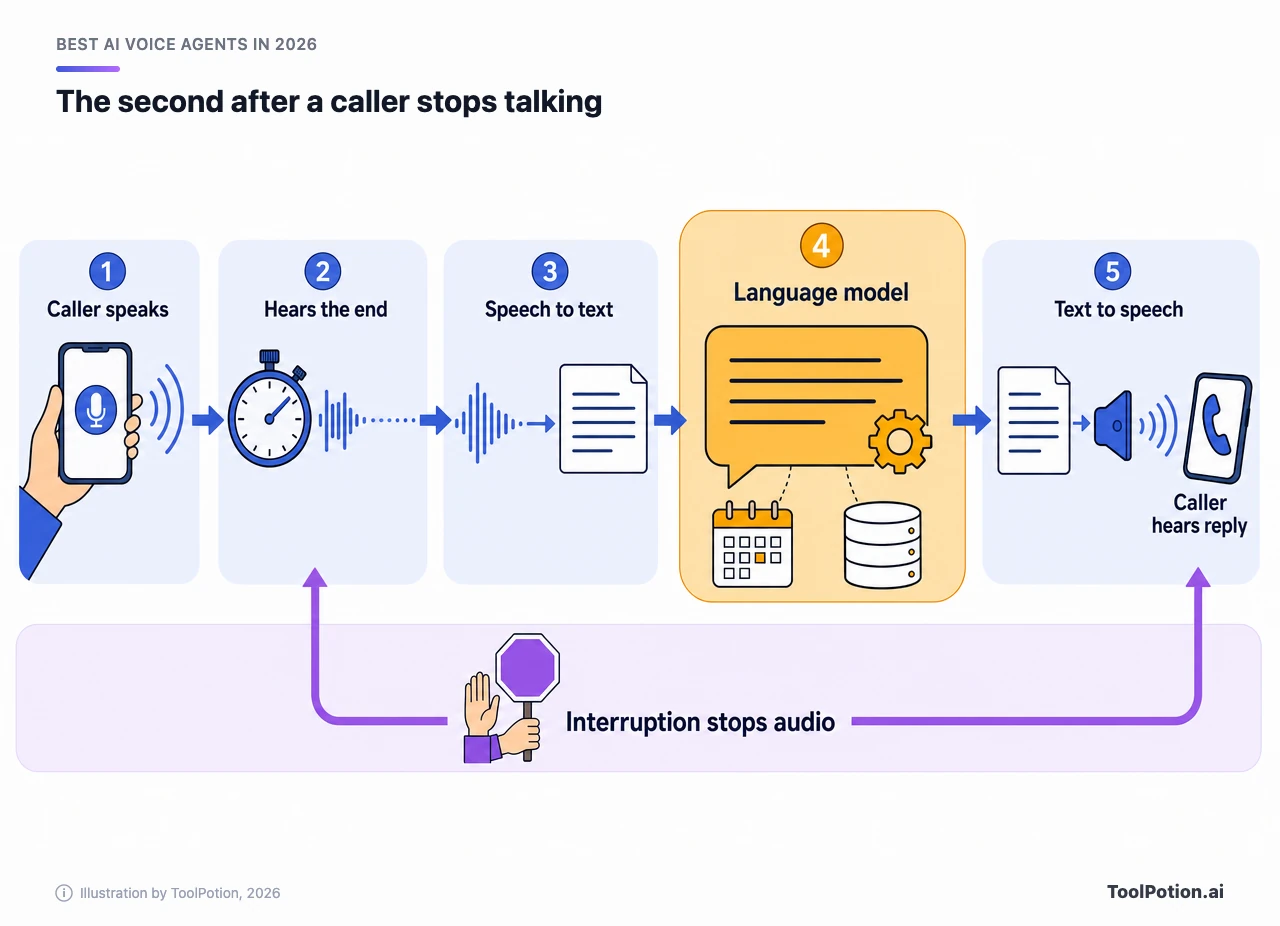
Each stage is its own model, and each adds delay. The chart below uses the same benchmark to show where the time goes.
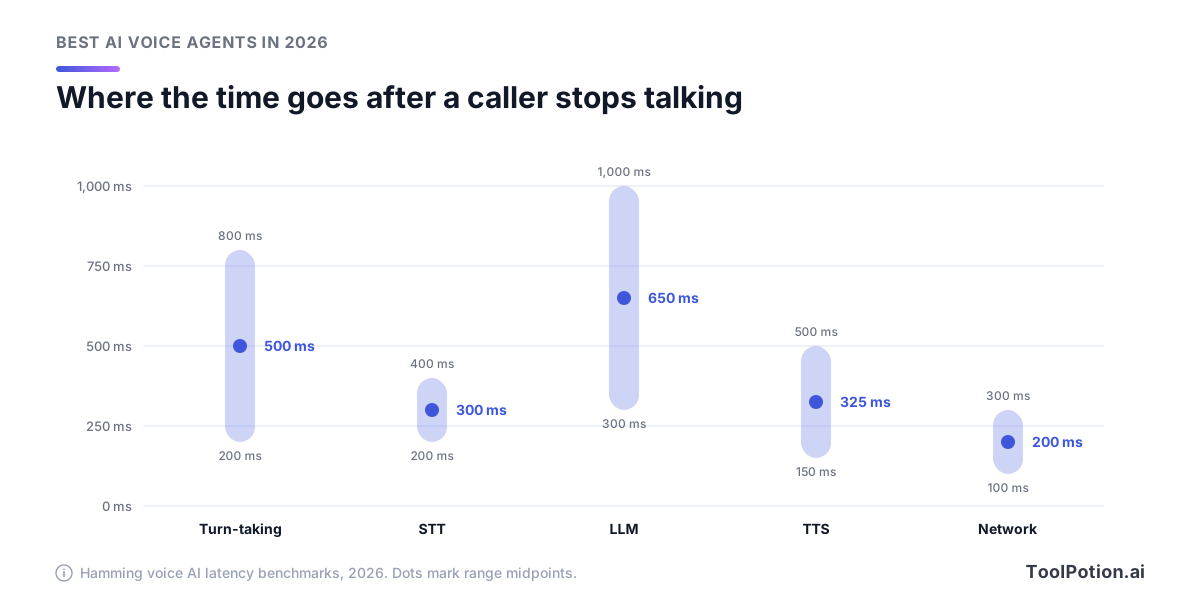
The language model is the widest band, which is why so many platforms let you swap it. Streaming helps: the first words of speech can start before the model has finished its sentence (Retell says it aims for about 600 milliseconds, which is a vendor claim worth testing on your own calls).
The leaders, reviewed
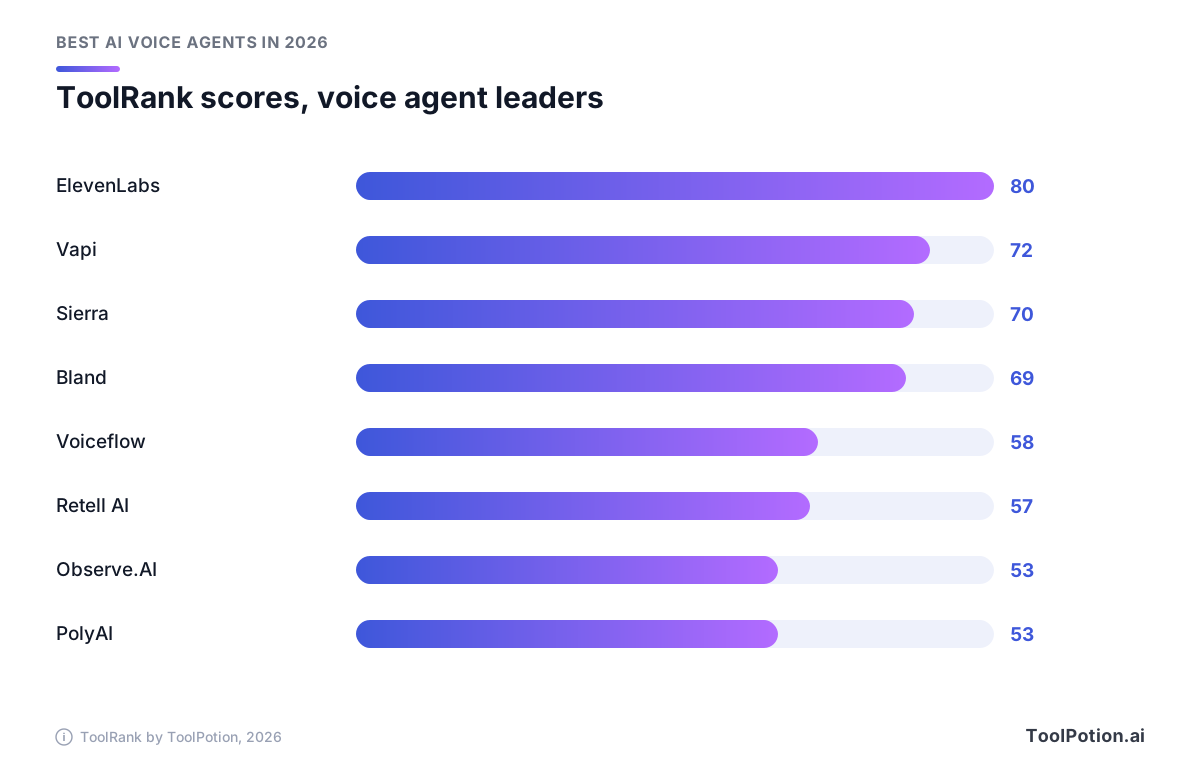
The chart shows every scored entry in the top eleven. Dialpad, LiveKit and Quo are ranked but not yet scored, so they stay out of the chart.
ElevenLabs: best for voice quality and breadth
ElevenLabs holds #1 on the 2026 board with a ToolRank score of 80, elite tier. It began as a text-to-speech company, and it shows: lifelike voices in more than 70 languages, voice cloning, a speech-to-text API, and now ElevenAgents for conversational calls. That is the widest toolkit on the board, and the only place where the voice itself is the product.
The catch is pricing that needs a calculator. Agent minutes cost $0.08 on every plan, the language model is billed on top, and the free plan includes just 15 minutes (ElevenLabs pricing). Higher plans include more minutes (the $99 Pro plan has 1,238, the $990 Business plan 12,375), but you're still paying twice, once for the agent and once for the model underneath it.
Vapi: the developer's default
Vapi is #2 with a score of 72, strong tier. It handles the unglamorous parts of a phone agent (calls, SIP, concurrency, testing) and lets you pick the speech, model and voice vendors. Its pricing page shows a $0.05 per minute hosting fee, $5 in free credits, and pass-through model costs with no markup. Transcription runs roughly a cent a minute, the voice $0.015 to $0.024, and the model anywhere from under a cent to about 4.5 cents (Vapi pricing).
Add telephony (Twilio inbound is $0.008 a minute) and the real figure lands near nine cents at the cheap end. Healthcare teams should note that HIPAA compliance is a $2,000 monthly add-on.
Sierra: for brands that want outcomes, not minutes
Sierra sits at #3 with a score of 70. It isn't a voice-first tool. You describe an agent in plain English or from documents, and one agent then works across chat, SMS, email and voice. The company says more than 40 percent of the Fortune 50 are customers. You won't find a per-minute price, because Sierra charges for outcomes such as a resolved conversation, not minutes. If you are a mid-size company that wants to test one phone flow, this isn't the door to knock on.
Bland: made for regulated phone work
Bland is #4 with a score of 69, down one place on the 2026 board. It focuses on inbound and outbound calling for industries like insurance and healthcare, with models you can run entirely on your own infrastructure. Pricing is public: the Start plan charges $0.14 a minute of talk time with no monthly fee, and Build adds a $299 monthly fee to drop that to $0.12 (Bland pricing). Build only pays off past about 15,000 minutes a month.
Voiceflow: where designers and support leads build
Voiceflow is #5, with a score of 58, solid tier. It is a workspace for designing chat and voice agents together, so a support team can iterate on conversation logic without waiting on engineers. It scores well below the four platforms above it, and it's a design tool before it is a telephony stack. Choose it when the hard part of your project is the conversation, not the audio.
Retell AI: closest rival to Vapi
Retell AI ranks #6 with a score of 57. It sells the same promise as Vapi, a production-ready phone agent with testing and monitoring, but quotes one headline range: $0.07 to $0.31 a minute, with $10 in free credits and 20 concurrent calls included. The parts are itemised, too. Infrastructure is $0.055, voices $0.015 to $0.04, and language models start at a tenth of a cent a minute (Retell pricing). Its use-case list leans toward receptionist, appointment-setting and lead qualification.
Dialpad and LiveKit: two ends of the spectrum
Dialpad is #7 and LiveKit #8, and neither has a ToolRank score yet. They couldn't be more different. Dialpad is an AI-native contact center: voice, chat, SMS and email, with autonomous agents that handle refunds and rebookings and hand off to people. It's the pick if your agents already live in Dialpad.
LiveKit is the opposite: an open-source framework for voice, video and physical AI agents, with telephony support and its own turn-detection model. The hosted plans run from a free Build tier to Ship at $50 a month and Scale at $500, with agent sessions at one cent a minute plus separate model costs (LiveKit pricing). The price is cheap and so is the hand-holding. You get the building blocks.
Quo: the small-business receptionist
Quo, formerly OpenPhone, is #9. It is a shared business phone first and an AI tool second. Its Sona voice agent answers calls around the clock and comes with every plan, which start at $15 per user per month on annual billing. The limit is built into the pricing: you get 10 calls of Sona automation free, and extra calls cost $1.00 each on the cheapest plan (Quo pricing). Fine for after-hours coverage, expensive for a call-heavy front desk.
PolyAI, Synthflow and Observe.AI
Three more with a score of 53. PolyAI builds enterprise dialog agents on its own Raven model and has both a no-code builder and a developer kit, though it slipped from #2 to #11 on the 2026 board. Synthflow targets automated phone calls with HIPAA, SOC 2 and PCI DSS compliance, and its enterprise pricing starts at $30,000 a year (Synthflow pricing). Observe.AI comes from conversation analytics and QA, so it suits teams that want to coach human agents and add voice AI in the same product.
One more worth knowing: Cartesia, #14, makes the speech models underneath other people's agents, and now sells its own voice agents at $0.06 a minute plus telephony (Cartesia pricing). Telnyx (#19) is the carrier side: global telephony with AI infrastructure on top.
What voice agents really cost
Per-minute pricing is the hardest thing to compare, because each vendor draws the line in a different place. Some quote a platform fee and bill the model and the phone line separately. Others bundle everything into one rate. A few won't publish a number at all.
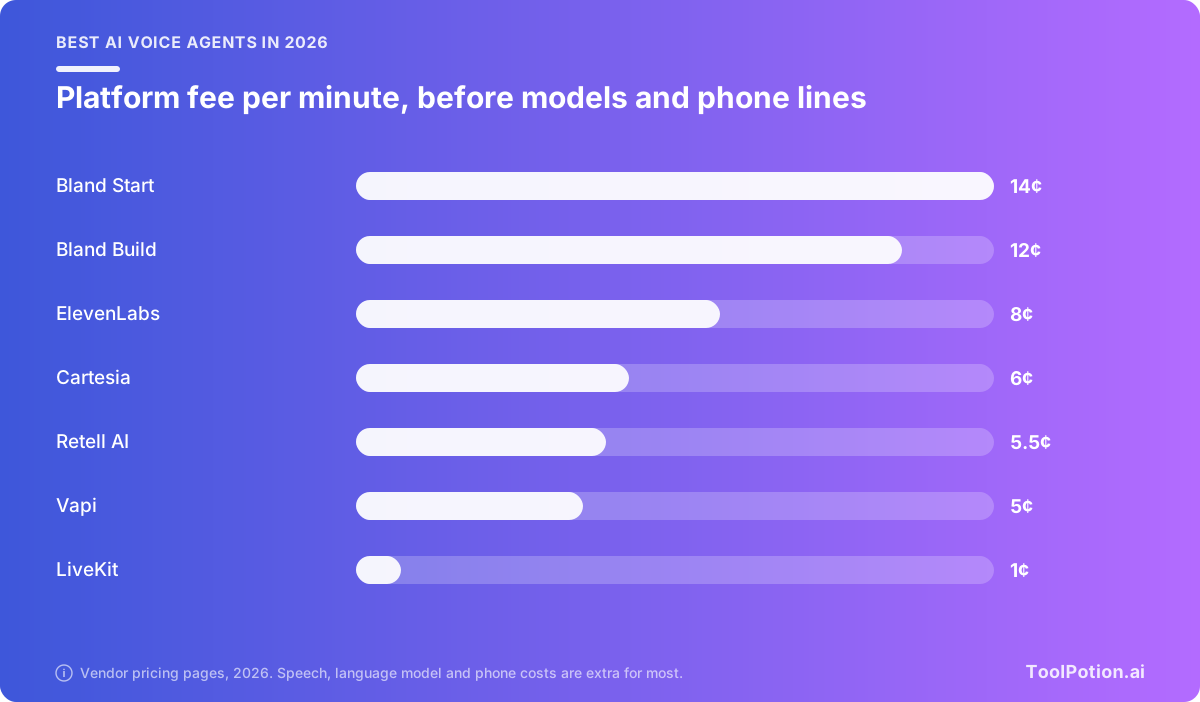
Read the chart as a floor, not a total. Vapi's five cents looks cheap until you add a voice, a model and a carrier. Bland's fourteen cents looks high but bundles the model, transcription and voice. ElevenLabs sits in between and leaves the model bill to you.
The calculator below plugs in your monthly minutes and uses only rates from the vendors' own pricing pages. Where a figure is a floor, it says so.
Run it at 2,000 minutes and again at 40,000. The ordering barely changes, but the gap between a floor and a quote grows quickly. Ask every vendor for the all-in cost of a five-minute call, including the phone line and the model.
How to choose
Start with the team, not the tool. Developer-led teams can assemble a stack in days. Ops teams without engineers need a managed agent or a builder. Companies that already own a contact center should look at what their current vendor ships before adding another system.
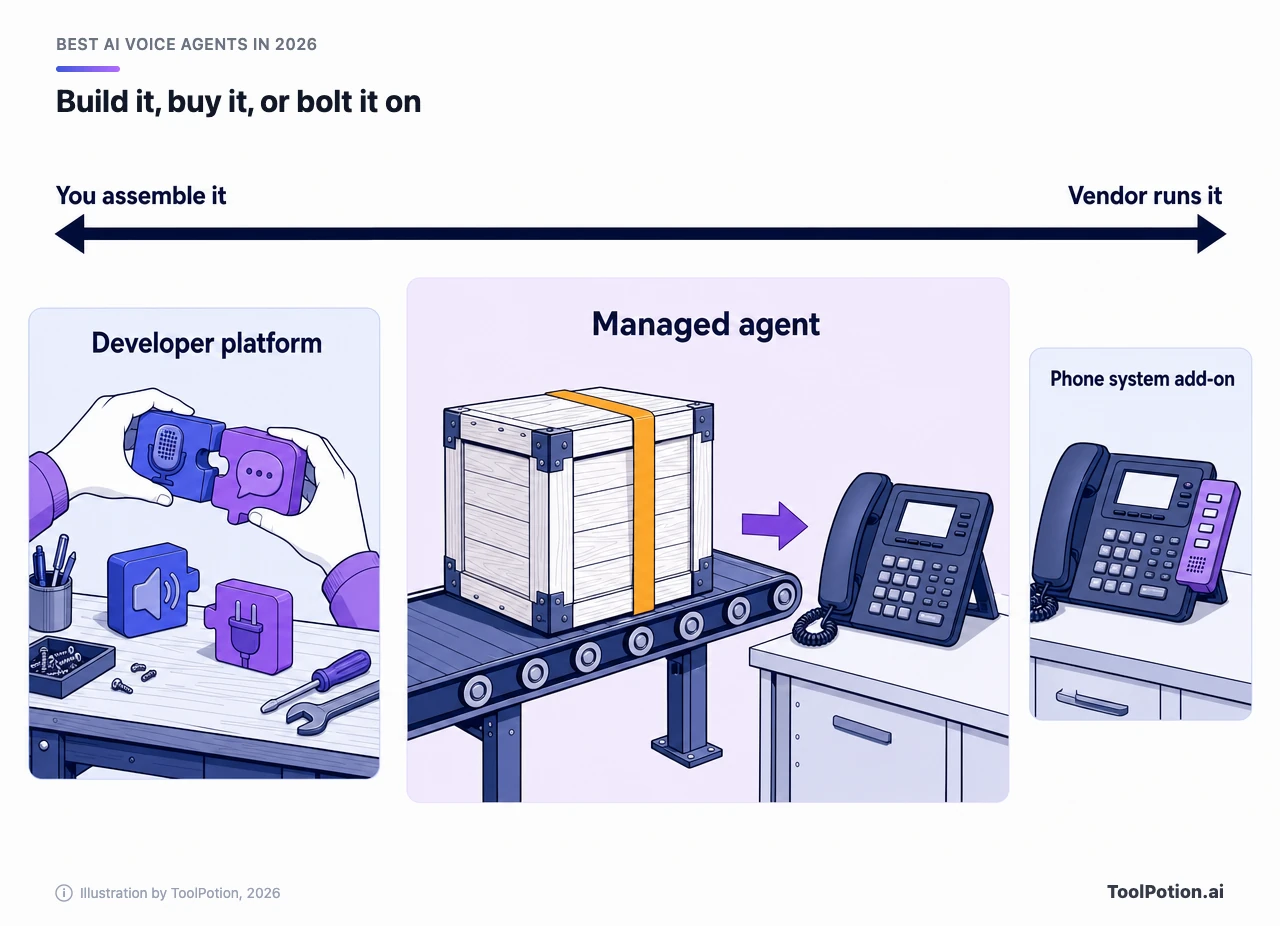
The map above is the whole decision in miniature. Moving right buys speed and takes away control, and you pay for that in minutes or in contracts. Moving left costs engineering time but lets you change the model next quarter without asking anyone.
If that still leaves you unsure, answer three questions below.
Telephony is the next trap. Every voice agent has to connect to a phone number somewhere, and the options differ. Vapi lets you bring numbers from Twilio, Vonage or Telnyx, and its own pricing page lists Twilio at $0.008 a minute inbound, Vonage at about the same and Telnyx at $0.0055 (Vapi pricing). LiveKit includes a free US local number and charges $0.01 a minute inbound. If your company already has a SIP trunk or a contact-center platform, check that the agent can plug into it before you look at anything else.
Pricing models matter too. Per-minute rates punish long, chatty calls, while a per-call or per-outcome model punishes volume. A support line with many short calls and a debt-collection line with long ones can reach opposite conclusions from the same price sheet.
Before you sign anything, run the same five hard calls through each finalist: a caller who interrupts, a thick accent, a request the agent can't answer, a transfer to a human, and a call dropped halfway. Ask for latency at the 90th percentile, not the average. Hamming's numbers show how far the tail runs from the median.
Then check the rules. In the US, the FCC ruled in 2024 that AI-generated voices count as artificial under the TCPA, so outbound AI calls need the recipient's prior consent (McDermott Will & Emery). Many states also require all parties to consent to recording, so announce it at the start of the call. And if you use a cloned voice, you need the speaker's consent, with local law varying on how that must be documented. None of this replaces advice from a lawyer.
About ToolRank
ToolRank is ToolPotion's independent ranking engine, and placement can't be bought. Every board, including this one, is part of the full set of leaderboards. You can browse the whole category in the AI voice agents directory, or see the live top 150 voice agents list.
Rising and newer names worth watching
Just past the top 25, Plivo AI Agents (#28) comes from a communications-API company and pitches no-code builders. Wizi (#27) aims at high-volume enterprise operations, and Phonely AI (#31) is a phone-answering product for small businesses. Replicant (#33) sells customer-service automation modeled on a company's best agents.
Vertical specialists are the quiet trend. Numa and Toma serve car dealerships, and ConverseNow takes restaurant orders. A narrow tool trained on one kind of call often beats a general platform on that call.
If voice is one part of a broader project, these boards overlap: AI tools for customer support agents, chatbot builders, sales call analysis and AI agent builders.
Frequently asked questions
What is the best AI voice agent in 2026?
ElevenLabs is #1 on the 2026 board with a ToolRank score of 80. For developers, Vapi is the usual first stop. For enterprises, Sierra and Bland lead. The best one depends on who will run it.
How much does an AI voice agent cost per minute?
Published platform rates run from about one cent (LiveKit sessions) to fourteen cents (Bland Start). Add speech, language model and phone costs and the real figure climbs. Retell's headline range for a full call is $0.07 to $0.31.
Do I need a developer to set one up?
For Vapi, Retell and LiveKit, yes, at least for the first build. Voiceflow, Synthflow and Quo are designed so non-engineers can configure agents, and Bland and Sierra do most of the setup for you.
How fast should an AI voice agent respond?
Under about 800 milliseconds from the end of the caller's sentence. The median across more than 10 million production minutes is 1.4 to 1.7 seconds, so a fast agent will stand out.
Is it legal to use AI voice agents for phone calls?
Often yes, but with conditions. In the US, AI-generated voices on outbound calls need prior consent under the TCPA, and many states require everyone's consent to record. Rules differ elsewhere, so check local law.
Can an AI voice agent hand a call to a human?
Yes, and you should insist on it. Dialpad lists AI-to-human handoff as a core feature, and Bland prices transfer time separately, so it is a normal part of the call flow.