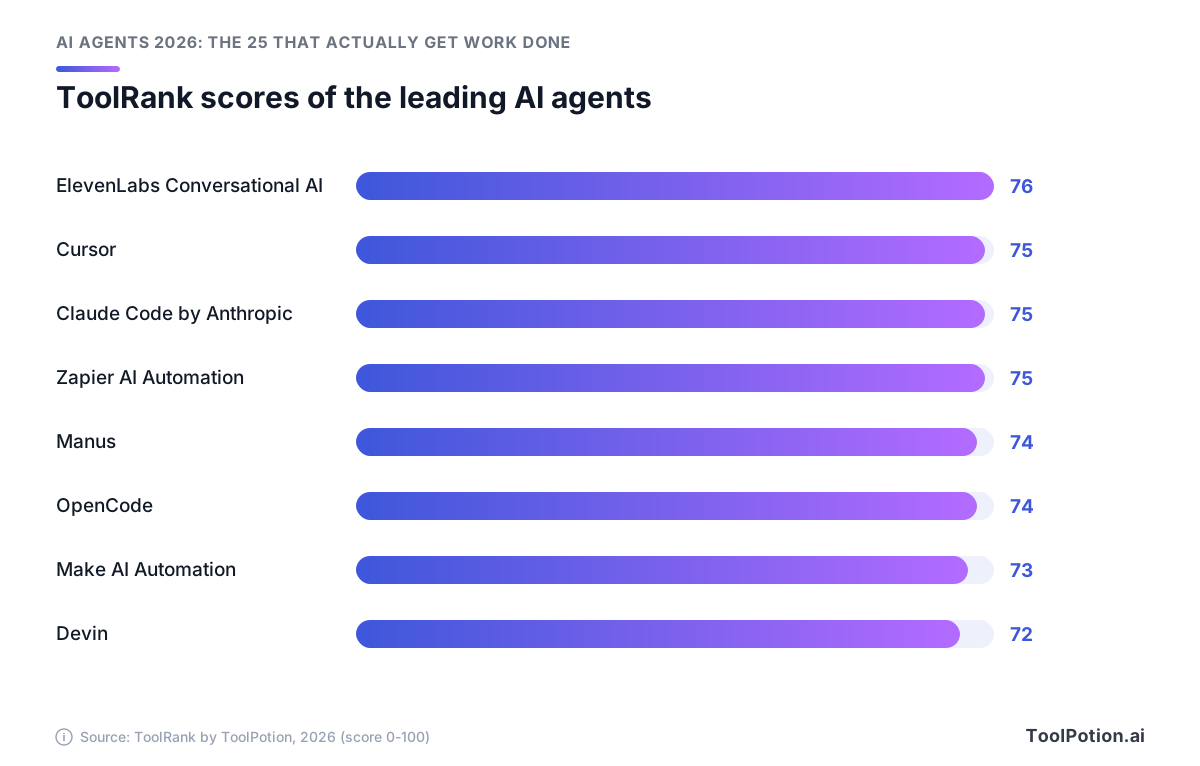
If you're shortlisting the best AI agents of 2026, start with ElevenLabs Conversational AI. It's #1 on our leaderboard with a ToolRank score of 76. Coding agents hold the next two spots, and Cursor and Claude Code both score 75.
Our live leaderboard ranks 417 AI agents this year. All of the top 25 are in the strong tier, and only nine points separate #1 (76) from #25 (67). If you write code, start with Cursor or Claude Code. Claude Code is included in Anthropic's $20/month Pro plan (Claude Pricing), so you may already pay for it.
Prices in the reviews come from each vendor's own pricing page, and the guide near the end matches common situations to a specific agent.
The top 25 AI agents on our 2026 board
- # 1Top PickClaude Code by Anthropic | AI Coding Agent, Terminal, IDEAI AgentClaude Code is an AI coding agent designed for developers. It understands codebases, edits files, runs commands, and integrates seamlessly with existing tools, enabling faster shipping of software projects.77ToolRankStrong
- # 2Runner UpManus: Hands On AIAI AgentManus is an AI action engine that automates workflows, executes tasks, and extends your capabilities. It integrates seamlessly with your browser to enhance productivity and streamline complex processes without constant supervision.77ToolRankStrong
- # 3Third PlaceDevin | The AI Software EngineerAI AgentDevin is an AI coding agent designed to assist developers in building better software more efficiently. It utilizes parallel cloud agents to enhance productivity for serious engineering teams.73ToolRankStrong


- 4Claude for ChromeAI AgentClaude for Chrome is an AI-powered browser extension that automates tasks like form filling, data extraction, and workflow management directly within your browser, enhancing productivity across various web activities.72ToolRankStrong
- 5Intercom AI HelpdeskAI AgentIntercom is a helpdesk designed for the AI Agent era, featuring a natively integrated AI Agent named Fin. It enables perfect customer experiences by improving conversations over time. The platform offers an AI-powered workspace for human agents, AI-driven insights, and a self-improving system for continuous enhancement.71ToolRankStrong
- 6HarveyAI AgentHarvey is an AI platform designed for legal and professional services, streamlining contract analysis, due diligence, compliance, and litigation. It helps law firms and corporate legal teams enhance efficiency and collaboration across their practices.71ToolRankStrong
- 7KiroAI AgentKiro is an agentic AI development tool with an IDE, CLI, web interface, and mobile app that turns prompts into executable specs, checks code correctness, and builds across large codebases with parallel agents.71ToolRankStrong
- 8Claude CoworkAI AgentClaude Cowork by Anthropic is an AI agent that automates multi-step tasks across your files and tools. It works on web, desktop, and mobile, allowing you to start tasks at your desk and check in from your phone. Schedule tasks and receive polished documents for review.70ToolRankStrong
- 9Sierra AI AgentsAI AgentSierra empowers businesses to build advanced AI agents for enhanced customer experiences. It enables personalized interactions across multiple channels, automates workflows, and provides deep insights into agent performance, all while offering outcome-based pricing for measurable value delivery.70ToolRankStrong
- 10OpenClawAI AgentOpenClaw is an open-source AI assistant that runs locally on your machine. It integrates seamlessly with your existing chat applications, providing personalized assistance and control over your digital environment.70ToolRankStrong
- 11VapiAI AgentVapi is a platform that enables developers to build, test, and deploy advanced voice AI agents quickly. It streamlines the creation of conversational voice experiences, allowing businesses to enhance customer interactions efficiently.70ToolRankStrong
- 12Decagon AI ConciergeAI AgentDecagon builds, optimizes, and scales AI agents designed to act as a personalized concierge for every customer. It offers a unified platform for defining workflows in natural language, testing, and analytics, enabling consistent, trusted customer experiences across chat, voice, and email channels.69ToolRankStrong
- 13GumloopAI AgentA multiplayer AI agent builder that lets anyone at a company build agents with any AI model and integration to automate work, while IT keeps control over access and usage.69ToolRankStrong
- 14AutoGPTAI AgentAutoGPT is an AI agent platform that allows users to build, deploy, and run agents to automate digital workflows like research, outreach, and content management without needing to write code.68ToolRankStrong
- 15OpenHandsAI AgentOpenHands is an open-source, model-agnostic platform for cloud coding agents that automates engineering tasks securely and transparently. It allows teams to build faster with full control over their coding agents and workflows.68ToolRankStrong
- 16Fin AI AgentAI AgentFin is an AI Customer Agent designed to enhance customer experiences across service, sales, and eCommerce. Trusted by over 12,000 brands, it delivers accurate responses and resolves complex queries across multiple channels, ensuring seamless customer interactions.68ToolRankStrong
- 17TabnineAI AgentTabnine is a private, organization-aware AI coding agent that runs inside a company's own environment. It connects to an organization's repositories to deliver code completions, chat, and autonomous coding tasks such as refactoring and test generation, for engineering teams that need AI assistance without sending code outside their infrastructure.68ToolRankStrong
- 18Automation AnywhereAI AgentAutomation Anywhere provides agentic automation solutions to autonomously run mission-critical processes. It empowers employees by handling complex tasks, streamlining operations across teams and systems with an AI-powered platform designed for enterprise-level transformation and secure, end-to-end automation.67ToolRankStrong
- 19Google AntigravityAI AgentGoogle Antigravity is an agent-first development platform with an AI IDE, CLI, and SDK for building with coding agents. It is built for professional developers, hobbyists, and enterprise teams.67ToolRankStrong
- 20Gemini CLIAI AgentGemini CLI is a powerful tool that allows users to build, debug, and deploy applications using AI. It enables querying and editing large codebases, generating apps from images or PDFs, and automating complex workflows directly from the terminal.67ToolRankStrong
- 21NablaAI AgentNabla is an advanced AI assistant designed for healthcare professionals. It streamlines clinical workflows by offering ambient AI, dictation, and real-time intelligence to improve documentation quality and coding accuracy. Nabla aims to restore the human connection in healthcare by reducing administrative burden and clinician burnout.67ToolRankStrong
- 22Jules - An Autonomous Coding AgentAI AgentJules is an Autonomous coding agent that allows developers to focus on their coding tasks while it handles the mundane tasks. It streamlines the coding process, making it easier to manage projects and collaborate effectively.66ToolRankStrong
- 23ClineAI AgentCline is an open-source AI coding assistant designed to enhance development workflows. It features Plan/Act modes, terminal execution, and Model Context Protocol support, making it a trusted tool for over 8 million developers worldwide.66ToolRankStrong
- 24Moveworks AI Assistant PlatformAI AgentMoveworks is an AI assistant platform that empowers your entire workforce to instantly find answers and automate tasks across business applications. It provides secure, governed, and personalized enterprise AI, integrating with over 50 systems to deliver an enhanced employee experience and streamline workflows.66ToolRankStrong
- 25Gemini Code Assist for teams and businessesAI AgentGemini Code Assist from Google provides AI-powered coding assistance for businesses, enhancing productivity throughout the software development lifecycle. It offers features like code completion, natural language chat, and integration with popular IDEs, ensuring developers can innovate and deploy efficiently.65ToolRankStrong





















How ToolRank works
ToolRank is ToolPotion’s proprietary ranking engine.
It continuously evaluates hundreds of signals across the open web — real traffic and popularity, audience and community strength, authority and longevity, adoption and engagement — processing millions of data points to place every tool where it has earned to be.
Every AI type is measured by its own tailored model: what proves traction for a SaaS app is not what proves it for an open-source framework or a creator channel. Missing a platform never counts against a tool — ToolRank judges the evidence that exists.
No paid placement. No self-reported numbers.
Quick picks: the best AI agents of 2026 by need
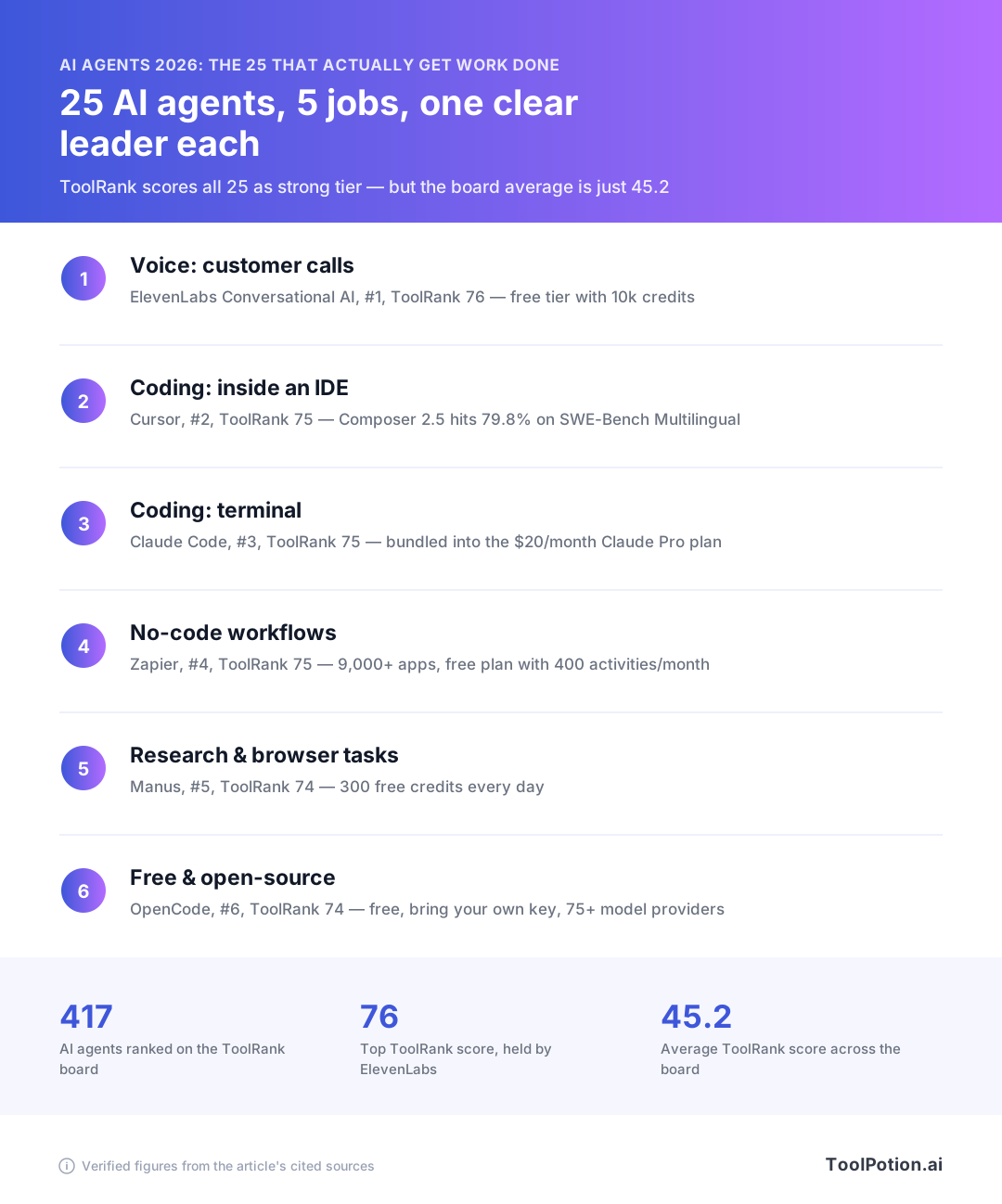
Each pick is the highest-placed tool for its job on our Top 250 AI Agents leaderboard, with its 2026 rank, its ToolRank score and one reason to choose it.
| Your need | Pick | 2026 rank | ToolRank | Why it's the pick |
|---|---|---|---|---|
| Voice agent for customer calls | ElevenLabs Conversational AI | #1 | 76 (strong) | Hosted voice and chat agents with a knowledge base, in 70+ languages (ElevenLabs) |
| Coding agent inside an IDE | Cursor | #2 | 75 (strong) | Agent work happens inside the IDE, and its Composer 2.5 model scores 79.8% on SWE-Bench Multilingual, a vendor figure (Cursor) |
| Terminal coding agent | Claude Code | #3 | 75 (strong) | Runs in your terminal and connects to your IDE, and it's included in the $20/month Claude Pro plan (Claude) |
| No-code business workflows | Zapier | #4 | 75 (strong) | Agents reach 9,000+ apps, so they can work across the business tools you already use (Zapier) |
| Research and browser tasks | Manus | #5 | 74 (strong) | Takes an open-ended goal and works through the browser on its own (Manus) |
| Free and open source | OpenCode | #6 | 74 (strong) | Free and open source, and works with 75+ model providers using your own API key (OpenCode) |
If you already pay for Claude Pro, start with Claude Code. Trying the agent costs nothing extra, and you can move up to Max once Pro's allowance starts slowing you down. Cursor is the better fit when your team works in an editor all day. If you don't want another subscription, OpenCode costs nothing to run, and you'll only pay for whatever model you connect.
Don't read too much into the order, though. Three tools tie at 75 and two tie at 74. The average score across the whole board is 45.2, so every agent in the leaderboard above sits well clear of the typical entry.
What changed for AI agents in 2026
Cursor shipped a new coding model this year, and Anthropic made Sonnet 5 and Opus 5 the default models in Claude Code. AWS replaced a coding assistant with an agent, and Make moved agents onto its canvas.
Cursor shipped Composer 2.5 and Claude Code got new defaults
Cursor's Composer 2.5 costs $0.50 per million input tokens and $2.50 per million output tokens. Cursor says it matches Opus-tier performance at roughly a tenth of the cost (Cursor). That's the vendor's own claim, so run it on your own repos before you move a team onto it.
Anthropic updated the defaults in Claude Code. According to its changelog, Claude Sonnet 5 became the default model on Pro and Team Standard seats in summer 2026, and Opus 5 became the default Opus model a few weeks later. Both have a 1M-token context window. On those seats, the new model is now what you get by default.
AWS replaced Amazon Q Developer with Kiro
Kiro, AWS's agentic IDE, reached general availability on May 7, 2026, as a ground-up replacement for Amazon Q Developer, and it runs on Claude models through Amazon Bedrock (Kiro). Kiro is #13 on the 2026 board with a ToolRank score of 71.
Make put agents on the canvas
Make's AI agents moved into its visual scenario builder on February 2, 2026, and the feature is still in Open Beta (Make).
Open-source agents now have large followings
OpenCode now reports 195,000 GitHub stars and more than 16 million developers a month (OpenCode).
OpenClaw now has about 390,000 stars, twice OpenCode's count (GitHub). Stars aren't users, so read them as a measure of developer interest. OpenCode is the coding agent of the pair, and OpenClaw is the self-hosted personal assistant.
The coding agents at the top, reviewed
Five of the top 13 spots on the 2026 board belong to coding agents, and they fall into two groups. Cursor, Claude Code and OpenCode keep you in the loop while the agent edits. Devin and Kiro work best when you write the task down, hand it over and check back later. If none of these five fits, the full AI coding assistants ranking goes much deeper.
Cursor: best for agentic coding inside an IDE
Cursor builds the agent into its editing environment, with completions, code navigation and multi-agent runs. Composer 2.5, covered above, is its in-house model, built on a Kimi K2.5 checkpoint.
Hobby is free and needs no credit card, but it limits Agent requests, so treat it as a trial. Individual plans start at $20/month, Teams costs $40/user/month and Enterprise pricing is custom (Cursor pricing). Teams that spend the day in an editor and want one shared bill should look here first.
Claude Code: best for terminal-first developers
Claude Code runs locally in your terminal and connects to your IDE. It can read a whole codebase, edit many files in one pass and run commands. That makes it a good fit for long refactors, bug hunts and test loops you'd rather script than click through.
It's included in Pro at $20/month ($17 billed annually), where usage is measured per 5-hour session, and in Max from $100/month, which gives you 5x Pro usage. Team seats cost $25/month for Standard or $125/month for Premium (Claude pricing).
Start on Pro. If you often find yourself waiting for the session allowance to reset, that's when Max is worth the extra $80.
OpenCode: best free, open-source and model-agnostic pick
OpenCode is the free option among these five. You bring your own API keys, and it connects to 75+ LLM providers through Models.dev (OpenCode). You can run it in a terminal, in an IDE or as a desktop app. It has LSP support and links for sharing sessions.
You pay each model provider directly, so watching keys and spend is your job.
Devin: best for handing off whole tickets to cloud agents
Devin sits at #8 with a 72, and it's built for hand-offs: parallel agents in the cloud take on bug fixes, code migrations, documentation and visual QA. Because the work comes back later, a vague ticket is hard to check, so write acceptance criteria before you assign anything.
The free plan works in Desktop only. Pro costs $20/month and includes full frontier model access plus a limited-time free SWE-2 offer. Max costs $200/month, and Teams costs $80/month plus $40 for each developer seat (Devin pricing). At those rates, a five-developer team pays $280/month on Teams.
Kiro: best for spec-driven teams
Kiro is the spec-driven option. It turns prompts into executable specs and checks code correctness, and it can run parallel agents across large codebases. It comes as an IDE, a CLI, a web app and a mobile app.
The free plan includes 50 credits a month. Pro costs $20/user/month for 1,000 credits, Pro+ costs $40 for 2,000, Pro Max costs $100 for 5,000 and Power costs $200 for 10,000. Every plan charges $0.04 per extra credit and has no daily or weekly rate limits (Kiro pricing).
Without rate limits, heavy use shows up on your bill instead of stopping you. A Pro user who uses 1,500 credits pays $20 plus $20 in overage, which is $40, the same price as Pro+ with 2,000 credits included.
Voice, automation and general-purpose agents, reviewed
These five are the highest-placed agents on the 2026 board once you set aside coding tools and specialist platforms, which get their own sections. What separates them is where the agent does its work: on a phone line, inside your app stack, in a browser or on your own machine. They also bill in different units.
ElevenLabs Conversational AI: best for voice agents that talk to customers
ElevenLabs' platform builds voice and chat agents that answer support calls or book appointments in 70+ languages. You attach a knowledge base and define the actions the agent is allowed to take. Plans run Free ($0, 10k credits), Starter ($6/month), Creator ($22), Pro ($99), Scale ($299 with 3 seats) and Business ($990 with 10 seats) (ElevenLabs).
Agent usage comes out of the same shared credit pool as the rest of your ElevenLabs usage, so if a team also makes voiceovers on the account, it can use up the budget your phone agent needs. If you give the agent a cloned voice, get the speaker's consent and check local law first. Developers who'd rather build the voice stack themselves should compare Vapi, covered further down.
Zapier: best for connecting agents to thousands of apps
You'd pick Zapier AI Automation for reach: agents can work across 9,000+ apps, and admins get one place to set guardrails and control which models people can use. It also connects Claude and ChatGPT over MCP.
On the free plan, Agents get 400 activities a month, capped at 10 per run. Pro raises that to 1,500 a month and 40 per run (Zapier). Watch the per-run number more than the monthly one. A lead-enrichment job that needs more than 10 activities won't finish on the free plan, however much of your monthly allowance is left.
Manus: best for open-ended research and browser tasks
Manus takes a loose goal, like researching a market or pulling data off a list of websites, and works through the browser by itself until it has something to hand back.
The free tier gives you 300 credits a day and 1 task at a time. Pro starts at $20/month for 4,000 credits and 20 concurrent tasks, and the $40 plan doubles the credits to 8,000 (Manus). Since everything is billed in credits, check your balance after your first few long research runs before you pick a plan. With a single task slot, one slow job also holds up everything behind it. Stay on the free tier until you need tasks running in parallel.
Make: best for visual builders who want to watch agents reason
Make is #7 with a 73. We covered its canvas relaunch above. The Reasoning panel is the reason to pick it, since it shows the agent's reasoning live next to the scenario. You also get in-canvas chat for testing, file handling across formats and a Library of prebuilt agent templates, all on every paid plan (Make).
Agents are still in beta, so plan for changes before you put anything customer-facing on them. Make lists 3,000+ integrations to Zapier's 9,000+. Choose Make when you need to see why an agent took a path, and Zapier when app coverage matters more.
OpenClaw: best free, self-hosted personal assistant
OpenClaw is #11 with a 71, and it's the only one of these five with no paid plan. It's MIT-licensed and self-hosted. Peter Steinberger created it, and the nonprofit OpenClaw Foundation now looks after it. It works inside WhatsApp, Telegram, Slack and Discord (GitHub), with persistent memory and browser control.
There's no hosted tier, so running and securing it is up to you. An assistant that can read your chats and control a browser needs tight permissions and a machine you keep patched. If you'd rather not run that machine yourself, choose one of the hosted tools above.
Where the rest of the top 25 fits
Ranks 9 to 25 in the leaderboard above have ToolRank scores between 67 and 72. The scores are too close together to choose on score alone. Group them by the job they do, and most of them will drop off your shortlist quickly.
Customer service and employee help agents: Intercom, Fin, Sierra, Decagon and Moveworks
Support is the most crowded job in this part of the board. Intercom's AI helpdesk (#14, score 70) is a full helpdesk with its own AI agent, Fin, built in. Fin (#20, 68) is that agent on its own board entry, and over 12,000 brands use it for service, sales and eCommerce.
Sierra (#15, 70) and Decagon (#18, 68) suit companies that want to build their own agent for customers. Decagon lets you write workflows in natural language and test them before launch. That matters most when a wrong answer goes straight to a paying customer.
Moveworks (#25, 67) points inward. It answers your employees' questions and connects to more than 50 business systems.
Voice agents and automation platforms: Vapi, UiPath, Automation Anywhere, Gumloop and AutoGPT
Vapi (#12, 71) is the API-first voice platform for developers, with custom SIP support, multilingual agents and automated testing tools. Its billing works differently from ElevenLabs credits. The Free tier starts you with $5 of credit and charges a $0.05/minute platform fee, Core costs $29/month and Pro has a $999/month minimum, and speech-to-text, the LLM, TTS and telephony are billed separately at provider rates (Vapi pricing). Price a month of calls both ways before you choose it over ElevenLabs.
The other four differ by who does the building. UiPath Platform (#16, 70) coordinates AI agents, robots and people in one place, so it fits companies that want all three managed together. Automation Anywhere (#17, 68) focuses on mission-critical processes that run without supervision. Gumloop (#21, 68) suits companies that want agent building spread across teams: anyone at the company can build an agent, and IT keeps control over access and usage. AutoGPT (#23, 67) is a no-code platform for research and outreach workflows.
Specialists and builders: Harvey, Scale AI, Google Antigravity, Lovable and OpenHands
This is the most mixed group, and only some of these tools are agents you hand work to. Harvey for legal teams (#9, 72) has the top score of the five, and it's built for law firms and corporate legal departments doing contract analysis and due diligence. Legal AI tools don't replace a qualified lawyer.
Scale AI (#10, 71) belongs on your list only if you build AI yourself. It's a data platform for data annotation and model evaluation.
The three builder tools are easier to place. Google Antigravity (#19, 68) is an agent-first development platform with an IDE, CLI and SDK. OpenHands (#24, 67) is the open-source, model-agnostic choice for teams that run coding agents in the cloud. Lovable (#22, 67) is for people who don't code: you describe an app or website and it builds a working prototype. If you do write code, all five coding agents reviewed earlier rank above these three.
How to choose the right AI agent for your work
Start from the job you need done
Pick the job first and use rank to break ties. The #1 voice agent won't help you with a backlog of bug tickets. If you aren't sure the work needs an agent at all, the FAQ below explains how an agent differs from an automation.
The quick picks cover the most common jobs. These situations aren't in that table:
| Your situation | Start with |
|---|---|
| You want to hand off tickets and check back later | Devin |
| You want the agent to write a spec before it writes code | Kiro |
| Your developers are building the voice stack themselves | Vapi |
| You'd rather build automations visually and see the agent's reasoning | Make |
| You want a personal assistant you host yourself | OpenClaw |
Not seeing your job? Browse every AI agent in our directory.
Match the pricing model to how you'll use it
Two agents with the same monthly price can charge for very different things. Five billing models show up among the tools reviewed here, and each one gets expensive in a different way.
- Cursor Teams charges per seat, so your bill grows with headcount even if some people barely use the agent.
- ElevenLabs draws everything from one shared credit pool, so a busy month of agent calls can use up credits you'd planned to spend on other audio work.
- Zapier Agents caps how much a single job can do, on both Free and Pro. Test your longest workflow against that per-run cap before you build ten more like it.
- Kiro charges overage credits once your allowance runs out. A heavy sprint won't lock you out, but it will raise the invoice.
- Manus's free tier resets daily credits and allows one task at a time, which suits a little research each day better than one big batch job.
Before you compare monthly fees, work out what one real job costs in the vendor's own billing unit.
Pilot on a real task before you hand it off
Start with a task that's small and easy to undo. For a coding agent, that could be a bug fix on a branch you're happy to delete. For a support or voice agent, use an internal queue or a test phone number before any customer hears it.
In the first week, read every output. Check the diff or the call transcript, and see whether the agent did what you asked or just something close to it. Give it more autonomy only after it has handled the same kind of task correctly several times, and grant access one system at a time so a mistake stays contained. If it keeps getting the same step wrong, fix the instructions or the tool access before you blame the model.
Just outside the top 25: #26 to #40
If none of the top 25 fits your job, look just below it on the 2026 board. Six of the 15 are coding agents, and the range also holds healthcare and meeting agents, two jobs with no dedicated entry higher up.
The six coding agents in this range sit between #26 and #35. Tabnine (#26) is an enterprise code assistant that keeps your code private and secure. Cline (#27) is open source, with Plan/Act modes and terminal execution. Google has two entries in this range: Gemini Code Assist for teams and businesses (#29) is its coding assistant for companies, and Gemini CLI (#30) is for building and debugging apps with AI from the command line. Jules (#31) is an autonomous coding agent that takes the routine tasks so you can focus on the hard ones. Junie (#35) is JetBrains' coding agent.
On a team with strict code-privacy rules, start with Tabnine. If you want an open-source agent with a separate planning step, try Cline.
Healthcare gets two entries. Nabla (#28) is an AI assistant for healthcare professionals that uses ambient AI to help with clinical workflows, and Hippocratic AI (#33) builds generative AI agents for health systems, payors and pharma companies. Neither replaces a doctor or other qualified clinician.
Two automation tools are close behind. n8n (#34) is a workflow automation platform for technical teams that mixes AI steps into business processes. Relevance AI (#38) lets you build and run specialist agents for sales, support, marketing and HR. If you'd rather build your own agent than buy one, the board of top tools for building your own AI agents is a better place to shortlist.
Lindy (#36) is an AI executive assistant that manages your inbox and schedules your meetings, so try it if email takes up most of your day. tl;dv AI Agents (#39) handles the meetings themselves: it records and summarizes them, then sends the notes into your CRM and productivity apps.
About ToolRank
ToolRank is ToolPotion's independent ranking of AI tools, and no one can pay for a place on it. This board ranks 417 AI agents, publishes the top 250 and stays current all year. You can browse every ToolRank leaderboard for other categories and tasks.
Frequently asked questions
What is the best AI agent in 2026?
ElevenLabs Conversational AI is #1 on the 2026 board. Pick by job instead: ElevenLabs for voice support, Cursor or Claude Code for writing software, and Zapier for work that moves between business apps.
Are there any free AI agents worth using?
Yes, and the two strongest fully free options are open source. OpenCode is free and bring-your-own-key, though you'll still pay for whatever model you connect. OpenClaw is an MIT-licensed, self-hosted assistant with no paid tier that works through the chat apps you already use. If you'd rather use a hosted free tier, Manus has a daily free credit allowance, and Kiro includes 50 credits a month for free.
Is Claude Code or Cursor better for coding?
They're tied at 75 in 2026, so how you work decides it. Pick Claude Code if you work from the terminal on large repos, especially if you already pay for Claude Pro. Pick Cursor if you want the agent built into a full editor, and try it first on the free Hobby tier.
How much do AI agents cost per month?
Many coding and research agents start at $20 a month: Cursor at $20, Claude Code through Claude Pro at $20, Kiro Pro at $20 per user, Manus at $20 and Devin Pro at $20. Heavy users pay a lot more: Claude Max starts at $100/month, Kiro Power is $200 per user and Devin Max is $200. Voice plans vary more widely. ElevenLabs runs from $6 to $990 a month, and Vapi's Pro tier has a $999/month minimum.
What is the difference between an AI agent and an automation tool like Zapier?
An automation runs a fixed set of steps you define, while an agent gets a goal and decides the steps on its own. Zapier now sells both: Zaps for fixed processes, and Zapier Agents, which count work in activities with a cap on each run. Make moved the same way in 2026 and put agents inside its visual scenario builder, though the feature is still in Open Beta. Use a regular Zap when the process never changes, and an agent when the inputs vary so much you'd otherwise have to build dozens of branches.
Which AI agent is best for handling customer phone calls?
Choose ElevenLabs Conversational AI for a hosted voice agent with knowledge bases in 70+ languages, and Vapi if your developers want an API-first platform with custom SIP support. The two bill differently, as covered above: ElevenLabs draws calls from a shared credit pool, while Vapi's Free tier adds a per-minute platform fee on top of provider costs. Estimate your call volume before you choose a tier.
Can AI agents complete multi-step tasks without supervision?
For tasks with clear limits, yes, and vendors now sell agents on that basis. Devin runs parallel cloud agents on bug fixes and migrations, and Manus works through a browser on its own until it has a result. Vendors still put limits on a single run, though: Zapier Agents caps the activities one run can use on both Free and Pro. Let the agent run the steps, but have someone review the result before it reaches a customer or goes to production.