Perplexity is the best AI research assistant for most people in 2026, and NotebookLM is the one to pick when the answer has to come from your own files. Past those two, the right choice depends on what you're researching: papers, a clinical question, a stack of PDFs or the open web. The leaderboard below ranks the top 25, and this guide covers the ones worth your time.
The category looks crowded but it splits cleanly. Some tools search the web. Some read only what you hand them. Some search academic literature, and one big name is built for clinicians. What separates a good pick from a risky one is the same everywhere. You need to see where each claim came from, and you need to be able to check it.
That question runs through everything below. Citations are the product here, and citations can be wrong.
The top 25 right now
- # 1Top PickPerplexity — AI Answer EngineAI AppPerplexity is a free AI-powered answer engine that delivers accurate, trusted, and real-time answers to any question, making information retrieval efficient and straightforward.92ToolRankElite
- # 2Runner UpNotebookLMMobile AppNotebookLM is a personalized AI research assistant that helps users understand any topic. It offers a user-friendly interface and powerful features to enhance productivity and streamline research processes.74ToolRankStrong
- # 3Third PlaceOpenEvidenceAI AppOpenEvidence is America’s official medical knowledge platform, designed for healthcare professionals. It provides evidence-based answers grounded in peer-reviewed research from leading medical journals, enhancing clinical decision-making at the point of care.73ToolRankStrong



- 4OpenAI PrismAI AppOpenAI Prism is a free LaTeX editor and AI-native workspace designed for scientists. It integrates ChatGPT and Codex to enhance scientific writing and collaboration, providing AI-assisted proofreading, citations, and formatting.64ToolRankStrong
- 5SciSpace AI for ResearchAI AppSciSpace is an AI research assistant designed for academics, enabling systematic literature reviews on over 280M papers and assisting in writing papers with cited sources. Trusted by millions of students, PhDs, and researchers worldwide.62ToolRankStrong
- 6Google PinpointAI AppGoogle Pinpoint helps journalists quickly find important stories within large collections of PDFs, handwritten documents, images, email archives, and audio files using AI and machine learning.61ToolRankStrong
- 7ConsensusAI AppConsensus is an AI-powered academic search engine that analyzes peer-reviewed literature to accelerate research. It helps users find, organize, and analyze scientific papers 10x faster, transforming literature reviews from days into minutes. The platform supports rigorous academic inquiry with advanced filtering and summarization capabilities.61ToolRankStrong
- 8Westlaw Precision AIAI AppWestlaw Precision AI is an advanced legal research tool that leverages AI and trusted content to deliver fast, expert-level insights. It helps legal professionals move confidently from research to strategy, ensuring comprehensive and verifiable results.60ToolRankStrong
- 9ElicitAI AppElicit is an AI-powered research assistant that helps scientists and researchers find, summarize, and extract data from over 138 million academic papers. It automates systematic literature reviews, generates research reports, and provides sentence-level citations for accuracy, enabling faster discovery and evidence-based decision-making across various industries.60ToolRankStrong
- 10Gemini NotebookAI AppGemini Notebook is a source-grounded AI research notebook by Google, designed for quick summarization and note-taking. It serves as a virtual research assistant, providing reliable information and insights.59ToolRankSolid
- 11PatSnap AI Innovation PlatformAI AppPatSnap is an AI-driven platform offering patent search, drafting, monitoring, and IP analytics. It accelerates R&D productivity by 75% using over 2 billion expert data points, trusted by more than 15,000 innovators globally.58ToolRankSolid
- 12Semantic ScholarAI AppSemantic Scholar is a free, AI-powered research tool designed to help scholars discover relevant scientific literature. It leverages advanced AI and engineering to understand the semantics of research papers, making it easier to find and engage with academic content across all scientific fields. The platform aims to enhance research accessibility and context.57ToolRankSolid
- 13Rayyan AI Review PlatformAI AppRayyan is an AI-powered platform designed to accelerate systematic and literature reviews for researchers. It automates key tasks like screening, deduplication, and data extraction, enabling teams to synthesize evidence faster and more efficiently. Trusted by over a million researchers globally, Rayyan streamlines the entire review workflow.56ToolRankSolid
- 14Readwise ReaderAI AppReadwise Reader is a comprehensive read-it-later app designed for power readers. It consolidates articles, PDFs, and more into one place, offering powerful search and highlighting features.55ToolRankSolid
- 15ResearchRabbitAI AppResearchRabbit streamlines literature reviews by helping researchers discover related papers, build citation maps, and track research trends. It transforms the exploration of academic literature from a tedious task into a curiosity-driven discovery process, saving valuable time for academics and students.55ToolRankSolid
- 16SciteAI AppScite is an AI tool that searches over 300 million scholarly articles to provide citation-backed answers. It helps researchers understand the strength of evidence behind claims, making literature searches more efficient and reliable.55ToolRankSolid
- 17HebbiaAI AppHebbia is an AI platform designed for finance professionals, offering institutional intelligence to support high-stakes decisions. It connects to financial data sources, enabling users to analyze documents, uncover insights, and automate workflows. Trusted by leading financial institutions, Hebbia aims to enhance speed and influence investment processes.53ToolRankSolid
- 18LinerAI AppLiner is an AI-powered tool designed to enhance web browsing and research. It allows users to highlight, organize, and save content from web pages, creating a personalized knowledge base. The platform aims to streamline information discovery and retention for students, researchers, and professionals seeking to manage online data efficiently.53ToolRankSolid
- 19Scopus DatabaseAI AppScopus is a comprehensive abstract and citation database that provides access to scientific, technical, medical, and social sciences literature. It offers advanced search tools and metrics for researchers to identify trends, find collaborators, and measure research impact.53ToolRankSolid
- 20ScholarcyAI AppScholarcy simplifies research by summarizing papers, articles, and textbooks into interactive flashcards. It helps users understand complex research and organize their knowledge efficiently.53ToolRankSolid
- 21Dimensions AIAI AppDimensions AI is a comprehensive research database that connects grants, publications, datasets, clinical trials, patents, and policy documents. It provides tools for research analysis, enabling users to quickly navigate and interpret global research data for strategic insights.52ToolRankSolid
- 22InstrumentlAI AppInstrumentl is an AI-powered grant management platform that helps nonprofits find, win, and manage grants efficiently. It offers a comprehensive database, AI-driven matching, and tools for proposal writing and post-award management, all in one workspace.51ToolRankSolid
- 23GPT ResearcherGitHub RepoGPT Researcher is an autonomous agent designed for deep research on any topic, producing detailed, factual, and unbiased reports with citations. It utilizes planner and execution agents to generate research questions and gather information. The tool offers customization options and supports various file formats for local research.51ToolRankSolid
- 24Connected PapersAI AppConnected Papers is a visual tool designed for researchers and applied scientists to discover and explore academic papers relevant to their work. It generates interactive graphs of similar papers, helping users gain a visual understanding of trends, popular works, and dynamics within a field, ensuring no important research is missed.51ToolRankSolid
- 25Atlas.tiAI AppAtlas.ti is a leading software for qualitative data analysis, offering AI-driven tools for researchers, students, and businesses. It supports various data formats and provides intuitive features for efficient analysis and collaboration.50ToolRankSolid



















How ToolRank works
ToolRank is ToolPotion’s proprietary ranking engine.
It continuously evaluates hundreds of signals across the open web — real traffic and popularity, audience and community strength, authority and longevity, adoption and engagement — processing millions of data points to place every tool where it has earned to be.
Every AI type is measured by its own tailored model: what proves traction for a SaaS app is not what proves it for an open-source framework or a creator channel. Missing a platform never counts against a tool — ToolRank judges the evidence that exists.
No paid placement. No self-reported numbers.
Quick picks
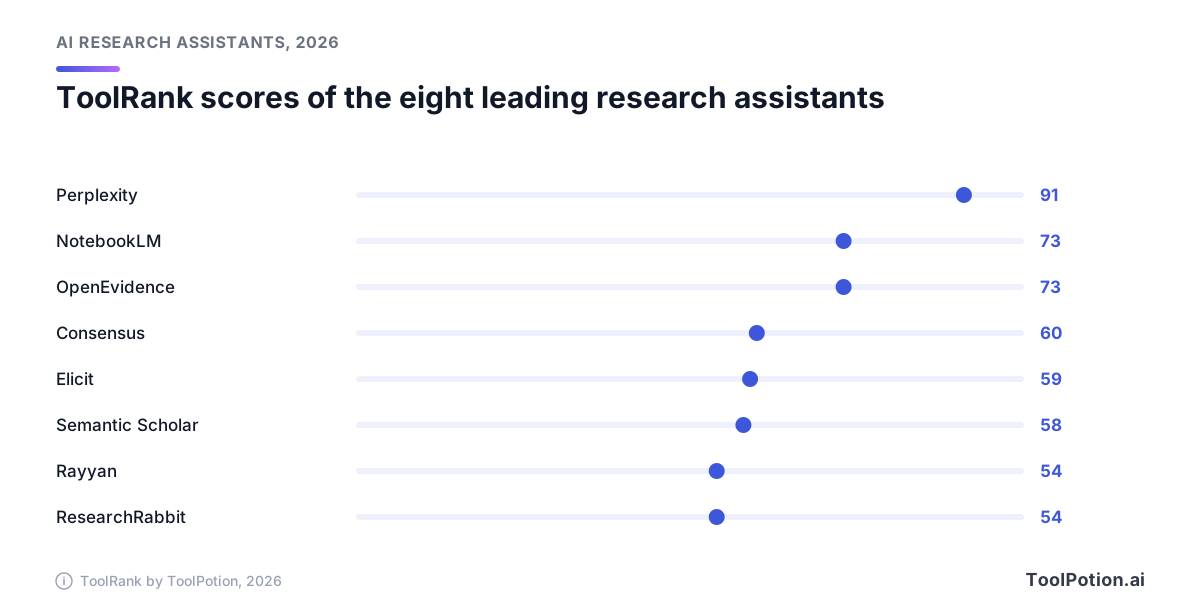
- Best overall is Perplexity, which holds #1 on the 2026 board with an elite-tier ToolRank of 91, 18 points clear of the next entry.
- Best for your own documents is NotebookLM, now branded Gemini Notebook, because it answers from the sources you upload and nothing else.
- For academic literature, Consensus is the quick read on what studies say and Elicit is the one that pulls data out of papers.
- Semantic Scholar is the best free scholarly option, and its maker is a nonprofit institute.
- Clinicians should look at OpenEvidence, which is built for medical questions.
- Anyone running a systematic review should start with Rayyan, which handles the screening grind.
Those are the leaders on the Top 100 AI Research Assistants board. The chart shows how tight the middle of the pack is, and how far Perplexity sits above it.
What changed in 2026
Google renamed NotebookLM to Gemini Notebook in 2026. It says it's the same standalone product, now with a secure cloud computer that runs code against your sources, and it reports more than 30 million users (Google). Our board listing still uses the NotebookLM name. NotebookLM also made the biggest jump among the leaders, climbing from #10 to #2 on the 2026 board.
OpenEvidence stays free for medical professionals, funded by advertising from pharmaceutical companies and others. Its CEO has said he'd like to change that model (NBC News). Nobody has said who pays instead.
The less cheerful change is on the paper side. Earlier this year arXiv began handing one-year submission bans to authors whose papers show unchecked AI output, hallucinated references included (SMU Libraries). If you cite it, you own it. That's the new baseline.
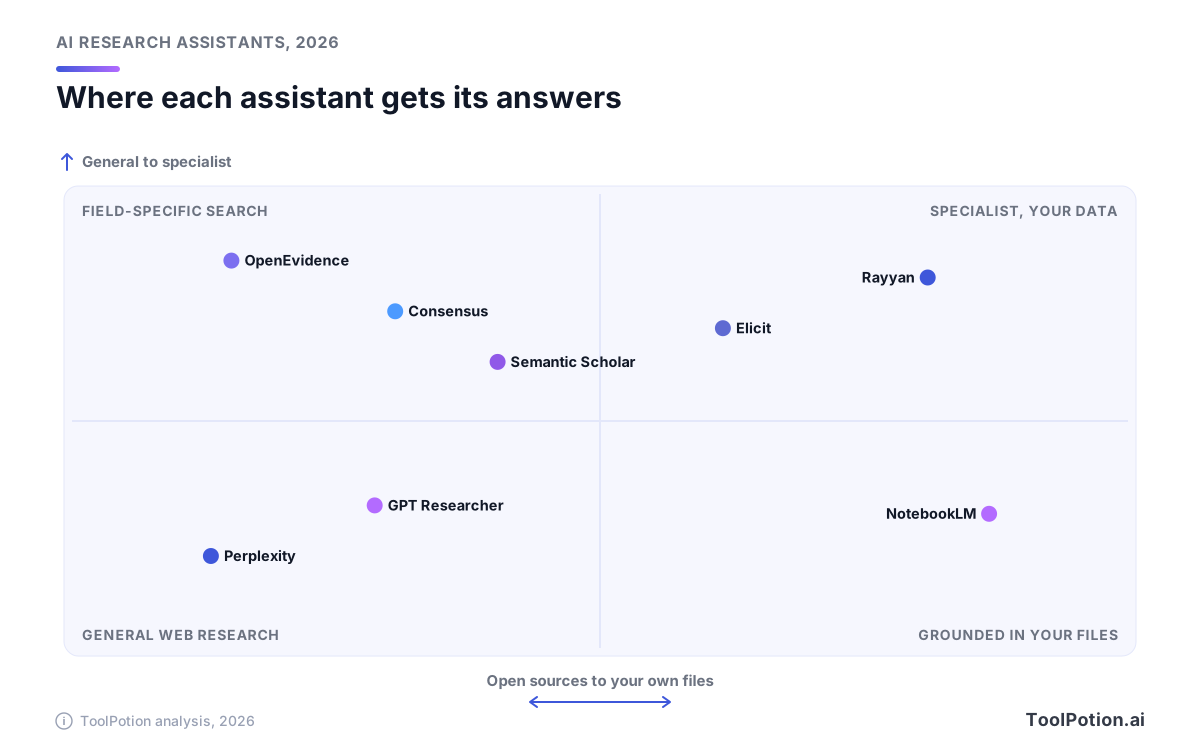
The map below sorts the field by where each tool gets its answers and how specialist it is.
The trust problem is a citation problem
A grounded answer gets built in five steps, and an error can slip in at any of them.
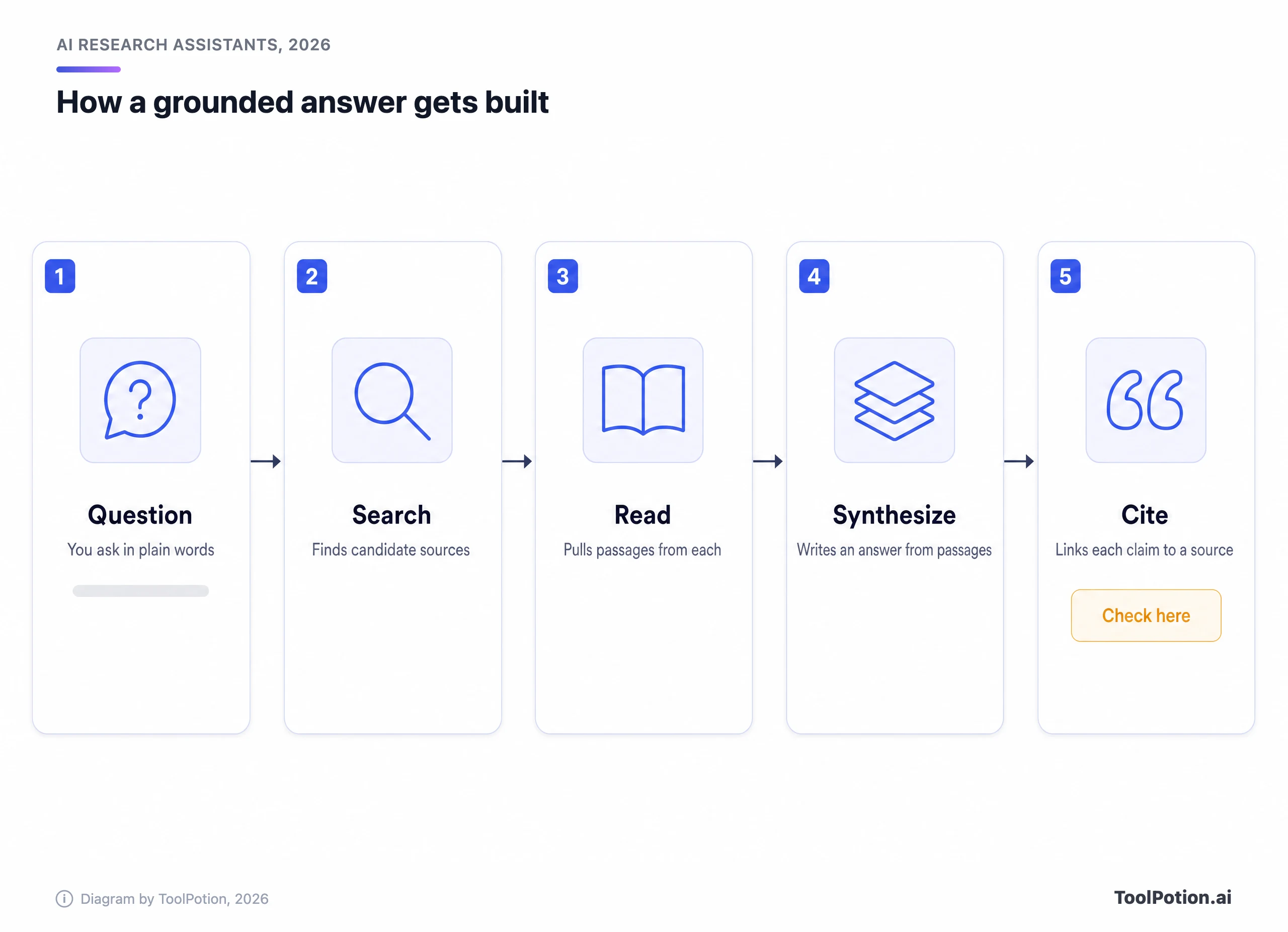
Search can miss the key paper. Reading can stop at the abstract. The writing step can drift from what the passages say. And the last step can attach a real link to a claim it doesn't support. A librarian test at HKUST found that Scite retrieved full text where the other tools mostly surfaced abstracts (HKUST Library).
The best-known audit comes from Columbia's Tow Center. It gave eight AI search engines excerpts from news articles and asked each to identify the headline, publisher, date and URL. Collectively they got more than 60% of the queries wrong. Perplexity did best with a 37% error rate, but the paid tiers of Perplexity and Grok were more confidently wrong than the free ones, and several tools cited fabricated or broken links (Columbia Journalism Review). That test measured how well engines attribute news excerpts, not how they cite scholarly papers. Treat it as a warning about confidence, not a verdict on any one tool.
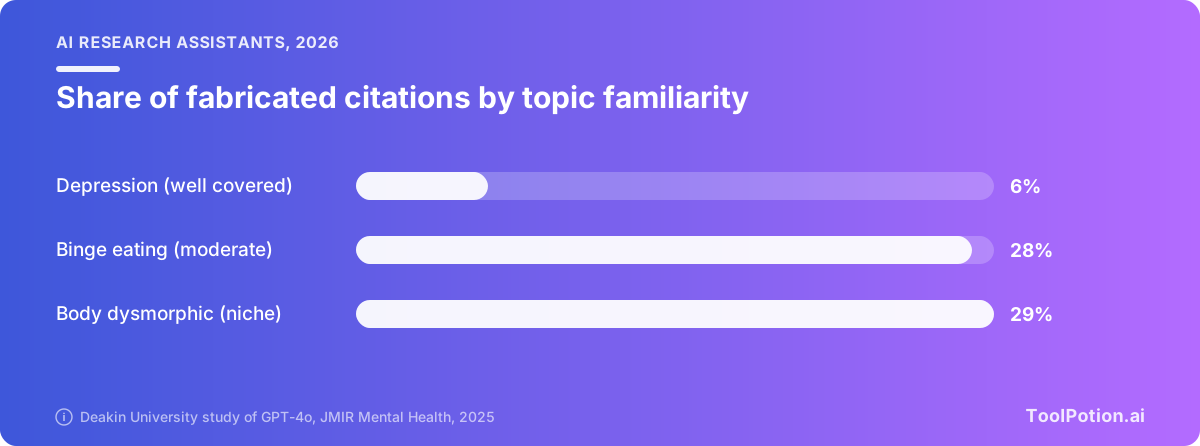
For papers, the sharpest evidence is about plain chatbots, which is exactly why grounding matters. Researchers at Deakin University had GPT-4o write six literature reviews on mental health topics. Of the citations it produced, 19.9% were fabricated, and 45.4% of the real ones carried errors such as wrong DOIs (EurekAlert). The pattern is the useful part. Fabrication was 6% on depression, a heavily studied topic, and 28% to 29% on two less-covered ones.
Dedicated research assistants do better, but not perfectly. In the HKUST test, Scite, Elicit, Consensus and Scopus AI all returned real citations on a question about sleep and weight gain. Matching each argument to its source was another matter, and Scopus AI was weakest, with arguments its sources didn't support. The librarians called the output a starting point, not a replacement for a literature review. It was one question on a well-studied topic, so expect rougher results on niche ones.
So the working rule is simple. Open the source before you use the claim. Rerun anything important. And test a new tool on a subject you already know cold.
The leaders, reviewed
Perplexity: best for fast cited answers on the open web
Perplexity is #1 on the 2026 board with an elite-tier ToolRank of 91, the only elite score on it. It searches the web and shows its sources beside the answer, which makes a first pass quick and a second pass easy. The catch is the one the Tow Center found: it was the least wrong of eight engines and still wrong 37% of the time when asked to attribute news excerpts, which is a different task from citing papers. Pro adds a model switcher and deeper research runs, and it's $20 a month, while Max is $200, per CloudZero's 2026 pricing guide, and there's a free tier too.
NotebookLM: best when the answer must come from your files
NotebookLM is #2 with a score of 73, in the strong tier. You upload papers, notes or transcripts and it answers only from those, which shrinks the room for invented facts. The flip side is that it can't tell you what you forgot to add. The free plan allows 100 notebooks, 50 sources per notebook and 50 chats a day, and paid Google AI plans raise those limits (Google Help). For a thesis folder or a pile of reports, it's the strongest fit on the board.
OpenEvidence: best for clinicians checking the literature
OpenEvidence sits at #3, also scored 73 and also in the strong tier, and it's the only medical specialist near the top. It answers clinical questions from peer-reviewed journals and is free for medical professionals. Evidence on accuracy is still thin. A preprint that tested 100 subspecialty scenarios from the MedXpertQA board-exam dataset found accuracy of at most 34% on its quick search and 41% on Deep Consult, and the authors argued expert oversight stays essential (medRxiv). It's a preprint, and the questions were hard. Still, these tools don't replace a clinician, and nobody should use one in place of a doctor.
Consensus: best for a quick read on what the studies say
Consensus is #4 with a score of 60, strong tier, up from #6 on the 2026 board. It searches academic papers, so a yes-or-no question comes back as a summary of studies instead of a pile of web pages. In the HKUST test it produced long, structured summaries with about ten citations each. Check its live pricing page for current plans before you commit.
Elicit: best for pulling data out of many papers
Elicit is #5, up from #8, with a solid-tier score of 59. Its edge is extraction: you build a table of papers and ask for the same details from each, such as sample size or outcome. The free Basic plan searches 138 million papers. Pro is $49 a month ($588 a year) and adds a systematic review workflow that can screen 5,000 papers, while Scale is $169 (Elicit pricing). The jump from free to $49 is steep, and the serious features sit behind it.
Semantic Scholar: best free scholarly search
Semantic Scholar is #6 with a 58, down from #4 on the 2026 board. It's a search engine first and an assistant second, built by the nonprofit Allen Institute for AI. It indexes more than 200 million papers and costs nothing (Semantic Scholar). There's no chat window doing your thinking for you. For many students that's a feature.
Rayyan: best for systematic review screening
Rayyan is #8 with a score of 54. Teams use it to screen thousands of titles and abstracts against inclusion rules, with AI suggesting which ones are likely relevant. The free plan covers 3 active reviews and 2 free reviewers, and Essential starts at $4.99 a month on annual billing (Rayyan). It's a workflow tool, so don't expect a question box that writes you an answer.
ResearchRabbit: best for mapping a field from a few seed papers
ResearchRabbit climbed from #16 to #9, scoring 54. You start from papers you trust, and it builds collections and citation maps of related work. It finds papers. It doesn't summarize them. Pair it with a reading tool and it earns its place early in a project, when you don't yet know what the field looks like.
Scite: best for seeing whether later papers back a claim
Scite sits at #10 with a 54. Its Smart Citations show whether later work supports or contrasts a paper, which is the context a raw citation count hides. In the HKUST comparison its summary was the most comprehensive of the four, and it was the only one that pulled full text. The search and assistant sit behind a paid plan, from $20 a month billed yearly (Scite pricing). Try it when a claim matters enough that you want to know who has disputed it.
GPT Researcher: best open-source option for deep web research
GPT Researcher is #17 with a 50, the only open-source project in the top 25. A planner agent writes the research questions, other agents gather material, and a publisher assembles a cited report. The project is Apache-2.0 licensed and has about 29,900 GitHub stars (GitHub). You run it yourself and supply the model, so it suits developers and tinkerers more than a student with a deadline.
Three more are ranked but not yet scored. Scopus Database (#7) is a citation database, Readwise Reader (#11) is a read-it-later app and Atlas.ti (#15) is for qualitative analysis. They're useful, but they're not the same kind of tool as the rest, which is why they sit out of the charts above.
How to choose
Start from the kind of research you do, because that settles most of it. Price comes second, and the tool's polish comes last.
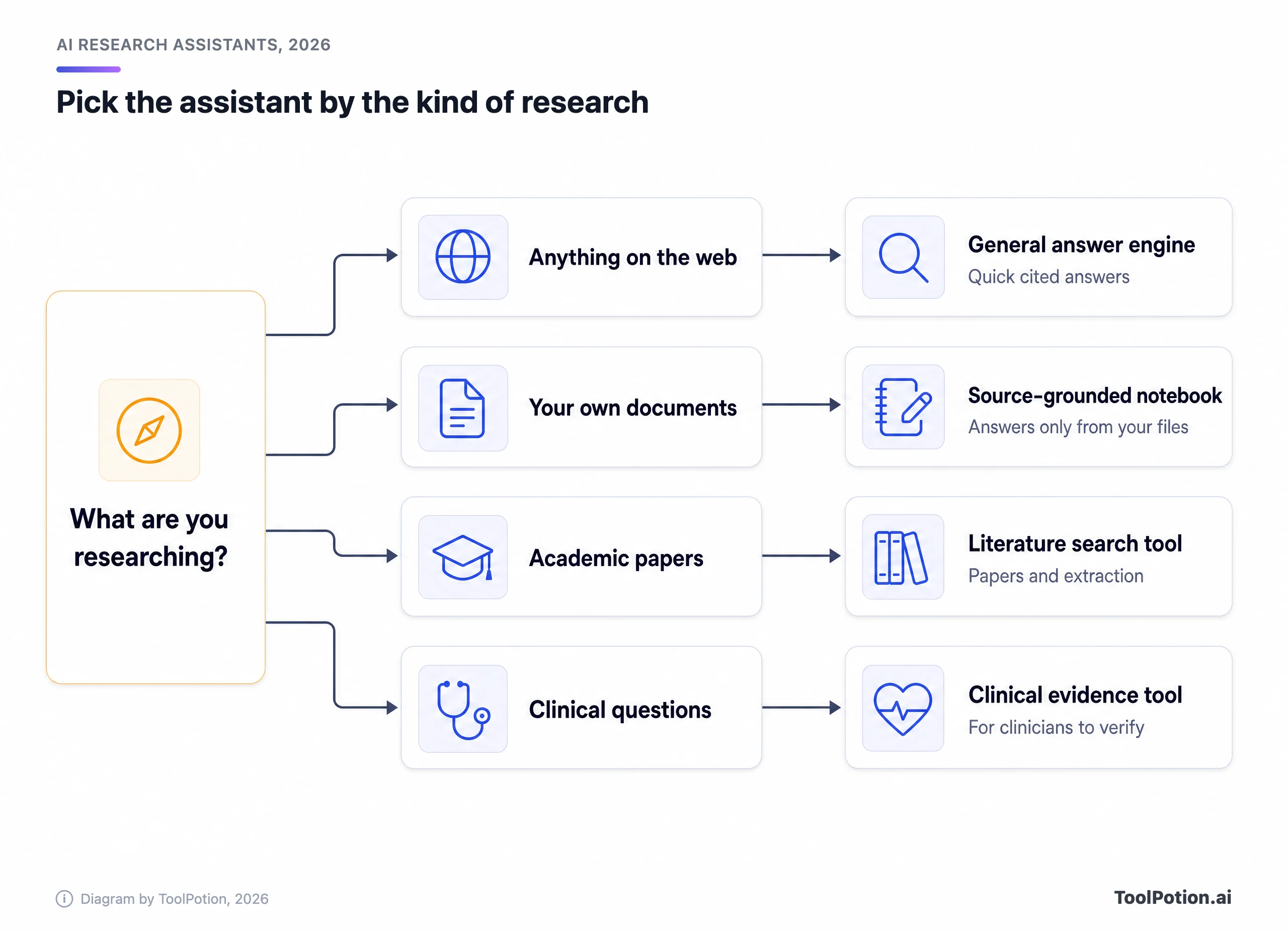
Writing a literature review is the common hard case. Use Consensus or Semantic Scholar to find what exists, ResearchRabbit to follow the citation trail, Elicit to extract the data, and Rayyan if the review has to be formal. If you're working from a fixed set of reports or interviews, NotebookLM beats all of them. If you need a quick answer on a topic you can verify, Perplexity is fine.
Two situations deserve extra care. Anything medical should go through a professional, and OpenEvidence is for clinicians, not patients. And niche topics, where the Deakin numbers jumped, call for opening every reference.
Prices matter less than the free tiers, so try those first. The table sorts nine of the leaders by what they search and what they charge. Where we couldn't confirm a figure, it says so.
About ToolRank
ToolRank is ToolPotion's independent ranking of AI tools, and placement can't be bought. Every board shows a score and a tier for each scored entry. You can browse all of them on the ToolRank leaderboards page.
Mistakes that cost researchers time
The commonest one is using a general chatbot to produce references. The Deakin numbers say why that fails, and the arXiv ban says what it can cost. A research assistant that shows its retrieval is a safer starting point, and one that only reads your documents is safer still.
The second is paying for the top plan on day one. Perplexity's Max tier is $200 a month and Elicit's Scale tier is $169, and both are built for heavy use. Most students and analysts never get near those limits. Start on a free tier, hit a wall, then pay for the wall you actually hit.
The third is treating a summary as a literature review. A tool can tell you what ten abstracts say. It can't tell you which studies are weak, which are outdated, or what's missing from the set. That part is still your job, and it's where a human reader earns the credit.
The last is asking a non-medical tool a medical question and trusting the polish of the answer. Don't.
Rising and newer names worth watching
Connected Papers moved from #15 to #13 with a visual map of how papers relate. A few younger tools are close behind the top 25. Ai2 Asta (#27) comes from the same institute behind Semantic Scholar and pairs literature understanding with data-driven discovery. Keenious (#34) suggests papers based on what you're writing and plugs into Word. PapersFlow (#32) offers literature reviews inside an AI workspace, and AnswerThis (#40) answers with direct citations. STORM (#33) is a Stanford research prototype that drafts Wikipedia-style articles with sources.
The full directory of AI research assistants has the rest. If your work is narrower, the related boards are a better start, such as AI tools for searching academic literature, AI tools for researchers, academic writing and citations and tools for chatting with PDF documents. Or go back up to the live research assistant leaderboard to see where everything sits.
Frequently asked questions
What is the best free AI research assistant?
Semantic Scholar is entirely free. Perplexity, NotebookLM and Elicit also have free tiers, and NotebookLM's free plan allows 50 sources per notebook. Start there before paying for anything.
Can AI research assistants make up citations?
Yes. Plain chatbots do it most, as the Deakin study showed, and grounded tools do it less. Even a real citation can be attached to a claim the paper doesn't make, so open the source every time.
Is NotebookLM the same as Gemini Notebook?
Yes. Google renamed it in 2026 and says it remains a standalone product.
Is OpenEvidence free?
It's free for medical professionals and paid for by advertising. It's built for medical professionals and doesn't replace a clinician's judgment.
Which tool is best for a literature review?
No single one covers it. Combine a search tool like Consensus or Semantic Scholar with ResearchRabbit for mapping and Elicit for extraction, and add Rayyan for a formal systematic review.
How do I check an AI-generated reference?
Click through to the paper and confirm it exists. Then confirm it says what the answer claims, and check the DOI against the publisher's site. Ten minutes of that beats a retracted claim.